
Bringing	
  the	
  excitement	
  back	
  to	
  
             data	
  analysis	
  

                               MC	
  Brown	
  
                      VP,	
  TechPubs	
  and	
  Educa?on	


                                                               1	
  
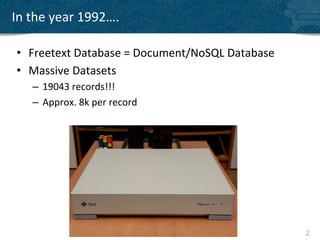
In	
  the	
  year	
  1992….	
  

 •  Freetext	
  Database	
  =	
  Document/NoSQL	
  Database	
  
 •  Massive	
  Datasets	
  
     –  19043	
  records!!!	
  
     –  Approx.	
  8k	
  per	
  record	


                                                                  2	
  
The	
  Drug	
  

 •    Data	
  Analysis	
  was	
  ‘Exci?ng’	
  
 •    2-­‐3	
  days	
  to	
  write	
  the	
  analysis	
  program	
  
 •    Processing	
  would	
  occur	
  overnight	
  
 •    Sta?s?cs	
  required	
  ‘whole	
  set’	
  processing	


                                                                       3	
  
The	
  Hit	
  

 •  Mornings	
  were	
  ‘the	
  hit’	


 •  The	
  joy	
  of	
  real	
  data	
  analysis	
  is	
  the	
  
      output	
  of	
  a	
  good	
  report	
  
 •  Get	
  good	
  stats	
  
      –  I	
  know	
  how	
  many	
  teachers	
  teach	
  Geography	
  in	
  Scotland!	
  
      –  I	
  know	
  400	
  people	
  have	
  purchased	
  our	
  History	
  so]ware!	
  
 •  The	
  wait	
  and	
  the	
  results	
  kept	
  us	
  working	
  

                                                                                             4	
  
In	
  the	
  year	
  2002	
  

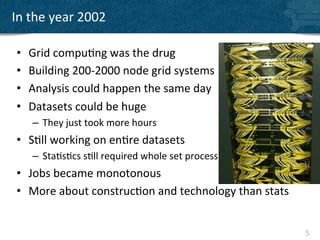
 •    Grid	
  compu?ng	
  was	
  the	
  drug	
  
 •    Building	
  200-­‐2000	
  node	
  grid	
  systems	
  
 •    Analysis	
  could	
  happen	
  the	
  same	
  day	
  
 •    Datasets	
  could	
  be	
  huge	
  
       –  They	
  just	
  took	
  more	
  hours	
  
 •  S?ll	
  working	
  on	
  en?re	
  datasets	
  
       –  Sta?s?cs	
  s?ll	
  required	
  whole	
  set	
  process	
  
 •  Jobs	
  became	
  monotonous	
  
 •  More	
  about	
  construc?on	
  and	
  technology	
  than	
  stats	


                                                                             5	
  
In	
  the	
  year	
  2012	
  

 •  Need	
  info	
  and	
  sta?s?cs	
  quicker	
  than	
  ever	
  
 •  Database	
  clusters	
  provide	
  the	
  backbone	
  
      –  Grids	
  without	
  the	
  headache	
  
 •  Build	
  a	
  query	
  in	
  seconds;	
  Get	
  the	
  result	
  in	
  seconds	
  
 •  Need	
  sta?s?cs	
  in	
  different	
  ways:	
  
      –  Live	
  
      –  Online	
  (and	
  some?mes	
  user	
  visible)	
  
      –  Whole	
  of	
  set	
  and	
  par?al	
  set,	
  but	
  based	
  on	
  Big	
  Data	
  
 •  Slice	
  and	
  dice	
  in	
  more	
  ways	
  without	
  effort	


                                                                                                6	
  
Couchbase	
  Background	
  Stats	
  

 •  Couchbase	
  1.8	
  already	
  hits	
  interes?ng	
  numbers	
  
 •  Draw	
  Something	
  (OMGPOP),	
  within	
  6	
  weeks:	
  
     –  15	
  million	
  daily	
  ac?ve	
  users	
  	
  
     –  3000	
  drawings	
  generated	
  every	
  two	
  seconds	
  
     –  Over	
  two	
  billion	
  stored	
  drawings	
  
     –  90	
  nodes	
  
     –  3	
  clusters	
  
     –  No	
  stops!	


                                                                       7	
  
The	
  new	
  drug	
  

 •    Couchbase	
  Server	
  2.0	
  
 •    Cluster-­‐based	
  database	
  
 •    Fast,	
  Scalable,	
  Predictable	
  
 •    Map/Reduce	
  based	
  querying	
  
 •    JavaScript/Web-­‐based	
  interface	
  
      –  Type	
  in	
  your	
  query,	
  get	
  your	
  results	
  
 •  Instant	
  Gra?fica?on!	


                                                                      8	
  
The	
  Data	
  End	
  

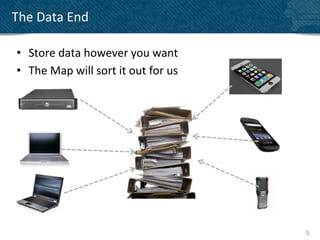
 •  Store	
  data	
  however	
  you	
  want	
  
 •  The	
  Map	
  will	
  sort	
  it	
  out	
  for	
  us	


                                                               9	
  
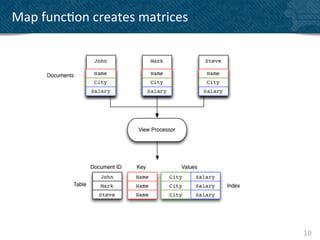
Map	
  func?on	
  creates	
  matrices	


                                            10	
  
Map/Reduce	
  Creates	
  Indexes	
  

 •    Not	
  Hadoop	
  
 •    Map/Reduce	
  creates	
  an	
  index	
  
 •    Map	
  *AND*	
  Reduce	
  output	
  are	
  stored	
  
 •    Index	
  is	
  used	
  for	
  queries	
  
 •    Makes	
  queries	
  faster	
  (obviously!)	
  
 •    Index	
  is	
  ‘materialized’	
  at	
  query	
  ?me	
  
       –  Updated,	
  not	
  recreated	
  
 •  Incremental	
  map/reduce	


                                                                11	
  
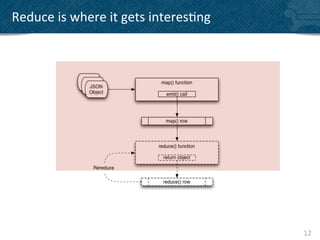
Reduce	
  is	
  where	
  it	
  gets	
  interes?ng	


                                                        12	
  
Reduce	
  

 •  Reduce	
  summarizes	
  data	
  
 •  Built-­‐in	
  func?ons	
  
    –  _sum	
  
    –  _count	
  
    –  _stats	
  
        {!
              "value" : {!
                  "count" : 3,!
                  "min" : 5000,!
                  "sumsqr" : 594000000,!
                  "max" : 20000,!
                  "sum" : 38000!
              },!
              "key" : [!
                  "James"!
              ]!
        },!                                13	
  
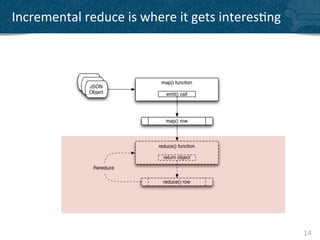
Incremental	
  reduce	
  is	
  where	
  it	
  gets	
  interes?ng	


                                                                       14	
  
Incremental	
  Reduce	
  

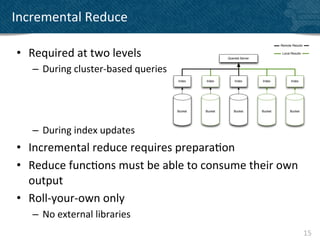
 •  Required	
  at	
  two	
  levels	
  
     –  During	
  cluster-­‐based	
  queries	


     –  During	
  index	
  updates	
  
 •  Incremental	
  reduce	
  requires	
  prepara?on	
  
 •  Reduce	
  func?ons	
  must	
  be	
  able	
  to	
  consume	
  their	
  own	
  
    output	
  
 •  Roll-­‐your-­‐own	
  only	
  
     –  No	
  external	
  libraries	
  
                                                                                    15	
  
Tips	
  for	
  incremental	
  

 •  Use	
  simple	
  values	
  when	
  possible	
  
 •  Use	
  complex	
  (JSON)	
  structures	
  
     –  Allows	
  for	
  more	
  incremental	
  structure	
  
     –  Store	
  the	
  ‘current’	
  result	
  
     –  Store	
  the	
  informa?on	
  needed	
  for	
  the	
  incremental	
  result	
  
 •  Iden?fy	
  rereduce:	
  
     –  func?on(key,	
  value,	
  rereduce)	
  {}	


                                                                                          16	
  
Simple	
  reduce	
  (incremental	
  average)	
  

 function(key, values, rereduce) {!
    var result = {total: 0, count: 0};!
    for(i=0; i < values.length; i++) {!
      if(rereduce) {
          result.total = result.total + values[i].total;
          result.count = result.count + values[i].count;
      } else {
          result.total = sum(values);
          result.count = values.length;
      }
    }
    return(result); !
 }!


                                                       17	
  
Combining	
  Reduce	
  with	
  Complex	
  Keys	
  

 •  Example:	
  logging	
  data	
  with	
  date?me	
  
 •  Explode	
  the	
  date:	
  
     –  [	
  year	
  ,	
  month,	
  day,	
  hour,	
  minute]	
  
 •  Now	
  you	
  can	
  query:	
  
     –  Single	
  Date:	
  [2012,	
  9,	
  19]	
  
     –  Mul?ple	
  Dates:	
  [	
  [	
  2012,	
  9,	
  19],	
  [2012,	
  9,	
  10]	
  ]	
  	
  
     –  Range	
  (hours)	
  [2012,	
  9,	
  0,	
  9,	
  0]	
  –	
  [2012,	
  9,	
  30,	
  21,	
  0]	
  
     –  Range	
  (days)	
  [	
  2012,	
  1,	
  1]	
  –	
  [2012,	
  9,	
  19]	
  
     –  Range	
  (months)	
  [	
  2009,	
  9]	
  –	
  [2012,3]	
  
 •  And	
  you	
  can	
  calculate	
  aggregate	
  sta?s?cs	
  

                                                                                                          18	
  
Complex	
  reduce	
  

 function(key, data, rereduce) {!
    var response = {"warning" : 0, "error": 0, "fatal" : 0 };!
    for(i=0; i<data.length; i++) {!
       if (rereduce) {!
          response.warning = response.warning + data.warning;!
          response.error = response.error + data.error;!
          response.fatal = response.fatal + data.fatal;!
       } else {!
          if (data[i] == "warning") {!
             response.warning++;!
          }!
          if (data[i] == "error" ) {!
             response.error++;!
          }!
          if (data[i] == "fatal" ) {!
             response.error++;!
          }!
       }!
    }!
    return response;!
 }!
                                                               19	
  
Complex	
  reduce	
  output	
  

 {"rows":[
 {"key":[2010,7], "value":{"warning":4,"error":2,"fatal":0}},
 {"key":[2010,8], "value":{"warning":4,"error":3,"fatal":0}},
 {"key":[2010,9], "value":{"warning":4,"error":6,"fatal":0}},
 {"key":[2010,10],"value":{"warning":7,"error":6,"fatal":0}},
 {"key":[2010,11],"value":{"warning":5,"error":8,"fatal":0}},
 {"key":[2010,12],"value":{"warning":2,"error":2,"fatal":0}},
 {"key":[2011,1], "value":{"warning":5,"error":1,"fatal":0}},
 {"key":[2011,2], "value":{"warning":3,"error":5,"fatal":0}},
 {"key":[2011,3], "value":{"warning":4,"error":4,"fatal":0}},
 {"key":[2011,4], "value":{"warning":3,"error":6,"fatal":0}}
 ]
 } !


                                                            20	
  
Why	
  is	
  the	
  excitement	
  back?	
  

 •  Data	
  in	
  is	
  easy;	
  no	
  schema,	
  no	
  formavng,	
  no	
  updates	
  
 •  Data	
  out	
  is	
  about	
  the	
  stats	
  
       –  Not	
  how	
  we	
  are	
  going	
  to	
  produce	
  them	
  
 •    Queries	
  are	
  live	
  
 •    Tweaks	
  and	
  updates	
  and	
  extensions	
  are	
  live	
  
 •    Mul?ple	
  views,	
  mul?ple	
  queries	
  
 •    Reduce	
  is	
  op?onal	
  (raw	
  data)	
  
 •    Massive	
  datasets	
  are	
  not	
  a	
  problem	


                                                                                         21	
  
Q&A	


          22	
  

Bringing back the excitement to data analysis

  • 1.
    Bringing  the  excitement  back  to   data  analysis   MC  Brown   VP,  TechPubs  and  Educa?on   1  
  • 2.
    In  the  year  1992….   •  Freetext  Database  =  Document/NoSQL  Database   •  Massive  Datasets   –  19043  records!!!   –  Approx.  8k  per  record   2  
  • 3.
    The  Drug   •  Data  Analysis  was  ‘Exci?ng’   •  2-­‐3  days  to  write  the  analysis  program   •  Processing  would  occur  overnight   •  Sta?s?cs  required  ‘whole  set’  processing   3  
  • 4.
    The  Hit   •  Mornings  were  ‘the  hit’       •  The  joy  of  real  data  analysis  is  the   output  of  a  good  report   •  Get  good  stats   –  I  know  how  many  teachers  teach  Geography  in  Scotland!   –  I  know  400  people  have  purchased  our  History  so]ware!   •  The  wait  and  the  results  kept  us  working   4  
  • 5.
    In  the  year  2002   •  Grid  compu?ng  was  the  drug   •  Building  200-­‐2000  node  grid  systems   •  Analysis  could  happen  the  same  day   •  Datasets  could  be  huge   –  They  just  took  more  hours   •  S?ll  working  on  en?re  datasets   –  Sta?s?cs  s?ll  required  whole  set  process   •  Jobs  became  monotonous   •  More  about  construc?on  and  technology  than  stats     5  
  • 6.
    In  the  year  2012   •  Need  info  and  sta?s?cs  quicker  than  ever   •  Database  clusters  provide  the  backbone   –  Grids  without  the  headache   •  Build  a  query  in  seconds;  Get  the  result  in  seconds   •  Need  sta?s?cs  in  different  ways:   –  Live   –  Online  (and  some?mes  user  visible)   –  Whole  of  set  and  par?al  set,  but  based  on  Big  Data   •  Slice  and  dice  in  more  ways  without  effort     6  
  • 7.
    Couchbase  Background  Stats   •  Couchbase  1.8  already  hits  interes?ng  numbers   •  Draw  Something  (OMGPOP),  within  6  weeks:   –  15  million  daily  ac?ve  users     –  3000  drawings  generated  every  two  seconds   –  Over  two  billion  stored  drawings   –  90  nodes   –  3  clusters   –  No  stops!   7  
  • 8.
    The  new  drug   •  Couchbase  Server  2.0   •  Cluster-­‐based  database   •  Fast,  Scalable,  Predictable   •  Map/Reduce  based  querying   •  JavaScript/Web-­‐based  interface   –  Type  in  your  query,  get  your  results   •  Instant  Gra?fica?on!   8  
  • 9.
    The  Data  End   •  Store  data  however  you  want   •  The  Map  will  sort  it  out  for  us   9  
  • 10.
    Map  func?on  creates  matrices   10  
  • 11.
    Map/Reduce  Creates  Indexes   •  Not  Hadoop   •  Map/Reduce  creates  an  index   •  Map  *AND*  Reduce  output  are  stored   •  Index  is  used  for  queries   •  Makes  queries  faster  (obviously!)   •  Index  is  ‘materialized’  at  query  ?me   –  Updated,  not  recreated   •  Incremental  map/reduce   11  
  • 12.
    Reduce  is  where  it  gets  interes?ng   12  
  • 13.
    Reduce   • Reduce  summarizes  data   •  Built-­‐in  func?ons   –  _sum   –  _count   –  _stats   {! "value" : {! "count" : 3,! "min" : 5000,! "sumsqr" : 594000000,! "max" : 20000,! "sum" : 38000! },! "key" : [! "James"! ]! },! 13  
  • 14.
    Incremental  reduce  is  where  it  gets  interes?ng   14  
  • 15.
    Incremental  Reduce   •  Required  at  two  levels   –  During  cluster-­‐based  queries     –  During  index  updates   •  Incremental  reduce  requires  prepara?on   •  Reduce  func?ons  must  be  able  to  consume  their  own   output   •  Roll-­‐your-­‐own  only   –  No  external  libraries   15  
  • 16.
    Tips  for  incremental   •  Use  simple  values  when  possible   •  Use  complex  (JSON)  structures   –  Allows  for  more  incremental  structure   –  Store  the  ‘current’  result   –  Store  the  informa?on  needed  for  the  incremental  result   •  Iden?fy  rereduce:   –  func?on(key,  value,  rereduce)  {}   16  
  • 17.
    Simple  reduce  (incremental  average)   function(key, values, rereduce) {! var result = {total: 0, count: 0};! for(i=0; i < values.length; i++) {! if(rereduce) { result.total = result.total + values[i].total; result.count = result.count + values[i].count; } else { result.total = sum(values); result.count = values.length; } } return(result); ! }! 17  
  • 18.
    Combining  Reduce  with  Complex  Keys   •  Example:  logging  data  with  date?me   •  Explode  the  date:   –  [  year  ,  month,  day,  hour,  minute]   •  Now  you  can  query:   –  Single  Date:  [2012,  9,  19]   –  Mul?ple  Dates:  [  [  2012,  9,  19],  [2012,  9,  10]  ]     –  Range  (hours)  [2012,  9,  0,  9,  0]  –  [2012,  9,  30,  21,  0]   –  Range  (days)  [  2012,  1,  1]  –  [2012,  9,  19]   –  Range  (months)  [  2009,  9]  –  [2012,3]   •  And  you  can  calculate  aggregate  sta?s?cs   18  
  • 19.
    Complex  reduce   function(key, data, rereduce) {! var response = {"warning" : 0, "error": 0, "fatal" : 0 };! for(i=0; i<data.length; i++) {! if (rereduce) {! response.warning = response.warning + data.warning;! response.error = response.error + data.error;! response.fatal = response.fatal + data.fatal;! } else {! if (data[i] == "warning") {! response.warning++;! }! if (data[i] == "error" ) {! response.error++;! }! if (data[i] == "fatal" ) {! response.error++;! }! }! }! return response;! }! 19  
  • 20.
    Complex  reduce  output   {"rows":[ {"key":[2010,7], "value":{"warning":4,"error":2,"fatal":0}}, {"key":[2010,8], "value":{"warning":4,"error":3,"fatal":0}}, {"key":[2010,9], "value":{"warning":4,"error":6,"fatal":0}}, {"key":[2010,10],"value":{"warning":7,"error":6,"fatal":0}}, {"key":[2010,11],"value":{"warning":5,"error":8,"fatal":0}}, {"key":[2010,12],"value":{"warning":2,"error":2,"fatal":0}}, {"key":[2011,1], "value":{"warning":5,"error":1,"fatal":0}}, {"key":[2011,2], "value":{"warning":3,"error":5,"fatal":0}}, {"key":[2011,3], "value":{"warning":4,"error":4,"fatal":0}}, {"key":[2011,4], "value":{"warning":3,"error":6,"fatal":0}} ] } ! 20  
  • 21.
    Why  is  the  excitement  back?   •  Data  in  is  easy;  no  schema,  no  formavng,  no  updates   •  Data  out  is  about  the  stats   –  Not  how  we  are  going  to  produce  them   •  Queries  are  live   •  Tweaks  and  updates  and  extensions  are  live   •  Mul?ple  views,  mul?ple  queries   •  Reduce  is  op?onal  (raw  data)   •  Massive  datasets  are  not  a  problem   21  
  • 22.
    Q&A   22