MOP 2007 Black Group Algebraic Techniques in Combinatorics Yufei Zhao 
Algebraic Techniques in Combinatorics 
June 26, 2007 
Yufei Zhao 
yufeiz@mit.edu 
Linear algebra 
Useful facts in linear algebra 
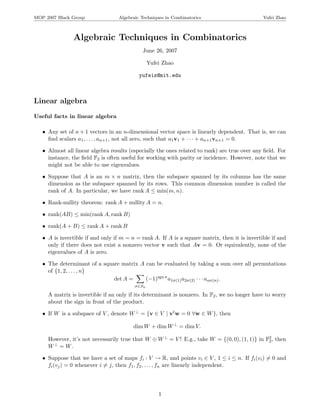
 Any set of n+1 vectors in an n-dimensional vector space is linearly dependent. That is, we can
nd scalars a1; : : : ; an+1, not all zero, such that a1v1 +    + an+1vn+1 = 0. 
 Almost all linear algebra results (especially the ones related to rank) are true over any
eld. For 
instance, the
eld F2 is often useful for working with parity or incidence. However, note that we 
might not be able to use eigenvalues. 
 Suppose that A is an m  n matrix, then the subspace spanned by its columns has the same 
dimension as the subspace spanned by its rows. This common dimension number is called the 
rank of A. In particular, we have rankA  min(m; n). 
 Rank-nullity theorem: rankA + nullityA = n. 
 rank(AB)  min(rank A; rankB) 
 rank(A + B)  rankA + rankB 
 A is invertible if and only if m = n = rankA. If A is a square matrix, then it is invertible if and 
only if there does not exist a nonzero vector v such that Av = 0. Or equivalently, none of the 
eigenvalues of A is zero. 
 The determinant of a square matrix A can be evaluated by taking a sum over all permutations 
of f1; 2; : : : ; ng 
detA = 
X 
2Sn 
(1)sgn a1(1)a2(2)    an(n): 
A matrix is invertible if an only if its determinant is nonzero. In F2, we no longer have to worry 
about the sign in front of the product. 
 If W is a subspace of V , denote W? = fv 2 V j vtw = 0 8w 2 Wg, then 
dimW + dimW? = dim V: 
However, it's not necessarily true that W W? = V ! E.g., take W = f(0; 0); (1; 1)g in F22 
, then 
W? = W. 
 Suppose that we have a set of maps fi : V ! R, and points vi 2 V , 1  i  n. If fi(vi)6= 0 and 
fi(vj) = 0 whenever i6= j, then f1; f2; : : : ; fn are linearly independent. 
1
MOP 2007 Black Group Algebraic Techniques in Combinatorics Yufei Zhao 
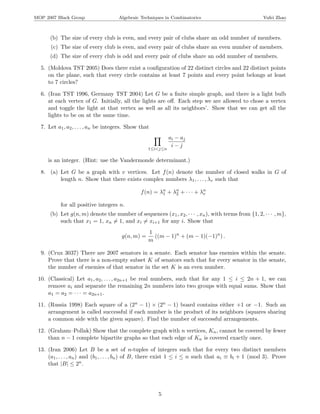
Problem: (St. Petersburg) Students in a school go for ice cream in groups of at least two. After 
k  1 groups have gone, every two students have gone together exactly once. Prove that the number 
of students in the school is at most k. 
Solution. There is a combinatorial solution which is somewhat long and non-intuitive. However, a 
much quicker (and more intuitive) solution is available using the tools of linear algebra. 
Let there be n students. Note if some student went for ice cream only once, then everyone else has 
to have gone with that student, due to the constraint that every pair of student have gone together 
exactly once. Furthermore, since each group consists of two students, no other groups can be formed. 
However, k  1, so this situation cannot occur. Therefore, every student went for ice cream at least 
twice. 
Let us construct incidence vectors vi 2 Rk; 1  1  n, representing the students. That is, the 
j-th component of vi is 1 if student i went with the j-th group, and 0 otherwise. 
The condition that every two students have gone together exactly once translates into the dot 
product vi  vj = 1 for i6= j. The condition that every student went for ice cream at least twice 
translates into jvij2  2. 
We want to prove that n  k. Suppose otherwise. Then fv1; : : : ; vng consists of at least k + 1 
vectors in Rk, so they must be linearly dependent. It follows that there are real numbers 1; : : : ; n, 
not all zero, such that 
1v1 +    + nvn = 0: 
Let us square the above expression (i.e., taking the dot product with itself. We get 
0 = 
Xn 
i=1 
2 
i jvij2 + 2 
X 
ij 
ijvi  vj = 
Xn 
i=1 
2 
i jvij2 + 2 
X 
ij 
ij = 
Xn 
i=1 
2 
i 
 
jvij2  1 
 
+ 
  
Xn 
i=1 
i 
!2 
: 
However, the RHS expression is positive, since jvij2  2 and some i is nonzero. Contradiction. 
Alternatively, we can use an incidence matrix to obtain a somewhat faster (albeit more tech- 
nically involved) solution. The incidence matrix M is a k n matrix, where Mij is 1 if the i-th group 
includes student j. Using the notation in the previous solution, we can write this as 
M = 
0 
@ 
j j    j 
v1 v2    vn 
j j    j 
1 
A 
Consider the product MtM. Since vi vj = 1 for i6= j and jvij2  2 for all i, we see that MtM = J+A, 
where J is the nn matrix with all entries 1, and A is a diagonal matrix with positive diagonal entries. 
Note that J is positive semide
nite (meaning that xtJx  0 for all vectors x) and M is positive de

Algebraic techniques in combinatorics

  • 1.
    MOP 2007 BlackGroup Algebraic Techniques in Combinatorics Yufei Zhao Algebraic Techniques in Combinatorics June 26, 2007 Yufei Zhao yufeiz@mit.edu Linear algebra Useful facts in linear algebra Any set of n+1 vectors in an n-dimensional vector space is linearly dependent. That is, we can
  • 2.
    nd scalars a1;: : : ; an+1, not all zero, such that a1v1 + + an+1vn+1 = 0. Almost all linear algebra results (especially the ones related to rank) are true over any
  • 3.
  • 4.
    eld F2 isoften useful for working with parity or incidence. However, note that we might not be able to use eigenvalues. Suppose that A is an m n matrix, then the subspace spanned by its columns has the same dimension as the subspace spanned by its rows. This common dimension number is called the rank of A. In particular, we have rankA min(m; n). Rank-nullity theorem: rankA + nullityA = n. rank(AB) min(rank A; rankB) rank(A + B) rankA + rankB A is invertible if and only if m = n = rankA. If A is a square matrix, then it is invertible if and only if there does not exist a nonzero vector v such that Av = 0. Or equivalently, none of the eigenvalues of A is zero. The determinant of a square matrix A can be evaluated by taking a sum over all permutations of f1; 2; : : : ; ng detA = X 2Sn (1)sgn a1(1)a2(2) an(n): A matrix is invertible if an only if its determinant is nonzero. In F2, we no longer have to worry about the sign in front of the product. If W is a subspace of V , denote W? = fv 2 V j vtw = 0 8w 2 Wg, then dimW + dimW? = dim V: However, it's not necessarily true that W W? = V ! E.g., take W = f(0; 0); (1; 1)g in F22 , then W? = W. Suppose that we have a set of maps fi : V ! R, and points vi 2 V , 1 i n. If fi(vi)6= 0 and fi(vj) = 0 whenever i6= j, then f1; f2; : : : ; fn are linearly independent. 1
  • 5.
    MOP 2007 BlackGroup Algebraic Techniques in Combinatorics Yufei Zhao Problem: (St. Petersburg) Students in a school go for ice cream in groups of at least two. After k 1 groups have gone, every two students have gone together exactly once. Prove that the number of students in the school is at most k. Solution. There is a combinatorial solution which is somewhat long and non-intuitive. However, a much quicker (and more intuitive) solution is available using the tools of linear algebra. Let there be n students. Note if some student went for ice cream only once, then everyone else has to have gone with that student, due to the constraint that every pair of student have gone together exactly once. Furthermore, since each group consists of two students, no other groups can be formed. However, k 1, so this situation cannot occur. Therefore, every student went for ice cream at least twice. Let us construct incidence vectors vi 2 Rk; 1 1 n, representing the students. That is, the j-th component of vi is 1 if student i went with the j-th group, and 0 otherwise. The condition that every two students have gone together exactly once translates into the dot product vi vj = 1 for i6= j. The condition that every student went for ice cream at least twice translates into jvij2 2. We want to prove that n k. Suppose otherwise. Then fv1; : : : ; vng consists of at least k + 1 vectors in Rk, so they must be linearly dependent. It follows that there are real numbers 1; : : : ; n, not all zero, such that 1v1 + + nvn = 0: Let us square the above expression (i.e., taking the dot product with itself. We get 0 = Xn i=1 2 i jvij2 + 2 X ij ijvi vj = Xn i=1 2 i jvij2 + 2 X ij ij = Xn i=1 2 i jvij2 1 + Xn i=1 i !2 : However, the RHS expression is positive, since jvij2 2 and some i is nonzero. Contradiction. Alternatively, we can use an incidence matrix to obtain a somewhat faster (albeit more tech- nically involved) solution. The incidence matrix M is a k n matrix, where Mij is 1 if the i-th group includes student j. Using the notation in the previous solution, we can write this as M = 0 @ j j j v1 v2 vn j j j 1 A Consider the product MtM. Since vi vj = 1 for i6= j and jvij2 2 for all i, we see that MtM = J+A, where J is the nn matrix with all entries 1, and A is a diagonal matrix with positive diagonal entries. Note that J is positive semide
  • 6.
    nite (meaning thatxtJx 0 for all vectors x) and M is positive de