(Effective Alternative Secondary Education)(Effective Alternative Secondary Education)
MATHEMATICS II
MODULE 2
Radical Expressions
BUREAU OF SECONDARY EDUCATION
Department of Education
DepEd Complex, Meralco Avenue, Pasig City
1
Y
X
Module 2
Radical Expressions
What this module is about
This module is about radical expressions and rational exponents. Some
lessons include transforming radical expressions into exponential form and vice
versa. You will also develop skills in simplifying radical expressions and
expressions with rational exponents. Several activities are provided for you in
this module.
What you are expected to learn
This module is designed for you to:
• define rational exponents.
• write expressions in radical or exponential form.
• simplify expressions involving rational exponents.
How much do you know
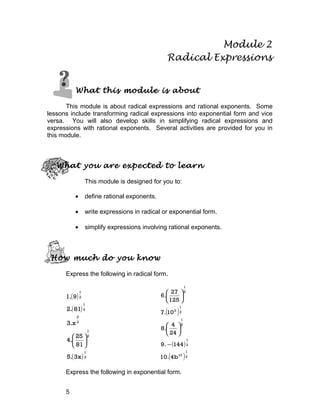
Express the following in radical form.
( )
( )
( )3
1
2
1
3
2
4
1
2
1
x3.5
81
25
.4
x.3
81.2
9.1






( )
( )
( )2
1
10
2
1
2
1
2
1
2
3
1
b4.10
144.9
24
4
.8
10.7
125
27
.6
−












Express the following in exponential form.
5
1. 64 6. 3 2
10m
2. 3 2
8m 7. 4 5
9
3. ab 8. 3
16
4. ( )5
4
24 9. 4 4
24b
5. ( )3
5xy 10. 22
yx
Change the indicated roots into radicals and evaluate.
( )
( )
( )
( )
( )3
2
3
1
2
1
2
1
2
1
8.5
64.4
169.3
121.2
16.1
−
( )
( )
( )
( )
( )6
5
2
5
5
3
2
3
4
3
64.10
36.9
32.8
25.7
16.6
−
What you will do
Lesson 1
Write Expressions with Rational Exponents as
Radical Expressions and Vice Versa
In the radical expressions n
x we shall call n the index. The
exponent of x in this expression is 1. n
x can be transformed as the rational
expression n
x
1
and vice versa. Notice that in the rational expression n
x
1
, the
denominator n of the exponent is the index and the numerator 1 is the index of
the radical expression n
x .
You can use this knowledge to write expressions involving rational
exponents as radicals and vice versa.
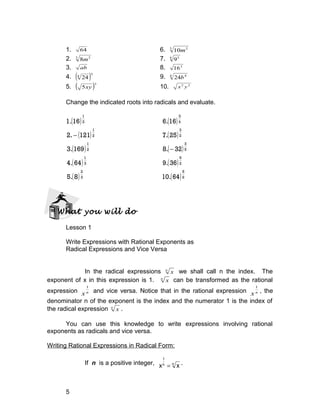
Writing Rational Expressions in Radical Form:
If n is a positive integer, nn
1
xx = .
5
The denominator is the index. If
the index is 2, there is no need of writing.
Examples:
Write each rational expression in radical form.
1) 2
1
25 = 25
2) 3
1
8 = 3
8
3) 4
1
81 =
4
81
If
n
m
is any rational number where mnn mn
m
xxxn )(,0 ==≠ .
Examples:
Write each rational expression in radical form.
1) 5 35
3
aa =
2) ( ) ( ) 4 334 3
4
3
nmmnmn ==
3) 6 56
5
y22y =
4) ( ) ( ) 6 56 5
6
5
32y2y24 ==
Examples:
Write each rational expression in radical form.
1) ( )3
2
ab 3) ( )4
3
3x
2) 4
3
3x 4) 7
2
x
Solutions:
1) ( ) ( ) 3 223 2
3
2
baabab ==
2) 4 34
3
x33x =
5
The denominator is 3 and so
the index is 3.
The denominator is 4 and
so the index is 4.
Here we use
n mn
m
aa = , which is
generally the preferred form in this situation.
The exponent applies to mn
because of the parenthesis.
Note that the exponent
applies only to the variable y.
Now the exponent applies
to 2y because of the parenthesis.
3) ( ) ( ) 4 34 3
4
3
27x3x3x ==
4) 7 27
2
xx = or ( )
2
7
x
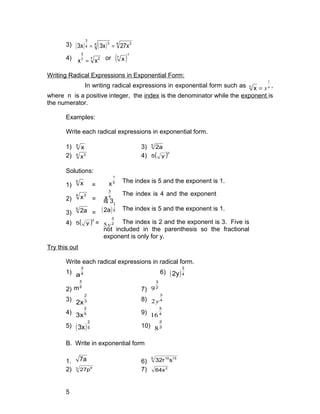
Writing Radical Expressions in Exponential Form:
In writing radical expressions in exponential form such as n
x
1
=n
x ,
where n is a positive integer, the index is the denominator while the exponent is
the numerator.
Examples:
Write each radical expressions in exponential form.
1) 5
x 3) 5
2a
2) 4 3
x 4) ( )3
y5
Solutions:
1)
5
x = 5
1
x
2)
4 3
x = 4
3
x
3)
5
2a = ( )5
1
2a
4) ( )3
y5 = 2
3
y5
Try this out
Write each radical expressions in radical form.
1) 4
3
a 6) ( )4
3
2y
2) 6
5
m 7) 2
3
9
3) 3
2
2x 8) 4
3
y2
4) 5
2
3x 9) 4
3
16
5) ( )5
2
3x 10) 3
2
8
B. Write in exponential form
1. 7a 6)
5 1510
s32r
2) 3 6
27p 7) 2
64x
5
The index is 5 and the exponent is 1.
The index is 4 and the exponent
is 3.
The index is 5 and the exponent is 1.
The index is 2 and the exponent is 3. Five is
not included in the parenthesis so the fractional
exponent is only for y.
3) 4 8
81x 16
y 8) 5 5
32y
4)
4
25w 9) 121
5) 93 6
n8m 10) 3
64
C. Math Integration
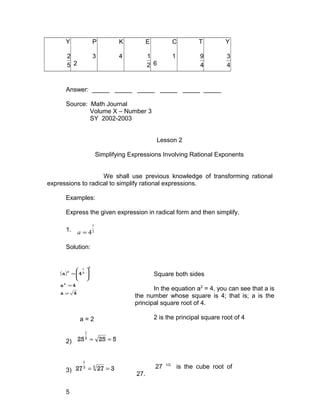
Where Is the Temple of Artemis?
The temple of Artemis is one of the seven wonders of the world. It
was built mostly of marble around 550 B.C. in honor of a Greek goddess,
Artemis.
In what country can this temple be found?
To answer, simplify the following radical expressions. Cross out
each box that contains an answer. The remaining boxes will spell out the answer
to the question.
1)
3
8 = ___________
2)
4 3
16 = ___________
3) -( )3
4 = ___________
4)
5
4 = ___________
5)
25
4
= ___________
6)
2
3
8
27








= ___________
7) ( )3
4
81 = ___________
8) ( )4
6
64 = ___________
G
2
T
9
E
2
7
U
1
G
-
8
R
1
2
E
8
5
Square both sides
In the equation a2
= 4, you can see that a is
the number whose square is 4; that is; a is the
principal square root of 4.
2 is the principal square root of 4
Y
5
2
P
3
2
K
4
E
2
1
C
1
6
T
4
9
Y
4
3
Answer: _____ _____ _____ _____ _____ _____
Source: Math Journal
Volume X – Number 3
SY 2002-2003
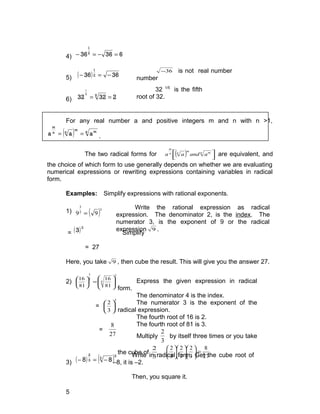
Lesson 2
Simplifying Expressions Involving Rational Exponents
We shall use previous knowledge of transforming rational
expressions to radical to simplify rational expressions.
Examples:
Express the given expression in radical form and then simplify.
1. 2
1
4=a
Solution:
a = 2
2) 525252
1
==
3) 32727 33
1
==
5
( )
4a
4a
4a
2
2
2
1
2
=
=








=
27 1/3
is the cube root of
27.
Write the rational expression as radical
expression. The denominator 2, is the index. The
numerator 3, is the exponent of 9 or the radical
expression 9 .
Express the given expression in radical
form.
The denominator 4 is the index.
The numerator 3 is the exponent of the
radical expression.
The fourth root of 16 is 2.
The fourth root of 81 is 3.
Multiply
3
2
by itself three times or you take
the cube of
3
2
.
27
8
3
2
3
2
3
2
=

















4) 636362
1
=−=−
5) ( ) 3636 2
1
−=−
6) 23232 55
1
==
For any real number a and positive integers m and n with n >1,
( ) n mm
nn
m
aaa == .
The two radical forms for ( ) 


 n mm
nn
m
aandaa are equivalent, and
the choice of which form to use generally depends on whether we are evaluating
numerical expressions or rewriting expressions containing variables in radical
form.
Examples: Simplify expressions with rational exponents.
1) ( )3
2
3
99 =
= ( )3
3 Simplify
= 27
Here, you take 9 , then cube the result. This will give you the answer 27.
2)
3
4
4
3
81
16
81
16








=





=
3
3
2






=
27
8
3) ( ) ( )2
3
3
2
8−=− 8
5
36− is not real number
number
32 1/5
is the fifth
root of 32.
Write in radical form. Get the cube root of
–8, it is –2.
Then, you square it.
= ( )2
2−
= 4
Note that in example 1, you could also have evaluated the expression as
72999 32
3
== = 27.
This shows why we use ( )m
n
a for n
m
a when evaluating numerical
expressions. The numbers involved will be smaller and easier to work with
Try this out
Use the definition of n
1
a to evaluate each expression.
1) 2
1
36 6) ( )3
1
64-
2) 2
1
100 7) 4
1
81
3) 2
1
25 8)
5
1
32−
4) ( )2
1
64 9)
2
1
9
4






5) 3
1
27 10)
3
1
8
27






Use the definition of n
m
a to evaluate each expression.
1) 3
2
27 6)
3
2
27
8






2) 2
3
16 7) ( )4
3
81−
3) ( )3
4
8− 8)
2
3
4
9






4) 3
2
125 9) 2
3
81
5) 5
2
32 10) ( )5
3
243−
Math Integration
The First Man to Orbit the Earth
5
In 1961, this Russian cosmonaut orbited the earth in a spaceship.
Who was he?
To find out, evaluate the following. Then encircle the letter that
corresponds to the correct answer. These letters will spell out the name of this
Russian cosmonaut. Have fun!
1) 2
1
144 Y. 12 Z. 14
2) 2
1
169 O. 9 U. 13
3) 3
1
125 Q 25 R. 5
4) 3
1
216 E. 16 I. 6
5) 4
1
625 G. 5 H. 25
6) 2
3
9 A. 27 E. 9
7) ( )3
2
8− F. –4 G. 4
8) ( )3
4
27− A. 81 E. -81
9) ( )3
1
343− R. –7 S. 7
10) ( )5
4
32− E. –16 I. 16
11)
4
3
81
16






− N.
27
8
− P.
27
8
Answer:
1 2 3 4 5 6 7 8 9 10 11
Source: Math Journal – Volume XI-Number 2
SY 2003-2004
ISSN 0118-1211
Now you can extend your knowledge on rational exponent notation.
Using the definition of negative exponents, you can write
n
m
n
m
-
a
1
a =
Examples:
Simplify each expression.
5
Change the negative
exponent to positive exponent. Then
simplify.
1)
4
1
16
1
16
1
16
2
1
===
−
2
1
2)
( )2
3
3
2
3
2
27
1
27
1
27 ==
−
=
( )2
3
1
=
9
1
Try this out
Simplify each expression.
1) 4
1
-
16 6) 4
1
-
81
2) 4
3
-
81 7) 2
3
-
9
3) 2
1
-
49 8) 6
5
-
64
4) 2
3
-
4 9)
2
1
-
25
4






5) 2
1
-
25 10) 2
1
-
121
Let’s Summarize
As you mentioned earlier, you assume that all your previous
exponent properties will continue to hold for rational exponents. These
properties are restated here.
For any nonzero real numbers a and b and rational numbers m and n,
1) Product Rule
nmnm
aaa +
=•
5
Follow the same procedure as
in example 1.
Quotient Rule nm
n
m
a
a
a −
=
Power Rule ( ) mnnm
aa =
Product-power rule ( ) mmm
baab =
Quotient-power rule m
mm
b
a
b
a
=





In general, n
1
n
xx = if x and n are real numbers and n > 0.
For any real numbers a and positive integers m and n where n > 1 ,
( ) n mm
nn
m
aaa == .
What have you learned
Express the following in radical form.
1) ( )2
1
5x 6. ( )5
1
33
y6x
2) ( )2
1
22
y3x 7. ( )2
1
2y
3) 3
2
y 8. ( )6
1
3a
4) 4
3
25 9. ( )3
1
8x
5) 5
1
x 10. 2
1
x6
Express the following in exponential form.
1) 3a 6) 42
yx
2) 4 43
yx 7) 5 55
y32x
3) 3 9xy 8) 6 5
y
4) ( )3
xy 9)
4
25
4








5) ( )2
5 5
27x 10) ( )3
x3
Change the indicated roots into radicals and evaluate.
1) 2
3
36 6) 4
3
81
2)
2
5
64
25





 7)
2
3
121
49






5
3) ( )2
1
225 8)
3
4
64
27






4) ( )2
3
169 9) 3
2
-
8
5) ( )3
2
27 10) 2
1
-
81

Answer Key
How much do you know
1) 9
2) 4
81
3) 3 2
x
4)
81
25
5) 3
3x
6) 3
125
27
7) 2
10
8)
25
4
9) 144−
10) 10
4b
1) 2
1
64
2) 3
2
8
3) ( )2
1
ab
4) 4
5
24
5) ( )2
3
5xy
6) ( )3
1
2
10m
7) 4
5
9
8)
2
3
16
9) ( )4
1
4
24b
5
10) ( )2
1
22
yx
1) 416 =
2) 11121 −=−
3) 13169 =
4) 4643
=
5) 4=3 2
8
6) 8164 3
=
7) 125253
=
8) 8325 3
−=−
9) 7776365
=
10) 32646 5
=
Try this out
Lesson 1
A. 1)
4 3
a
2)
6 5
m
3)
3 2
x2
4)
5 2
x3
5) ( )2
5
3x
6)
( )3
4 2y
7)
3
9
8) 4 3
y2
9)
4 3
16
10) 3 2
8
B. 1) ( )2
1
7a
2) ( )3
1
6
27p
3) ( )4
1
168
y81x
4) ( )2
1
4
25w
5) ( )3
1
96
n8m
6) ( )5
1
1510
s32r
7) ( )2
1
2
64x
5
8) ( )5
1
5
32y
9) ( )2
1
121
10) ( )3
1
64
C. 1) 2
2) 8
3) –8
4) 32
5)
5
2
6)
4
9
7) 27
8) 16
Answer: TURKEY
Lesson 2
1) 6
2) 10
3) 5
4) 8
5) 3
6) –4
7) 3
8) –2
9)
3
2
10)
2
3
B.
1) 9
2) 64
3) 16
4) 25
5) 4
6)
9
4
7) –27
8)
8
27
9) 729
10)-27
C. 1) 12 Y
2) 13 U
5
3) 5 R
4) 6 I
5) 5 G
6) 27 A
7) 4 G
8) 81 A
9) -7 R
10) 16 I
11)
27
8
− N
Negative Exponents
Try this out
1)
2
1
2)
27
1
3)
7
1
4)
8
1
5)
5
1
6)
3
1
7)
27
1
8)
32
1
9)
2
5
10)
11
1
What have you learned
A. 1) 5x
2) 22
y3x
3) 3 2
y
4) 4 3
25
5) 5
x
6) 5 33
y6x
7) 2y
8) 6
3a
5
9) 3
8x
10) x6
B. 1) ( )2
1
3a
2) ( )4
1
43
yx
3) ( )3
1
9xy
4) ( )2
3
xy
5) ( )5
2
5
27x
6) ( )2
1
42
yx
7) ( )5
1
55
y32x
8) 6
5
y
9)
2
4
25
4






10) 2
3
3x
C. 1) ( ) 21636
3
=
2)
32768
3125
64
25
5
=







3) 15225 =
4) ( ) 2197169
3
=
5) ( ) 927
2
3
=
6) ( ) 2781
3
4
=
7)
1331
343
121
49
3
=







8)
256
81
64
27
4
3 =







9)
( ) 4
1
8
1
2
3
=
10)
9
1
81
1
=
5

Mathematics 9 Radical Expressions (1)

  • 1.
    (Effective Alternative SecondaryEducation)(Effective Alternative Secondary Education) MATHEMATICS II MODULE 2 Radical Expressions BUREAU OF SECONDARY EDUCATION Department of Education DepEd Complex, Meralco Avenue, Pasig City 1 Y X
  • 2.
    Module 2 Radical Expressions Whatthis module is about This module is about radical expressions and rational exponents. Some lessons include transforming radical expressions into exponential form and vice versa. You will also develop skills in simplifying radical expressions and expressions with rational exponents. Several activities are provided for you in this module. What you are expected to learn This module is designed for you to: • define rational exponents. • write expressions in radical or exponential form. • simplify expressions involving rational exponents. How much do you know Express the following in radical form. ( ) ( ) ( )3 1 2 1 3 2 4 1 2 1 x3.5 81 25 .4 x.3 81.2 9.1       ( ) ( ) ( )2 1 10 2 1 2 1 2 1 2 3 1 b4.10 144.9 24 4 .8 10.7 125 27 .6 −             Express the following in exponential form. 5
  • 3.
    1. 64 6.3 2 10m 2. 3 2 8m 7. 4 5 9 3. ab 8. 3 16 4. ( )5 4 24 9. 4 4 24b 5. ( )3 5xy 10. 22 yx Change the indicated roots into radicals and evaluate. ( ) ( ) ( ) ( ) ( )3 2 3 1 2 1 2 1 2 1 8.5 64.4 169.3 121.2 16.1 − ( ) ( ) ( ) ( ) ( )6 5 2 5 5 3 2 3 4 3 64.10 36.9 32.8 25.7 16.6 − What you will do Lesson 1 Write Expressions with Rational Exponents as Radical Expressions and Vice Versa In the radical expressions n x we shall call n the index. The exponent of x in this expression is 1. n x can be transformed as the rational expression n x 1 and vice versa. Notice that in the rational expression n x 1 , the denominator n of the exponent is the index and the numerator 1 is the index of the radical expression n x . You can use this knowledge to write expressions involving rational exponents as radicals and vice versa. Writing Rational Expressions in Radical Form: If n is a positive integer, nn 1 xx = . 5
  • 4.
    The denominator isthe index. If the index is 2, there is no need of writing. Examples: Write each rational expression in radical form. 1) 2 1 25 = 25 2) 3 1 8 = 3 8 3) 4 1 81 = 4 81 If n m is any rational number where mnn mn m xxxn )(,0 ==≠ . Examples: Write each rational expression in radical form. 1) 5 35 3 aa = 2) ( ) ( ) 4 334 3 4 3 nmmnmn == 3) 6 56 5 y22y = 4) ( ) ( ) 6 56 5 6 5 32y2y24 == Examples: Write each rational expression in radical form. 1) ( )3 2 ab 3) ( )4 3 3x 2) 4 3 3x 4) 7 2 x Solutions: 1) ( ) ( ) 3 223 2 3 2 baabab == 2) 4 34 3 x33x = 5 The denominator is 3 and so the index is 3. The denominator is 4 and so the index is 4. Here we use n mn m aa = , which is generally the preferred form in this situation. The exponent applies to mn because of the parenthesis. Note that the exponent applies only to the variable y. Now the exponent applies to 2y because of the parenthesis.
  • 5.
    3) ( )( ) 4 34 3 4 3 27x3x3x == 4) 7 27 2 xx = or ( ) 2 7 x Writing Radical Expressions in Exponential Form: In writing radical expressions in exponential form such as n x 1 =n x , where n is a positive integer, the index is the denominator while the exponent is the numerator. Examples: Write each radical expressions in exponential form. 1) 5 x 3) 5 2a 2) 4 3 x 4) ( )3 y5 Solutions: 1) 5 x = 5 1 x 2) 4 3 x = 4 3 x 3) 5 2a = ( )5 1 2a 4) ( )3 y5 = 2 3 y5 Try this out Write each radical expressions in radical form. 1) 4 3 a 6) ( )4 3 2y 2) 6 5 m 7) 2 3 9 3) 3 2 2x 8) 4 3 y2 4) 5 2 3x 9) 4 3 16 5) ( )5 2 3x 10) 3 2 8 B. Write in exponential form 1. 7a 6) 5 1510 s32r 2) 3 6 27p 7) 2 64x 5 The index is 5 and the exponent is 1. The index is 4 and the exponent is 3. The index is 5 and the exponent is 1. The index is 2 and the exponent is 3. Five is not included in the parenthesis so the fractional exponent is only for y.
  • 6.
    3) 4 8 81x16 y 8) 5 5 32y 4) 4 25w 9) 121 5) 93 6 n8m 10) 3 64 C. Math Integration Where Is the Temple of Artemis? The temple of Artemis is one of the seven wonders of the world. It was built mostly of marble around 550 B.C. in honor of a Greek goddess, Artemis. In what country can this temple be found? To answer, simplify the following radical expressions. Cross out each box that contains an answer. The remaining boxes will spell out the answer to the question. 1) 3 8 = ___________ 2) 4 3 16 = ___________ 3) -( )3 4 = ___________ 4) 5 4 = ___________ 5) 25 4 = ___________ 6) 2 3 8 27         = ___________ 7) ( )3 4 81 = ___________ 8) ( )4 6 64 = ___________ G 2 T 9 E 2 7 U 1 G - 8 R 1 2 E 8 5
  • 7.
    Square both sides Inthe equation a2 = 4, you can see that a is the number whose square is 4; that is; a is the principal square root of 4. 2 is the principal square root of 4 Y 5 2 P 3 2 K 4 E 2 1 C 1 6 T 4 9 Y 4 3 Answer: _____ _____ _____ _____ _____ _____ Source: Math Journal Volume X – Number 3 SY 2002-2003 Lesson 2 Simplifying Expressions Involving Rational Exponents We shall use previous knowledge of transforming rational expressions to radical to simplify rational expressions. Examples: Express the given expression in radical form and then simplify. 1. 2 1 4=a Solution: a = 2 2) 525252 1 == 3) 32727 33 1 == 5 ( ) 4a 4a 4a 2 2 2 1 2 = =         = 27 1/3 is the cube root of 27.
  • 8.
    Write the rationalexpression as radical expression. The denominator 2, is the index. The numerator 3, is the exponent of 9 or the radical expression 9 . Express the given expression in radical form. The denominator 4 is the index. The numerator 3 is the exponent of the radical expression. The fourth root of 16 is 2. The fourth root of 81 is 3. Multiply 3 2 by itself three times or you take the cube of 3 2 . 27 8 3 2 3 2 3 2 =                  4) 636362 1 =−=− 5) ( ) 3636 2 1 −=− 6) 23232 55 1 == For any real number a and positive integers m and n with n >1, ( ) n mm nn m aaa == . The two radical forms for ( )     n mm nn m aandaa are equivalent, and the choice of which form to use generally depends on whether we are evaluating numerical expressions or rewriting expressions containing variables in radical form. Examples: Simplify expressions with rational exponents. 1) ( )3 2 3 99 = = ( )3 3 Simplify = 27 Here, you take 9 , then cube the result. This will give you the answer 27. 2) 3 4 4 3 81 16 81 16         =      = 3 3 2       = 27 8 3) ( ) ( )2 3 3 2 8−=− 8 5 36− is not real number number 32 1/5 is the fifth root of 32. Write in radical form. Get the cube root of –8, it is –2. Then, you square it.
  • 9.
    = ( )2 2− =4 Note that in example 1, you could also have evaluated the expression as 72999 32 3 == = 27. This shows why we use ( )m n a for n m a when evaluating numerical expressions. The numbers involved will be smaller and easier to work with Try this out Use the definition of n 1 a to evaluate each expression. 1) 2 1 36 6) ( )3 1 64- 2) 2 1 100 7) 4 1 81 3) 2 1 25 8) 5 1 32− 4) ( )2 1 64 9) 2 1 9 4       5) 3 1 27 10) 3 1 8 27       Use the definition of n m a to evaluate each expression. 1) 3 2 27 6) 3 2 27 8       2) 2 3 16 7) ( )4 3 81− 3) ( )3 4 8− 8) 2 3 4 9       4) 3 2 125 9) 2 3 81 5) 5 2 32 10) ( )5 3 243− Math Integration The First Man to Orbit the Earth 5
  • 10.
    In 1961, thisRussian cosmonaut orbited the earth in a spaceship. Who was he? To find out, evaluate the following. Then encircle the letter that corresponds to the correct answer. These letters will spell out the name of this Russian cosmonaut. Have fun! 1) 2 1 144 Y. 12 Z. 14 2) 2 1 169 O. 9 U. 13 3) 3 1 125 Q 25 R. 5 4) 3 1 216 E. 16 I. 6 5) 4 1 625 G. 5 H. 25 6) 2 3 9 A. 27 E. 9 7) ( )3 2 8− F. –4 G. 4 8) ( )3 4 27− A. 81 E. -81 9) ( )3 1 343− R. –7 S. 7 10) ( )5 4 32− E. –16 I. 16 11) 4 3 81 16       − N. 27 8 − P. 27 8 Answer: 1 2 3 4 5 6 7 8 9 10 11 Source: Math Journal – Volume XI-Number 2 SY 2003-2004 ISSN 0118-1211 Now you can extend your knowledge on rational exponent notation. Using the definition of negative exponents, you can write n m n m - a 1 a = Examples: Simplify each expression. 5
  • 11.
    Change the negative exponentto positive exponent. Then simplify. 1) 4 1 16 1 16 1 16 2 1 === − 2 1 2) ( )2 3 3 2 3 2 27 1 27 1 27 == − = ( )2 3 1 = 9 1 Try this out Simplify each expression. 1) 4 1 - 16 6) 4 1 - 81 2) 4 3 - 81 7) 2 3 - 9 3) 2 1 - 49 8) 6 5 - 64 4) 2 3 - 4 9) 2 1 - 25 4       5) 2 1 - 25 10) 2 1 - 121 Let’s Summarize As you mentioned earlier, you assume that all your previous exponent properties will continue to hold for rational exponents. These properties are restated here. For any nonzero real numbers a and b and rational numbers m and n, 1) Product Rule nmnm aaa + =• 5 Follow the same procedure as in example 1.
  • 12.
    Quotient Rule nm n m a a a− = Power Rule ( ) mnnm aa = Product-power rule ( ) mmm baab = Quotient-power rule m mm b a b a =      In general, n 1 n xx = if x and n are real numbers and n > 0. For any real numbers a and positive integers m and n where n > 1 , ( ) n mm nn m aaa == . What have you learned Express the following in radical form. 1) ( )2 1 5x 6. ( )5 1 33 y6x 2) ( )2 1 22 y3x 7. ( )2 1 2y 3) 3 2 y 8. ( )6 1 3a 4) 4 3 25 9. ( )3 1 8x 5) 5 1 x 10. 2 1 x6 Express the following in exponential form. 1) 3a 6) 42 yx 2) 4 43 yx 7) 5 55 y32x 3) 3 9xy 8) 6 5 y 4) ( )3 xy 9) 4 25 4         5) ( )2 5 5 27x 10) ( )3 x3 Change the indicated roots into radicals and evaluate. 1) 2 3 36 6) 4 3 81 2) 2 5 64 25       7) 2 3 121 49       5
  • 13.
    3) ( )2 1 2258) 3 4 64 27       4) ( )2 3 169 9) 3 2 - 8 5) ( )3 2 27 10) 2 1 - 81 Answer Key How much do you know 1) 9 2) 4 81 3) 3 2 x 4) 81 25 5) 3 3x 6) 3 125 27 7) 2 10 8) 25 4 9) 144− 10) 10 4b 1) 2 1 64 2) 3 2 8 3) ( )2 1 ab 4) 4 5 24 5) ( )2 3 5xy 6) ( )3 1 2 10m 7) 4 5 9 8) 2 3 16 9) ( )4 1 4 24b 5
  • 14.
    10) ( )2 1 22 yx 1)416 = 2) 11121 −=− 3) 13169 = 4) 4643 = 5) 4=3 2 8 6) 8164 3 = 7) 125253 = 8) 8325 3 −=− 9) 7776365 = 10) 32646 5 = Try this out Lesson 1 A. 1) 4 3 a 2) 6 5 m 3) 3 2 x2 4) 5 2 x3 5) ( )2 5 3x 6) ( )3 4 2y 7) 3 9 8) 4 3 y2 9) 4 3 16 10) 3 2 8 B. 1) ( )2 1 7a 2) ( )3 1 6 27p 3) ( )4 1 168 y81x 4) ( )2 1 4 25w 5) ( )3 1 96 n8m 6) ( )5 1 1510 s32r 7) ( )2 1 2 64x 5
  • 15.
    8) ( )5 1 5 32y 9)( )2 1 121 10) ( )3 1 64 C. 1) 2 2) 8 3) –8 4) 32 5) 5 2 6) 4 9 7) 27 8) 16 Answer: TURKEY Lesson 2 1) 6 2) 10 3) 5 4) 8 5) 3 6) –4 7) 3 8) –2 9) 3 2 10) 2 3 B. 1) 9 2) 64 3) 16 4) 25 5) 4 6) 9 4 7) –27 8) 8 27 9) 729 10)-27 C. 1) 12 Y 2) 13 U 5
  • 16.
    3) 5 R 4)6 I 5) 5 G 6) 27 A 7) 4 G 8) 81 A 9) -7 R 10) 16 I 11) 27 8 − N Negative Exponents Try this out 1) 2 1 2) 27 1 3) 7 1 4) 8 1 5) 5 1 6) 3 1 7) 27 1 8) 32 1 9) 2 5 10) 11 1 What have you learned A. 1) 5x 2) 22 y3x 3) 3 2 y 4) 4 3 25 5) 5 x 6) 5 33 y6x 7) 2y 8) 6 3a 5
  • 17.
    9) 3 8x 10) x6 B.1) ( )2 1 3a 2) ( )4 1 43 yx 3) ( )3 1 9xy 4) ( )2 3 xy 5) ( )5 2 5 27x 6) ( )2 1 42 yx 7) ( )5 1 55 y32x 8) 6 5 y 9) 2 4 25 4       10) 2 3 3x C. 1) ( ) 21636 3 = 2) 32768 3125 64 25 5 =        3) 15225 = 4) ( ) 2197169 3 = 5) ( ) 927 2 3 = 6) ( ) 2781 3 4 = 7) 1331 343 121 49 3 =        8) 256 81 64 27 4 3 =        9) ( ) 4 1 8 1 2 3 = 10) 9 1 81 1 = 5