Chapter 1
RADICAL FUNCTIONS
Math Box
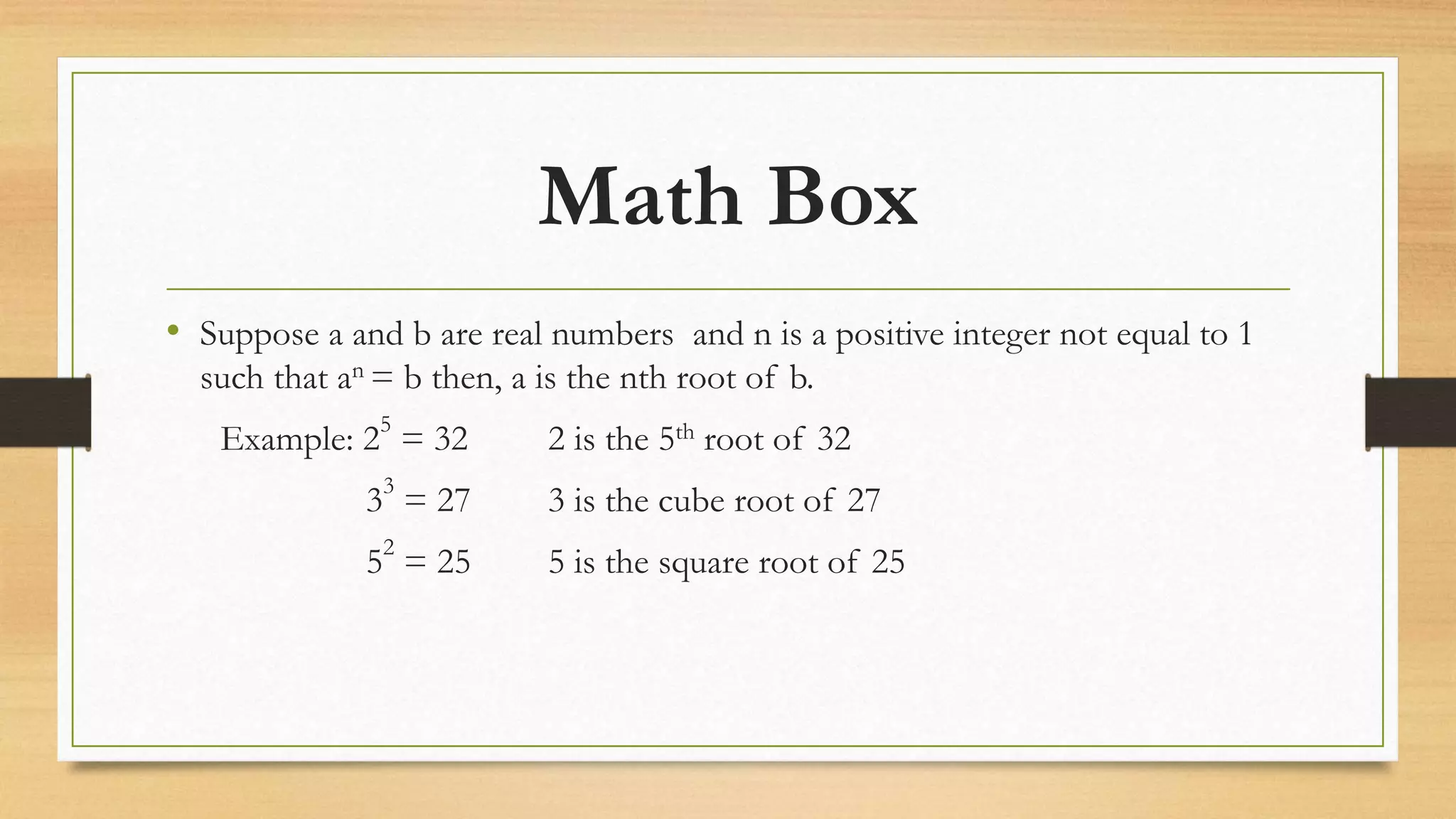
• Suppose a and b are real numbers and n is a positive integer not equal to 1
such that an = b then, a is the nth root of b.
Example: 2
5
= 32 2 is the 5th root of 32
3
3
= 27 3 is the cube root of 27
5
2
= 25 5 is the square root of 25
Rational Exponents: Its Roots
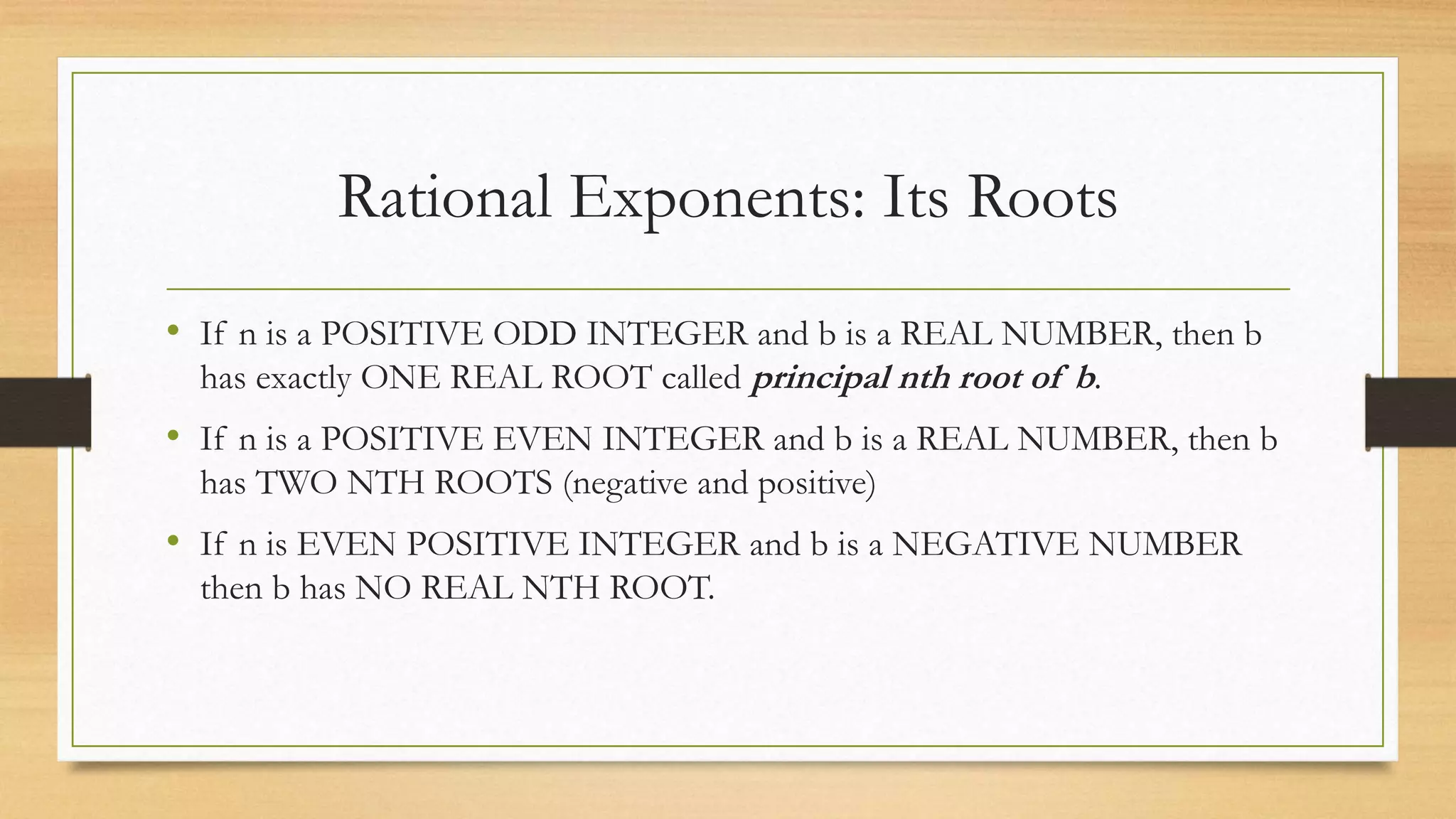
• If n is a POSITIVE ODD INTEGER and b is a REAL NUMBER, then b
has exactly ONE REAL ROOT called principal nth root of b.
• If n is a POSITIVE EVEN INTEGER and b is a REAL NUMBER, then b
has TWO NTH ROOTS (negative and positive)
• If n is EVEN POSITIVE INTEGER and b is a NEGATIVE NUMBER
then b has NO REAL NTH ROOT.
Rational Exponent: Its Definition
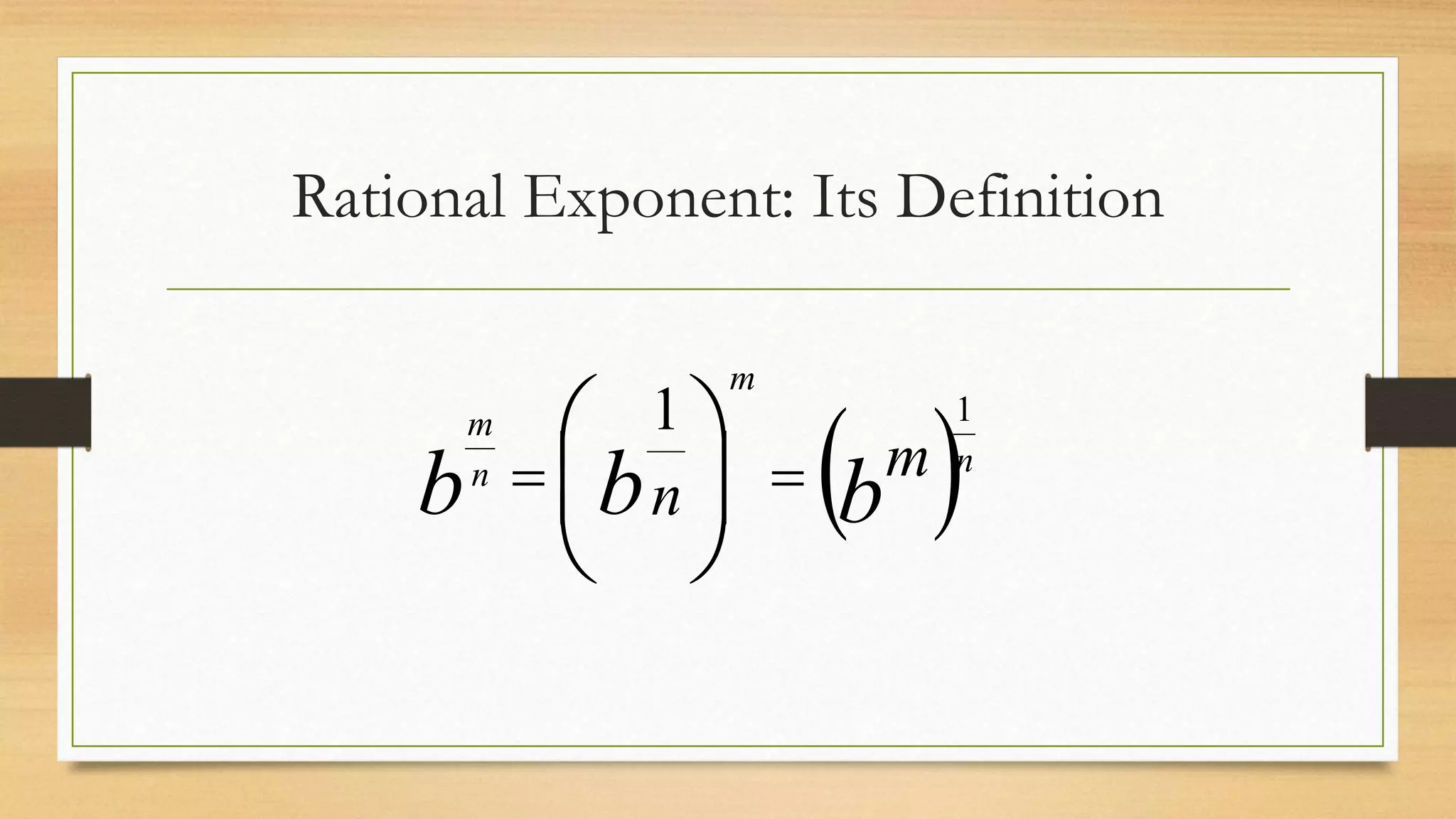
 bbb m
n
n
m
n
m 11
 





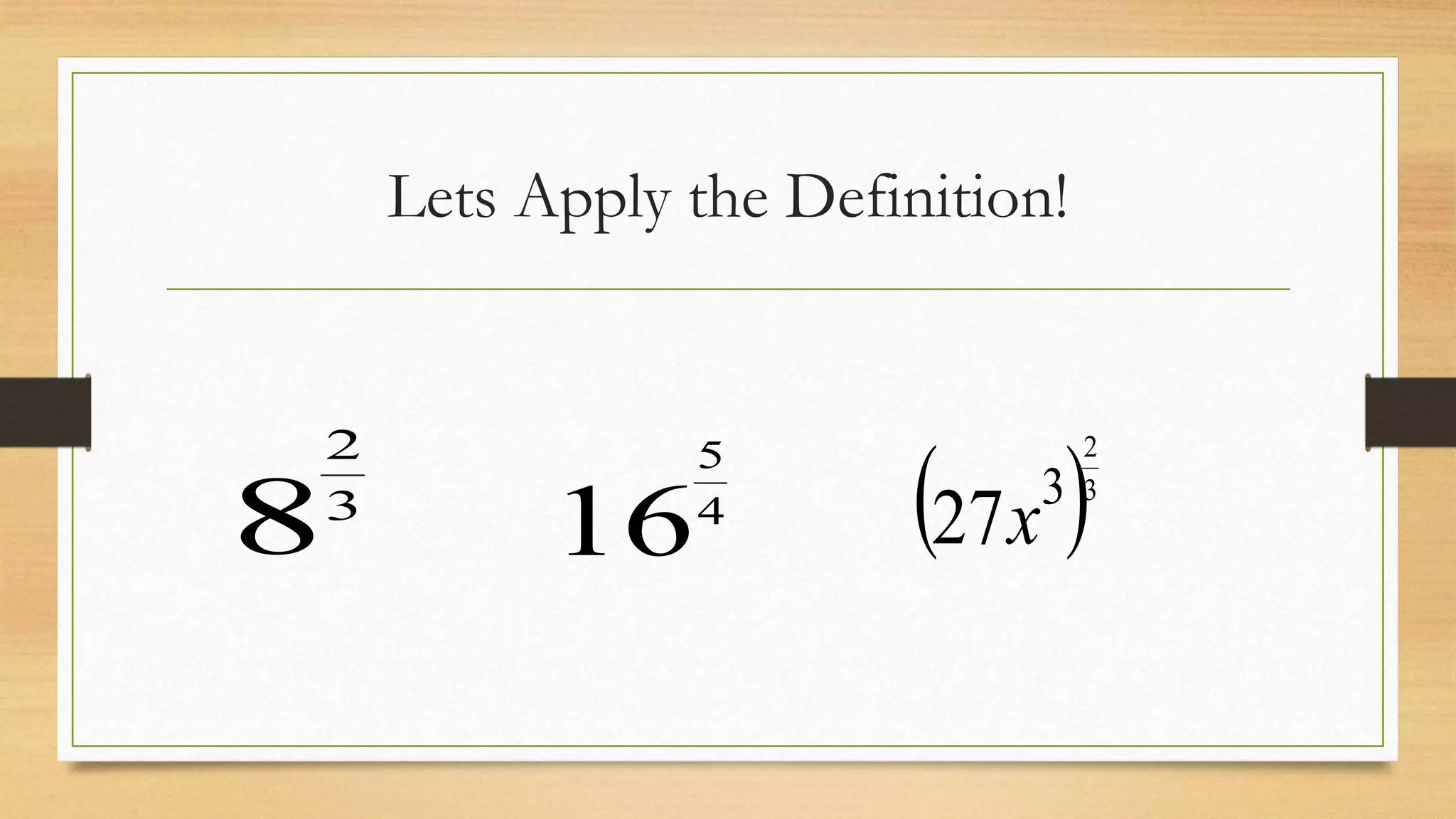
Lets Apply the Definition!
83
2
164
5
 x27
3 3
2
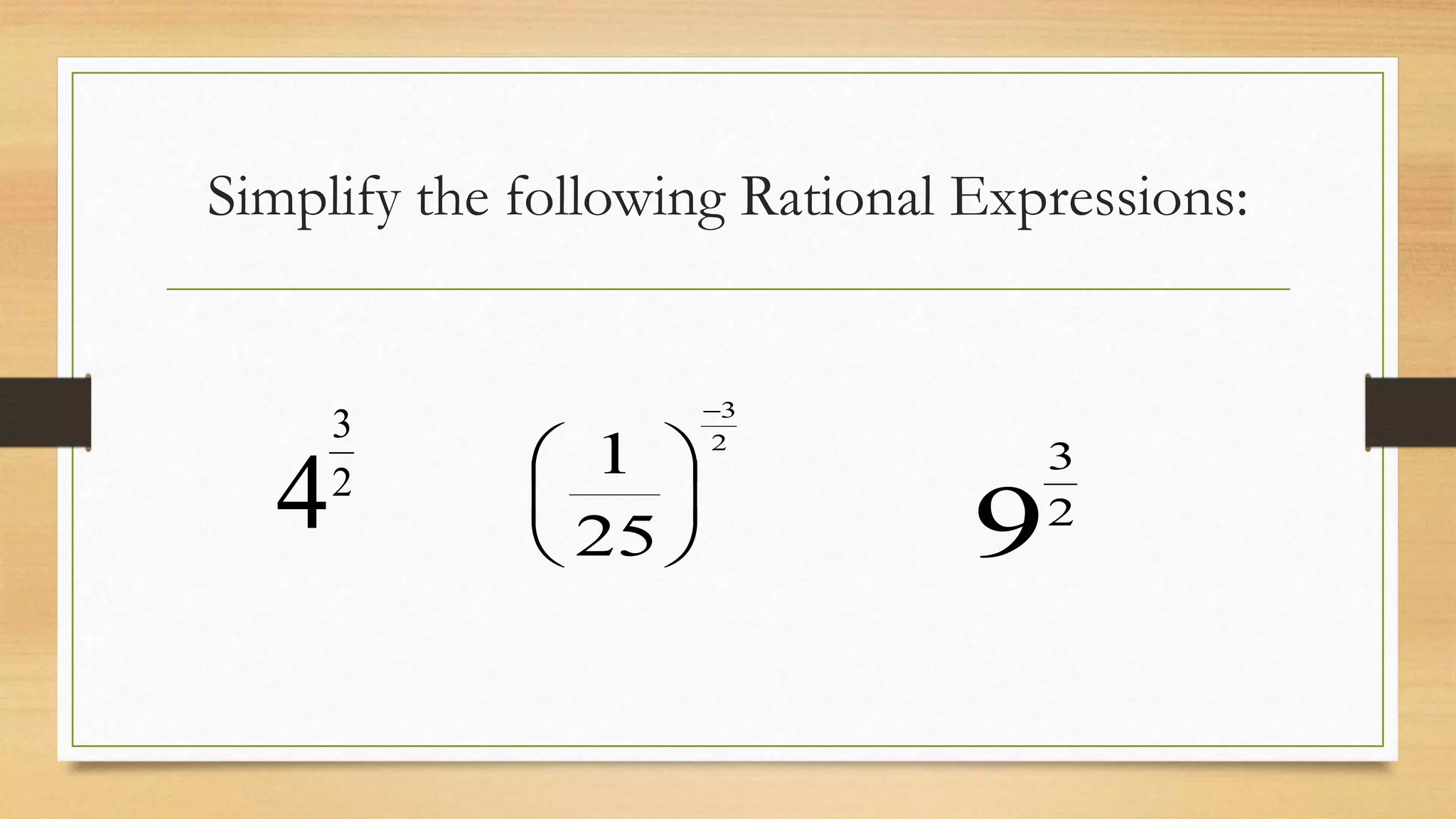
Simplify the following Rational Expressions:
42
3







25
1 2
3
92
3
Activity 1:
Simplify the following Rational Exponents
RADICALS
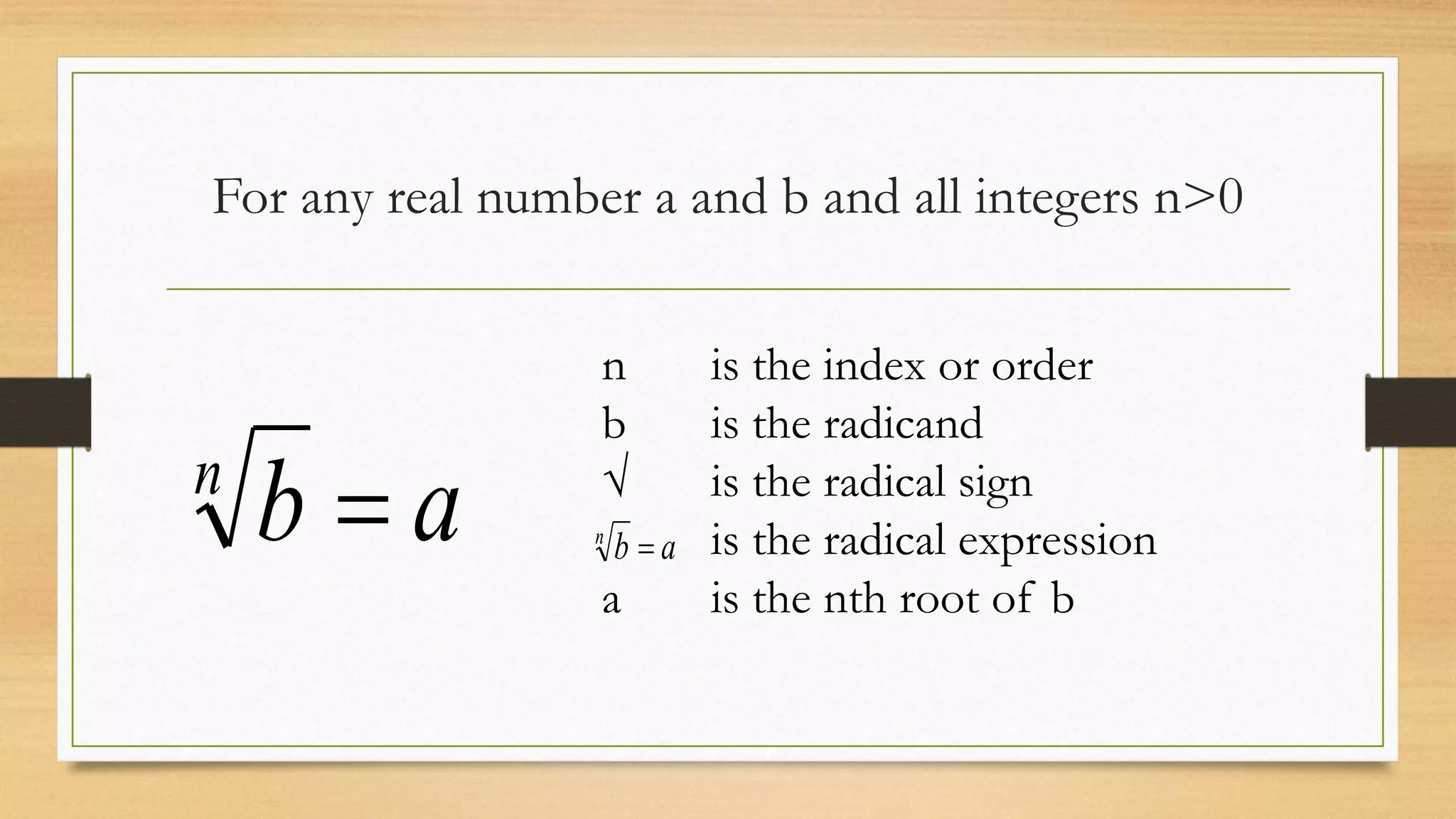
For any real number a and b and all integers n>0
abn

n is the index or order
b is the radicand
√ is the radical sign
is the radical expression
a is the nth root of b
abn

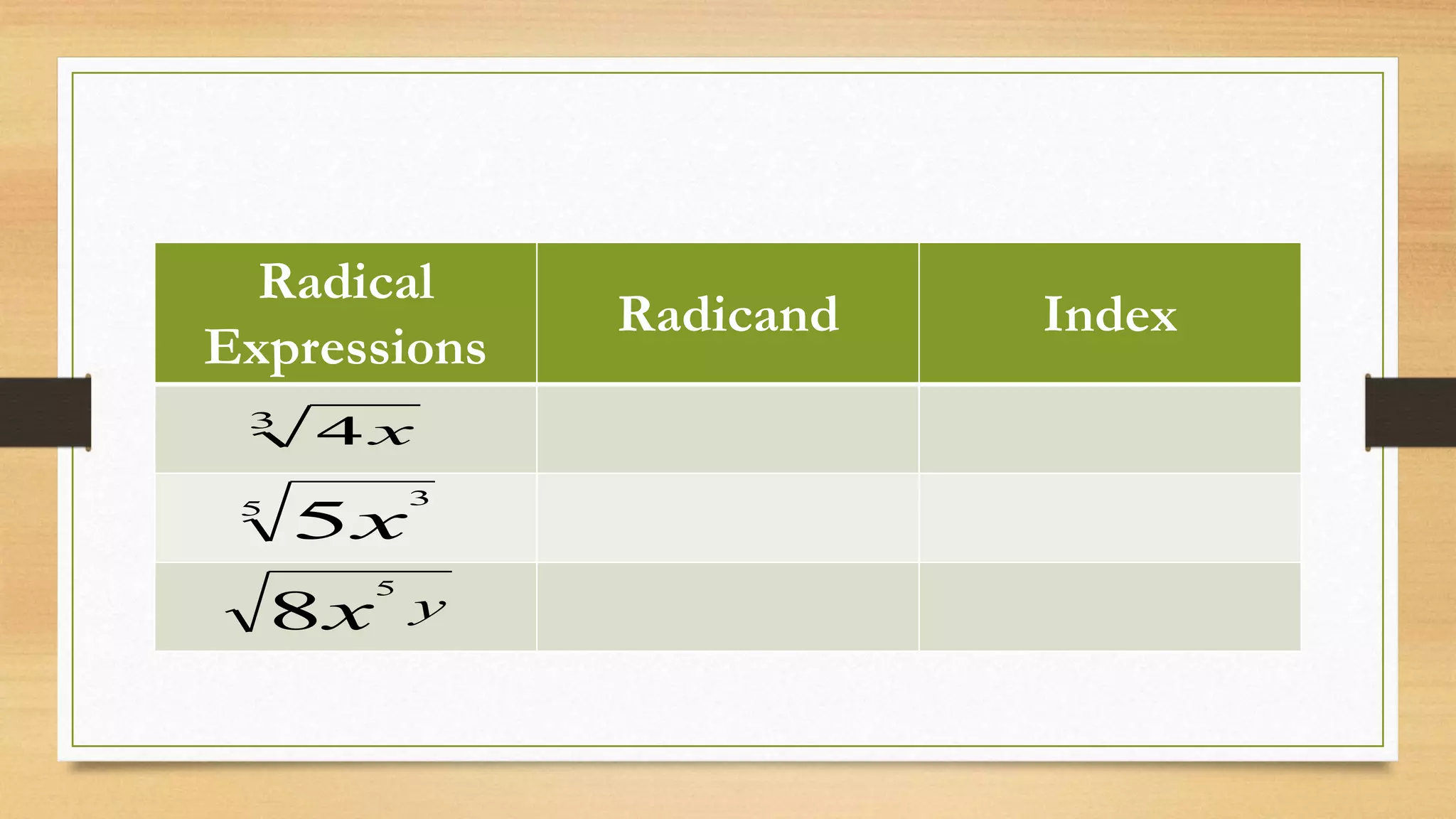
Radical
Expressions
Radicand Index
3
4x
5 3
5x
yx8
5
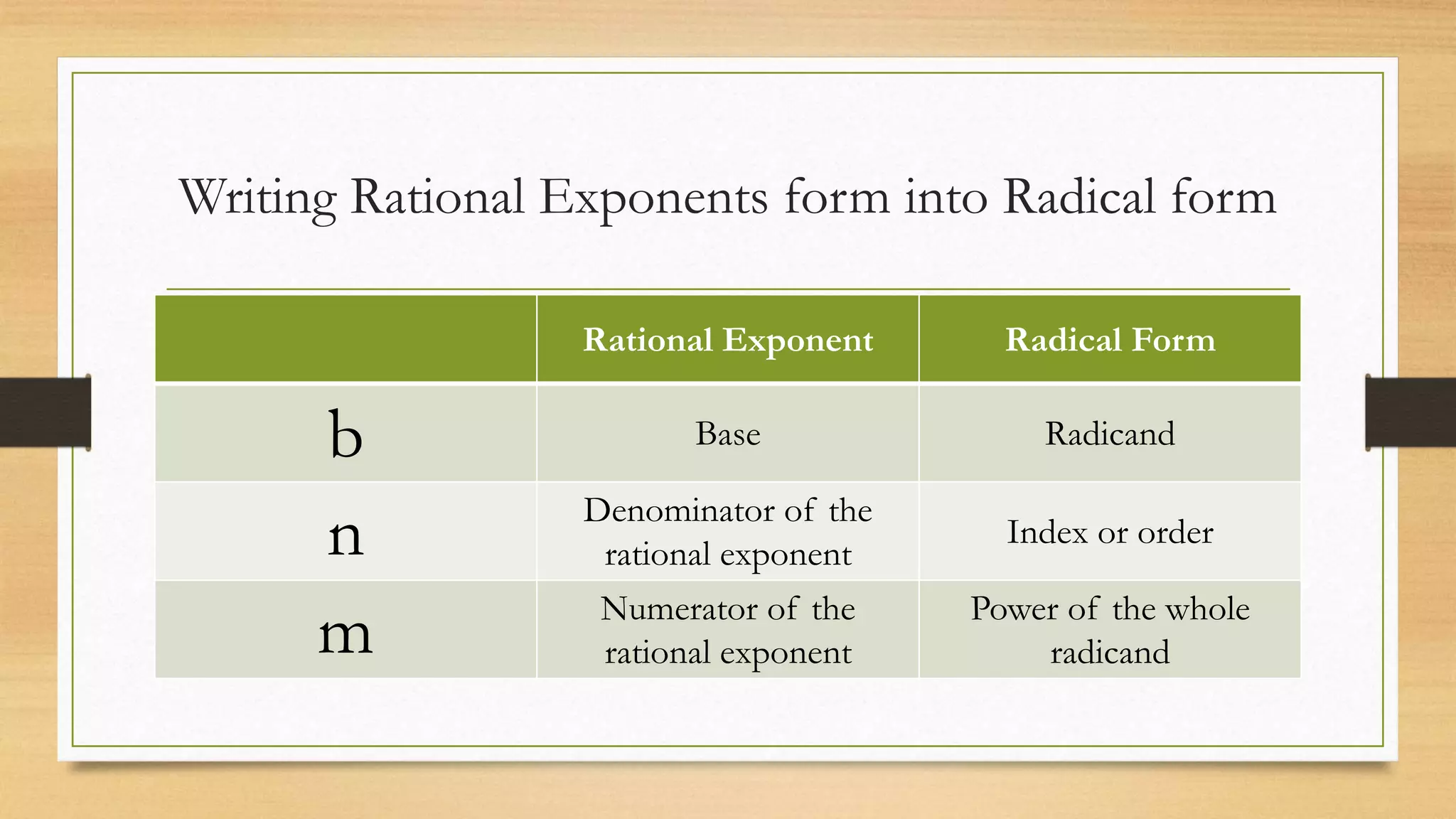
Writing Rational Exponents form into Radical form
Rational Exponent Radical Form
b Base Radicand
n Denominator of the
rational exponent
Index or order
m Numerator of the
rational exponent
Power of the whole
radicand
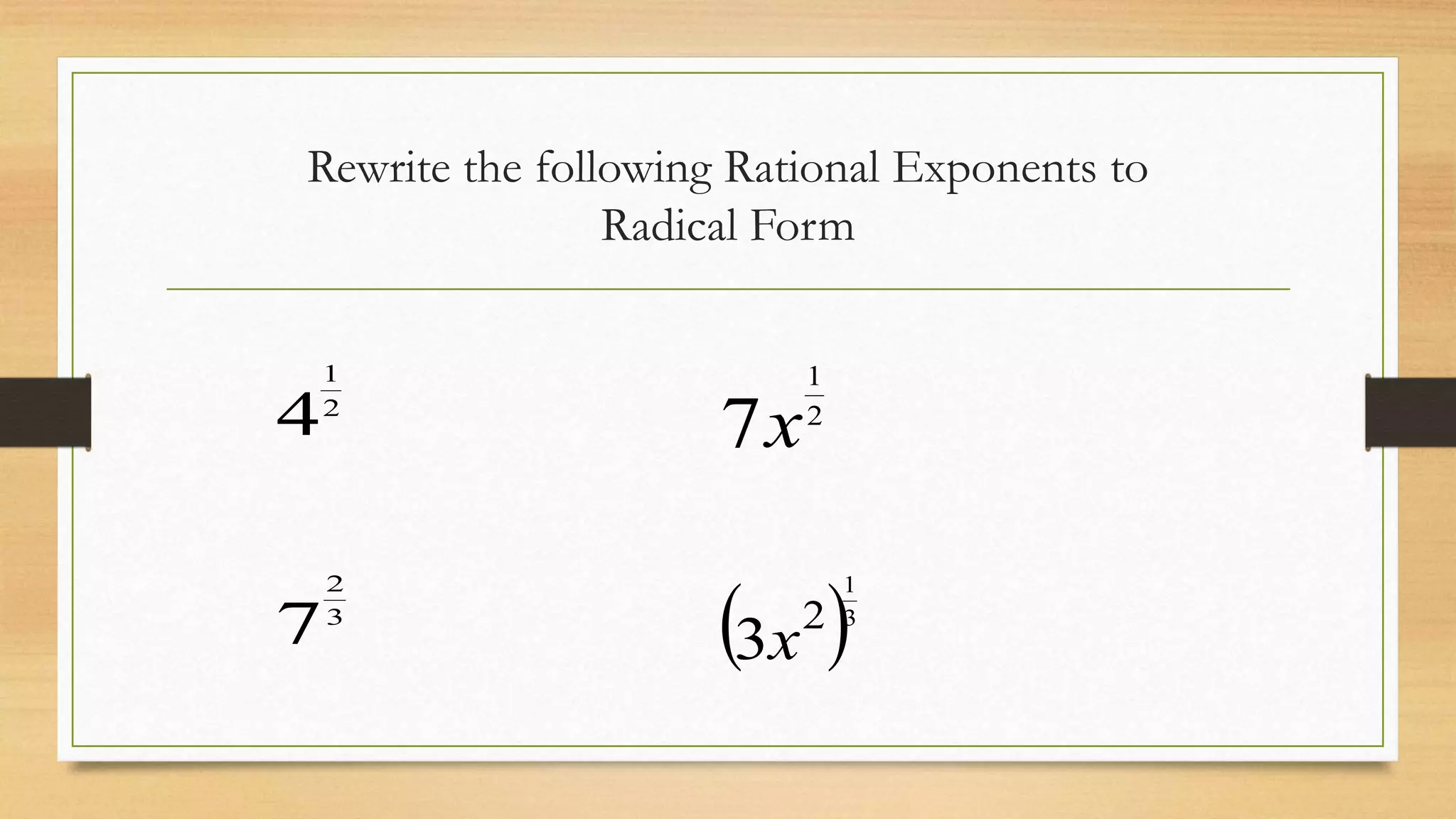
Rewrite the following Rational Exponents to
Radical Form
42
1
x7 2
1
73
2
 x3
2 3
1
Activity B:
Rewrite the following Rational Exponents to
Radical Form
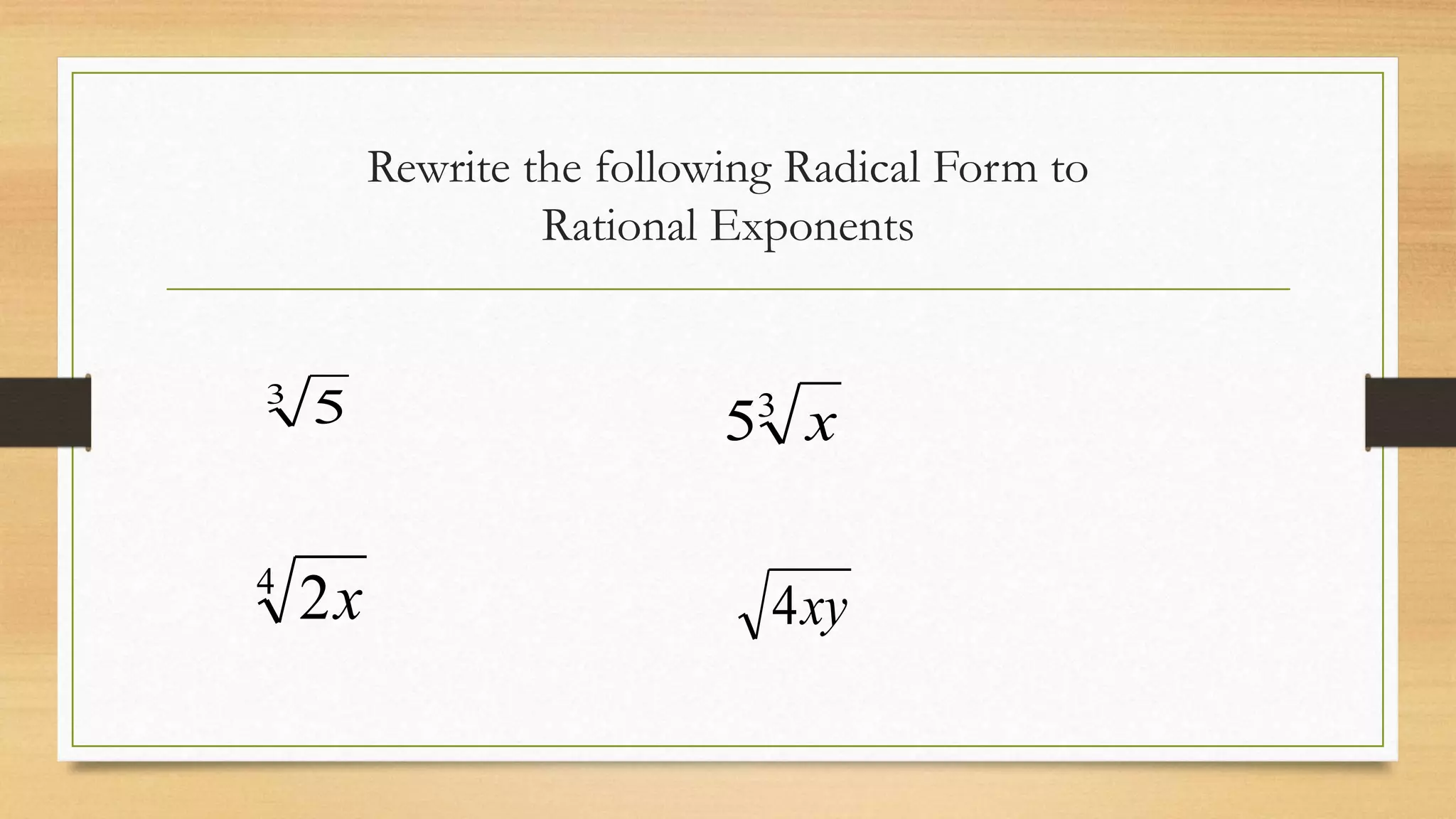
Rewrite the following Radical Form to
Rational Exponents
3
5 3
5 x
4
2x xy4
Activity C:
Rewrite the following Radical Form to
Rational Exponents
LAWS OF RADICALS
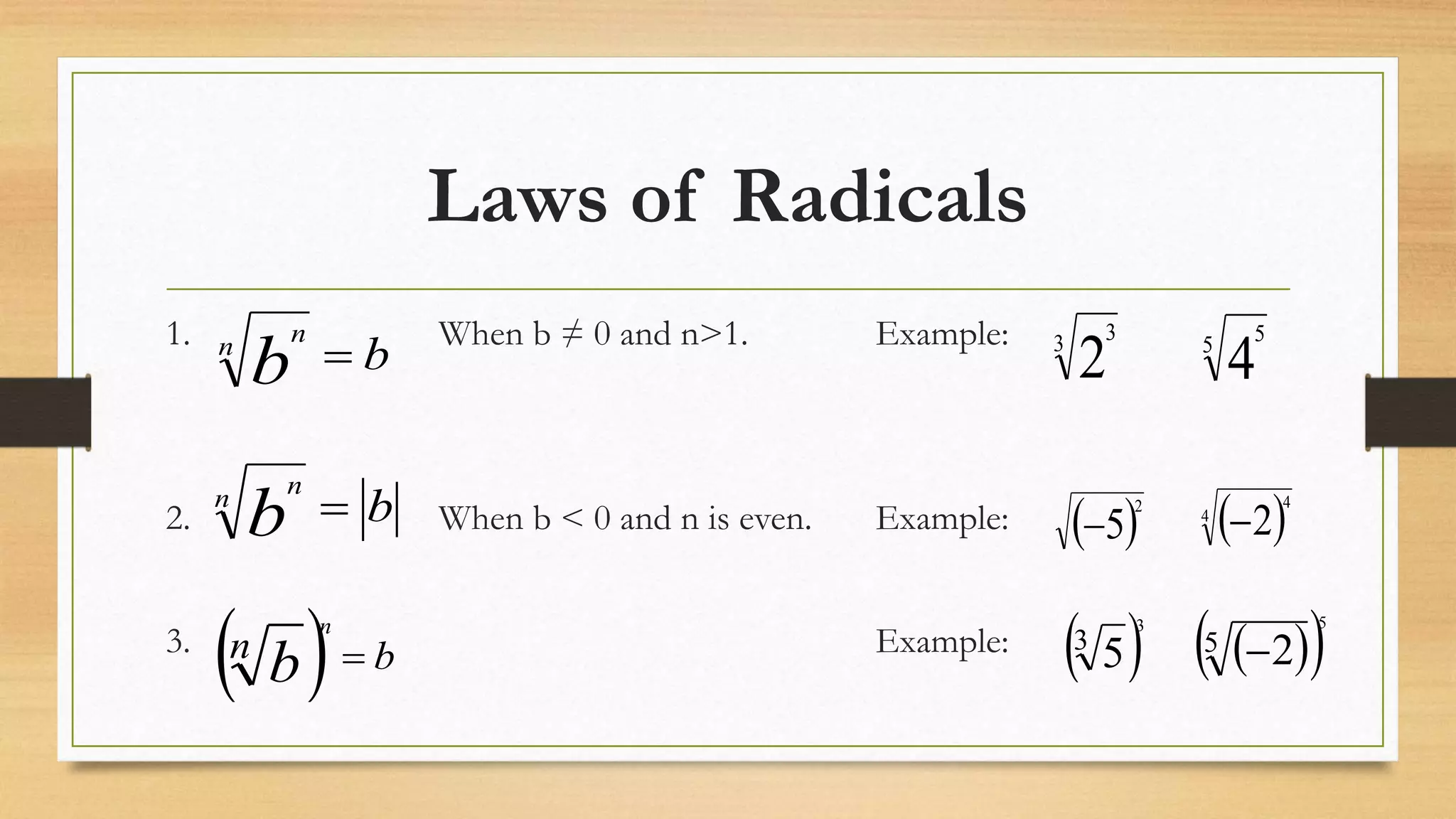
Laws of Radicals
1. When b ≠ 0 and n>1. Example:
2. When b < 0 and n is even. Example:
3. Example:
bn n
b 
bn n
b 
  bn
b
n

3 3
2 5 5
4
 5
2
  4
4
2
 3
5
3
  5 2
5

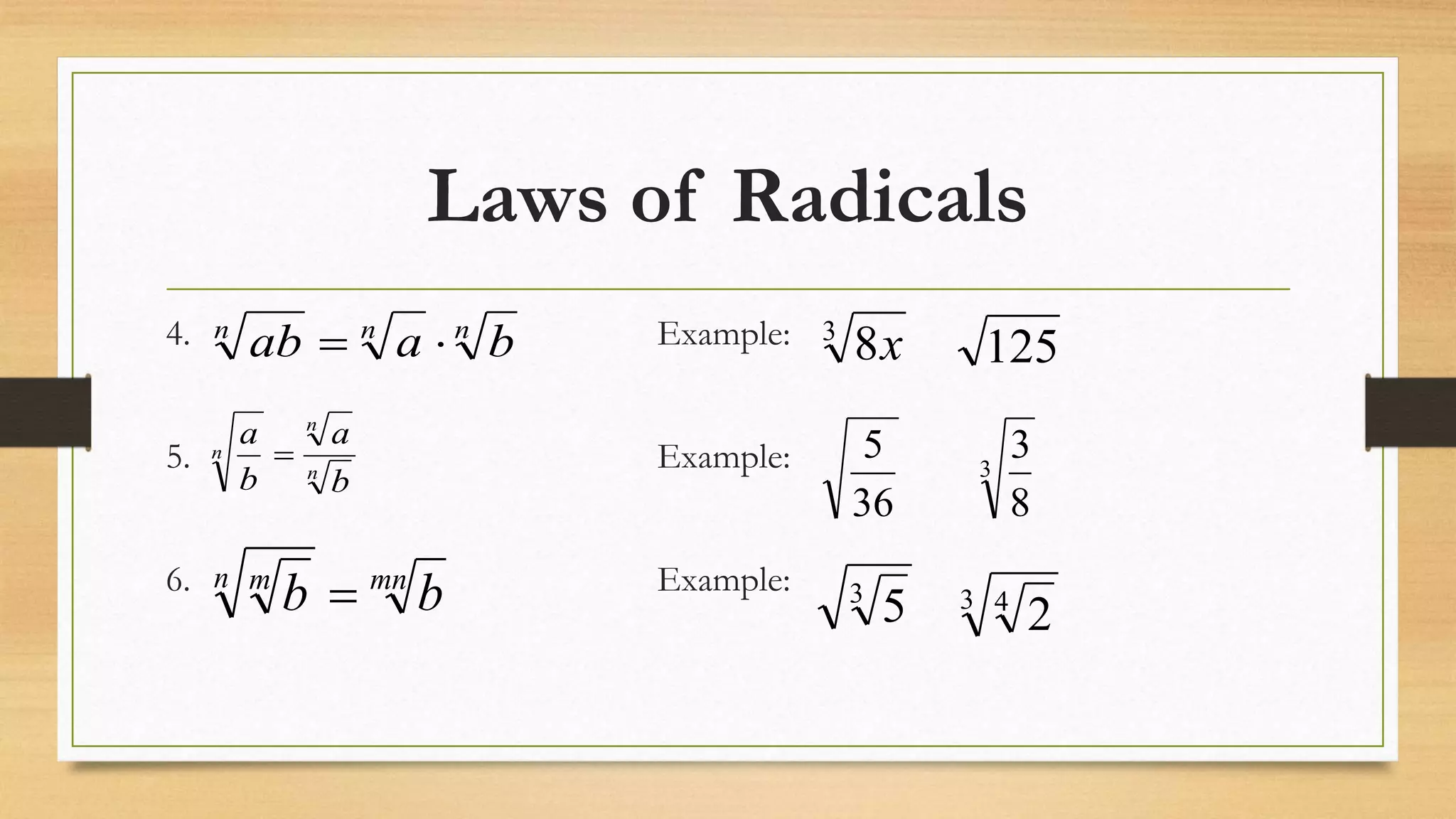
Laws of Radicals
4. Example:
5. Example:
6. Example:
nnn
baab 
n
n
n
b
a
b
a

mnn m
bb 
3
8x 125
36
5 3
8
3
3
5 3 4
2
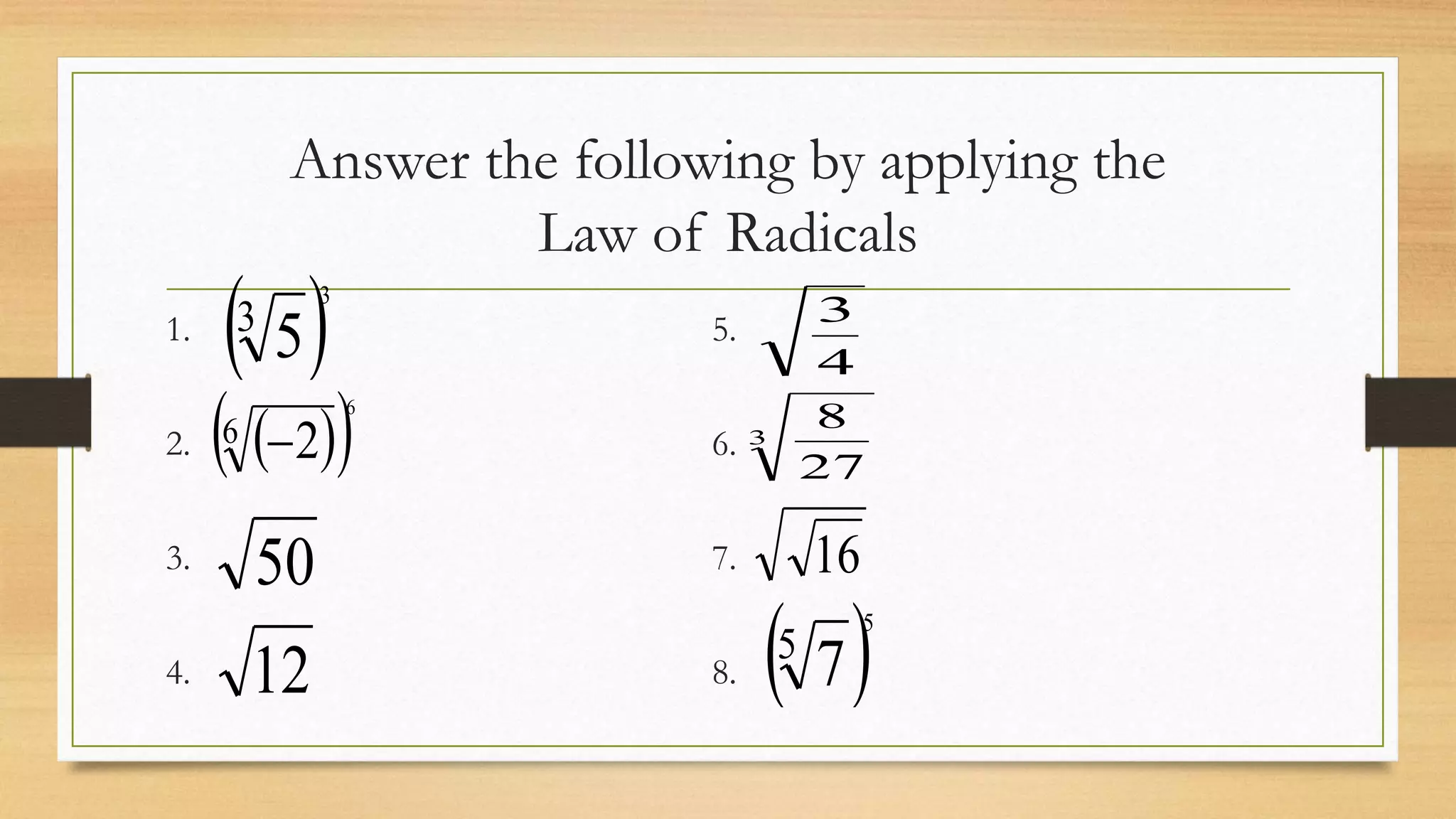
Answer the following by applying the
Law of Radicals
1. 5.
2. 6.
3. 7.
4. 8.
 3
5
3
  6 2
6

50
12
4
3
3
27
8
16
 5
7
5
Simplification of
Radicals
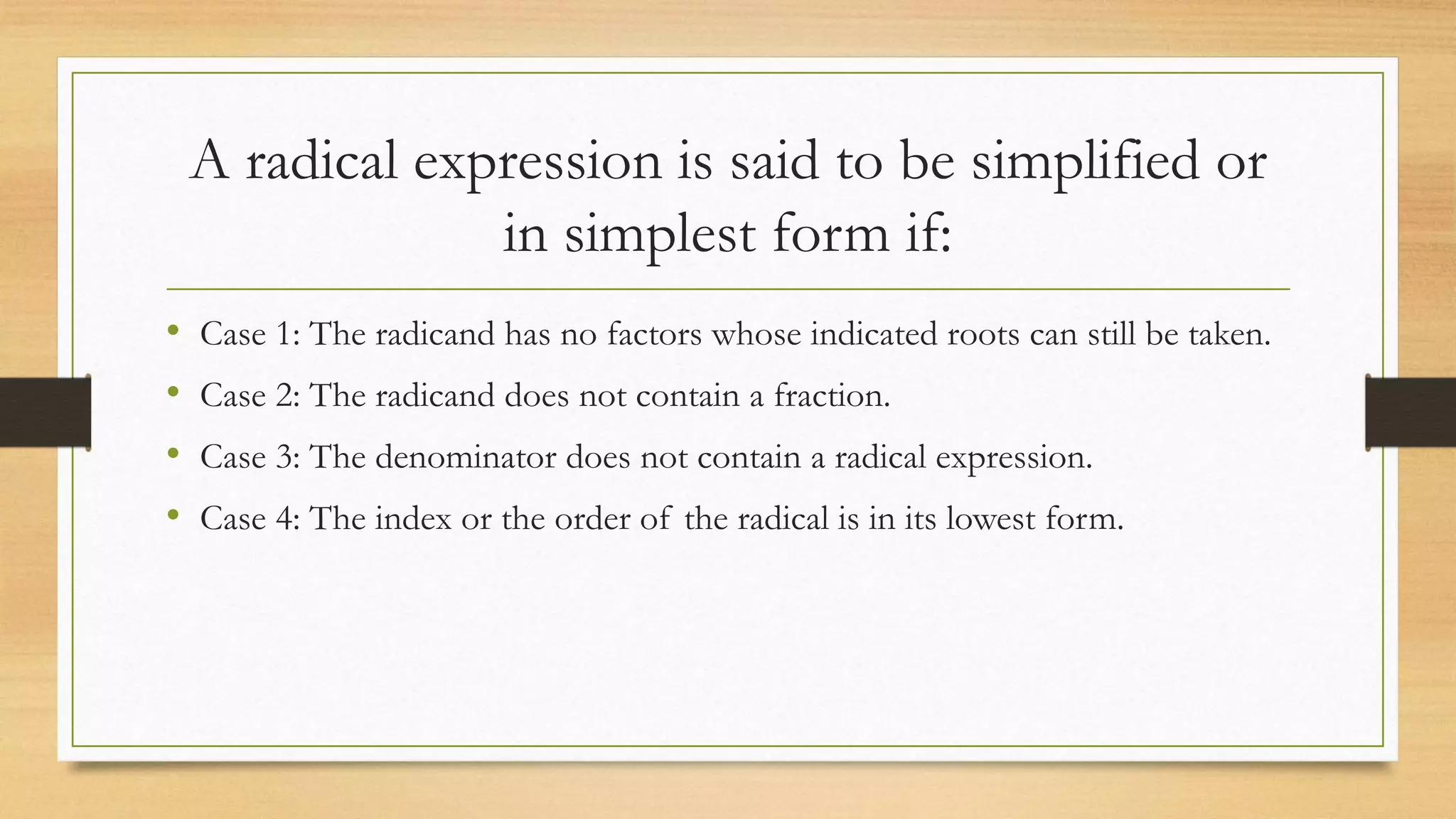
A radical expression is said to be simplified or
in simplest form if:
• Case 1: The radicand has no factors whose indicated roots can still be taken.
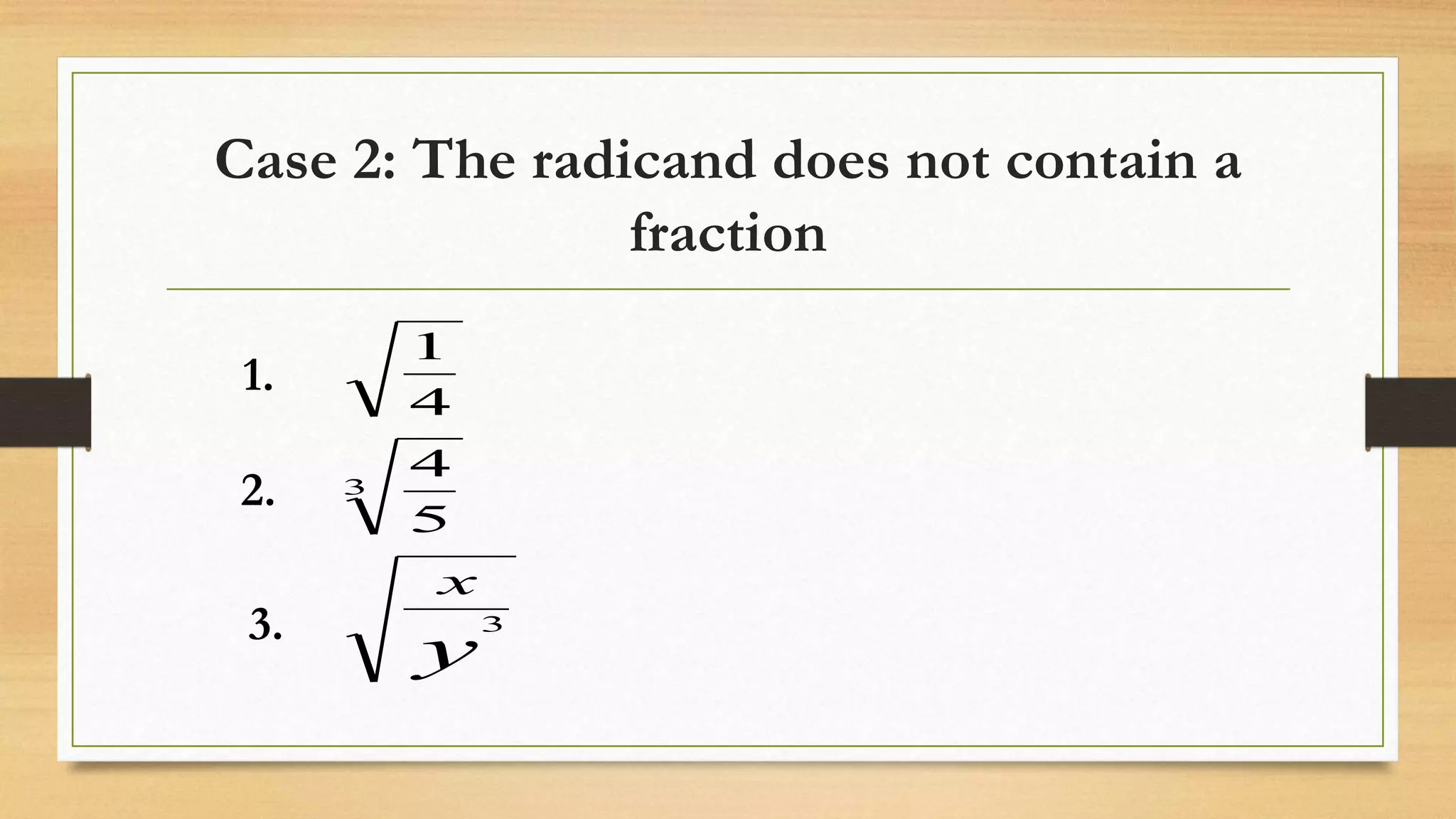
• Case 2: The radicand does not contain a fraction.

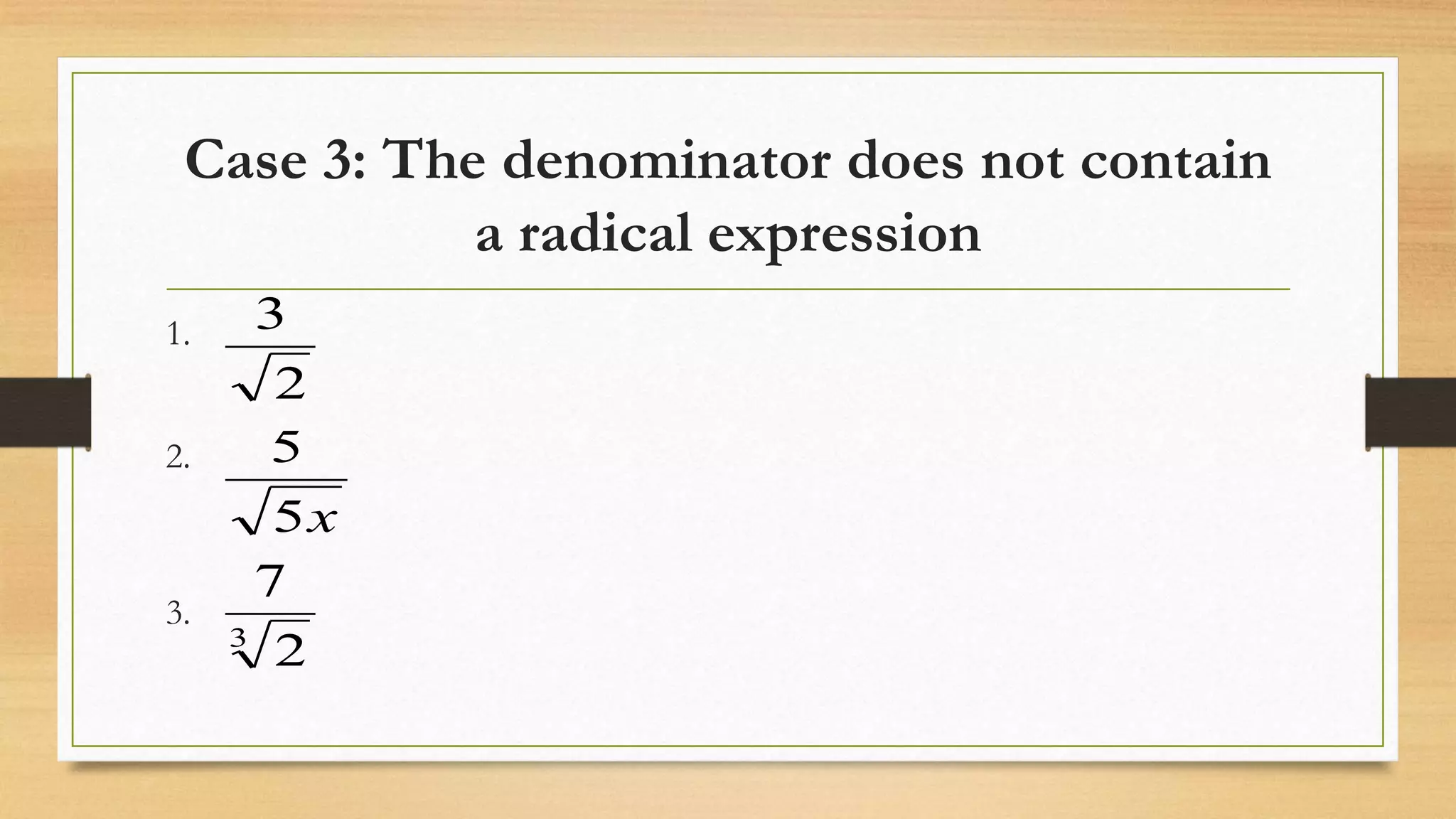
• Case 3: The denominator does not contain a radical expression.
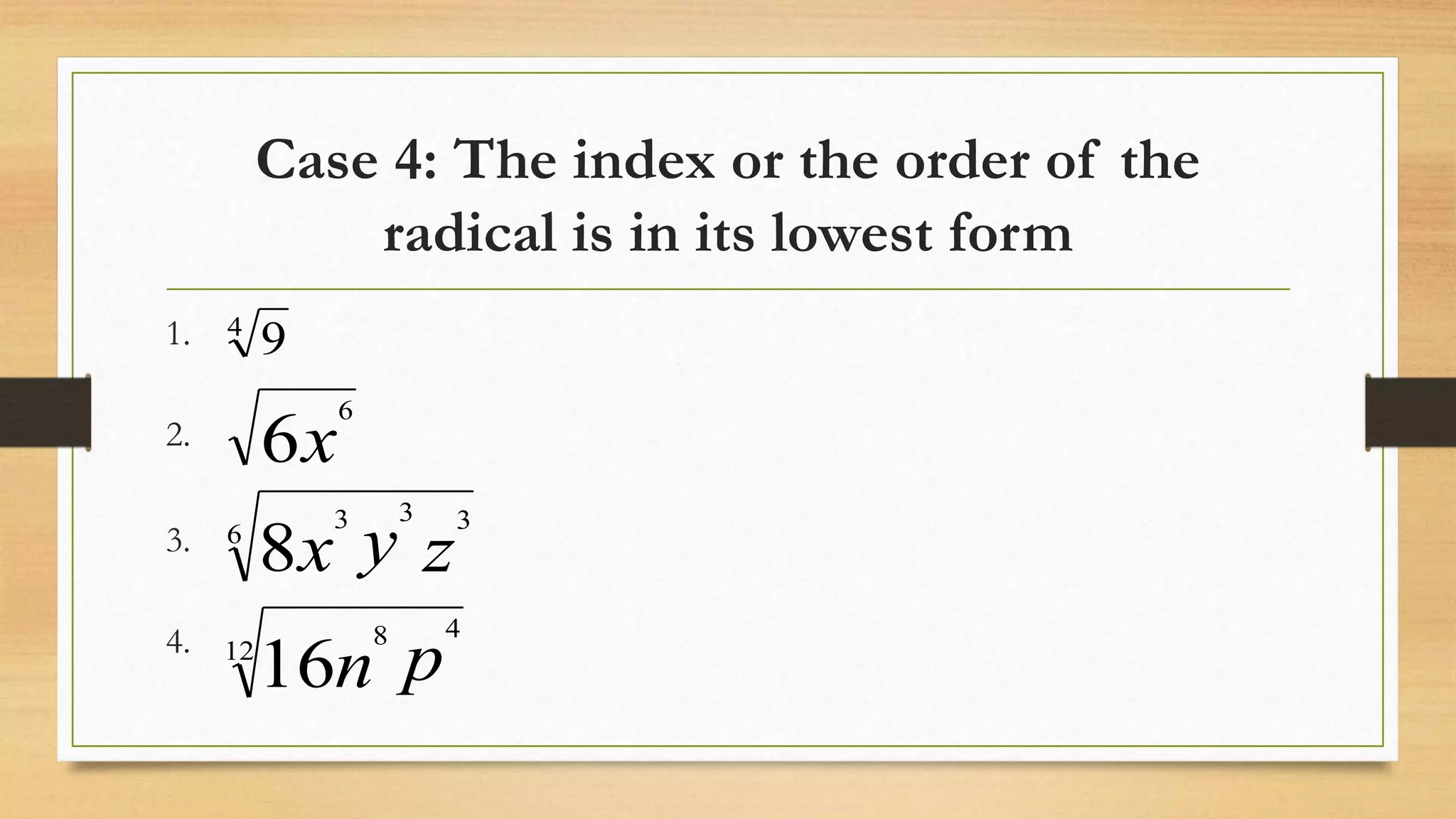
• Case 4: The index or the order of the radical is in its lowest form.
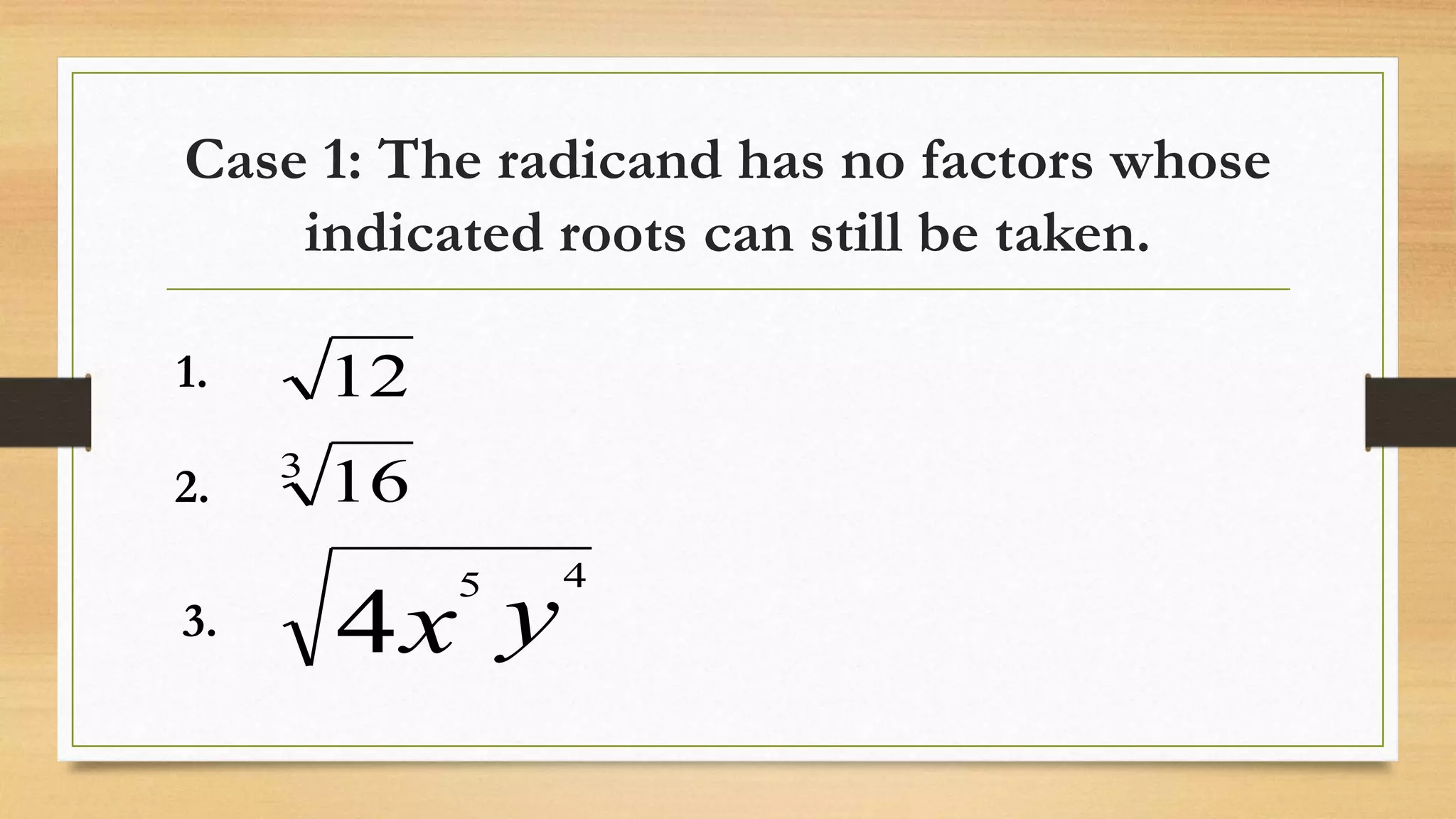
Case 1: The radicand has no factors whose
indicated roots can still be taken.
yx
45
3
4
16
121.
2.
3.
Case 2: The radicand does not contain a
fraction
y
x
3
3
5
4
4
1
1.
2.
3.
Case 3: The denominator does not contain
a radical expression
1.
2.
3.
3
2
7
5
5
2
3
x
Case 4: The index or the order of the
radical is in its lowest form
1.
2.
3.
4. 12
48
6
333
6
4
16
8
6
9
pn
zyx
x
Before Class Activity
In your Math Book
Page 7
Items 1-10
Operations of
Radicals
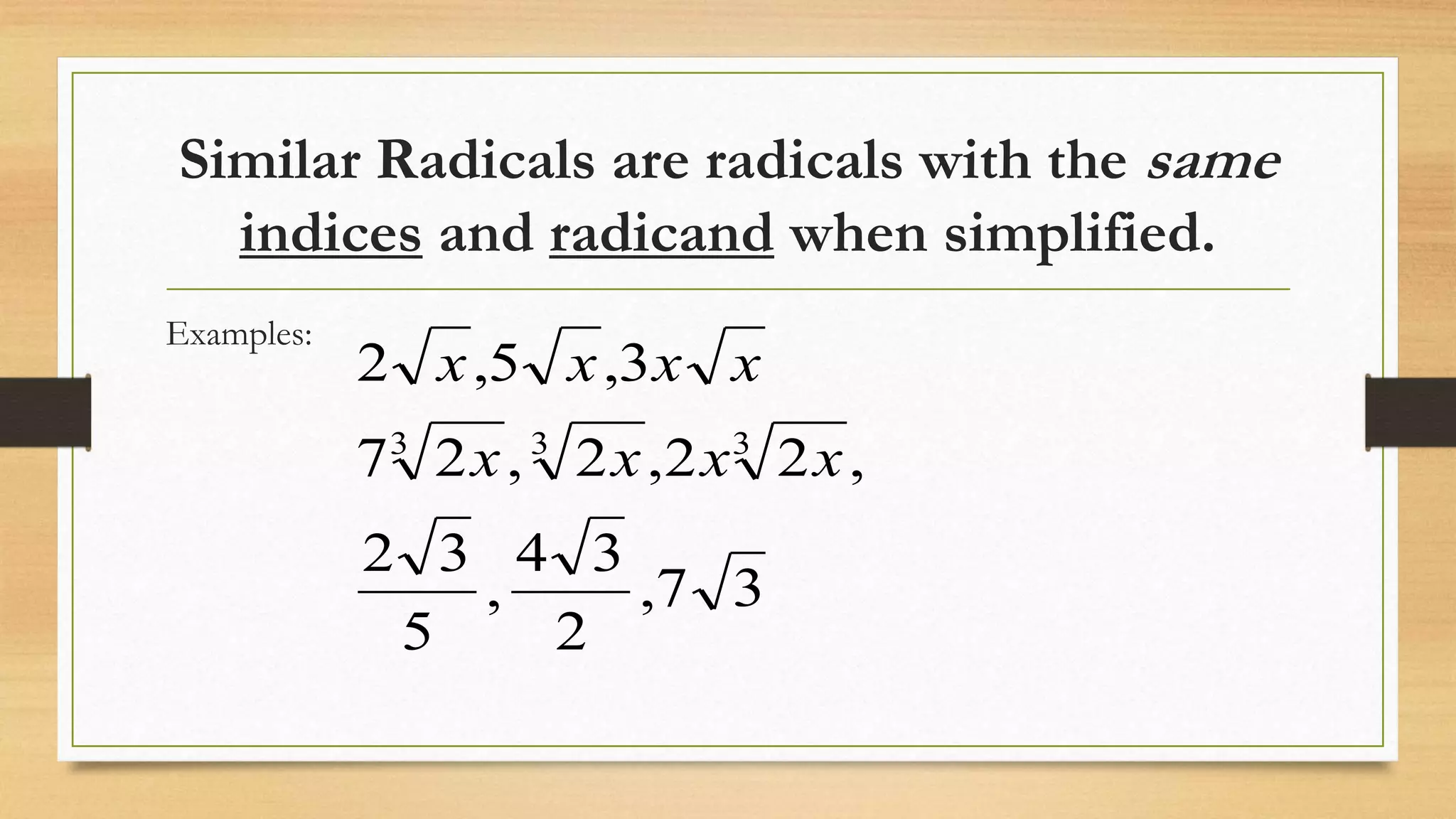
Similar Radicals are radicals with the same
indices and radicand when simplified.
Examples:
37,
2
34
,
5
32
,22,2,27
3,5,2
333
xxxx
xxxx
Multiplication of Radicals
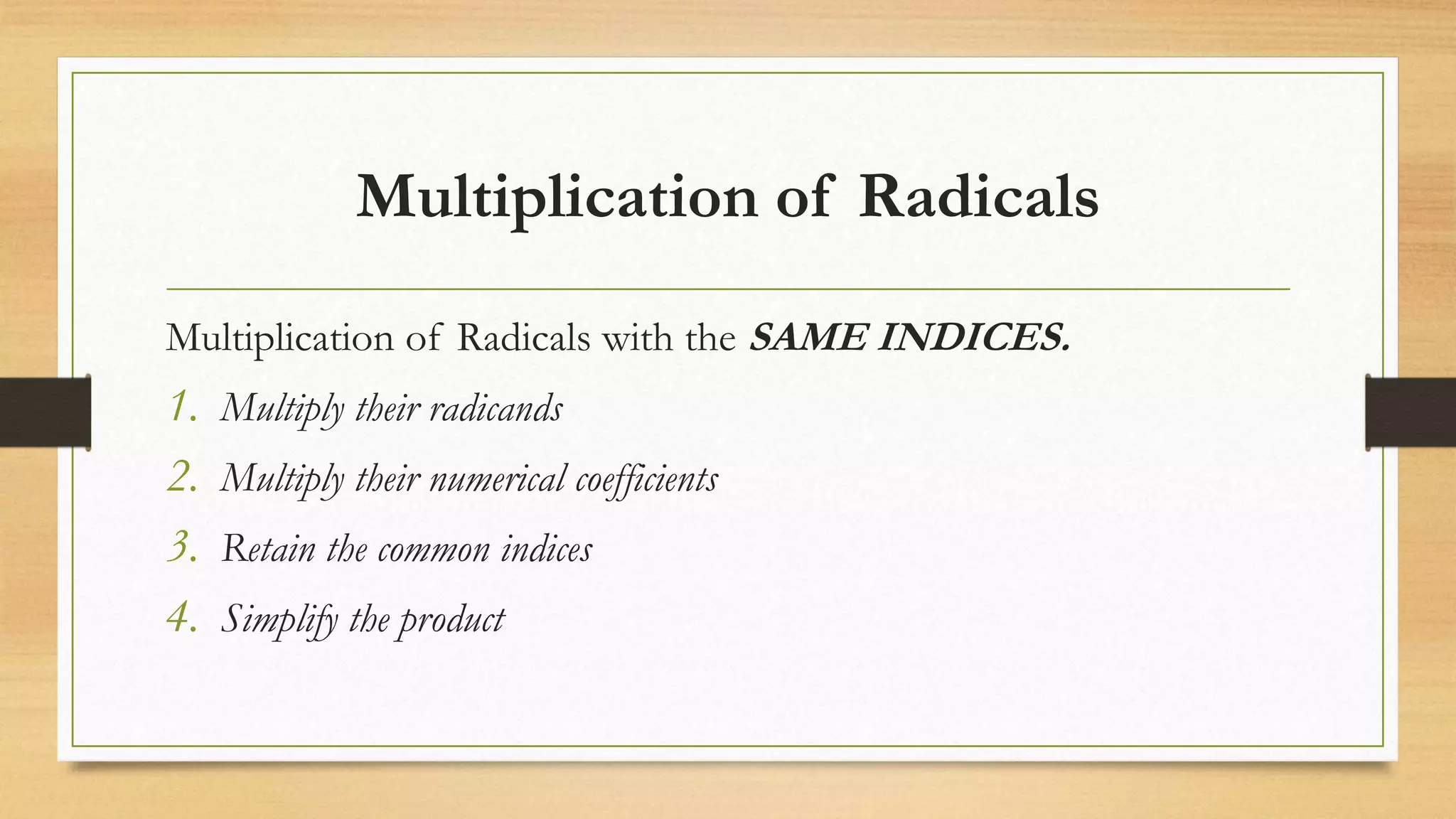
Multiplication of Radicals with the SAME INDICES.
1. Multiply their radicands
2. Multiply their numerical coefficients
3. Retain the common indices
4. Simplify the product
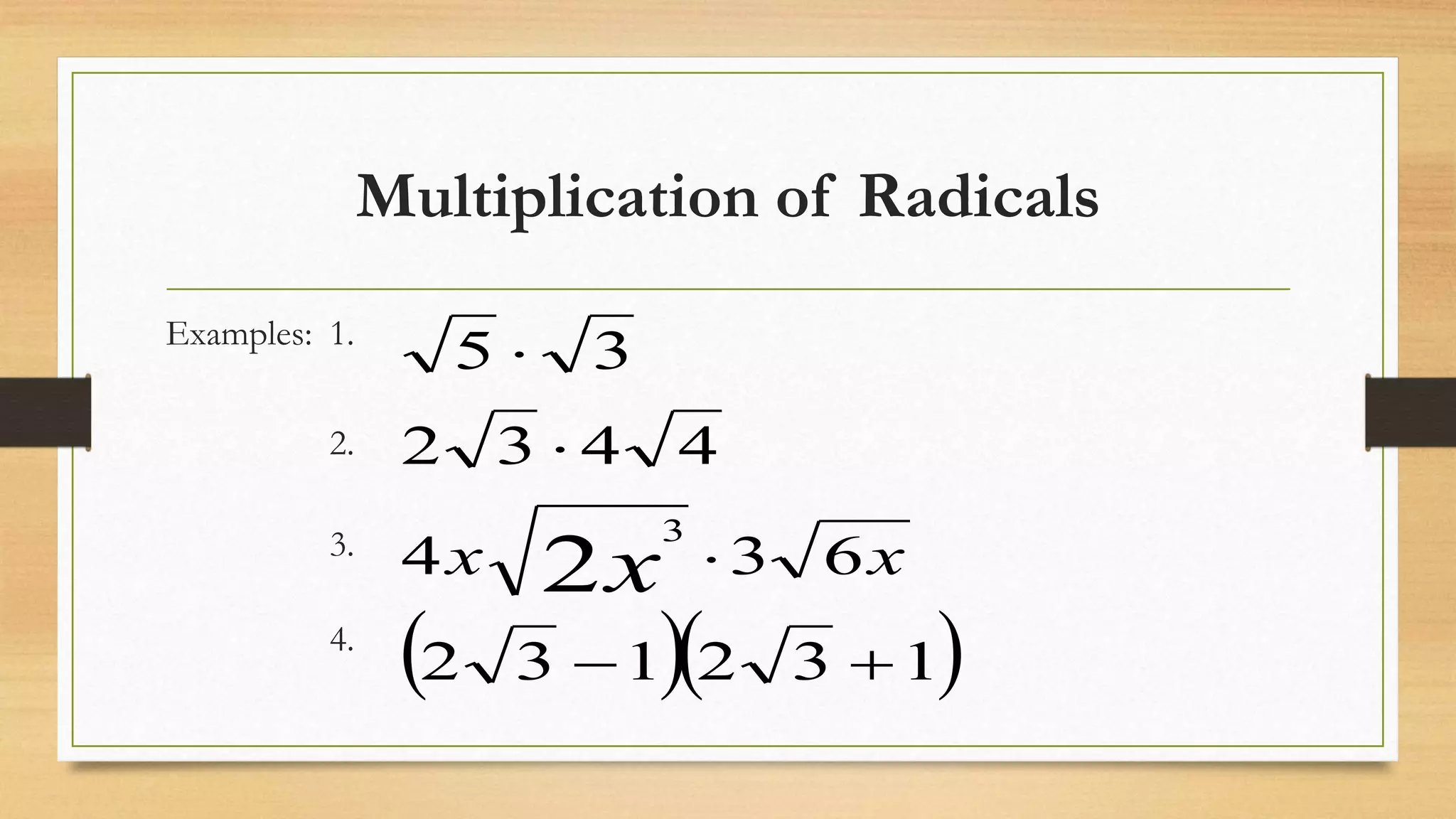
Multiplication of Radicals
Examples: 1.
2.
3.
4.
  132132
634
4432
35
2
3




xx x
Its Your Turn!
Warm-Up Practice
Activity A
Page 20
ODD Items Only
Multiplication of Radicals
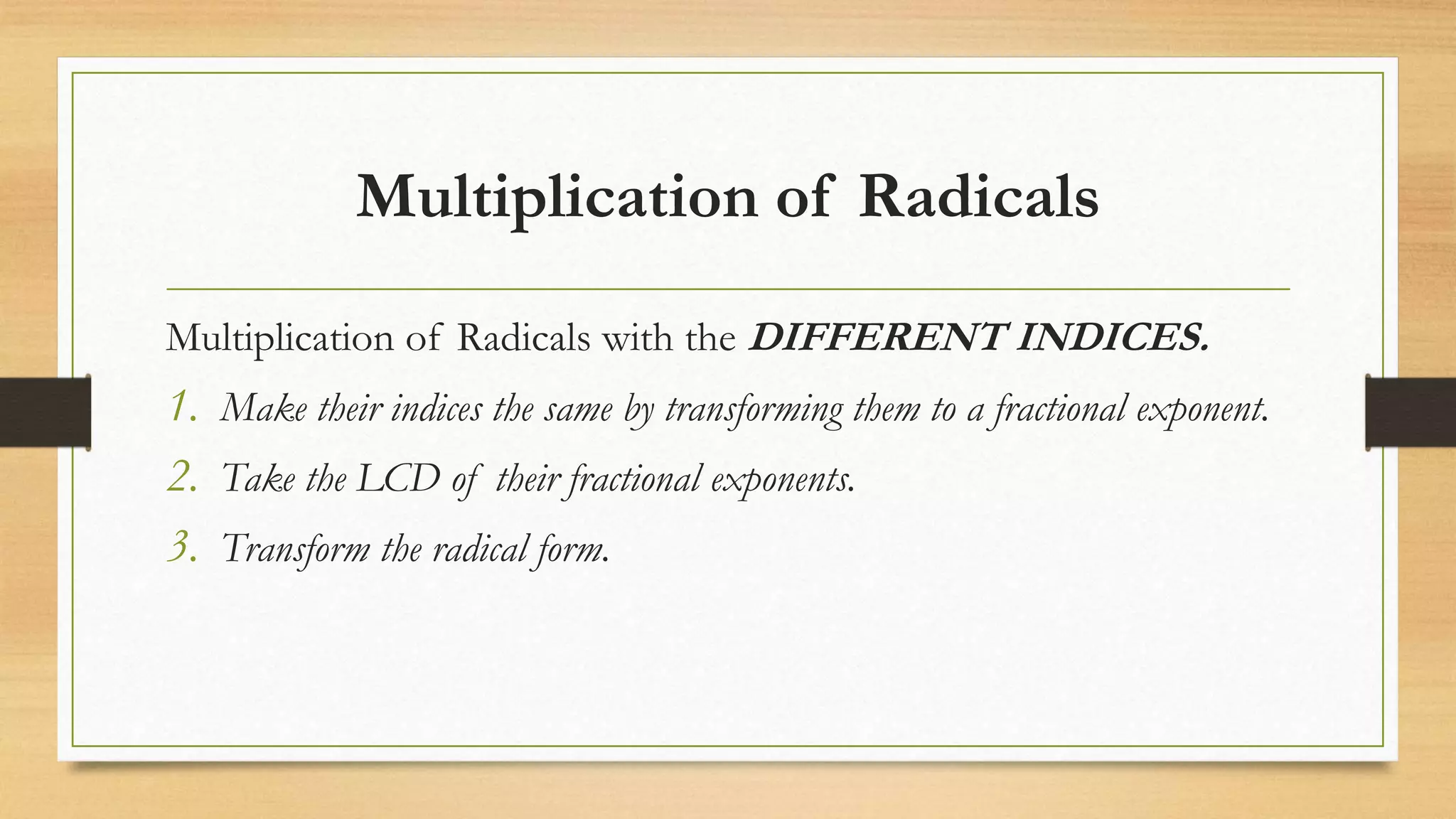
Multiplication of Radicals with the DIFFERENT INDICES.
1. Make their indices the same by transforming them to a fractional exponent.
2. Take the LCD of their fractional exponents.
3. Transform the radical form.
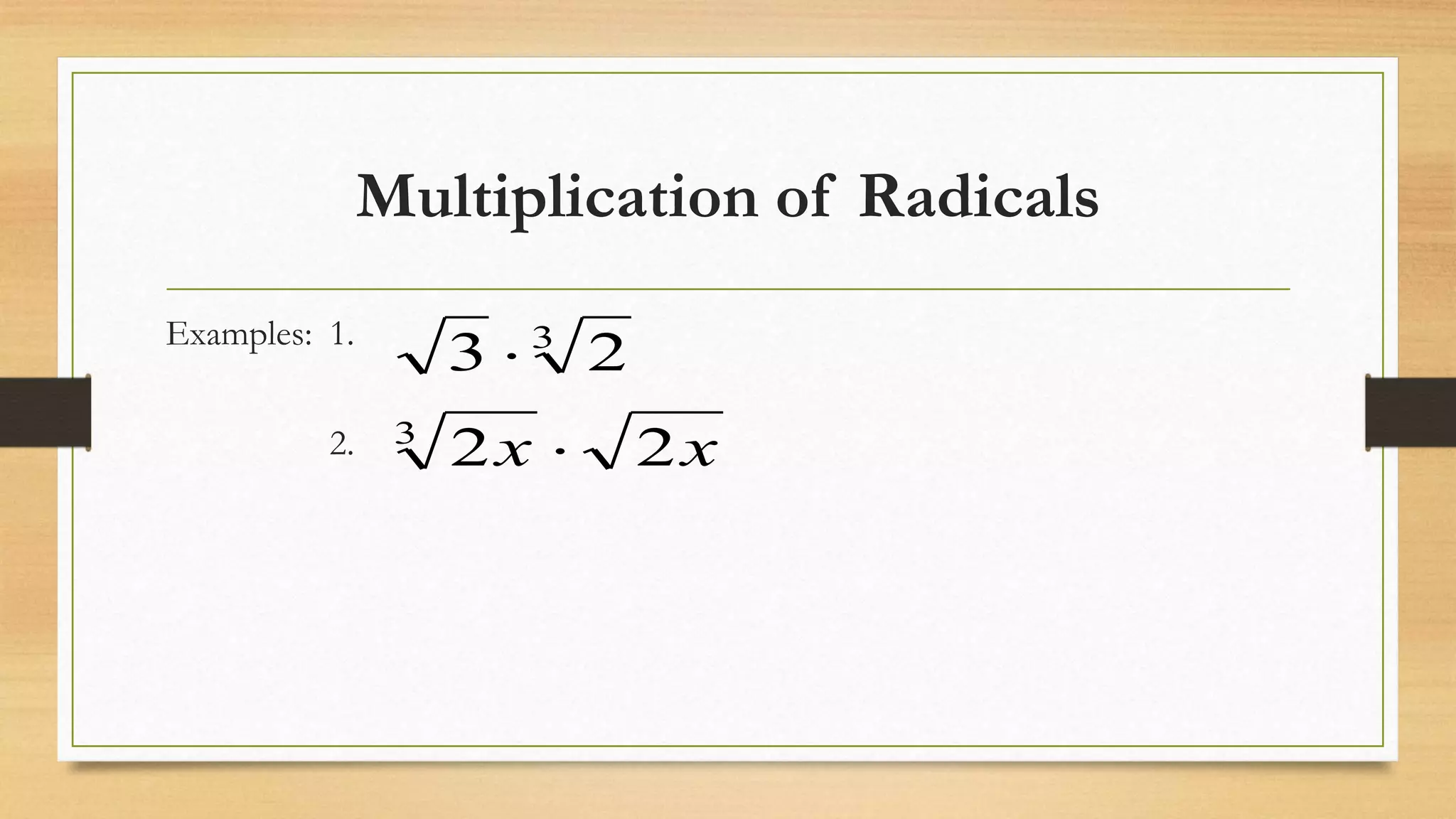
Multiplication of Radicals
Examples: 1.
2. xx 22
23
3
3


Addition and Subtraction of
Similar Radicals
Similar Radicals are radicals with the
same indices and radicand when
simplified.
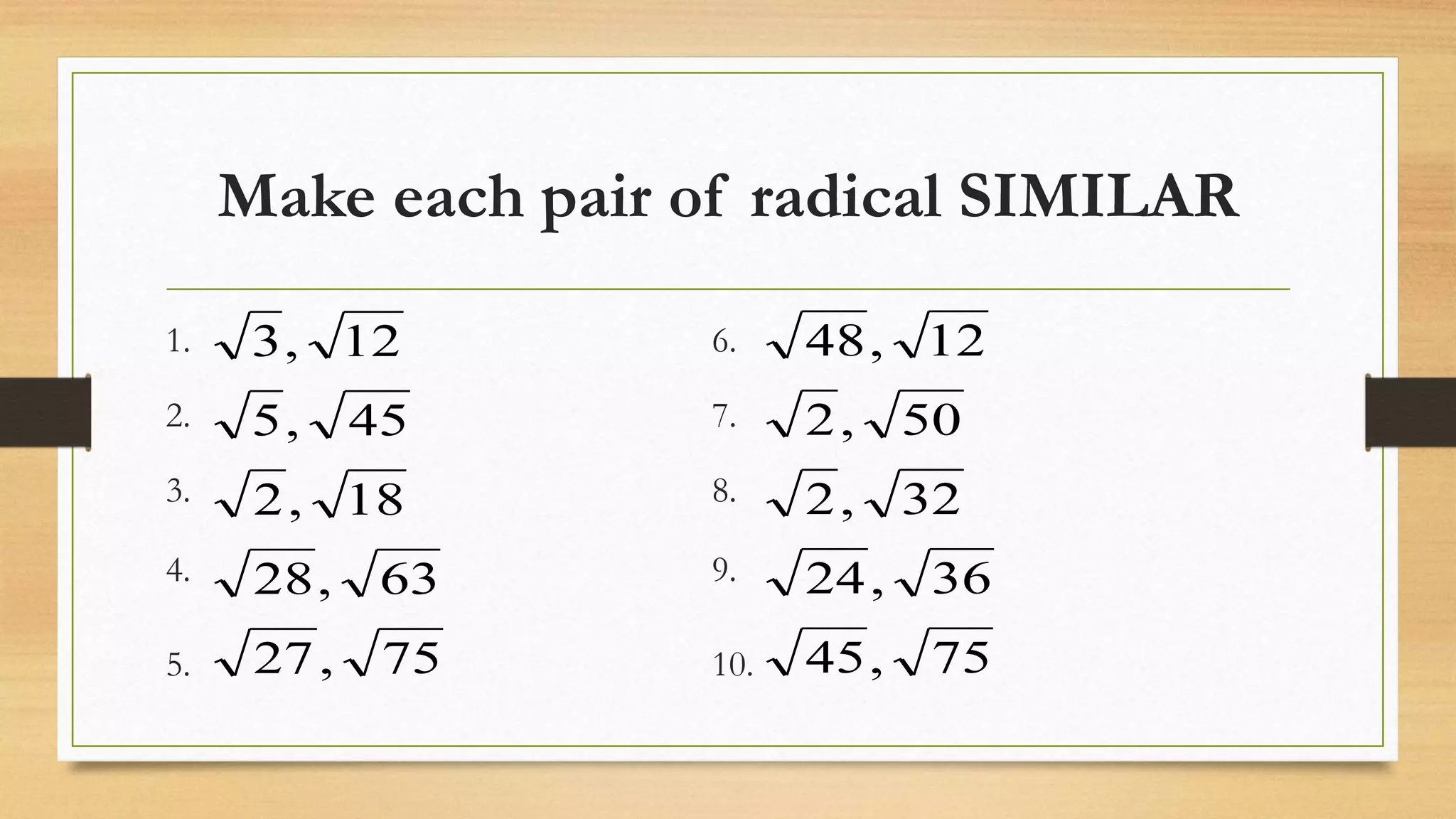
Make each pair of radical SIMILAR
75,27
63,28
18,2
45,5
12,31. 6.
2. 7.
3. 8.
4. 9.
5. 10. 75,45
36,24
32,2
50,2
12,48
Addition and Subtraction of
Similar Radicals
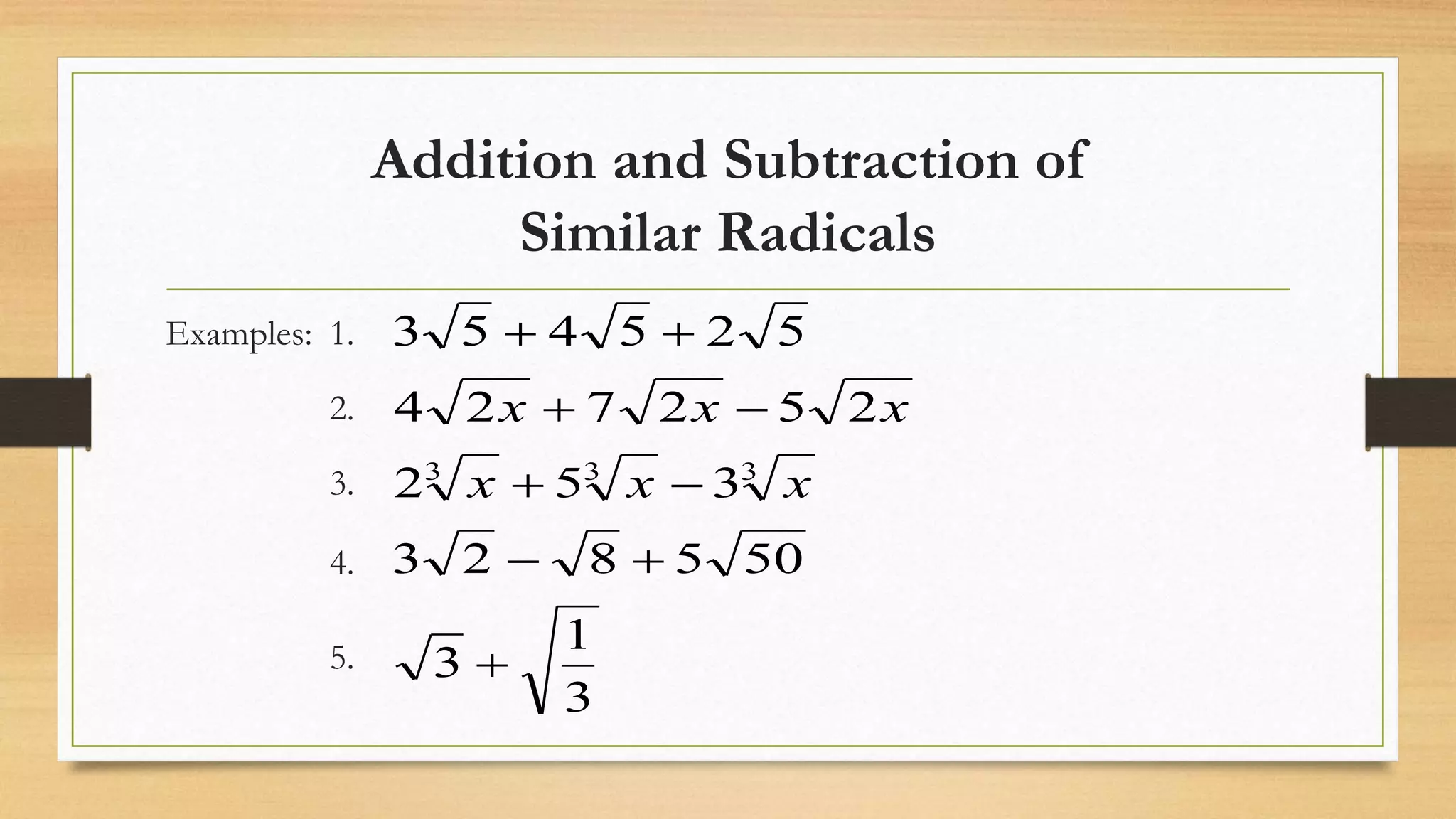
Examples: 1.
2.
3.
4.
5.
3
1
3
505823
352
252724
525453
333





xxx
xxx
Its Your Turn!
Warm-Up Practice
Activity A
Page 13
Items 1-7
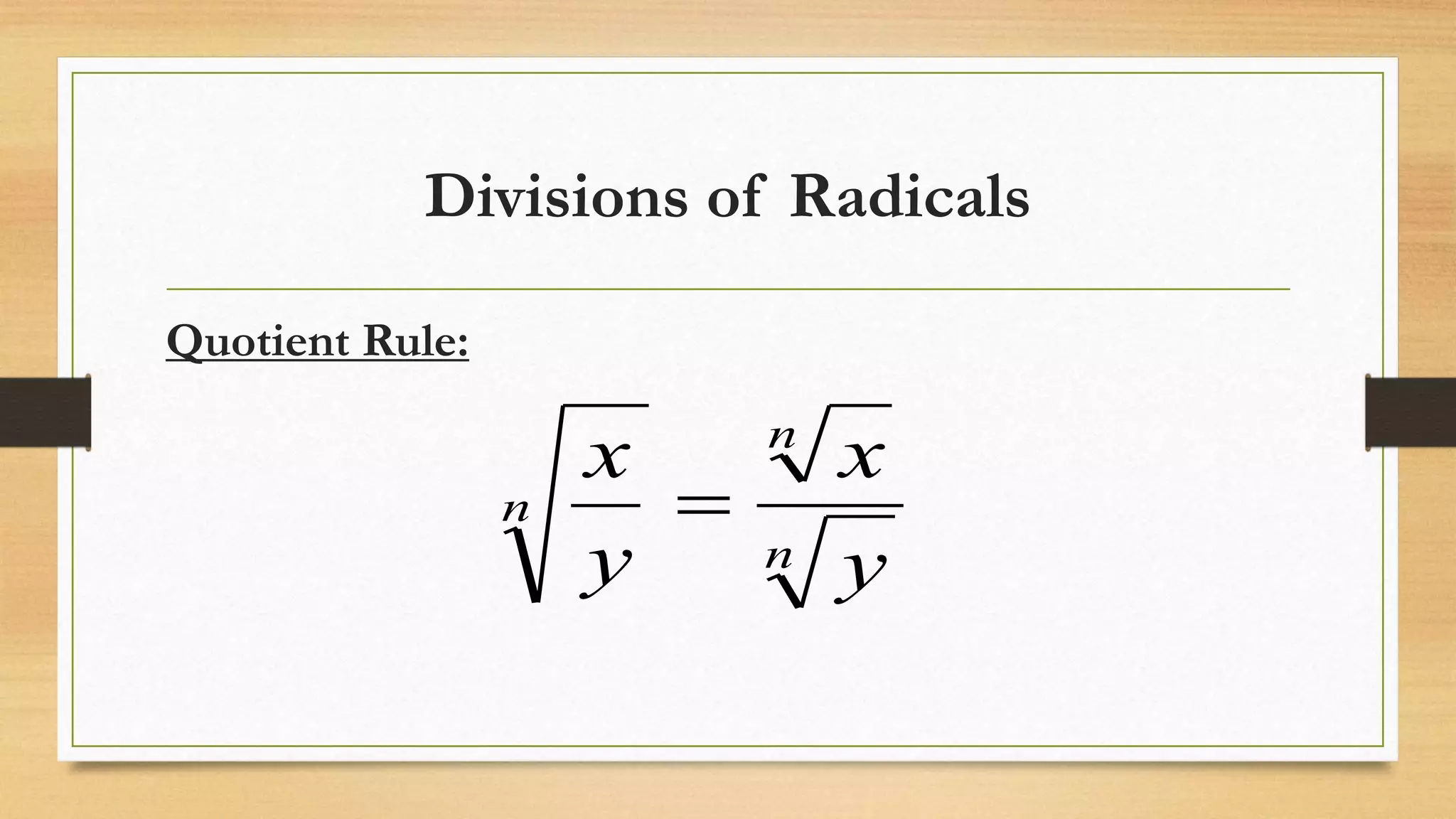
Divisions of Radicals
Quotient Rule:
n
n
n
y
x
y
x

Divisions of Radicals
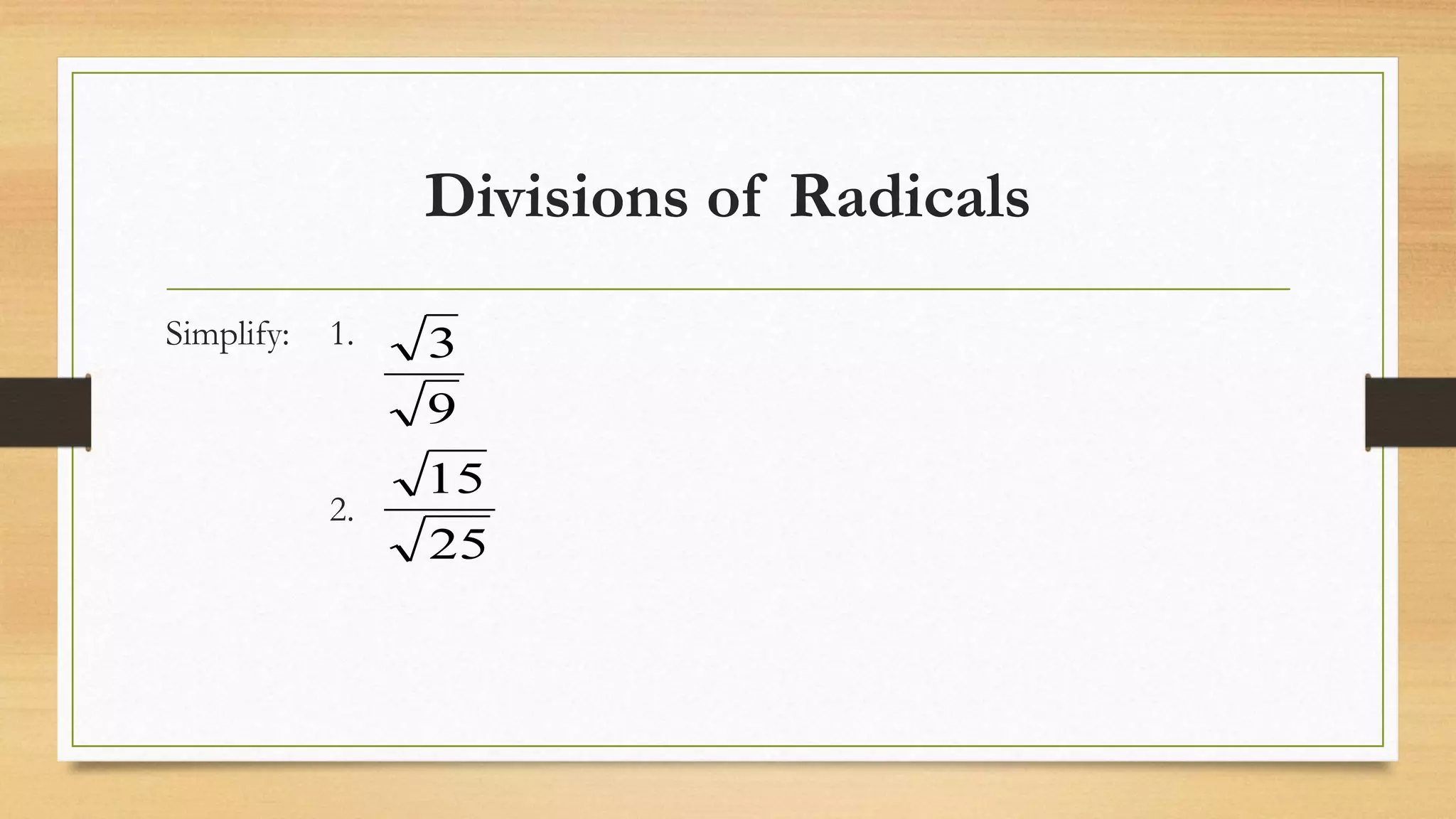
Simplify: 1.
2.
25
15
9
3
Divisions of Radicals
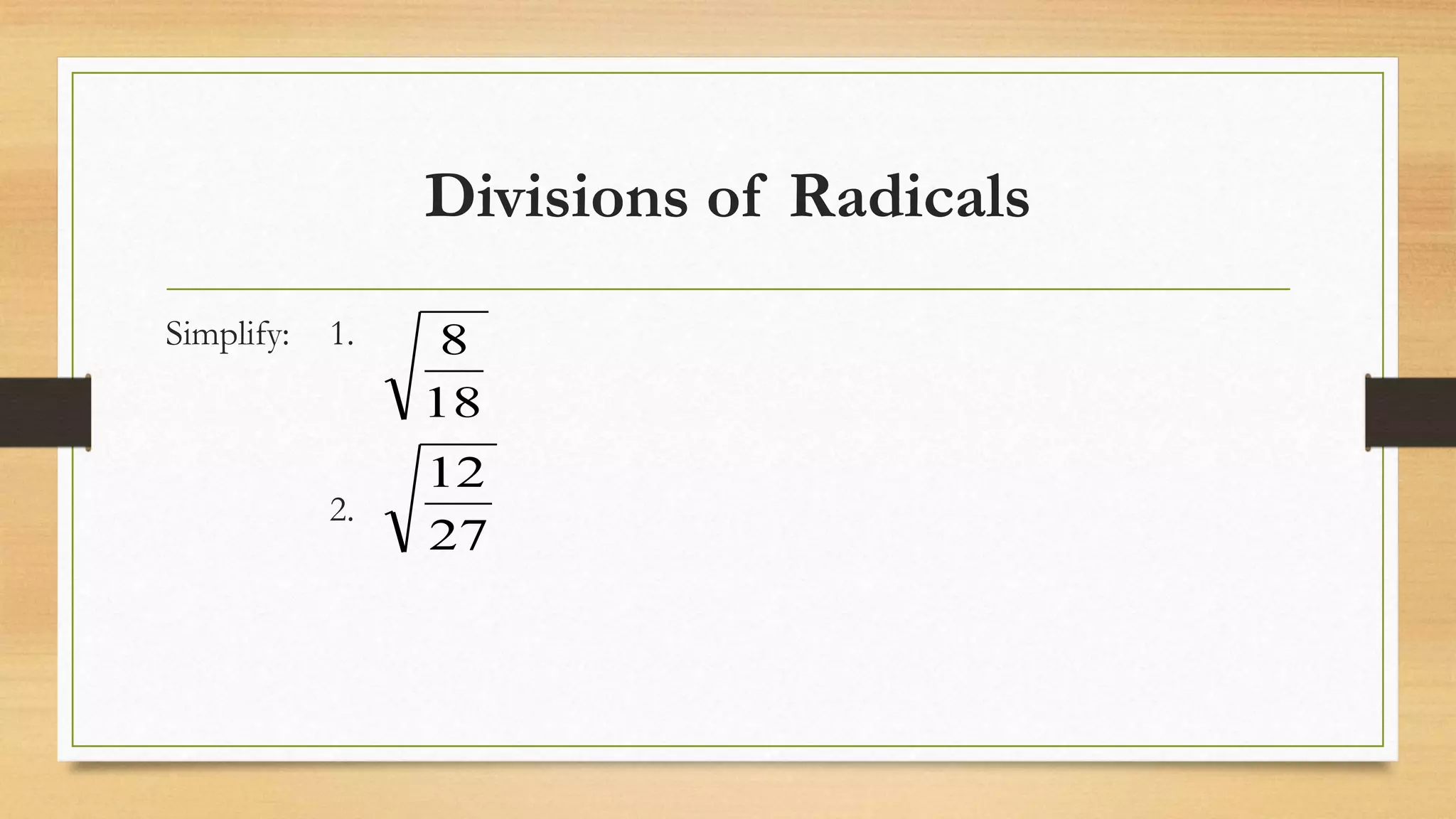
Simplify: 1.
2.
27
12
18
8
Divisions of Radicals
Simplify: 1.
2.
3.
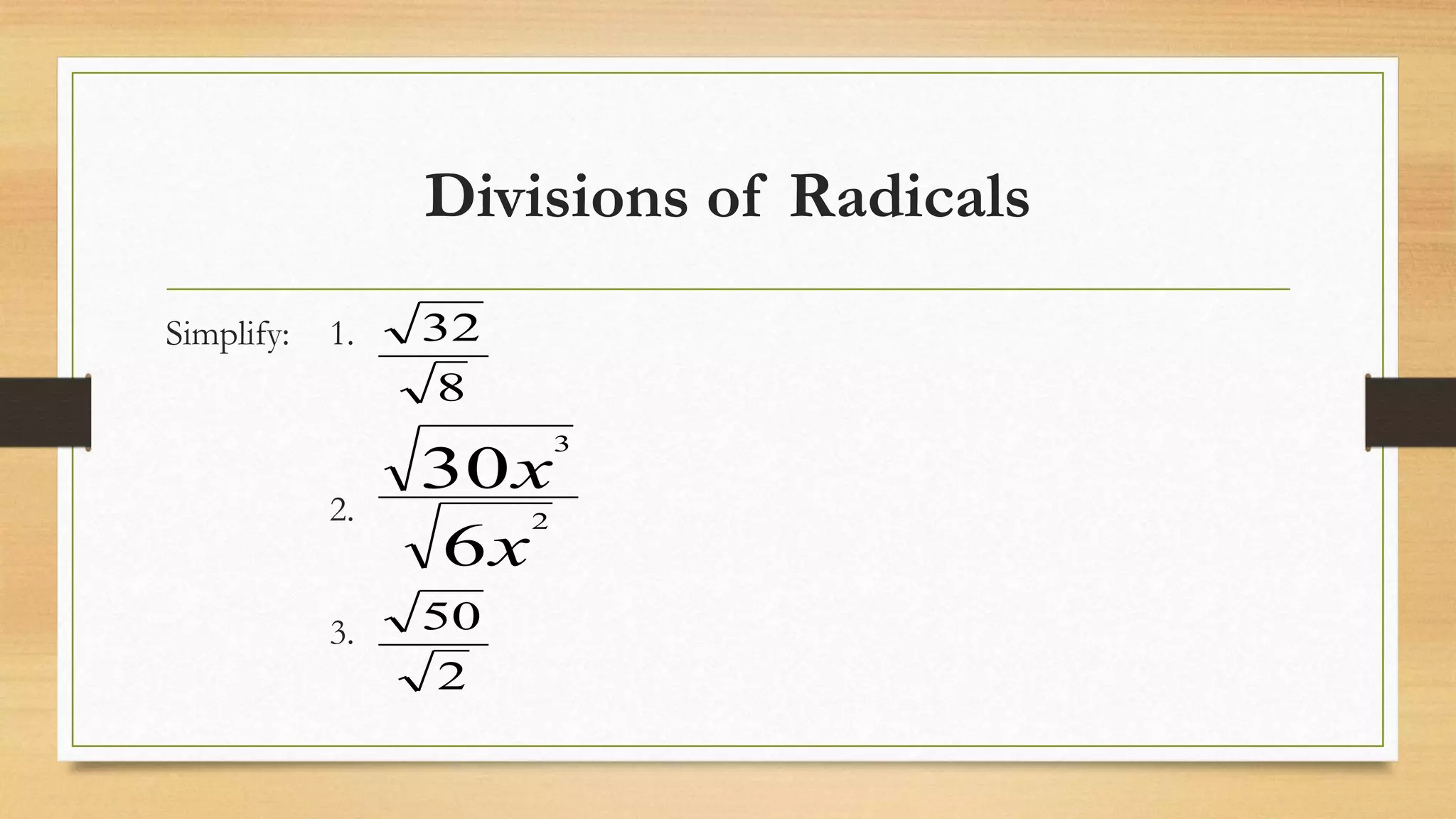
2
50
8
32
6
30
2
3
x
x
Rationalizing the Denominator
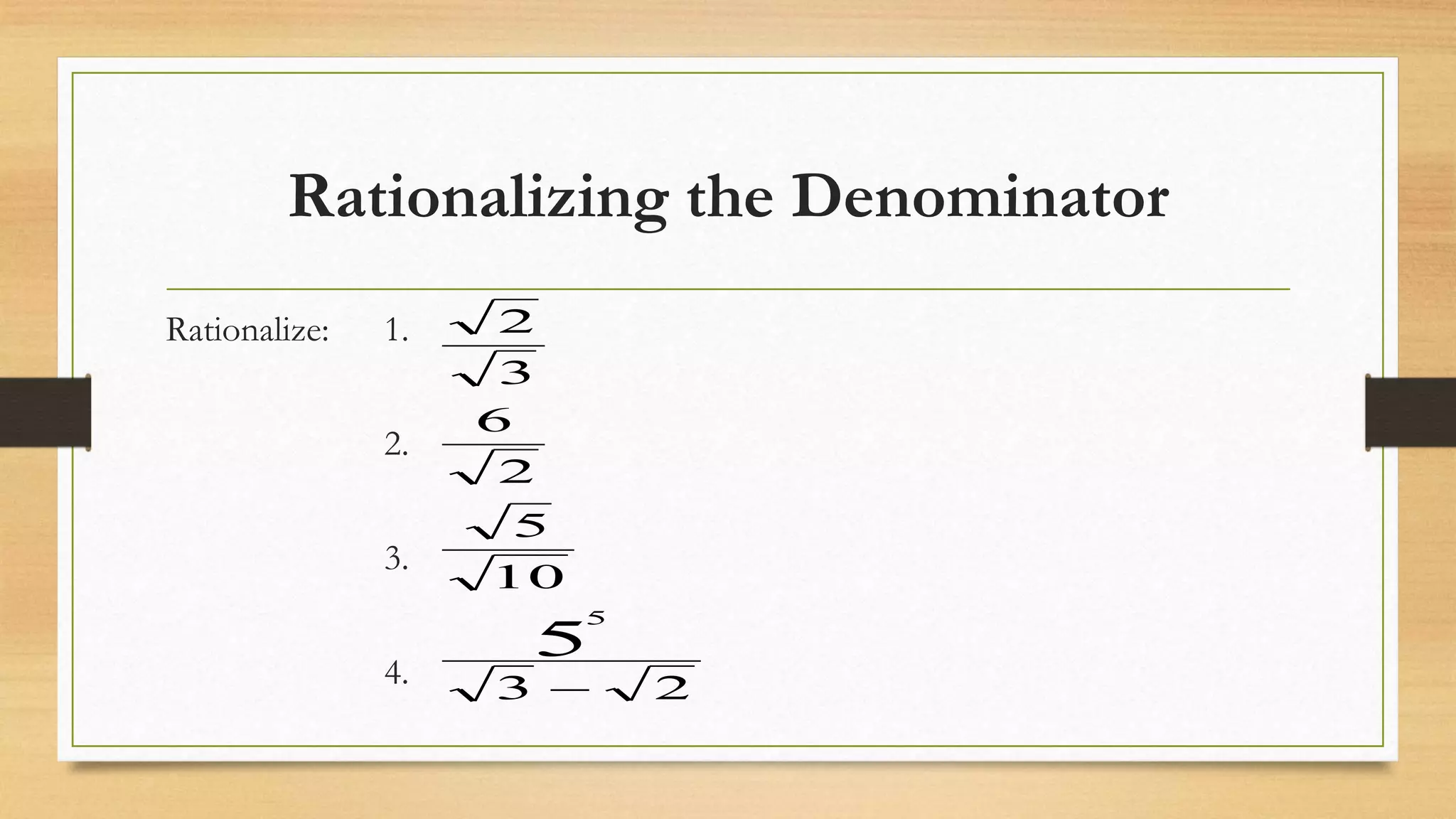
Rationalize: 1.
2.
3.
4. 23
10
5
2
6
3
2
5
5

Its Your Turn!
Warm-Up Practice
Activity B
Page 27
Items 1-8
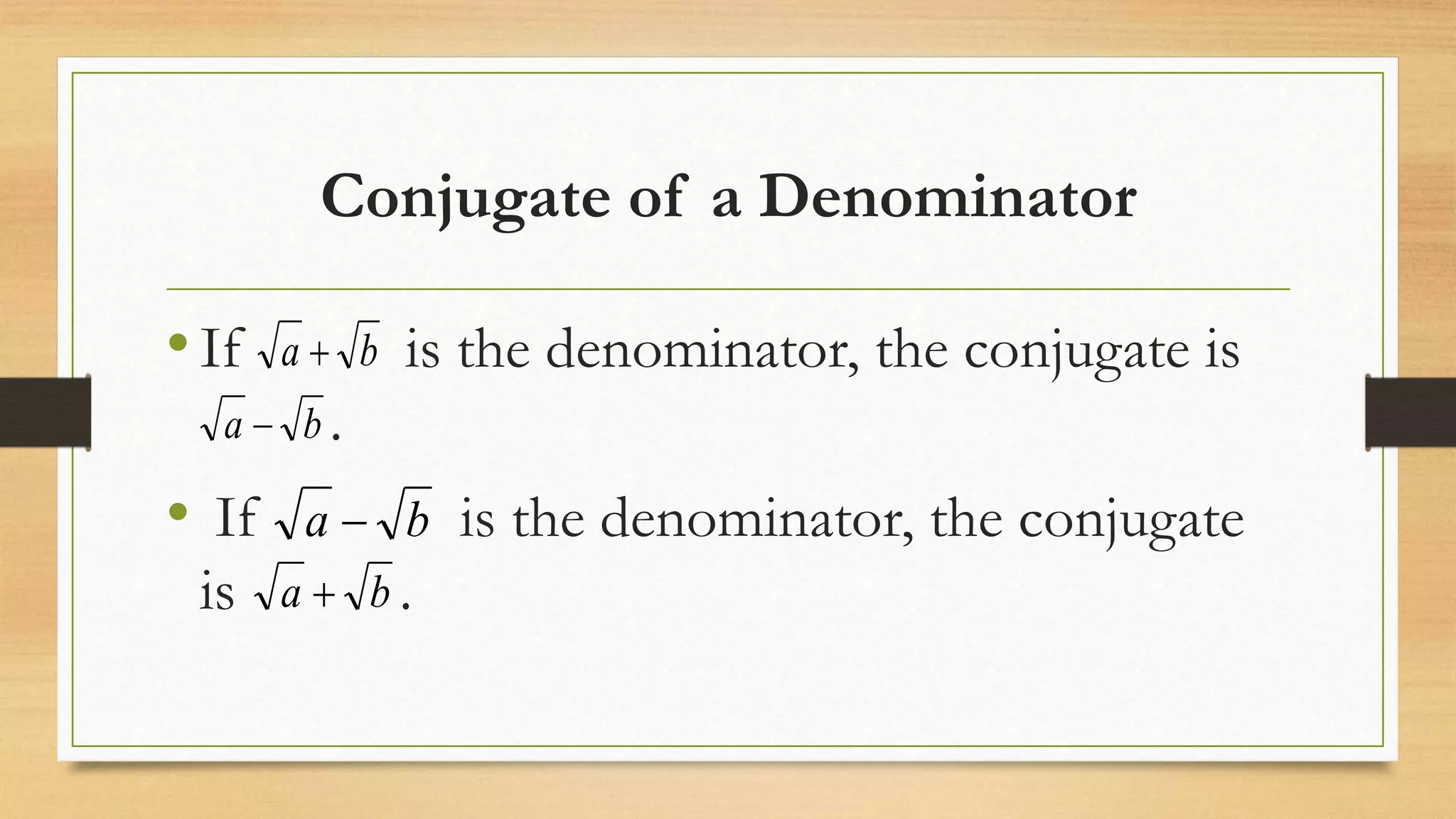
Conjugate of a Denominator
•If is the denominator, the conjugate is
.
• If is the denominator, the conjugate
is .
ba 
ba 
ba 
ba 
Give the conjugate of each expression:
1.
2.
3. 12
35
13
3



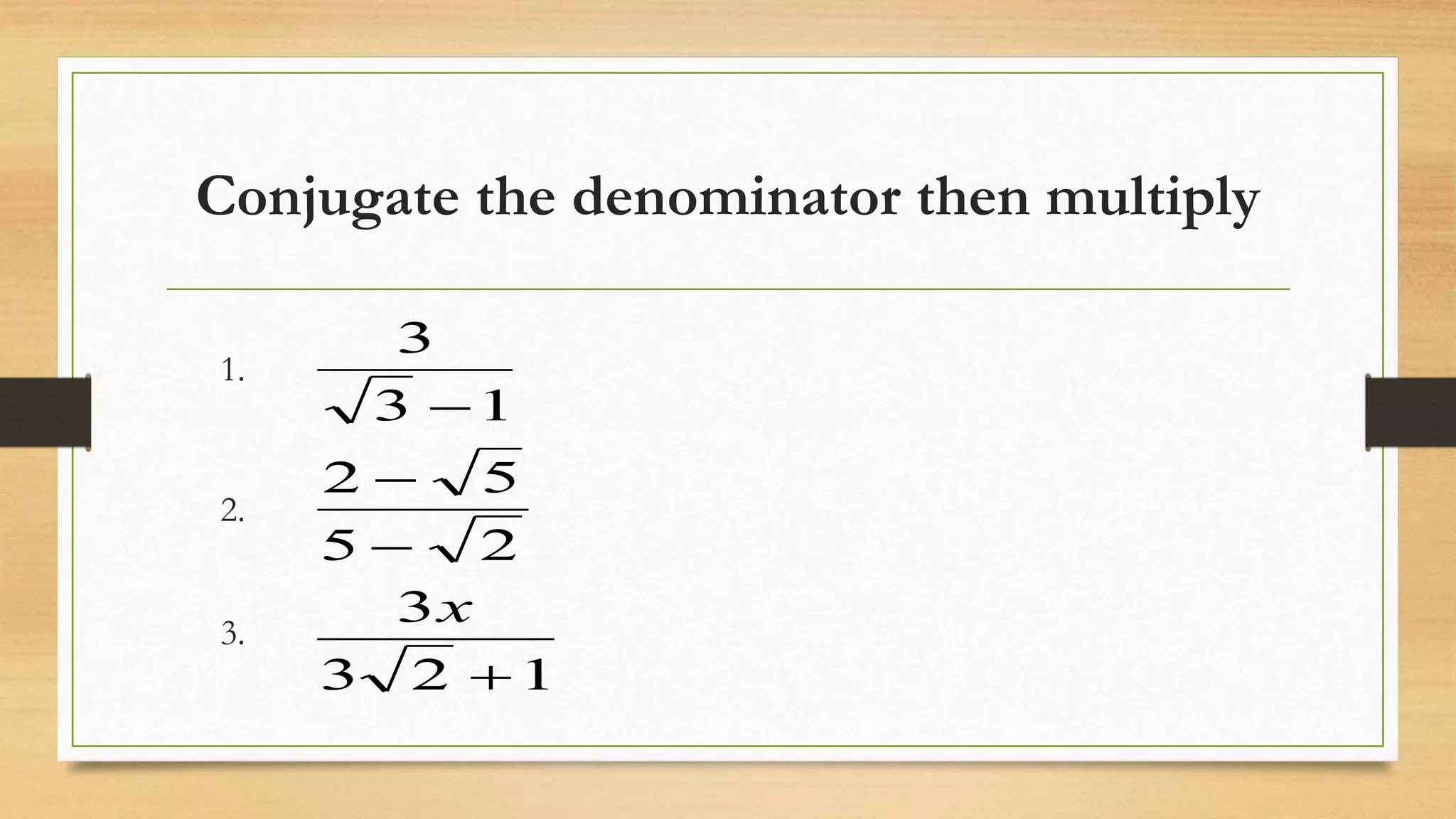
Conjugate the denominator then multiply
1.
2.
3.
123
3
25
52
13
3




x
Its Your Turn!
Warm-Up Practice
Activity C
Page 27
Items 1-6

1 lesson 1 4