1
Math/CSE 1019C:
Discrete Mathematics for Computer Science
Fall 2011
Suprakash Datta
datta@cse.yorku.ca
Office: CSEB 3043
Phone: 416-736-2100 ext 77875
Course page: http://www.cse.yorku.ca/course/1019
2
Administrivia
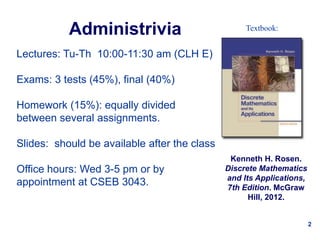
Kenneth H. Rosen.
Discrete Mathematics
and Its Applications,
7th Edition. McGraw
Hill, 2012.
Lectures: Tu-Th 10:00-11:30 am (CLH E)
Exams: 3 tests (45%), final (40%)
Homework (15%): equally divided
between several assignments.
Slides: should be available after the class
Office hours: Wed 3-5 pm or by
appointment at CSEB 3043.
Textbook:
3
Administrivia – contd.
• Cheating will not be tolerated. Visit the
class webpage for more details on
policies.
• TA: Tutorials/office hours TBA.
• HW submitted late will not be graded.
4
Course objectives
We will focus on two major goals:
• Basic tools and techniques in discrete
mathematics
– Propositional logic
– Set Theory
– Simple algorithms
– Induction, recursion
– Counting techniques (Combinatorics)
• Precise and rigorous mathematical reasoning
– Writing proofs
5
To do well you should:
• Study with pen and paper
• Ask for help immediately
• Practice, practice, practice…
• Follow along in class rather than take notes
• Ask questions in class
• Keep up with the class
• Read the book, not just the slides
6
Reasoning about problems
• 0.999999999999999….=1?
• There exists integers a,b,c that satisfy
the equation a2+b2 = c2
• The program below that I wrote works
correctly for all possible inputs…..
• The program that I wrote never hangs
(i.e. always terminates)…
7
Tools for reasoning: Logic
Ch. 1: Introduction to Propositional Logic
• Truth values, truth tables
• Boolean logic:   
• Implications:  
8
Why study propositional logic?
• A formal mathematical “language” for
precise reasoning.
• Start with propositions.
• Add other constructs like negation,
conjunction, disjunction, implication etc.
• All of these are based on ideas we use
daily to reason about things.
9
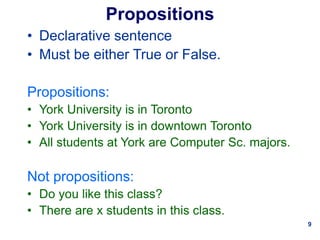
Propositions
• Declarative sentence
• Must be either True or False.
Propositions:
• York University is in Toronto
• York University is in downtown Toronto
• All students at York are Computer Sc. majors.
Not propositions:
• Do you like this class?
• There are x students in this class.
10
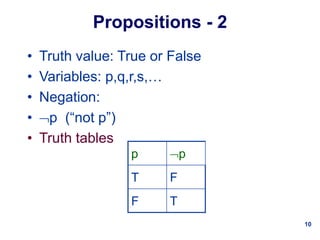
Propositions - 2
• Truth value: True or False
• Variables: p,q,r,s,…
• Negation:
• p (“not p”)
• Truth tables
p p
T F
F T
11
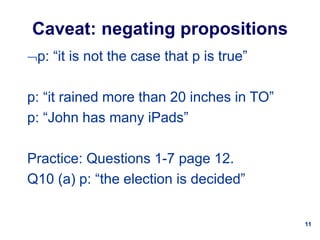
Caveat: negating propositions
p: “it is not the case that p is true”
p: “it rained more than 20 inches in TO”
p: “John has many iPads”
Practice: Questions 1-7 page 12.
Q10 (a) p: “the election is decided”
12
Conjunction, Disjunction
• Conjunction: p  q [“and”]
• Disjunction: p  q [“or”]
p q p  q p  q
T T T T
T F F T
F T F T
F F F F
13
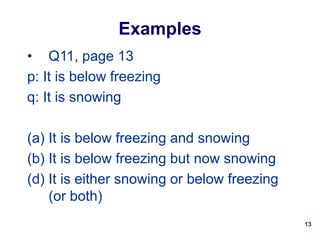
Examples
• Q11, page 13
p: It is below freezing
q: It is snowing
(a) It is below freezing and snowing
(b) It is below freezing but now snowing
(d) It is either snowing or below freezing
(or both)
14
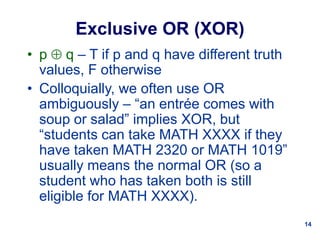
Exclusive OR (XOR)
• p  q – T if p and q have different truth
values, F otherwise
• Colloquially, we often use OR
ambiguously – “an entrée comes with
soup or salad” implies XOR, but
“students can take MATH XXXX if they
have taken MATH 2320 or MATH 1019”
usually means the normal OR (so a
student who has taken both is still
eligible for MATH XXXX).
15
Conditional
• p  q [“if p then q”]
• p: hypothesis, q: conclusion
• E.g.: “If you turn in a homework late, it will not
be graded”; “If you get 100% in this course,
you will get an A+”.
• TRICKY: Is p  q TRUE if p is FALSE?
YES!!
• Think of “If you get 100% in this course, you
will get an A+” as a promise – is the promise
violated if someone gets 50% and does not
receive an A+?
16
Conditional - 2
• p  q [“if p then q”]
• Truth table:
p q p  q  p  q
T T T T
T F F F
F T T T
F F T T
Note the truth table of  p  q
17
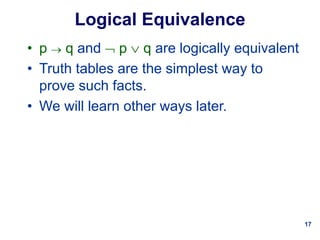
Logical Equivalence
• p  q and  p  q are logically equivalent
• Truth tables are the simplest way to
prove such facts.
• We will learn other ways later.
18
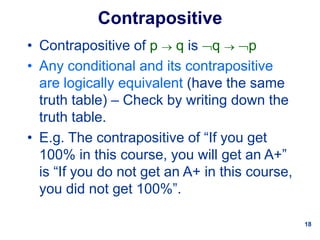
Contrapositive
• Contrapositive of p  q is q  p
• Any conditional and its contrapositive
are logically equivalent (have the same
truth table) – Check by writing down the
truth table.
• E.g. The contrapositive of “If you get
100% in this course, you will get an A+”
is “If you do not get an A+ in this course,
you did not get 100%”.
19
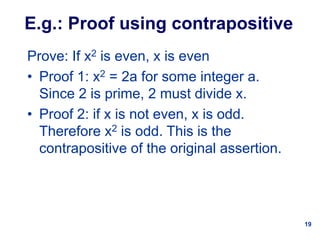
E.g.: Proof using contrapositive
Prove: If x2 is even, x is even
• Proof 1: x2 = 2a for some integer a.
Since 2 is prime, 2 must divide x.
• Proof 2: if x is not even, x is odd.
Therefore x2 is odd. This is the
contrapositive of the original assertion.
20
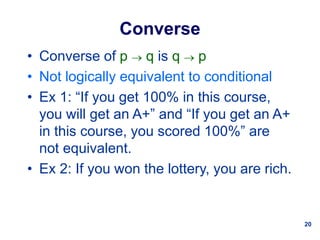
Converse
• Converse of p  q is q  p
• Not logically equivalent to conditional
• Ex 1: “If you get 100% in this course,
you will get an A+” and “If you get an A+
in this course, you scored 100%” are
not equivalent.
• Ex 2: If you won the lottery, you are rich.
21
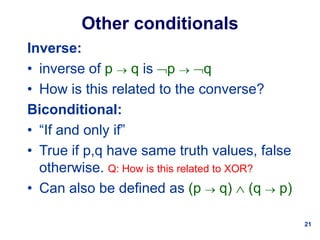
Other conditionals
Inverse:
• inverse of p  q is p  q
• How is this related to the converse?
Biconditional:
• “If and only if”
• True if p,q have same truth values, false
otherwise. Q: How is this related to XOR?
• Can also be defined as (p  q)  (q  p)
22
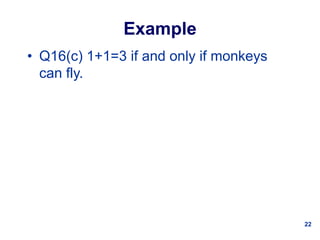
Example
• Q16(c) 1+1=3 if and only if monkeys
can fly.
23
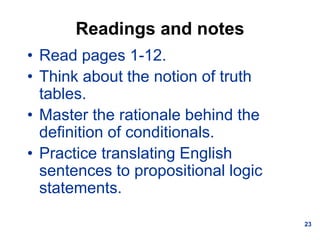
Readings and notes
• Read pages 1-12.
• Think about the notion of truth
tables.
• Master the rationale behind the
definition of conditionals.
• Practice translating English
sentences to propositional logic
statements.
24
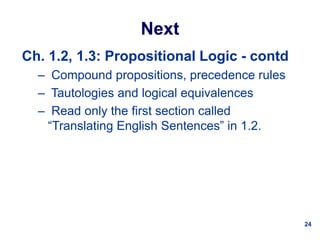
Next
Ch. 1.2, 1.3: Propositional Logic - contd
– Compound propositions, precedence rules
– Tautologies and logical equivalences
– Read only the first section called
“Translating English Sentences” in 1.2.
25
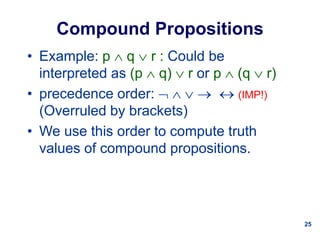
Compound Propositions
• Example: p  q  r : Could be
interpreted as (p  q)  r or p  (q  r)
• precedence order:      (IMP!)
(Overruled by brackets)
• We use this order to compute truth
values of compound propositions.
26
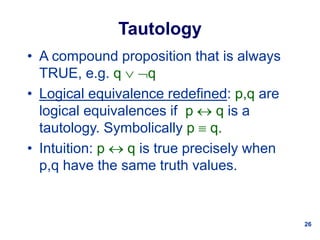
Tautology
• A compound proposition that is always
TRUE, e.g. q  q
• Logical equivalence redefined: p,q are
logical equivalences if p  q is a
tautology. Symbolically p  q.
• Intuition: p  q is true precisely when
p,q have the same truth values.
27
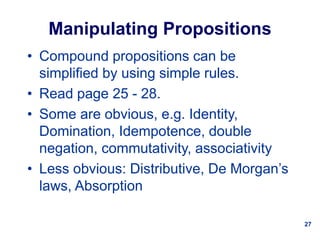
Manipulating Propositions
• Compound propositions can be
simplified by using simple rules.
• Read page 25 - 28.
• Some are obvious, e.g. Identity,
Domination, Idempotence, double
negation, commutativity, associativity
• Less obvious: Distributive, De Morgan’s
laws, Absorption
28
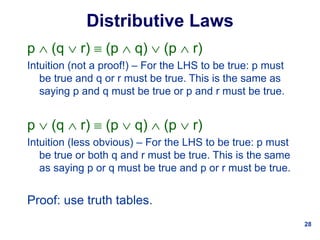
Distributive Laws
p  (q  r)  (p  q)  (p  r)
Intuition (not a proof!) – For the LHS to be true: p must
be true and q or r must be true. This is the same as
saying p and q must be true or p and r must be true.
p  (q  r)  (p  q)  (p  r)
Intuition (less obvious) – For the LHS to be true: p must
be true or both q and r must be true. This is the same
as saying p or q must be true and p or r must be true.
Proof: use truth tables.
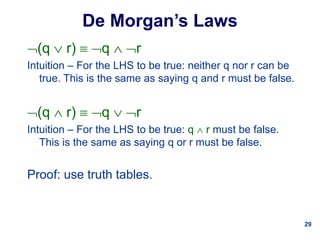
29
De Morgan’s Laws
(q  r)  q  r
Intuition – For the LHS to be true: neither q nor r can be
true. This is the same as saying q and r must be false.
(q  r)  q  r
Intuition – For the LHS to be true: q  r must be false.
This is the same as saying q or r must be false.
Proof: use truth tables.
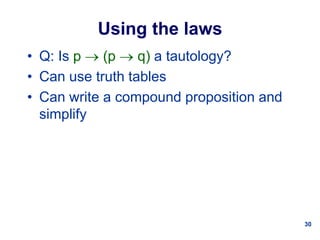
30
Using the laws
• Q: Is p  (p  q) a tautology?
• Can use truth tables
• Can write a compound proposition and
simplify
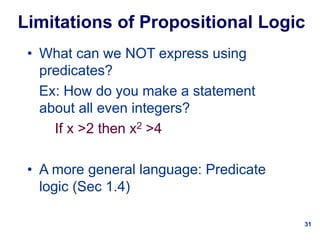
31
Limitations of Propositional Logic
• What can we NOT express using
predicates?
Ex: How do you make a statement
about all even integers?
If x >2 then x2 >4
• A more general language: Predicate
logic (Sec 1.4)
32
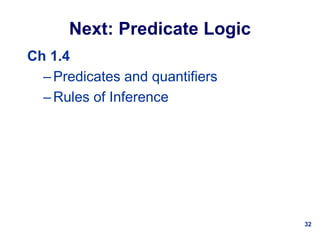
Next: Predicate Logic
Ch 1.4
–Predicates and quantifiers
–Rules of Inference
33
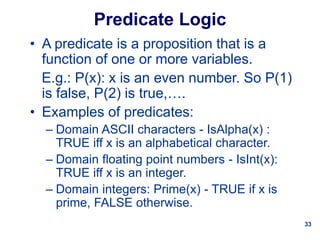
Predicate Logic
• A predicate is a proposition that is a
function of one or more variables.
E.g.: P(x): x is an even number. So P(1)
is false, P(2) is true,….
• Examples of predicates:
– Domain ASCII characters - IsAlpha(x) :
TRUE iff x is an alphabetical character.
– Domain floating point numbers - IsInt(x):
TRUE iff x is an integer.
– Domain integers: Prime(x) - TRUE if x is
prime, FALSE otherwise.
34
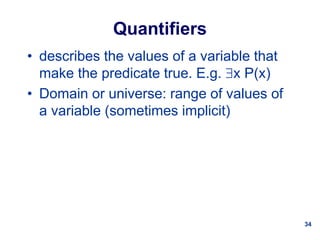
Quantifiers
• describes the values of a variable that
make the predicate true. E.g. x P(x)
• Domain or universe: range of values of
a variable (sometimes implicit)
35
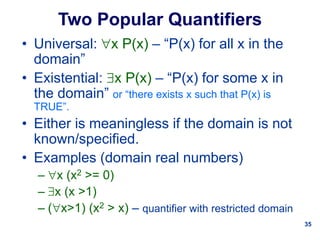
Two Popular Quantifiers
• Universal: x P(x) – “P(x) for all x in the
domain”
• Existential: x P(x) – “P(x) for some x in
the domain” or “there exists x such that P(x) is
TRUE”.
• Either is meaningless if the domain is not
known/specified.
• Examples (domain real numbers)
– x (x2 >= 0)
– x (x >1)
– (x>1) (x2 > x) – quantifier with restricted domain
36
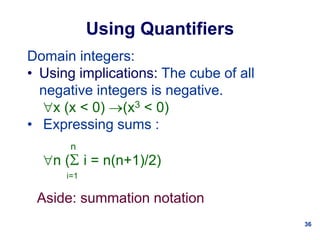
Using Quantifiers
Domain integers:
• Using implications: The cube of all
negative integers is negative.
x (x < 0) (x3 < 0)
• Expressing sums :
n
n ( i = n(n+1)/2)
i=1
Aside: summation notation
37
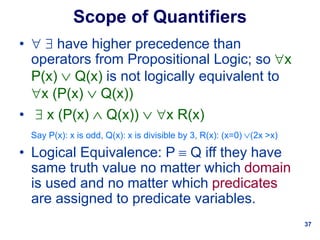
Scope of Quantifiers
•   have higher precedence than
operators from Propositional Logic; so x
P(x)  Q(x) is not logically equivalent to
x (P(x)  Q(x))
•  x (P(x)  Q(x))  x R(x)
Say P(x): x is odd, Q(x): x is divisible by 3, R(x): (x=0) (2x >x)
• Logical Equivalence: P  Q iff they have
same truth value no matter which domain
is used and no matter which predicates
are assigned to predicate variables.
38
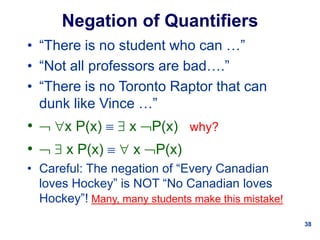
Negation of Quantifiers
• “There is no student who can …”
• “Not all professors are bad….”
• “There is no Toronto Raptor that can
dunk like Vince …”
•  x P(x)   x P(x) why?
•   x P(x)   x P(x)
• Careful: The negation of “Every Canadian
loves Hockey” is NOT “No Canadian loves
Hockey”! Many, many students make this mistake!
39
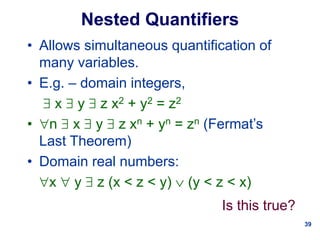
Nested Quantifiers
• Allows simultaneous quantification of
many variables.
• E.g. – domain integers,
 x  y  z x2 + y2 = z2
• n  x  y  z xn + yn = zn (Fermat’s
Last Theorem)
• Domain real numbers:
x  y  z (x < z < y)  (y < z < x)
Is this true?
40
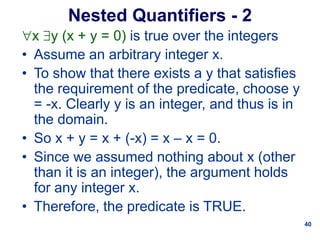
Nested Quantifiers - 2
x y (x + y = 0) is true over the integers
• Assume an arbitrary integer x.
• To show that there exists a y that satisfies
the requirement of the predicate, choose y
= -x. Clearly y is an integer, and thus is in
the domain.
• So x + y = x + (-x) = x – x = 0.
• Since we assumed nothing about x (other
than it is an integer), the argument holds
for any integer x.
• Therefore, the predicate is TRUE.
41
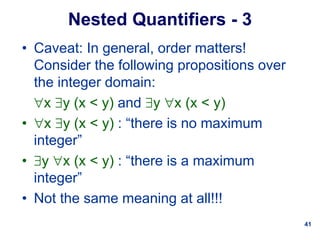
Nested Quantifiers - 3
• Caveat: In general, order matters!
Consider the following propositions over
the integer domain:
x y (x < y) and y x (x < y)
• x y (x < y) : “there is no maximum
integer”
• y x (x < y) : “there is a maximum
integer”
• Not the same meaning at all!!!

1019Lec1.ppt

  • 1.
    1 Math/CSE 1019C: Discrete Mathematicsfor Computer Science Fall 2011 Suprakash Datta datta@cse.yorku.ca Office: CSEB 3043 Phone: 416-736-2100 ext 77875 Course page: http://www.cse.yorku.ca/course/1019
  • 2.
    2 Administrivia Kenneth H. Rosen. DiscreteMathematics and Its Applications, 7th Edition. McGraw Hill, 2012. Lectures: Tu-Th 10:00-11:30 am (CLH E) Exams: 3 tests (45%), final (40%) Homework (15%): equally divided between several assignments. Slides: should be available after the class Office hours: Wed 3-5 pm or by appointment at CSEB 3043. Textbook:
  • 3.
    3 Administrivia – contd. •Cheating will not be tolerated. Visit the class webpage for more details on policies. • TA: Tutorials/office hours TBA. • HW submitted late will not be graded.
  • 4.
    4 Course objectives We willfocus on two major goals: • Basic tools and techniques in discrete mathematics – Propositional logic – Set Theory – Simple algorithms – Induction, recursion – Counting techniques (Combinatorics) • Precise and rigorous mathematical reasoning – Writing proofs
  • 5.
    5 To do wellyou should: • Study with pen and paper • Ask for help immediately • Practice, practice, practice… • Follow along in class rather than take notes • Ask questions in class • Keep up with the class • Read the book, not just the slides
  • 6.
    6 Reasoning about problems •0.999999999999999….=1? • There exists integers a,b,c that satisfy the equation a2+b2 = c2 • The program below that I wrote works correctly for all possible inputs….. • The program that I wrote never hangs (i.e. always terminates)…
  • 7.
    7 Tools for reasoning:Logic Ch. 1: Introduction to Propositional Logic • Truth values, truth tables • Boolean logic:    • Implications:  
  • 8.
    8 Why study propositionallogic? • A formal mathematical “language” for precise reasoning. • Start with propositions. • Add other constructs like negation, conjunction, disjunction, implication etc. • All of these are based on ideas we use daily to reason about things.
  • 9.
    9 Propositions • Declarative sentence •Must be either True or False. Propositions: • York University is in Toronto • York University is in downtown Toronto • All students at York are Computer Sc. majors. Not propositions: • Do you like this class? • There are x students in this class.
  • 10.
    10 Propositions - 2 •Truth value: True or False • Variables: p,q,r,s,… • Negation: • p (“not p”) • Truth tables p p T F F T
  • 11.
    11 Caveat: negating propositions p:“it is not the case that p is true” p: “it rained more than 20 inches in TO” p: “John has many iPads” Practice: Questions 1-7 page 12. Q10 (a) p: “the election is decided”
  • 12.
    12 Conjunction, Disjunction • Conjunction:p  q [“and”] • Disjunction: p  q [“or”] p q p  q p  q T T T T T F F T F T F T F F F F
  • 13.
    13 Examples • Q11, page13 p: It is below freezing q: It is snowing (a) It is below freezing and snowing (b) It is below freezing but now snowing (d) It is either snowing or below freezing (or both)
  • 14.
    14 Exclusive OR (XOR) •p  q – T if p and q have different truth values, F otherwise • Colloquially, we often use OR ambiguously – “an entrée comes with soup or salad” implies XOR, but “students can take MATH XXXX if they have taken MATH 2320 or MATH 1019” usually means the normal OR (so a student who has taken both is still eligible for MATH XXXX).
  • 15.
    15 Conditional • p q [“if p then q”] • p: hypothesis, q: conclusion • E.g.: “If you turn in a homework late, it will not be graded”; “If you get 100% in this course, you will get an A+”. • TRICKY: Is p  q TRUE if p is FALSE? YES!! • Think of “If you get 100% in this course, you will get an A+” as a promise – is the promise violated if someone gets 50% and does not receive an A+?
  • 16.
    16 Conditional - 2 •p  q [“if p then q”] • Truth table: p q p  q  p  q T T T T T F F F F T T T F F T T Note the truth table of  p  q
  • 17.
    17 Logical Equivalence • p q and  p  q are logically equivalent • Truth tables are the simplest way to prove such facts. • We will learn other ways later.
  • 18.
    18 Contrapositive • Contrapositive ofp  q is q  p • Any conditional and its contrapositive are logically equivalent (have the same truth table) – Check by writing down the truth table. • E.g. The contrapositive of “If you get 100% in this course, you will get an A+” is “If you do not get an A+ in this course, you did not get 100%”.
  • 19.
    19 E.g.: Proof usingcontrapositive Prove: If x2 is even, x is even • Proof 1: x2 = 2a for some integer a. Since 2 is prime, 2 must divide x. • Proof 2: if x is not even, x is odd. Therefore x2 is odd. This is the contrapositive of the original assertion.
  • 20.
    20 Converse • Converse ofp  q is q  p • Not logically equivalent to conditional • Ex 1: “If you get 100% in this course, you will get an A+” and “If you get an A+ in this course, you scored 100%” are not equivalent. • Ex 2: If you won the lottery, you are rich.
  • 21.
    21 Other conditionals Inverse: • inverseof p  q is p  q • How is this related to the converse? Biconditional: • “If and only if” • True if p,q have same truth values, false otherwise. Q: How is this related to XOR? • Can also be defined as (p  q)  (q  p)
  • 22.
    22 Example • Q16(c) 1+1=3if and only if monkeys can fly.
  • 23.
    23 Readings and notes •Read pages 1-12. • Think about the notion of truth tables. • Master the rationale behind the definition of conditionals. • Practice translating English sentences to propositional logic statements.
  • 24.
    24 Next Ch. 1.2, 1.3:Propositional Logic - contd – Compound propositions, precedence rules – Tautologies and logical equivalences – Read only the first section called “Translating English Sentences” in 1.2.
  • 25.
    25 Compound Propositions • Example:p  q  r : Could be interpreted as (p  q)  r or p  (q  r) • precedence order:      (IMP!) (Overruled by brackets) • We use this order to compute truth values of compound propositions.
  • 26.
    26 Tautology • A compoundproposition that is always TRUE, e.g. q  q • Logical equivalence redefined: p,q are logical equivalences if p  q is a tautology. Symbolically p  q. • Intuition: p  q is true precisely when p,q have the same truth values.
  • 27.
    27 Manipulating Propositions • Compoundpropositions can be simplified by using simple rules. • Read page 25 - 28. • Some are obvious, e.g. Identity, Domination, Idempotence, double negation, commutativity, associativity • Less obvious: Distributive, De Morgan’s laws, Absorption
  • 28.
    28 Distributive Laws p (q  r)  (p  q)  (p  r) Intuition (not a proof!) – For the LHS to be true: p must be true and q or r must be true. This is the same as saying p and q must be true or p and r must be true. p  (q  r)  (p  q)  (p  r) Intuition (less obvious) – For the LHS to be true: p must be true or both q and r must be true. This is the same as saying p or q must be true and p or r must be true. Proof: use truth tables.
  • 29.
    29 De Morgan’s Laws (q r)  q  r Intuition – For the LHS to be true: neither q nor r can be true. This is the same as saying q and r must be false. (q  r)  q  r Intuition – For the LHS to be true: q  r must be false. This is the same as saying q or r must be false. Proof: use truth tables.
  • 30.
    30 Using the laws •Q: Is p  (p  q) a tautology? • Can use truth tables • Can write a compound proposition and simplify
  • 31.
    31 Limitations of PropositionalLogic • What can we NOT express using predicates? Ex: How do you make a statement about all even integers? If x >2 then x2 >4 • A more general language: Predicate logic (Sec 1.4)
  • 32.
    32 Next: Predicate Logic Ch1.4 –Predicates and quantifiers –Rules of Inference
  • 33.
    33 Predicate Logic • Apredicate is a proposition that is a function of one or more variables. E.g.: P(x): x is an even number. So P(1) is false, P(2) is true,…. • Examples of predicates: – Domain ASCII characters - IsAlpha(x) : TRUE iff x is an alphabetical character. – Domain floating point numbers - IsInt(x): TRUE iff x is an integer. – Domain integers: Prime(x) - TRUE if x is prime, FALSE otherwise.
  • 34.
    34 Quantifiers • describes thevalues of a variable that make the predicate true. E.g. x P(x) • Domain or universe: range of values of a variable (sometimes implicit)
  • 35.
    35 Two Popular Quantifiers •Universal: x P(x) – “P(x) for all x in the domain” • Existential: x P(x) – “P(x) for some x in the domain” or “there exists x such that P(x) is TRUE”. • Either is meaningless if the domain is not known/specified. • Examples (domain real numbers) – x (x2 >= 0) – x (x >1) – (x>1) (x2 > x) – quantifier with restricted domain
  • 36.
    36 Using Quantifiers Domain integers: •Using implications: The cube of all negative integers is negative. x (x < 0) (x3 < 0) • Expressing sums : n n ( i = n(n+1)/2) i=1 Aside: summation notation
  • 37.
    37 Scope of Quantifiers •  have higher precedence than operators from Propositional Logic; so x P(x)  Q(x) is not logically equivalent to x (P(x)  Q(x)) •  x (P(x)  Q(x))  x R(x) Say P(x): x is odd, Q(x): x is divisible by 3, R(x): (x=0) (2x >x) • Logical Equivalence: P  Q iff they have same truth value no matter which domain is used and no matter which predicates are assigned to predicate variables.
  • 38.
    38 Negation of Quantifiers •“There is no student who can …” • “Not all professors are bad….” • “There is no Toronto Raptor that can dunk like Vince …” •  x P(x)   x P(x) why? •   x P(x)   x P(x) • Careful: The negation of “Every Canadian loves Hockey” is NOT “No Canadian loves Hockey”! Many, many students make this mistake!
  • 39.
    39 Nested Quantifiers • Allowssimultaneous quantification of many variables. • E.g. – domain integers,  x  y  z x2 + y2 = z2 • n  x  y  z xn + yn = zn (Fermat’s Last Theorem) • Domain real numbers: x  y  z (x < z < y)  (y < z < x) Is this true?
  • 40.
    40 Nested Quantifiers -2 x y (x + y = 0) is true over the integers • Assume an arbitrary integer x. • To show that there exists a y that satisfies the requirement of the predicate, choose y = -x. Clearly y is an integer, and thus is in the domain. • So x + y = x + (-x) = x – x = 0. • Since we assumed nothing about x (other than it is an integer), the argument holds for any integer x. • Therefore, the predicate is TRUE.
  • 41.
    41 Nested Quantifiers -3 • Caveat: In general, order matters! Consider the following propositions over the integer domain: x y (x < y) and y x (x < y) • x y (x < y) : “there is no maximum integer” • y x (x < y) : “there is a maximum integer” • Not the same meaning at all!!!