Sepsis
Recognising and managing Sepsis as an Obstetric Emergency
Sepsis - Learning Objectives
Recognise severe maternal sepsis
Knowledge of the emergency management of sepsis
Need for early IV antibiotics, fluids, and use of serum
lactate for sepsis severity
Importance of using observation chart / early warning
score chart
Importance of the multi-disciplinary team
Complications of severe sepsis
What is sepsis?
Sepsis is the body's response to infection following the invasion of the body by
microorganisms, usually bacteria.
Infection may be limited to a particular body region (e.g. chorioamnionitis) or
widespread in the bloodstream, resulting in septicaemia.
It is a medical emergency as it can result in an interruption of the supply of
oxygen and nutrients to the tissues.
This will severely affect the vital organs such as the brain, heart, liver,
kidneys, lungs and intestines, resulting in acidosis, organ failure and death.
Definitions
Sepsis - Systemic inflammatory response with signs of known or suspected
infection.
Severe Sepsis – as above and with multi-organ dysfunction.
Septic Shock – as above and with persistent hypotension despite fluid
resuscitation.
Incidence
Mortality rate of sepsis is 1.1/100,000 (CMACE 2011). 26 women died, the
majority following normal vaginal births.
There is a 20-40% mortality rate with sepsis and severe sepsis, increasing to
60% where septic shock develops.
For each hour that antibiotic therapy is delayed, mortality increases by 7.6%.
In India: estimate is 11% of maternal deaths between 2001-2003 were due to
sepsis
In a study in rural Maharashtra sepsis was 2nd major cause of maternal
mortality at 13.2% after PPH
National Health Portal of India
Recognition
The onset may be slow or may show extremely rapid clinical deterioration.
This rapid deterioration is often the case in a streptococcal infection.
It is essential that all staff are aware of the signs and symptoms of sepsis
because it is often;
Unrecognised
Underestimated
This can lead to delay in treatment and serious morbidity and death.
Providing information to women about risks, signs and symptoms of genital
tract infection is extremely important and encouragement for women to seek
advice if concerned.
Signs and symptoms
What are the signs and symptoms?
Symptoms first.
Symptoms
Fever
Diarrhoea
Vomiting
Abdominal pain
Sore throat
Upper respiratory tract infection
Vaginal discharge
Wound infection
Breast abscess
Women who ‘just don’t feel well’.
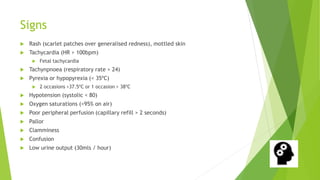
Signs
Rash (scarlet patches over generalised redness), mottled skin
Tachycardia (HR > 100bpm)
Fetal tachycardia
Tachynpnoea (respiratory rate > 24)
Pyrexia or hypopyrexia (< 35ºC)
2 occasions >37.5ºC or 1 occasion > 38ºC
Hypotension (systolic < 80)
Oxygen saturations (<95% on air)
Poor peripheral perfusion (capillary refill > 2 seconds)
Pallor
Clamminess
Confusion
Low urine output (30mls / hour)
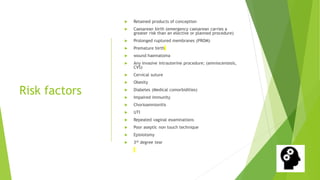
Risk factors
Retained products of conception
Caesarean birth (emergency caesarean carries a
greater risk than an elective or planned procedure)
Prolonged ruptured membranes (PROM)
Premature birth
wound haematoma
Any invasive intrauterine procedure; (amniocentesis,
CVS)
Cervical suture
Obesity
Diabetes (Medical comorbidities)
Impaired immunity
Chorioamnionitis
UTI
Repeated vaginal examinations
Poor aseptic non touch technique
Episiotomy
3rd degree tear
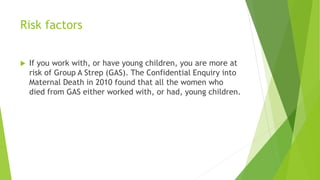
Risk factors
If you work with, or have young children, you are more at
risk of Group A Strep (GAS). The Confidential Enquiry into
Maternal Death in 2010 found that all the women who
died from GAS either worked with, or had, young children.
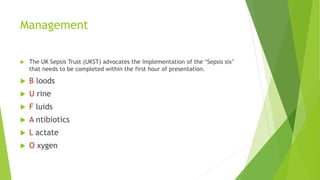
Management
The UK Sepsis Trust (UKST) advocates the implementation of the ‘Sepsis six’
that needs to be completed within the first hour of presentation.

B loods
U rine
F luids
A ntibiotics
L actate
O xygen
Management
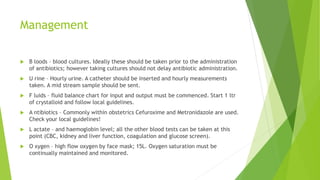
B loods – blood cultures. Ideally these should be taken prior to the administration
of antibiotics; however taking cultures should not delay antibiotic administration.
U rine – Hourly urine. A catheter should be inserted and hourly measurements
taken. A mid stream sample should be sent.
F luids – fluid balance chart for input and output must be commenced. Start 1 ltr
of crystalloid and follow local guidelines.
A ntibiotics – Commonly within obstetrics Cefuroxime and Metronidazole are used.
Check your local guidelines!
L actate – and haemoglobin level; all the other blood tests can be taken at this
point (CBC, kidney and liver function, coagulation and glucose screen).
O xygen – high flow oxygen by face mask; 15L. Oxygen saturation must be
continually maintained and monitored.
Management
Remember: 3 in 3 out!
Oxygen
Fluids
Antibiotics
Out:
Urine
Blood cultures
Lactate
Investigations
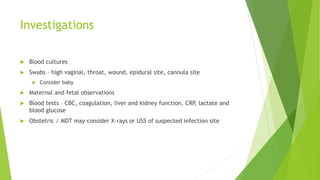
Blood cultures
Swabs – high vaginal, throat, wound, epidural site, cannula site
Consider baby
Maternal and fetal observations
Blood tests – CBC, coagulation, liver and kidney function, CRP, lactate and
blood glucose
Obstetric / MDT may consider X-rays or USS of suspected infection site
Prevention
The importance of hand washing, hygiene and
antisepsis is absolutely crucial and needs
improvement in every scenario.
Remember Dr Semmelweiss!!
WE STILL HAVE A LOT TO IMPROVE WITH THE BASICS!
Scenario
Background
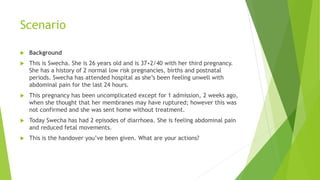
This is Swecha. She is 26 years old and is 37+2/40 with her third pregnancy.
She has a history of 2 normal low risk pregnancies, births and postnatal
periods. Swecha has attended hospital as she’s been feeling unwell with
abdominal pain for the last 24 hours.
This pregnancy has been uncomplicated except for 1 admission, 2 weeks ago,
when she thought that her membranes may have ruptured; however this was
not confirmed and she was sent home without treatment.
Today Swecha has had 2 episodes of diarrhoea. She is feeling abdominal pain
and reduced fetal movements.
This is the handover you’ve been given. What are your actions?
Scenario
SBAR;
S ituation
B ackground
A ssessment
R ecommendations
Summary
Identify potential sepsis
Act quickly – within the first hour
Use multi-disciplinary approach
Remember BUFALO / Sepsis 6 / 3 in; 3 out
Whatever helps you remember what to do.

Maternal Sepsis- objective, management, preventive measures

  • 1.
    Sepsis Recognising and managingSepsis as an Obstetric Emergency
  • 2.
    Sepsis - LearningObjectives Recognise severe maternal sepsis Knowledge of the emergency management of sepsis Need for early IV antibiotics, fluids, and use of serum lactate for sepsis severity Importance of using observation chart / early warning score chart Importance of the multi-disciplinary team Complications of severe sepsis
  • 3.
    What is sepsis? Sepsisis the body's response to infection following the invasion of the body by microorganisms, usually bacteria. Infection may be limited to a particular body region (e.g. chorioamnionitis) or widespread in the bloodstream, resulting in septicaemia. It is a medical emergency as it can result in an interruption of the supply of oxygen and nutrients to the tissues. This will severely affect the vital organs such as the brain, heart, liver, kidneys, lungs and intestines, resulting in acidosis, organ failure and death.
  • 4.
    Definitions Sepsis - Systemicinflammatory response with signs of known or suspected infection. Severe Sepsis – as above and with multi-organ dysfunction. Septic Shock – as above and with persistent hypotension despite fluid resuscitation.
  • 5.
    Incidence Mortality rate ofsepsis is 1.1/100,000 (CMACE 2011). 26 women died, the majority following normal vaginal births. There is a 20-40% mortality rate with sepsis and severe sepsis, increasing to 60% where septic shock develops. For each hour that antibiotic therapy is delayed, mortality increases by 7.6%. In India: estimate is 11% of maternal deaths between 2001-2003 were due to sepsis In a study in rural Maharashtra sepsis was 2nd major cause of maternal mortality at 13.2% after PPH National Health Portal of India
  • 6.
    Recognition The onset maybe slow or may show extremely rapid clinical deterioration. This rapid deterioration is often the case in a streptococcal infection. It is essential that all staff are aware of the signs and symptoms of sepsis because it is often; Unrecognised Underestimated This can lead to delay in treatment and serious morbidity and death. Providing information to women about risks, signs and symptoms of genital tract infection is extremely important and encouragement for women to seek advice if concerned.
  • 7.
    Signs and symptoms Whatare the signs and symptoms? Symptoms first.
  • 8.
    Symptoms Fever Diarrhoea Vomiting Abdominal pain Sore throat Upperrespiratory tract infection Vaginal discharge Wound infection Breast abscess Women who ‘just don’t feel well’.
  • 9.
    Signs Rash (scarlet patchesover generalised redness), mottled skin Tachycardia (HR > 100bpm) Fetal tachycardia Tachynpnoea (respiratory rate > 24) Pyrexia or hypopyrexia (< 35ºC) 2 occasions >37.5ºC or 1 occasion > 38ºC Hypotension (systolic < 80) Oxygen saturations (<95% on air) Poor peripheral perfusion (capillary refill > 2 seconds) Pallor Clamminess Confusion Low urine output (30mls / hour)
  • 10.
    Risk factors Retained productsof conception Caesarean birth (emergency caesarean carries a greater risk than an elective or planned procedure) Prolonged ruptured membranes (PROM) Premature birth wound haematoma Any invasive intrauterine procedure; (amniocentesis, CVS) Cervical suture Obesity Diabetes (Medical comorbidities) Impaired immunity Chorioamnionitis UTI Repeated vaginal examinations Poor aseptic non touch technique Episiotomy 3rd degree tear
  • 11.
    Risk factors If youwork with, or have young children, you are more at risk of Group A Strep (GAS). The Confidential Enquiry into Maternal Death in 2010 found that all the women who died from GAS either worked with, or had, young children.
  • 12.
    Management The UK SepsisTrust (UKST) advocates the implementation of the ‘Sepsis six’ that needs to be completed within the first hour of presentation. B loods U rine F luids A ntibiotics L actate O xygen
  • 13.
    Management B loods –blood cultures. Ideally these should be taken prior to the administration of antibiotics; however taking cultures should not delay antibiotic administration. U rine – Hourly urine. A catheter should be inserted and hourly measurements taken. A mid stream sample should be sent. F luids – fluid balance chart for input and output must be commenced. Start 1 ltr of crystalloid and follow local guidelines. A ntibiotics – Commonly within obstetrics Cefuroxime and Metronidazole are used. Check your local guidelines! L actate – and haemoglobin level; all the other blood tests can be taken at this point (CBC, kidney and liver function, coagulation and glucose screen). O xygen – high flow oxygen by face mask; 15L. Oxygen saturation must be continually maintained and monitored.
  • 14.
    Management Remember: 3 in3 out! Oxygen Fluids Antibiotics Out: Urine Blood cultures Lactate
  • 15.
    Investigations Blood cultures Swabs –high vaginal, throat, wound, epidural site, cannula site Consider baby Maternal and fetal observations Blood tests – CBC, coagulation, liver and kidney function, CRP, lactate and blood glucose Obstetric / MDT may consider X-rays or USS of suspected infection site
  • 16.
    Prevention The importance ofhand washing, hygiene and antisepsis is absolutely crucial and needs improvement in every scenario. Remember Dr Semmelweiss!! WE STILL HAVE A LOT TO IMPROVE WITH THE BASICS!
  • 17.
    Scenario Background This is Swecha.She is 26 years old and is 37+2/40 with her third pregnancy. She has a history of 2 normal low risk pregnancies, births and postnatal periods. Swecha has attended hospital as she’s been feeling unwell with abdominal pain for the last 24 hours. This pregnancy has been uncomplicated except for 1 admission, 2 weeks ago, when she thought that her membranes may have ruptured; however this was not confirmed and she was sent home without treatment. Today Swecha has had 2 episodes of diarrhoea. She is feeling abdominal pain and reduced fetal movements. This is the handover you’ve been given. What are your actions?
  • 18.
    Scenario SBAR; S ituation B ackground Assessment R ecommendations
  • 19.
    Summary Identify potential sepsis Actquickly – within the first hour Use multi-disciplinary approach Remember BUFALO / Sepsis 6 / 3 in; 3 out Whatever helps you remember what to do.