BY
M.LOORTHUSELVI
INTRODUCTION
• Any bleeding in pregnancyis abnormal .Vaginal blood loss in early
pregnancy should be thought of as a threatened micarriage until
shown otherwise.About 20% of all pregnancies end in abortion .since
many pregnancies end at or around the time of implantation ie
before the first menstural period,they got unnoticed.About 80% of all
recognized abortions occur during 2nd and 3rd trimester.
DEFINITION:
Abortion is the expulsion or extraction from its mother of an embryo
or fetus weighing 500gm or less when it is not capable of independent
survival.
- WHO
Abortion is the process of partial or complete separation of the
products of conception from the uterine wall with or without partial or
complete expulsion from the uterine cavity before the age of viability.
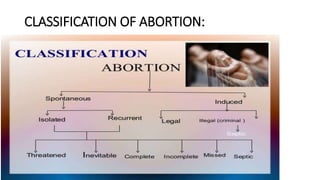
CLASSIFICATION OF ABORTION:
SPONTANEOUS ABORTION:
• Spontaneous abortion is defined as the involuntary loss of the
products of conception proir to 28 weeks of gestation,when the fetal
weighs approximately 1000gm or less.
• occurs once in every 15 pregnancies.
• In India 2millions are spontaneous abortion takes place in every year.
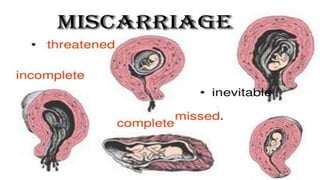
THREATENED ABORTION:
This type of abortion starts with pain that occurs as a result of
abnormal uterine activity.The embryo is usually alive.
The woman will have crampy pain that gradually increase in severity.
A mild bleeding or blood stained vaginal discharge can occur.
The cervix of the uterus remains closed.
There is possibility of continuation of pregnancy on proper and timely
management.
MANAGEMENT:
• General and systemic examination.
• investigations include hb,ABO grouping and RH,urine routine,throid
dysfunction,plasma progestrone estimation if corpsluteum insuffiency
is suspected.
• complete bed rest.
• treatment according to the results.
TREATMENT:
• The aim is to try and conserve the pregnancy by decreasing uterine
contraction.
• Complete bed rest.
• Uterine relaxant like ISOXSPURINE HYDROCHLORIDE OR RITODRINE
and sedating the patient to prevent uterine contraction.
• PROGESTRONE supplement for progestrone deficiency.
• HUMAN CHORIONIC GONADOTROPHIN injections.
INEVITABLE ABORTION:
• If the treatment of threatened abortion is not adequately or timely
,the abortion may become inevitable.
• In this type besides pain and bleeding there is dilatation of the
cervix.And products of expulsion cannot be stopped.
• on examination products may be seen in vagina.
• uterus may be smaller than expected.
MANAGEMENT:
• The aim of treatment is to prevent further pain and bleeding .
• If bleeding is already severe spportive treatment like iv fluids and
blood transfusion bocome necessary.
• INJ.syntocin or inj ergometrin.
• analgesics.
• D&C will be done.
INCOMPLETE ABORTION:
• Occasionally some part of the gestational tissue may be retained
within the uterus during the process of the abortionwhile other parts
may be expelled .
MANAGEMENT:
• Evacuate the uterus completely by D&C to prevent infection.
• Intramuscular ergometrine is given to control the bleeding.
COMPLETE ABORTION:
• When embyonic and placental components have been expelled
completely ,it is called a complete abortion.
• Normally ,once complete abortion occurs ,there is complete sessation
of pain and bleeding.
• contracted uterus
MANAGEMENT:
Supportive with antibiotics ,pain reliving tabblets.
MISSED ABORTION /EARLY FETAL DEMISE:
• Tis is a type of abortion where the product is dead ,but retained
inside the uterus before 8 weeks of gestation.
• There may be mild brown or dirty vaginal discharge.
• Frank bleeding is rare.
• Some times there will be no pain or bleeding.
• Release of thromboplastin from placental bed to maternal circulation
will cause disseminated intravascular coagulaton usually about 5
weeks after death.
MANAGEMENT:
• Remove the dead products as soon as possible.
• coagulation profile is done because of risk of hypofibrinogenemia
• in second trimester administration of prostoglandin
intramuscularly.
RECURRENT ABORTION:
• When three or more abortions occur consecutively and
spontaneously,the process is termed as recurrent or habitual
abortion.
• Occur at same gestational age.
• leads to cervical incompetence.
MANAGEMENT:
• Blood test for hormonal level and for infection.
• Blood glucose level.
• USG for uterine causes.
• HSG to identify cervical incompetence.
• If the cervical incompetence is the cause ,the cervical opening is
sutured untill the 37th week of gestation.
SEPTIC ABORTION:
• This is a type of abortion where there is sepsis or infection of the
uterus.
• The underlying abortion is usually incomplete but sometimes
inevitable or threatened.
• patient suffer from highfever and looks toxic.
• foul smelling vaginal discharge which may or may not be blood
stained.
TREATMENT:
• high grade antibiotics and anti-inflamatory drugs.
• evacuation of the uterus under anesthesia.
INDUCED ABORTION:
• Induced abortion is deliberately interruption of an intact pregnancy.
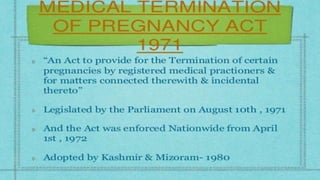
induced abortions are performed legally in india since the medical
termination of pregnancy act of 1971.
LEGAL:
THERAPEUTIC ABORTION:
• The deliberate induction of abortion on grounds of safety for the
maternal life and health is termed as medical termination of
pregnancy.
ILLEGAL ABORTION
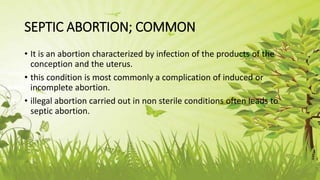
SEPTIC ABORTION; COMMON
• It is an abortion characterized by infection of the products of the
conception and the uterus.
• this condition is most commonly a complication of induced or
incomplete abortion.
• illegal abortion carried out in non sterile conditions often leads to
septic abortion.
CAUSES:
• inexpert attempt at termination of pregnancy by passing sticks
catheters,pastes or soap solution in to intrauterine cavity.
• inevitable abortion with infection.
• MTP with infection.
CLINICAL MANIFESTATION:
• Pyrexia
• headache
• nausea
• foul smelling discharge per vagina
• anexal masses -USG
• uterine and tubes infection
• septecemia with peritonitis
• septic shock
• gas gangrene of the uterus.
TREATMENT:
• Intravenous antibiotic
• plvic abscess if present will be drained.
• uterine evacuation by gentel curettage
• heparinization to prevent intravascular coagulation
• exchange transfusion.
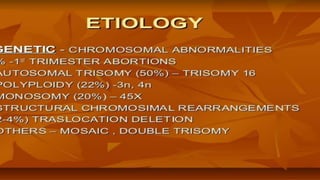
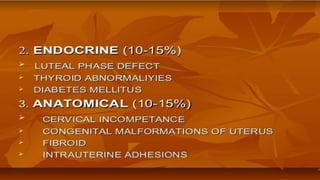
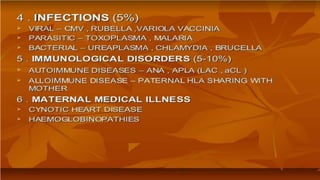
ETIOLOGY OF ABORTION:
CLINICAL FEATURES OF
ABRTION. 1. Heavy spotting
2. vaginal Bleeding
3. discharge of tissue or fluid from
vagina.
4. abdomen pain
5. back pain.
METHODS OF
TERMINATION OF
PREGNCY
menstural regulation
suction evacuation and curettage
dilatation and evacuation
pharmacological methods
SECOND TRIMESTER 1) Intrauterine instillation
2) extra uterine instillation-ethacridine
lactate
3) prostoglandin and oxytocin
4) hystreotomy
NURSING
MANAGEMENT:
ASSESSMENT
NURSING DIAGNOSIS
PLANNING
IMPLEMENTATION
EVALUATION
COMPLICATIONS
Pain
bleeding
low grade fever
hematometra
retained products of conception
uterine perforation
bladder anbowel injury
cervical shock
cervical laceration
cont...
gynecological
chronic pelvic inflammation
infertility
menstural disturbance
scar endometriosis
cervical incompetencebor
preterm labor
dysmaturity
CONCLUSION
Abortion is any bleeding in pregnancy is abnormal.The term
miscaaiage and abortion are synonymous.There are various types
in abortion.Treatment has to be given accordind to the types and
time of abortion occurs.
Abortion

Abortion

  • 1.
  • 2.
    INTRODUCTION • Any bleedingin pregnancyis abnormal .Vaginal blood loss in early pregnancy should be thought of as a threatened micarriage until shown otherwise.About 20% of all pregnancies end in abortion .since many pregnancies end at or around the time of implantation ie before the first menstural period,they got unnoticed.About 80% of all recognized abortions occur during 2nd and 3rd trimester.
  • 3.
    DEFINITION: Abortion is theexpulsion or extraction from its mother of an embryo or fetus weighing 500gm or less when it is not capable of independent survival. - WHO Abortion is the process of partial or complete separation of the products of conception from the uterine wall with or without partial or complete expulsion from the uterine cavity before the age of viability.
  • 4.
  • 5.
    SPONTANEOUS ABORTION: • Spontaneousabortion is defined as the involuntary loss of the products of conception proir to 28 weeks of gestation,when the fetal weighs approximately 1000gm or less. • occurs once in every 15 pregnancies. • In India 2millions are spontaneous abortion takes place in every year.


  • 6.
    THREATENED ABORTION: This typeof abortion starts with pain that occurs as a result of abnormal uterine activity.The embryo is usually alive. The woman will have crampy pain that gradually increase in severity. A mild bleeding or blood stained vaginal discharge can occur. The cervix of the uterus remains closed. There is possibility of continuation of pregnancy on proper and timely management.
  • 7.
    MANAGEMENT: • General andsystemic examination. • investigations include hb,ABO grouping and RH,urine routine,throid dysfunction,plasma progestrone estimation if corpsluteum insuffiency is suspected. • complete bed rest. • treatment according to the results.
  • 8.
    TREATMENT: • The aimis to try and conserve the pregnancy by decreasing uterine contraction. • Complete bed rest. • Uterine relaxant like ISOXSPURINE HYDROCHLORIDE OR RITODRINE and sedating the patient to prevent uterine contraction. • PROGESTRONE supplement for progestrone deficiency. • HUMAN CHORIONIC GONADOTROPHIN injections.
  • 9.
    INEVITABLE ABORTION: • Ifthe treatment of threatened abortion is not adequately or timely ,the abortion may become inevitable. • In this type besides pain and bleeding there is dilatation of the cervix.And products of expulsion cannot be stopped. • on examination products may be seen in vagina. • uterus may be smaller than expected.
  • 10.
    MANAGEMENT: • The aimof treatment is to prevent further pain and bleeding . • If bleeding is already severe spportive treatment like iv fluids and blood transfusion bocome necessary. • INJ.syntocin or inj ergometrin. • analgesics. • D&C will be done.
  • 11.
    INCOMPLETE ABORTION: • Occasionallysome part of the gestational tissue may be retained within the uterus during the process of the abortionwhile other parts may be expelled .
  • 12.
    MANAGEMENT: • Evacuate theuterus completely by D&C to prevent infection. • Intramuscular ergometrine is given to control the bleeding.
  • 13.
    COMPLETE ABORTION: • Whenembyonic and placental components have been expelled completely ,it is called a complete abortion. • Normally ,once complete abortion occurs ,there is complete sessation of pain and bleeding. • contracted uterus
  • 14.
  • 15.
    MISSED ABORTION /EARLYFETAL DEMISE: • Tis is a type of abortion where the product is dead ,but retained inside the uterus before 8 weeks of gestation. • There may be mild brown or dirty vaginal discharge. • Frank bleeding is rare. • Some times there will be no pain or bleeding. • Release of thromboplastin from placental bed to maternal circulation will cause disseminated intravascular coagulaton usually about 5 weeks after death.
  • 16.
    MANAGEMENT: • Remove thedead products as soon as possible. • coagulation profile is done because of risk of hypofibrinogenemia • in second trimester administration of prostoglandin intramuscularly.
  • 17.
    RECURRENT ABORTION: • Whenthree or more abortions occur consecutively and spontaneously,the process is termed as recurrent or habitual abortion. • Occur at same gestational age. • leads to cervical incompetence.
  • 18.
    MANAGEMENT: • Blood testfor hormonal level and for infection. • Blood glucose level. • USG for uterine causes. • HSG to identify cervical incompetence. • If the cervical incompetence is the cause ,the cervical opening is sutured untill the 37th week of gestation.
  • 19.
    SEPTIC ABORTION: • Thisis a type of abortion where there is sepsis or infection of the uterus. • The underlying abortion is usually incomplete but sometimes inevitable or threatened. • patient suffer from highfever and looks toxic. • foul smelling vaginal discharge which may or may not be blood stained.
  • 20.
    TREATMENT: • high gradeantibiotics and anti-inflamatory drugs. • evacuation of the uterus under anesthesia.
  • 22.
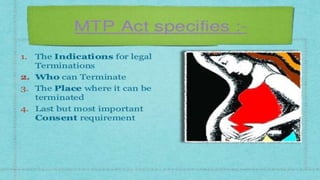
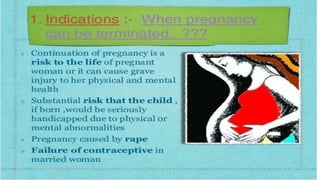
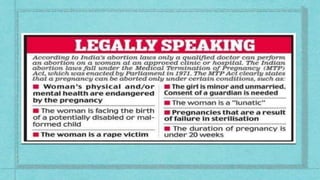
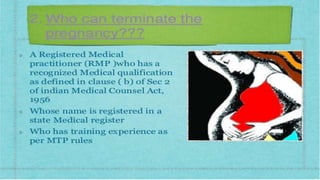
    INDUCED ABORTION: • Inducedabortion is deliberately interruption of an intact pregnancy. induced abortions are performed legally in india since the medical termination of pregnancy act of 1971.
  • 23.
    LEGAL: THERAPEUTIC ABORTION: • Thedeliberate induction of abortion on grounds of safety for the maternal life and health is termed as medical termination of pregnancy.
  • 35.
  • 36.
    SEPTIC ABORTION; COMMON •It is an abortion characterized by infection of the products of the conception and the uterus. • this condition is most commonly a complication of induced or incomplete abortion. • illegal abortion carried out in non sterile conditions often leads to septic abortion.
  • 37.
    CAUSES: • inexpert attemptat termination of pregnancy by passing sticks catheters,pastes or soap solution in to intrauterine cavity. • inevitable abortion with infection. • MTP with infection.
  • 38.
    CLINICAL MANIFESTATION: • Pyrexia •headache • nausea • foul smelling discharge per vagina • anexal masses -USG • uterine and tubes infection • septecemia with peritonitis • septic shock • gas gangrene of the uterus.
  • 39.
    TREATMENT: • Intravenous antibiotic •plvic abscess if present will be drained. • uterine evacuation by gentel curettage • heparinization to prevent intravascular coagulation • exchange transfusion.
  • 40.
  • 44.
    CLINICAL FEATURES OF ABRTION.1. Heavy spotting 2. vaginal Bleeding 3. discharge of tissue or fluid from vagina. 4. abdomen pain 5. back pain.
  • 45.
    METHODS OF TERMINATION OF PREGNCY mensturalregulation suction evacuation and curettage dilatation and evacuation pharmacological methods
  • 46.
    SECOND TRIMESTER 1)Intrauterine instillation 2) extra uterine instillation-ethacridine lactate 3) prostoglandin and oxytocin 4) hystreotomy
  • 47.
  • 48.
    COMPLICATIONS Pain bleeding low grade fever hematometra retainedproducts of conception uterine perforation bladder anbowel injury cervical shock cervical laceration
  • 49.
    cont... gynecological chronic pelvic inflammation infertility mensturaldisturbance scar endometriosis cervical incompetencebor preterm labor dysmaturity
  • 50.
    CONCLUSION Abortion is anybleeding in pregnancy is abnormal.The term miscaaiage and abortion are synonymous.There are various types in abortion.Treatment has to be given accordind to the types and time of abortion occurs.

Editor's Notes