BLEEDING IN EARLY
PREGNANCY
DR KTD PRIYADARSHANI
REGISTRAR IN EMERGENCY MEDICINE
NATIONAL HOSPITAL- KANDY
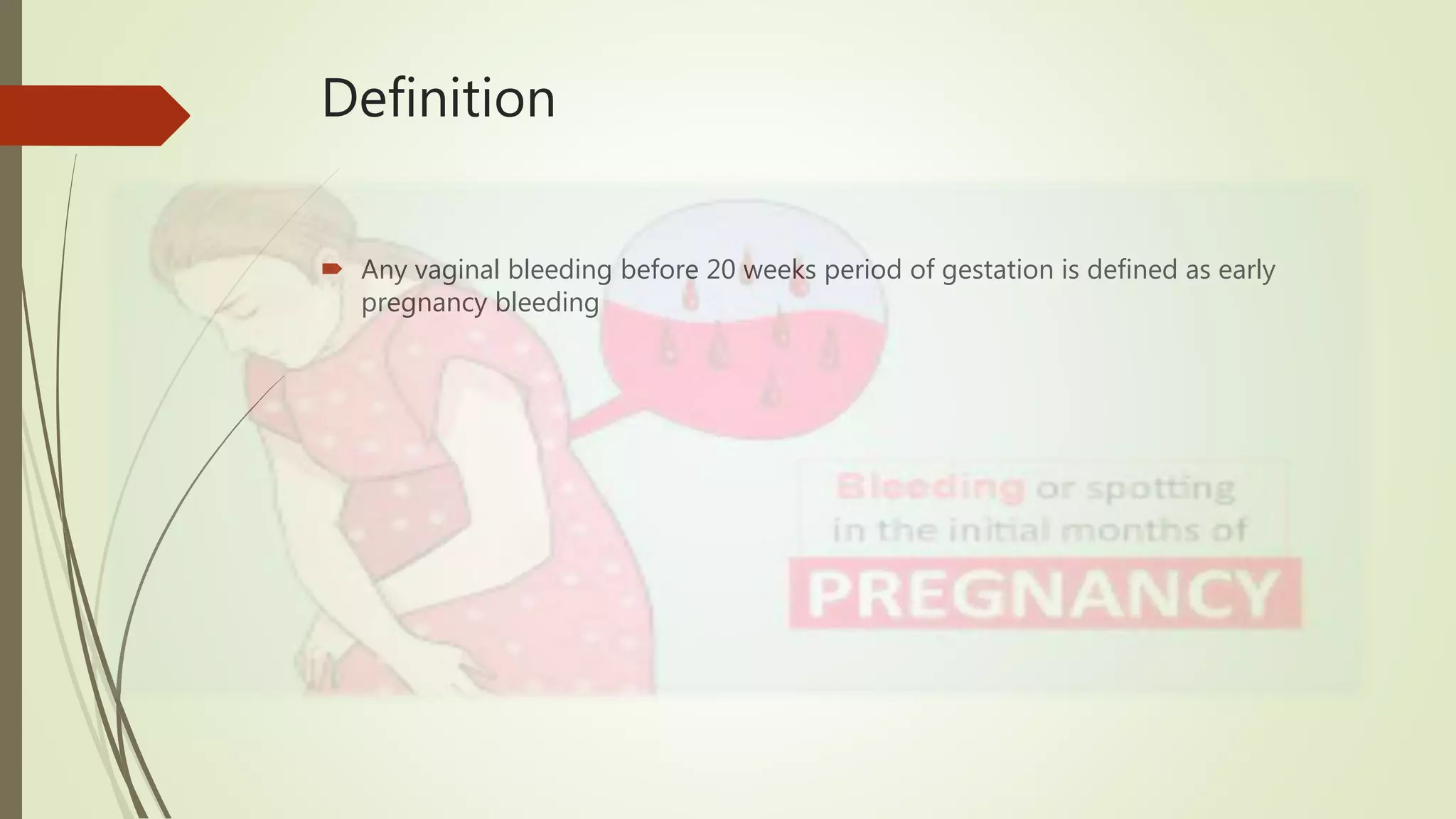
Definition
 Any vaginal bleeding before 20 weeks period of gestation is defined as early
pregnancy bleeding
Case scenario..
 A 37years old P4C2 mother presented to ETU with history of PV bleeding for 6days.
 It was a mild to moderate fresh bleeding.
 It was associated with abdominal pain.
 There was no fever or faintishness.
 She had good urine output.
 Her last regular menstrual period was 1st of July with POA of 7+5 weeks
 She was tested for urine hCG and found positive
Differential diagnoses to think about..
Bleeding in 1st
trimester
Related to pregnant
state
Miscarriage Ectopic pregnancy
Trophoblastic
disease
Septic abortion
Associated with the
pregnant state
Cervical erosion Cervical polyp Cervical malignancy Post coital bleeding
History
 Maternal age, parity, POA, Pregnancy confirmation
 Bleeding
 Number of episodes, Amount of blood loss, color
 Passage of clots or vesicles
 Purulent vaginal discharge, fever
 Associated symptoms- abdominal pain- quality, location, spread
 Past obs & gyn history
 Past medical, surgical history
 Drug history
 Social history
Case scenario..
 On admission PR was 88bpm. Blood pressure 120/80mmHg.
 Abdomen was soft in palpation.
 Speculum examination showed mild contact bleeding with closed OS
 VE- No adnexal tenderness or masses palpable
Examination
 General
 Febrile, pallor
 CVS
 PR, Pulse characteristics, BP, pulse pressure
 CRT, cold clammy peripheries
 Abdomen
 Tenderness, Guarding, rigidity
 Uterine size
 Speculum examination
 Bleeding from OS or from outside
 Products, clots, blood in posterior fornix
 VE
 Os open or closed
 Cervical excitation
 Adnexal tenderness/ masses
Resuscitation
 ABCDE approach
 Main concern in hemodynamic stability
 Fluid resuscitation depends on class of haemorrhage
 2 large bore IV cannula
 DT and reserve blood – 6units
 Urine HCG
 Rhesus status- antiD Immunoglobulin may be required
 Urgent O&G referral
This would now be a good time to think
about lab work…
 Urine hCG – already done
 FBC
 Blood grouping and Rh
 Clotting= risk of DIC
Urine HCG
USS (TAS/TVS) for
IUP
YES
FETAL HB/ PARTS
FHB+ Threatened
Miscarriage
Fetal products
incomplete
Miscarriage
SNOW STORM
H MOLE
S B hCG CXR
NO
PREGNANCY IN
ECTOPIC SITE
S B hCG
Miscarriage
Type of miscarriages
1. Threaten miscarriage
2. Inevitable miscarriage
3. Missed miscarriage
4. Incomplete miscarriage
5. Complete miscarriage
6. Pregnancy of uncertain viability
Definitions
Diagnosis
Management of miscarriages
 Factors to be taken into account
01. Type of miscarriage
02. Gestation at which miscarriage is diagnosed
03. Medical history, for example cardiac disease and sickle cell anemia
04. Facilities available at individual units
05. Cost
06. Patient preference
 Options
01. Expectant management
02. Medical management
03. Surgical management
Conti…
1. Expectant management
Up to 85% of miscarriages will resolve spontaneously within 3 weeks of the diagnosis
Need adequate counseling
02. Medical management
Induce evacuation with prostaglandin
Misoprostol (PGE1)
fallow FIGO guidance or NICE
03. Surgical management
ERPC
Ectopic pregnancy
Ectopic pregnancy
 Definition
Implantation of a fertilized ovum outside of endometrial cavity
 Types
1. Tubal ectopic pregnancy
2. Ovarian ectopic
3. Cervical ectopic
4. Interstitial ectopic
5. Abdominal ectopic
6. Caesarean scar ectopic
7. Heterotrophic ectopic
Ectopic pregnancy- diagnosis
 Primary diagnostic tool – USS preferably TVS
 Gold standard of diagnosis- laparoscopy
Management – Ectopic pregnancy
 Depend on number of factors
01.Symptoms profile – bleeding and degree of pain
02. Type of ectopic
03. Size of the ectopic
04. Level of serum beta Hcg
05 viability
 Options
01. Expectant management
02. Medical management
03. Surgical management
Conti…
Factor Expectant Medical Surgical
Type of ectopic(Tubal )
2. Symptoms No internal or genital
bleeding, no significant
abdominal pain
No internal or genital
bleeding, no significant
abdominal pain
Evidence of internal bleeding
and significant pain, unstable
3. Viability Non- viable Non- viable viable
4. Size of ectopic <30mm <35mm >35mm
5. Level of serum beta Hcg <1500 IU 1500 up to 5000 IU >1500IU
6. Procedure • Rpt beta Hcg on day 4
• If >15% drop
• Repeat weekly Hcg until
<20IU/L
• IM MTX 50mg/m2 single
dose
• Rpt beta Hcg day 4 and 7
• If drop >15% repeat
weekly until <15IU/L
To be decide on
Laparotomy/ laparoscopy
And salpingectomy /
salpingotomy
Gestational trophoblastic
disease
GTD
Classification
1. GTD
1. Complete mole
2. Partial mole
3. Atypical placental site nodule
2. GTN
1. Chorio carcinoma
2. Malignant invasive mole
3. Placental site trophoblastic tumor
4. Epithelioid trophoblastic tumor
Definitive diagnosis done by histological confirmation
Management of GTD
1. Patient counseling
2. Pre operative preparation
1. Investigation – FBC/ CXR/ base line beta Hcg level
2. Cross match and DT
3. Fasting
4. Informed written consent
3. Suction evacuation
4. Further management depend on histological diagnosis
Conti..
 CHM
 Do Beta Hcg level 1 – 2 weekly until normal
 Rpt Beta Hcg one monthly after normalization for 6 months
 PHM
 Do Beta Hcg level 1-2 weekly until normal
 Rpt beta Hcg level one month after normalization
REFERENCES
 Green top guideline No 21- Diagnosis and Management of Ectopic
Pregnancy
 Green top guideline No 38- Management of Gestational Trophoblastic
Disease
 NICE guideline- Ectopic pregnancy and miscarriage: diagnosis and initial
management
QUESTIONS?
Thank you!

Bleeding in early pregnancy

  • 1.
    BLEEDING IN EARLY PREGNANCY DRKTD PRIYADARSHANI REGISTRAR IN EMERGENCY MEDICINE NATIONAL HOSPITAL- KANDY
  • 2.
    Definition  Any vaginalbleeding before 20 weeks period of gestation is defined as early pregnancy bleeding
  • 3.
    Case scenario..  A37years old P4C2 mother presented to ETU with history of PV bleeding for 6days.  It was a mild to moderate fresh bleeding.  It was associated with abdominal pain.  There was no fever or faintishness.  She had good urine output.  Her last regular menstrual period was 1st of July with POA of 7+5 weeks  She was tested for urine hCG and found positive
  • 4.
    Differential diagnoses tothink about.. Bleeding in 1st trimester Related to pregnant state Miscarriage Ectopic pregnancy Trophoblastic disease Septic abortion Associated with the pregnant state Cervical erosion Cervical polyp Cervical malignancy Post coital bleeding
  • 5.
    History  Maternal age,parity, POA, Pregnancy confirmation  Bleeding  Number of episodes, Amount of blood loss, color  Passage of clots or vesicles  Purulent vaginal discharge, fever  Associated symptoms- abdominal pain- quality, location, spread  Past obs & gyn history  Past medical, surgical history  Drug history  Social history
  • 6.
    Case scenario..  Onadmission PR was 88bpm. Blood pressure 120/80mmHg.  Abdomen was soft in palpation.  Speculum examination showed mild contact bleeding with closed OS  VE- No adnexal tenderness or masses palpable
  • 7.
    Examination  General  Febrile,pallor  CVS  PR, Pulse characteristics, BP, pulse pressure  CRT, cold clammy peripheries  Abdomen  Tenderness, Guarding, rigidity  Uterine size  Speculum examination  Bleeding from OS or from outside  Products, clots, blood in posterior fornix  VE  Os open or closed  Cervical excitation  Adnexal tenderness/ masses
  • 8.
    Resuscitation  ABCDE approach Main concern in hemodynamic stability  Fluid resuscitation depends on class of haemorrhage  2 large bore IV cannula  DT and reserve blood – 6units  Urine HCG  Rhesus status- antiD Immunoglobulin may be required  Urgent O&G referral
  • 9.
    This would nowbe a good time to think about lab work…  Urine hCG – already done  FBC  Blood grouping and Rh  Clotting= risk of DIC
  • 10.
    Urine HCG USS (TAS/TVS)for IUP YES FETAL HB/ PARTS FHB+ Threatened Miscarriage Fetal products incomplete Miscarriage SNOW STORM H MOLE S B hCG CXR NO PREGNANCY IN ECTOPIC SITE S B hCG
  • 11.
  • 12.
    Type of miscarriages 1.Threaten miscarriage 2. Inevitable miscarriage 3. Missed miscarriage 4. Incomplete miscarriage 5. Complete miscarriage 6. Pregnancy of uncertain viability
  • 13.
  • 14.
  • 15.
    Management of miscarriages Factors to be taken into account 01. Type of miscarriage 02. Gestation at which miscarriage is diagnosed 03. Medical history, for example cardiac disease and sickle cell anemia 04. Facilities available at individual units 05. Cost 06. Patient preference  Options 01. Expectant management 02. Medical management 03. Surgical management
  • 16.
    Conti… 1. Expectant management Upto 85% of miscarriages will resolve spontaneously within 3 weeks of the diagnosis Need adequate counseling 02. Medical management Induce evacuation with prostaglandin Misoprostol (PGE1) fallow FIGO guidance or NICE 03. Surgical management ERPC
  • 17.
  • 18.
    Ectopic pregnancy  Definition Implantationof a fertilized ovum outside of endometrial cavity  Types 1. Tubal ectopic pregnancy 2. Ovarian ectopic 3. Cervical ectopic 4. Interstitial ectopic 5. Abdominal ectopic 6. Caesarean scar ectopic 7. Heterotrophic ectopic
  • 19.
    Ectopic pregnancy- diagnosis Primary diagnostic tool – USS preferably TVS  Gold standard of diagnosis- laparoscopy
  • 20.
    Management – Ectopicpregnancy  Depend on number of factors 01.Symptoms profile – bleeding and degree of pain 02. Type of ectopic 03. Size of the ectopic 04. Level of serum beta Hcg 05 viability  Options 01. Expectant management 02. Medical management 03. Surgical management
  • 21.
    Conti… Factor Expectant MedicalSurgical Type of ectopic(Tubal ) 2. Symptoms No internal or genital bleeding, no significant abdominal pain No internal or genital bleeding, no significant abdominal pain Evidence of internal bleeding and significant pain, unstable 3. Viability Non- viable Non- viable viable 4. Size of ectopic <30mm <35mm >35mm 5. Level of serum beta Hcg <1500 IU 1500 up to 5000 IU >1500IU 6. Procedure • Rpt beta Hcg on day 4 • If >15% drop • Repeat weekly Hcg until <20IU/L • IM MTX 50mg/m2 single dose • Rpt beta Hcg day 4 and 7 • If drop >15% repeat weekly until <15IU/L To be decide on Laparotomy/ laparoscopy And salpingectomy / salpingotomy
  • 22.
  • 23.
    GTD Classification 1. GTD 1. Completemole 2. Partial mole 3. Atypical placental site nodule 2. GTN 1. Chorio carcinoma 2. Malignant invasive mole 3. Placental site trophoblastic tumor 4. Epithelioid trophoblastic tumor Definitive diagnosis done by histological confirmation
  • 24.
    Management of GTD 1.Patient counseling 2. Pre operative preparation 1. Investigation – FBC/ CXR/ base line beta Hcg level 2. Cross match and DT 3. Fasting 4. Informed written consent 3. Suction evacuation 4. Further management depend on histological diagnosis
  • 25.
    Conti..  CHM  DoBeta Hcg level 1 – 2 weekly until normal  Rpt Beta Hcg one monthly after normalization for 6 months  PHM  Do Beta Hcg level 1-2 weekly until normal  Rpt beta Hcg level one month after normalization
  • 26.
    REFERENCES  Green topguideline No 21- Diagnosis and Management of Ectopic Pregnancy  Green top guideline No 38- Management of Gestational Trophoblastic Disease  NICE guideline- Ectopic pregnancy and miscarriage: diagnosis and initial management
  • 27.
  • 28.