SEPSIS/ SEPTIC
SHOCK IN
OBSTETRIC
PATIENTS
S.BUHOBE
DEFINITIONS
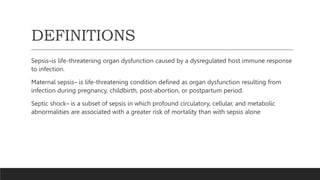
Sepsis–is life-threatening organ dysfunction caused by a dysregulated host immune response
to infection.
Maternal sepsis– is life-threatening condition defined as organ dysfunction resulting from
infection during pregnancy, childbirth, post-abortion, or postpartum period.
Septic shock– is a subset of sepsis in which profound circulatory, cellular, and metabolic
abnormalities are associated with a greater risk of mortality than with sepsis alone
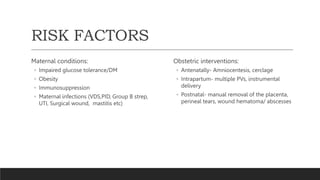
RISK FACTORS
Maternal conditions:
◦ Impaired glucose tolerance/DM
◦ Obesity
◦ Immunosuppression
◦ Maternal infections (VDS,PID, Group B strep,
UTI, Surgical wound, mastitis etc)
Obstetric interventions:
◦ Antenatally- Amniocentesis, cerclage
◦ Intrapartum- multiple PVs, instrumental
delivery
◦ Postnatal- manual removal of the placenta,
perineal tears, wound hematoma/ abscesses
MANAGEMENT
Early detection and treatment (GOLDEN HOUR)
Measurement of serum lactate levels.
If serum lactate level is more than 2 mmol/L, then recheck it.
Use of broad-spectrum antibiotics.
Send blood culture before use of antibiotics.
Use of intravenous crystalloid 30 mL/kg for hypotension or lactate level ≥ 4 mmol/L.
In case of hypotension, use a vasopressor to maintain mean arterial pressure more than 65 mmHg.
TREATMENT
The speed and intensity of response vary with the hemodynamic stability of the patient.
Patients who are hemodynamically unstable require emergency resuscitation (inotropes as
needed).
The patient may require management in the emergency department or operating room
setting to maximize resuscitation.
SCREENING OF SEPSIS
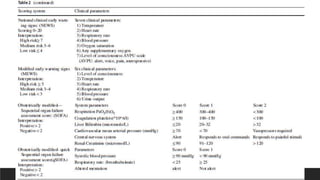
Different scoring systems scores are used :
◦ Sequential Organ Failure Assessment (SOFA)
◦ quick Sequential Organ Failure (qSOFA)
◦ Modified Early Warning or National early warning(NEWS)
RESUSCITATION
Sepsis and septic shock are medical emergencies, and IT IS recommended that treatment and
resuscitation begin immediately.
Establish IV access with a wide bore iv cannula.
For patients with sepsis induced hypoperfusion or septic shock at least 30 mL/kg of IV crystalloid
fluid should be given within the first 3 hours of resuscitation.
Aim for MAP of 65mmHg and lactate of <2.
Apply vasopressors for hypotension that is not responding to initial fluid resuscitation to maintain
mean arterial pressure (MAP) >65mmHg.
Admission to ICU should be with in 6hr.
EXAM
General appearance:- oriented, appears relax, agitated or distressed, wseating,
communicating well, regular breathing or hyperventilating, colour, hydration status and if
bed bound,
Vital signs:-BP, Pulse, Temperature.
CVS:- hyperdynamic state
Abdominal signs:- tenderness, signs of peritonism.
Gynaecological findings:- PV bleeding, lacerations, products of conception, discharge, cervix.
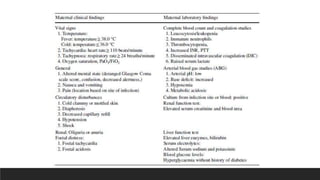
INVESTIGATIONS
Complete blood counts with differential and smear
Urine pregnancy test/ serum BHCG
Chemistries, liver function tests, and coagulation studies including D-dimer level, TEG.
CRP and Procalcitonin
Serum lactate - as an adjunct to the management protocol of endotoxic shock.
Peripheral blood cultures (aerobic and anaerobic cultures from at least two different sites)
Urinalysis
Arterial blood gas (ABG) analysis – ABGs may reveal acidosis, hypoxemia, or hypercapnia.
Cervical or high vaginal swab is taken prior to internal examination for MCS
Ultrasound:- can aid in the diagnosis by demonstrating retained products of conception,
pyometra, foreign body (intrauterine or intra-abdominal), free fluid in the peritoneal cavity or
in the pouch of Douglas (pelvic abscess).
Plain X-ray
◦ Abdomen—in suspected cases of bowel injury.
◦ Chest—for cases with pulmonary complications (atelectasis and ARDS).
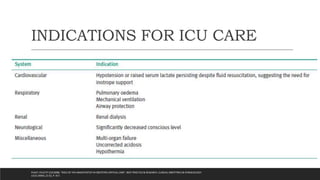
INDICATIONS FOR ICU CARE
PLAAT, FELICITY (10/2008). "ROLE OF THE ANAESTHETIST IN OBSTETRIC CRITICAL CARE". BEST PRACTICE & RESEARCH. CLINICAL OBSTETRICS & GYNAECOLOGY
(1521-6934), 22 (5), P. 917.
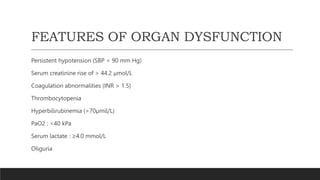
FEATURES OF ORGAN DYSFUNCTION
Persistent hypotension (SBP < 90 mm Hg)
Serum creatinine rise of > 44.2 μmol/L
Coagulation abnormalities (INR > 1.5)
Thrombocytopenia
Hyperbilirubinemia (>70µmil/L)
PaO2 : <40 kPa
Serum lactate : ≥4.0 mmol/L
Oliguria
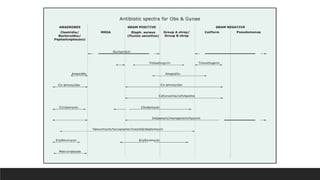
ANTIBIOTICS
For adults with possible septic shock or a high likelihood for sepsis, recommendation is to
administer antimicrobials immediately, ideally within one hour of recognition.
The combination of intravenous ampicillin, gentamicin, and metronidazole has been shown to
to have the highest laboratory susceptibility results while piperacillin-tazobactam provided
greatest single-agent microbial coverage.
Patients with suspected toxin-producing infection or group A Streptococcus benefit from
inclusion of clindamycin in their treatment regimen.
Antibiotic coverage is tailored once culture results are available.
FOUKS, Y., SAMUELOFF, O., LEVIN, I., MANY, A., AMIT, S. & COHEN, A. 2020, "ASSESSING THE EFFECTIVENESS OF EMPIRIC ANTIMICROBIAL REGIMENS IN CASES
OF SEPTIC/INFECTED ABORTIONS", THE AMERICAN JOURNAL OF EMERGENCY MEDICINE, VOL. 38, NO. 6, PP. 1123-1128
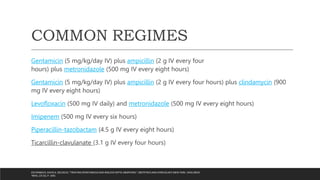
COMMON REGIMES
Gentamicin (5 mg/kg/day IV) plus ampicillin (2 g IV every four
hours) plus metronidazole (500 mg IV every eight hours)
Gentamicin (5 mg/kg/day IV) plus ampicillin (2 g IV every four hours) plus clindamycin (900
mg IV every eight hours)
Levofloxacin (500 mg IV daily) and metronidazole (500 mg IV every eight hours)
Imipenem (500 mg IV every six hours)
Piperacillin-tazobactam (4.5 g IV every eight hours)
Ticarcillin-clavulanate (3.1 g IV every four hours)
ESCHENBACH, DAVID A. (05/2015). "TREATING SPONTANEOUS AND INDUCED SEPTIC ABORTIONS". OBSTETRICS AND GYNECOLOGY (NEW YORK. 1953) (0029-
7844), 125 (5), P. 1042.
Once identified, eliminate the sources of infection such as specific anatomical sites or
intravenous access to curtail sources of infection.
This may involve evacuation of retained products of infection or intra-abdominal or pelvic
pus by medical or surgical procedure.
Daily evaluation to decrease the need of antibiotics over using fixed durations should be
done.
Clinical evaluation and procalcitonin measurement are used for further continuation of
antibiotics.
Other Therapies
Intravenous hydrocortisone should be reserved for septic refractory shock at a dose of
200 mg per day.
Use of prophylaxis for stress ulcer in patients who have a high risk of gastrointestinal tract
bleeding.
For venous thromboprophylaxis low molecular weight heparin is preferred.
OBSTETRIC MANAGEMENT
Stabilize the mother, after which the foetal health will improve.
Delivery will be determined by :
◦ including the patient's clinical parameters
◦ foetus lung maturity and gestational age
◦ the stage of labour
◦ any existence of uterine infection like chorioamnionitis.
COMPLICATIONS
Haemorrhage related due to abortion process and also due to the injury inflicted during the
interference.
Endotoxic shock—mostly due to E. coli or Cl. welchii infection.
Acute renal failure—multiple factors are involved producing patchy cortical necrosis or acute
tubular necrosis. It is common in infection with Cl. welchii.
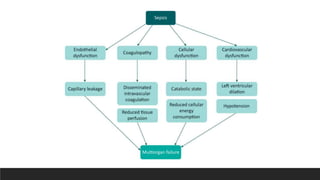
ARDS
DIC
Injury may occur to the uterus and also to the adjacent structures particularly the bowels.
Post traumatic stress disorder
PREVENTION
To optimise up family planning acceptance in order to curb the unwanted pregnancies.
Rigid enforcement of legalized abortion in practice and to curb the prevalence of unsafe
abortions. Education, motivation and extension of the facilities are sine qua non to get the
real benefit out of it.
To take antiseptic and aseptic precautions either during internal examination or during
operation in spontaneous abortion.
Administration of antibiotics are recommended in following conditions
◦ Colonisation of Group B Streptococcus for GBS infection prevention in newborns.
◦ Manual removal of placenta.
◦ (PPROM) Preterm and prelabour rupture of membranes.
◦ Perineal tear: Third/fourth degree
◦ Elective or emergency caesarean section.
◦ Operative vaginal delivery: use of vacuum or forceps
CONCLUSION
Septic abortions are a leading cause of maternal mortalities in 3rd world countries
Early recognition and treatment are paramount to survival.
REMEMBER TO RESCUSCITATE, START ANTIBIOTICS WITH IN THE HOUR OF PRESENTATION.
DO NOT DELAY LAPAROTOMY AND HYSTERECTOMY IN PATIENTS THAT ARE UNSTABLE,NOT
IMPROVING AND THOSE THAT ARE WORSENING.
SEPSIS.pptx

SEPSIS.pptx

  • 1.
  • 2.
    DEFINITIONS Sepsis–is life-threatening organdysfunction caused by a dysregulated host immune response to infection. Maternal sepsis– is life-threatening condition defined as organ dysfunction resulting from infection during pregnancy, childbirth, post-abortion, or postpartum period. Septic shock– is a subset of sepsis in which profound circulatory, cellular, and metabolic abnormalities are associated with a greater risk of mortality than with sepsis alone
  • 5.
    RISK FACTORS Maternal conditions: ◦Impaired glucose tolerance/DM ◦ Obesity ◦ Immunosuppression ◦ Maternal infections (VDS,PID, Group B strep, UTI, Surgical wound, mastitis etc) Obstetric interventions: ◦ Antenatally- Amniocentesis, cerclage ◦ Intrapartum- multiple PVs, instrumental delivery ◦ Postnatal- manual removal of the placenta, perineal tears, wound hematoma/ abscesses
  • 6.
    MANAGEMENT Early detection andtreatment (GOLDEN HOUR) Measurement of serum lactate levels. If serum lactate level is more than 2 mmol/L, then recheck it. Use of broad-spectrum antibiotics. Send blood culture before use of antibiotics. Use of intravenous crystalloid 30 mL/kg for hypotension or lactate level ≥ 4 mmol/L. In case of hypotension, use a vasopressor to maintain mean arterial pressure more than 65 mmHg.
  • 7.
    TREATMENT The speed andintensity of response vary with the hemodynamic stability of the patient. Patients who are hemodynamically unstable require emergency resuscitation (inotropes as needed). The patient may require management in the emergency department or operating room setting to maximize resuscitation.
  • 8.
    SCREENING OF SEPSIS Differentscoring systems scores are used : ◦ Sequential Organ Failure Assessment (SOFA) ◦ quick Sequential Organ Failure (qSOFA) ◦ Modified Early Warning or National early warning(NEWS)
  • 10.
    RESUSCITATION Sepsis and septicshock are medical emergencies, and IT IS recommended that treatment and resuscitation begin immediately. Establish IV access with a wide bore iv cannula. For patients with sepsis induced hypoperfusion or septic shock at least 30 mL/kg of IV crystalloid fluid should be given within the first 3 hours of resuscitation. Aim for MAP of 65mmHg and lactate of <2. Apply vasopressors for hypotension that is not responding to initial fluid resuscitation to maintain mean arterial pressure (MAP) >65mmHg. Admission to ICU should be with in 6hr.
  • 11.
    EXAM General appearance:- oriented,appears relax, agitated or distressed, wseating, communicating well, regular breathing or hyperventilating, colour, hydration status and if bed bound, Vital signs:-BP, Pulse, Temperature. CVS:- hyperdynamic state Abdominal signs:- tenderness, signs of peritonism. Gynaecological findings:- PV bleeding, lacerations, products of conception, discharge, cervix.
  • 12.
    INVESTIGATIONS Complete blood countswith differential and smear Urine pregnancy test/ serum BHCG Chemistries, liver function tests, and coagulation studies including D-dimer level, TEG. CRP and Procalcitonin Serum lactate - as an adjunct to the management protocol of endotoxic shock. Peripheral blood cultures (aerobic and anaerobic cultures from at least two different sites) Urinalysis Arterial blood gas (ABG) analysis – ABGs may reveal acidosis, hypoxemia, or hypercapnia.
  • 13.
    Cervical or highvaginal swab is taken prior to internal examination for MCS Ultrasound:- can aid in the diagnosis by demonstrating retained products of conception, pyometra, foreign body (intrauterine or intra-abdominal), free fluid in the peritoneal cavity or in the pouch of Douglas (pelvic abscess). Plain X-ray ◦ Abdomen—in suspected cases of bowel injury. ◦ Chest—for cases with pulmonary complications (atelectasis and ARDS).
  • 15.
    INDICATIONS FOR ICUCARE PLAAT, FELICITY (10/2008). "ROLE OF THE ANAESTHETIST IN OBSTETRIC CRITICAL CARE". BEST PRACTICE & RESEARCH. CLINICAL OBSTETRICS & GYNAECOLOGY (1521-6934), 22 (5), P. 917.
  • 16.
    FEATURES OF ORGANDYSFUNCTION Persistent hypotension (SBP < 90 mm Hg) Serum creatinine rise of > 44.2 μmol/L Coagulation abnormalities (INR > 1.5) Thrombocytopenia Hyperbilirubinemia (>70µmil/L) PaO2 : <40 kPa Serum lactate : ≥4.0 mmol/L Oliguria
  • 17.
    ANTIBIOTICS For adults withpossible septic shock or a high likelihood for sepsis, recommendation is to administer antimicrobials immediately, ideally within one hour of recognition. The combination of intravenous ampicillin, gentamicin, and metronidazole has been shown to to have the highest laboratory susceptibility results while piperacillin-tazobactam provided greatest single-agent microbial coverage. Patients with suspected toxin-producing infection or group A Streptococcus benefit from inclusion of clindamycin in their treatment regimen. Antibiotic coverage is tailored once culture results are available. FOUKS, Y., SAMUELOFF, O., LEVIN, I., MANY, A., AMIT, S. & COHEN, A. 2020, "ASSESSING THE EFFECTIVENESS OF EMPIRIC ANTIMICROBIAL REGIMENS IN CASES OF SEPTIC/INFECTED ABORTIONS", THE AMERICAN JOURNAL OF EMERGENCY MEDICINE, VOL. 38, NO. 6, PP. 1123-1128
  • 18.
    COMMON REGIMES Gentamicin (5mg/kg/day IV) plus ampicillin (2 g IV every four hours) plus metronidazole (500 mg IV every eight hours) Gentamicin (5 mg/kg/day IV) plus ampicillin (2 g IV every four hours) plus clindamycin (900 mg IV every eight hours) Levofloxacin (500 mg IV daily) and metronidazole (500 mg IV every eight hours) Imipenem (500 mg IV every six hours) Piperacillin-tazobactam (4.5 g IV every eight hours) Ticarcillin-clavulanate (3.1 g IV every four hours) ESCHENBACH, DAVID A. (05/2015). "TREATING SPONTANEOUS AND INDUCED SEPTIC ABORTIONS". OBSTETRICS AND GYNECOLOGY (NEW YORK. 1953) (0029- 7844), 125 (5), P. 1042.
  • 20.
    Once identified, eliminatethe sources of infection such as specific anatomical sites or intravenous access to curtail sources of infection. This may involve evacuation of retained products of infection or intra-abdominal or pelvic pus by medical or surgical procedure. Daily evaluation to decrease the need of antibiotics over using fixed durations should be done. Clinical evaluation and procalcitonin measurement are used for further continuation of antibiotics.
  • 21.
    Other Therapies Intravenous hydrocortisoneshould be reserved for septic refractory shock at a dose of 200 mg per day. Use of prophylaxis for stress ulcer in patients who have a high risk of gastrointestinal tract bleeding. For venous thromboprophylaxis low molecular weight heparin is preferred.
  • 22.
    OBSTETRIC MANAGEMENT Stabilize themother, after which the foetal health will improve. Delivery will be determined by : ◦ including the patient's clinical parameters ◦ foetus lung maturity and gestational age ◦ the stage of labour ◦ any existence of uterine infection like chorioamnionitis.
  • 23.
    COMPLICATIONS Haemorrhage related dueto abortion process and also due to the injury inflicted during the interference. Endotoxic shock—mostly due to E. coli or Cl. welchii infection. Acute renal failure—multiple factors are involved producing patchy cortical necrosis or acute tubular necrosis. It is common in infection with Cl. welchii. ARDS DIC Injury may occur to the uterus and also to the adjacent structures particularly the bowels. Post traumatic stress disorder
  • 24.
    PREVENTION To optimise upfamily planning acceptance in order to curb the unwanted pregnancies. Rigid enforcement of legalized abortion in practice and to curb the prevalence of unsafe abortions. Education, motivation and extension of the facilities are sine qua non to get the real benefit out of it. To take antiseptic and aseptic precautions either during internal examination or during operation in spontaneous abortion.
  • 25.
    Administration of antibioticsare recommended in following conditions ◦ Colonisation of Group B Streptococcus for GBS infection prevention in newborns. ◦ Manual removal of placenta. ◦ (PPROM) Preterm and prelabour rupture of membranes. ◦ Perineal tear: Third/fourth degree ◦ Elective or emergency caesarean section. ◦ Operative vaginal delivery: use of vacuum or forceps
  • 26.
    CONCLUSION Septic abortions area leading cause of maternal mortalities in 3rd world countries Early recognition and treatment are paramount to survival. REMEMBER TO RESCUSCITATE, START ANTIBIOTICS WITH IN THE HOUR OF PRESENTATION. DO NOT DELAY LAPAROTOMY AND HYSTERECTOMY IN PATIENTS THAT ARE UNSTABLE,NOT IMPROVING AND THOSE THAT ARE WORSENING.