SHIP DRY DOCKING
WALKTROUGH THROUGH THE BASICS OF DRY DOCKING , PREPARED USING THE
KNOWLEDGE GAINED AS AN INTERN AT A PUBLIC SECTOR SHIPYARD IN INDIA
Jishnu Saji ,
Dept. Of Naval Architecture & Shipbuilding ,
SNGCE , Kerala ,
India
What is dry docking ?
Well simply put, it is docking the vessel in such a way so as
to expose all the wetted area for inspection , repair and
maintenance. Obviously this will also be a good time to
undertake the maximum repairs and inspection jobs. This
is a period when the vessel is docked in a facility which is
best equipped for all hull and machinery jobs and
therefore all major inspections are also scheduled during
this operation
WHY DRY DOCK THE SHIP ?
The dry dock is not required by SOLAS , MARPOL ,
TONNAGE OR LOADLINE conventions. It is actually a
CLASS society requirement. This is to conduct the
docking survey as per the classification society. The
docking survey is part of the periodical survey
conducted by the classification society in order to
maintain the vessel in class. The docking surveys are
conducted by the class societies surveyors.
The durations to conduct dry dock
• For ships of up-to 15 years age (before the 3rd special
survey ) 2 dry docks in each window of 5 years.
• The duration between above two surveys will be at-least
2 years and maximum 3 years.
• For ships over 15 years of age (beyond the 3rd special
survey ) dry dock every 2 years.
MAIN AREAS OF INTEREST IN DRY DOCK INSPECTION
• Shell plating
• Side shell coating
• Stern frame
• Rudder
• Propeller
• Sacrificial anodes / ICCP arrangement
• Logs and echo sounder transducer
• Anchor and cable
• Chain locker
• Sea suctions and chests
• Bilge keel and fittings
Personnel involved
• Ship’s officers
• Manager’s superintendent
• Ship repair manager ( from Dry dock)
• Class society’s surveyor / surveyors
• Repair foremen
• Paint company’s representative (the company who’s paint you will use on your hull)
• Sub-contractors representative ( eg. Radio or automation company for specific jobs )
In case the dry dock is following a damage or accident then it will be necessary
for a H&M underwriter and the owners P&I correspondent to also attend.
Generally following is the sequence followed:-
• Vessel will maintain a running defect list.
• The defects which warrant attendance in the dry dock will be moved to a dry dock file.
• The contents of the dry dock repairs is updated to include all the particulars and plans
relevant to the repair or maintenance.
• Basis of the current contents of the dry docking file , a consolidated initial Dry dock
specification will be generated.
• This copy is considered both by ship’s officers as well as the manager’s superintendent.
• With due review of the specs, they are finalized and forwarded to various dry docks for
raising quotations.
• Basis of the vessels operating area and availability of dock ,,also most importantly ,,the
tenders submitted by the various dry docks ,the vessel is booked for dry dock in a
particular period.
• Charterers are informed and the vessel is arranged to go out of
employment for the period it is to be in the dry dock.
• It is common for most ship owners to maintain patronage with a
particular group of dry docks and try to arrange the employment of their
vessels in such a fashion that they may disengage and proceed for dry
dock without wasting too much time in transit.
• Ship’s plans are forwarded to the dry dock in advance.
• A docking plan is discussed.
• Keel blocks are laid as per the vessel’s docking plan.
• Stability calculations are prepared prior arriving at the dry dock.
• In consultation with the dry dock the docking trim is agreed upon.
Structural features of the ship are considered.
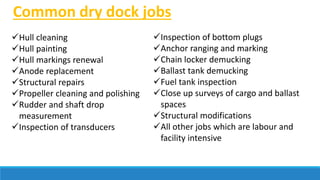
Common dry dock jobs
Hull cleaning
Hull painting
Hull markings renewal
Anode replacement
Structural repairs
Propeller cleaning and polishing
Rudder and shaft drop
measurement
Inspection of transducers
Inspection of bottom plugs
Anchor ranging and marking
Chain locker demucking
Ballast tank demucking
Fuel tank inspection
Close up surveys of cargo and ballast
spaces
Structural modifications
All other jobs which are labour and
facility intensive
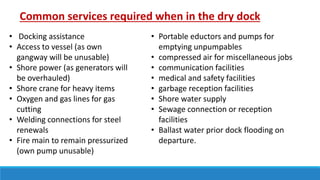
Common services required when in the dry dock
• Docking assistance
• Access to vessel (as own
gangway will be unusable)
• Shore power (as generators will
be overhauled)
• Shore crane for heavy items
• Oxygen and gas lines for gas
cutting
• Welding connections for steel
renewals
• Fire main to remain pressurized
(own pump unusable)
• Portable eductors and pumps for
emptying unpumpables
• compressed air for miscellaneous jobs
• communication facilities
• medical and safety facilities
• garbage reception facilities
• Shore water supply
• Sewage connection or reception
facilities
• Ballast water prior dock flooding on
departure.
SPECIFIC GUIDANCE
ON HULL MAINTENANCE
When asking for quotations for hull fabric maintenance it is necessary to make an accurate
assessment of corrosion on the side shell and also the area of various sectors as follows:-
Formulae for Accessing area
underwater area = [ (2X Keel to waterline + Breadth ] X LBP X block co.eff
also :- Wetted area = 2.58 X displacement X LOA
Underwater Vertical sides area = (2 X Keel to waterline) X LCB X (Breadth / 2)
Dry vertical side area = 2 X Freeboard X { LOA +( Breadth/2)}
Boot top strip = 2 X Bw X {LBP + (breadth /2)}
Flat bottom = u/w area – wetted vertical sides (as calculated above)
In contemporary use and practical application it is common for
vessel to be provided with a paint manual which will include all
above information about the vessel and same may be referred for
raising quotations.
When noting the area to be grit blasted a set of reference cards are
used. Each card has a picture of a surface with corrosion. It is
marked as 5% surface corroded, 10% surface corroded, 20%
surface corroded etc..
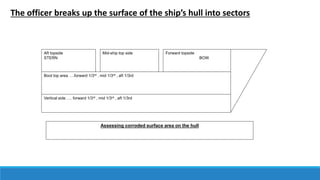
The officer breaks up the surface of the ship’s hull into sectors
Aft topside
STERN
Mid-ship top side Forward topside
BOW
Boot top area ….forward 1/3rd , mid 1/3rd , aft 1/3rd
Vertical side …. forward 1/3rd , mid 1/3rd , aft 1/3rd
Assessing corroded surface area on the hull
Once the area corroded is
established we do the
following:
• Area corroded + 10% = area to grit blast
• If area to blast is > 65% of total area then might as well grit blast the whole with almost same
expense.
• One of the major expenses during a dry docking is the hull cleaning, grit blasting and coating. For
this purpose the owners engage a particular paint company. It is usual for the company to send a
paint manager to attend to the whole process. His job is to monitor surface preparation , cleaning
and painting process. It must be ensured that panting is not done in conditions of excessive relative
humidity (air temp should ideally be 3 to 5 degrees above the dew point of the air )
• The area which has been blasted will be touched up with a first coat which will overlap up-to 10%
beyond the blasted area. The second coat will overlap 20% of the blasted area. The whole process
of mixing and preparing paints and also application renders about 10 to 20 % wastage and this
should be accounted for when ordering paints.
• The “touch dry “ and curing times of various layers must be well understood.
STABILITY
CONSIDERATIONS
ON DOCKING AND
UNDOCKING
When the vessel takes to the dry dock keel blocks it
experiences an upthrust on the point where the hull
makes contact with the block. This upthrust can be
considered as the discharging of weights from that point.
You can understand that if we discharge weights from
the bottom of the vessel we shall cause the centre of
gravity of the ship to rapidly rise. Due to this rise in COG,
there is a virtual loss of GM, which may render the vessel
in an unsafe , unstable condition if due regard is not
given to anticipate this loss of GM.
Vessel must have :-
• Adequate initial GM so that despite the loss of GM (apperant loss ) the vessel
shall still have residual positive GM and remain in stable equilibrium )
• Must have minimum trim (preferably by stern ) to ensure not too much
upthrust is generated ( upthrust = trim at time of taking blocks X MCTC )
• Vessel must arrive upright to avoid any problems when taking to the blocks
• Appreciate that RM = (W-P) X GM sin heel – P X KG sin heel ) hence have min
GM required to have adequate RM to keep vessel upright
• Pre-empt all intermediate GM and drafts fwd and aft for the critical period.
• Pre-calculate the draft at the time that blocks are takes all over.
Excessive trim = excessive up-thrust = excessive load on the stern frame
= excessive loss in GM.
Hence a minimum or moderate trim must be arrived at for purpose of docking. Also
disposition of ballast for refloatation must be such that the trim on refloatation is also not
excessive to avoid the same problems. Here you must appreciate that ballast has to be put
back in the tanks by shore facilities to allow refloatation trim to be achieved. As this is a
paid facility owners will press you to refloat with the minimum ballast. In this case the
minimum ballast to take will be such that the Main sea suction must be submerged on
floatation so that M/E cooling is achieved and further ballasting may be done by vessel.
The distribution of such ballast will again take into account the trim on refloatation.
This presentation gives very
limited knowledge ,but
covered the very basics of
dry docking procedures.
DO NOT REPRODUCE/EDIT THIS DOCUMENT ,
THANK YOU

Ship dry docking

  • 1.
    SHIP DRY DOCKING WALKTROUGHTHROUGH THE BASICS OF DRY DOCKING , PREPARED USING THE KNOWLEDGE GAINED AS AN INTERN AT A PUBLIC SECTOR SHIPYARD IN INDIA Jishnu Saji , Dept. Of Naval Architecture & Shipbuilding , SNGCE , Kerala , India
  • 2.
    What is drydocking ? Well simply put, it is docking the vessel in such a way so as to expose all the wetted area for inspection , repair and maintenance. Obviously this will also be a good time to undertake the maximum repairs and inspection jobs. This is a period when the vessel is docked in a facility which is best equipped for all hull and machinery jobs and therefore all major inspections are also scheduled during this operation
  • 3.
    WHY DRY DOCKTHE SHIP ? The dry dock is not required by SOLAS , MARPOL , TONNAGE OR LOADLINE conventions. It is actually a CLASS society requirement. This is to conduct the docking survey as per the classification society. The docking survey is part of the periodical survey conducted by the classification society in order to maintain the vessel in class. The docking surveys are conducted by the class societies surveyors.
  • 4.
    The durations toconduct dry dock • For ships of up-to 15 years age (before the 3rd special survey ) 2 dry docks in each window of 5 years. • The duration between above two surveys will be at-least 2 years and maximum 3 years. • For ships over 15 years of age (beyond the 3rd special survey ) dry dock every 2 years.
  • 5.
    MAIN AREAS OFINTEREST IN DRY DOCK INSPECTION • Shell plating • Side shell coating • Stern frame • Rudder • Propeller • Sacrificial anodes / ICCP arrangement • Logs and echo sounder transducer • Anchor and cable • Chain locker • Sea suctions and chests • Bilge keel and fittings
  • 6.
    Personnel involved • Ship’sofficers • Manager’s superintendent • Ship repair manager ( from Dry dock) • Class society’s surveyor / surveyors • Repair foremen • Paint company’s representative (the company who’s paint you will use on your hull) • Sub-contractors representative ( eg. Radio or automation company for specific jobs ) In case the dry dock is following a damage or accident then it will be necessary for a H&M underwriter and the owners P&I correspondent to also attend.
  • 8.
    Generally following isthe sequence followed:- • Vessel will maintain a running defect list. • The defects which warrant attendance in the dry dock will be moved to a dry dock file. • The contents of the dry dock repairs is updated to include all the particulars and plans relevant to the repair or maintenance. • Basis of the current contents of the dry docking file , a consolidated initial Dry dock specification will be generated. • This copy is considered both by ship’s officers as well as the manager’s superintendent. • With due review of the specs, they are finalized and forwarded to various dry docks for raising quotations. • Basis of the vessels operating area and availability of dock ,,also most importantly ,,the tenders submitted by the various dry docks ,the vessel is booked for dry dock in a particular period.
  • 9.
    • Charterers areinformed and the vessel is arranged to go out of employment for the period it is to be in the dry dock. • It is common for most ship owners to maintain patronage with a particular group of dry docks and try to arrange the employment of their vessels in such a fashion that they may disengage and proceed for dry dock without wasting too much time in transit. • Ship’s plans are forwarded to the dry dock in advance. • A docking plan is discussed. • Keel blocks are laid as per the vessel’s docking plan. • Stability calculations are prepared prior arriving at the dry dock. • In consultation with the dry dock the docking trim is agreed upon. Structural features of the ship are considered.
  • 10.
    Common dry dockjobs Hull cleaning Hull painting Hull markings renewal Anode replacement Structural repairs Propeller cleaning and polishing Rudder and shaft drop measurement Inspection of transducers Inspection of bottom plugs Anchor ranging and marking Chain locker demucking Ballast tank demucking Fuel tank inspection Close up surveys of cargo and ballast spaces Structural modifications All other jobs which are labour and facility intensive
  • 11.
    Common services requiredwhen in the dry dock • Docking assistance • Access to vessel (as own gangway will be unusable) • Shore power (as generators will be overhauled) • Shore crane for heavy items • Oxygen and gas lines for gas cutting • Welding connections for steel renewals • Fire main to remain pressurized (own pump unusable) • Portable eductors and pumps for emptying unpumpables • compressed air for miscellaneous jobs • communication facilities • medical and safety facilities • garbage reception facilities • Shore water supply • Sewage connection or reception facilities • Ballast water prior dock flooding on departure.
  • 12.
  • 13.
    When asking forquotations for hull fabric maintenance it is necessary to make an accurate assessment of corrosion on the side shell and also the area of various sectors as follows:- Formulae for Accessing area underwater area = [ (2X Keel to waterline + Breadth ] X LBP X block co.eff also :- Wetted area = 2.58 X displacement X LOA Underwater Vertical sides area = (2 X Keel to waterline) X LCB X (Breadth / 2) Dry vertical side area = 2 X Freeboard X { LOA +( Breadth/2)} Boot top strip = 2 X Bw X {LBP + (breadth /2)} Flat bottom = u/w area – wetted vertical sides (as calculated above)
  • 14.
    In contemporary useand practical application it is common for vessel to be provided with a paint manual which will include all above information about the vessel and same may be referred for raising quotations. When noting the area to be grit blasted a set of reference cards are used. Each card has a picture of a surface with corrosion. It is marked as 5% surface corroded, 10% surface corroded, 20% surface corroded etc..
  • 15.
    The officer breaksup the surface of the ship’s hull into sectors Aft topside STERN Mid-ship top side Forward topside BOW Boot top area ….forward 1/3rd , mid 1/3rd , aft 1/3rd Vertical side …. forward 1/3rd , mid 1/3rd , aft 1/3rd Assessing corroded surface area on the hull
  • 16.
    Once the areacorroded is established we do the following:
  • 17.
    • Area corroded+ 10% = area to grit blast • If area to blast is > 65% of total area then might as well grit blast the whole with almost same expense. • One of the major expenses during a dry docking is the hull cleaning, grit blasting and coating. For this purpose the owners engage a particular paint company. It is usual for the company to send a paint manager to attend to the whole process. His job is to monitor surface preparation , cleaning and painting process. It must be ensured that panting is not done in conditions of excessive relative humidity (air temp should ideally be 3 to 5 degrees above the dew point of the air ) • The area which has been blasted will be touched up with a first coat which will overlap up-to 10% beyond the blasted area. The second coat will overlap 20% of the blasted area. The whole process of mixing and preparing paints and also application renders about 10 to 20 % wastage and this should be accounted for when ordering paints. • The “touch dry “ and curing times of various layers must be well understood.
  • 18.
  • 19.
    When the vesseltakes to the dry dock keel blocks it experiences an upthrust on the point where the hull makes contact with the block. This upthrust can be considered as the discharging of weights from that point. You can understand that if we discharge weights from the bottom of the vessel we shall cause the centre of gravity of the ship to rapidly rise. Due to this rise in COG, there is a virtual loss of GM, which may render the vessel in an unsafe , unstable condition if due regard is not given to anticipate this loss of GM.
  • 20.
    Vessel must have:- • Adequate initial GM so that despite the loss of GM (apperant loss ) the vessel shall still have residual positive GM and remain in stable equilibrium ) • Must have minimum trim (preferably by stern ) to ensure not too much upthrust is generated ( upthrust = trim at time of taking blocks X MCTC ) • Vessel must arrive upright to avoid any problems when taking to the blocks • Appreciate that RM = (W-P) X GM sin heel – P X KG sin heel ) hence have min GM required to have adequate RM to keep vessel upright • Pre-empt all intermediate GM and drafts fwd and aft for the critical period. • Pre-calculate the draft at the time that blocks are takes all over.
  • 22.
    Excessive trim =excessive up-thrust = excessive load on the stern frame = excessive loss in GM. Hence a minimum or moderate trim must be arrived at for purpose of docking. Also disposition of ballast for refloatation must be such that the trim on refloatation is also not excessive to avoid the same problems. Here you must appreciate that ballast has to be put back in the tanks by shore facilities to allow refloatation trim to be achieved. As this is a paid facility owners will press you to refloat with the minimum ballast. In this case the minimum ballast to take will be such that the Main sea suction must be submerged on floatation so that M/E cooling is achieved and further ballasting may be done by vessel. The distribution of such ballast will again take into account the trim on refloatation.
  • 23.
    This presentation givesvery limited knowledge ,but covered the very basics of dry docking procedures.
  • 24.
    DO NOT REPRODUCE/EDITTHIS DOCUMENT , THANK YOU