

Ship Energy Efficiency
Management
Mohammud Hanif Dewan, IEng IMarEng IMarEST MRINA
Lecturer, Malaysian Maritime Academy
1
350
300
250
200
150
Years Before Present
Source: IPCC (Intergovernmental Panel on
Climate Change) Assessment Report 2014
0100,000200,000300,000400,000
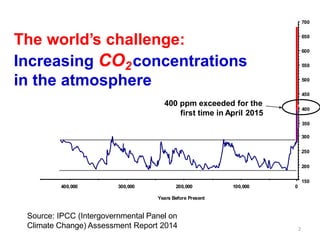
The world’s challenge:
Increasing CO2concentrations
in the atmosphere
400
450
500
550
600
650
700
400 ppm exceeded for the
first time in April 2015
2
Global Warming
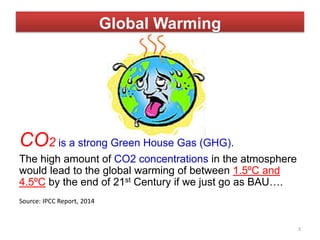
CO2 is a strong Green House Gas (GHG).
The high amount of CO2 concentrations in the atmosphere
would lead to the global warming of between 1.5ºC and
4.5ºC by the end of 21st Century if we just go as BAU….
Source: IPCC Report, 2014
3
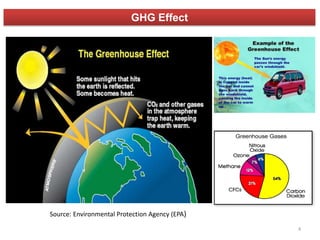
GHG Effect
4
Source: Environmental Protection Agency (EPA)
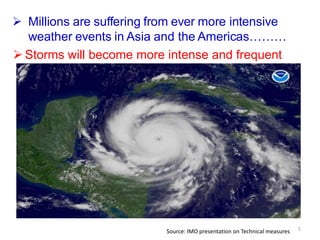
 Millions are suffering from ever more intensive
weather events in Asia and the Americas………
Source: IMO presentation on Technical measures 5
 Storms will become more intense and frequent
6
Ice caps are melting & glaciers are
shrinking in the Arctic.
7
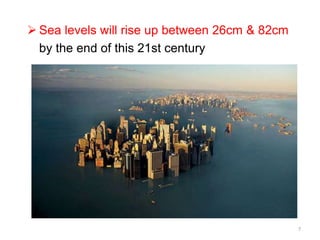
 Sea levels will rise up between 26cm & 82cm
by the end of this 21st century
8
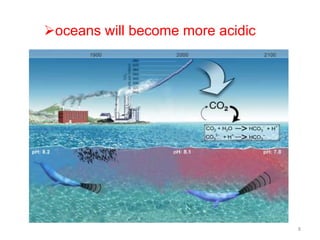
oceans will become more acidic
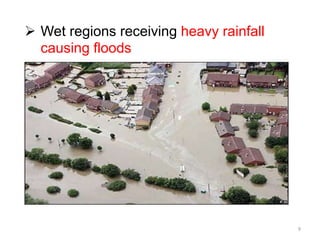
 Wet regions receiving heavy rainfall
causing floods
9
10
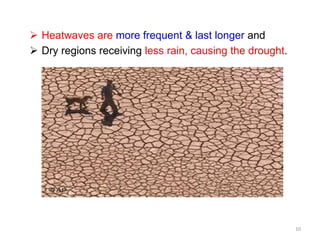
 Heatwaves are more frequent & last longer and
 Dry regions receiving less rain, causing the drought.
7
Source: IMO presentation on Technical measures
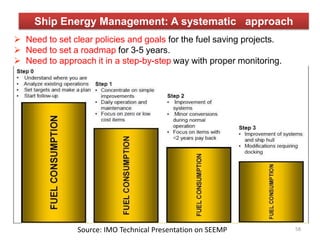
Because of so much CO2 Emissions everyday………..
11
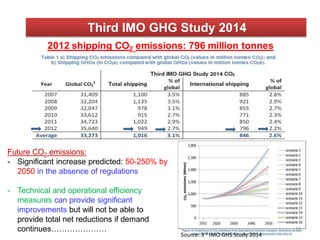
Third IMO GHG Study 2014
Future CO2 emissions:
- Significant increase predicted: 50-250% by
2050 in the absence of regulations
- Technical and operational efficiency
measures can provide significant
improvements but will not be able to
provide total net reductions if demand
continues…………………
Source: 3rd IMO GHS Study 2014
12
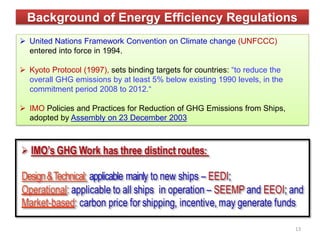
Background of Energy Efficiency Regulations
 United Nations Framework Convention on Climate change (UNFCCC)
entered into force in 1994.
 Kyoto Protocol (1997), sets binding targets for countries: “to reduce the
overall GHG emissions by at least 5% below existing 1990 levels, in the
commitment period 2008 to 2012.“
 IMO Policies and Practices for Reduction of GHG Emissions from Ships,
adopted by Assembly on 23 December 2003
13
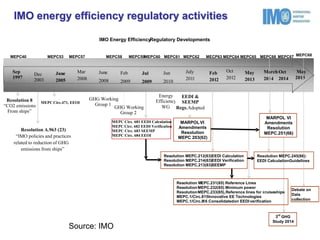
IMO energy efficiency regulatory activities
MEPC68
IMO Energy EfficiencyRegulatory Developments
Resolution MEPC.212(63)EEDI Calculation
Resolution MEPC.214(63)EEDI Verification
Resolution MEPC.213(63)SEEMP
Resolution A.963 (23)
“IMO policies and practices
related to reduction of GHG
emissions from ships”
Dec
2003
June
2005
Mar
2008
June
2008
GHG Working
Group 2
Feb
2009
MEPC Circ. 681 EEDI Calculation
MEPC Circ. 682 EEDI Verification
MEPC Circ. 683 SEEMP
MEPC Circ. 684 EEOI
Jul
2009
Energy
Efficiency
WG
Jun
2010
Sep
1997
Feb
2012
July
2011
EEDI &
SEEMP
Regs.Adopted
GHG Working
Group 1
MEPC40 MEPC53 MEPC57 MEPC58 MEPC59MEPC60 MEPC61 MEPC62 MECP63 MEPC64 MEPC65 MEPC66 MEPC67
Resolution 8
“CO2 emissions
From ships”
MARPOLVI
Amendments
Resolution
MEPC 203(62)
May
2013
March
2014
Oct
2012
MEPC Circ.471, EEOI
Oct May
20152014
3
rd
GHG
Study 2014
MARPOL VI
Amendments
Resolution
MEPC.251(66)
Resolution MEPC.245(66):
EEDI CalculationGuidelines
Resolution MEPC.231(65) Reference Lines
Resolution MEPC.232(65) Minimum power
ResolutionMEPC.233(65),Reference lines for cruiseships
MEPC.1/Circ.815Innovative EE Technologies
MEPC.1/Circ.816 Consolidatedon EEDI verification
Debate on
Data
collection
Source: IMO
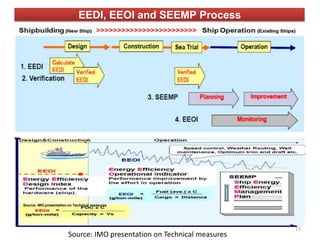
EEDI, EEOI and SEEMP Process
Source: IMO presentation on Technical measures
15
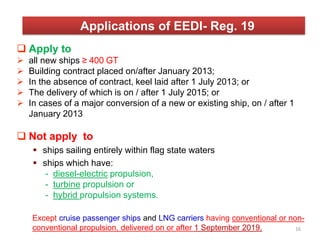
Applications of EEDI- Reg. 19
 Apply to
 all new ships ≥ 400 GT
 Building contract placed on/after January 2013;
 In the absence of contract, keel laid after 1 July 2013; or
 The delivery of which is on / after 1 July 2015; or
 In cases of a major conversion of a new or existing ship, on / after 1
January 2013
 Not apply to
 ships sailing entirely within flag state waters
 ships which have:
- diesel-electric propulsion,
- turbine propulsion or
- hybrid propulsion systems.
Except cruise passenger ships and LNG carriers having conventional or non-
conventional propulsion, delivered on or after 1 September 2019. 16
Attained EEDI- Reg. 20
Energy Efficiency Design Index (EEDI)
 EEDI is an index which quantify the amount of CO2 is emitted
by a ship while transported 1 ton cargo 1 knot (cargo transport)
 The actual EEDI of a vessel is called the “attained EEDI” and is
calculated based on guidelines published by IMO
(Resolution MEPC.245-66).
 Attained EEDI ≤ Required EEDI
 Attain EEDI” specific to each new ship ……… and be accompanied
by the EEDI Technical File…….
17
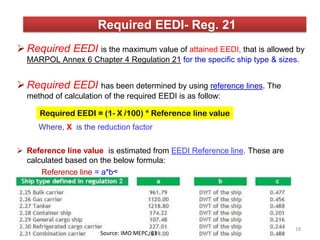
Required EEDI- Reg. 21
Required EEDI is the maximum value of attained EEDI, that is allowed by
MARPOL Annex 6 Chapter 4 Regulation 21 for the specific ship type & sizes.
Required EEDI has been determined by using reference lines. The
method of calculation of the required EEDI is as follow:
Where, X is the reduction factor
 Reference line value is estimated from EEDI Reference line. These are
calculated based on the below formula:
Reference line = a*b-c
18
Source: IMO MEPC, 63
Required EEDI = (1- X /100) * Reference line value
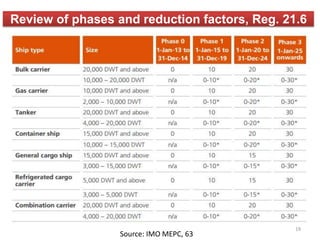
Review of phases and reduction factors, Reg. 21.6
Source: IMO MEPC, 63
19
Main Engine(s) Aux
Engine(s)
Innovative Energy Eff.
Power Gen.
Technologies
Innovative
Energy Eff.
Propulsion
Technologies
Boilers are excluded from EEDI
EEDI =
[gCO2/(tonne.nm)]
fc.
Attained EEDI: Calculation formula
Source: IMO presentation on
Technical measures
20
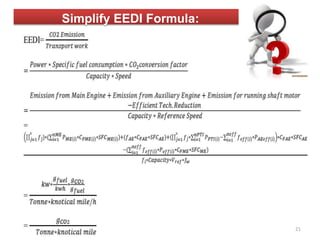
Simplify EEDI Formula:
21
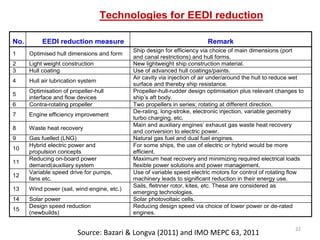
Technologies for EEDI reduction
No. EEDI reduction measure Remark
1 Optimised hull dimensions and form
Ship design for efficiency via choice of main dimensions (port
and canal restrictions) and hull forms.
2 Light weight construction New lightweight ship construction material.
3 Hull coating Use of advanced hull coatings/paints.
4 Hull air lubrication system
Air cavity via injection of air under/around the hull to reduce wet
surface and thereby ship resistance.
5
Optimisation of propeller-hull
interface and flow devices
Propeller-hull-rudder design optimisation plus relevant changes to
ship’s aft body.
6 Contra-rotating propeller Two propellers in series; rotating at different direction.
7 Engine efficiency improvement
De-rating, long-stroke, electronic injection, variable geometry
turbo charging, etc.
8 Waste heat recovery
Main and auxiliary engines’ exhaust gas waste heat recovery
and conversion to electric power.
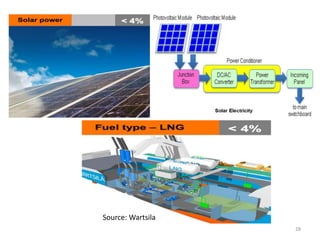
9 Gas fuelled (LNG) Natural gas fuel and dual fuel engines.
10
Hybrid electric power and
propulsion concepts
For some ships, the use of electric or hybrid would be more
efficient.
11
Reducing on-board power
demand(auxiliary system
andhotelloads).
Maximum heat recovery and minimizing required electrical loads
flexible power solutions and power management.
12
Variable speed drive for pumps,
fans etc.
Use of variable speed electric motors for control of rotating flow
machinery leads to significant reduction in their energy use.
13 Wind power (sail, wind engine, etc.)
Sails, fletnner rotor, kites, etc. These are considered as
emerging technologies.
14 Solar power Solar photovoltaic cells.
15
Design speed reduction
(newbuilds)
Reducing design speed via choice of lower power or de-rated
engines.
Source: Bazari & Longva (2011) and IMO MEPC 63, 2011
22
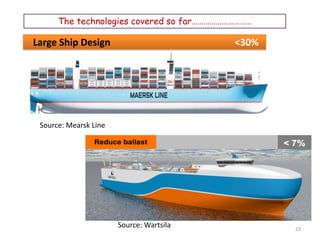
Large Ship Design <30%
Source: Mearsk Line
Source: Wartsila
The technologies covered so far…………………………
23
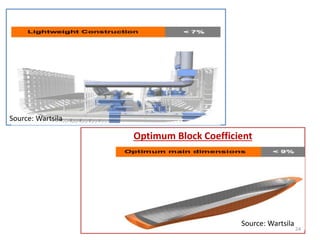
Lightweight Structures
Optimum Block Coefficient
Source: Wartsila
Source: Wartsila
24
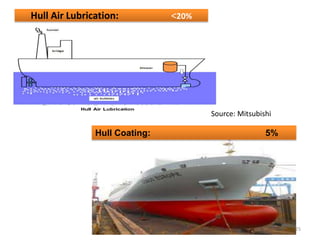
Hull Air Lubrication: <20%
Hull Coating: 5%
Source: Mitsubishi
25
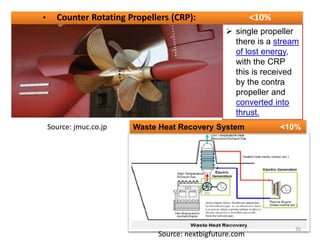
• Counter Rotating Propellers (CRP): <10%
Source: jmuc.co.jp
Source: nextbigfuture.com
26
 single propeller
there is a stream
of lost energy,
with the CRP
this is received
by the contra
propeller and
converted into
thrust.
Waste Heat Recovery System <10%
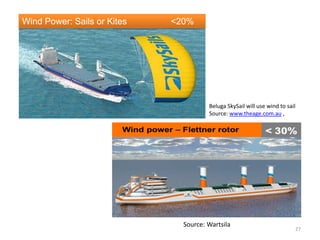
Wind Power: Sails or Kites <20%
Beluga SkySail will use wind to sail
Source: www.theage.com.au ,
Source: Wartsila
27
Source: Wartsila
28
Regulation 22- SEEMP
29
SEEMP Applicability:
(according to Resolution MEPC.203(62))
• All vessels of ≥ 400 GT
• Each vessel to be provided with a ship-specific SEEMP not
later than the first intermediate or renewal survey (whichever is
first) on or after 1 January 2013.
• The administration or RO will check that the SEEMP is onboard
and subsequently issue the International Energy Efficiency
Certificate (IEEC).
• PSC inspection is limited to verifying if there is a valid
IEEC on board.
Ship Energy Efficiency Management Plan
(SEEMP)- Reg. 22
30
SEEMP – Reg. 22
 A SEEMP provides:
- A possible approach for improving ship and fleet
energy efficiency over time; and
- Some options to be considered for optimizing the
performance of the ship.
 SEEMP purpose
 The purpose of a SEEMP is to establish a mechanism
for a company and/or a ship to improve the energy
efficiency of a ship's operation.
 The SEEMP has to be developed for a specific ship by
IMO guidelines Resolution MEPC.213(63): 2012
31
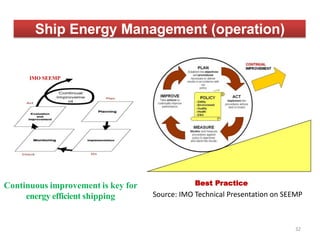
Ship Energy Management (operation)
IMO SEEMP
Best PracticeContinuous improvement is key for
energy efficient shipping Source: IMO Technical Presentation on SEEMP
32
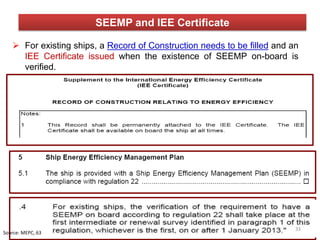
 For existing ships, a Record of Construction needs to be filled and an
IEE Certificate issued when the existence of SEEMP on-board is
verified.
SEEMP and IEE Certificate
Source: MEPC, 63
33
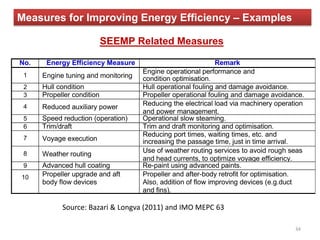
SEEMP Related Measures
No. Energy Efficiency Measure Remark
1 Engine tuning and monitoring
Engine operational performance and
condition optimisation.
2 Hull condition Hull operational fouling and damage avoidance.
3 Propeller condition Propeller operational fouling and damage avoidance.
4 Reduced auxiliary power
Reducing the electrical load via machinery operation
and power management.
5 Speed reduction (operation) Operational slow steaming.
6 Trim/draft Trim and draft monitoring and optimisation.
7 Voyage execution
Reducing port times, waiting times, etc. and
increasing the passage time, just in time arrival.
8 Weather routing Use of weather routing services to avoid rough seas
and head currents, to optimize voyage efficiency.
9 Advanced hull coating Re-paint using advanced paints.
10 Propeller upgrade and aft
body flow devices
Propeller and after-body retrofit for optimisation.
Also, addition of flow improving devices (e.g.duct
and fins).
Measures for Improving Energy Efficiency – Examples
Source: Bazari & Longva (2011) and IMO MEPC 63
34
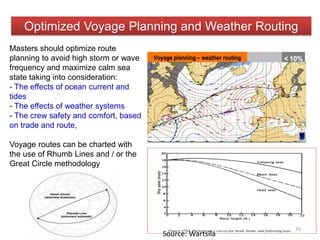
Masters should optimize route
planning to avoid high storm or wave
frequency and maximize calm sea
state taking into consideration:
- The effects of ocean current and
tides
- The effects of weather systems
- The crew safety and comfort, based
on trade and route,
Voyage routes can be charted with
the use of Rhumb Lines and / or the
Great Circle methodology
Optimized Voyage Planning and Weather Routing
Source: Wartsila
35
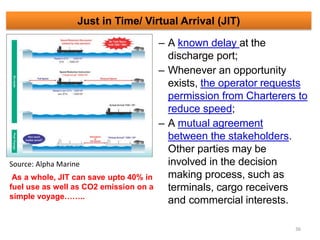
Just in Time/ Virtual Arrival (JIT)
– A known delay at the
discharge port;
– Whenever an opportunity
exists, the operator requests
permission from Charterers to
reduce speed;
– A mutual agreement
between the stakeholders.
Other parties may be
involved in the decision
making process, such as
terminals, cargo receivers
and commercial interests.
As a whole, JIT can save upto 40% in
fuel use as well as CO2 emission on a
simple voyage……..
Source: Alpha Marine
36
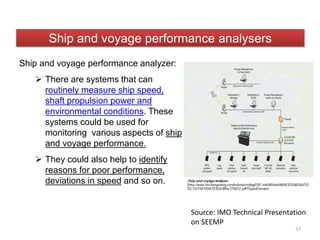
Ship and voyage performance analysers
Ship and voyage performance analyzer:
 There are systems that can
routinely measure ship speed,
shaft propulsion power and
environmental conditions. These
systems could be used for
monitoring various aspects of ship
and voyage performance.
 They could also help to identify
reasons for poor performance,
deviations in speed and so on.
Source: IMO Technical Presentation
on SEEMP
37
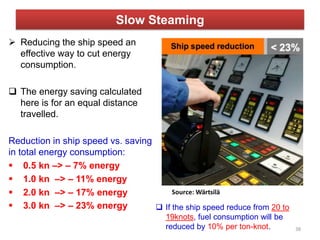
Slow Steaming
 Reducing the ship speed an
effective way to cut energy
consumption.
 The energy saving calculated
here is for an equal distance
travelled.
Reduction in ship speed vs. saving
in total energy consumption:
 0.5 kn –> – 7% energy
 1.0 kn –> – 11% energy
 2.0 kn –> – 17% energy
 3.0 kn –> – 23% energy  If the ship speed reduce from 20 to
19knots, fuel consumption will be
reduced by 10% per ton-knot. 38
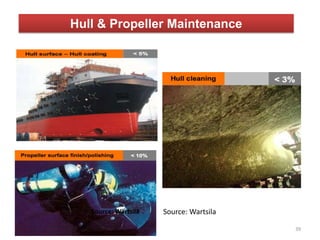
Hull & Propeller Maintenance
Source: Wartsila
39
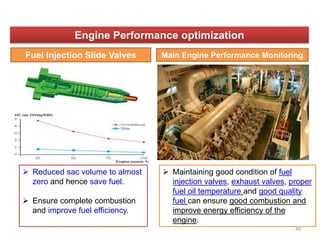
Main Engine Performance MonitoringFuel Injection Slide Valves
40
Source: MAN B& W
Engine Performance optimization
 Maintaining good condition of fuel
injection valves, exhaust valves, proper
fuel oil temperature and good quality
fuel can ensure good combustion and
improve energy efficiency of the
engine.
 Reduced sac volume to almost
zero and hence save fuel.
 Ensure complete combustion
and improve fuel efficiency.
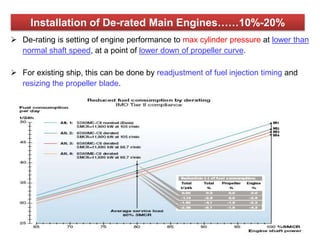
 De-rating is setting of engine performance to max cylinder pressure at lower than
normal shaft speed, at a point of lower down of propeller curve.
 For existing ship, this can be done by readjustment of fuel injection timing and
resizing the propeller blade.
Installation of De-rated Main Engines……10%-20%
Source: Lloyd’s Register
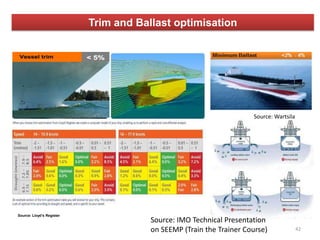
Trim and Ballast optimisation
Source: Wartsila
Source: IMO Technical Presentation
on SEEMP (Train the Trainer Course) 42
Source: Wärtsilä
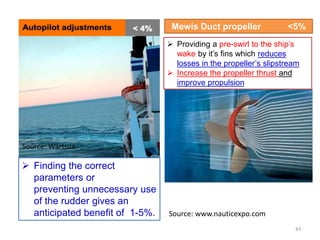
 Finding the correct
parameters or
preventing unnecessary use
of the rudder gives an
anticipated benefit of 1-5%.
Mewis Duct propeller <5%
 Providing a pre-swirl to the ship’s
wake by it’s fins which reduces
losses in the propeller’s slipstream
 Increase the propeller thrust and
improve propulsion
Source: www.nauticexpo.com
43
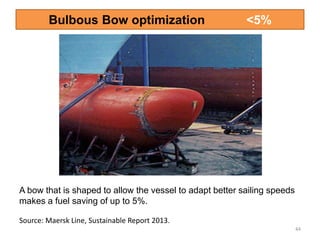
Bulbous Bow optimization <5%
44
A bow that is shaped to allow the vessel to adapt better sailing speeds
makes a fuel saving of up to 5%.
Source: Maersk Line, Sustainable Report 2013.
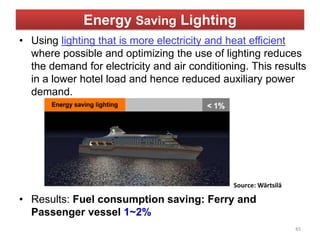
Energy Saving Lighting
• Using lighting that is more electricity and heat efficient
where possible and optimizing the use of lighting reduces
the demand for electricity and air conditioning. This results
in a lower hotel load and hence reduced auxiliary power
demand.
• Results: Fuel consumption saving: Ferry and
Passenger vessel 1~2%
45
Source: Wartsila
Source: Wartsila
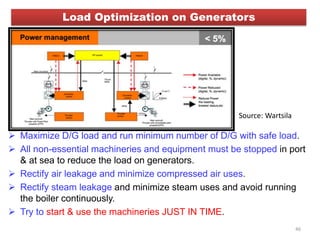
 Maximize D/G load and run minimum number of D/G with safe load.
 All non-essential machineries and equipment must be stopped in port
& at sea to reduce the load on generators.
 Rectify air leakage and minimize compressed air uses.
 Rectify steam leakage and minimize steam uses and avoid running
the boiler continuously.
 Try to start & use the machineries JUST IN TIME.
Load Optimization on Generators
46
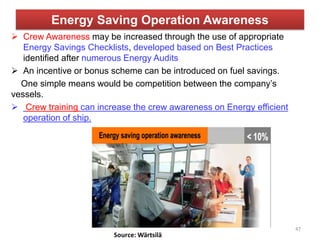
Energy Saving Operation Awareness
 Crew Awareness may be increased through the use of appropriate
Energy Savings Checklists, developed based on Best Practices
identified after numerous Energy Audits
 An incentive or bonus scheme can be introduced on fuel savings.
One simple means would be competition between the company’s
vessels.
 Crew training can increase the crew awareness on Energy efficient
operation of ship.
47
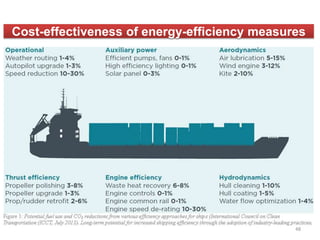
Cost-effectiveness of energy-efficiency measures
48
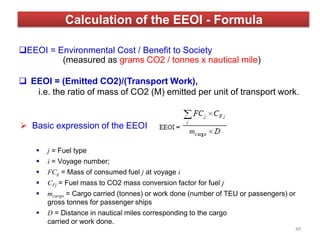
 Basic expression of the EEOI
 j = Fuel type
 i = Voyage number;
 FCij = Mass of consumed fuel j at voyage i
 CFj = Fuel mass to CO2 mass conversion factor for fuel j
 mcargo = Cargo carried (tonnes) or work done (number of TEU or passengers) or
gross tonnes for passenger ships
 D = Distance in nautical miles corresponding to the cargo
carried or work done.
Calculation of the EEOI - Formula
EEOI = Environmental Cost / Benefit to Society
(measured as grams CO2 / tonnes x nautical mile)
 EEOI = (Emitted CO2)/(Transport Work),
i.e. the ratio of mass of CO2 (M) emitted per unit of transport work.
49
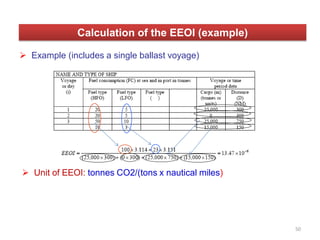
 Example (includes a single ballast voyage)
 Unit of EEOI: tonnes CO2/(tons x nautical miles)
Calculation of the EEOI (example)
50
For EEOI Calculation
Always remember…………
 For calculation of EEOI, you need to have some cargo transport
(cargo X distance travelled).
So, if no cargo transport, EEOI will become infinity (very large).
Therefore, for anchorage or for ballast voyage, EEOI cannot be
calculated.
 The FPSO and offshore vessels are not moving. If the ship does
not move or the ship has no cargo, then EEOI cannot be
calculated.
51
IEE (International Energy Efficiency) Certificate (Reg. 6)
IEEC will be issued when………..
1. For New ship with a Calculated & Varified Attained EEDI, EEDI
Technical File and a verified SEEMP onboard
1. For Existing Ship, with a verified SEEMP and “Record of
Construction related to Energy Efficiency” file
 An IEE Certificate … issued to any
ship ≥ 400 GT
 IEE Certificate shall be valid
throughout the life of the ship if no
major conversion, no transfer of flag or
not withdrawn from service.
52
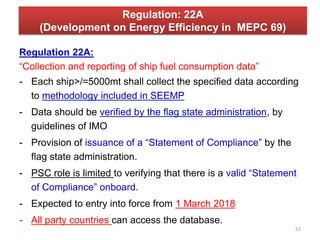
Regulation: 22A
(Development on Energy Efficiency in MEPC 69)
Regulation 22A:
“Collection and reporting of ship fuel consumption data”
- Each ship>/=5000mt shall collect the specified data according
to methodology included in SEEMP
- Data should be verified by the flag state administration, by
guidelines of IMO
- Provision of issuance of a “Statement of Compliance” by the
flag state administration.
- PSC role is limited to verifying that there is a valid “Statement
of Compliance” onboard.
- Expected to entry into force from 1 March 2018
- All party countries can access the database.
53
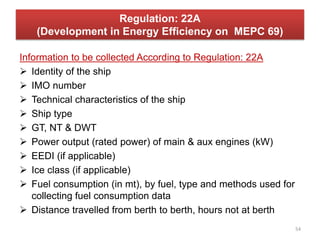
Regulation: 22A
(Development in Energy Efficiency on MEPC 69)
Information to be collected According to Regulation: 22A
 Identity of the ship
 IMO number
 Technical characteristics of the ship
 Ship type
 GT, NT & DWT
 Power output (rated power) of main & aux engines (kW)
 EEDI (if applicable)
 Ice class (if applicable)
 Fuel consumption (in mt), by fuel, type and methods used for
collecting fuel consumption data
 Distance travelled from berth to berth, hours not at berth
54
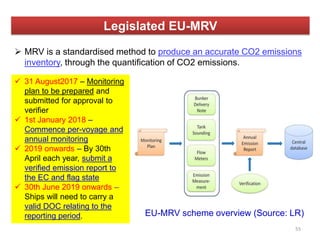
Legislated EU-MRV
55
 MRV is a standardised method to produce an accurate CO2 emissions
inventory, through the quantification of CO2 emissions.
EU-MRV scheme overview (Source: LR)
 31 August2017 – Monitoring
plan to be prepared and
submitted for approval to
verifier
 1st January 2018 –
Commence per-voyage and
annual monitoring
 2019 onwards – By 30th
April each year, submit a
verified emission report to
the EC and flag state
 30th June 2019 onwards –
Ships will need to carry a
valid DOC relating to the
reporting period.
56
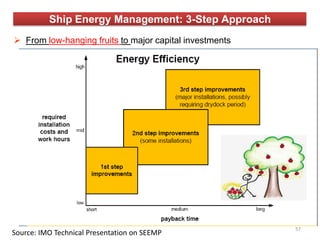
Ship’s Energy Efficiency Management and Plan
Ship Energy Management: 3-Step Approach
 From low-hanging fruits to major capital investments
Source: IMO Technical Presentation on SEEMP
57
 Need to set clear policies and goals for the fuel saving projects.
 Need to set a roadmap for 3-5 years.
 Need to approach it in a step-by-step way with proper monitoring.
Ship Energy Management: A systematic approach
Source: IMO Technical Presentation on SEEMP 58
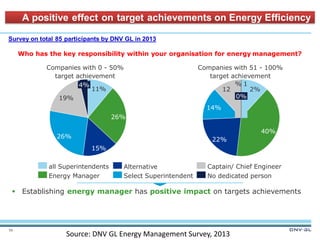
Survey on total 85 participants by DNV GL in 2013
Who has the key responsibility within your organisation for energy management?
Companies with 0 - 50%
target achievement
Companies with 51 - 100%
target achievement
12 2%
 Establishing energy manager has positive impact on targets achievements
19%
14%
26%
40%
22%
4%
26%
15%
11%
A positive effect on target achievements on Energy Efficiency
Captain/ Chief Engineer
No dedicated person
Alternative
Select Superintendent
all Superintendents
Energy Manager
% 1
0%
Source: DNV GL Energy Management Survey, 2013
59
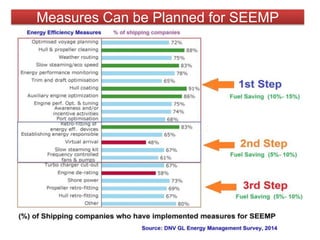
Measures Can be Planned for SEEMP
60
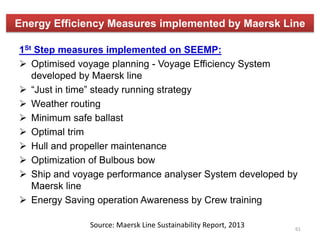
Energy Efficiency Measures implemented by Maersk Line
1St Step measures implemented on SEEMP:
 Optimised voyage planning - Voyage Efficiency System
developed by Maersk line
 “Just in time” steady running strategy
 Weather routing
 Minimum safe ballast
 Optimal trim
 Hull and propeller maintenance
 Optimization of Bulbous bow
 Ship and voyage performance analyser System developed by
Maersk line
 Energy Saving operation Awareness by Crew training
61
Source: Maersk Line Sustainability Report, 2013
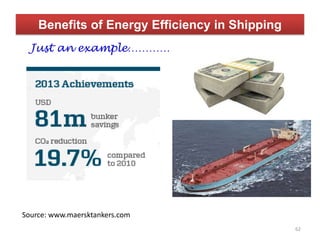
Benefits of Energy Efficiency in Shipping
62
Source: www.maersktankers.com
Just an example…………
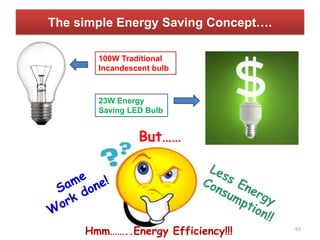
The simple Energy Saving Concept….
100W Traditional
Incandescent bulb
23W Energy
Saving LED Bulb
But……
Hmm……..Energy Efficiency!!! 63
Energy Efficiency, Just a step!
Same Work Done!……..
Less Energy Use!!…………..
Saving more fuels!!!…………
So, more saving money!!!!…..
And Saving GREEN Planet!……
So, Energy Efficiency is Just in our next steps………. 64
Thank you for your
attention!
For more information please see:
www.imo.org
65

Ship Energy Efficiency Management-2016

  • 1.
    Ship Energy Efficiency Management MohammudHanif Dewan, IEng IMarEng IMarEST MRINA Lecturer, Malaysian Maritime Academy 1
  • 2.
    350 300 250 200 150 Years Before Present Source:IPCC (Intergovernmental Panel on Climate Change) Assessment Report 2014 0100,000200,000300,000400,000 The world’s challenge: Increasing CO2concentrations in the atmosphere 400 450 500 550 600 650 700 400 ppm exceeded for the first time in April 2015 2
  • 3.
    Global Warming CO2 isa strong Green House Gas (GHG). The high amount of CO2 concentrations in the atmosphere would lead to the global warming of between 1.5ºC and 4.5ºC by the end of 21st Century if we just go as BAU…. Source: IPCC Report, 2014 3
  • 4.
    GHG Effect 4 Source: EnvironmentalProtection Agency (EPA)
  • 5.
     Millions aresuffering from ever more intensive weather events in Asia and the Americas……… Source: IMO presentation on Technical measures 5  Storms will become more intense and frequent
  • 6.
    6 Ice caps aremelting & glaciers are shrinking in the Arctic.
  • 7.
    7  Sea levelswill rise up between 26cm & 82cm by the end of this 21st century
  • 8.
  • 9.
     Wet regionsreceiving heavy rainfall causing floods 9
  • 10.
    10  Heatwaves aremore frequent & last longer and  Dry regions receiving less rain, causing the drought.
  • 11.
    7 Source: IMO presentationon Technical measures Because of so much CO2 Emissions everyday……….. 11
  • 12.
    Third IMO GHGStudy 2014 Future CO2 emissions: - Significant increase predicted: 50-250% by 2050 in the absence of regulations - Technical and operational efficiency measures can provide significant improvements but will not be able to provide total net reductions if demand continues………………… Source: 3rd IMO GHS Study 2014 12
  • 13.
    Background of EnergyEfficiency Regulations  United Nations Framework Convention on Climate change (UNFCCC) entered into force in 1994.  Kyoto Protocol (1997), sets binding targets for countries: “to reduce the overall GHG emissions by at least 5% below existing 1990 levels, in the commitment period 2008 to 2012.“  IMO Policies and Practices for Reduction of GHG Emissions from Ships, adopted by Assembly on 23 December 2003 13
  • 14.
    IMO energy efficiencyregulatory activities MEPC68 IMO Energy EfficiencyRegulatory Developments Resolution MEPC.212(63)EEDI Calculation Resolution MEPC.214(63)EEDI Verification Resolution MEPC.213(63)SEEMP Resolution A.963 (23) “IMO policies and practices related to reduction of GHG emissions from ships” Dec 2003 June 2005 Mar 2008 June 2008 GHG Working Group 2 Feb 2009 MEPC Circ. 681 EEDI Calculation MEPC Circ. 682 EEDI Verification MEPC Circ. 683 SEEMP MEPC Circ. 684 EEOI Jul 2009 Energy Efficiency WG Jun 2010 Sep 1997 Feb 2012 July 2011 EEDI & SEEMP Regs.Adopted GHG Working Group 1 MEPC40 MEPC53 MEPC57 MEPC58 MEPC59MEPC60 MEPC61 MEPC62 MECP63 MEPC64 MEPC65 MEPC66 MEPC67 Resolution 8 “CO2 emissions From ships” MARPOLVI Amendments Resolution MEPC 203(62) May 2013 March 2014 Oct 2012 MEPC Circ.471, EEOI Oct May 20152014 3 rd GHG Study 2014 MARPOL VI Amendments Resolution MEPC.251(66) Resolution MEPC.245(66): EEDI CalculationGuidelines Resolution MEPC.231(65) Reference Lines Resolution MEPC.232(65) Minimum power ResolutionMEPC.233(65),Reference lines for cruiseships MEPC.1/Circ.815Innovative EE Technologies MEPC.1/Circ.816 Consolidatedon EEDI verification Debate on Data collection Source: IMO
  • 15.
    EEDI, EEOI andSEEMP Process Source: IMO presentation on Technical measures Source: IMO presentation on Technical measures 15
  • 16.
    Applications of EEDI-Reg. 19  Apply to  all new ships ≥ 400 GT  Building contract placed on/after January 2013;  In the absence of contract, keel laid after 1 July 2013; or  The delivery of which is on / after 1 July 2015; or  In cases of a major conversion of a new or existing ship, on / after 1 January 2013  Not apply to  ships sailing entirely within flag state waters  ships which have: - diesel-electric propulsion, - turbine propulsion or - hybrid propulsion systems. Except cruise passenger ships and LNG carriers having conventional or non- conventional propulsion, delivered on or after 1 September 2019. 16
  • 17.
    Attained EEDI- Reg.20 Energy Efficiency Design Index (EEDI)  EEDI is an index which quantify the amount of CO2 is emitted by a ship while transported 1 ton cargo 1 knot (cargo transport)  The actual EEDI of a vessel is called the “attained EEDI” and is calculated based on guidelines published by IMO (Resolution MEPC.245-66).  Attained EEDI ≤ Required EEDI  Attain EEDI” specific to each new ship ……… and be accompanied by the EEDI Technical File……. 17
  • 18.
    Required EEDI- Reg.21 Required EEDI is the maximum value of attained EEDI, that is allowed by MARPOL Annex 6 Chapter 4 Regulation 21 for the specific ship type & sizes. Required EEDI has been determined by using reference lines. The method of calculation of the required EEDI is as follow: Where, X is the reduction factor  Reference line value is estimated from EEDI Reference line. These are calculated based on the below formula: Reference line = a*b-c 18 Source: IMO MEPC, 63 Required EEDI = (1- X /100) * Reference line value
  • 19.
    Review of phasesand reduction factors, Reg. 21.6 Source: IMO MEPC, 63 19
  • 20.
    Main Engine(s) Aux Engine(s) InnovativeEnergy Eff. Power Gen. Technologies Innovative Energy Eff. Propulsion Technologies Boilers are excluded from EEDI EEDI = [gCO2/(tonne.nm)] fc. Attained EEDI: Calculation formula Source: IMO presentation on Technical measures 20
  • 21.
  • 22.
    Technologies for EEDIreduction No. EEDI reduction measure Remark 1 Optimised hull dimensions and form Ship design for efficiency via choice of main dimensions (port and canal restrictions) and hull forms. 2 Light weight construction New lightweight ship construction material. 3 Hull coating Use of advanced hull coatings/paints. 4 Hull air lubrication system Air cavity via injection of air under/around the hull to reduce wet surface and thereby ship resistance. 5 Optimisation of propeller-hull interface and flow devices Propeller-hull-rudder design optimisation plus relevant changes to ship’s aft body. 6 Contra-rotating propeller Two propellers in series; rotating at different direction. 7 Engine efficiency improvement De-rating, long-stroke, electronic injection, variable geometry turbo charging, etc. 8 Waste heat recovery Main and auxiliary engines’ exhaust gas waste heat recovery and conversion to electric power. 9 Gas fuelled (LNG) Natural gas fuel and dual fuel engines. 10 Hybrid electric power and propulsion concepts For some ships, the use of electric or hybrid would be more efficient. 11 Reducing on-board power demand(auxiliary system andhotelloads). Maximum heat recovery and minimizing required electrical loads flexible power solutions and power management. 12 Variable speed drive for pumps, fans etc. Use of variable speed electric motors for control of rotating flow machinery leads to significant reduction in their energy use. 13 Wind power (sail, wind engine, etc.) Sails, fletnner rotor, kites, etc. These are considered as emerging technologies. 14 Solar power Solar photovoltaic cells. 15 Design speed reduction (newbuilds) Reducing design speed via choice of lower power or de-rated engines. Source: Bazari & Longva (2011) and IMO MEPC 63, 2011 22
  • 23.
    Large Ship Design<30% Source: Mearsk Line Source: Wartsila The technologies covered so far………………………… 23
  • 24.
    Lightweight Structures Optimum BlockCoefficient Source: Wartsila Source: Wartsila 24
  • 25.
    Hull Air Lubrication:<20% Hull Coating: 5% Source: Mitsubishi 25
  • 26.
    • Counter RotatingPropellers (CRP): <10% Source: jmuc.co.jp Source: nextbigfuture.com 26  single propeller there is a stream of lost energy, with the CRP this is received by the contra propeller and converted into thrust. Waste Heat Recovery System <10%
  • 27.
    Wind Power: Sailsor Kites <20% Beluga SkySail will use wind to sail Source: www.theage.com.au , Source: Wartsila 27
  • 28.
  • 29.
  • 30.
    SEEMP Applicability: (according toResolution MEPC.203(62)) • All vessels of ≥ 400 GT • Each vessel to be provided with a ship-specific SEEMP not later than the first intermediate or renewal survey (whichever is first) on or after 1 January 2013. • The administration or RO will check that the SEEMP is onboard and subsequently issue the International Energy Efficiency Certificate (IEEC). • PSC inspection is limited to verifying if there is a valid IEEC on board. Ship Energy Efficiency Management Plan (SEEMP)- Reg. 22 30
  • 31.
    SEEMP – Reg.22  A SEEMP provides: - A possible approach for improving ship and fleet energy efficiency over time; and - Some options to be considered for optimizing the performance of the ship.  SEEMP purpose  The purpose of a SEEMP is to establish a mechanism for a company and/or a ship to improve the energy efficiency of a ship's operation.  The SEEMP has to be developed for a specific ship by IMO guidelines Resolution MEPC.213(63): 2012 31
  • 32.
    Ship Energy Management(operation) IMO SEEMP Best PracticeContinuous improvement is key for energy efficient shipping Source: IMO Technical Presentation on SEEMP 32
  • 33.
     For existingships, a Record of Construction needs to be filled and an IEE Certificate issued when the existence of SEEMP on-board is verified. SEEMP and IEE Certificate Source: MEPC, 63 33
  • 34.
    SEEMP Related Measures No.Energy Efficiency Measure Remark 1 Engine tuning and monitoring Engine operational performance and condition optimisation. 2 Hull condition Hull operational fouling and damage avoidance. 3 Propeller condition Propeller operational fouling and damage avoidance. 4 Reduced auxiliary power Reducing the electrical load via machinery operation and power management. 5 Speed reduction (operation) Operational slow steaming. 6 Trim/draft Trim and draft monitoring and optimisation. 7 Voyage execution Reducing port times, waiting times, etc. and increasing the passage time, just in time arrival. 8 Weather routing Use of weather routing services to avoid rough seas and head currents, to optimize voyage efficiency. 9 Advanced hull coating Re-paint using advanced paints. 10 Propeller upgrade and aft body flow devices Propeller and after-body retrofit for optimisation. Also, addition of flow improving devices (e.g.duct and fins). Measures for Improving Energy Efficiency – Examples Source: Bazari & Longva (2011) and IMO MEPC 63 34
  • 35.
    Masters should optimizeroute planning to avoid high storm or wave frequency and maximize calm sea state taking into consideration: - The effects of ocean current and tides - The effects of weather systems - The crew safety and comfort, based on trade and route, Voyage routes can be charted with the use of Rhumb Lines and / or the Great Circle methodology Optimized Voyage Planning and Weather Routing Source: Wartsila 35
  • 36.
    Just in Time/Virtual Arrival (JIT) – A known delay at the discharge port; – Whenever an opportunity exists, the operator requests permission from Charterers to reduce speed; – A mutual agreement between the stakeholders. Other parties may be involved in the decision making process, such as terminals, cargo receivers and commercial interests. As a whole, JIT can save upto 40% in fuel use as well as CO2 emission on a simple voyage…….. Source: Alpha Marine 36
  • 37.
    Ship and voyageperformance analysers Ship and voyage performance analyzer:  There are systems that can routinely measure ship speed, shaft propulsion power and environmental conditions. These systems could be used for monitoring various aspects of ship and voyage performance.  They could also help to identify reasons for poor performance, deviations in speed and so on. Source: IMO Technical Presentation on SEEMP 37
  • 38.
    Slow Steaming  Reducingthe ship speed an effective way to cut energy consumption.  The energy saving calculated here is for an equal distance travelled. Reduction in ship speed vs. saving in total energy consumption:  0.5 kn –> – 7% energy  1.0 kn –> – 11% energy  2.0 kn –> – 17% energy  3.0 kn –> – 23% energy  If the ship speed reduce from 20 to 19knots, fuel consumption will be reduced by 10% per ton-knot. 38
  • 39.
    Hull & PropellerMaintenance Source: Wartsila 39
  • 40.
    Main Engine PerformanceMonitoringFuel Injection Slide Valves 40 Source: MAN B& W Engine Performance optimization  Maintaining good condition of fuel injection valves, exhaust valves, proper fuel oil temperature and good quality fuel can ensure good combustion and improve energy efficiency of the engine.  Reduced sac volume to almost zero and hence save fuel.  Ensure complete combustion and improve fuel efficiency.
  • 41.
     De-rating issetting of engine performance to max cylinder pressure at lower than normal shaft speed, at a point of lower down of propeller curve.  For existing ship, this can be done by readjustment of fuel injection timing and resizing the propeller blade. Installation of De-rated Main Engines……10%-20%
  • 42.
    Source: Lloyd’s Register Trimand Ballast optimisation Source: Wartsila Source: IMO Technical Presentation on SEEMP (Train the Trainer Course) 42
  • 43.
    Source: Wärtsilä  Findingthe correct parameters or preventing unnecessary use of the rudder gives an anticipated benefit of 1-5%. Mewis Duct propeller <5%  Providing a pre-swirl to the ship’s wake by it’s fins which reduces losses in the propeller’s slipstream  Increase the propeller thrust and improve propulsion Source: www.nauticexpo.com 43
  • 44.
    Bulbous Bow optimization<5% 44 A bow that is shaped to allow the vessel to adapt better sailing speeds makes a fuel saving of up to 5%. Source: Maersk Line, Sustainable Report 2013.
  • 45.
    Energy Saving Lighting •Using lighting that is more electricity and heat efficient where possible and optimizing the use of lighting reduces the demand for electricity and air conditioning. This results in a lower hotel load and hence reduced auxiliary power demand. • Results: Fuel consumption saving: Ferry and Passenger vessel 1~2% 45
  • 46.
    Source: Wartsila Source: Wartsila Maximize D/G load and run minimum number of D/G with safe load.  All non-essential machineries and equipment must be stopped in port & at sea to reduce the load on generators.  Rectify air leakage and minimize compressed air uses.  Rectify steam leakage and minimize steam uses and avoid running the boiler continuously.  Try to start & use the machineries JUST IN TIME. Load Optimization on Generators 46
  • 47.
    Energy Saving OperationAwareness  Crew Awareness may be increased through the use of appropriate Energy Savings Checklists, developed based on Best Practices identified after numerous Energy Audits  An incentive or bonus scheme can be introduced on fuel savings. One simple means would be competition between the company’s vessels.  Crew training can increase the crew awareness on Energy efficient operation of ship. 47
  • 48.
  • 49.
     Basic expressionof the EEOI  j = Fuel type  i = Voyage number;  FCij = Mass of consumed fuel j at voyage i  CFj = Fuel mass to CO2 mass conversion factor for fuel j  mcargo = Cargo carried (tonnes) or work done (number of TEU or passengers) or gross tonnes for passenger ships  D = Distance in nautical miles corresponding to the cargo carried or work done. Calculation of the EEOI - Formula EEOI = Environmental Cost / Benefit to Society (measured as grams CO2 / tonnes x nautical mile)  EEOI = (Emitted CO2)/(Transport Work), i.e. the ratio of mass of CO2 (M) emitted per unit of transport work. 49
  • 50.
     Example (includesa single ballast voyage)  Unit of EEOI: tonnes CO2/(tons x nautical miles) Calculation of the EEOI (example) 50
  • 51.
    For EEOI Calculation Alwaysremember…………  For calculation of EEOI, you need to have some cargo transport (cargo X distance travelled). So, if no cargo transport, EEOI will become infinity (very large). Therefore, for anchorage or for ballast voyage, EEOI cannot be calculated.  The FPSO and offshore vessels are not moving. If the ship does not move or the ship has no cargo, then EEOI cannot be calculated. 51
  • 52.
    IEE (International EnergyEfficiency) Certificate (Reg. 6) IEEC will be issued when……….. 1. For New ship with a Calculated & Varified Attained EEDI, EEDI Technical File and a verified SEEMP onboard 1. For Existing Ship, with a verified SEEMP and “Record of Construction related to Energy Efficiency” file  An IEE Certificate … issued to any ship ≥ 400 GT  IEE Certificate shall be valid throughout the life of the ship if no major conversion, no transfer of flag or not withdrawn from service. 52
  • 53.
    Regulation: 22A (Development onEnergy Efficiency in MEPC 69) Regulation 22A: “Collection and reporting of ship fuel consumption data” - Each ship>/=5000mt shall collect the specified data according to methodology included in SEEMP - Data should be verified by the flag state administration, by guidelines of IMO - Provision of issuance of a “Statement of Compliance” by the flag state administration. - PSC role is limited to verifying that there is a valid “Statement of Compliance” onboard. - Expected to entry into force from 1 March 2018 - All party countries can access the database. 53
  • 54.
    Regulation: 22A (Development inEnergy Efficiency on MEPC 69) Information to be collected According to Regulation: 22A  Identity of the ship  IMO number  Technical characteristics of the ship  Ship type  GT, NT & DWT  Power output (rated power) of main & aux engines (kW)  EEDI (if applicable)  Ice class (if applicable)  Fuel consumption (in mt), by fuel, type and methods used for collecting fuel consumption data  Distance travelled from berth to berth, hours not at berth 54
  • 55.
    Legislated EU-MRV 55  MRVis a standardised method to produce an accurate CO2 emissions inventory, through the quantification of CO2 emissions. EU-MRV scheme overview (Source: LR)  31 August2017 – Monitoring plan to be prepared and submitted for approval to verifier  1st January 2018 – Commence per-voyage and annual monitoring  2019 onwards – By 30th April each year, submit a verified emission report to the EC and flag state  30th June 2019 onwards – Ships will need to carry a valid DOC relating to the reporting period.
  • 56.
    56 Ship’s Energy EfficiencyManagement and Plan
  • 57.
    Ship Energy Management:3-Step Approach  From low-hanging fruits to major capital investments Source: IMO Technical Presentation on SEEMP 57
  • 58.
     Need toset clear policies and goals for the fuel saving projects.  Need to set a roadmap for 3-5 years.  Need to approach it in a step-by-step way with proper monitoring. Ship Energy Management: A systematic approach Source: IMO Technical Presentation on SEEMP 58
  • 59.
    Survey on total85 participants by DNV GL in 2013 Who has the key responsibility within your organisation for energy management? Companies with 0 - 50% target achievement Companies with 51 - 100% target achievement 12 2%  Establishing energy manager has positive impact on targets achievements 19% 14% 26% 40% 22% 4% 26% 15% 11% A positive effect on target achievements on Energy Efficiency Captain/ Chief Engineer No dedicated person Alternative Select Superintendent all Superintendents Energy Manager % 1 0% Source: DNV GL Energy Management Survey, 2013 59
  • 60.
    Measures Can bePlanned for SEEMP 60
  • 61.
    Energy Efficiency Measuresimplemented by Maersk Line 1St Step measures implemented on SEEMP:  Optimised voyage planning - Voyage Efficiency System developed by Maersk line  “Just in time” steady running strategy  Weather routing  Minimum safe ballast  Optimal trim  Hull and propeller maintenance  Optimization of Bulbous bow  Ship and voyage performance analyser System developed by Maersk line  Energy Saving operation Awareness by Crew training 61 Source: Maersk Line Sustainability Report, 2013
  • 62.
    Benefits of EnergyEfficiency in Shipping 62 Source: www.maersktankers.com Just an example…………
  • 63.
    The simple EnergySaving Concept…. 100W Traditional Incandescent bulb 23W Energy Saving LED Bulb But…… Hmm……..Energy Efficiency!!! 63
  • 64.
    Energy Efficiency, Justa step! Same Work Done!…….. Less Energy Use!!………….. Saving more fuels!!!………… So, more saving money!!!!….. And Saving GREEN Planet!…… So, Energy Efficiency is Just in our next steps………. 64
  • 65.
    Thank you foryour attention! For more information please see: www.imo.org 65