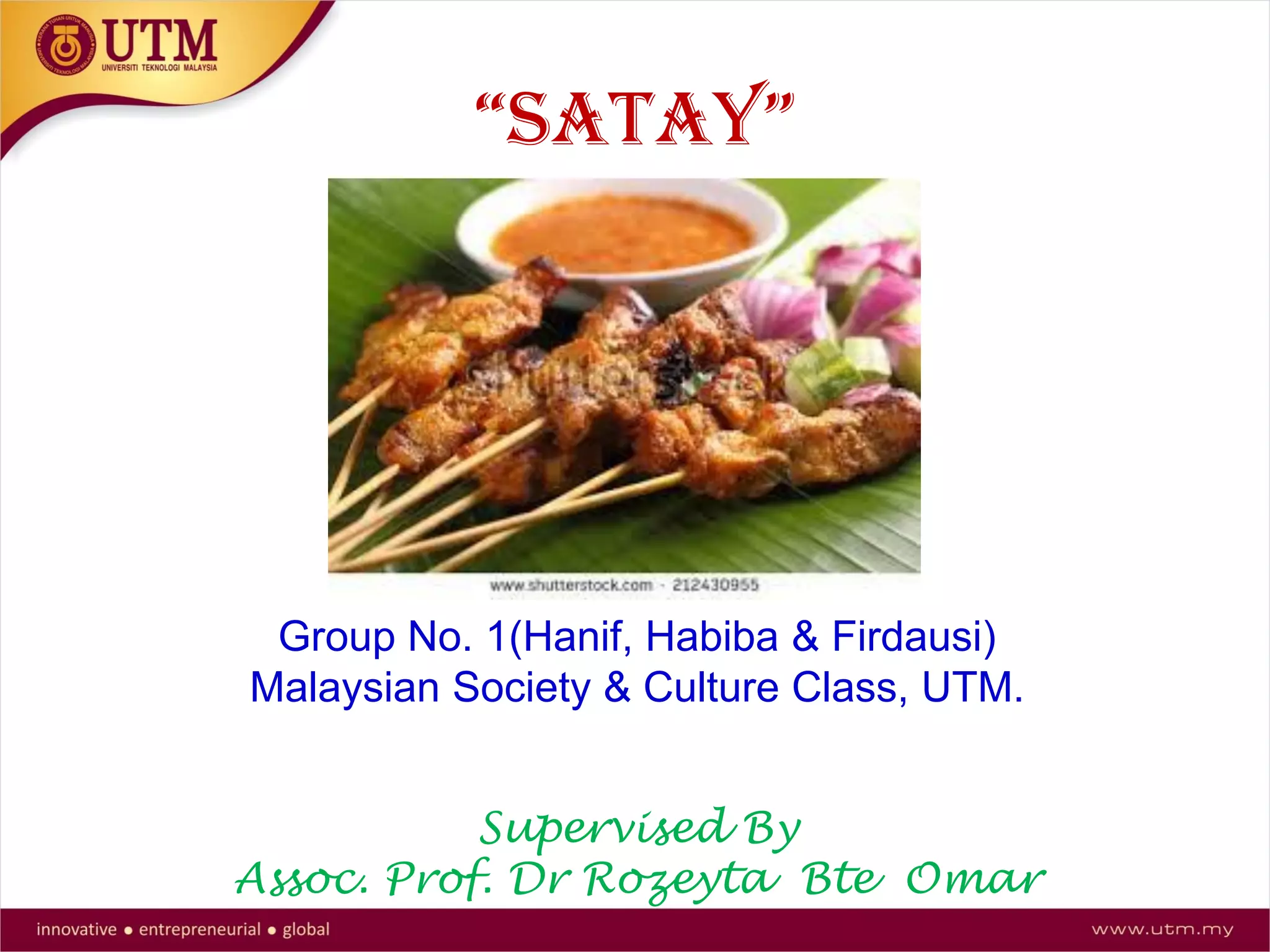




“Satay”
Group No. 1(Hanif, Habiba & Firdausi)
Malaysian Society & Culture Class, UTM.
Presented to
Assoc. Prof. Dr Rozeyta Bte Omar
Introduction
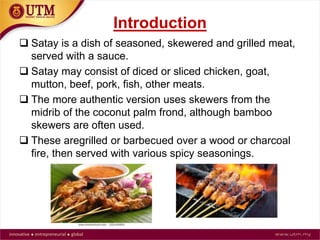
Satay is a dish of seasoned, skewered and grilled meat,
served with a sauce.
 Satay may consist of diced or sliced chicken, goat,
mutton, beef, pork, fish, other meats.
 The more authentic version uses skewers from the
midrib of the coconut palm frond, although bamboo
skewers are often used.
 These are grilled or barbecued over a wood or charcoal
fire, then served with various spicy seasonings.
Satay- The Most Delicious Food!
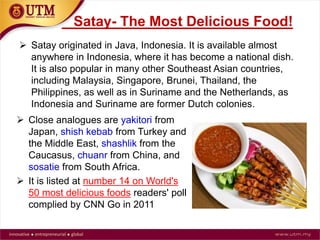
 Satay originated in Java, Indonesia. It is available almost
anywhere in Indonesia, where it has become a national dish.
It is also popular in many other Southeast Asian countries,
including Malaysia, Singapore, Brunei, Thailand, the
Philippines, as well as in Suriname and the Netherlands, as
Indonesia and Suriname are former Dutch colonies.
 Close analogues are yakitori from
Japan, shish kebab from Turkey and
the Middle East, shashlik from the
Caucasus, chuanr from China, and
sosatie from South Africa.
 It is listed at number 14 on World's
50 most delicious foods readers' poll
complied by CNN Go in 2011
Satay in Malaysia
 Satay is Malaysia’s national dish and it is actually quite easy
to recreate at home. The Thai and Indonesians have their
own version of satay but they are quite different from the
Malaysian version.
 The Malaysian version is sweeter than the Indonesian version
and the recipes seems to have more spices and heavier use
of lemongrass and fresh turmeric. Malay peanut satay sauce
is thicker and richer than that in Thailand or Indonesia.
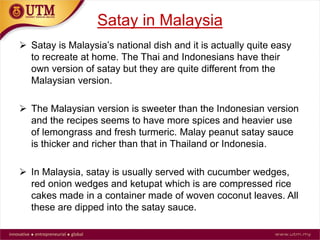
 In Malaysia, satay is usually served with cucumber wedges,
red onion wedges and ketupat which is are compressed rice
cakes made in a container made of woven coconut leaves. All
these are dipped into the satay sauce.
History of Satay
 Although both Thailand and Malaysia claim it as their own, it’s
Southeast Asian origin was in Java, Indonesia. There satay was
developed from the Indian kebab brought by the Muslim traders. Even
India cannot claim its origin, for there it was a legacy of Middle Eastern
influence.
— Jennifer Brennan (1988).
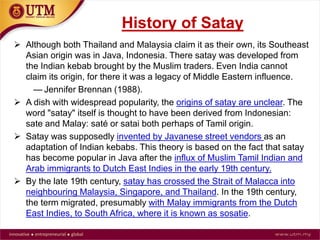
 A dish with widespread popularity, the origins of satay are unclear. The
word "satay" itself is thought to have been derived from Indonesian:
sate and Malay: satĂŠ or satai both perhaps of Tamil origin.
 Satay was supposedly invented by Javanese street vendors as an
adaptation of Indian kebabs. This theory is based on the fact that satay
has become popular in Java after the influx of Muslim Tamil Indian and
Arab immigrants to Dutch East Indies in the early 19th century.
 By the late 19th century, satay has crossed the Strait of Malacca into
neighbouring Malaysia, Singapore, and Thailand. In the 19th century,
the term migrated, presumably with Malay immigrants from the Dutch
East Indies, to South Africa, where it is known as sosatie.
Ingredients
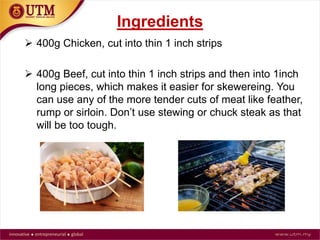
 400g Chicken, cut into thin 1 inch strips
 400g Beef, cut into thin 1 inch strips and then into 1inch
long pieces, which makes it easier for skewereing. You
can use any of the more tender cuts of meat like feather,
rump or sirloin. Don’t use stewing or chuck steak as that
will be too tough.
Satay Meat Marinade
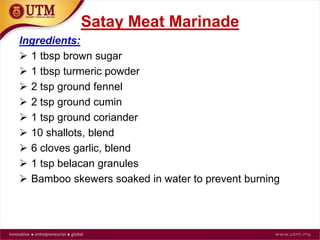
Ingredients:
 1 tbsp brown sugar
 1 tbsp turmeric powder
 2 tsp ground fennel
 2 tsp ground cumin
 1 tsp ground coriander
 10 shallots, blend
 6 cloves garlic, blend Fig: Row Satay
 1 tsp belacan granules
 Bamboo skewers soaked in water to prevent burning
How to Make Satay
 Blend the garlic and shallots and combine the spices. Then add all
the other ingredients.
 Marinade the meat in this mixture for at least 2 hours or better if it is
left overnight in the fridge.
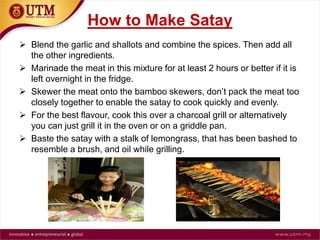
 Skewer the meat onto the bamboo skewers, don’t pack the meat too
closely together to enable the satay to cook quickly and evenly.
 For the best flavour, cook this over a charcoal grill or alternatively
you can just grill it in the oven or on a griddle pan.
 Baste the satay with a stalk of lemongrass, that has been bashed to
resemble a brush, and oil while grilling.
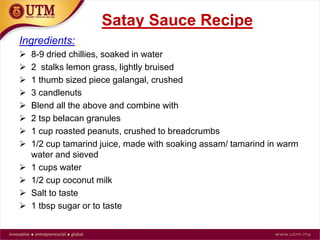
Satay Sauce Recipe
Ingredients:
 8-9 dried chillies, soaked in water
 2 stalks lemon grass, lightly bruised
 1 thumb sized piece galangal, crushed
 3 candlenuts
 Blend all the above and combine with
 2 tsp belacan granules
 1 cup roasted peanuts, crushed to breadcrumbs
 1/2 cup tamarind juice, made with soaking assam/ tamarind in warm
water and sieved
 1 cups water
 1/2 cup coconut milk
 Salt to taste
 1 tbsp sugar or to taste
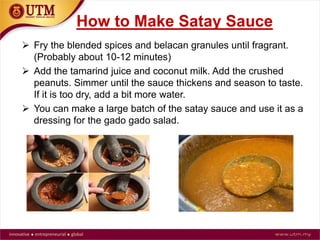
How to Make Satay Sauce
 Fry the blended spices and belacan granules until fragrant.
(Probably about 10-12 minutes)
 Add the tamarind juice and coconut milk. Add the crushed
peanuts. Simmer until the sauce thickens and season to taste.
If it is too dry, add a bit more water.
 You can make a large batch of the satay sauce and use it as a
dressing for the gado gado salad.
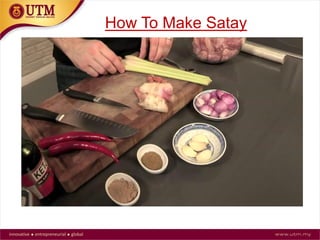
How To Make Satay
Different Types of Satay
Fig: Satay Ayam Fig: Satay Blora
Fig: Satay Buntel Fig: Satay Hati
When To Eat Satay
 Satay is mostly eaten in the late evening and served
warm
 It can be served as an appetizer or make meal out of it
by adding rice and vegetable
 The food is also safe for pregnant women but its
advisable not to eat road side satay, most especially
during pregnancy due to hygiene issue
 Be careful where you buy and eat satay. Avoid to buy
and eat satay in a poor hygiene environment.
Satay, The Most Tasty Food!
Want To Eat Satay?
Any Question?

Satay

  • 1.
    “Satay” Group No. 1(Hanif,Habiba & Firdausi) Malaysian Society & Culture Class, UTM. Presented to Assoc. Prof. Dr Rozeyta Bte Omar
  • 2.
    Introduction Satay is adish of seasoned, skewered and grilled meat, served with a sauce.  Satay may consist of diced or sliced chicken, goat, mutton, beef, pork, fish, other meats.  The more authentic version uses skewers from the midrib of the coconut palm frond, although bamboo skewers are often used.  These are grilled or barbecued over a wood or charcoal fire, then served with various spicy seasonings.
  • 3.
    Satay- The MostDelicious Food!  Satay originated in Java, Indonesia. It is available almost anywhere in Indonesia, where it has become a national dish. It is also popular in many other Southeast Asian countries, including Malaysia, Singapore, Brunei, Thailand, the Philippines, as well as in Suriname and the Netherlands, as Indonesia and Suriname are former Dutch colonies.  Close analogues are yakitori from Japan, shish kebab from Turkey and the Middle East, shashlik from the Caucasus, chuanr from China, and sosatie from South Africa.  It is listed at number 14 on World's 50 most delicious foods readers' poll complied by CNN Go in 2011
  • 4.
    Satay in Malaysia Satay is Malaysia’s national dish and it is actually quite easy to recreate at home. The Thai and Indonesians have their own version of satay but they are quite different from the Malaysian version.  The Malaysian version is sweeter than the Indonesian version and the recipes seems to have more spices and heavier use of lemongrass and fresh turmeric. Malay peanut satay sauce is thicker and richer than that in Thailand or Indonesia.  In Malaysia, satay is usually served with cucumber wedges, red onion wedges and ketupat which is are compressed rice cakes made in a container made of woven coconut leaves. All these are dipped into the satay sauce.
  • 5.
    History of Satay Although both Thailand and Malaysia claim it as their own, it’s Southeast Asian origin was in Java, Indonesia. There satay was developed from the Indian kebab brought by the Muslim traders. Even India cannot claim its origin, for there it was a legacy of Middle Eastern influence. — Jennifer Brennan (1988).  A dish with widespread popularity, the origins of satay are unclear. The word "satay" itself is thought to have been derived from Indonesian: sate and Malay: saté or satai both perhaps of Tamil origin.  Satay was supposedly invented by Javanese street vendors as an adaptation of Indian kebabs. This theory is based on the fact that satay has become popular in Java after the influx of Muslim Tamil Indian and Arab immigrants to Dutch East Indies in the early 19th century.  By the late 19th century, satay has crossed the Strait of Malacca into neighbouring Malaysia, Singapore, and Thailand. In the 19th century, the term migrated, presumably with Malay immigrants from the Dutch East Indies, to South Africa, where it is known as sosatie.
  • 6.
    Ingredients  400g Chicken,cut into thin 1 inch strips  400g Beef, cut into thin 1 inch strips and then into 1inch long pieces, which makes it easier for skewereing. You can use any of the more tender cuts of meat like feather, rump or sirloin. Don’t use stewing or chuck steak as that will be too tough.
  • 7.
    Satay Meat Marinade Ingredients: 1 tbsp brown sugar  1 tbsp turmeric powder  2 tsp ground fennel  2 tsp ground cumin  1 tsp ground coriander  10 shallots, blend  6 cloves garlic, blend Fig: Row Satay  1 tsp belacan granules  Bamboo skewers soaked in water to prevent burning
  • 8.
    How to MakeSatay  Blend the garlic and shallots and combine the spices. Then add all the other ingredients.  Marinade the meat in this mixture for at least 2 hours or better if it is left overnight in the fridge.  Skewer the meat onto the bamboo skewers, don’t pack the meat too closely together to enable the satay to cook quickly and evenly.  For the best flavour, cook this over a charcoal grill or alternatively you can just grill it in the oven or on a griddle pan.  Baste the satay with a stalk of lemongrass, that has been bashed to resemble a brush, and oil while grilling.
  • 9.
    Satay Sauce Recipe Ingredients: 8-9 dried chillies, soaked in water  2 stalks lemon grass, lightly bruised  1 thumb sized piece galangal, crushed  3 candlenuts  Blend all the above and combine with  2 tsp belacan granules  1 cup roasted peanuts, crushed to breadcrumbs  1/2 cup tamarind juice, made with soaking assam/ tamarind in warm water and sieved  1 cups water  1/2 cup coconut milk  Salt to taste  1 tbsp sugar or to taste
  • 10.
    How to MakeSatay Sauce  Fry the blended spices and belacan granules until fragrant. (Probably about 10-12 minutes)  Add the tamarind juice and coconut milk. Add the crushed peanuts. Simmer until the sauce thickens and season to taste. If it is too dry, add a bit more water.  You can make a large batch of the satay sauce and use it as a dressing for the gado gado salad.
  • 11.
  • 12.
    Different Types ofSatay Fig: Satay Ayam Fig: Satay Blora Fig: Satay Buntel Fig: Satay Hati
  • 13.
    When To EatSatay  Satay is mostly eaten in the late evening and served warm  It can be served as an appetizer or make meal out of it by adding rice and vegetable  The food is also safe for pregnant women but its advisable not to eat road side satay, most especially during pregnancy due to hygiene issue  Be careful where you buy and eat satay. Avoid to buy and eat satay in a poor hygiene environment.
  • 14.
    Satay, The MostTasty Food!
  • 15.
  • 16.