mission: SHIP DESIGN
The Early Stage Ship Design
PRAVEEN K CH.
Contents
1. Introduction
2. Concept Design
3. Preliminary Design
INTRODUCTION
Section 1
Ship Design
(Activity)
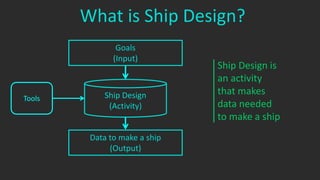
What is Ship Design?
Goals
(Input)
Data to make a ship
(Output)
Ship Design is
an activity
that makes
data needed
to make a ship
Tools
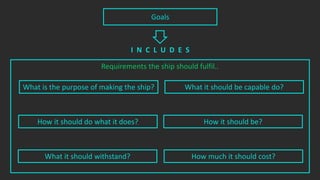
Goals
Requirements the ship should fulfil..
I N C L U D E S
What it should be capable do?What is the purpose of making the ship?
How it should be?
What it should withstand?
How it should do what it does?
How much it should cost?
Ship Design Data
Specifications, Drawings, Plans etc., that satisfactorily define a ship to
construct, operate...
How it actually looks?
How to construct??
How it performs?
What are the specs?
What are all there in it?
Certificates
I N C L U D E S
How things are arranged inside? How to Operate??
Where lies what?
Design Conditions
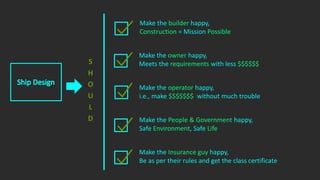
Make the builder happy,
Construction = Mission Possible
Make the owner happy,
Meets the requirements with less $$$$$$
Make the operator happy,
i.e., make $$$$$$$ without much trouble
Make the People & Government happy,
Safe Environment, Safe Life
Make the Insurance guy happy,
Be as per their rules and get the class certificate
S
H
O
U
L
D
Ship Design is not done in one go by one individual
Split into
Done in
By
TASKS
PHASES
TEAMS
Ship
Design
is
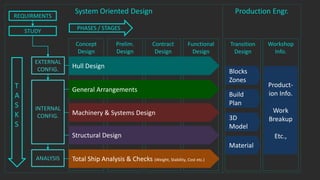
System Oriented Design Production Engr.
Prelim.
Design
Contract
Design
Concept
Design
Functional
Design
Transition
Design
Workshop
Info.
Structural Design
Total Ship Analysis & Checks (Weight, Stability, Cost etc.)
Hull Design
General Arrangements
Machinery & Systems Design
Product-
ion Info.
Work
Breakup
Etc.,
Blocks
Zones
Build
Plan
3D
Model
Material
INTERNAL
CONFIG.
EXTERNAL
CONFIG.
ANALYSIS
PHASES / STAGES
T
A
S
K
S
REQUIRMENTS
STUDY
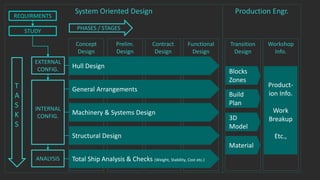
System Oriented Design Production Engr.
Prelim.
Design
Contract
Design
Concept
Design
Functional
Design
Transition
Design
Workshop
Info.
Structural Design
Total Ship Analysis & Checks (Weight, Stability, Cost etc.)
Hull Design
General Arrangements
Machinery & Systems Design
Product-
ion Info.
Work
Breakup
Etc.,
Blocks
Zones
Build
Plan
3D
Model
Material
INTERNAL
CONFIG.
EXTERNAL
CONFIG.
ANALYSIS
PHASES / STAGES
T
A
S
K
S
REQUIRMENTS
STUDY
Prelim.
Design
Contract
Design
Concept
Design
Functional
Design
Transition
Design
Workshop
Info.
Structural Design
Total Ship Analysis & Checks (Weight, Stability, Cost etc.)
Hull Design
Machinery & Systems Design
Product-
ion Info.
Work
Breakup
Etc.,
Blocks
Zones
Build
Plan
3D
Model
Material
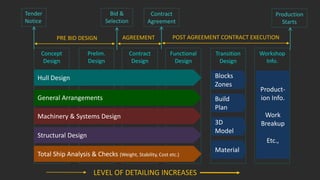
PRE BID DESIGN AGREEMENT POST AGREEMENT CONTRACT EXECUTION
Tender
Notice
Bid &
Selection
Contract
Agreement
Production
Starts
LEVEL OF DETAILING INCREASES
General Arrangements
CONCEPT DESIGN PHASE
Section 2
Concept Design: Why?
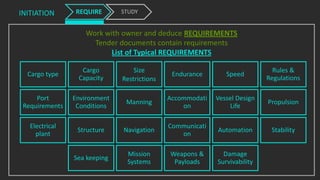
• Work with owner & deduce RequirementsREQUIREMENTS
• Check feasibilityFEASIBILITY
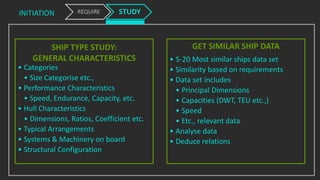
• Search similar ship data & AnalyseSHIPS
• Build a Concept model of the shipMODEL
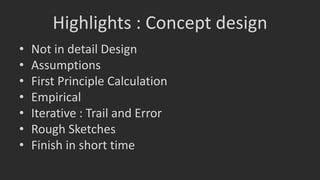
Highlights : Concept design
• Not in detail Design
• Assumptions
• First Principle Calculation
• Empirical
• Iterative : Trail and Error
• Rough Sketches
• Finish in short time
Cargo type
Cargo
Capacity
Size
Restrictions
Endurance Speed
Rules &
Regulations
Port
Requirements
Environment
Conditions
Manning
Accommodati
on
Vessel Design
Life
Propulsion
Electrical
plant
Structure Navigation
Communicati
on
Automation Stability
Sea keeping
Mission
Systems
Weapons &
Payloads
Damage
Survivability
Work with owner and deduce REQUIREMENTS
Tender documents contain requirements
List of Typical REQUIREMENTS
INITIATION REQUIRE STUDY
SHIP TYPE STUDY:
GENERAL CHARACTERISTICS
• Categories
• Size Categorise etc.,
• Performance Characteristics
• Speed, Endurance, Capacity, etc.
• Hull Characteristics
• Dimensions, Ratios, Coefficient etc.
• Typical Arrangements
• Systems & Machinery on board
• Structural Configuration
GET SIMILAR SHIP DATA
• 5-20 Most similar ships data set
• Similarity based on requirements
• Data set includes
• Principal Dimensions
• Capacities (DWT, TEU etc.,)
• Speed
• Etc., relevant data
• Analyse data
• Deduce relations
INITIATION REQUIRE STUDY
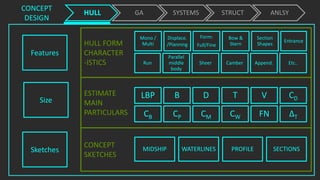
CONCEPT
DESIGN
Mono /
Multi
Displace.
/Planning
Form:
Full/Fine
Bow &
Stern
Section
Shapes
Entrance
Run
Parallel
middle
body
Sheer Camber Append. Etc..
ESTIMATE
MAIN
PARTICULARS
LBP B D T V CD
CB CP CM CW FN ΔT
CONCEPT
SKETCHES
MIDSHIP WATERLINES PROFILE SECTIONS
HULL FORM
CHARACTER
-ISTICS
Features
Size
Sketches
HULL GA SYSTEMS STRUCT ANLSY
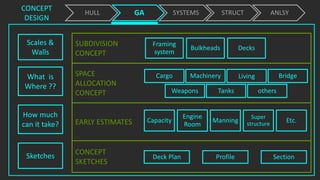
SPACE
ALLOCATION
CONCEPT
EARLY ESTIMATES
CONCEPT
SKETCHES
Cargo Machinery Living Bridge
Weapons Tanks others
Capacity
Engine
Room
Manning
Super
structure
Etc.
Deck Plan Profile Section
SUBDIVISION
CONCEPT
Framing
system
Bulkheads Decks
What is
Where ??
Scales &
Walls
How much
can it take?
Sketches
CONCEPT
DESIGN
HULL GA SYSTEMS STRUCT ANLSY
CONCEPT
DESIGN
PROPULSION
CONCEPT
SKETCHES
Resistance Power Plant Propeller
Simple Line Diagrams
LIST KEY
SYSTEMS
& THEIR TYPE
Main
Propulsion
Service
Systems
Steering
Gear
Fire
Safety
Cargo
handling
Electrical Etc.
Tech Specs
Mover
Diagrams
HULL GA SYSTEMS STRUCT ANLSY
CONCEPT
DESIGN
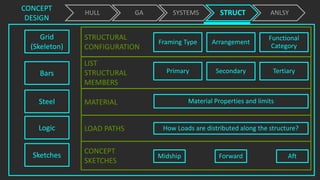
LIST
STRUCTURAL
MEMBERS
CONCEPT
SKETCHES
Midship Forward Aft
STRUCTURAL
CONFIGURATION
MATERIAL
LOAD PATHS
Framing Type Arrangement
Functional
Category
Primary Secondary Tertiary
Material Properties and limits
How Loads are distributed along the structure?
Grid
(Skeleton)
Bars
Steel
Logic
Sketches
HULL GA SYSTEMS STRUCT ANLSY
CONCEPT
DESIGN
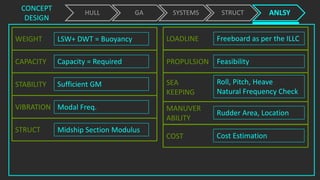
CAPACITY
WEIGHT
STABILITY
PROPULSION
LSW+ DWT = Buoyancy
Capacity = Required
Sufficient GM
Feasibility
SEA
KEEPING
Roll, Pitch, Heave
Natural Frequency Check
LOADLINE Freeboard as per the ILLC
COST Cost Estimation
MANUVER
ABILITY
Rudder Area, Location
STRUCT Midship Section Modulus
VIBRATION Modal Freq.
HULL GA SYSTEMS STRUCT ANLSY
PRELIMINARY DESIGN PHASE
Section 3
PRELIMINARY DESIGN
• Ship Systems are designed
• A basis for tender
• Formal Calculations & Drawings
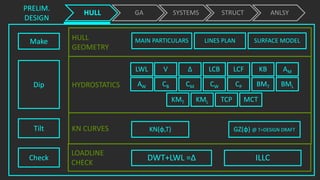
PRELIM.
DESIGN
MAIN PARTICULARS LINES PLAN SURFACE MODEL
HYDROSTATICS
LWL V ∆ LCB LCF KB AM
AW CB CM CW CP BMT BML
KMT KML TCP MCT
LOADLINE
CHECK
DWT+LWL =∆ ILLC
HULL
GEOMETRY
KN CURVES KN(φ,T) GZ(φ) @ T=DESIGN DRAFT
Make
Dip
Tilt
Check
HULL GA SYSTEMS STRUCT ANLSY
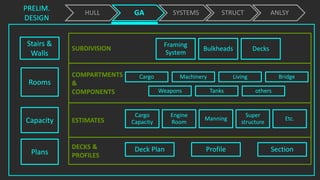
PRELIM.
DESIGN
COMPARTMENTS
&
COMPONENTS
ESTIMATES
DECKS &
PROFILES
Cargo Machinery Living Bridge
Weapons Tanks others
Cargo
Capacity
Engine
Room
Manning
Super
structure
Etc.
Deck Plan Profile Section
SUBDIVISION
Framing
System
Bulkheads Decks
Stairs &
Walls
Rooms
Capacity
Plans
HULL GA SYSTEMS STRUCT ANLSY
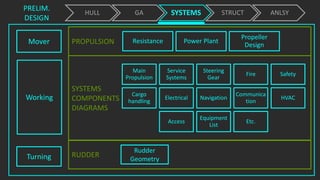
PRELIM.
DESIGN
Resistance Power Plant
Propeller
Design
SYSTEMS
COMPONENTS
DIAGRAMS
Main
Propulsion
Service
Systems
Steering
Gear
Fire Safety
Cargo
handling
Electrical Navigation
Communica
tion
HVAC
Access
Equipment
List
Etc.
Mover
Working
PROPULSION
RUDDER
Rudder
GeometryTurning
HULL GA SYSTEMS STRUCT ANLSY
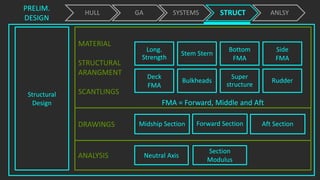
PRELIM.
DESIGN
DRAWINGS Midship Section Forward Section Aft Section
MATERIAL
STRUCTURAL
ARANGMENT
SCANTLINGS
ANALYSIS
Long.
Strength
Stem Stern
Bottom
FMA
Side
FMA
Deck
FMA
Bulkheads
Super
structure
Rudder
Neutral Axis
FMA = Forward, Middle and Aft
Structural
Design
HULL GA SYSTEMS STRUCT ANLSY
Section
Modulus
PRELIM.
DESIGN
CAPACITY
WEIGHT
STABILITY
& LONG.
STRENGTH
PROPULSION
LSW+ DWT = Buoyancy
Capacity = Required
Trim & stability book
Probabilistic Damage
stability
Systems Analysis SEA
KEEPING
Motions and Loads
LOADLINE ILLC Table
COST Cost Estimation
MANUVER
ABILITY
Characteristics
VIBRATION Modal Analysis
HULL GA SYSTEMS STRUCT ANLSY
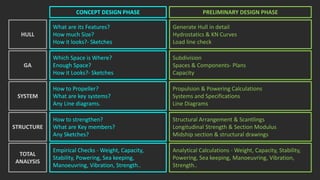
HULL
SYSTEM
GA
STRUCTURE
What are its Features?
How much Size?
How it looks?- Sketches
Which Space is Where?
Enough Space?
How it Looks?- Sketches
How to Propeller?
What are key systems?
Any Line diagrams.
How to strengthen?
What are Key members?
Any Sketches?
Empirical Checks - Weight, Capacity,
Stability, Powering, Sea keeping,
Manoeuvring, Vibration, Strength..
TOTAL
ANALYSIS
Generate Hull in detail
Hydrostatics & KN Curves
Load line check
Subdivision
Spaces & Components- Plans
Capacity
Propulsion & Powering Calculations
Systems and Specifications
Line Diagrams
Structural Arrangement & Scantlings
Longitudinal Strength & Section Modulus
Midship section & structural drawings
Analytical Calculations - Weight, Capacity, Stability,
Powering, Sea keeping, Manoeuvring, Vibration,
Strength..
CONCEPT DESIGN PHASE PRELIMINARY DESIGN PHASE
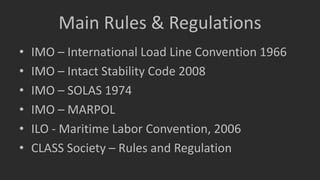
Main Rules & Regulations
• IMO – International Load Line Convention 1966
• IMO – Intact Stability Code 2008
• IMO – SOLAS 1974
• IMO – MARPOL
• ILO - Maritime Labor Convention, 2006
• CLASS Society – Rules and Regulation
That’s all For now…

Early stage Ship design Process

  • 1.
    mission: SHIP DESIGN TheEarly Stage Ship Design PRAVEEN K CH.
  • 2.
    Contents 1. Introduction 2. ConceptDesign 3. Preliminary Design
  • 3.
  • 4.
    Ship Design (Activity) What isShip Design? Goals (Input) Data to make a ship (Output) Ship Design is an activity that makes data needed to make a ship Tools
  • 5.
    Goals Requirements the shipshould fulfil.. I N C L U D E S What it should be capable do?What is the purpose of making the ship? How it should be? What it should withstand? How it should do what it does? How much it should cost?
  • 6.
    Ship Design Data Specifications,Drawings, Plans etc., that satisfactorily define a ship to construct, operate... How it actually looks? How to construct?? How it performs? What are the specs? What are all there in it? Certificates I N C L U D E S How things are arranged inside? How to Operate?? Where lies what? Design Conditions
  • 7.
    Make the builderhappy, Construction = Mission Possible Make the owner happy, Meets the requirements with less $$$$$$ Make the operator happy, i.e., make $$$$$$$ without much trouble Make the People & Government happy, Safe Environment, Safe Life Make the Insurance guy happy, Be as per their rules and get the class certificate S H O U L D
  • 8.
    Ship Design isnot done in one go by one individual Split into Done in By TASKS PHASES TEAMS Ship Design is
  • 9.
    System Oriented DesignProduction Engr. Prelim. Design Contract Design Concept Design Functional Design Transition Design Workshop Info. Structural Design Total Ship Analysis & Checks (Weight, Stability, Cost etc.) Hull Design General Arrangements Machinery & Systems Design Product- ion Info. Work Breakup Etc., Blocks Zones Build Plan 3D Model Material INTERNAL CONFIG. EXTERNAL CONFIG. ANALYSIS PHASES / STAGES T A S K S REQUIRMENTS STUDY
  • 10.
    System Oriented DesignProduction Engr. Prelim. Design Contract Design Concept Design Functional Design Transition Design Workshop Info. Structural Design Total Ship Analysis & Checks (Weight, Stability, Cost etc.) Hull Design General Arrangements Machinery & Systems Design Product- ion Info. Work Breakup Etc., Blocks Zones Build Plan 3D Model Material INTERNAL CONFIG. EXTERNAL CONFIG. ANALYSIS PHASES / STAGES T A S K S REQUIRMENTS STUDY
  • 11.
    Prelim. Design Contract Design Concept Design Functional Design Transition Design Workshop Info. Structural Design Total ShipAnalysis & Checks (Weight, Stability, Cost etc.) Hull Design Machinery & Systems Design Product- ion Info. Work Breakup Etc., Blocks Zones Build Plan 3D Model Material PRE BID DESIGN AGREEMENT POST AGREEMENT CONTRACT EXECUTION Tender Notice Bid & Selection Contract Agreement Production Starts LEVEL OF DETAILING INCREASES General Arrangements
  • 12.
  • 13.
    Concept Design: Why? •Work with owner & deduce RequirementsREQUIREMENTS • Check feasibilityFEASIBILITY • Search similar ship data & AnalyseSHIPS • Build a Concept model of the shipMODEL
  • 14.
    Highlights : Conceptdesign • Not in detail Design • Assumptions • First Principle Calculation • Empirical • Iterative : Trail and Error • Rough Sketches • Finish in short time
  • 15.
    Cargo type Cargo Capacity Size Restrictions Endurance Speed Rules& Regulations Port Requirements Environment Conditions Manning Accommodati on Vessel Design Life Propulsion Electrical plant Structure Navigation Communicati on Automation Stability Sea keeping Mission Systems Weapons & Payloads Damage Survivability Work with owner and deduce REQUIREMENTS Tender documents contain requirements List of Typical REQUIREMENTS INITIATION REQUIRE STUDY
  • 16.
    SHIP TYPE STUDY: GENERALCHARACTERISTICS • Categories • Size Categorise etc., • Performance Characteristics • Speed, Endurance, Capacity, etc. • Hull Characteristics • Dimensions, Ratios, Coefficient etc. • Typical Arrangements • Systems & Machinery on board • Structural Configuration GET SIMILAR SHIP DATA • 5-20 Most similar ships data set • Similarity based on requirements • Data set includes • Principal Dimensions • Capacities (DWT, TEU etc.,) • Speed • Etc., relevant data • Analyse data • Deduce relations INITIATION REQUIRE STUDY
  • 17.
    CONCEPT DESIGN Mono / Multi Displace. /Planning Form: Full/Fine Bow & Stern Section Shapes Entrance Run Parallel middle body SheerCamber Append. Etc.. ESTIMATE MAIN PARTICULARS LBP B D T V CD CB CP CM CW FN ΔT CONCEPT SKETCHES MIDSHIP WATERLINES PROFILE SECTIONS HULL FORM CHARACTER -ISTICS Features Size Sketches HULL GA SYSTEMS STRUCT ANLSY
  • 18.
    SPACE ALLOCATION CONCEPT EARLY ESTIMATES CONCEPT SKETCHES Cargo MachineryLiving Bridge Weapons Tanks others Capacity Engine Room Manning Super structure Etc. Deck Plan Profile Section SUBDIVISION CONCEPT Framing system Bulkheads Decks What is Where ?? Scales & Walls How much can it take? Sketches CONCEPT DESIGN HULL GA SYSTEMS STRUCT ANLSY
  • 19.
    CONCEPT DESIGN PROPULSION CONCEPT SKETCHES Resistance Power PlantPropeller Simple Line Diagrams LIST KEY SYSTEMS & THEIR TYPE Main Propulsion Service Systems Steering Gear Fire Safety Cargo handling Electrical Etc. Tech Specs Mover Diagrams HULL GA SYSTEMS STRUCT ANLSY
  • 20.
    CONCEPT DESIGN LIST STRUCTURAL MEMBERS CONCEPT SKETCHES Midship Forward Aft STRUCTURAL CONFIGURATION MATERIAL LOADPATHS Framing Type Arrangement Functional Category Primary Secondary Tertiary Material Properties and limits How Loads are distributed along the structure? Grid (Skeleton) Bars Steel Logic Sketches HULL GA SYSTEMS STRUCT ANLSY
  • 21.
    CONCEPT DESIGN CAPACITY WEIGHT STABILITY PROPULSION LSW+ DWT =Buoyancy Capacity = Required Sufficient GM Feasibility SEA KEEPING Roll, Pitch, Heave Natural Frequency Check LOADLINE Freeboard as per the ILLC COST Cost Estimation MANUVER ABILITY Rudder Area, Location STRUCT Midship Section Modulus VIBRATION Modal Freq. HULL GA SYSTEMS STRUCT ANLSY
  • 22.
  • 23.
    PRELIMINARY DESIGN • ShipSystems are designed • A basis for tender • Formal Calculations & Drawings
  • 24.
    PRELIM. DESIGN MAIN PARTICULARS LINESPLAN SURFACE MODEL HYDROSTATICS LWL V ∆ LCB LCF KB AM AW CB CM CW CP BMT BML KMT KML TCP MCT LOADLINE CHECK DWT+LWL =∆ ILLC HULL GEOMETRY KN CURVES KN(φ,T) GZ(φ) @ T=DESIGN DRAFT Make Dip Tilt Check HULL GA SYSTEMS STRUCT ANLSY
  • 25.
    PRELIM. DESIGN COMPARTMENTS & COMPONENTS ESTIMATES DECKS & PROFILES Cargo MachineryLiving Bridge Weapons Tanks others Cargo Capacity Engine Room Manning Super structure Etc. Deck Plan Profile Section SUBDIVISION Framing System Bulkheads Decks Stairs & Walls Rooms Capacity Plans HULL GA SYSTEMS STRUCT ANLSY
  • 26.
    PRELIM. DESIGN Resistance Power Plant Propeller Design SYSTEMS COMPONENTS DIAGRAMS Main Propulsion Service Systems Steering Gear FireSafety Cargo handling Electrical Navigation Communica tion HVAC Access Equipment List Etc. Mover Working PROPULSION RUDDER Rudder GeometryTurning HULL GA SYSTEMS STRUCT ANLSY
  • 27.
    PRELIM. DESIGN DRAWINGS Midship SectionForward Section Aft Section MATERIAL STRUCTURAL ARANGMENT SCANTLINGS ANALYSIS Long. Strength Stem Stern Bottom FMA Side FMA Deck FMA Bulkheads Super structure Rudder Neutral Axis FMA = Forward, Middle and Aft Structural Design HULL GA SYSTEMS STRUCT ANLSY Section Modulus
  • 28.
    PRELIM. DESIGN CAPACITY WEIGHT STABILITY & LONG. STRENGTH PROPULSION LSW+ DWT= Buoyancy Capacity = Required Trim & stability book Probabilistic Damage stability Systems Analysis SEA KEEPING Motions and Loads LOADLINE ILLC Table COST Cost Estimation MANUVER ABILITY Characteristics VIBRATION Modal Analysis HULL GA SYSTEMS STRUCT ANLSY
  • 29.
    HULL SYSTEM GA STRUCTURE What are itsFeatures? How much Size? How it looks?- Sketches Which Space is Where? Enough Space? How it Looks?- Sketches How to Propeller? What are key systems? Any Line diagrams. How to strengthen? What are Key members? Any Sketches? Empirical Checks - Weight, Capacity, Stability, Powering, Sea keeping, Manoeuvring, Vibration, Strength.. TOTAL ANALYSIS Generate Hull in detail Hydrostatics & KN Curves Load line check Subdivision Spaces & Components- Plans Capacity Propulsion & Powering Calculations Systems and Specifications Line Diagrams Structural Arrangement & Scantlings Longitudinal Strength & Section Modulus Midship section & structural drawings Analytical Calculations - Weight, Capacity, Stability, Powering, Sea keeping, Manoeuvring, Vibration, Strength.. CONCEPT DESIGN PHASE PRELIMINARY DESIGN PHASE
  • 30.
    Main Rules &Regulations • IMO – International Load Line Convention 1966 • IMO – Intact Stability Code 2008 • IMO – SOLAS 1974 • IMO – MARPOL • ILO - Maritime Labor Convention, 2006 • CLASS Society – Rules and Regulation
  • 31.