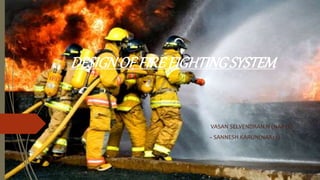
DESIGNOF FIREFIGHTINGSYSTEM
-VASAN SELVENDRAN.N
Dept. of Naval Architecture & offshore engineering
AMET university
INTRODUCTION:
 Fire are common hazard on sea. It results in loss of cargo, damage to vessel and some
times a threat to personnel life. Fire is a result of combination of three factors :
1. A substance that will burn
2. An ignition source
3. A supply of oxygen, usually from air.
 In this session let us discuss about various types of fire that occurs on-board a vessel and
what are the ways to extinguish it and also the design of fire fighting
systems on-board the vessel.
OBJECTIVES OF FIRE SAFETY SYSTEMS
 1 prevent the occurrence of fire and explosion;
 2 reduce the risk to life caused by fire;
 3 reduce the risk of damage caused by fire to the ship, its cargo and the environment;
 4 contain, control and suppress fire and explosion in the compartment of origin; and
 5 provide adequate and readily accessible means of escape for passengers and crew.
Classification of Fire
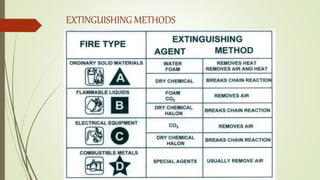
 Fires are classified according to the types of material acting as fuel. These classification is
also used for extinguishers and it is essential to use the correct classification of
extinguisher for a fire, to avoid spreading the fire or creating additional hazards. Fires are
classified as follows;
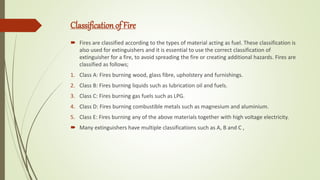
1. Class A: Fires burning wood, glass fibre, upholstery and furnishings.
2. Class B: Fires burning liquids such as lubrication oil and fuels.
3. Class C: Fires burning gas fuels such as LPG.
4. Class D: Fires burning combustible metals such as magnesium and aluminium.
5. Class E: Fires burning any of the above materials together with high voltage electricity.
 Many extinguishers have multiple classifications such as A, B and C ,
Functional Requirements
1. division of the ship into main vertical and horizontal zones by thermal and structural
boundaries;
2. separation of accommodation spaces from the remainder of the ship by thermal and
structural boundaries;
3. restricted use of combustible materials;
4. detection of any fire in the zone of origin;
5. containment and extinction of any fire in the space of origin;
6. protection of means of escape and access for fire-fighting;
7. ready availability of fire-extinguishing appliances; and
8. minimization of possibility of ignition of flammable cargo vapour
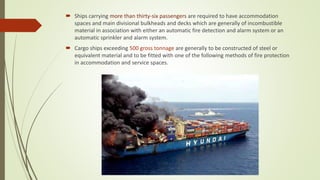
 Ships carrying more than thirty-six passengers are required to have accommodation
spaces and main divisional bulkheads and decks which are generally of incombustible
material in association with either an automatic fire detection and alarm system or an
automatic sprinkler and alarm system.
 Cargo ships exceeding 500 gross tonnage are generally to be constructed of steel or
equivalent material and to be fitted with one of the following methods of fire protection
in accommodation and service spaces.
FIRE SUPPRESSION
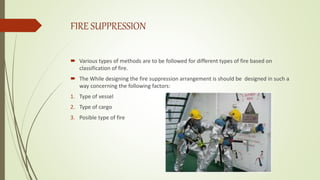
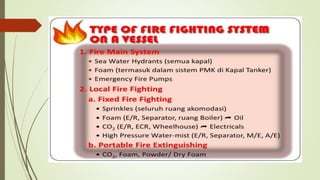
 Various types of methods are to be followed for different types of fire based on
classification of fire.
 The While designing the fire suppression arrangement is should be designed in such a
way concerning the following factors:
1. Type of vessel
2. Type of cargo
3. Posible type of fire
EXTINGUISHING METHODS
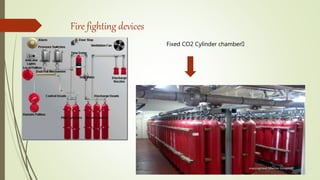
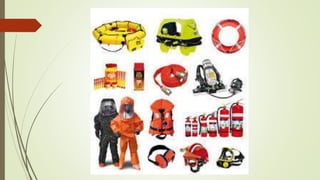
Fire fighting devices
Fixed CO2 Cylinder chamber
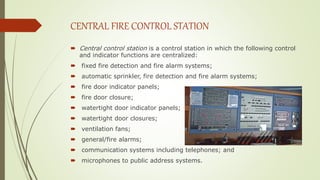
CENTRAL FIRE CONTROL STATION
 Central control station is a control station in which the following control
and indicator functions are centralized:
 fixed fire detection and fire alarm systems;
 automatic sprinkler, fire detection and fire alarm systems;
 fire door indicator panels;
 fire door closure;
 watertight door indicator panels;
 watertight door closures;
 ventilation fans;
 general/fire alarms;
 communication systems including telephones; and
 microphones to public address systems.
ENGINEERING ANALYSIS
 The engineering analysis shall be prepared and submitted to the Administration, based on
the guidelines developed by the Organization* and shall include, as a minimum, the
following elements:
 1 determination of the ship type and space(s) concerned;
 2 identification of prescriptive requirement(s) with which the ship or the space(s) will not
comply;
 3 identification of the fire and explosion hazards of the ship or the space(s) concerned;
 3.1 identification of the possible ignition sources;
 3.2 identification of the fire growth potential of each space concerned;
 3.3 identification of the smoke and toxic effluent generation potential for each space
concerned;
 3.4 identification of the potential for the spread of fire, smoke or of toxic effluents from
the space(s) concerned to other spaces;
ENGINEERING ANALYSIS
 4 determination of the required fire safety performance criteria for the ships or the
space(s) concerned addressed by the prescriptive requirement(s);
 4.1 performance criteria shall be based on the fire safety objectives and on the functional
requirements of this chapter;
 4.2 performance criteria shall provide a degree of safety not less than that achieved by
using the prescriptive requirements; and
 4.3 performance criteria shall be quantifiable and measurable;
Location AND AVAILABILITY
 The general arrangement plan should be permanently exhibited for the guidance of ship
officer in conspicuous locations such as navigating bridge, engine room and
accommodation.
 At least one copy of the fire control plan shall be available ashore at the offices of the
Company.
 Copies of the fire control plan must be provided to each of the members of the fire patrol
team in a passenger ship and also posted at each continuously manned central control
station.
 A copy of Fire Control Plan should be permanently stored in prominently marked weather
tight enclosures outside deckhouse for assistance of shore side fire fighting system in case
the ship is in port or in dry-dock
 One copy of the same should be available on board and be easily accessible. These plans
should be kept up-to-date and if alterations are made shall be recorded as soon as
possible. The fire plan should be available in the working language of the crew on board
and also in English language.
Renewal, update of Fire control plan:
Following are the cases when renewal or update in the fire control plan is required:
 Change in the fire fighting system, alarm system, escape route design or anything
related to current fire plan takes place. The new system or design must be included
and approval should be taken from the classification society
 Modification In ship structure or ship particulars which effect the current fire plan
must be added to the new plan with approval of the classification society
 In case of revision of statutes related to fire control plan under SOLAS done by IMO
or similar authority, the new fire plan to be provided and the fire fighting system or
equipment must be as per the new revised plan
 When change of flag in a ship happens, the assigned classification society must
review the ship fire control plan
 During the change of classification society, the fire control plan must be reviewed
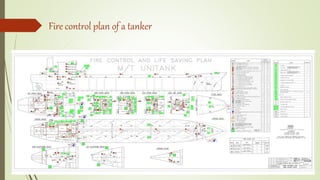
Fire control plan of a tanker
Following surveys are required:
 Initial Survey: This is the survey to be done for issuing the approved fire
control plan to the newly built ship.
 Annual Survey: The fire control plan survey comes under the continuous
ship safety equipment survey (CSSE) which is performed annually.
 Renewal Survey: If the CSSE certificate is under renewal period requiring
a survey, the fire control plan will require this survey.
 The attending surveyor is required and expected to make a specific and
explicit statement in the report of the relevant survey as to whether he
has examined and has verified that the content of fire control plan found
on board are in a readable state, updated, approved (or examined for
compliance) and in accordance with the requirements of Regulations
under SOLAS
Protection of Special Category Spaces
 A special category space is an enclosed space above or below the bulkhead deck used for
the carriage of motor vehicles with fuel for their own propulsion in their own tanks and to
which passengers have access.
 Obvious examples are the garage spaces in ro-ro passenger ferries and vehicle decks in ro-
ro cargo ships. Such spaces cannot have the normal main vertical fire zoning without
interfering with the working of the ship.
 Equivalent protection is provided in such spaces by ensuring that the horizontal and
vertical boundaries of the space are treated as main fire zone divisions and an efficient
fixed fire-extinguishing system is fitted within the space.
 This takes the form of a fixed pressure water spraying system generally in association with
an automatic fire detection system.
 Special scupper arrangements are provided to clear the deck of the water deposited by
the system in the event of a fire to avoid a drastic reduction in stability.
 As required by Chapter II-2 of International Convention For the Safety of Life at Sea (SOLAS) 1974 as amended:
This code is applicable for ships whose keel is laid on or after 1 July 2002.
 Type Approval:
 All fire extinguishers shall be type approved and the designs based on the guidelines developed by the
organisation.
 Engineering Specification:
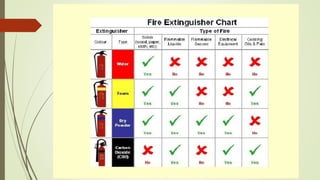
 Each powder or CO2 Extinguisher shall have a capacity of atleast 5 kg, and
 each foam extinguisher shall have a capacity of atleast 9 litre.
 The mass of all portable fire extinguishers shall not exceed23 kg and they shall have a fire fighting capability atleast
equivalent to that of a 9 liter fluid extinguisher.
 The administration shall determine the equivalents of fire extinguishers.
 Recharging
Only refills for the fire extinguisher in question should be used for recharging.
 Portable Foam applicators:
A portable foam applicator shall consist of a foam nozzle of an inductor type capable of being connected to the fire
main by a fier hose, together with aportable tank containing atleast 20 litre of foam – forming liquid and one spare tank
of foam making liquid. The nozzle shall be capable of producing effectivefoam suitable for extinguishing an oil fire, at
the rate of atleast 1.5 cu m / min.
SolasregulationforPortableFireExtinguishers
SOME IMPORTANT POINTS
 An escape plan shall be provided in all fire zones.
 Accessibility of helicopters may also be considers for sone cases of ship.
 Fire safety operational booklets should be provided to the crew.
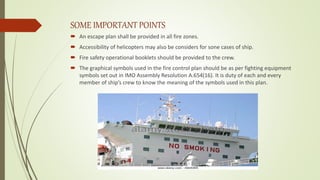
 The graphical symbols used in the fire control plan should be as per fighting equipment
symbols set out in IMO Assembly Resolution A.654(16). It is duty of each and every
member of ship’s crew to know the meaning of the symbols used in this plan.
As a naval architect:
We should design a ship’s fire fighting system according to
classification society rules and regulations.
Possibilities of fire should be analysed and suitable
extinguishing method and devices should be designed in
the design stage itself.
REFERNCE
 Ship Construction – D.J.Eyres
 SOLAS-( 1 January 2012 Chapter II-2)
 Marine Insight – Marine Engineering
Fire Fighting system on ship

Fire Fighting system on ship

  • 1.
    DESIGNOF FIREFIGHTINGSYSTEM -VASAN SELVENDRAN.N Dept.of Naval Architecture & offshore engineering AMET university
  • 2.
    INTRODUCTION:  Fire arecommon hazard on sea. It results in loss of cargo, damage to vessel and some times a threat to personnel life. Fire is a result of combination of three factors : 1. A substance that will burn 2. An ignition source 3. A supply of oxygen, usually from air.  In this session let us discuss about various types of fire that occurs on-board a vessel and what are the ways to extinguish it and also the design of fire fighting systems on-board the vessel.
  • 3.
    OBJECTIVES OF FIRESAFETY SYSTEMS  1 prevent the occurrence of fire and explosion;  2 reduce the risk to life caused by fire;  3 reduce the risk of damage caused by fire to the ship, its cargo and the environment;  4 contain, control and suppress fire and explosion in the compartment of origin; and  5 provide adequate and readily accessible means of escape for passengers and crew.
  • 4.
    Classification of Fire Fires are classified according to the types of material acting as fuel. These classification is also used for extinguishers and it is essential to use the correct classification of extinguisher for a fire, to avoid spreading the fire or creating additional hazards. Fires are classified as follows; 1. Class A: Fires burning wood, glass fibre, upholstery and furnishings. 2. Class B: Fires burning liquids such as lubrication oil and fuels. 3. Class C: Fires burning gas fuels such as LPG. 4. Class D: Fires burning combustible metals such as magnesium and aluminium. 5. Class E: Fires burning any of the above materials together with high voltage electricity.  Many extinguishers have multiple classifications such as A, B and C ,
  • 5.
    Functional Requirements 1. divisionof the ship into main vertical and horizontal zones by thermal and structural boundaries; 2. separation of accommodation spaces from the remainder of the ship by thermal and structural boundaries; 3. restricted use of combustible materials; 4. detection of any fire in the zone of origin; 5. containment and extinction of any fire in the space of origin; 6. protection of means of escape and access for fire-fighting; 7. ready availability of fire-extinguishing appliances; and 8. minimization of possibility of ignition of flammable cargo vapour
  • 6.
     Ships carryingmore than thirty-six passengers are required to have accommodation spaces and main divisional bulkheads and decks which are generally of incombustible material in association with either an automatic fire detection and alarm system or an automatic sprinkler and alarm system.  Cargo ships exceeding 500 gross tonnage are generally to be constructed of steel or equivalent material and to be fitted with one of the following methods of fire protection in accommodation and service spaces.
  • 7.
    FIRE SUPPRESSION  Varioustypes of methods are to be followed for different types of fire based on classification of fire.  The While designing the fire suppression arrangement is should be designed in such a way concerning the following factors: 1. Type of vessel 2. Type of cargo 3. Posible type of fire
  • 9.
  • 11.
    Fire fighting devices FixedCO2 Cylinder chamber
  • 13.
    CENTRAL FIRE CONTROLSTATION  Central control station is a control station in which the following control and indicator functions are centralized:  fixed fire detection and fire alarm systems;  automatic sprinkler, fire detection and fire alarm systems;  fire door indicator panels;  fire door closure;  watertight door indicator panels;  watertight door closures;  ventilation fans;  general/fire alarms;  communication systems including telephones; and  microphones to public address systems.
  • 14.
    ENGINEERING ANALYSIS  Theengineering analysis shall be prepared and submitted to the Administration, based on the guidelines developed by the Organization* and shall include, as a minimum, the following elements:  1 determination of the ship type and space(s) concerned;  2 identification of prescriptive requirement(s) with which the ship or the space(s) will not comply;  3 identification of the fire and explosion hazards of the ship or the space(s) concerned;  3.1 identification of the possible ignition sources;  3.2 identification of the fire growth potential of each space concerned;  3.3 identification of the smoke and toxic effluent generation potential for each space concerned;  3.4 identification of the potential for the spread of fire, smoke or of toxic effluents from the space(s) concerned to other spaces;
  • 15.
    ENGINEERING ANALYSIS  4determination of the required fire safety performance criteria for the ships or the space(s) concerned addressed by the prescriptive requirement(s);  4.1 performance criteria shall be based on the fire safety objectives and on the functional requirements of this chapter;  4.2 performance criteria shall provide a degree of safety not less than that achieved by using the prescriptive requirements; and  4.3 performance criteria shall be quantifiable and measurable;
  • 16.
    Location AND AVAILABILITY The general arrangement plan should be permanently exhibited for the guidance of ship officer in conspicuous locations such as navigating bridge, engine room and accommodation.  At least one copy of the fire control plan shall be available ashore at the offices of the Company.  Copies of the fire control plan must be provided to each of the members of the fire patrol team in a passenger ship and also posted at each continuously manned central control station.  A copy of Fire Control Plan should be permanently stored in prominently marked weather tight enclosures outside deckhouse for assistance of shore side fire fighting system in case the ship is in port or in dry-dock  One copy of the same should be available on board and be easily accessible. These plans should be kept up-to-date and if alterations are made shall be recorded as soon as possible. The fire plan should be available in the working language of the crew on board and also in English language.
  • 18.
    Renewal, update ofFire control plan: Following are the cases when renewal or update in the fire control plan is required:  Change in the fire fighting system, alarm system, escape route design or anything related to current fire plan takes place. The new system or design must be included and approval should be taken from the classification society  Modification In ship structure or ship particulars which effect the current fire plan must be added to the new plan with approval of the classification society  In case of revision of statutes related to fire control plan under SOLAS done by IMO or similar authority, the new fire plan to be provided and the fire fighting system or equipment must be as per the new revised plan  When change of flag in a ship happens, the assigned classification society must review the ship fire control plan  During the change of classification society, the fire control plan must be reviewed
  • 19.
    Fire control planof a tanker
  • 20.
    Following surveys arerequired:  Initial Survey: This is the survey to be done for issuing the approved fire control plan to the newly built ship.  Annual Survey: The fire control plan survey comes under the continuous ship safety equipment survey (CSSE) which is performed annually.  Renewal Survey: If the CSSE certificate is under renewal period requiring a survey, the fire control plan will require this survey.  The attending surveyor is required and expected to make a specific and explicit statement in the report of the relevant survey as to whether he has examined and has verified that the content of fire control plan found on board are in a readable state, updated, approved (or examined for compliance) and in accordance with the requirements of Regulations under SOLAS
  • 21.
    Protection of SpecialCategory Spaces  A special category space is an enclosed space above or below the bulkhead deck used for the carriage of motor vehicles with fuel for their own propulsion in their own tanks and to which passengers have access.  Obvious examples are the garage spaces in ro-ro passenger ferries and vehicle decks in ro- ro cargo ships. Such spaces cannot have the normal main vertical fire zoning without interfering with the working of the ship.  Equivalent protection is provided in such spaces by ensuring that the horizontal and vertical boundaries of the space are treated as main fire zone divisions and an efficient fixed fire-extinguishing system is fitted within the space.  This takes the form of a fixed pressure water spraying system generally in association with an automatic fire detection system.  Special scupper arrangements are provided to clear the deck of the water deposited by the system in the event of a fire to avoid a drastic reduction in stability.
  • 22.
     As requiredby Chapter II-2 of International Convention For the Safety of Life at Sea (SOLAS) 1974 as amended: This code is applicable for ships whose keel is laid on or after 1 July 2002.  Type Approval:  All fire extinguishers shall be type approved and the designs based on the guidelines developed by the organisation.  Engineering Specification:  Each powder or CO2 Extinguisher shall have a capacity of atleast 5 kg, and  each foam extinguisher shall have a capacity of atleast 9 litre.  The mass of all portable fire extinguishers shall not exceed23 kg and they shall have a fire fighting capability atleast equivalent to that of a 9 liter fluid extinguisher.  The administration shall determine the equivalents of fire extinguishers.  Recharging Only refills for the fire extinguisher in question should be used for recharging.  Portable Foam applicators: A portable foam applicator shall consist of a foam nozzle of an inductor type capable of being connected to the fire main by a fier hose, together with aportable tank containing atleast 20 litre of foam – forming liquid and one spare tank of foam making liquid. The nozzle shall be capable of producing effectivefoam suitable for extinguishing an oil fire, at the rate of atleast 1.5 cu m / min. SolasregulationforPortableFireExtinguishers
  • 23.
    SOME IMPORTANT POINTS An escape plan shall be provided in all fire zones.  Accessibility of helicopters may also be considers for sone cases of ship.  Fire safety operational booklets should be provided to the crew.  The graphical symbols used in the fire control plan should be as per fighting equipment symbols set out in IMO Assembly Resolution A.654(16). It is duty of each and every member of ship’s crew to know the meaning of the symbols used in this plan.
  • 24.
    As a navalarchitect: We should design a ship’s fire fighting system according to classification society rules and regulations. Possibilities of fire should be analysed and suitable extinguishing method and devices should be designed in the design stage itself.
  • 25.
    REFERNCE  Ship Construction– D.J.Eyres  SOLAS-( 1 January 2012 Chapter II-2)  Marine Insight – Marine Engineering