Fatigue crack propagation
Solid Mechanics Anders Ekberg
1 (20)
Fatigue crack propagation
Repetition Ð Crack initiation and growth
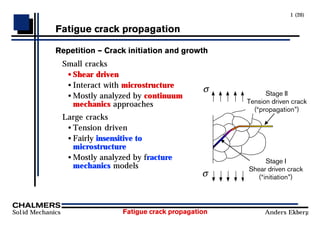
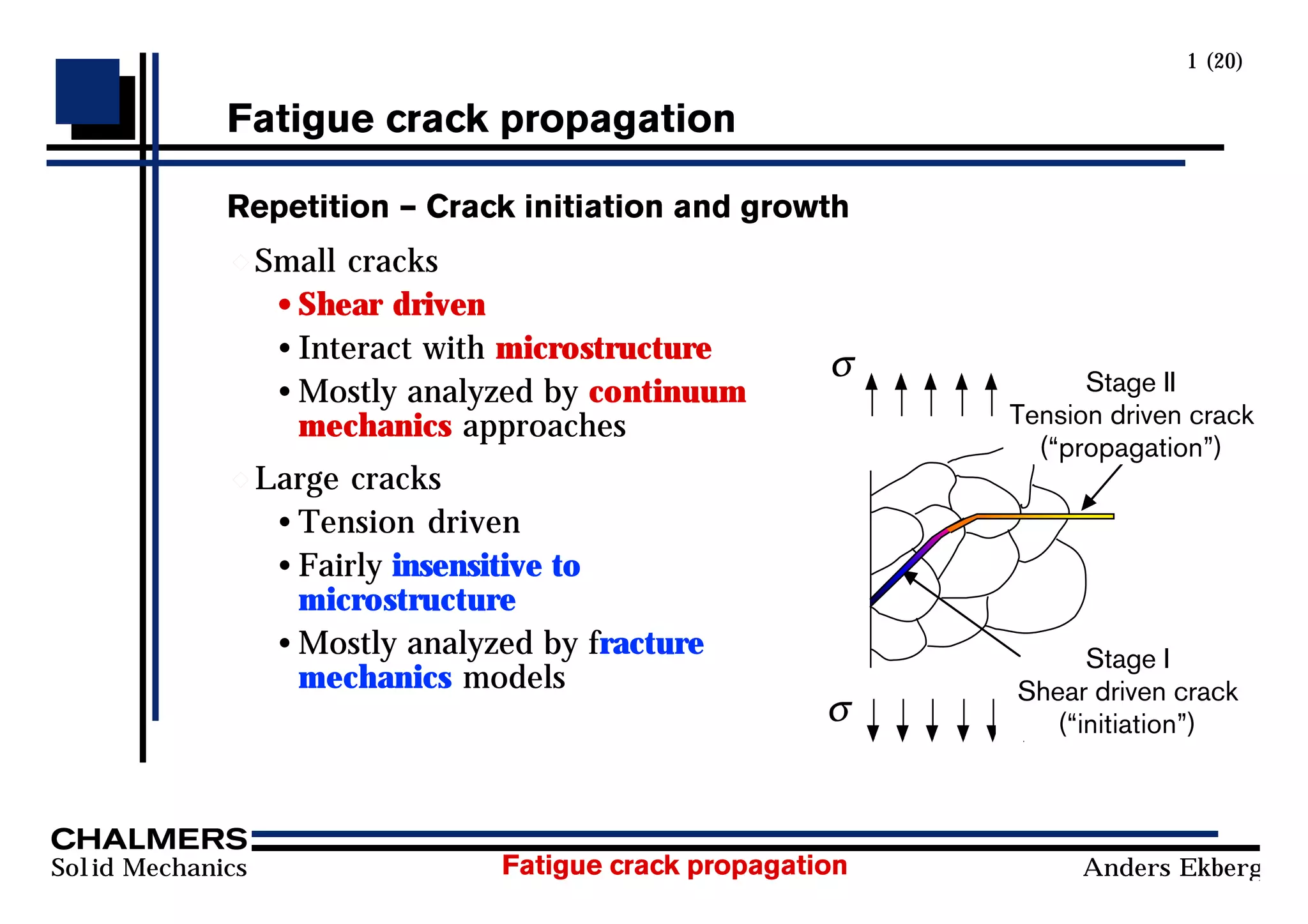
Small cracks
• Shear driven
• Interact with microstructure
• Mostly analyzed by continuum
mechanics approaches
Large cracks
• Tension driven
• Fairly insensitive to
microstructure
• Mostly analyzed by fracture
mechanics models
σ
σ
Stage II
Tension driven crack
(ÒpropagationÓ)
Stage I
Shear driven crack
(ÒinitiationÓ)
Fatigue crack propagation
Solid Mechanics Anders Ekberg
2 (20)
Stress intensity factors and fracture
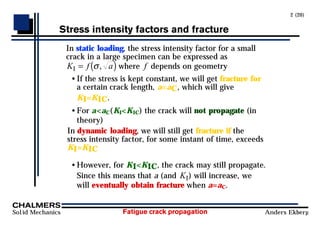
In static loading, the stress intensity factor for a small
crack in a large specimen can be expressed as
K f a
I = ( )
σ, where f depends on geometry
• If the stress is kept constant, we will get fracture for
a certain crack length, a=aC, which will give
KI=KIC.
• For a<aC(KI<KIC) the crack will not propagate (in
theory)
In dynamic loading, we will still get fracture if the
stress intensity factor, for some instant of time, exceeds
KI=KIC
• However, for KI<KIC, the crack may still propagate.
Since this means that a (and KI) will increase, we
will eventually obtain fracture when a=aC.
Fatigue crack propagation
Solid Mechanics Anders Ekberg
3 (20)
Crack growth as a function of ∆K
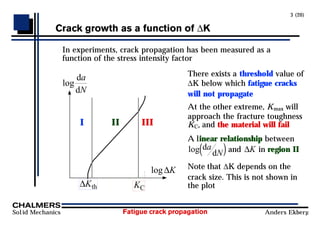
In experiments, crack propagation has been measured as a
function of the stress intensity factor
I II III
log
da
dN
log∆K
∆Kth KC
There exists a threshold value of
∆K below which fatigue cracks
will not propagate
At the other extreme, Kmax will
approach the fracture toughness
KC, and the material will fail
A linear relationship between
log d
d
a
N
( )and ∆K in region II
Note that ∆K depends on the
crack size. This is not shown in
the plot
Fatigue crack propagation
Solid Mechanics Anders Ekberg
4 (20)
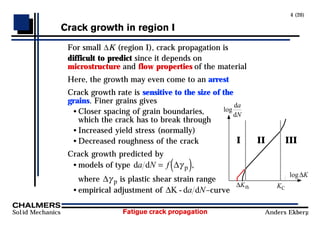
Crack growth in region I
For small ∆K (region I), crack propagation is
difficult to predict since it depends on
microstructure and flow properties of the material
Here, the growth may even come to an arrest
Crack growth rate is sensitive to the size of the
grains. Finer grains gives
• Closer spacing of grain boundaries,
which the crack has to break through
• Increased yield stress (normally)
• Decreased roughness of the crack
Crack growth predicted by
• models of type d d p
a N f
= ( )
∆γ ,
where ∆γ p is plastic shear strain range
• empirical adjustment of ∆K - d d
a N–curve
I II III
log
da
dN
log∆K
∆Kth KC
Fatigue crack propagation
Solid Mechanics Anders Ekberg
5 (20)
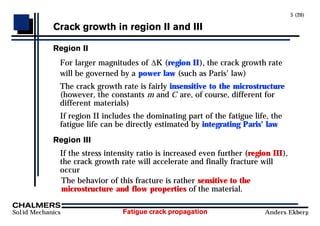
Crack growth in region II and III
Region II
For larger magnitudes of ∆K (region II), the crack growth rate
will be governed by a power law (such as Paris’ law)
The crack growth rate is fairly insensitive to the microstructure
(however, the constants m and C are, of course, different for
different materials)
If region II includes the dominating part of the fatigue life, the
fatigue life can be directly estimated by integrating Paris’ law
Region III
If the stress intensity ratio is increased even further (region III),
the crack growth rate will accelerate and finally fracture will
occur
The behavior of this fracture is rather sensitive to the
microstructure and flow properties of the material.
Fatigue crack propagation
Solid Mechanics Anders Ekberg
6 (20)
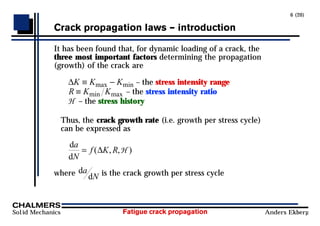
Crack propagation laws Ð introduction
It has been found that, for dynamic loading of a crack, the
three most important factors determining the propagation
(growth) of the crack are
∆K K K
≡ −
max min – the stress intensity range
R K K
≡ min max – the stress intensity ratio
H – the stress history
Thus, the crack growth rate (i.e. growth per stress cycle)
can be expressed as
d
d
a
N
f K R
= ( , , )
∆ H
where d
d
a
N is the crack growth per stress cycle
Fatigue crack propagation
Solid Mechanics Anders Ekberg
7 (20)
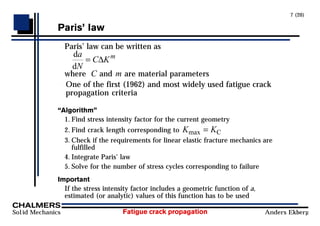
ParisÕ law
Paris’ law can be written as
d
d
a
N
C Km
= ∆
where C and m are material parameters
One of the first (1962) and most widely used fatigue crack
propagation criteria
ÒAlgorithmÓ
1. Find stress intensity factor for the current geometry
2. Find crack length corresponding to K K
max = C
3. Check if the requirements for linear elastic fracture mechanics are
fulfilled
4. Integrate Paris’ law
5. Solve for the number of stress cycles corresponding to failure
Important
If the stress intensity factor includes a geometric function of a,
estimated (or analytic) values of this function has to be used
Fatigue crack propagation
Solid Mechanics Anders Ekberg
8 (20)
ParisÕ law Ð drawbacks
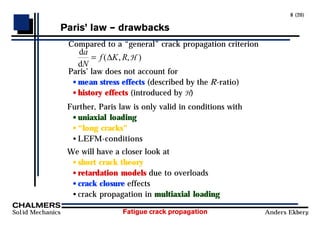
Compared to a “general” crack propagation criterion
d
d
a
N
f K R
= ( , , )
∆ H
Paris’ law does not account for
• mean stress effects (described by the R-ratio)
• history effects (introduced by H)
Further, Paris law is only valid in conditions with
• uniaxial loading
• “long cracks”
• LEFM-conditions
We will have a closer look at
• short crack theory
• retardation models due to overloads
• crack closure effects
• crack propagation in multiaxial loading
Fatigue crack propagation
Solid Mechanics Anders Ekberg
9 (20)
Short cracks
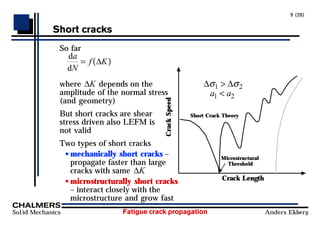
So far
d
d
a
N
f K
= ( )
∆
where ∆K depends on the
amplitude of the normal stress
(and geometry)
But short cracks are shear
stress driven also LEFM is
not valid
Two types of short cracks
• mechanically short cracks –
propagate faster than large
cracks with same ∆K
• microstructurally short cracks
– interact closely with the
microstructure and grow fast
Short Crack Theory
Microstructural
Threshold
Crack
Speed
Crack Length
∆σ1 > ∆σ2
a1 < a2
Fatigue crack propagation
Solid Mechanics Anders Ekberg
10 (20)
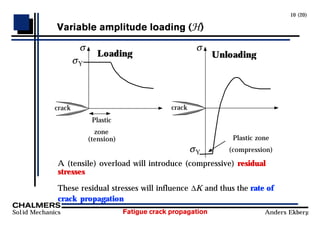
Variable amplitude loading (H)
crack
Plastic
zone
(tension)
Loading Unloading
crack
Plastic zone
(compression)
σY
σY
σ σ
A (tensile) overload will introduce (compressive) residual
stresses
These residual stresses will influence ∆K and thus the rate of
crack propagation
Fatigue crack propagation
Solid Mechanics Anders Ekberg
11 (20)
The Wheeler model
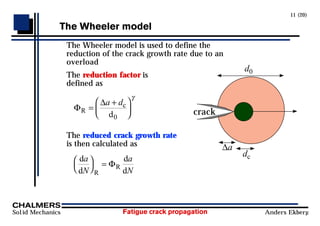
The Wheeler model is used to define the
reduction of the crack growth rate due to an
overload
The reduction factor is
defined as
Φ
∆
R
c
0
d
=
+






a d
γ
The reduced crack growth rate
is then calculated as
d
d
d
d
R
R
a
N
a
N




= Φ
crack
d0
∆a
dc
Variable Amplitude Loading, contÕd
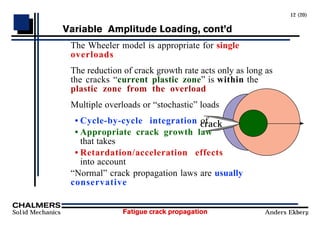
The Wheeler model is appropriate for single
overloads
The reduction of crack growth rate acts only as long as
the cracks “current plastic zone” is within the
plastic zone from the overload
Multiple overloads or “stochastic” loads
• Cycle-by-cycle integration of
• Appropriate crack growth law
that takes
• Retardation/acceleration effects
into account
“Normal” crack propagation laws are usually
conservative
Fatigue crack propagation
Solid Mechanics Anders Ekberg
12 (20)
crack
Fatigue crack propagation
Solid Mechanics Anders Ekberg
13 (20)
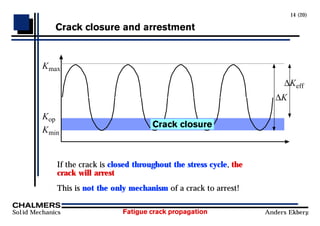
Crack closure (R)
Elber, in 1970, discovered that crack closure exists in cyclic
loading, even for loads that are greater than zero
This crack closure will decrease the fatigue crack growth rate
by reducing the effective stress intensity range
The stress intensity rate
∆K K K
K K
≡ −
= [ ]
max min
min min
max ,0
Crack closure att K=Kop gives
∆K K K
eff op
≡ −
max
Paris law using effective stress intensity rate
d
d eff
a
N C Km
= ∆
Empirical relation
K R K
R R R R
op =
= + + − ≤ ≤
ϕ
ϕ
( )
( ) . . .
max
0 25 0 5 0 25 1 1
2
Fatigue crack propagation
Solid Mechanics Anders Ekberg
14 (20)
Crack closure and arrestment
Crack closure
Kmax
∆Keff
Kop
Kmin
∆K
If the crack is closed throughout the stress cycle, the
crack will arrest
This is not the only mechanism of a crack to arrest!
Fatigue crack propagation
Solid Mechanics Anders Ekberg
15 (20)
Crack closure and arrestment Ð II
1 0.8 0.6 0.4 0.2 0 0.2 0.4 0.6 0.8 1
-10
-8
-6
-4
-2
0
2
4
6
8
10
R
K
op
and
K
min Kop
Kmin
Smallest magnitude of
Kmin in Paris law
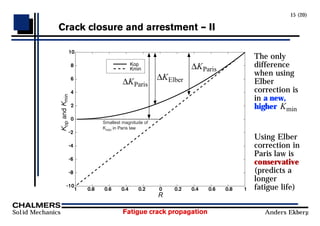
∆KParis
∆KElber
∆KParis
Using Elber
correction in
Paris law is
conservative
(predicts a
longer
fatigue life)
The only
difference
when using
Elber
correction is
in a new,
higher Kmin
Fatigue crack propagation
Solid Mechanics Anders Ekberg
16 (20)
Crack arrestment
d
d eff
eff
max op
max
max min
op
max
max
min
max
op
a
N
C K C
K
K
K
C
K K
K
K
C
K
K K
K
K
K
C
K
K
K
K
K
K
K
C
m
m
m
m
m
= = 



=
−






=
−
−












=
−
−




















=
−
∆
∆
∆
∆
∆
∆
∆
∆
∆
∆
1
1
1 R
R
K
K
K
m
−












op
∆
∆
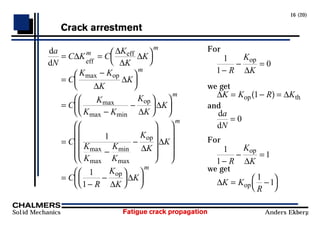
For
1
1
0
−
− =
R
K
K
op
∆
we get
∆ ∆
K K R K
= −
( ) =
op th
1
and
d
d
a
N
= 0
For
1
1
1
−
− =
R
K
K
op
∆
we get
∆K K
R
= −




op
1
1
Fatigue crack propagation
Solid Mechanics Anders Ekberg
17 (20)
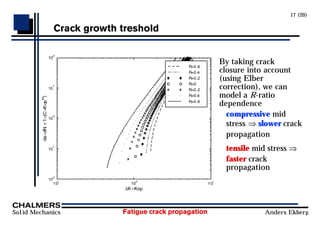
Crack growth treshold
By taking crack
closure into account
(using Elber
correction), we can
model a R-ratio
dependence
compressive mid
stress ⇒ slower crack
propagation
tensile mid stress ⇒
faster crack
propagation
Fatigue crack propagation
Solid Mechanics Anders Ekberg
18 (20)
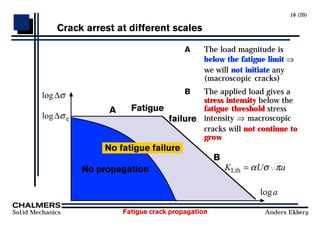
Crack arrest at different scales
A The load magnitude is
below the fatigue limit ⇒
we will not initiate any
(macroscopic cracks)
B The applied load gives a
stress intensity below the
fatigue threshold stress
intensity ⇒ macroscopic
cracks will not continue to
grow
A
B
Fatigue
failure
loga
KI,th = αUσ πa
No fatigue failure
No propagation
log∆σ
log∆σe
Fatigue crack propagation
Solid Mechanics Anders Ekberg
19 (20)
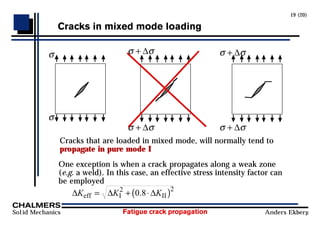
Cracks in mixed mode loading
σ
σ
σ + ∆σ
σ + ∆σ
σ + ∆σ
σ + ∆σ
Cracks that are loaded in mixed mode, will normally tend to
propagate in pure mode I
One exception is when a crack propagates along a weak zone
(e.g. a weld). In this case, an effective stress intensity factor can
be employed
∆ ∆ ∆
K K K
eff I II
= + ⋅
( )
2 2
0 8
.
Fatigue crack propagation
Solid Mechanics Anders Ekberg
20 (20)
Crack propagation Ð summary
Under one dimensional, elastic conditions and constant load range
Paris’ law, can predict fatigue life of large cracks
Under variable amplitude loading, plastic residual stress fields mostly
gives a decrease in crack growth rate.
Microstructurally small cracks interact closely with microstructure.
Mechanically small cracks propagate faster than long cracks.
Closure effects of large cracks can give a pronounced effect. It’s one
mechanism behind crack arrestment
In multiaxial loading, most cracks tend to propagate in pure mode I
Less ÒmatureÓ areas
Cases where LEFM is not applicable
The propagation of short, especially microstructurally short, cracks
Cases where crack closure and crack friction has a profound effect
Conditions of variable amplitude loading
Multiaxial loading conditions

Fatigue crack propagation.pdf

  • 1.
    Fatigue crack propagation SolidMechanics Anders Ekberg 1 (20) Fatigue crack propagation Repetition Ð Crack initiation and growth Small cracks • Shear driven • Interact with microstructure • Mostly analyzed by continuum mechanics approaches Large cracks • Tension driven • Fairly insensitive to microstructure • Mostly analyzed by fracture mechanics models σ σ Stage II Tension driven crack (ÒpropagationÓ) Stage I Shear driven crack (ÒinitiationÓ)
  • 2.
    Fatigue crack propagation SolidMechanics Anders Ekberg 2 (20) Stress intensity factors and fracture In static loading, the stress intensity factor for a small crack in a large specimen can be expressed as K f a I = ( ) σ, where f depends on geometry • If the stress is kept constant, we will get fracture for a certain crack length, a=aC, which will give KI=KIC. • For a<aC(KI<KIC) the crack will not propagate (in theory) In dynamic loading, we will still get fracture if the stress intensity factor, for some instant of time, exceeds KI=KIC • However, for KI<KIC, the crack may still propagate. Since this means that a (and KI) will increase, we will eventually obtain fracture when a=aC.
  • 3.
    Fatigue crack propagation SolidMechanics Anders Ekberg 3 (20) Crack growth as a function of ∆K In experiments, crack propagation has been measured as a function of the stress intensity factor I II III log da dN log∆K ∆Kth KC There exists a threshold value of ∆K below which fatigue cracks will not propagate At the other extreme, Kmax will approach the fracture toughness KC, and the material will fail A linear relationship between log d d a N ( )and ∆K in region II Note that ∆K depends on the crack size. This is not shown in the plot
  • 4.
    Fatigue crack propagation SolidMechanics Anders Ekberg 4 (20) Crack growth in region I For small ∆K (region I), crack propagation is difficult to predict since it depends on microstructure and flow properties of the material Here, the growth may even come to an arrest Crack growth rate is sensitive to the size of the grains. Finer grains gives • Closer spacing of grain boundaries, which the crack has to break through • Increased yield stress (normally) • Decreased roughness of the crack Crack growth predicted by • models of type d d p a N f = ( ) ∆γ , where ∆γ p is plastic shear strain range • empirical adjustment of ∆K - d d a N–curve I II III log da dN log∆K ∆Kth KC
  • 5.
    Fatigue crack propagation SolidMechanics Anders Ekberg 5 (20) Crack growth in region II and III Region II For larger magnitudes of ∆K (region II), the crack growth rate will be governed by a power law (such as Paris’ law) The crack growth rate is fairly insensitive to the microstructure (however, the constants m and C are, of course, different for different materials) If region II includes the dominating part of the fatigue life, the fatigue life can be directly estimated by integrating Paris’ law Region III If the stress intensity ratio is increased even further (region III), the crack growth rate will accelerate and finally fracture will occur The behavior of this fracture is rather sensitive to the microstructure and flow properties of the material.
  • 6.
    Fatigue crack propagation SolidMechanics Anders Ekberg 6 (20) Crack propagation laws Ð introduction It has been found that, for dynamic loading of a crack, the three most important factors determining the propagation (growth) of the crack are ∆K K K ≡ − max min – the stress intensity range R K K ≡ min max – the stress intensity ratio H – the stress history Thus, the crack growth rate (i.e. growth per stress cycle) can be expressed as d d a N f K R = ( , , ) ∆ H where d d a N is the crack growth per stress cycle
  • 7.
    Fatigue crack propagation SolidMechanics Anders Ekberg 7 (20) ParisÕ law Paris’ law can be written as d d a N C Km = ∆ where C and m are material parameters One of the first (1962) and most widely used fatigue crack propagation criteria ÒAlgorithmÓ 1. Find stress intensity factor for the current geometry 2. Find crack length corresponding to K K max = C 3. Check if the requirements for linear elastic fracture mechanics are fulfilled 4. Integrate Paris’ law 5. Solve for the number of stress cycles corresponding to failure Important If the stress intensity factor includes a geometric function of a, estimated (or analytic) values of this function has to be used
  • 8.
    Fatigue crack propagation SolidMechanics Anders Ekberg 8 (20) ParisÕ law Ð drawbacks Compared to a “general” crack propagation criterion d d a N f K R = ( , , ) ∆ H Paris’ law does not account for • mean stress effects (described by the R-ratio) • history effects (introduced by H) Further, Paris law is only valid in conditions with • uniaxial loading • “long cracks” • LEFM-conditions We will have a closer look at • short crack theory • retardation models due to overloads • crack closure effects • crack propagation in multiaxial loading
  • 9.
    Fatigue crack propagation SolidMechanics Anders Ekberg 9 (20) Short cracks So far d d a N f K = ( ) ∆ where ∆K depends on the amplitude of the normal stress (and geometry) But short cracks are shear stress driven also LEFM is not valid Two types of short cracks • mechanically short cracks – propagate faster than large cracks with same ∆K • microstructurally short cracks – interact closely with the microstructure and grow fast Short Crack Theory Microstructural Threshold Crack Speed Crack Length ∆σ1 > ∆σ2 a1 < a2
  • 10.
    Fatigue crack propagation SolidMechanics Anders Ekberg 10 (20) Variable amplitude loading (H) crack Plastic zone (tension) Loading Unloading crack Plastic zone (compression) σY σY σ σ A (tensile) overload will introduce (compressive) residual stresses These residual stresses will influence ∆K and thus the rate of crack propagation
  • 11.
    Fatigue crack propagation SolidMechanics Anders Ekberg 11 (20) The Wheeler model The Wheeler model is used to define the reduction of the crack growth rate due to an overload The reduction factor is defined as Φ ∆ R c 0 d = +       a d γ The reduced crack growth rate is then calculated as d d d d R R a N a N     = Φ crack d0 ∆a dc
  • 12.
    Variable Amplitude Loading,contÕd The Wheeler model is appropriate for single overloads The reduction of crack growth rate acts only as long as the cracks “current plastic zone” is within the plastic zone from the overload Multiple overloads or “stochastic” loads • Cycle-by-cycle integration of • Appropriate crack growth law that takes • Retardation/acceleration effects into account “Normal” crack propagation laws are usually conservative Fatigue crack propagation Solid Mechanics Anders Ekberg 12 (20) crack
  • 13.
    Fatigue crack propagation SolidMechanics Anders Ekberg 13 (20) Crack closure (R) Elber, in 1970, discovered that crack closure exists in cyclic loading, even for loads that are greater than zero This crack closure will decrease the fatigue crack growth rate by reducing the effective stress intensity range The stress intensity rate ∆K K K K K ≡ − = [ ] max min min min max ,0 Crack closure att K=Kop gives ∆K K K eff op ≡ − max Paris law using effective stress intensity rate d d eff a N C Km = ∆ Empirical relation K R K R R R R op = = + + − ≤ ≤ ϕ ϕ ( ) ( ) . . . max 0 25 0 5 0 25 1 1 2
  • 14.
    Fatigue crack propagation SolidMechanics Anders Ekberg 14 (20) Crack closure and arrestment Crack closure Kmax ∆Keff Kop Kmin ∆K If the crack is closed throughout the stress cycle, the crack will arrest This is not the only mechanism of a crack to arrest!
  • 15.
    Fatigue crack propagation SolidMechanics Anders Ekberg 15 (20) Crack closure and arrestment Ð II 1 0.8 0.6 0.4 0.2 0 0.2 0.4 0.6 0.8 1 -10 -8 -6 -4 -2 0 2 4 6 8 10 R K op and K min Kop Kmin Smallest magnitude of Kmin in Paris law ∆KParis ∆KElber ∆KParis Using Elber correction in Paris law is conservative (predicts a longer fatigue life) The only difference when using Elber correction is in a new, higher Kmin
  • 16.
    Fatigue crack propagation SolidMechanics Anders Ekberg 16 (20) Crack arrestment d d eff eff max op max max min op max max min max op a N C K C K K K C K K K K C K K K K K K C K K K K K K K C m m m m m = =     = −       = − −             = − −                     = − ∆ ∆ ∆ ∆ ∆ ∆ ∆ ∆ ∆ ∆ 1 1 1 R R K K K m −             op ∆ ∆ For 1 1 0 − − = R K K op ∆ we get ∆ ∆ K K R K = − ( ) = op th 1 and d d a N = 0 For 1 1 1 − − = R K K op ∆ we get ∆K K R = −     op 1 1
  • 17.
    Fatigue crack propagation SolidMechanics Anders Ekberg 17 (20) Crack growth treshold By taking crack closure into account (using Elber correction), we can model a R-ratio dependence compressive mid stress ⇒ slower crack propagation tensile mid stress ⇒ faster crack propagation
  • 18.
    Fatigue crack propagation SolidMechanics Anders Ekberg 18 (20) Crack arrest at different scales A The load magnitude is below the fatigue limit ⇒ we will not initiate any (macroscopic cracks) B The applied load gives a stress intensity below the fatigue threshold stress intensity ⇒ macroscopic cracks will not continue to grow A B Fatigue failure loga KI,th = αUσ πa No fatigue failure No propagation log∆σ log∆σe
  • 19.
    Fatigue crack propagation SolidMechanics Anders Ekberg 19 (20) Cracks in mixed mode loading σ σ σ + ∆σ σ + ∆σ σ + ∆σ σ + ∆σ Cracks that are loaded in mixed mode, will normally tend to propagate in pure mode I One exception is when a crack propagates along a weak zone (e.g. a weld). In this case, an effective stress intensity factor can be employed ∆ ∆ ∆ K K K eff I II = + ⋅ ( ) 2 2 0 8 .
  • 20.
    Fatigue crack propagation SolidMechanics Anders Ekberg 20 (20) Crack propagation Ð summary Under one dimensional, elastic conditions and constant load range Paris’ law, can predict fatigue life of large cracks Under variable amplitude loading, plastic residual stress fields mostly gives a decrease in crack growth rate. Microstructurally small cracks interact closely with microstructure. Mechanically small cracks propagate faster than long cracks. Closure effects of large cracks can give a pronounced effect. It’s one mechanism behind crack arrestment In multiaxial loading, most cracks tend to propagate in pure mode I Less ÒmatureÓ areas Cases where LEFM is not applicable The propagation of short, especially microstructurally short, cracks Cases where crack closure and crack friction has a profound effect Conditions of variable amplitude loading Multiaxial loading conditions