MOLECULES & METALLIC CRYSTAL
STRUCTURE
MOLECULES –Crystal structures :Fundamental concepts, Unit cells
 A molecule may be defined as a group of atoms that are bonded together by strong primary
bonds.
 Consequently, molecular materials have relatively low melting and boiling temperatures.
 In the condensed liquid and solid states, bonds between molecules are weak secondary ones.
 Most of those that have small molecules composed of a few atoms are gases at ordinary, or
ambient, temperatures and pressures.
 Many of the modern polymers, being molecular materials composed of extremely large
molecules, exist as solids; some of their properties are strongly dependent on the presence of
van der Waals and hydrogen secondary bonds
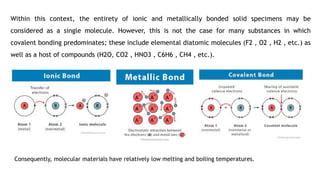
Within this context, the entirety of ionic and metallically bonded solid specimens may be
considered as a single molecule. However, this is not the case for many substances in which
covalent bonding predominates; these include elemental diatomic molecules (F2 , O2 , H2 , etc.) as
well as a host of compounds (H2O, CO2 , HNO3 , C6H6 , CH4 , etc.).
Consequently, molecular materials have relatively low melting and boiling temperatures.
CRYSTAL STRUCTURES
 A crystalline material is one in which the atoms are situated in a repeating or periodic array over large
atomic distances;
Upon solidification, the atoms will position themselves in a repetitive three-dimensional pattern, in
which each atom is bonded to its nearest-neighbor atoms.
 Some of the properties of crystalline solids depend on the crystal structure of the material, the
manner in which atoms, ions, or molecules are spatially arranged.
 There is an extremely large number of different crystal structures all having long range atomic order;
these vary from relatively simple structures for metals, to exceedingly complex ones.
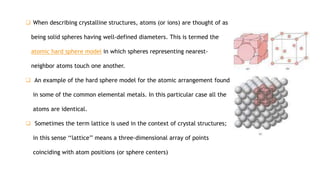
 When describing crystalline structures, atoms (or ions) are thought of as
being solid spheres having well-defined diameters. This is termed the
atomic hard sphere model in which spheres representing nearest-
neighbor atoms touch one another.
 An example of the hard sphere model for the atomic arrangement found
in some of the common elemental metals. In this particular case all the
atoms are identical.
 Sometimes the term lattice is used in the context of crystal structures;
in this sense ‘‘lattice’’ means a three-dimensional array of points
coinciding with atom positions (or sphere centers)
UNIT CELLS
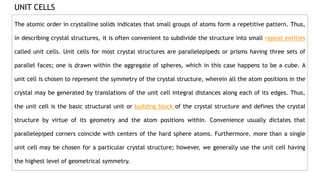
The atomic order in crystalline solids indicates that small groups of atoms form a repetitive pattern. Thus,
in describing crystal structures, it is often convenient to subdivide the structure into small repeat entities
called unit cells. Unit cells for most crystal structures are parallelepipeds or prisms having three sets of
parallel faces; one is drawn within the aggregate of spheres, which in this case happens to be a cube. A
unit cell is chosen to represent the symmetry of the crystal structure, wherein all the atom positions in the
crystal may be generated by translations of the unit cell integral distances along each of its edges. Thus,
the unit cell is the basic structural unit or building block of the crystal structure and defines the crystal
structure by virtue of its geometry and the atom positions within. Convenience usually dictates that
parallelepiped corners coincide with centers of the hard sphere atoms. Furthermore, more than a single
unit cell may be chosen for a particular crystal structure; however, we generally use the unit cell having
the highest level of geometrical symmetry.
METALLIC CRYSTAL STRUCTURES
The atomic bonding in this group of materials is metallic, and thus non directional in nature.
Consequently, there are no restrictions as to the number and position of nearest-neighbour
atoms; this leads to relatively large numbers of nearest neighbors and dense atomic packing
for most metallic crystal structures. Also, for metals, using the hard sphere model for the
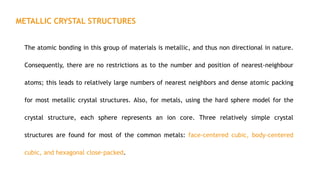
crystal structure, each sphere represents an ion core. Three relatively simple crystal
structures are found for most of the common metals: face-centered cubic, body-centered
cubic, and hexagonal close-packed.
{d
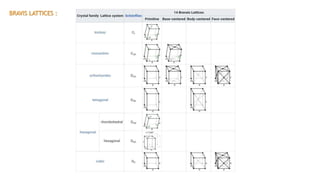
BRAVIS LATTICES :
Vectors and planes in a crystal lattice are described by the 3-value Miller index notation. This syntax uses the
indices ℓ, m, and n as directional parameters. Considering only (ℓ m n) planes intersecting one or more lattice
points (the lattice planes), the distance d between adjacent lattice planes is related to the (shortest) reciprocal
lattice vector orthogonal to the planes by the formula
• }} 𝑑 =
2𝜋
𝑔𝑙𝑚𝑛
For the special case of simple cubic crystals, the lattice vectors are orthogonal
and of equal length (usually denoted a); similarly for the reciprocal lattice. So,
in this common case, the Miller indices (ℓmn) and [ℓmn] both simply denote
normals/directions in Cartesian coordinates. For cubic crystals with lattice
constant a, the spacing d between adjacent (ℓmn) lattice planes is
𝑑𝑙𝑚𝑛=
𝑎
𝑙2 + 𝑚2 + 𝑛2 Miller indices
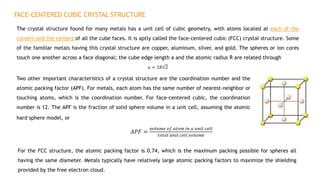
FACE-CENTERED CUBIC CRYSTAL STRUCTURE
The crystal structure found for many metals has a unit cell of cubic geometry, with atoms located at each of the
corners and the centers of all the cube faces. It is aptly called the face-centered cubic (FCC) crystal structure. Some
of the familiar metals having this crystal structure are copper, aluminum, silver, and gold. The spheres or ion cores
touch one another across a face diagonal; the cube edge length a and the atomic radius R are related through
𝑎 = 2𝑅 2
Two other important characteristics of a crystal structure are the coordination number and the
atomic packing factor (APF). For metals, each atom has the same number of nearest-neighbor or
touching atoms, which is the coordination number. For face-centered cubic, the coordination
number is 12. The APF is the fraction of solid sphere volume in a unit cell, assuming the atomic
hard sphere model, or
𝐴𝑃𝐹 =
𝑣𝑜𝑙𝑢𝑚𝑒 𝑜𝑓 𝑎𝑡𝑜𝑚 𝑖𝑛 𝑎 𝑢𝑛𝑖𝑡 𝑐𝑒𝑙𝑙
𝑡𝑜𝑡𝑎𝑙 𝑢𝑛𝑖𝑡 𝑐𝑒𝑙𝑙 𝑣𝑜𝑙𝑢𝑚𝑒
For the FCC structure, the atomic packing factor is 0.74, which is the maximum packing possible for spheres all
having the same diameter. Metals typically have relatively large atomic packing factors to maximize the shielding
provided by the free electron cloud.
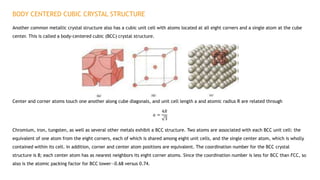
BODY CENTERED CUBIC CRYSTAL STRUCTURE
Another common metallic crystal structure also has a cubic unit cell with atoms located at all eight corners and a single atom at the cube
center. This is called a body-centered cubic (BCC) crystal structure.
Center and corner atoms touch one another along cube diagonals, and unit cell length a and atomic radius R are related through
𝑎 =
4𝑅
3
Chromium, iron, tungsten, as well as several other metals exhibit a BCC structure. Two atoms are associated with each BCC unit cell: the
equivalent of one atom from the eight corners, each of which is shared among eight unit cells, and the single center atom, which is wholly
contained within its cell. In addition, corner and center atom positions are equivalent. The coordination number for the BCC crystal
structure is 8; each center atom has as nearest neighbors its eight corner atoms. Since the coordination number is less for BCC than FCC, so
also is the atomic packing factor for BCC lower—0.68 versus 0.74.
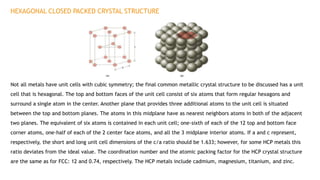
HEXAGONAL CLOSED PACKED CRYSTAL STRUCTURE
Not all metals have unit cells with cubic symmetry; the final common metallic crystal structure to be discussed has a unit
cell that is hexagonal. The top and bottom faces of the unit cell consist of six atoms that form regular hexagons and
surround a single atom in the center. Another plane that provides three additional atoms to the unit cell is situated
between the top and bottom planes. The atoms in this midplane have as nearest neighbors atoms in both of the adjacent
two planes. The equivalent of six atoms is contained in each unit cell; one-sixth of each of the 12 top and bottom face
corner atoms, one-half of each of the 2 center face atoms, and all the 3 midplane interior atoms. If a and c represent,
respectively, the short and long unit cell dimensions of the c/a ratio should be 1.633; however, for some HCP metals this
ratio deviates from the ideal value. The coordination number and the atomic packing factor for the HCP crystal structure
are the same as for FCC: 12 and 0.74, respectively. The HCP metals include cadmium, magnesium, titanium, and zinc.
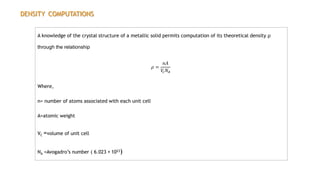
DENSITY COMPUTATIONS
A knowledge of the crystal structure of a metallic solid permits computation of its theoretical density ρ
through the relationship
𝜌 =
𝑛𝐴
𝑉
𝑐𝑁𝐴
Where,
n= number of atoms associated with each unit cell
A=atomic weight
VC =volume of unit cell
NA =Avogadro’s number ( 6.023 × 10²³)

Molecules and metallic crystal structure

  • 1.
    MOLECULES & METALLICCRYSTAL STRUCTURE MOLECULES –Crystal structures :Fundamental concepts, Unit cells
  • 2.
     A moleculemay be defined as a group of atoms that are bonded together by strong primary bonds.  Consequently, molecular materials have relatively low melting and boiling temperatures.  In the condensed liquid and solid states, bonds between molecules are weak secondary ones.  Most of those that have small molecules composed of a few atoms are gases at ordinary, or ambient, temperatures and pressures.  Many of the modern polymers, being molecular materials composed of extremely large molecules, exist as solids; some of their properties are strongly dependent on the presence of van der Waals and hydrogen secondary bonds
  • 3.
    Within this context,the entirety of ionic and metallically bonded solid specimens may be considered as a single molecule. However, this is not the case for many substances in which covalent bonding predominates; these include elemental diatomic molecules (F2 , O2 , H2 , etc.) as well as a host of compounds (H2O, CO2 , HNO3 , C6H6 , CH4 , etc.). Consequently, molecular materials have relatively low melting and boiling temperatures.
  • 4.
    CRYSTAL STRUCTURES  Acrystalline material is one in which the atoms are situated in a repeating or periodic array over large atomic distances; Upon solidification, the atoms will position themselves in a repetitive three-dimensional pattern, in which each atom is bonded to its nearest-neighbor atoms.  Some of the properties of crystalline solids depend on the crystal structure of the material, the manner in which atoms, ions, or molecules are spatially arranged.  There is an extremely large number of different crystal structures all having long range atomic order; these vary from relatively simple structures for metals, to exceedingly complex ones.
  • 5.
     When describingcrystalline structures, atoms (or ions) are thought of as being solid spheres having well-defined diameters. This is termed the atomic hard sphere model in which spheres representing nearest- neighbor atoms touch one another.  An example of the hard sphere model for the atomic arrangement found in some of the common elemental metals. In this particular case all the atoms are identical.  Sometimes the term lattice is used in the context of crystal structures; in this sense ‘‘lattice’’ means a three-dimensional array of points coinciding with atom positions (or sphere centers)
  • 6.
    UNIT CELLS The atomicorder in crystalline solids indicates that small groups of atoms form a repetitive pattern. Thus, in describing crystal structures, it is often convenient to subdivide the structure into small repeat entities called unit cells. Unit cells for most crystal structures are parallelepipeds or prisms having three sets of parallel faces; one is drawn within the aggregate of spheres, which in this case happens to be a cube. A unit cell is chosen to represent the symmetry of the crystal structure, wherein all the atom positions in the crystal may be generated by translations of the unit cell integral distances along each of its edges. Thus, the unit cell is the basic structural unit or building block of the crystal structure and defines the crystal structure by virtue of its geometry and the atom positions within. Convenience usually dictates that parallelepiped corners coincide with centers of the hard sphere atoms. Furthermore, more than a single unit cell may be chosen for a particular crystal structure; however, we generally use the unit cell having the highest level of geometrical symmetry.
  • 7.
    METALLIC CRYSTAL STRUCTURES Theatomic bonding in this group of materials is metallic, and thus non directional in nature. Consequently, there are no restrictions as to the number and position of nearest-neighbour atoms; this leads to relatively large numbers of nearest neighbors and dense atomic packing for most metallic crystal structures. Also, for metals, using the hard sphere model for the crystal structure, each sphere represents an ion core. Three relatively simple crystal structures are found for most of the common metals: face-centered cubic, body-centered cubic, and hexagonal close-packed. {d
  • 8.
  • 9.
    Vectors and planesin a crystal lattice are described by the 3-value Miller index notation. This syntax uses the indices ℓ, m, and n as directional parameters. Considering only (ℓ m n) planes intersecting one or more lattice points (the lattice planes), the distance d between adjacent lattice planes is related to the (shortest) reciprocal lattice vector orthogonal to the planes by the formula • }} 𝑑 = 2𝜋 𝑔𝑙𝑚𝑛 For the special case of simple cubic crystals, the lattice vectors are orthogonal and of equal length (usually denoted a); similarly for the reciprocal lattice. So, in this common case, the Miller indices (ℓmn) and [ℓmn] both simply denote normals/directions in Cartesian coordinates. For cubic crystals with lattice constant a, the spacing d between adjacent (ℓmn) lattice planes is 𝑑𝑙𝑚𝑛= 𝑎 𝑙2 + 𝑚2 + 𝑛2 Miller indices
  • 10.
    FACE-CENTERED CUBIC CRYSTALSTRUCTURE The crystal structure found for many metals has a unit cell of cubic geometry, with atoms located at each of the corners and the centers of all the cube faces. It is aptly called the face-centered cubic (FCC) crystal structure. Some of the familiar metals having this crystal structure are copper, aluminum, silver, and gold. The spheres or ion cores touch one another across a face diagonal; the cube edge length a and the atomic radius R are related through 𝑎 = 2𝑅 2 Two other important characteristics of a crystal structure are the coordination number and the atomic packing factor (APF). For metals, each atom has the same number of nearest-neighbor or touching atoms, which is the coordination number. For face-centered cubic, the coordination number is 12. The APF is the fraction of solid sphere volume in a unit cell, assuming the atomic hard sphere model, or 𝐴𝑃𝐹 = 𝑣𝑜𝑙𝑢𝑚𝑒 𝑜𝑓 𝑎𝑡𝑜𝑚 𝑖𝑛 𝑎 𝑢𝑛𝑖𝑡 𝑐𝑒𝑙𝑙 𝑡𝑜𝑡𝑎𝑙 𝑢𝑛𝑖𝑡 𝑐𝑒𝑙𝑙 𝑣𝑜𝑙𝑢𝑚𝑒 For the FCC structure, the atomic packing factor is 0.74, which is the maximum packing possible for spheres all having the same diameter. Metals typically have relatively large atomic packing factors to maximize the shielding provided by the free electron cloud.
  • 11.
    BODY CENTERED CUBICCRYSTAL STRUCTURE Another common metallic crystal structure also has a cubic unit cell with atoms located at all eight corners and a single atom at the cube center. This is called a body-centered cubic (BCC) crystal structure. Center and corner atoms touch one another along cube diagonals, and unit cell length a and atomic radius R are related through 𝑎 = 4𝑅 3 Chromium, iron, tungsten, as well as several other metals exhibit a BCC structure. Two atoms are associated with each BCC unit cell: the equivalent of one atom from the eight corners, each of which is shared among eight unit cells, and the single center atom, which is wholly contained within its cell. In addition, corner and center atom positions are equivalent. The coordination number for the BCC crystal structure is 8; each center atom has as nearest neighbors its eight corner atoms. Since the coordination number is less for BCC than FCC, so also is the atomic packing factor for BCC lower—0.68 versus 0.74.
  • 12.
    HEXAGONAL CLOSED PACKEDCRYSTAL STRUCTURE Not all metals have unit cells with cubic symmetry; the final common metallic crystal structure to be discussed has a unit cell that is hexagonal. The top and bottom faces of the unit cell consist of six atoms that form regular hexagons and surround a single atom in the center. Another plane that provides three additional atoms to the unit cell is situated between the top and bottom planes. The atoms in this midplane have as nearest neighbors atoms in both of the adjacent two planes. The equivalent of six atoms is contained in each unit cell; one-sixth of each of the 12 top and bottom face corner atoms, one-half of each of the 2 center face atoms, and all the 3 midplane interior atoms. If a and c represent, respectively, the short and long unit cell dimensions of the c/a ratio should be 1.633; however, for some HCP metals this ratio deviates from the ideal value. The coordination number and the atomic packing factor for the HCP crystal structure are the same as for FCC: 12 and 0.74, respectively. The HCP metals include cadmium, magnesium, titanium, and zinc.
  • 13.
    DENSITY COMPUTATIONS A knowledgeof the crystal structure of a metallic solid permits computation of its theoretical density ρ through the relationship 𝜌 = 𝑛𝐴 𝑉 𝑐𝑁𝐴 Where, n= number of atoms associated with each unit cell A=atomic weight VC =volume of unit cell NA =Avogadro’s number ( 6.023 × 10²³)