Quantum Computing: The Next New Technology in Computing
Mark Jackson
October 24, 2020
• Established in 2014
• Globally operated with 100+ employees
• Over 60 scientists (35+ PhDs) with deep expertise to deliver
hardware agnostic solutions
• Recognized by the UK Government to deliver the
Quantum Readiness Program (QRP) with NQIT
• Specialties include:
• Quantum Development Platform – t|ket>™
• Enterprise Applications in Quantum Chemistry – Eumen
• Machine Learning and Quantum Algorithms
• Quantum Augmented Cybersecurity – IronBridge™
A leading independent quantum software and security technology provider
About Cambridge Quantum Computing
• Introduction to Quantum Computing
• Machine Learning and AI
• Compiler and Hardware Access
Agenda
The Birth of Computing: 1820
Today’s Computing
Much more
powerful…
But conceptually
identical
Key Quantum Definitions
Qubit
• A quantum bit is the
basic unit of quantum
information
• 2-state quantum-
mechanical system
Entanglement
• Phenomenon where
particles that interact
with each other become
permanently dependent
on each other’s
quantum states and
properties
• Essentially, the qubits
behave as a single entity
Superposition
• The ability of a qubit to
be in more than one
quantum state at the
same time
Supremacy
• The goal of
demonstrating that a
programmable quantum
device can solve a
problem that classical
computer practically
cannot. Also called
Quantum Advantage.
Exponential Speed Increase
billion-x
all atoms in the
Universe
16x
4 30 300
Speed
# of qubits
Objectives
• Reduce computational speed or number of samples required
• Increase accuracy for complex problems
• Solve problems that are intractable on today’s classical
supercomputers
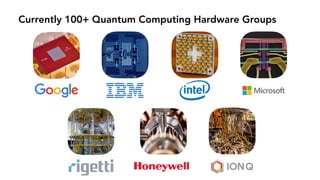
Currently 100+ Quantum Computing Hardware Groups
Moore’s Law implies doubling of
classical computing power every
~18 months
IBM believes they can double the
‘quantum volume’ every year
Honeywell claims they can increase it
by a factor of TEN every year, meaning
100,000x improvement by 2025
*Beta-version which is expected
QuantumVolume
1
10
100
1,000
10,000
100,000
1,000,000
10,000,000
2017 2018 2019 2020 2021 2022 2023 2024 2025 2026 2027 2028
64
32
16
8
4
Roadmap for Quantum Hardware Improvement
IBM Progress
Honeywell
Progress
128
IonQ 4M*
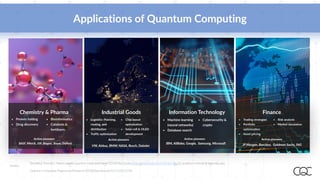
Applications of Quantum Computing
▪ Protein folding
▪ Drug discovery
▪ Bioinformatics
▪ Catalysts &
fertilizers
Chemistry & Pharma Industrial Goods
▪ Logistics: Planning,
routing, and
distribution
▪ Traffic optimization
▪ Chip layout
optimization
▪ Solar cell & OLED
development
▪ Machine learning
(neural networks)
▪ Database search
▪ Cybersecurity &
crypto
Information Technology Finance
▪ Trading strategies
▪ Portfolio
optimization
▪ Asset pricing
▪ Risk analysis
▪ Market simulation
BASF, Merck, JSR ,Biogen, Bayer, DuPont
VW, Airbus, BMW, NASA, Bosch, Daimler
IBM, AliBaba, Google, Samsung, Microsoft JP Morgan, Barclays, Goldman Sachs, ING
Seealso:
Quantum Computing: Progress andProspects (2018):https://doi.org/10.17226/25196
Berenberg Thematics “Howto playthe quantum computingtheme”(2018) https://www.bcg.com/publications/2018/next-decade-quantum-computing-how-play.aspx
Active pioneers Active pioneers Active pioneers Active pioneers
Quantum
Machine Learning
and AI
QML
Classical Machine Learning: Probability-based
Quantum Monte Carlo Analysis: Quadratically Faster
Option Pricing
via Black-Scholes
The quantum algorithm allows
a quadratic speed-up
compared to traditional
Monte Carlo simulations,
sometimes used in financial
modeling
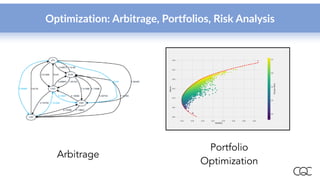
Optimization: Arbitrage, Portfolios, Risk Analysis
Portfolio
Optimization
Arbitrage
Financial Organizations Moving Into Quantum
Oct	17,	2019
Jan	31,	2020
Feb	10,	2020
Jan	6,	2020
May	4,	2020
18
The Knapsack Problem
In order to compare classical vs quantum
approaches, CQC developed a prototype
Knapsack Quantum Algorithm
Given a set of items, each with a weight
and a value, determine the number of each
item to include in a collection so that the
total weight is less than or equal to a given
limit and the total value is as large as
possible
19
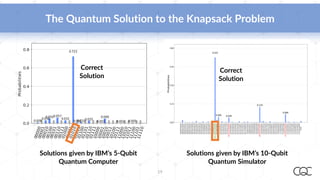
The Quantum Solution to the Knapsack Problem
Solutions given by IBM’s 5-Qubit
Quantum Computer
Correct
Solution
Solutions given by IBM’s 10-Qubit
Quantum Simulator
Correct
Solution
t|ket⟩ Compiler and
Hardware Access
pytket
Q# t|ket〉
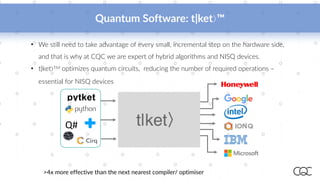
Quantum Software: t|ket⟩™
• We still need to take advantage of every small, incremental step on the hardware side,
and that is why at CQC we are expert of hybrid algorithms and NISQ devices.
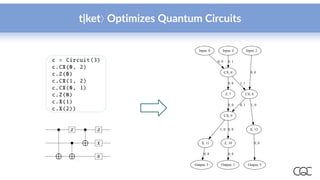
• t|ket⟩TM optimizes quantum circuits, reducing the number of required operations –
essential for NISQ devices
>4x more effective than the next nearest compiler/ optimiser
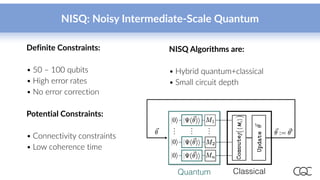
NISQ: Noisy Intermediate-Scale Quantum
Definite Constraints:
• 50 – 100 qubits
• High error rates
• No error correction
Potential Constraints:
• Connectivity constraints
• Low coherence time
Quantum Classical
𝒇({𝑴𝒊})
NISQ Algorithms are:
• Hybrid quantum+classical
• Small circuit depth
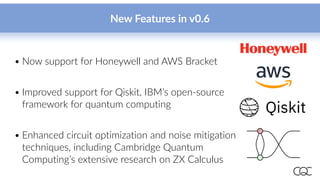
New Features in v0.6
• Now support for Honeywell and AWS Bracket
• Improved support for Qiskit, IBM’s open-source
framework for quantum computing
• Enhanced circuit optimization and noise mitigation
techniques, including Cambridge Quantum
Computing’s extensive research on ZX Calculus
t|ket⟩ Optimizes Quantum Circuits
Input, 0
CX, 6
0, 0
Input, 2
CX, 8
0, 0
Input, 4
0, 1
Output, 1Output, 3 Output, 5
Z, 7
0, 0 1, 1
CX, 9
0, 0 0, 1
X, 12
1, 0
Z, 10
0, 0
X, 11
1, 0
0, 00, 0
0, 0
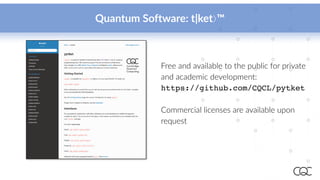
Quantum Software: t|ket⟩™
Free and available to the public for private
and academic development:
https://github.com/CQCL/pytket
Commercial licenses are available upon
request
IBM & Honeywell Hardware Access
• Quantum hardware access can cost ~$millions with multi-year commitments
• CQC is uniquely able to offer 6 months of quarter-share access to IBM’s
premium quantum hardware
• Can also introduce you to Honeywell’s team for quick access
Summary
• Quantum Computing will have significant benefits and risks
• We believe that in about 2-3 years we could see a quantum advantage
• It takes time to develop quantum algorithms, we start with simple cases and
work our way up to take advantage of qubit counts and quantum computer
features
• Quantum hardware is developing much faster than we thought, we believe
there may be several hundred qubits by next year
• The time to start developing is now
Next Steps
•Work on POC in Quantum Machine Learning
Project
•Download t|ket⟩ for R&D use
•Hardware access for IBM and Honeywell
G e n e r a l : m a r k . j a c k s o n @ c a m b r i d g e q u a n t u m . c o m
W e b s i t e : w w w . c a m b r i d g e q u a n t u m . c o m
© Cambridge Quantum Computing Limited, 2020. All rights reserved. CQC acknowledge the trademarks of all logos and brand names
belonging to third parties on this presentation, wherever they may appear.

Quantum Computing: The next new technology in computing

  • 1.
    Quantum Computing: TheNext New Technology in Computing Mark Jackson October 24, 2020
  • 2.
    • Established in2014 • Globally operated with 100+ employees • Over 60 scientists (35+ PhDs) with deep expertise to deliver hardware agnostic solutions • Recognized by the UK Government to deliver the Quantum Readiness Program (QRP) with NQIT • Specialties include: • Quantum Development Platform – t|ket>™ • Enterprise Applications in Quantum Chemistry – Eumen • Machine Learning and Quantum Algorithms • Quantum Augmented Cybersecurity – IronBridge™ A leading independent quantum software and security technology provider About Cambridge Quantum Computing
  • 3.
    • Introduction toQuantum Computing • Machine Learning and AI • Compiler and Hardware Access Agenda
  • 4.
    The Birth ofComputing: 1820
  • 5.
  • 6.
    Key Quantum Definitions Qubit •A quantum bit is the basic unit of quantum information • 2-state quantum- mechanical system Entanglement • Phenomenon where particles that interact with each other become permanently dependent on each other’s quantum states and properties • Essentially, the qubits behave as a single entity Superposition • The ability of a qubit to be in more than one quantum state at the same time Supremacy • The goal of demonstrating that a programmable quantum device can solve a problem that classical computer practically cannot. Also called Quantum Advantage.
  • 7.
    Exponential Speed Increase billion-x allatoms in the Universe 16x 4 30 300 Speed # of qubits
  • 8.
    Objectives • Reduce computationalspeed or number of samples required • Increase accuracy for complex problems • Solve problems that are intractable on today’s classical supercomputers
  • 9.
    Currently 100+ QuantumComputing Hardware Groups
  • 10.
    Moore’s Law impliesdoubling of classical computing power every ~18 months IBM believes they can double the ‘quantum volume’ every year Honeywell claims they can increase it by a factor of TEN every year, meaning 100,000x improvement by 2025 *Beta-version which is expected QuantumVolume 1 10 100 1,000 10,000 100,000 1,000,000 10,000,000 2017 2018 2019 2020 2021 2022 2023 2024 2025 2026 2027 2028 64 32 16 8 4 Roadmap for Quantum Hardware Improvement IBM Progress Honeywell Progress 128 IonQ 4M*
  • 11.
    Applications of QuantumComputing ▪ Protein folding ▪ Drug discovery ▪ Bioinformatics ▪ Catalysts & fertilizers Chemistry & Pharma Industrial Goods ▪ Logistics: Planning, routing, and distribution ▪ Traffic optimization ▪ Chip layout optimization ▪ Solar cell & OLED development ▪ Machine learning (neural networks) ▪ Database search ▪ Cybersecurity & crypto Information Technology Finance ▪ Trading strategies ▪ Portfolio optimization ▪ Asset pricing ▪ Risk analysis ▪ Market simulation BASF, Merck, JSR ,Biogen, Bayer, DuPont VW, Airbus, BMW, NASA, Bosch, Daimler IBM, AliBaba, Google, Samsung, Microsoft JP Morgan, Barclays, Goldman Sachs, ING Seealso: Quantum Computing: Progress andProspects (2018):https://doi.org/10.17226/25196 Berenberg Thematics “Howto playthe quantum computingtheme”(2018) https://www.bcg.com/publications/2018/next-decade-quantum-computing-how-play.aspx Active pioneers Active pioneers Active pioneers Active pioneers
  • 12.
  • 13.
    Classical Machine Learning:Probability-based
  • 15.
    Quantum Monte CarloAnalysis: Quadratically Faster Option Pricing via Black-Scholes The quantum algorithm allows a quadratic speed-up compared to traditional Monte Carlo simulations, sometimes used in financial modeling
  • 16.
    Optimization: Arbitrage, Portfolios,Risk Analysis Portfolio Optimization Arbitrage
  • 17.
    Financial Organizations MovingInto Quantum Oct 17, 2019 Jan 31, 2020 Feb 10, 2020 Jan 6, 2020 May 4, 2020
  • 18.
    18 The Knapsack Problem Inorder to compare classical vs quantum approaches, CQC developed a prototype Knapsack Quantum Algorithm Given a set of items, each with a weight and a value, determine the number of each item to include in a collection so that the total weight is less than or equal to a given limit and the total value is as large as possible
  • 19.
    19 The Quantum Solutionto the Knapsack Problem Solutions given by IBM’s 5-Qubit Quantum Computer Correct Solution Solutions given by IBM’s 10-Qubit Quantum Simulator Correct Solution
  • 20.
  • 21.
    pytket Q# t|ket〉 Quantum Software:t|ket⟩™ • We still need to take advantage of every small, incremental step on the hardware side, and that is why at CQC we are expert of hybrid algorithms and NISQ devices. • t|ket⟩TM optimizes quantum circuits, reducing the number of required operations – essential for NISQ devices >4x more effective than the next nearest compiler/ optimiser
  • 22.
    NISQ: Noisy Intermediate-ScaleQuantum Definite Constraints: • 50 – 100 qubits • High error rates • No error correction Potential Constraints: • Connectivity constraints • Low coherence time Quantum Classical 𝒇({𝑴𝒊}) NISQ Algorithms are: • Hybrid quantum+classical • Small circuit depth
  • 23.
    New Features inv0.6 • Now support for Honeywell and AWS Bracket • Improved support for Qiskit, IBM’s open-source framework for quantum computing • Enhanced circuit optimization and noise mitigation techniques, including Cambridge Quantum Computing’s extensive research on ZX Calculus
  • 24.
    t|ket⟩ Optimizes QuantumCircuits Input, 0 CX, 6 0, 0 Input, 2 CX, 8 0, 0 Input, 4 0, 1 Output, 1Output, 3 Output, 5 Z, 7 0, 0 1, 1 CX, 9 0, 0 0, 1 X, 12 1, 0 Z, 10 0, 0 X, 11 1, 0 0, 00, 0 0, 0
  • 25.
    Quantum Software: t|ket⟩™ Freeand available to the public for private and academic development: https://github.com/CQCL/pytket Commercial licenses are available upon request
  • 26.
    IBM & HoneywellHardware Access • Quantum hardware access can cost ~$millions with multi-year commitments • CQC is uniquely able to offer 6 months of quarter-share access to IBM’s premium quantum hardware • Can also introduce you to Honeywell’s team for quick access
  • 27.
    Summary • Quantum Computingwill have significant benefits and risks • We believe that in about 2-3 years we could see a quantum advantage • It takes time to develop quantum algorithms, we start with simple cases and work our way up to take advantage of qubit counts and quantum computer features • Quantum hardware is developing much faster than we thought, we believe there may be several hundred qubits by next year • The time to start developing is now
  • 28.
    Next Steps •Work onPOC in Quantum Machine Learning Project •Download t|ket⟩ for R&D use •Hardware access for IBM and Honeywell
  • 29.
    G e ne r a l : m a r k . j a c k s o n @ c a m b r i d g e q u a n t u m . c o m W e b s i t e : w w w . c a m b r i d g e q u a n t u m . c o m © Cambridge Quantum Computing Limited, 2020. All rights reserved. CQC acknowledge the trademarks of all logos and brand names belonging to third parties on this presentation, wherever they may appear.