Omnipresence of Materials
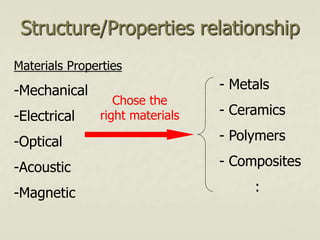
Structure/Properties relationship 
Materials Properties 
-Mechanical 
-Electrical 
-Optical 
-Acoustic 
-Magnetic 
- Metals 
- Ceramics 
- Polymers 
- Composites 
: 
Chose the 
right materials
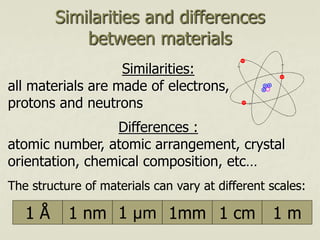
Similarities and differences 
between materials 
Similarities: 
all materials are made of electrons, 
protons and neutrons 
Differences : 
atomic number, atomic arrangement, crystal 
orientation, chemical composition, etc… 
The structure of materials can vary at different scales: 
1 Å 1 nm 1 μm 1mm 1 cm 1 m
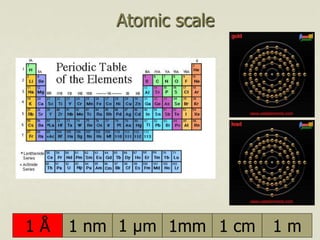
Atomic scale 
1 Å 1 nm 1 μm 1mm 1 cm 1 m
Compounds 
2 Al + 3 O → Al2O3 
Metal + gas → ceramic 
Many combinations 
are possible with 2, 
3 or more elements 
Perovskite: LaScO3 
1 Å 1 nm 1 μm 1mm 1 cm 1 m
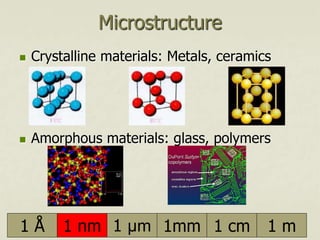
Microstructure 
 Crystalline materials: Metals, ceramics 
 Amorphous materials: glass, polymers 
1 Å 1 nm 1 μm 1mm 1 cm 1 m
Crystal Structure 
Carbon exists under several forms. The properties of 
carbon vary depending on its atomic arrangement. 
Diamond structure 
Graphite structure 
Fullerenes C60 and C70 
Carbon 
nanotubes 
1 Å 1 nm 1 μm 1mm 1 cm 1 m
Defects in Crystal Structure 
Theoretical strength of 
perfect crystals is about 
3-4 orders of magnitude 
larger than those 
typically measured in 
experiments. 
1 Å 1 nm 1 μm 1mm 1 cm 1 m
Microscopic scale 
Crystalline materials are usually not made of a single 
crystal but of a arrangement of different crystals. 
Different phases can be present. 
Orientation map of an Copper sample 
1 Å 1 nm 1 μm 1mm 1 cm 1 m
Microscopic scale 
1 Å 1 nm 1 μm 1mm 1 cm 1 m
Microscopic scale 
Examples of Microstructures in Steels 
1 Å 1 nm 1 μm 1mm 1 cm 1 m
Microscopic scale 
Ti Alloys 
1 Å 1 nm 1 μm 1mm 1 cm 1 m
Macroscopic scale 
Composite materials are made of several materials, 
each one having its own properties. 
Ceramic Fiber/Ceramic 
Matrix Composite 
Phase β 
Phase α 
1 Å 1 nm 1 μm 1mm 1 cm 1 m
Reinforced Concrete/Steel Structures 
1 Å 1 nm 1 μm 1mm 1 cm 1 m
Anisotropy 
Mechanical properties 
Optical properties 
Magnetic properties 
Experimentally measured anisotropic 
magnetic fields from nanomagnets
Fundamental Problems in 
Materials Design 
 Can we identify the complete set of 
microstructures that are predicted to 
yield a specific combination of 
properties? 
 Can we identify processing routes to 
realize the superior microstructures with 
their attendant properties?
Material Naming Conventions 
SAE 
designa 
tion 
Type 
1xxx Carbon steels 
2xxx Nickel steels 
3xxx Nickel-chromium steels 
4xxx Molybdenum steels 
5xxx Chromium steels 
6xxx Chromium-vanadium steels 
7xxx Tungsten steels 
8xxx Nickel-chromium-molybdenum steels 
9xxx Silicon-manganese steels 
Carbon steels 
10xx Plain carbon (Mn 1.00% max.) 
11xx Resulfurized 
12xx Resulfurized and rephosphorized 
15xx Plain carbon (Mn 1.00–1.65%) 
7075-T6 Al 
5.6–6.1% Zn, 2.1-2.5% Mg, 1.2–1.6% Cu 
T6 temper implies an UTS of 510–572 MPa, 
YS of 434–503 MPa, and a failure elongation 
of 5–11%. The T6 temper is usually achieved 
by homogenizing the cast 7075 at 450 C for 
several hours, and then aging at 120 C for 24 
hours. 
Alloy naming conventions are largely based on chemical composition and 
some details of final processing steps. They do not account for the 
multitude of structures that could be produced with the same overall 
composition. They are also used to require certain combinations of 
properties of general (not customized) interest to applications.
Conventional Explorations in Materials 
Development 
Process Space Properties Space 
An element of process space is a hybrid process, which is 
made up of a sequence of unit manufacturing processes 
Interpolations in process space cannot be easily interpreted
Core Materials Activity: Exploration of Process- 
Structure-Property (PSP) Linkages 
Process Space Structure Space Properties Space 
Structure = Rigorous description of the material at any selected scale 
Hierarchical Structure = Rigorous description of the material including 
at least two well-separated structure scales 
Workflow = Sequence of steps employed for establishing PSP linkages 
of interest to any specific engineering/technology application
Main Challenge in Exploring PSP Linkages 
• Explorations in the composition and process space are highly inefficient 
• Properties are intrinsically related to microstructures
Data Science Enabled Exploration of PSP Linkages 
Structure space is the most natural space for expressing PSP linkages
Materials Data Transformations 
Wisdom 
Invertible PSP linkages needed in design/optimization 
Knowledge 
Comprehensive PSP linkages (with quantified uncertainty) 
Information 
Trends in Process-Structure-Properties (PSP) linkages 
Data 
Experiments, Models, Simulations 
Integrated workflows are needed to objectively 
extract knowledge and wisdom from raw data
What are Integrated Workflows? 
• Utilize the best combination of experiments and 
simulations in extracting robust and reliable PSP 
linkages 
• Engage and exploit cross-disciplinary expertise 
that includes materials science, manufacturing, 
systems approaches, uncertainty quantification, 
computational science, data and information 
sciences 
• Ensure that the workflows output the critical 
information needed by design and manufacturing 
stakeholders in the materials development value 
chain
Microstructure Function 
Macroscale Object 
L 
Mesoscale Structure 
푙 
휔푙 
Well-Separated Length Scales: 푙 < 휔푙≪ 퐿 
Existence of an RVE
RVE: Assumptions, Limitations 
• Statistical Homogeneity 
• No Large Gradients at the higher scale 
• Large Enough Volume 
• Disparate Features (e.g., Interfaces) 
• Boundary Conditions
Local State Spaces 
ℎ = 휌, 푐푖 
휌 
퐻 = 휌, 푐푖 휌 ∈ 훼, 훽, 훾,… , 푐푖 ∈ 퐶푖

Materials informatics

  • 1.
  • 2.
    Structure/Properties relationship MaterialsProperties -Mechanical -Electrical -Optical -Acoustic -Magnetic - Metals - Ceramics - Polymers - Composites : Chose the right materials
  • 3.
    Similarities and differences between materials Similarities: all materials are made of electrons, protons and neutrons Differences : atomic number, atomic arrangement, crystal orientation, chemical composition, etc… The structure of materials can vary at different scales: 1 Å 1 nm 1 μm 1mm 1 cm 1 m
  • 4.
    Atomic scale 1Å 1 nm 1 μm 1mm 1 cm 1 m
  • 5.
    Compounds 2 Al+ 3 O → Al2O3 Metal + gas → ceramic Many combinations are possible with 2, 3 or more elements Perovskite: LaScO3 1 Å 1 nm 1 μm 1mm 1 cm 1 m
  • 6.
    Microstructure  Crystallinematerials: Metals, ceramics  Amorphous materials: glass, polymers 1 Å 1 nm 1 μm 1mm 1 cm 1 m
  • 7.
    Crystal Structure Carbonexists under several forms. The properties of carbon vary depending on its atomic arrangement. Diamond structure Graphite structure Fullerenes C60 and C70 Carbon nanotubes 1 Å 1 nm 1 μm 1mm 1 cm 1 m
  • 8.
    Defects in CrystalStructure Theoretical strength of perfect crystals is about 3-4 orders of magnitude larger than those typically measured in experiments. 1 Å 1 nm 1 μm 1mm 1 cm 1 m
  • 9.
    Microscopic scale Crystallinematerials are usually not made of a single crystal but of a arrangement of different crystals. Different phases can be present. Orientation map of an Copper sample 1 Å 1 nm 1 μm 1mm 1 cm 1 m
  • 10.
    Microscopic scale 1Å 1 nm 1 μm 1mm 1 cm 1 m
  • 11.
    Microscopic scale Examplesof Microstructures in Steels 1 Å 1 nm 1 μm 1mm 1 cm 1 m
  • 12.
    Microscopic scale TiAlloys 1 Å 1 nm 1 μm 1mm 1 cm 1 m
  • 13.
    Macroscopic scale Compositematerials are made of several materials, each one having its own properties. Ceramic Fiber/Ceramic Matrix Composite Phase β Phase α 1 Å 1 nm 1 μm 1mm 1 cm 1 m
  • 14.
    Reinforced Concrete/Steel Structures 1 Å 1 nm 1 μm 1mm 1 cm 1 m
  • 15.
    Anisotropy Mechanical properties Optical properties Magnetic properties Experimentally measured anisotropic magnetic fields from nanomagnets
  • 16.
    Fundamental Problems in Materials Design  Can we identify the complete set of microstructures that are predicted to yield a specific combination of properties?  Can we identify processing routes to realize the superior microstructures with their attendant properties?
  • 17.
    Material Naming Conventions SAE designa tion Type 1xxx Carbon steels 2xxx Nickel steels 3xxx Nickel-chromium steels 4xxx Molybdenum steels 5xxx Chromium steels 6xxx Chromium-vanadium steels 7xxx Tungsten steels 8xxx Nickel-chromium-molybdenum steels 9xxx Silicon-manganese steels Carbon steels 10xx Plain carbon (Mn 1.00% max.) 11xx Resulfurized 12xx Resulfurized and rephosphorized 15xx Plain carbon (Mn 1.00–1.65%) 7075-T6 Al 5.6–6.1% Zn, 2.1-2.5% Mg, 1.2–1.6% Cu T6 temper implies an UTS of 510–572 MPa, YS of 434–503 MPa, and a failure elongation of 5–11%. The T6 temper is usually achieved by homogenizing the cast 7075 at 450 C for several hours, and then aging at 120 C for 24 hours. Alloy naming conventions are largely based on chemical composition and some details of final processing steps. They do not account for the multitude of structures that could be produced with the same overall composition. They are also used to require certain combinations of properties of general (not customized) interest to applications.
  • 18.
    Conventional Explorations inMaterials Development Process Space Properties Space An element of process space is a hybrid process, which is made up of a sequence of unit manufacturing processes Interpolations in process space cannot be easily interpreted
  • 19.
    Core Materials Activity:Exploration of Process- Structure-Property (PSP) Linkages Process Space Structure Space Properties Space Structure = Rigorous description of the material at any selected scale Hierarchical Structure = Rigorous description of the material including at least two well-separated structure scales Workflow = Sequence of steps employed for establishing PSP linkages of interest to any specific engineering/technology application
  • 20.
    Main Challenge inExploring PSP Linkages • Explorations in the composition and process space are highly inefficient • Properties are intrinsically related to microstructures
  • 21.
    Data Science EnabledExploration of PSP Linkages Structure space is the most natural space for expressing PSP linkages
  • 22.
    Materials Data Transformations Wisdom Invertible PSP linkages needed in design/optimization Knowledge Comprehensive PSP linkages (with quantified uncertainty) Information Trends in Process-Structure-Properties (PSP) linkages Data Experiments, Models, Simulations Integrated workflows are needed to objectively extract knowledge and wisdom from raw data
  • 23.
    What are IntegratedWorkflows? • Utilize the best combination of experiments and simulations in extracting robust and reliable PSP linkages • Engage and exploit cross-disciplinary expertise that includes materials science, manufacturing, systems approaches, uncertainty quantification, computational science, data and information sciences • Ensure that the workflows output the critical information needed by design and manufacturing stakeholders in the materials development value chain
  • 24.
    Microstructure Function MacroscaleObject L Mesoscale Structure 푙 휔푙 Well-Separated Length Scales: 푙 < 휔푙≪ 퐿 Existence of an RVE
  • 25.
    RVE: Assumptions, Limitations • Statistical Homogeneity • No Large Gradients at the higher scale • Large Enough Volume • Disparate Features (e.g., Interfaces) • Boundary Conditions
  • 26.
    Local State Spaces ℎ = 휌, 푐푖 휌 퐻 = 휌, 푐푖 휌 ∈ 훼, 훽, 훾,… , 푐푖 ∈ 퐶푖