Product Costing & Material
Ledger
Product Costing Overview
Acquire an overall perspective of Product Cost
Planning within R/3.
Observe a product life cycle from the perspective of
Product Cost Planning.
Acquire an overall perspective of product cost object
controlling within R/3.
Understand the period oriented product cost
controlling.
Obtain an understanding of the functions in the
material ledger.
Analysis of product costs.
Material Ledger Overview
Obtain an understanding of the actual costing
function in the material ledger.
Know how to revaluate inventories of semi finished
products, and finished products with calculated
actual costs or accrue variances.
Analysis of actual product costs.
Why utilize Product Costing?
•Product Costing is the backbone of a strong standard cost
system. This is the process by which production activities
are recorded at standard values and variances from actual
costs are isolated.
•For planning purposes, the corporation wants a preliminary
target of what they think it will cost to produce X units of a
product.
•To set attainable standards by which efficiencies within the
production operations can be measured.
•To provide feedback to management on the actual
performance of the production process in relation to those
targets. Identified variances may indicate inefficiencies that
have to be investigated. Corrective action may have to be
taken.
Costing Methodology
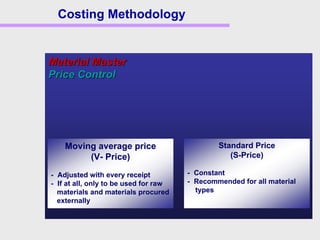
Material MasterMaterial Master
PricePrice ControlControl
Standard Price
(S-Price)
- Constant
- Recommended for all material
types
Moving average price
(V- Price)
- Adjusted with every receipt
- If at all, only to be used for raw
materials and materials procured
externally
Costing Methodology
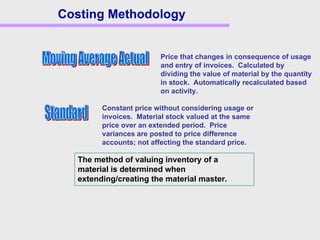
The method of valuing inventory of a
material is determined when
extending/creating the material master.
Price that changes in consequence of usage
and entry of invoices. Calculated by
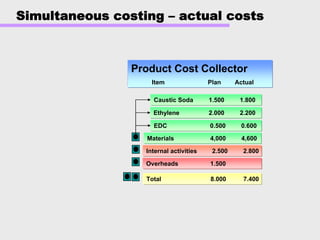
dividing the value of material by the quantity
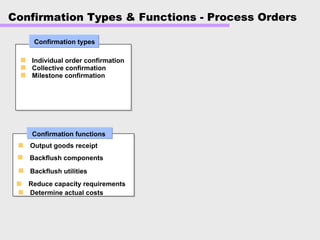
in stock. Automatically recalculated based
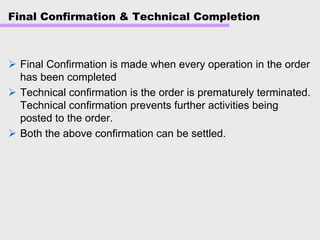
on activity.
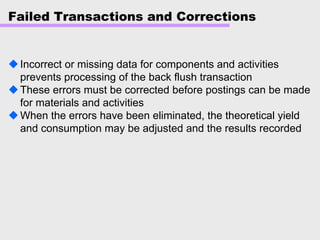
Constant price without considering usage or
invoices. Material stock valued at the same
price over an extended period. Price
variances are posted to price difference
accounts; not affecting the standard price.
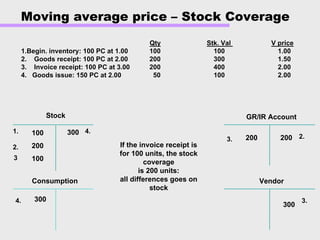
Moving average price – Stock Coverage
GR/IR Account
Vendor
200
300
200
100
200
100
300
Consumption
300
If the invoice receipt is
for 100 units, the stock
coverage
is 200 units:
all differences goes on
stock
Stock
QtyQty Stk. ValStk. Val V priceV price
1.Begin. inventory: 100 PC at 1.001.Begin. inventory: 100 PC at 1.00 100100 100100 1.001.00
2. Goods receipt: 100 PC at 2.002. Goods receipt: 100 PC at 2.00 200200 300300 1.501.50
3. Invoice receipt: 100 PC at 3.003. Invoice receipt: 100 PC at 3.00 200200 400400 2.002.00
4. Goods issue: 150 PC at 2.004. Goods issue: 150 PC at 2.00 5050 100100 2.002.00
1.1.
2.2.
33
3.3. 2.2.
3.3.4.4.
4.4.
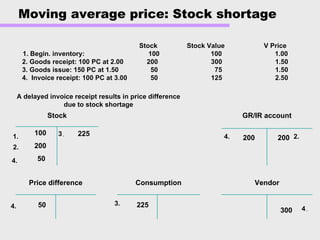
Moving average price: Stock shortage
Stock
Price difference
GR/IR account
Vendor
100
200
50
200200
50
300
Consumption
2253.3.
225
StockStock StockStock ValueValue V PriceV Price
1. Begin. inventory:1. Begin. inventory: 100100 100100 1.001.00
2. Goods receipt: 100 PC at 2.002. Goods receipt: 100 PC at 2.00 200200 300300 1.501.50
3. Goods issue: 150 PC at 1.503. Goods issue: 150 PC at 1.50 5050 7575 1.501.50
4. Invoice receipt: 100 PC at 3.004. Invoice receipt: 100 PC at 3.00 5050 125125 22.50.50
1.1.
2.2.
33.. 4.4.
4.4.
2.2.
A delayed invoice receipt results in price differenceA delayed invoice receipt results in price difference
due to stock shortagedue to stock shortage
44..4.4.
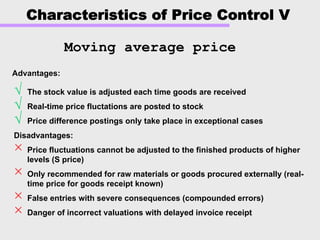
Characteristics of Price Control V
√ The stock value is adjusted each time goods are received
√ Real-time price fluctations are posted to stock
√ Price difference postings only take place in exceptional cases
Disadvantages:
× Price fluctuations cannot be adjusted to the finished products of higher
levels (S price)
× Only recommended for raw materials or goods procured externally (real-
time price for goods receipt known)
× False entries with severe consequences (compounded errors)
× Danger of incorrect valuations with delayed invoice receipt
Moving average price
Advantages:Advantages:
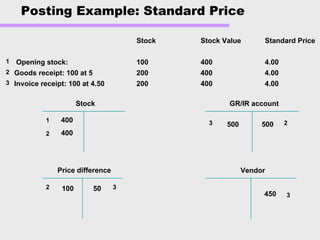
Posting Example: Standard Price
Stock
Price difference
GR/IR account
Vendor
3450
Stock Stock Value Standard Price
Opening stock: 100 400 4.00
Goods receipt: 100 at 5 200 400 4.00
Invoice receipt: 100 at 4.50 200 400 4.00
1
2
3
1 400
4002
500 23 500
2 100 350
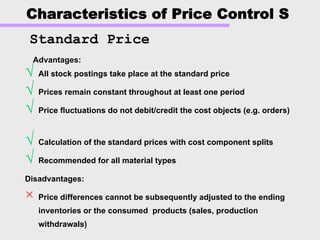
Characteristics of Price Control S
√ All stock postings take place at the standard price
√ Prices remain constant throughout at least one period
√ Price fluctuations do not debit/credit the cost objects (e.g. orders)
√ Calculation of the standard prices with cost component splits
√ Recommended for all material types
Disadvantages:
× Price differences cannot be subsequently adjusted to the ending
inventories or the consumed products (sales, production
withdrawals)
Advantages:Advantages:
Standard Price
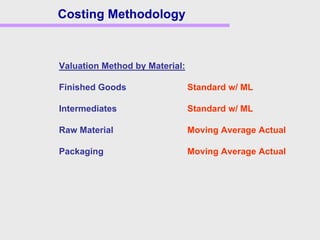
Costing Methodology
Valuation Method by Material:
Finished Goods Standard w/ ML
Intermediates Standard w/ ML
Raw Material Moving Average Actual
Packaging Moving Average Actual
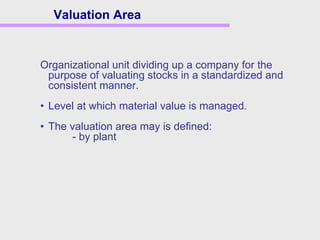
Organizational unit dividing up a company for the
purpose of valuating stocks in a standardized and
consistent manner.
• Level at which material value is managed.
• The valuation area may is defined:
- by plant
Valuation Area
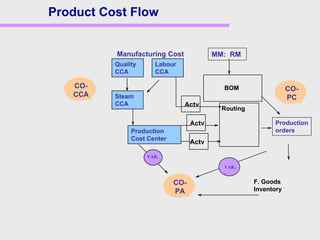
Quality
CCA
Labour
CCA
F. Goods
Inventory
BOM
Routing
Production
orders
CO-
CCA
CO-
PA
CO-
PC
Manufacturing Cost MM: RM
Steam
CCA
Production
Cost Center
VAR.
VAR..
.
Product Cost Flow
ActvActv
ActvActv
ActvActv
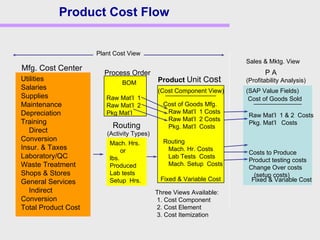
Product Cost Flow
Plant Cost View
Sales & Mktg. View
Mfg. Cost Center
(Activity Types)
Utilities
Salaries
Supplies
Maintenance
Depreciation
Training
Direct
Conversion
Insur. & Taxes
Laboratory/QC
Waste Treatment
Shops & Stores
General Services
Indirect
Conversion
Total Product Cost
Mach. Hrs.
or
lbs.
Produced
Lab tests
Setup Hrs.
P A
(Profitability Analysis)
Raw Mat’l 1 & 2 Costs
Pkg. Mat’l Costs
Costs to Produce
Product testing costs
Change Over costs
(setup costs)
Routing
Product Unit Cost
Cost of Goods Mfg.
Raw Mat’l 1 Costs
Raw Mat’l 2 Costs
Pkg. Mat’l Costs
Routing
Mach. Hr. Costs
Lab Tests Costs
Mach. Setup Costs
Process Order
Raw Mat’l 1
Raw Mat’l 2
Pkg Mat’l
BOM
(Cost Component View) (SAP Value Fields)
Three Views Available:
1. Cost Component
2. Cost Element
3. Cost Itemization
Cost of Goods Sold
Fixed & Variable Cost Fixed & Variable Cost
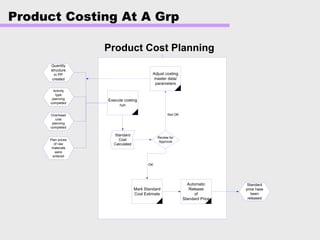
Product Costing At A Grp
Product Cost Planning
Yes
Execute costing
run
Automatic
Release
of
Standard Price
Mark Standard
Cost Estimate
Activity
type
planning
completed
Quantity
structure
in PP
created
Overhead
cost
planning
completed
Plan prices
of raw
materials
were
entered
Standard
Cost
Calculated
Review for
Approval
Adjust costing
master data/
parameters
Standard
price hase
been
released
OK
Not OK
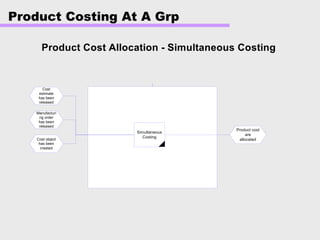
Product Costing At A Grp
Product Cost Allocation - Simultaneous Costing
Yes
Simultaneous
Costing
Cost
estimate
has been
released
Manufacturi
ng order
has been
released
Cost object
has been
created
Product cost
are
allocated
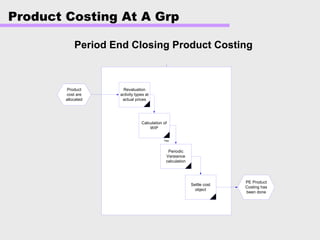
Product Costing At A Grp
Period End Closing Product Costing
Yes
Revaluation
activity types at
actual prices
Product
cost are
allocated
PE Product
Costing has
been done
Calculation of
WIP
Periodic
Varaiance
calculation
Settle cost
object
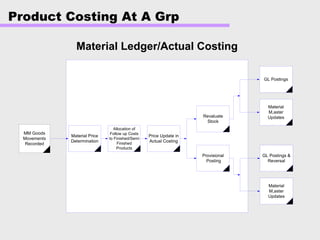
Product Costing At A Grp
Material Ledger/Actual Costing
Allocation of
Follow up Costs
to Finished/Semi
Finished
Products
Price Update in
Actual Costing
Material Price
Determination
GL Postings
MM Goods
Movements
Recorded
Material
M,aster
Updates
GL Postings &
Reversal
Material
M,aster
Updates
Revaluate
Stock
Provisional
Posting
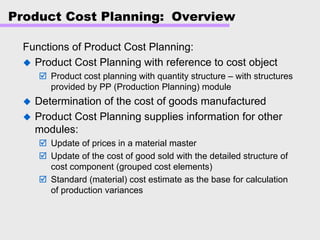
Product Cost Planning: Overview
Functions of Product Cost Planning:
Product Cost Planning with reference to cost object
Product cost planning with quantity structure – with structures
provided by PP (Production Planning) module
Determination of the cost of goods manufactured
Product Cost Planning supplies information for other
modules:
Update of prices in a material master
Update of the cost of good sold with the detailed structure of
cost component (grouped cost elements)
Standard (material) cost estimate as the base for calculation
of production variances
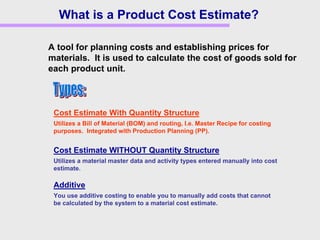
What is a Product Cost Estimate?
Cost Estimate With Quantity Structure
Utilizes a Bill of Material (BOM) and routing, I.e. Master Recipe for costing
purposes. Integrated with Production Planning (PP).
Additive
You use additive costing to enable you to manually add costs that cannot
be calculated by the system to a material cost estimate.
A tool for planning costs and establishing prices for
materials. It is used to calculate the cost of goods sold for
each product unit.
Cost Estimate WITHOUT Quantity Structure
Utilizes a material master data and activity types entered manually into cost
estimate.
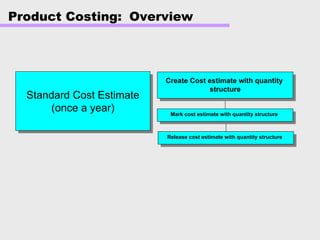
Product Costing: Overview
Standard Cost Estimate
(once a year)
Standard Cost Estimate
(once a year)
Release cost estimate with quantity structure
Mark cost estimate with quantity structure
Create Cost estimate with quantity
structure
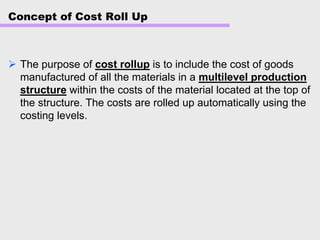
Concept of Cost Roll Up
The purpose of cost rollup is to include the cost of goods
manufactured of all the materials in a multilevel production
structure within the costs of the material located at the top of
the structure. The costs are rolled up automatically using the
costing levels.
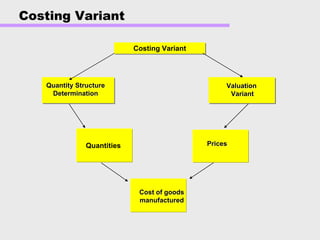
Costing Variant
ValuationValuation
VariantVariant
Quantity StructureQuantity Structure
DeterminationDetermination
Costing VariantCosting Variant
PricesPricesQuantities
Cost of goodsCost of goods
manufacturedmanufactured
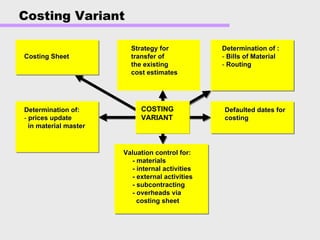
Costing Variant
COSTING
VARIANT
Strategy forStrategy for
transfer oftransfer of
the existingthe existing
cost estimatescost estimates
Determination of :Determination of :
-- Bills of MaterialBills of Material
-- RoutingRouting
Defaulted dates forDefaulted dates for
costingcosting
Costing SheetCosting Sheet
Determination of:Determination of:
-- prices updateprices update
in material masterin material master
Valuation control for:Valuation control for:
-- materialsmaterials
-- internal activitiesinternal activities
-- external activitiesexternal activities
-- subcontractingsubcontracting
-- overheads viaoverheads via
costing sheetcosting sheet
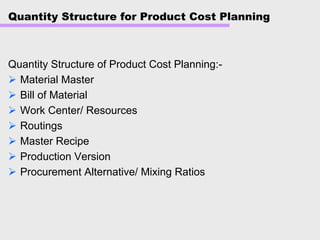
Quantity Structure for Product Cost Planning
Quantity Structure of Product Cost Planning:-
Material Master
Bill of Material
Work Center/ Resources
Routings
Master Recipe
Production Version
Procurement Alternative/ Mixing Ratios
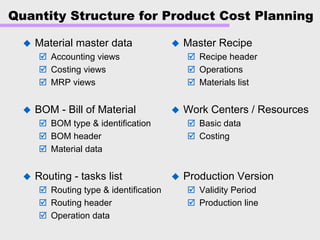
Quantity Structure for Product Cost Planning
Material master data
Accounting views
Costing views
MRP views
BOM - Bill of Material
BOM type & identification
BOM header
Material data
Routing - tasks list
Routing type & identification
Routing header
Operation data
Master Recipe
Recipe header
Operations
Materials list
Work Centers / Resources
Basic data
Costing
Production Version
Validity Period
Production line
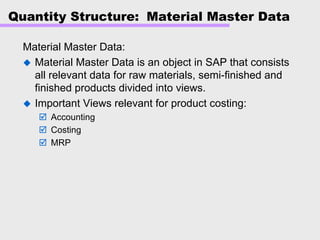
Quantity Structure: Material Master Data
Material Master Data:
Material Master Data is an object in SAP that consists
all relevant data for raw materials, semi-finished and
finished products divided into views.
Important Views relevant for product costing:
Accounting
Costing
MRP
Quantity Structure: Production Version
Production versions combine a specific BOM alternative
with a specific routing/recipe
For one material, you can have several Production
versions for various validity periods and lot size ranges
Production version facilitate different situations
Production using different resources
Production using different procedures
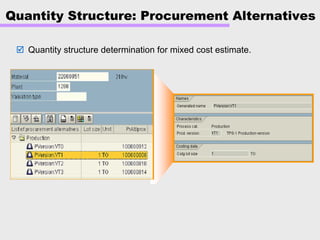
Quantity Structure: Procurement Alternatives
Quantity structure determination for mixed cost estimate.
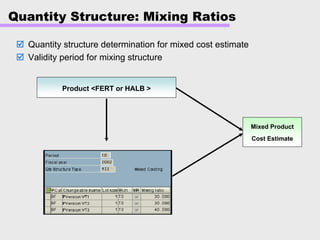
Quantity Structure: Mixing Ratios
Product <FERT or HALB >
Mixed Product
Cost Estimate
Quantity structure determination for mixed cost estimate
Validity period for mixing structure
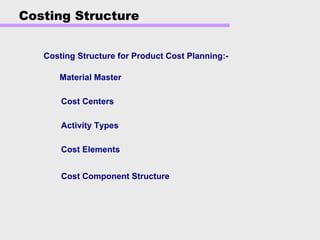
Costing Structure
Costing Structure for Product Cost Planning:-
Activity Types
Cost Elements
Cost Component Structure
Cost Centers
Material Master
Costing Structure for Product Cost Planning
Material master data
Accounting views
Costing views
Cost Centers
Validity period
Category
Functional area
Activity Types
Validity period
Activity unit
Allocation cost element
Cost Elements
Validity period
Category
Costing Structure
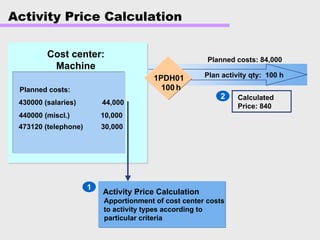
Activity types define the type of activity that can be provided
by a cost center (work activity, production hours, and so on).
Cost center
h
Cost center:
Machine
Planned costs:
430000 (salaries) 44,000
440000 (miscl.) 10,000
473120 (telephone) 30,000
Plan activity qty: 100 h
Planned costs: 84,000
Calculated
Price: 840
Activity Price Calculation:
Apportionment of cost center costs
to activity types according to
particular criteria
1PDH01
Activity Price Calculation
1
2
100
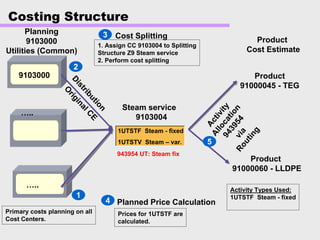
Costing Structure
Steam service
9103004
943954 UT: Steam fix
Product
91000045 - TEG
Product
91000060 - LLDPE
9103000
…..
…..
Distribution
Activity
Allocation
943954viaRouting
Cost Splitting
Planning
9103000
Utilities (Common)
Product
Cost Estimate
Activity Types Used:
1UTSTF Steam - fixed
O
riginalCE
1UTSTF Steam - fixed
1UTSTV Steam – var.
2
3
5
Primary costs planning on all
Cost Centers.
1
Planned Price Calculation
Prices for 1UTSTF are
calculated.
4
1. Assign CC 9103004 to Splitting
Structure Z9 Steam service
2. Perform cost splitting
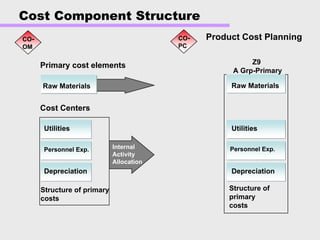
Cost Component Structure
Raw Materials
Utilities
Personnel Exp.
Depreciation
Primary cost elements
Product Cost Planning
Cost Centers
Utilities
Personnel Exp.
Depreciation
Structure of primary
costs
CO-
PC
CO-
OM
Raw Materials
Internal
Activity
Allocation
Structure of
primary
costs
Z9
A Grp-Primary
Product Costing: Overview
Standard Cost Estimate
(once a year)
Standard Cost Estimate
(once a year)
Release cost estimate with quantity
structure
Mark cost estimate with quantity
structure
Create Cost estimate with quantity structure
Price update
Standard price
Only one validated standard price per product per period,
The price represents most desired (or most likely) costs
Only one price per product over the year (recommended)
Determined during costing runs for Z9P1 costing variants - standard
cost estimate is populated in appropriate valuation views
Includes variable and fix cost elements
Base for variances calculation; which is then posted to FI and CO-
PA
Used for stock valuation of finished goods and semi-finished
products
Stored in material master data (accounting view) in Legal, Group
and Profit Center valuation views after releasing the cost estimate
Price update
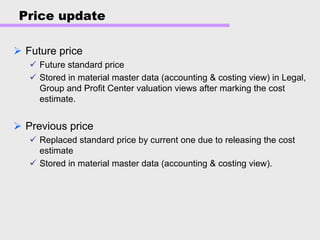
Future price
Future standard price
Stored in material master data (accounting & costing view) in Legal,
Group and Profit Center valuation views after marking the cost
estimate.
Previous price
Replaced standard price by current one due to releasing the cost
estimate
Stored in material master data (accounting & costing view).
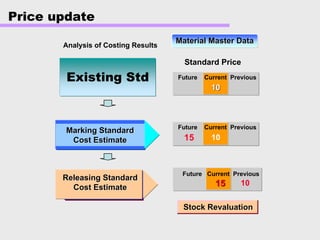
Price update
Existing Std
Material Master DataMaterial Master Data
Standard Price
Future Current Previous
1010
Future Current Previous
Marking StandardMarking Standard
Cost EstimateCost Estimate 1015
Future Current Previous
101515
Stock RevaluationStock Revaluation
Releasing StandardReleasing Standard
Cost EstimateCost Estimate
Analysis of Costing Results
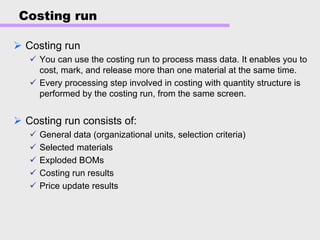
Costing run
Costing run
You can use the costing run to process mass data. It enables you to
cost, mark, and release more than one material at the same time.
Every processing step involved in costing with quantity structure is
performed by the costing run, from the same screen.
Costing run consists of:
General data (organizational units, selection criteria)
Selected materials
Exploded BOMs
Costing run results
Price update results
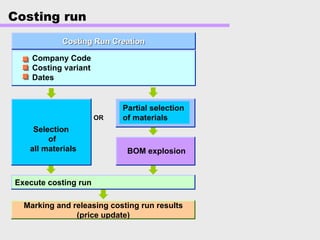
Costing run
Marking and releasing costing run results
(price update)
Execute costing run
Selection
of
all materials
Partial selection
of materials
BOM explosion
Costing Run CreationCosting Run Creation
Company Code
Costing variant
Dates
OROR
Product Costing: Overview
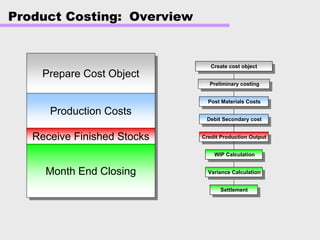
Prepare Cost ObjectPrepare Cost Object
Production CostsProduction Costs
Receive Finished StocksReceive Finished Stocks
Month End ClosingMonth End Closing
Post Materials Costs
Debit Secondary cost
Credit Production Output
WIP Calculation
Variance Calculation
Settlement
Preliminary costing
Create cost object
Cost Object Controlling: Overview
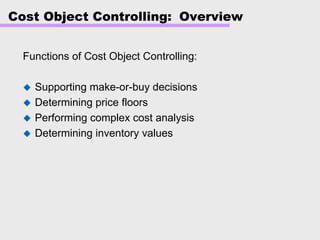
Functions of Cost Object Controlling:
Supporting make-or-buy decisions
Determining price floors
Performing complex cost analysis
Determining inventory values
Cost Object Controlling: Overview
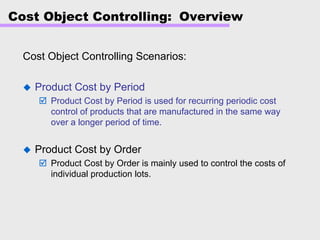
Cost Object Controlling Scenarios:
Product Cost by Period
Product Cost by Period is used for recurring periodic cost
control of products that are manufactured in the same way
over a longer period of time.
Product Cost by Order
Product Cost by Order is mainly used to control the costs of
individual production lots.
Cost Object Controlling: Overview
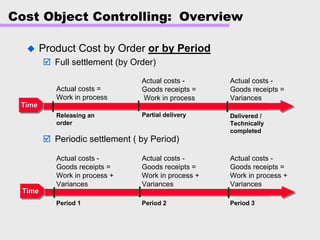
Product Cost by Order or by Period
Full settlement (by Order)
Periodic settlement ( by Period)
Actual costs =
Work in process
Actual costs -
Goods receipts =
Work in process
Actual costs -
Goods receipts =
Variances
Releasing an
order
Partial delivery Delivered /
Technically
completed
Actual costs -
Goods receipts =
Work in process +
Variances
Period 1 Period 2 Period 3
Actual costs -
Goods receipts =
Work in process +
Variances
Actual costs -
Goods receipts =
Work in process +
Variances
TimeTime
TimeTime
Cost Object Controlling: Overview
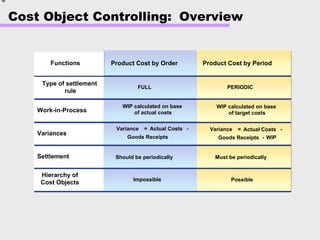
Product Cost by Order
Type of settlement
rule
Work-in-Process
Variances
Settlement
Hierarchy of
Cost Objects
FULL PERIODIC
WIP calculated on base
of actual costs
Variance = Actual Costs -
Goods Receipts
Variance = Actual Costs -
Goods Receipts - WIP
Should be periodically
Impossible Possible
FunkcjeFunctions Product Cost by Period
WIP calculated on base
of target costs
Must be periodically
Cost Object Controlling: Overview
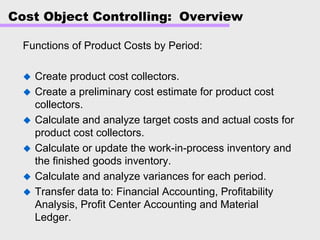
Functions of Product Costs by Period:
Create product cost collectors.
Create a preliminary cost estimate for product cost
collectors.
Calculate and analyze target costs and actual costs for
product cost collectors.
Calculate or update the work-in-process inventory and
the finished goods inventory.
Calculate and analyze variances for each period.
Transfer data to: Financial Accounting, Profitability
Analysis, Profit Center Accounting and Material
Ledger.
Product Costing: Overview
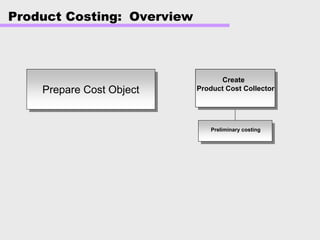
Prepare Cost ObjectPrepare Cost Object
Preliminary costing
Create
Product Cost Collector
Objects in Cost Object Controlling
Product cost collectors in the following production
environments:
In order-related production (that is, when you are using
production orders) when you want to analyze the costs by
period rather than by lot
In process manufacturing (that is, when you are using process
orders) when you want to analyze the costs by period rather
than by lot
In repetitive manufacturing you always use product cost
collectors as the cost objects.
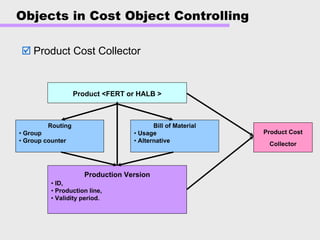
Objects in Cost Object Controlling
Product <FERT or HALB >
Bill of Material
• Usage
• Alternative
Routing
• Group
• Group counter
Production Version
• ID,
• Production line,
• Validity period.
Product Cost
Collector
Product Cost Collector
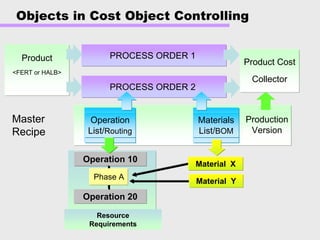
Objects in Cost Object Controlling
Master
Recipe
Production
Version
PROCESS ORDER 2
Operation
List/Routing
Materials
List/BOM
Resource
Requirements
Operation 10
Operation 20
Phase A
Material Y
Material X
Product Cost
Collector
PROCESS ORDER 1Product
<FERT or HALB>
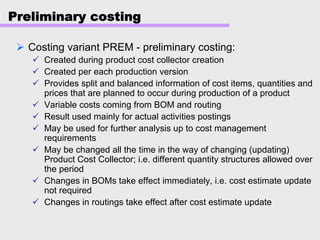
Preliminary costing
Costing variant PREM - preliminary costing:
Created during product cost collector creation
Created per each production version
Provides split and balanced information of cost items, quantities and
prices that are planned to occur during production of a product
Variable costs coming from BOM and routing
Result used mainly for actual activities postings
May be used for further analysis up to cost management
requirements
May be changed all the time in the way of changing (updating)
Product Cost Collector; i.e. different quantity structures allowed over
the period
Changes in BOMs take effect immediately, i.e. cost estimate update
not required
Changes in routings take effect after cost estimate update
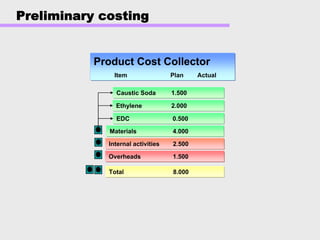
Preliminary costing
Product Cost Collector
Item Plan Actual
Materials 4.000
Internal activities 2.500
Overheads 1.500
EDC 0.500
Ethylene 2.000
Caustic Soda 1.500
Total 8.000
Simultaneous costing – actual costs
Product Cost Collector
Item Plan Actual
Materials 4,000 4,600
Internal activities 2.500 2.800
Overheads 1.500
EDC 0.500 0.600
Ethylene 2.000 2.200
Caustic Soda 1.500 1.800
Total 8.000 7.400
Confirmation Types & Functions - Process Orders
Individual confirmation
Collective confirmation
Milestone confirmation
Progress confirmation
Order confirmation
Confirmation with reference
Individual order confirmation
Collective confirmation
Milestone confirmation
Confirmation types
Confirm with goods movement
Defaults for remaining time
Check operation sequence
Check delivery tolerances
Plant data collection interface
Backflushing
Reduce capacity requirements
Determine actual costs
Output goods receipt
Determine actual costs
Confirmation functions
Backflush components
Backflush utilities
Reduce capacity requirements
Final Confirmation & Technical Completion
Final Confirmation is made when every operation in the order
has been completed
Technical confirmation is the order is prematurely terminated.
Technical confirmation prevents further activities being
posted to the order.
Both the above confirmation can be settled.
Failed Transactions and Corrections
Incorrect or missing data for components and activities
prevents processing of the back flush transaction
These errors must be corrected before postings can be made
for materials and activities
When the errors have been eliminated, the theoretical yield
and consumption may be adjusted and the results recorded
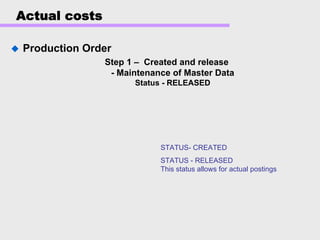
Actual costs
Production Order
Step 1 – Created and release
- Maintenance of Master Data
Status - RELEASED
STATUS- CREATED
STATUS - RELEASED
This status allows for actual postings
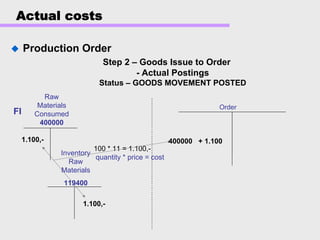
Actual costs
Production Order
Step 2 – Goods Issue to Order
- Actual Postings
Status – GOODS MOVEMENT POSTED
Order
100 * 11 = 1.100,-
quantity * price = cost
Raw
Materials
Consumed
400000
Inventory
Raw
Materials
119400
1.100,-
1.100,-
400000 + 1.100
FI
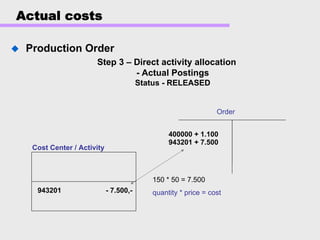
Actual costs
Production Order
Step 3 – Direct activity allocation
- Actual Postings
Status - RELEASED
400000 + 1.100
Cost Center / Activity
943201 - 7.500,-
943201 + 7.500
150 * 50 = 7.500
quantity * price = cost
Order
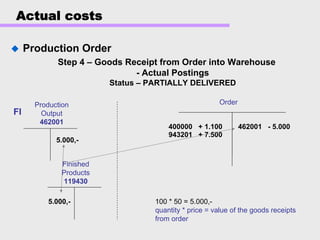
Actual costs
Production Order
Step 4 – Goods Receipt from Order into Warehouse
- Actual Postings
Status – PARTIALLY DELIVERED
Order
400000 + 1.100
943201 + 7.500
100 * 50 = 5.000,-
quantity * price = value of the goods receipts
from order
Production
Output
462001
Finished
Products
119430
5.000,-
5.000,-
462001 - 5.000
FI
Actual costs - Summary
The results from the output receipts, plus material & resource
consumptions, update the stock records and provide
valuation of production according to standard cost approach.
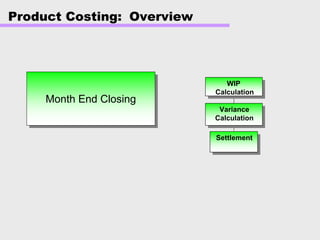
Product Costing: Overview
Month End ClosingMonth End Closing
Settlement
Variance
Calculation
WIP
Calculation
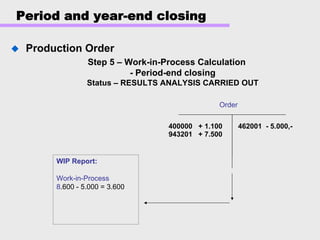
Period and year-end closing
Production Order
Step 5 – Work-in-Process Calculation
- Period-end closing
Status – RESULTS ANALYSIS CARRIED OUT
Order
400000 + 1.100
943201 + 7.500
462001 - 5.000,-
WIP Report:
Work-in-Process
8.600 - 5.000 = 3.600
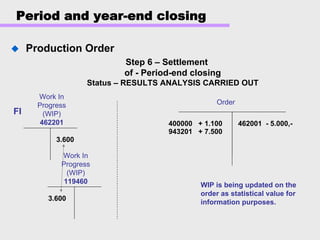
Period and year-end closing
Production Order
Step 6 – Settlement
of - Period-end closing
Status – RESULTS ANALYSIS CARRIED OUT
Order
400000 + 1.100
943201 + 7.500
462001 - 5.000,-
Work In
Progress
(WIP)
462201
Work In
Progress
(WIP)
119460
3.600
FI
3.600
WIP is being updated on the
order as statistical value for
information purposes.
Period and year-end closing
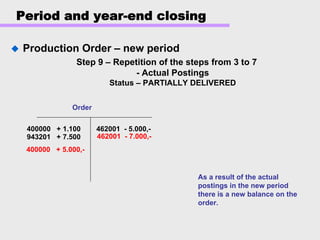
Production Order – new period
Step 9 – Repetition of the steps from 3 to 7
- Actual Postings
Status – PARTIALLY DELIVERED
Order
As a result of the actual
postings in the new period
there is a new balance on the
order.
400000 + 1.100
943201 + 7.500
462001 - 5.000,-
400000 + 5.000,-
462001 - 7.000,-
Period and year-end closing
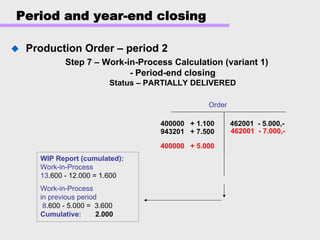
Production Order – period 2
Step 7 – Work-in-Process Calculation (variant 1)
- Period-end closing
Status – PARTIALLY DELIVERED
WIP Report (cumulated):
Work-in-Process
13.600 - 12.000 = 1.600
Work-in-Process
in previous period
8.600 - 5.000 = 3.600
Cumulative: 2.000
Order
400000 + 1.100
943201 + 7.500
462001 - 5.000,-
400000 + 5.000
462001 - 7.000,-
Period and year-end closing
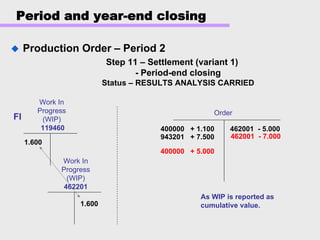
Production Order – Period 2
Step 11 – Settlement (variant 1)
- Period-end closing
Status – RESULTS ANALYSIS CARRIED
Order
Work In
Progress
(WIP)
119460
Work In
Progress
(WIP)
462201
FI
1.600
1.600
400000 + 1.100
943201 + 7.500
462001 - 5.000
400000 + 5.000
462001 - 7.000
As WIP is reported as
cumulative value.
Period and year-end closing
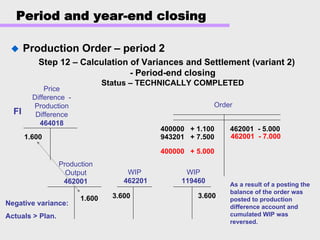
Production Order – period 2
Step 12 – Calculation of Variances and Settlement (variant 2)
- Period-end closing
Status – TECHNICALLY COMPLETED
Price
Difference -
Production
Difference
464018
Production
FI
1.600
Output
462001
1.600
Order
400000 + 1.100
943201 + 7.500
462001 - 5.000
400000 + 5.000
462001 - 7.000
Negative variance:
Actuals > Plan.
As a result of a posting the
balance of the order was
posted to production
difference account and
cumulated WIP was
reversed.
WIP
462201
WIP
119460
3.600 3.600
Period and year-end closing
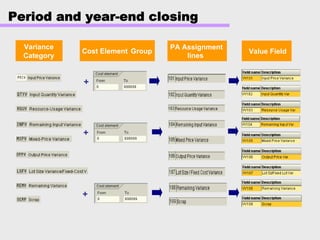
Variance
Category
PA Assignment
lines
Value FieldCost Element Group
+
+
+
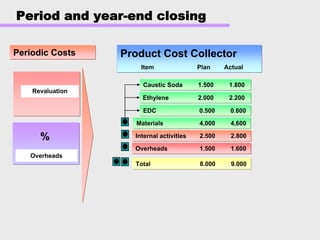
Period and year-end closing
Product Cost Collector
Item Plan Actual
Materials 4,000 4,600
Internal activities 2.500 2.800
Overheads 1.500 1.600
EDC 0.500 0.600
Ethylene 2.000 2.200
Caustic Soda 1.500 1.800
Total 8.000 9.000
Revaluation
Overheads
Periodic Costs
%
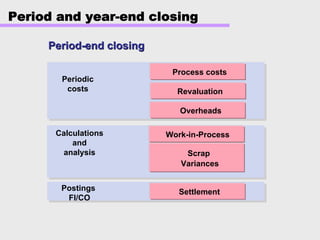
Period and year-end closing
Work-in-Process
Overheads
Process costs
Revaluation
Periodic
costs
Calculations
and
analysis
Postings
FI/CO
Settlement
Scrap
Variances
PeriodPeriod--end closingend closing
Material Ledger: Overview
Functions of Material Ledger:
Cost accounting using actual prices
Storing values of stock in three different valuations
(legal valuation, valuation for reporting purposes, and
profit center valuation) in multiple currencies.
Material Ledger: Overview
Functions of Material Ledger:
Cost accounting using actual prices
Storing values of stock in three different valuations
(legal valuation, group valuation for reporting purposes,
and profit center valuation) in multiple currencies.
What is the Material Ledger/Actual Cost Concept?
The Material Ledger(ML) is a tool within the CO
Module that collects all transactional data for
materials whose master data is stored in the
material master. It acts as a subledger for selected
materials that captures all goods movements,
invoice values, transfers and price changes. On
the basis of this data, the material ledger
calculates and maintains the actual cost for these
materials. This actual cost can then be utilized to
valuate the material stock accounts.
Objectives of the Material Ledger
1. Actual Costing.
During the period, valuation of all goods movements is done
with the preliminary valuation price which is normally the
standard price. All variances from the preliminary valuation are
maintained in the ML. At period end, revaluation of ending
inventory can be performed with the determined actual price.
This is not mandatory. Actual prices can be calculated for
statistical purposes only.
2. Parallel currencies and/or valuations of material stocks.
All goods movements in the ledger can be maintained in 3
currencies. The values are translated into other currencies
using the historical exchange rates. Prerequisite for usage of
transfer pricing functionality.
Benefits of the Material Ledger
►Variances of Finished Goods
Variances from external procurement (purchase orders) as well
as from production activities are rolled up from raw and semi-
finished materials to the finished goods level.
►To provide support for procurement related decisions.
Detailed reporting for procurement processes and sources
possible. Make vs.. Buy, Vendor A vs.. Vendor B. Price History.
►Combines the benefits of Moving Average and Standard Price
Stable prices used for controlling purposes (standard) and actual
prices used for valuation purposes (average).
►Easy to use display and error finding by consolidating the views.
Allows quick access to detailed views of material master,
standard costs and documents
Benefits of the Material Ledger
►Relatively simple configuration and set up
►True Cost of Sales Accounting
Purchasing and production variances for unsold stocks are
inventoried.
►Contribution Margin with Actual Costs of Sales
By utilizing multi-level settlement, actual values for your cost
component split can be attained. This can be transferred to PA
Single Level Settlement
The term single level always refers to one material andThe term single level always refers to one material and
its procurement process; which means that all values andits procurement process; which means that all values and
quantities that arise during a procurement for saidquantities that arise during a procurement for said
material are stored singlematerial are stored single-- levellevel
Multi - Level Settlement
The “multi-level” settlement functionality adds the
most value because it passes the lower level variance
in a production processes up to the final finished
product.
All the manufacturing variances can be included in
the total cost to manufacture the finished products
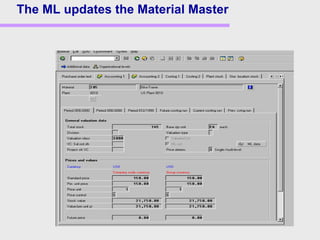
The ML updates the Material Master
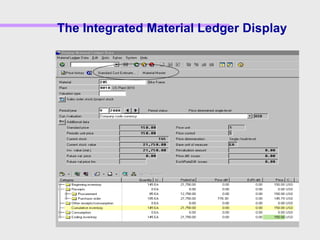
The Integrated Material Ledger Display
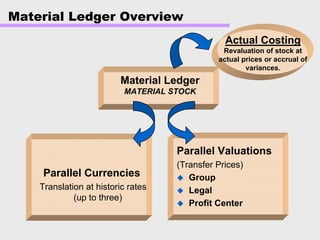
Material Ledger Overview
Material Ledger
MATERIAL STOCK
Parallel Currencies
Translation at historic rates
(up to three)
Parallel Valuations
(Transfer Prices)
Group
Legal
Profit Center
Actual Costing
Revaluation of stock at
actual prices or accrual of
variances.
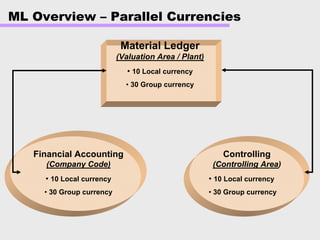
ML Overview – Parallel Currencies
Material Ledger
(Valuation Area / Plant)
• 10 Local currency
• 30 Group currency
Financial Accounting
(Company Code)
• 10 Local currency
• 30 Group currency
Controlling
(Controlling Area)
• 10 Local currency
• 30 Group currency
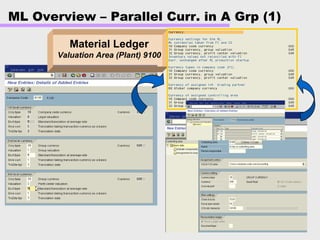
ML Overview – Parallel Curr. in A Grp (1)
Material Ledger
Valuation Area (Plant) 9100
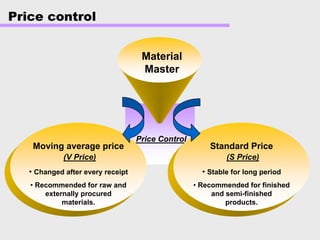
Price Control
Price control
Moving average price
(V Price)
• Changed after every receipt
• Recommended for raw and
externally procured
materials.
Standard Price
(S Price)
• Stable for long period
• Recommended for finished
and semi-finished
products.
Material
Master
Price control
Moving average price
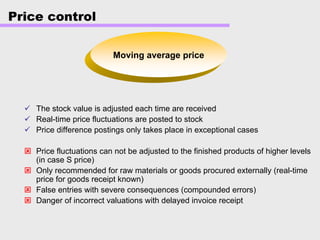
The stock value is adjusted each time are received
Real-time price fluctuations are posted to stock
Price difference postings only takes place in exceptional cases
Price fluctuations can not be adjusted to the finished products of higher levels
(in case S price)
Only recommended for raw materials or goods procured externally (real-time
price for goods receipt known)
False entries with severe consequences (compounded errors)
Danger of incorrect valuations with delayed invoice receipt
Price control
Standard Price
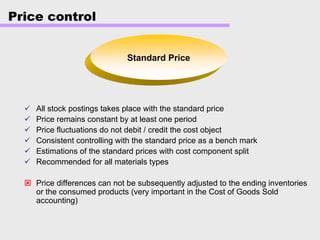
All stock postings takes place with the standard price
Price remains constant by at least one period
Price fluctuations do not debit / credit the cost object
Consistent controlling with the standard price as a bench mark
Estimations of the standard prices with cost component split
Recommended for all materials types
Price differences can not be subsequently adjusted to the ending inventories
or the consumed products (very important in the Cost of Goods Sold
accounting)
Price determination control
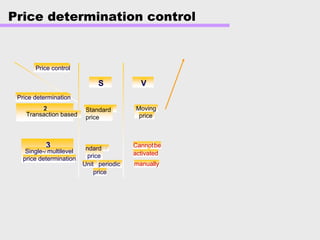
SS VV
Standard
price
Moving
price
2
Transaction based
Price control
Price determination
3
Single-/ multilevel
price determination
Standardndard
price
periodicUnit
price
Cannotbe
activated
manually
Actual Values Overview
Setting 2 of transaction-based price determination functions in the
same way as the system without the material ledger, but has the added
advantage of allowing you to carry standard prices and moving prices in
multiple currencies or valuations. This option is possible for materials with
the price control S or V.
With single-/multilevel material price determination (indicator 3 in the
material master),
a standard price is used for preliminary valuation, and a periodic unit
price is calculated for material valuation of the closed period. This option
is only possible for materials with the price control indicator S, and is only
recommended when you want to use actual costing in combination with
multiple currencies or valuations.
With single-multilevel material price determination, the periodic unit
price is updated for informational purposes and can be used for
material valuation of the closed period.
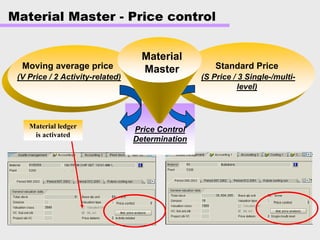
Material Master - Price control
Price Control
Determination
Moving average price
(V Price / 2 Activity-related)
Standard Price
(S Price / 3 Single-/multi-
level)
Material
Master
Material ledger
is activated
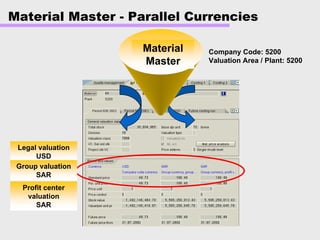
Material Master - Parallel Currencies
Material
Master
Company Code: 5200
Valuation Area / Plant: 5200
Legal valuation
USD
Group valuation
SAR
Profit center
valuation
SAR
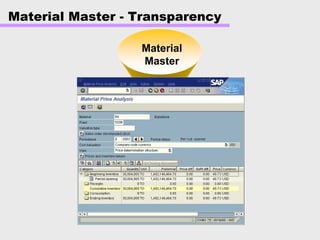
Material Master - Transparency
Material
Master
Actual Values Overview
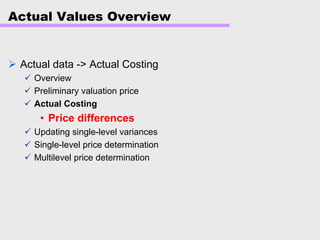
Actual data -> Actual Costing
Overview
Preliminary valuation price
Actual Costing
• Price differences
Updating single-level variances
Single-level price determination
Multilevel price determination
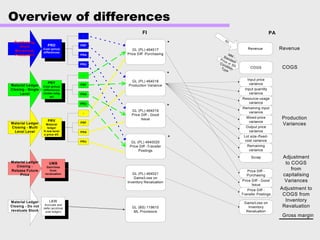
Overview of differences
-
PRF
PRA
PRU
PRD
Cost (price)
differences
-
PRF
PRA
PRU
PRY
Cost (price)
differences
(mater.ledg
er)
-
PRF
PRA
PRU
PRV
Material
ledger
fr.low.level
s price dif.
UMB
Gain/loss
from
revaluation
LKW
Accruals and
defer.acct(mat
erial ledger)
GL (PL) 464017
Price Diff -Purchasing
GL (PL) 464018
Production Variance
GL (PL) 464019
Price Diff - Good
Issue
GL (PL) 4640020
Price Diff -Transfer
Postings
GL (PL) 464021
Gains/Loss on
Inventory Revaluation
GL (BS) 119610
ML Provisions
Purchasing,
Stock
Movement,
Production
Material Ledger
Closing - Single
Level
Material Ledger
Closing - Multi
Level Level
Material Ledger
Closing -
Release Future
Price
Material Ledger
Closing - Do not
revaluate Stock
FI PA
Revenue
SD
Revenue
COGS
MM -Standard
Price or SD
ConditionType
Input price
variance
Input quantity
variance
Resource-usage
variance
Remaining input
variance
Mixed-price
variance
Output price
variance
Lot size-/fixed-
cost variance
Remaining
variance
Scrap
Price Diff -
Purchasing
Price Diff - Good
Issue
Price Diff -
Transfer Postings
Gains/Loss on
Inventory
Revaluation
COGS
Production
Variances
Adjustment
to COGS
from
capitalising
Variances
Adjustment to
COGS from
Inventory
Revaluation
Gross margin
*
*
*
*
Actual Values Overview
Actual data -> Actual Costing
Overview
Preliminary valuation price
Actual Costing
• Price differences
Updating single-level variances
Single-level price determination
Multilevel price determination
Preliminary valuation price
When Actual costing is used all materials are valuated with a
preliminary periodic unit price. This price remains constant
within a period.
This price can be the result of a standard cost estimate, a
manual price or an actual price calculated in the previous
period.
The advantage of this price is (as with the standard price)
that standard costs can be calculated independently without
price fluctuations hindering the controlling of the production
processes.
Actual Values Overview
Actual data -> Actual Costing
Overview
Preliminary valuation price
Actual Costing
• Price differences
Updating single-level variances
Single-level price determination
Multilevel price determination
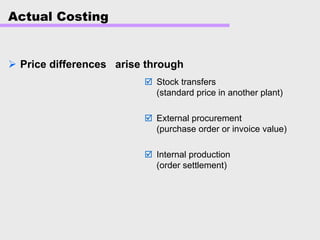
Actual Costing
Price differences arise through
Stock transfers
(standard price in another plant)
External procurement
(purchase order or invoice value)
Internal production
(order settlement)
Actual Values Overview
Actual data -> Actual Costing
Overview
Preliminary valuation price
Actual Costing
• Price differences
Updating single-level variances
Single-level price determination
Multilevel price determination
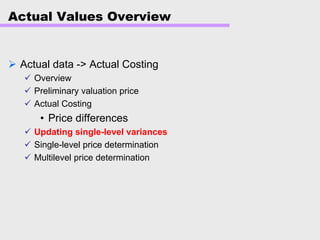
Updating Single Level Variances
During a period, variances are incurred for this preliminary valuation
price (or standard price).
These variances are posted from the material ledger to a price
difference account and updated for each material. Single-level
variances are the variances incurred for a material during its direct
procurement.
For raw materials, these are, as a rule, variances from price fluctuations
in the case of external procurement from vendors.
For semi-finished and finished products, the single-level variances include
internal cost fluctuations from production that are calculated during order
settlement.
Single-level variances do not include price differences from materials from
lower levels of production. For example, price variances incurred during
the procurement of raw materials are not included in order settlement,
because the raw materials were assigned to the order at preliminary
valuation.
Actual Values Overview
Actual data -> Actual Costing
Overview
Preliminary valuation price
Actual Costing
• Price differences
Updating single-level variances
Single-level price determination
Multilevel price determination
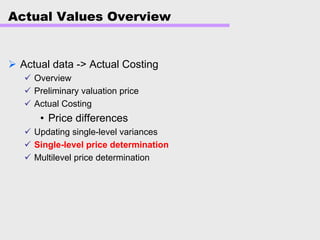
Single level Price determination
At the end of the period, you can use the functions for single-
level price determination to assign the variances for each
material. In this way, cumulated price differences can be
proportionally assigned to the ending inventory and material
consumption of the period at the end of the period.
The stock can valuated with the actual price of this period,
the periodic unit price. The price differences assigned to
consumption first remain on the price difference account.
When you settle an order, the system allocates the price
differences incurred during a production process to the
respective materials.
Actual Values Overview
Actual data -> Actual Costing
Overview
Preliminary valuation price
Actual Costing
• Price differences
Updating single-level variances
Single-level price determination
Multilevel price determination
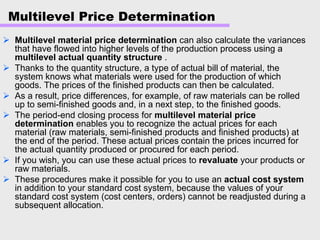
Multilevel Price Determination
Multilevel material price determination can also calculate the variances
that have flowed into higher levels of the production process using a
multilevel actual quantity structure .
Thanks to the quantity structure, a type of actual bill of material, the
system knows what materials were used for the production of which
goods. The prices of the finished products can then be calculated.
As a result, price differences, for example, of raw materials can be rolled
up to semi-finished goods and, in a next step, to the finished goods.
The period-end closing process for multilevel material price
determination enables you to recognize the actual prices for each
material (raw materials, semi-finished products and finished products) at
the end of the period. These actual prices contain the prices incurred for
the actual quantity produced or procured for each period.
If you wish, you can use these actual prices to revaluate your products or
raw materials.
These procedures make it possible for you to use an actual cost system
in addition to your standard cost system, because the values of your
standard cost system (cost centers, orders) cannot be readjusted during a
subsequent allocation.
Period End Overview
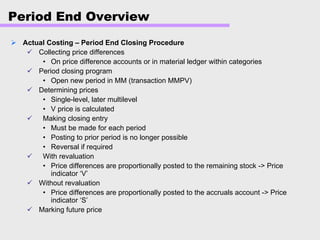
Actual Costing – Period End Closing Procedure
Collecting price differences
• On price difference accounts or in material ledger within categories
Period closing program
• Open new period in MM (transaction MMPV)
Determining prices
• Single-level, later multilevel
• V price is calculated
Making closing entry
• Must be made for each period
• Posting to prior period is no longer possible
• Reversal if required
With revaluation
• Price differences are proportionally posted to the remaining stock -> Price
indicator ‘V’
Without revaluation
• Price differences are proportionally posted to the accruals account -> Price
indicator ‘S’
Marking future price
Period End Overview – Closing Entry (1)
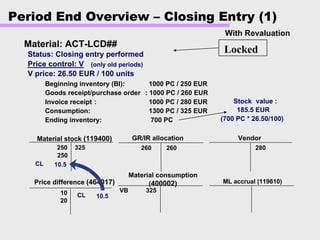
Beginning inventory (BI): 1000 PC / 250 EUR
Goods receipt/purchase order : 1000 PC / 260 EUR
Invoice receipt : 1000 PC / 280 EUR
Consumption: 1300 PC / 325 EUR
Ending inventory: 700 PC
Material: ACT-LCD##
VB 325
Material stock (119400)
325250
250
GR/IR allocation
260 260
Vendor
280
Price difference (464017)
10
20
Status: Closing entry performed
Price control: V (only old periods)
V price: 26.50 EUR / 100 units
ML accrual (119610)
10.5
10.5CL
CL
Stock value :
185.5 EUR
(700 PC * 26.50/100)
Locked
With Revaluation
Material consumption
(400002)
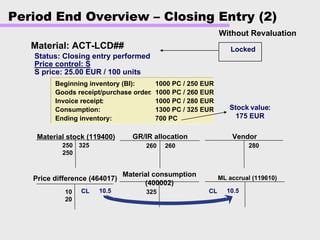
Period End Overview – Closing Entry (2)
Beginning inventory (BI): 1000 PC / 250 EUR
Goods receipt/purchase order: 1000 PC / 260 EUR
Invoice receipt: 1000 PC / 280 EUR
Consumption: 1300 PC / 325 EUR
Ending inventory: 700 PC
Material: ACT-LCD##
325
Material stock (119400)
325250
250
GR/IR allocation
260 260
Vendor
280
Price difference (464017)
10
20
ML accrual (119610)
Stock value:
175 EUR
10.5CL CL
Status: Closing entry performed
Price control: S
S price: 25.00 EUR / 100 units
Locked
10.5
Material consumption
(400002)
Without Revaluation
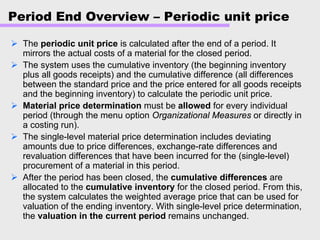
Period End Overview – Periodic unit price
The periodic unit price is calculated after the end of a period. It
mirrors the actual costs of a material for the closed period.
The system uses the cumulative inventory (the beginning inventory
plus all goods receipts) and the cumulative difference (all differences
between the standard price and the price entered for all goods receipts
and the beginning inventory) to calculate the periodic unit price.
Material price determination must be allowed for every individual
period (through the menu option Organizational Measures or directly in
a costing run).
The single-level material price determination includes deviating
amounts due to price differences, exchange-rate differences and
revaluation differences that have been incurred for the (single-level)
procurement of a material in this period.
After the period has been closed, the cumulative differences are
allocated to the cumulative inventory for the closed period. From this,
the system calculates the weighted average price that can be used for
valuation of the ending inventory. With single-level price determination,
the valuation in the current period remains unchanged.
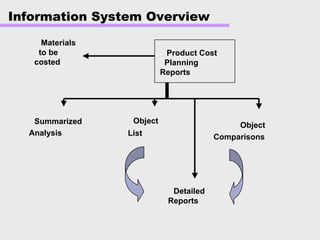
Detailed
Reports
Object
List
Object
Comparisons
Materials
to be
costed
Summarized
Analysis
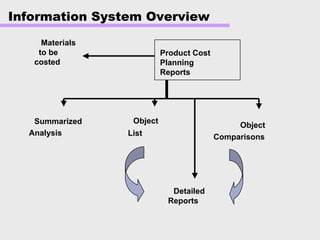
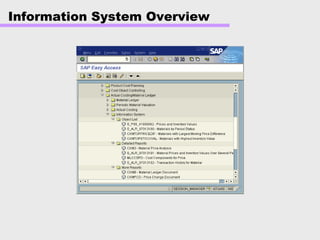
Information System Overview
Product Cost
Planning
Reports
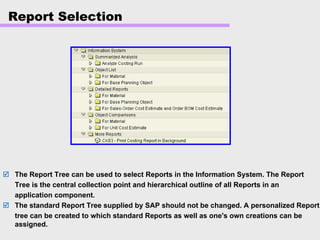
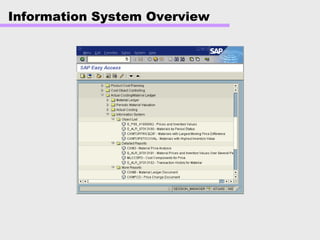
Report Selection
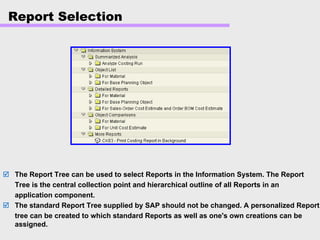
The Report Tree can be used to select Reports in the Information System. The Report
Tree is the central collection point and hierarchical outline of all Reports in an
application component.
The standard Report Tree supplied by SAP should not be changed. A personalized Report
tree can be created to which standard Reports as well as one's own creations can be
assigned.
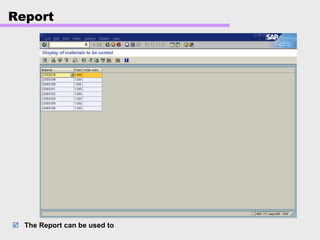
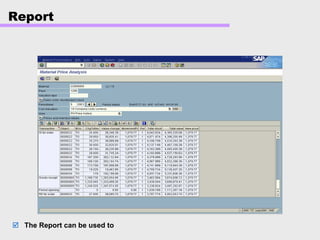
Report
The Report can be used to
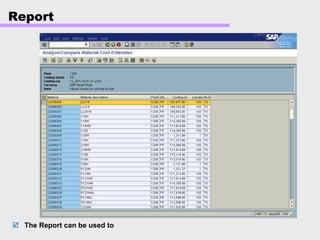
Report
The Report can be used to
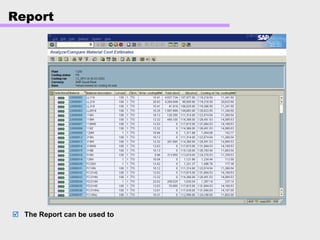
Report
The Report can be used to
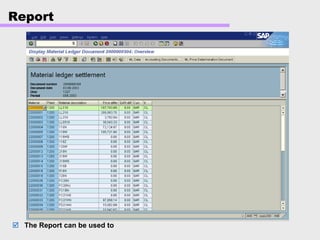
Report
The Report can be used to
Report
The Report can be used to
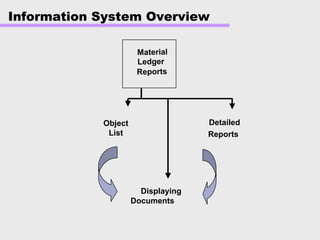
Information System Overview
Displaying
Documents
Material
Ledger
Reports
Object
List Reports
Detailed
Information System Overview
Detailed
Reports
Object
List
Object
Comparisons
Materials
to be
costed
Summarized
Analysis
Information System Overview
Product Cost
Planning
Reports
Report Selection
The Report Tree can be used to select Reports in the Information System. The Report
Tree is the central collection point and hierarchical outline of all Reports in an
application component.
The standard Report Tree supplied by SAP should not be changed. A personalized Report
tree can be created to which standard Reports as well as one's own creations can be
assigned.
Information System Overview
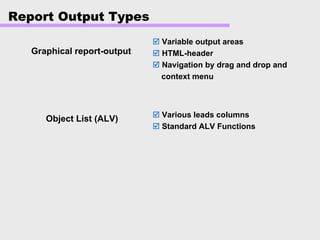
Report Output Types
Graphical report-output
Variable output areas
HTML-header
Navigation by drag and drop and
context menu
Object List (ALV) Various leads columns
Standard ALV Functions
Material Ledger Product costing

Material Ledger Product costing

  • 1.
    Product Costing &Material Ledger
  • 2.
    Product Costing Overview Acquirean overall perspective of Product Cost Planning within R/3. Observe a product life cycle from the perspective of Product Cost Planning. Acquire an overall perspective of product cost object controlling within R/3. Understand the period oriented product cost controlling. Obtain an understanding of the functions in the material ledger. Analysis of product costs.
  • 3.
    Material Ledger Overview Obtainan understanding of the actual costing function in the material ledger. Know how to revaluate inventories of semi finished products, and finished products with calculated actual costs or accrue variances. Analysis of actual product costs.
  • 4.
    Why utilize ProductCosting? •Product Costing is the backbone of a strong standard cost system. This is the process by which production activities are recorded at standard values and variances from actual costs are isolated. •For planning purposes, the corporation wants a preliminary target of what they think it will cost to produce X units of a product. •To set attainable standards by which efficiencies within the production operations can be measured. •To provide feedback to management on the actual performance of the production process in relation to those targets. Identified variances may indicate inefficiencies that have to be investigated. Corrective action may have to be taken.
  • 5.
    Costing Methodology Material MasterMaterialMaster PricePrice ControlControl Standard Price (S-Price) - Constant - Recommended for all material types Moving average price (V- Price) - Adjusted with every receipt - If at all, only to be used for raw materials and materials procured externally
  • 6.
    Costing Methodology The methodof valuing inventory of a material is determined when extending/creating the material master. Price that changes in consequence of usage and entry of invoices. Calculated by dividing the value of material by the quantity in stock. Automatically recalculated based on activity. Constant price without considering usage or invoices. Material stock valued at the same price over an extended period. Price variances are posted to price difference accounts; not affecting the standard price.
  • 7.
    Moving average price– Stock Coverage GR/IR Account Vendor 200 300 200 100 200 100 300 Consumption 300 If the invoice receipt is for 100 units, the stock coverage is 200 units: all differences goes on stock Stock QtyQty Stk. ValStk. Val V priceV price 1.Begin. inventory: 100 PC at 1.001.Begin. inventory: 100 PC at 1.00 100100 100100 1.001.00 2. Goods receipt: 100 PC at 2.002. Goods receipt: 100 PC at 2.00 200200 300300 1.501.50 3. Invoice receipt: 100 PC at 3.003. Invoice receipt: 100 PC at 3.00 200200 400400 2.002.00 4. Goods issue: 150 PC at 2.004. Goods issue: 150 PC at 2.00 5050 100100 2.002.00 1.1. 2.2. 33 3.3. 2.2. 3.3.4.4. 4.4.
  • 8.
    Moving average price:Stock shortage Stock Price difference GR/IR account Vendor 100 200 50 200200 50 300 Consumption 2253.3. 225 StockStock StockStock ValueValue V PriceV Price 1. Begin. inventory:1. Begin. inventory: 100100 100100 1.001.00 2. Goods receipt: 100 PC at 2.002. Goods receipt: 100 PC at 2.00 200200 300300 1.501.50 3. Goods issue: 150 PC at 1.503. Goods issue: 150 PC at 1.50 5050 7575 1.501.50 4. Invoice receipt: 100 PC at 3.004. Invoice receipt: 100 PC at 3.00 5050 125125 22.50.50 1.1. 2.2. 33.. 4.4. 4.4. 2.2. A delayed invoice receipt results in price differenceA delayed invoice receipt results in price difference due to stock shortagedue to stock shortage 44..4.4.
  • 9.
    Characteristics of PriceControl V √ The stock value is adjusted each time goods are received √ Real-time price fluctations are posted to stock √ Price difference postings only take place in exceptional cases Disadvantages: × Price fluctuations cannot be adjusted to the finished products of higher levels (S price) × Only recommended for raw materials or goods procured externally (real- time price for goods receipt known) × False entries with severe consequences (compounded errors) × Danger of incorrect valuations with delayed invoice receipt Moving average price Advantages:Advantages:
  • 10.
    Posting Example: StandardPrice Stock Price difference GR/IR account Vendor 3450 Stock Stock Value Standard Price Opening stock: 100 400 4.00 Goods receipt: 100 at 5 200 400 4.00 Invoice receipt: 100 at 4.50 200 400 4.00 1 2 3 1 400 4002 500 23 500 2 100 350
  • 11.
    Characteristics of PriceControl S √ All stock postings take place at the standard price √ Prices remain constant throughout at least one period √ Price fluctuations do not debit/credit the cost objects (e.g. orders) √ Calculation of the standard prices with cost component splits √ Recommended for all material types Disadvantages: × Price differences cannot be subsequently adjusted to the ending inventories or the consumed products (sales, production withdrawals) Advantages:Advantages: Standard Price
  • 12.
    Costing Methodology Valuation Methodby Material: Finished Goods Standard w/ ML Intermediates Standard w/ ML Raw Material Moving Average Actual Packaging Moving Average Actual
  • 13.
    Organizational unit dividingup a company for the purpose of valuating stocks in a standardized and consistent manner. • Level at which material value is managed. • The valuation area may is defined: - by plant Valuation Area
  • 14.
    Quality CCA Labour CCA F. Goods Inventory BOM Routing Production orders CO- CCA CO- PA CO- PC Manufacturing CostMM: RM Steam CCA Production Cost Center VAR. VAR.. . Product Cost Flow ActvActv ActvActv ActvActv
  • 15.
    Product Cost Flow PlantCost View Sales & Mktg. View Mfg. Cost Center (Activity Types) Utilities Salaries Supplies Maintenance Depreciation Training Direct Conversion Insur. & Taxes Laboratory/QC Waste Treatment Shops & Stores General Services Indirect Conversion Total Product Cost Mach. Hrs. or lbs. Produced Lab tests Setup Hrs. P A (Profitability Analysis) Raw Mat’l 1 & 2 Costs Pkg. Mat’l Costs Costs to Produce Product testing costs Change Over costs (setup costs) Routing Product Unit Cost Cost of Goods Mfg. Raw Mat’l 1 Costs Raw Mat’l 2 Costs Pkg. Mat’l Costs Routing Mach. Hr. Costs Lab Tests Costs Mach. Setup Costs Process Order Raw Mat’l 1 Raw Mat’l 2 Pkg Mat’l BOM (Cost Component View) (SAP Value Fields) Three Views Available: 1. Cost Component 2. Cost Element 3. Cost Itemization Cost of Goods Sold Fixed & Variable Cost Fixed & Variable Cost
  • 16.
    Product Costing AtA Grp Product Cost Planning Yes Execute costing run Automatic Release of Standard Price Mark Standard Cost Estimate Activity type planning completed Quantity structure in PP created Overhead cost planning completed Plan prices of raw materials were entered Standard Cost Calculated Review for Approval Adjust costing master data/ parameters Standard price hase been released OK Not OK
  • 17.
    Product Costing AtA Grp Product Cost Allocation - Simultaneous Costing Yes Simultaneous Costing Cost estimate has been released Manufacturi ng order has been released Cost object has been created Product cost are allocated
  • 18.
    Product Costing AtA Grp Period End Closing Product Costing Yes Revaluation activity types at actual prices Product cost are allocated PE Product Costing has been done Calculation of WIP Periodic Varaiance calculation Settle cost object
  • 19.
    Product Costing AtA Grp Material Ledger/Actual Costing Allocation of Follow up Costs to Finished/Semi Finished Products Price Update in Actual Costing Material Price Determination GL Postings MM Goods Movements Recorded Material M,aster Updates GL Postings & Reversal Material M,aster Updates Revaluate Stock Provisional Posting
  • 20.
    Product Cost Planning:Overview Functions of Product Cost Planning: Product Cost Planning with reference to cost object Product cost planning with quantity structure – with structures provided by PP (Production Planning) module Determination of the cost of goods manufactured Product Cost Planning supplies information for other modules: Update of prices in a material master Update of the cost of good sold with the detailed structure of cost component (grouped cost elements) Standard (material) cost estimate as the base for calculation of production variances
  • 21.
    What is aProduct Cost Estimate? Cost Estimate With Quantity Structure Utilizes a Bill of Material (BOM) and routing, I.e. Master Recipe for costing purposes. Integrated with Production Planning (PP). Additive You use additive costing to enable you to manually add costs that cannot be calculated by the system to a material cost estimate. A tool for planning costs and establishing prices for materials. It is used to calculate the cost of goods sold for each product unit. Cost Estimate WITHOUT Quantity Structure Utilizes a material master data and activity types entered manually into cost estimate.
  • 22.
    Product Costing: Overview StandardCost Estimate (once a year) Standard Cost Estimate (once a year) Release cost estimate with quantity structure Mark cost estimate with quantity structure Create Cost estimate with quantity structure
  • 23.
    Concept of CostRoll Up The purpose of cost rollup is to include the cost of goods manufactured of all the materials in a multilevel production structure within the costs of the material located at the top of the structure. The costs are rolled up automatically using the costing levels.
  • 24.
    Costing Variant ValuationValuation VariantVariant Quantity StructureQuantityStructure DeterminationDetermination Costing VariantCosting Variant PricesPricesQuantities Cost of goodsCost of goods manufacturedmanufactured
  • 25.
    Costing Variant COSTING VARIANT Strategy forStrategyfor transfer oftransfer of the existingthe existing cost estimatescost estimates Determination of :Determination of : -- Bills of MaterialBills of Material -- RoutingRouting Defaulted dates forDefaulted dates for costingcosting Costing SheetCosting Sheet Determination of:Determination of: -- prices updateprices update in material masterin material master Valuation control for:Valuation control for: -- materialsmaterials -- internal activitiesinternal activities -- external activitiesexternal activities -- subcontractingsubcontracting -- overheads viaoverheads via costing sheetcosting sheet
  • 26.
    Quantity Structure forProduct Cost Planning Quantity Structure of Product Cost Planning:- Material Master Bill of Material Work Center/ Resources Routings Master Recipe Production Version Procurement Alternative/ Mixing Ratios
  • 27.
    Quantity Structure forProduct Cost Planning Material master data Accounting views Costing views MRP views BOM - Bill of Material BOM type & identification BOM header Material data Routing - tasks list Routing type & identification Routing header Operation data Master Recipe Recipe header Operations Materials list Work Centers / Resources Basic data Costing Production Version Validity Period Production line
  • 28.
    Quantity Structure: MaterialMaster Data Material Master Data: Material Master Data is an object in SAP that consists all relevant data for raw materials, semi-finished and finished products divided into views. Important Views relevant for product costing: Accounting Costing MRP
  • 29.
    Quantity Structure: ProductionVersion Production versions combine a specific BOM alternative with a specific routing/recipe For one material, you can have several Production versions for various validity periods and lot size ranges Production version facilitate different situations Production using different resources Production using different procedures
  • 30.
    Quantity Structure: ProcurementAlternatives Quantity structure determination for mixed cost estimate.
  • 31.
    Quantity Structure: MixingRatios Product <FERT or HALB > Mixed Product Cost Estimate Quantity structure determination for mixed cost estimate Validity period for mixing structure
  • 32.
    Costing Structure Costing Structurefor Product Cost Planning:- Activity Types Cost Elements Cost Component Structure Cost Centers Material Master
  • 33.
    Costing Structure forProduct Cost Planning Material master data Accounting views Costing views Cost Centers Validity period Category Functional area Activity Types Validity period Activity unit Allocation cost element Cost Elements Validity period Category
  • 34.
    Costing Structure Activity typesdefine the type of activity that can be provided by a cost center (work activity, production hours, and so on).
  • 35.
    Cost center h Cost center: Machine Plannedcosts: 430000 (salaries) 44,000 440000 (miscl.) 10,000 473120 (telephone) 30,000 Plan activity qty: 100 h Planned costs: 84,000 Calculated Price: 840 Activity Price Calculation: Apportionment of cost center costs to activity types according to particular criteria 1PDH01 Activity Price Calculation 1 2 100
  • 36.
    Costing Structure Steam service 9103004 943954UT: Steam fix Product 91000045 - TEG Product 91000060 - LLDPE 9103000 ….. ….. Distribution Activity Allocation 943954viaRouting Cost Splitting Planning 9103000 Utilities (Common) Product Cost Estimate Activity Types Used: 1UTSTF Steam - fixed O riginalCE 1UTSTF Steam - fixed 1UTSTV Steam – var. 2 3 5 Primary costs planning on all Cost Centers. 1 Planned Price Calculation Prices for 1UTSTF are calculated. 4 1. Assign CC 9103004 to Splitting Structure Z9 Steam service 2. Perform cost splitting
  • 37.
    Cost Component Structure RawMaterials Utilities Personnel Exp. Depreciation Primary cost elements Product Cost Planning Cost Centers Utilities Personnel Exp. Depreciation Structure of primary costs CO- PC CO- OM Raw Materials Internal Activity Allocation Structure of primary costs Z9 A Grp-Primary
  • 38.
    Product Costing: Overview StandardCost Estimate (once a year) Standard Cost Estimate (once a year) Release cost estimate with quantity structure Mark cost estimate with quantity structure Create Cost estimate with quantity structure
  • 39.
    Price update Standard price Onlyone validated standard price per product per period, The price represents most desired (or most likely) costs Only one price per product over the year (recommended) Determined during costing runs for Z9P1 costing variants - standard cost estimate is populated in appropriate valuation views Includes variable and fix cost elements Base for variances calculation; which is then posted to FI and CO- PA Used for stock valuation of finished goods and semi-finished products Stored in material master data (accounting view) in Legal, Group and Profit Center valuation views after releasing the cost estimate
  • 40.
    Price update Future price Futurestandard price Stored in material master data (accounting & costing view) in Legal, Group and Profit Center valuation views after marking the cost estimate. Previous price Replaced standard price by current one due to releasing the cost estimate Stored in material master data (accounting & costing view).
  • 41.
    Price update Existing Std MaterialMaster DataMaterial Master Data Standard Price Future Current Previous 1010 Future Current Previous Marking StandardMarking Standard Cost EstimateCost Estimate 1015 Future Current Previous 101515 Stock RevaluationStock Revaluation Releasing StandardReleasing Standard Cost EstimateCost Estimate Analysis of Costing Results
  • 42.
    Costing run Costing run Youcan use the costing run to process mass data. It enables you to cost, mark, and release more than one material at the same time. Every processing step involved in costing with quantity structure is performed by the costing run, from the same screen. Costing run consists of: General data (organizational units, selection criteria) Selected materials Exploded BOMs Costing run results Price update results
  • 43.
    Costing run Marking andreleasing costing run results (price update) Execute costing run Selection of all materials Partial selection of materials BOM explosion Costing Run CreationCosting Run Creation Company Code Costing variant Dates OROR
  • 44.
    Product Costing: Overview PrepareCost ObjectPrepare Cost Object Production CostsProduction Costs Receive Finished StocksReceive Finished Stocks Month End ClosingMonth End Closing Post Materials Costs Debit Secondary cost Credit Production Output WIP Calculation Variance Calculation Settlement Preliminary costing Create cost object
  • 45.
    Cost Object Controlling:Overview Functions of Cost Object Controlling: Supporting make-or-buy decisions Determining price floors Performing complex cost analysis Determining inventory values
  • 46.
    Cost Object Controlling:Overview Cost Object Controlling Scenarios: Product Cost by Period Product Cost by Period is used for recurring periodic cost control of products that are manufactured in the same way over a longer period of time. Product Cost by Order Product Cost by Order is mainly used to control the costs of individual production lots.
  • 47.
    Cost Object Controlling:Overview Product Cost by Order or by Period Full settlement (by Order) Periodic settlement ( by Period) Actual costs = Work in process Actual costs - Goods receipts = Work in process Actual costs - Goods receipts = Variances Releasing an order Partial delivery Delivered / Technically completed Actual costs - Goods receipts = Work in process + Variances Period 1 Period 2 Period 3 Actual costs - Goods receipts = Work in process + Variances Actual costs - Goods receipts = Work in process + Variances TimeTime TimeTime
  • 48.
    Cost Object Controlling:Overview Product Cost by Order Type of settlement rule Work-in-Process Variances Settlement Hierarchy of Cost Objects FULL PERIODIC WIP calculated on base of actual costs Variance = Actual Costs - Goods Receipts Variance = Actual Costs - Goods Receipts - WIP Should be periodically Impossible Possible FunkcjeFunctions Product Cost by Period WIP calculated on base of target costs Must be periodically
  • 49.
    Cost Object Controlling:Overview Functions of Product Costs by Period: Create product cost collectors. Create a preliminary cost estimate for product cost collectors. Calculate and analyze target costs and actual costs for product cost collectors. Calculate or update the work-in-process inventory and the finished goods inventory. Calculate and analyze variances for each period. Transfer data to: Financial Accounting, Profitability Analysis, Profit Center Accounting and Material Ledger.
  • 50.
    Product Costing: Overview PrepareCost ObjectPrepare Cost Object Preliminary costing Create Product Cost Collector
  • 51.
    Objects in CostObject Controlling Product cost collectors in the following production environments: In order-related production (that is, when you are using production orders) when you want to analyze the costs by period rather than by lot In process manufacturing (that is, when you are using process orders) when you want to analyze the costs by period rather than by lot In repetitive manufacturing you always use product cost collectors as the cost objects.
  • 52.
    Objects in CostObject Controlling Product <FERT or HALB > Bill of Material • Usage • Alternative Routing • Group • Group counter Production Version • ID, • Production line, • Validity period. Product Cost Collector Product Cost Collector
  • 53.
    Objects in CostObject Controlling Master Recipe Production Version PROCESS ORDER 2 Operation List/Routing Materials List/BOM Resource Requirements Operation 10 Operation 20 Phase A Material Y Material X Product Cost Collector PROCESS ORDER 1Product <FERT or HALB>
  • 54.
    Preliminary costing Costing variantPREM - preliminary costing: Created during product cost collector creation Created per each production version Provides split and balanced information of cost items, quantities and prices that are planned to occur during production of a product Variable costs coming from BOM and routing Result used mainly for actual activities postings May be used for further analysis up to cost management requirements May be changed all the time in the way of changing (updating) Product Cost Collector; i.e. different quantity structures allowed over the period Changes in BOMs take effect immediately, i.e. cost estimate update not required Changes in routings take effect after cost estimate update
  • 55.
    Preliminary costing Product CostCollector Item Plan Actual Materials 4.000 Internal activities 2.500 Overheads 1.500 EDC 0.500 Ethylene 2.000 Caustic Soda 1.500 Total 8.000
  • 56.
    Simultaneous costing –actual costs Product Cost Collector Item Plan Actual Materials 4,000 4,600 Internal activities 2.500 2.800 Overheads 1.500 EDC 0.500 0.600 Ethylene 2.000 2.200 Caustic Soda 1.500 1.800 Total 8.000 7.400
  • 57.
    Confirmation Types &Functions - Process Orders Individual confirmation Collective confirmation Milestone confirmation Progress confirmation Order confirmation Confirmation with reference Individual order confirmation Collective confirmation Milestone confirmation Confirmation types Confirm with goods movement Defaults for remaining time Check operation sequence Check delivery tolerances Plant data collection interface Backflushing Reduce capacity requirements Determine actual costs Output goods receipt Determine actual costs Confirmation functions Backflush components Backflush utilities Reduce capacity requirements
  • 58.
    Final Confirmation &Technical Completion Final Confirmation is made when every operation in the order has been completed Technical confirmation is the order is prematurely terminated. Technical confirmation prevents further activities being posted to the order. Both the above confirmation can be settled.
  • 59.
    Failed Transactions andCorrections Incorrect or missing data for components and activities prevents processing of the back flush transaction These errors must be corrected before postings can be made for materials and activities When the errors have been eliminated, the theoretical yield and consumption may be adjusted and the results recorded
  • 60.
    Actual costs Production Order Step1 – Created and release - Maintenance of Master Data Status - RELEASED STATUS- CREATED STATUS - RELEASED This status allows for actual postings
  • 61.
    Actual costs Production Order Step2 – Goods Issue to Order - Actual Postings Status – GOODS MOVEMENT POSTED Order 100 * 11 = 1.100,- quantity * price = cost Raw Materials Consumed 400000 Inventory Raw Materials 119400 1.100,- 1.100,- 400000 + 1.100 FI
  • 62.
    Actual costs Production Order Step3 – Direct activity allocation - Actual Postings Status - RELEASED 400000 + 1.100 Cost Center / Activity 943201 - 7.500,- 943201 + 7.500 150 * 50 = 7.500 quantity * price = cost Order
  • 63.
    Actual costs Production Order Step4 – Goods Receipt from Order into Warehouse - Actual Postings Status – PARTIALLY DELIVERED Order 400000 + 1.100 943201 + 7.500 100 * 50 = 5.000,- quantity * price = value of the goods receipts from order Production Output 462001 Finished Products 119430 5.000,- 5.000,- 462001 - 5.000 FI
  • 64.
    Actual costs -Summary The results from the output receipts, plus material & resource consumptions, update the stock records and provide valuation of production according to standard cost approach.
  • 65.
    Product Costing: Overview MonthEnd ClosingMonth End Closing Settlement Variance Calculation WIP Calculation
  • 66.
    Period and year-endclosing Production Order Step 5 – Work-in-Process Calculation - Period-end closing Status – RESULTS ANALYSIS CARRIED OUT Order 400000 + 1.100 943201 + 7.500 462001 - 5.000,- WIP Report: Work-in-Process 8.600 - 5.000 = 3.600
  • 67.
    Period and year-endclosing Production Order Step 6 – Settlement of - Period-end closing Status – RESULTS ANALYSIS CARRIED OUT Order 400000 + 1.100 943201 + 7.500 462001 - 5.000,- Work In Progress (WIP) 462201 Work In Progress (WIP) 119460 3.600 FI 3.600 WIP is being updated on the order as statistical value for information purposes.
  • 68.
    Period and year-endclosing Production Order – new period Step 9 – Repetition of the steps from 3 to 7 - Actual Postings Status – PARTIALLY DELIVERED Order As a result of the actual postings in the new period there is a new balance on the order. 400000 + 1.100 943201 + 7.500 462001 - 5.000,- 400000 + 5.000,- 462001 - 7.000,-
  • 69.
    Period and year-endclosing Production Order – period 2 Step 7 – Work-in-Process Calculation (variant 1) - Period-end closing Status – PARTIALLY DELIVERED WIP Report (cumulated): Work-in-Process 13.600 - 12.000 = 1.600 Work-in-Process in previous period 8.600 - 5.000 = 3.600 Cumulative: 2.000 Order 400000 + 1.100 943201 + 7.500 462001 - 5.000,- 400000 + 5.000 462001 - 7.000,-
  • 70.
    Period and year-endclosing Production Order – Period 2 Step 11 – Settlement (variant 1) - Period-end closing Status – RESULTS ANALYSIS CARRIED Order Work In Progress (WIP) 119460 Work In Progress (WIP) 462201 FI 1.600 1.600 400000 + 1.100 943201 + 7.500 462001 - 5.000 400000 + 5.000 462001 - 7.000 As WIP is reported as cumulative value.
  • 71.
    Period and year-endclosing Production Order – period 2 Step 12 – Calculation of Variances and Settlement (variant 2) - Period-end closing Status – TECHNICALLY COMPLETED Price Difference - Production Difference 464018 Production FI 1.600 Output 462001 1.600 Order 400000 + 1.100 943201 + 7.500 462001 - 5.000 400000 + 5.000 462001 - 7.000 Negative variance: Actuals > Plan. As a result of a posting the balance of the order was posted to production difference account and cumulated WIP was reversed. WIP 462201 WIP 119460 3.600 3.600
  • 72.
    Period and year-endclosing Variance Category PA Assignment lines Value FieldCost Element Group + + +
  • 73.
    Period and year-endclosing Product Cost Collector Item Plan Actual Materials 4,000 4,600 Internal activities 2.500 2.800 Overheads 1.500 1.600 EDC 0.500 0.600 Ethylene 2.000 2.200 Caustic Soda 1.500 1.800 Total 8.000 9.000 Revaluation Overheads Periodic Costs %
  • 74.
    Period and year-endclosing Work-in-Process Overheads Process costs Revaluation Periodic costs Calculations and analysis Postings FI/CO Settlement Scrap Variances PeriodPeriod--end closingend closing
  • 75.
    Material Ledger: Overview Functionsof Material Ledger: Cost accounting using actual prices Storing values of stock in three different valuations (legal valuation, valuation for reporting purposes, and profit center valuation) in multiple currencies.
  • 76.
    Material Ledger: Overview Functionsof Material Ledger: Cost accounting using actual prices Storing values of stock in three different valuations (legal valuation, group valuation for reporting purposes, and profit center valuation) in multiple currencies.
  • 77.
    What is theMaterial Ledger/Actual Cost Concept? The Material Ledger(ML) is a tool within the CO Module that collects all transactional data for materials whose master data is stored in the material master. It acts as a subledger for selected materials that captures all goods movements, invoice values, transfers and price changes. On the basis of this data, the material ledger calculates and maintains the actual cost for these materials. This actual cost can then be utilized to valuate the material stock accounts.
  • 78.
    Objectives of theMaterial Ledger 1. Actual Costing. During the period, valuation of all goods movements is done with the preliminary valuation price which is normally the standard price. All variances from the preliminary valuation are maintained in the ML. At period end, revaluation of ending inventory can be performed with the determined actual price. This is not mandatory. Actual prices can be calculated for statistical purposes only. 2. Parallel currencies and/or valuations of material stocks. All goods movements in the ledger can be maintained in 3 currencies. The values are translated into other currencies using the historical exchange rates. Prerequisite for usage of transfer pricing functionality.
  • 79.
    Benefits of theMaterial Ledger ►Variances of Finished Goods Variances from external procurement (purchase orders) as well as from production activities are rolled up from raw and semi- finished materials to the finished goods level. ►To provide support for procurement related decisions. Detailed reporting for procurement processes and sources possible. Make vs.. Buy, Vendor A vs.. Vendor B. Price History. ►Combines the benefits of Moving Average and Standard Price Stable prices used for controlling purposes (standard) and actual prices used for valuation purposes (average). ►Easy to use display and error finding by consolidating the views. Allows quick access to detailed views of material master, standard costs and documents
  • 80.
    Benefits of theMaterial Ledger ►Relatively simple configuration and set up ►True Cost of Sales Accounting Purchasing and production variances for unsold stocks are inventoried. ►Contribution Margin with Actual Costs of Sales By utilizing multi-level settlement, actual values for your cost component split can be attained. This can be transferred to PA
  • 81.
    Single Level Settlement Theterm single level always refers to one material andThe term single level always refers to one material and its procurement process; which means that all values andits procurement process; which means that all values and quantities that arise during a procurement for saidquantities that arise during a procurement for said material are stored singlematerial are stored single-- levellevel
  • 82.
    Multi - LevelSettlement The “multi-level” settlement functionality adds the most value because it passes the lower level variance in a production processes up to the final finished product. All the manufacturing variances can be included in the total cost to manufacture the finished products
  • 83.
    The ML updatesthe Material Master
  • 84.
  • 85.
    Material Ledger Overview MaterialLedger MATERIAL STOCK Parallel Currencies Translation at historic rates (up to three) Parallel Valuations (Transfer Prices) Group Legal Profit Center Actual Costing Revaluation of stock at actual prices or accrual of variances.
  • 86.
    ML Overview –Parallel Currencies Material Ledger (Valuation Area / Plant) • 10 Local currency • 30 Group currency Financial Accounting (Company Code) • 10 Local currency • 30 Group currency Controlling (Controlling Area) • 10 Local currency • 30 Group currency
  • 87.
    ML Overview –Parallel Curr. in A Grp (1) Material Ledger Valuation Area (Plant) 9100
  • 88.
    Price Control Price control Movingaverage price (V Price) • Changed after every receipt • Recommended for raw and externally procured materials. Standard Price (S Price) • Stable for long period • Recommended for finished and semi-finished products. Material Master
  • 89.
    Price control Moving averageprice The stock value is adjusted each time are received Real-time price fluctuations are posted to stock Price difference postings only takes place in exceptional cases Price fluctuations can not be adjusted to the finished products of higher levels (in case S price) Only recommended for raw materials or goods procured externally (real-time price for goods receipt known) False entries with severe consequences (compounded errors) Danger of incorrect valuations with delayed invoice receipt
  • 90.
    Price control Standard Price Allstock postings takes place with the standard price Price remains constant by at least one period Price fluctuations do not debit / credit the cost object Consistent controlling with the standard price as a bench mark Estimations of the standard prices with cost component split Recommended for all materials types Price differences can not be subsequently adjusted to the ending inventories or the consumed products (very important in the Cost of Goods Sold accounting)
  • 91.
    Price determination control SSVV Standard price Moving price 2 Transaction based Price control Price determination 3 Single-/ multilevel price determination Standardndard price periodicUnit price Cannotbe activated manually
  • 92.
    Actual Values Overview Setting2 of transaction-based price determination functions in the same way as the system without the material ledger, but has the added advantage of allowing you to carry standard prices and moving prices in multiple currencies or valuations. This option is possible for materials with the price control S or V. With single-/multilevel material price determination (indicator 3 in the material master), a standard price is used for preliminary valuation, and a periodic unit price is calculated for material valuation of the closed period. This option is only possible for materials with the price control indicator S, and is only recommended when you want to use actual costing in combination with multiple currencies or valuations. With single-multilevel material price determination, the periodic unit price is updated for informational purposes and can be used for material valuation of the closed period.
  • 93.
    Material Master -Price control Price Control Determination Moving average price (V Price / 2 Activity-related) Standard Price (S Price / 3 Single-/multi- level) Material Master Material ledger is activated
  • 94.
    Material Master -Parallel Currencies Material Master Company Code: 5200 Valuation Area / Plant: 5200 Legal valuation USD Group valuation SAR Profit center valuation SAR
  • 95.
    Material Master -Transparency Material Master
  • 96.
    Actual Values Overview Actualdata -> Actual Costing Overview Preliminary valuation price Actual Costing • Price differences Updating single-level variances Single-level price determination Multilevel price determination
  • 97.
    Overview of differences - PRF PRA PRU PRD Cost(price) differences - PRF PRA PRU PRY Cost (price) differences (mater.ledg er) - PRF PRA PRU PRV Material ledger fr.low.level s price dif. UMB Gain/loss from revaluation LKW Accruals and defer.acct(mat erial ledger) GL (PL) 464017 Price Diff -Purchasing GL (PL) 464018 Production Variance GL (PL) 464019 Price Diff - Good Issue GL (PL) 4640020 Price Diff -Transfer Postings GL (PL) 464021 Gains/Loss on Inventory Revaluation GL (BS) 119610 ML Provisions Purchasing, Stock Movement, Production Material Ledger Closing - Single Level Material Ledger Closing - Multi Level Level Material Ledger Closing - Release Future Price Material Ledger Closing - Do not revaluate Stock FI PA Revenue SD Revenue COGS MM -Standard Price or SD ConditionType Input price variance Input quantity variance Resource-usage variance Remaining input variance Mixed-price variance Output price variance Lot size-/fixed- cost variance Remaining variance Scrap Price Diff - Purchasing Price Diff - Good Issue Price Diff - Transfer Postings Gains/Loss on Inventory Revaluation COGS Production Variances Adjustment to COGS from capitalising Variances Adjustment to COGS from Inventory Revaluation Gross margin * * * *
  • 98.
    Actual Values Overview Actualdata -> Actual Costing Overview Preliminary valuation price Actual Costing • Price differences Updating single-level variances Single-level price determination Multilevel price determination
  • 99.
    Preliminary valuation price WhenActual costing is used all materials are valuated with a preliminary periodic unit price. This price remains constant within a period. This price can be the result of a standard cost estimate, a manual price or an actual price calculated in the previous period. The advantage of this price is (as with the standard price) that standard costs can be calculated independently without price fluctuations hindering the controlling of the production processes.
  • 100.
    Actual Values Overview Actualdata -> Actual Costing Overview Preliminary valuation price Actual Costing • Price differences Updating single-level variances Single-level price determination Multilevel price determination
  • 101.
    Actual Costing Price differencesarise through Stock transfers (standard price in another plant) External procurement (purchase order or invoice value) Internal production (order settlement)
  • 102.
    Actual Values Overview Actualdata -> Actual Costing Overview Preliminary valuation price Actual Costing • Price differences Updating single-level variances Single-level price determination Multilevel price determination
  • 103.
    Updating Single LevelVariances During a period, variances are incurred for this preliminary valuation price (or standard price). These variances are posted from the material ledger to a price difference account and updated for each material. Single-level variances are the variances incurred for a material during its direct procurement. For raw materials, these are, as a rule, variances from price fluctuations in the case of external procurement from vendors. For semi-finished and finished products, the single-level variances include internal cost fluctuations from production that are calculated during order settlement. Single-level variances do not include price differences from materials from lower levels of production. For example, price variances incurred during the procurement of raw materials are not included in order settlement, because the raw materials were assigned to the order at preliminary valuation.
  • 104.
    Actual Values Overview Actualdata -> Actual Costing Overview Preliminary valuation price Actual Costing • Price differences Updating single-level variances Single-level price determination Multilevel price determination
  • 105.
    Single level Pricedetermination At the end of the period, you can use the functions for single- level price determination to assign the variances for each material. In this way, cumulated price differences can be proportionally assigned to the ending inventory and material consumption of the period at the end of the period. The stock can valuated with the actual price of this period, the periodic unit price. The price differences assigned to consumption first remain on the price difference account. When you settle an order, the system allocates the price differences incurred during a production process to the respective materials.
  • 106.
    Actual Values Overview Actualdata -> Actual Costing Overview Preliminary valuation price Actual Costing • Price differences Updating single-level variances Single-level price determination Multilevel price determination
  • 107.
    Multilevel Price Determination Multilevelmaterial price determination can also calculate the variances that have flowed into higher levels of the production process using a multilevel actual quantity structure . Thanks to the quantity structure, a type of actual bill of material, the system knows what materials were used for the production of which goods. The prices of the finished products can then be calculated. As a result, price differences, for example, of raw materials can be rolled up to semi-finished goods and, in a next step, to the finished goods. The period-end closing process for multilevel material price determination enables you to recognize the actual prices for each material (raw materials, semi-finished products and finished products) at the end of the period. These actual prices contain the prices incurred for the actual quantity produced or procured for each period. If you wish, you can use these actual prices to revaluate your products or raw materials. These procedures make it possible for you to use an actual cost system in addition to your standard cost system, because the values of your standard cost system (cost centers, orders) cannot be readjusted during a subsequent allocation.
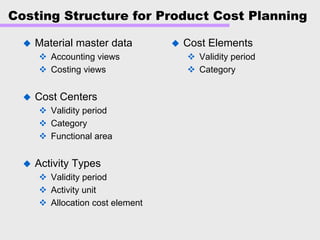
  • 108.
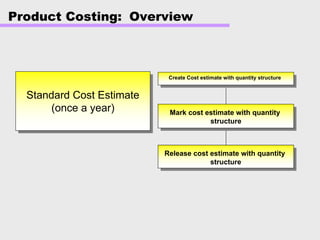
    Period End Overview ActualCosting – Period End Closing Procedure Collecting price differences • On price difference accounts or in material ledger within categories Period closing program • Open new period in MM (transaction MMPV) Determining prices • Single-level, later multilevel • V price is calculated Making closing entry • Must be made for each period • Posting to prior period is no longer possible • Reversal if required With revaluation • Price differences are proportionally posted to the remaining stock -> Price indicator ‘V’ Without revaluation • Price differences are proportionally posted to the accruals account -> Price indicator ‘S’ Marking future price
  • 109.
    Period End Overview– Closing Entry (1) Beginning inventory (BI): 1000 PC / 250 EUR Goods receipt/purchase order : 1000 PC / 260 EUR Invoice receipt : 1000 PC / 280 EUR Consumption: 1300 PC / 325 EUR Ending inventory: 700 PC Material: ACT-LCD## VB 325 Material stock (119400) 325250 250 GR/IR allocation 260 260 Vendor 280 Price difference (464017) 10 20 Status: Closing entry performed Price control: V (only old periods) V price: 26.50 EUR / 100 units ML accrual (119610) 10.5 10.5CL CL Stock value : 185.5 EUR (700 PC * 26.50/100) Locked With Revaluation Material consumption (400002)
  • 110.
    Period End Overview– Closing Entry (2) Beginning inventory (BI): 1000 PC / 250 EUR Goods receipt/purchase order: 1000 PC / 260 EUR Invoice receipt: 1000 PC / 280 EUR Consumption: 1300 PC / 325 EUR Ending inventory: 700 PC Material: ACT-LCD## 325 Material stock (119400) 325250 250 GR/IR allocation 260 260 Vendor 280 Price difference (464017) 10 20 ML accrual (119610) Stock value: 175 EUR 10.5CL CL Status: Closing entry performed Price control: S S price: 25.00 EUR / 100 units Locked 10.5 Material consumption (400002) Without Revaluation
  • 111.
    Period End Overview– Periodic unit price The periodic unit price is calculated after the end of a period. It mirrors the actual costs of a material for the closed period. The system uses the cumulative inventory (the beginning inventory plus all goods receipts) and the cumulative difference (all differences between the standard price and the price entered for all goods receipts and the beginning inventory) to calculate the periodic unit price. Material price determination must be allowed for every individual period (through the menu option Organizational Measures or directly in a costing run). The single-level material price determination includes deviating amounts due to price differences, exchange-rate differences and revaluation differences that have been incurred for the (single-level) procurement of a material in this period. After the period has been closed, the cumulative differences are allocated to the cumulative inventory for the closed period. From this, the system calculates the weighted average price that can be used for valuation of the ending inventory. With single-level price determination, the valuation in the current period remains unchanged.
  • 112.
  • 113.
    Report Selection The ReportTree can be used to select Reports in the Information System. The Report Tree is the central collection point and hierarchical outline of all Reports in an application component. The standard Report Tree supplied by SAP should not be changed. A personalized Report tree can be created to which standard Reports as well as one's own creations can be assigned.
  • 114.
  • 115.
  • 116.
  • 117.
  • 118.
  • 119.
  • 120.
  • 121.
  • 122.
    Report Selection The ReportTree can be used to select Reports in the Information System. The Report Tree is the central collection point and hierarchical outline of all Reports in an application component. The standard Report Tree supplied by SAP should not be changed. A personalized Report tree can be created to which standard Reports as well as one's own creations can be assigned.
  • 123.
  • 124.
    Report Output Types Graphicalreport-output Variable output areas HTML-header Navigation by drag and drop and context menu Object List (ALV) Various leads columns Standard ALV Functions