Case Study: Cooper Tire’s
SAP Material Ledger
Implementation Lessons
Learned
Chris Crim, Cooper Tire
Johannes Le Roux, Jari Consulting

© 2013 ERP Corp. All rights reserved.
Topics
•
•
•
•
•

3

Cooper Tire Strategy and Vision
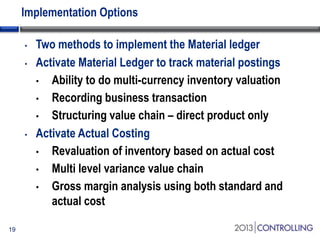
Implementation Options
Lessons Learned at Cooper Tire
Springboard to SAP Profitability and Cost Management
Summary
Cooper Tire Strategy and Vision
•

4

Cooper Tire weighed the pros and cons of activating SAP
Material Ledger as part of their initial SAP implementation or
during a future rollout phase. In this session we’ll cover:
• Why Cooper Tire implemented SAP Material Ledger as part of
their initial SAP implementation
• Leveraging Material Ledger as a springboard to SAP
Profitability and Cost Management software
• Proper master data setup lessons learned
• Best practices for configuring Material Ledger for long term
requirements
• Find out what Cooper Tire would advise companies
embarking on this process including importance of
understanding the impact on finance and non-finance
process teams
Cooper Tire Implementation Timeline
•

•

•

•

•
•

5

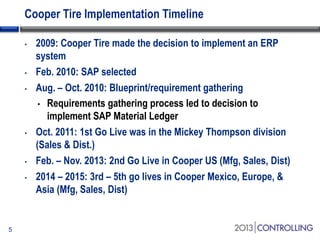
2009: Cooper Tire made the decision to implement an ERP
system
Feb. 2010: SAP selected
Aug. – Oct. 2010: Blueprint/requirement gathering
• Requirements gathering process led to decision to
implement SAP Material Ledger
Oct. 2011: 1st Go Live was in the Mickey Thompson division
(Sales & Dist.)
Feb. – Nov. 2013: 2nd Go Live in Cooper US (Mfg, Sales, Dist)
2014 – 2015: 3rd – 5th go lives in Cooper Mexico, Europe, &
Asia (Mfg, Sales, Dist)
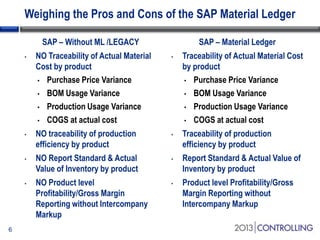
Weighing the Pros and Cons of the SAP Material Ledger
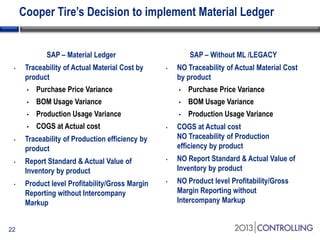
SAP – Without ML /LEGACY
•

•

•

•

6

NO Traceability of Actual Material
Cost by product
• Purchase Price Variance
• BOM Usage Variance
• Production Usage Variance
• COGS at actual cost
NO traceability of production
efficiency by product
NO Report Standard & Actual
Value of Inventory by product
NO Product level
Profitability/Gross Margin
Reporting without Intercompany
Markup

SAP – Material Ledger
•

•

•

•

Traceability of Actual Material Cost
by product
• Purchase Price Variance
• BOM Usage Variance
• Production Usage Variance
• COGS at actual cost
Traceability of production
efficiency by product
Report Standard & Actual Value of
Inventory by product
Product level Profitability/Gross
Margin Reporting without
Intercompany Markup
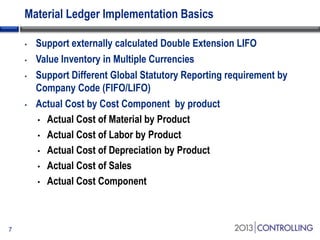
Material Ledger Implementation Basics
•
•
•

•

7

Support externally calculated Double Extension LIFO
Value Inventory in Multiple Currencies
Support Different Global Statutory Reporting requirement by
Company Code (FIFO/LIFO)
Actual Cost by Cost Component by product
• Actual Cost of Material by Product
• Actual Cost of Labor by Product
• Actual Cost of Depreciation by Product
• Actual Cost of Sales
• Actual Cost Component
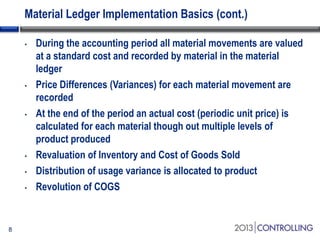
Material Ledger Implementation Basics (cont.)
•

•

•

•
•
•

8

During the accounting period all material movements are valued
at a standard cost and recorded by material in the material
ledger
Price Differences (Variances) for each material movement are
recorded
At the end of the period an actual cost (periodic unit price) is
calculated for each material though out multiple levels of
product produced
Revaluation of Inventory and Cost of Goods Sold
Distribution of usage variance is allocated to product
Revolution of COGS
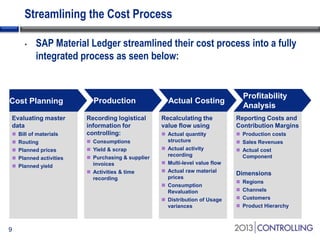
Streamlining the Cost Process
•

SAP Material Ledger streamlined their cost process into a fully
integrated process as seen below:

Cost Planning
Evaluating master
data

Production

Profitability
Analysis

 Planned prices
 Planned activities
 Planned yield

9

 Consumptions

 Yield & scrap
 Purchasing & supplier
invoices
 Activities & time
recording

Recalculating the
value flow using

Reporting Costs and
Contribution Margins

 Actual quantity
structure
 Actual activity
recording
 Multi-level value flow
 Actual raw material
prices
 Consumption
Revaluation

 Production costs
 Sales Revenues

 Distribution of Usage
variances

 Bill of materials
 Routing

Recording logistical
information for
controlling:

Actual Costing

 Customers

 Actual cost
Component

Dimensions
 Regions
 Channels

 Product Hierarchy
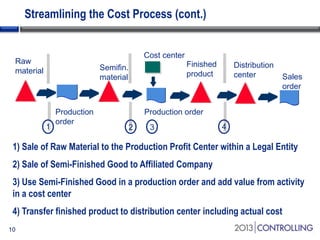
Streamlining the Cost Process (cont.)

Cost center

Raw
material

Finished
product

Semifin.
material

1

Production
order

Distribution
center

Sales
order

Production order
2

3

4

1) Sale of Raw Material to the Production Profit Center within a Legal Entity
2) Sale of Semi-Finished Good to Affiliated Company
3) Use Semi-Finished Good in a production order and add value from activity
in a cost center
4) Transfer finished product to distribution center including actual cost
10
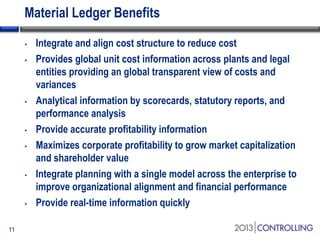
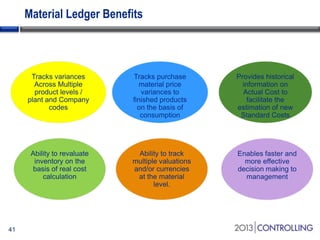
Material Ledger Benefits
•
•

•

•
•

•

•

11

Integrate and align cost structure to reduce cost
Provides global unit cost information across plants and legal
entities providing an global transparent view of costs and
variances
Analytical information by scorecards, statutory reports, and
performance analysis
Provide accurate profitability information
Maximizes corporate profitability to grow market capitalization
and shareholder value
Integrate planning with a single model across the enterprise to
improve organizational alignment and financial performance
Provide real-time information quickly
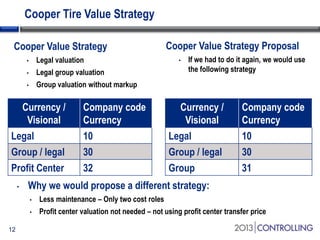
Cooper Tire Value Strategy
Cooper Value Strategy
•

Legal valuation

•

Legal group valuation

•

If we had to do it again, we would use
the following strategy

Group valuation without markup

Currency /
Visional

Legal
Group / legal
Profit Center
•

Cooper Value Strategy Proposal

Company code
Currency

10
30
32

•

Currency /
Visional

Legal
Group / legal
Group

Company code
Currency

10
30
31

Why we would propose a different strategy:
•
•

12

Less maintenance – Only two cost roles
Profit center valuation not needed – not using profit center transfer price
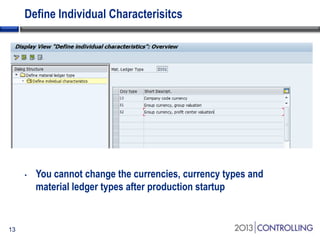
Define Individual Characterisitcs

•

13

You cannot change the currencies, currency types and
material ledger types after production startup
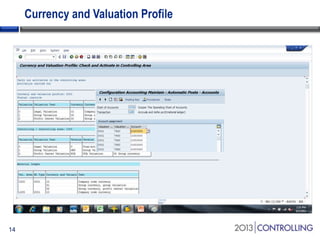
Currency and Valuation Profile

14
SAP Material Ledger Without Revaluation
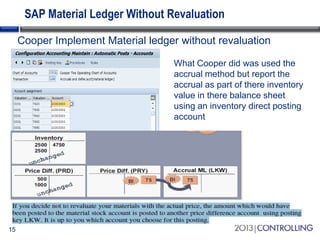
Cooper Implement Material ledger without revaluation
What Cooper did was used the
accrual method but report the
accrual as part of there inventory
value in there balance sheet
using an inventory direct posting
account

15
SAP Material Ledger Without Revaluation
•

16

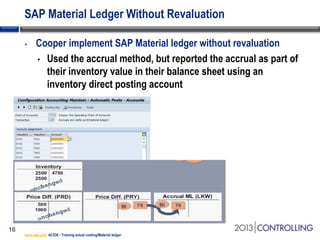
Cooper implement SAP Material ledger without revaluation
• Used the accrual method, but reported the accrual as part of
their inventory value in their balance sheet using an
inventory direct posting account

www.sap.com AC530 - Training actual costing/Material ledger
SAP Material Ledger Without Revaluation (cont.)
•

•

17

If you decide not to revaluate your materials with the actual
price, the amount which would have been posted to the material
stock account is posted to another price difference account
using posting key LKW
It is up to you which account you choose for this posting
Topics
•
•
•
•
•

18

Cooper Tire Strategy and Vision
Implementation Options
Lessons Learned at Cooper Tire
Springboard to SAP Profitability and Cost Management
Summary
Implementation Options
•
•

•

19

Two methods to implement the Material ledger
Activate Material Ledger to track material postings
• Ability to do multi-currency inventory valuation
• Recording business transaction
• Structuring value chain – direct product only
Activate Actual Costing
• Revaluation of inventory based on actual cost
• Multi level variance value chain
• Gross margin analysis using both standard and
actual cost
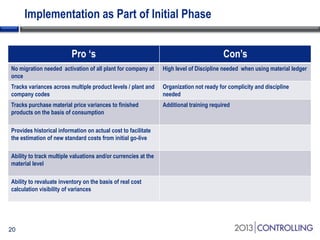
Implementation as Part of Initial Phase
Pro ‘s

Con’s

No migration needed activation of all plant for company at
once

High level of Discipline needed when using material ledger

Tracks variances across multiple product levels / plant and
company codes

Organization not ready for complicity and discipline
needed

Tracks purchase material price variances to finished
products on the basis of consumption

Additional training required

Provides historical information on actual cost to facilitate
the estimation of new standard costs from initial go-live
Ability to track multiple valuations and/or currencies at the
material level
Ability to revaluate inventory on the basis of real cost
calculation visibility of variances

20
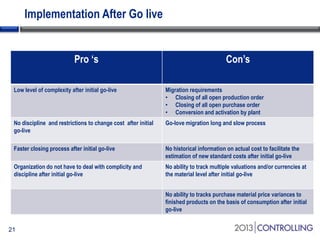
Implementation After Go live

Pro ‘s

Con’s

Low level of complexity after initial go-live

Migration requirements
• Closing of all open production order
• Closing of all open purchase order
• Conversion and activation by plant

No discipline and restrictions to change cost after initial
go-live

Go-love migration long and slow process

Faster closing process after initial go-live

No historical information on actual cost to facilitate the
estimation of new standard costs after initial go-live

Organization do not have to deal with complicity and
discipline after initial go-live

No ability to track multiple valuations and/or currencies at
the material level after initial go-live
No ability to tracks purchase material price variances to
finished products on the basis of consumption after initial
go-live

21
Cooper Tire’s Decision to implement Material Ledger

SAP – Material Ledger
•

Traceability of Actual Material Cost by
product

SAP – Without ML /LEGACY
•

NO Traceability of Actual Material Cost
by product

•

22

BOM Usage Variance

•

BOM Usage Variance

Production Usage Variance

•

Production Usage Variance

•

•

Purchase Price Variance

•

•

•

•

•

Purchase Price Variance

COGS at Actual cost

•

Traceability of Production efficiency by
product
Report Standard & Actual Value of
Inventory by product

•

Product level Profitability/Gross Margin
Reporting without Intercompany
Markup

•

COGS at Actual cost
NO Traceability of Production
efficiency by product
NO Report Standard & Actual Value of
Inventory by product
NO Product level Profitability/Gross
Margin Reporting without
Intercompany Markup
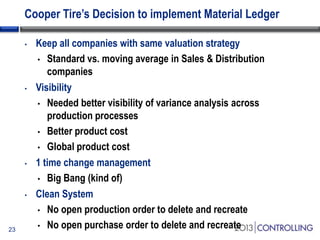
Cooper Tire’s Decision to implement Material Ledger
•

•

•

•

23

Keep all companies with same valuation strategy
• Standard vs. moving average in Sales & Distribution
companies
Visibility
• Needed better visibility of variance analysis across
production processes
• Better product cost
• Global product cost
1 time change management
• Big Bang (kind of)
Clean System
• No open production order to delete and recreate
• No open purchase order to delete and recreate
Topics
•
•
•
•
•

24

Cooper Tire Strategy and Vision
Implementation Options
Lessons Learned at Cooper Tire
Springboard to SAP Profitability and Cost Management
Summary
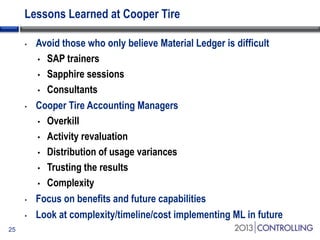
Lessons Learned at Cooper Tire
•

•

•
•
25

Avoid those who only believe Material Ledger is difficult
• SAP trainers
• Sapphire sessions
• Consultants
Cooper Tire Accounting Managers
• Overkill
• Activity revaluation
• Distribution of usage variances
• Trusting the results
• Complexity
Focus on benefits and future capabilities
Look at complexity/timeline/cost implementing ML in future
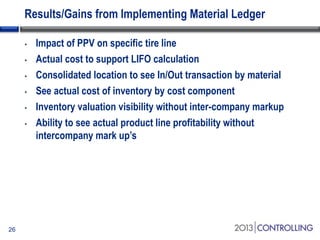
Results/Gains from Implementing Material Ledger
•
•
•
•
•
•

26

Impact of PPV on specific tire line
Actual cost to support LIFO calculation
Consolidated location to see In/Out transaction by material
See actual cost of inventory by cost component
Inventory valuation visibility without inter-company markup
Ability to see actual product line profitability without
intercompany mark up’s
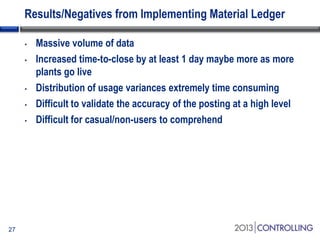
Results/Negatives from Implementing Material Ledger
•
•

•
•
•

27

Massive volume of data
Increased time-to-close by at least 1 day maybe more as more
plants go live
Distribution of usage variances extremely time consuming
Difficult to validate the accuracy of the posting at a high level
Difficult for casual/non-users to comprehend
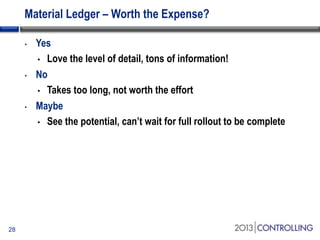
Material Ledger – Worth the Expense?
•

•

•

28

Yes
• Love the level of detail, tons of information!
No
• Takes too long, not worth the effort
Maybe
• See the potential, can’t wait for full rollout to be complete
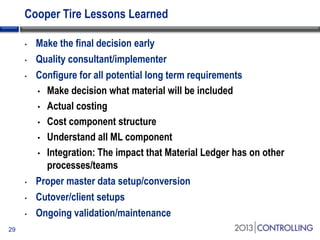
Cooper Tire Lessons Learned
•
•
•

•

•
•
29

Make the final decision early
Quality consultant/implementer
Configure for all potential long term requirements
• Make decision what material will be included
• Actual costing
• Cost component structure
• Understand all ML component
• Integration: The impact that Material Ledger has on other
processes/teams
Proper master data setup/conversion
Cutover/client setups
Ongoing validation/maintenance
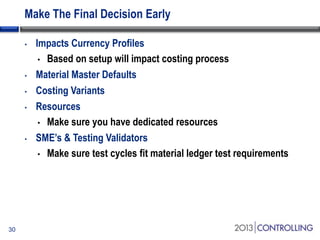
Make The Final Decision Early
•

•
•
•

•

30

Impacts Currency Profiles
• Based on setup will impact costing process
Material Master Defaults
Costing Variants
Resources
• Make sure you have dedicated resources
SME’s & Testing Validators
• Make sure test cycles fit material ledger test requirements
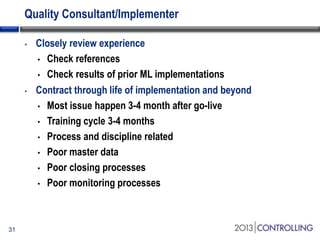
Quality Consultant/Implementer
•

•

31

Closely review experience
• Check references
• Check results of prior ML implementations
Contract through life of implementation and beyond
• Most issue happen 3-4 month after go-live
• Training cycle 3-4 months
• Process and discipline related
• Poor master data
• Poor closing processes
• Poor monitoring processes
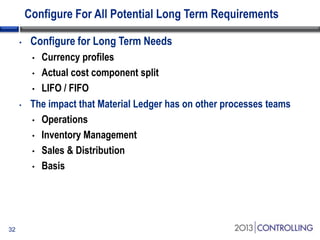
Configure For All Potential Long Term Requirements
•

Configure for Long Term Needs
Currency profiles
• Actual cost component split
• LIFO / FIFO
The impact that Material Ledger has on other processes teams
• Operations
• Inventory Management
• Sales & Distribution
• Basis
•

•

32
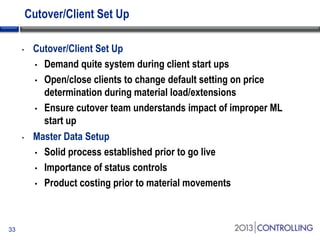
Cutover/Client Set Up
•

•

33

Cutover/Client Set Up
• Demand quite system during client start ups
• Open/close clients to change default setting on price
determination during material load/extensions
• Ensure cutover team understands impact of improper ML
start up
Master Data Setup
• Solid process established prior to go live
• Importance of status controls
• Product costing prior to material movements
Ongoing Validation/Maintenance
•
•

•

34

Daily/weekly distribution of usage variances
Set up detailed validation template
• Pick a raw material and follow it through a sale
Set up high level validation template
Resources
•
•

Do not underestimate the effort
Cooper staffing
• One lead business analyst
• Included plant accountant in each implementation
•
•

One lead consultant – Make that sure that he/she knows
Material Ledger
Due to conversion, support time ( 3 plus months) and training
required it could require additional business analyst
•

•

35

Learn the process
Understand data flow and conversion
Topics
•
•
•
•
•

36

Cooper Tire Strategy and Vision
Implementation Options
Lessons Learned at Cooper Tire
Springboard to SAP Profitability and Cost Management
Summary
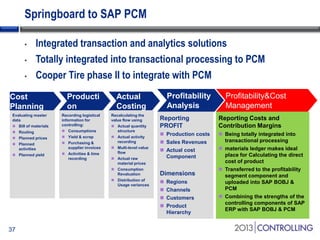
Springboard to SAP PCM
•
•
•

Integrated transaction and analytics solutions
Totally integrated into transactional processing to PCM
Cooper Tire phase II to integrate with PCM

Cost
Planning
Evaluating master
data
 Bill of materials

 Routing
 Planned prices
 Planned
activities
 Planned yield

Producti
on

Actual
Costing

Recording logistical
information for
controlling:
 Consumptions

Recalculating the
value flow using
 Actual quantity
structure

 Yield & scrap
 Purchasing &
supplier invoices

 Actual activity
recording
 Multi-level value
flow

 Activities & time
recording

 Actual raw
material prices
 Consumption
Revaluation
 Distribution of
Usage variances

Profitability
Analysis
Reporting
PROFIT

Reporting Costs and
Contribution Margins

 Production costs
 Sales Revenues

 Being totally integrated into
transactional processing
 materials ledger makes ideal
place for Calculating the direct
cost of product
 Transferred to the profitability
segment component and
uploaded into SAP BOBJ &
PCM

 Actual cost
Component

Dimensions
 Regions
 Channels
 Customers

 Product
Hierarchy

37

Profitability&Cost
Management

 Combining the strengths of the
controlling components of SAP
ERP with SAP BOBJ & PCM
Profitability Analysis Ideal Staging Area
•

•

38

Profitability Analysis is an ideal staging area for:
• Capturing revenue and sales data at the customer and
product level
• Furthermore, having functionality such as the materials
ledger makes the controlling component the ideal place for
calculating the actual direct cost of products
• Transferred to the profitability analysis component and then
loaded into SAP BusinessObjects Profitability and Cost
Management
Combining the strengths of costing and profitability reporting
functionality provided a makes it easier to use the two solutions
in tandem, enabling organizations to tailor a cost and
profitability reporting solution to match their needs
SAP Best Practice
•

•

•

•

39

Integrate ECC, business intelligence and enterprise
performance management
SAP BusinessObjects Profitability and Cost Management is the
selected solution on the SAP product road map for delivering
cost and profitability management
These tools can also be used for detailed scenario modeling,
such as assessing how changing the price of an individual
product or the discount given to an individual customer impacts
profitability
SAP uses integration with enterprise performance management
delivers true business performance optimization
Topics
•
•
•
•
•

40

Cooper Tire Strategy and Vision
Implementation Options
Lessons Learned at Cooper Tire
Springboard to SAP Profitability and Cost Management
Summary
Material Ledger Benefits

Tracks variances
Across Multiple
product levels /
plant and Company
codes

Provides historical
information on
Actual Cost to
facilitate the
estimation of new
Standard Costs

Ability to revaluate
inventory on the
basis of real cost
calculation

41

Tracks purchase
material price
variances to
finished products
on the basis of
consumption

Ability to track
multiple valuations
and/or currencies
at the material
level.

Enables faster and
more effective
decision making to
management
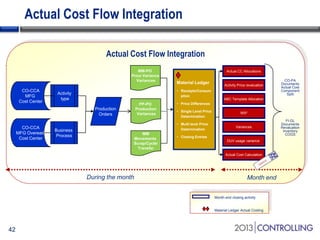
Actual Cost Flow Integration
MM-PO
Price Variance
Variances

CO-CCA
MFG
Cost Center

Business
Process

Material Ledger
• Receipts/Consum
ption

Activity
type
PP-PO
Production
Variances

Production
Orders
CO-CCA
MFG Overead
Cost Center

Actual CC Allocations

ABC Template Allocation

• Single Level Price
Determination

WIP

Variances

• Closing Entries
DUV usage variance

Actual Cost Calculation

During the month

Month end
Month end closing activity

Material Ledger Actual Costing

42

CO-PA
Documents
Actual Cost
Component
Split

• Price Differences

• Multi level Price
Determination

MM
Movements
Scrap/Cycle/
Transfer

Activity Price revaluation

FI-GL
Documents
Revaluation
Inventory
COGS
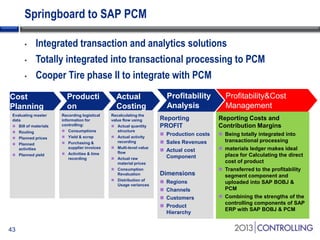
Springboard to SAP PCM
•
•
•

Integrated transaction and analytics solutions
Totally integrated into transactional processing to PCM
Cooper Tire phase II to integrate with PCM

Cost
Planning
Evaluating master
data
 Bill of materials

 Routing
 Planned prices
 Planned
activities
 Planned yield

Producti
on

Actual
Costing

Recording logistical
information for
controlling:
 Consumptions

Recalculating the
value flow using
 Actual quantity
structure

 Yield & scrap
 Purchasing &
supplier invoices

 Actual activity
recording
 Multi-level value
flow

 Activities & time
recording

 Actual raw
material prices
 Consumption
Revaluation
 Distribution of
Usage variances

Profitability
Analysis
Reporting
PROFIT

Reporting Costs and
Contribution Margins

 Production costs
 Sales Revenues

 Being totally integrated into
transactional processing
 materials ledger makes ideal
place for Calculating the direct
cost of product
 Transferred to the profitability
segment component and
uploaded into SAP BOBJ &
PCM

 Actual cost
Component

Dimensions
 Regions
 Channels
 Customers

 Product
Hierarchy

43

Profitability&Cost
Management

 Combining the strengths of the
controlling components of SAP
ERP with SAP BOBJ & PCM
Resources
•

•

•
•
•
•

44

SAP Finance
• www.sap.com/solutions/businesssuite/erp/financials/featuresfunctions/index.epx
SCN
• www.scn.com
AC530 - Training actual costing/Material ledger
Actuhttp://www.sap-press.com/
al Costing with the SAP Material Ledger - Vanda Reis
2011 Edition
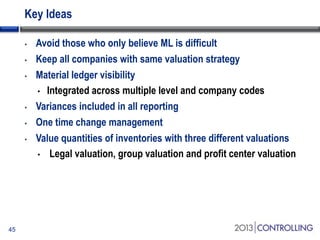
Key Ideas
•
•
•

•
•
•

45

Avoid those who only believe ML is difficult
Keep all companies with same valuation strategy
Material ledger visibility
• Integrated across multiple level and company codes
Variances included in all reporting
One time change management
Value quantities of inventories with three different valuations
• Legal valuation, group valuation and profit center valuation
Questions
•

•

Now:
• Ask questions now for immediate answers
Later:
• Johannes Le Roux - leroux@jari-consulting.com
• Chris Crim - cacrim@coopertire.com

Q&A
46
Disclaimer
SAP®, R/3, mySAP, mySAP.com, xApps, xApp, SAP NetWeaver®, Duet®, PartnerEdge, and other SAP® products and
services mentioned herein as well as their respective logos are trademarks or registered trademarks of SAP AG in
Germany and in several other countries all over the world. All other product and service names mentioned are the
trademarks of their respective companies. ERP Corp is neither owned nor controlled by SAP.

Case study material ledger implementation lessons learned

  • 2.
    Case Study: CooperTire’s SAP Material Ledger Implementation Lessons Learned Chris Crim, Cooper Tire Johannes Le Roux, Jari Consulting © 2013 ERP Corp. All rights reserved.
  • 3.
    Topics • • • • • 3 Cooper Tire Strategyand Vision Implementation Options Lessons Learned at Cooper Tire Springboard to SAP Profitability and Cost Management Summary
  • 4.
    Cooper Tire Strategyand Vision • 4 Cooper Tire weighed the pros and cons of activating SAP Material Ledger as part of their initial SAP implementation or during a future rollout phase. In this session we’ll cover: • Why Cooper Tire implemented SAP Material Ledger as part of their initial SAP implementation • Leveraging Material Ledger as a springboard to SAP Profitability and Cost Management software • Proper master data setup lessons learned • Best practices for configuring Material Ledger for long term requirements • Find out what Cooper Tire would advise companies embarking on this process including importance of understanding the impact on finance and non-finance process teams
  • 5.
    Cooper Tire ImplementationTimeline • • • • • • 5 2009: Cooper Tire made the decision to implement an ERP system Feb. 2010: SAP selected Aug. – Oct. 2010: Blueprint/requirement gathering • Requirements gathering process led to decision to implement SAP Material Ledger Oct. 2011: 1st Go Live was in the Mickey Thompson division (Sales & Dist.) Feb. – Nov. 2013: 2nd Go Live in Cooper US (Mfg, Sales, Dist) 2014 – 2015: 3rd – 5th go lives in Cooper Mexico, Europe, & Asia (Mfg, Sales, Dist)
  • 6.
    Weighing the Prosand Cons of the SAP Material Ledger SAP – Without ML /LEGACY • • • • 6 NO Traceability of Actual Material Cost by product • Purchase Price Variance • BOM Usage Variance • Production Usage Variance • COGS at actual cost NO traceability of production efficiency by product NO Report Standard & Actual Value of Inventory by product NO Product level Profitability/Gross Margin Reporting without Intercompany Markup SAP – Material Ledger • • • • Traceability of Actual Material Cost by product • Purchase Price Variance • BOM Usage Variance • Production Usage Variance • COGS at actual cost Traceability of production efficiency by product Report Standard & Actual Value of Inventory by product Product level Profitability/Gross Margin Reporting without Intercompany Markup
  • 7.
    Material Ledger ImplementationBasics • • • • 7 Support externally calculated Double Extension LIFO Value Inventory in Multiple Currencies Support Different Global Statutory Reporting requirement by Company Code (FIFO/LIFO) Actual Cost by Cost Component by product • Actual Cost of Material by Product • Actual Cost of Labor by Product • Actual Cost of Depreciation by Product • Actual Cost of Sales • Actual Cost Component
  • 8.
    Material Ledger ImplementationBasics (cont.) • • • • • • 8 During the accounting period all material movements are valued at a standard cost and recorded by material in the material ledger Price Differences (Variances) for each material movement are recorded At the end of the period an actual cost (periodic unit price) is calculated for each material though out multiple levels of product produced Revaluation of Inventory and Cost of Goods Sold Distribution of usage variance is allocated to product Revolution of COGS
  • 9.
    Streamlining the CostProcess • SAP Material Ledger streamlined their cost process into a fully integrated process as seen below: Cost Planning Evaluating master data Production Profitability Analysis  Planned prices  Planned activities  Planned yield 9  Consumptions  Yield & scrap  Purchasing & supplier invoices  Activities & time recording Recalculating the value flow using Reporting Costs and Contribution Margins  Actual quantity structure  Actual activity recording  Multi-level value flow  Actual raw material prices  Consumption Revaluation  Production costs  Sales Revenues  Distribution of Usage variances  Bill of materials  Routing Recording logistical information for controlling: Actual Costing  Customers  Actual cost Component Dimensions  Regions  Channels  Product Hierarchy
  • 10.
    Streamlining the CostProcess (cont.) Cost center Raw material Finished product Semifin. material 1 Production order Distribution center Sales order Production order 2 3 4 1) Sale of Raw Material to the Production Profit Center within a Legal Entity 2) Sale of Semi-Finished Good to Affiliated Company 3) Use Semi-Finished Good in a production order and add value from activity in a cost center 4) Transfer finished product to distribution center including actual cost 10
  • 11.
    Material Ledger Benefits • • • • • • • 11 Integrateand align cost structure to reduce cost Provides global unit cost information across plants and legal entities providing an global transparent view of costs and variances Analytical information by scorecards, statutory reports, and performance analysis Provide accurate profitability information Maximizes corporate profitability to grow market capitalization and shareholder value Integrate planning with a single model across the enterprise to improve organizational alignment and financial performance Provide real-time information quickly
  • 12.
    Cooper Tire ValueStrategy Cooper Value Strategy • Legal valuation • Legal group valuation • If we had to do it again, we would use the following strategy Group valuation without markup Currency / Visional Legal Group / legal Profit Center • Cooper Value Strategy Proposal Company code Currency 10 30 32 • Currency / Visional Legal Group / legal Group Company code Currency 10 30 31 Why we would propose a different strategy: • • 12 Less maintenance – Only two cost roles Profit center valuation not needed – not using profit center transfer price
  • 13.
    Define Individual Characterisitcs • 13 Youcannot change the currencies, currency types and material ledger types after production startup
  • 14.
  • 15.
    SAP Material LedgerWithout Revaluation Cooper Implement Material ledger without revaluation What Cooper did was used the accrual method but report the accrual as part of there inventory value in there balance sheet using an inventory direct posting account 15
  • 16.
    SAP Material LedgerWithout Revaluation • 16 Cooper implement SAP Material ledger without revaluation • Used the accrual method, but reported the accrual as part of their inventory value in their balance sheet using an inventory direct posting account www.sap.com AC530 - Training actual costing/Material ledger
  • 17.
    SAP Material LedgerWithout Revaluation (cont.) • • 17 If you decide not to revaluate your materials with the actual price, the amount which would have been posted to the material stock account is posted to another price difference account using posting key LKW It is up to you which account you choose for this posting
  • 18.
    Topics • • • • • 18 Cooper Tire Strategyand Vision Implementation Options Lessons Learned at Cooper Tire Springboard to SAP Profitability and Cost Management Summary
  • 19.
    Implementation Options • • • 19 Two methodsto implement the Material ledger Activate Material Ledger to track material postings • Ability to do multi-currency inventory valuation • Recording business transaction • Structuring value chain – direct product only Activate Actual Costing • Revaluation of inventory based on actual cost • Multi level variance value chain • Gross margin analysis using both standard and actual cost
  • 20.
    Implementation as Partof Initial Phase Pro ‘s Con’s No migration needed activation of all plant for company at once High level of Discipline needed when using material ledger Tracks variances across multiple product levels / plant and company codes Organization not ready for complicity and discipline needed Tracks purchase material price variances to finished products on the basis of consumption Additional training required Provides historical information on actual cost to facilitate the estimation of new standard costs from initial go-live Ability to track multiple valuations and/or currencies at the material level Ability to revaluate inventory on the basis of real cost calculation visibility of variances 20
  • 21.
    Implementation After Golive Pro ‘s Con’s Low level of complexity after initial go-live Migration requirements • Closing of all open production order • Closing of all open purchase order • Conversion and activation by plant No discipline and restrictions to change cost after initial go-live Go-love migration long and slow process Faster closing process after initial go-live No historical information on actual cost to facilitate the estimation of new standard costs after initial go-live Organization do not have to deal with complicity and discipline after initial go-live No ability to track multiple valuations and/or currencies at the material level after initial go-live No ability to tracks purchase material price variances to finished products on the basis of consumption after initial go-live 21
  • 22.
    Cooper Tire’s Decisionto implement Material Ledger SAP – Material Ledger • Traceability of Actual Material Cost by product SAP – Without ML /LEGACY • NO Traceability of Actual Material Cost by product • 22 BOM Usage Variance • BOM Usage Variance Production Usage Variance • Production Usage Variance • • Purchase Price Variance • • • • • Purchase Price Variance COGS at Actual cost • Traceability of Production efficiency by product Report Standard & Actual Value of Inventory by product • Product level Profitability/Gross Margin Reporting without Intercompany Markup • COGS at Actual cost NO Traceability of Production efficiency by product NO Report Standard & Actual Value of Inventory by product NO Product level Profitability/Gross Margin Reporting without Intercompany Markup
  • 23.
    Cooper Tire’s Decisionto implement Material Ledger • • • • 23 Keep all companies with same valuation strategy • Standard vs. moving average in Sales & Distribution companies Visibility • Needed better visibility of variance analysis across production processes • Better product cost • Global product cost 1 time change management • Big Bang (kind of) Clean System • No open production order to delete and recreate • No open purchase order to delete and recreate
  • 24.
    Topics • • • • • 24 Cooper Tire Strategyand Vision Implementation Options Lessons Learned at Cooper Tire Springboard to SAP Profitability and Cost Management Summary
  • 25.
    Lessons Learned atCooper Tire • • • • 25 Avoid those who only believe Material Ledger is difficult • SAP trainers • Sapphire sessions • Consultants Cooper Tire Accounting Managers • Overkill • Activity revaluation • Distribution of usage variances • Trusting the results • Complexity Focus on benefits and future capabilities Look at complexity/timeline/cost implementing ML in future
  • 26.
    Results/Gains from ImplementingMaterial Ledger • • • • • • 26 Impact of PPV on specific tire line Actual cost to support LIFO calculation Consolidated location to see In/Out transaction by material See actual cost of inventory by cost component Inventory valuation visibility without inter-company markup Ability to see actual product line profitability without intercompany mark up’s
  • 27.
    Results/Negatives from ImplementingMaterial Ledger • • • • • 27 Massive volume of data Increased time-to-close by at least 1 day maybe more as more plants go live Distribution of usage variances extremely time consuming Difficult to validate the accuracy of the posting at a high level Difficult for casual/non-users to comprehend
  • 28.
    Material Ledger –Worth the Expense? • • • 28 Yes • Love the level of detail, tons of information! No • Takes too long, not worth the effort Maybe • See the potential, can’t wait for full rollout to be complete
  • 29.
    Cooper Tire LessonsLearned • • • • • • 29 Make the final decision early Quality consultant/implementer Configure for all potential long term requirements • Make decision what material will be included • Actual costing • Cost component structure • Understand all ML component • Integration: The impact that Material Ledger has on other processes/teams Proper master data setup/conversion Cutover/client setups Ongoing validation/maintenance
  • 30.
    Make The FinalDecision Early • • • • • 30 Impacts Currency Profiles • Based on setup will impact costing process Material Master Defaults Costing Variants Resources • Make sure you have dedicated resources SME’s & Testing Validators • Make sure test cycles fit material ledger test requirements
  • 31.
    Quality Consultant/Implementer • • 31 Closely reviewexperience • Check references • Check results of prior ML implementations Contract through life of implementation and beyond • Most issue happen 3-4 month after go-live • Training cycle 3-4 months • Process and discipline related • Poor master data • Poor closing processes • Poor monitoring processes
  • 32.
    Configure For AllPotential Long Term Requirements • Configure for Long Term Needs Currency profiles • Actual cost component split • LIFO / FIFO The impact that Material Ledger has on other processes teams • Operations • Inventory Management • Sales & Distribution • Basis • • 32
  • 33.
    Cutover/Client Set Up • • 33 Cutover/ClientSet Up • Demand quite system during client start ups • Open/close clients to change default setting on price determination during material load/extensions • Ensure cutover team understands impact of improper ML start up Master Data Setup • Solid process established prior to go live • Importance of status controls • Product costing prior to material movements
  • 34.
    Ongoing Validation/Maintenance • • • 34 Daily/weekly distributionof usage variances Set up detailed validation template • Pick a raw material and follow it through a sale Set up high level validation template
  • 35.
    Resources • • Do not underestimatethe effort Cooper staffing • One lead business analyst • Included plant accountant in each implementation • • One lead consultant – Make that sure that he/she knows Material Ledger Due to conversion, support time ( 3 plus months) and training required it could require additional business analyst • • 35 Learn the process Understand data flow and conversion
  • 36.
    Topics • • • • • 36 Cooper Tire Strategyand Vision Implementation Options Lessons Learned at Cooper Tire Springboard to SAP Profitability and Cost Management Summary
  • 37.
    Springboard to SAPPCM • • • Integrated transaction and analytics solutions Totally integrated into transactional processing to PCM Cooper Tire phase II to integrate with PCM Cost Planning Evaluating master data  Bill of materials  Routing  Planned prices  Planned activities  Planned yield Producti on Actual Costing Recording logistical information for controlling:  Consumptions Recalculating the value flow using  Actual quantity structure  Yield & scrap  Purchasing & supplier invoices  Actual activity recording  Multi-level value flow  Activities & time recording  Actual raw material prices  Consumption Revaluation  Distribution of Usage variances Profitability Analysis Reporting PROFIT Reporting Costs and Contribution Margins  Production costs  Sales Revenues  Being totally integrated into transactional processing  materials ledger makes ideal place for Calculating the direct cost of product  Transferred to the profitability segment component and uploaded into SAP BOBJ & PCM  Actual cost Component Dimensions  Regions  Channels  Customers  Product Hierarchy 37 Profitability&Cost Management  Combining the strengths of the controlling components of SAP ERP with SAP BOBJ & PCM
  • 38.
    Profitability Analysis IdealStaging Area • • 38 Profitability Analysis is an ideal staging area for: • Capturing revenue and sales data at the customer and product level • Furthermore, having functionality such as the materials ledger makes the controlling component the ideal place for calculating the actual direct cost of products • Transferred to the profitability analysis component and then loaded into SAP BusinessObjects Profitability and Cost Management Combining the strengths of costing and profitability reporting functionality provided a makes it easier to use the two solutions in tandem, enabling organizations to tailor a cost and profitability reporting solution to match their needs
  • 39.
    SAP Best Practice • • • • 39 IntegrateECC, business intelligence and enterprise performance management SAP BusinessObjects Profitability and Cost Management is the selected solution on the SAP product road map for delivering cost and profitability management These tools can also be used for detailed scenario modeling, such as assessing how changing the price of an individual product or the discount given to an individual customer impacts profitability SAP uses integration with enterprise performance management delivers true business performance optimization
  • 40.
    Topics • • • • • 40 Cooper Tire Strategyand Vision Implementation Options Lessons Learned at Cooper Tire Springboard to SAP Profitability and Cost Management Summary
  • 41.
    Material Ledger Benefits Tracksvariances Across Multiple product levels / plant and Company codes Provides historical information on Actual Cost to facilitate the estimation of new Standard Costs Ability to revaluate inventory on the basis of real cost calculation 41 Tracks purchase material price variances to finished products on the basis of consumption Ability to track multiple valuations and/or currencies at the material level. Enables faster and more effective decision making to management
  • 42.
    Actual Cost FlowIntegration Actual Cost Flow Integration MM-PO Price Variance Variances CO-CCA MFG Cost Center Business Process Material Ledger • Receipts/Consum ption Activity type PP-PO Production Variances Production Orders CO-CCA MFG Overead Cost Center Actual CC Allocations ABC Template Allocation • Single Level Price Determination WIP Variances • Closing Entries DUV usage variance Actual Cost Calculation During the month Month end Month end closing activity Material Ledger Actual Costing 42 CO-PA Documents Actual Cost Component Split • Price Differences • Multi level Price Determination MM Movements Scrap/Cycle/ Transfer Activity Price revaluation FI-GL Documents Revaluation Inventory COGS
  • 43.
    Springboard to SAPPCM • • • Integrated transaction and analytics solutions Totally integrated into transactional processing to PCM Cooper Tire phase II to integrate with PCM Cost Planning Evaluating master data  Bill of materials  Routing  Planned prices  Planned activities  Planned yield Producti on Actual Costing Recording logistical information for controlling:  Consumptions Recalculating the value flow using  Actual quantity structure  Yield & scrap  Purchasing & supplier invoices  Actual activity recording  Multi-level value flow  Activities & time recording  Actual raw material prices  Consumption Revaluation  Distribution of Usage variances Profitability Analysis Reporting PROFIT Reporting Costs and Contribution Margins  Production costs  Sales Revenues  Being totally integrated into transactional processing  materials ledger makes ideal place for Calculating the direct cost of product  Transferred to the profitability segment component and uploaded into SAP BOBJ & PCM  Actual cost Component Dimensions  Regions  Channels  Customers  Product Hierarchy 43 Profitability&Cost Management  Combining the strengths of the controlling components of SAP ERP with SAP BOBJ & PCM
  • 44.
    Resources • • • • • • 44 SAP Finance • www.sap.com/solutions/businesssuite/erp/financials/featuresfunctions/index.epx SCN •www.scn.com AC530 - Training actual costing/Material ledger Actuhttp://www.sap-press.com/ al Costing with the SAP Material Ledger - Vanda Reis 2011 Edition
  • 45.
    Key Ideas • • • • • • 45 Avoid thosewho only believe ML is difficult Keep all companies with same valuation strategy Material ledger visibility • Integrated across multiple level and company codes Variances included in all reporting One time change management Value quantities of inventories with three different valuations • Legal valuation, group valuation and profit center valuation
  • 46.
    Questions • • Now: • Ask questionsnow for immediate answers Later: • Johannes Le Roux - leroux@jari-consulting.com • Chris Crim - cacrim@coopertire.com Q&A 46
  • 47.
    Disclaimer SAP®, R/3, mySAP,mySAP.com, xApps, xApp, SAP NetWeaver®, Duet®, PartnerEdge, and other SAP® products and services mentioned herein as well as their respective logos are trademarks or registered trademarks of SAP AG in Germany and in several other countries all over the world. All other product and service names mentioned are the trademarks of their respective companies. ERP Corp is neither owned nor controlled by SAP.