2/10/2021 1
Calculate Material Lead Time & Process Lead Time in PPC
QAMAR MAQSOOD
BBA HONS , LLB , MS PROJECT MANAGEMENT
+923124511312
www.myteachers.pk
LU -1 Calculate Material Lead Time
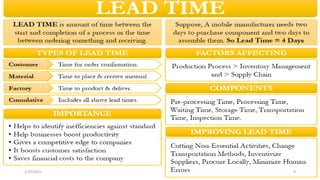
Material Lead Time: The time elapsing between placing an order and
having goods in stock.
Lead time equals the total time it takes from receiving an order to
delivering an item.
2/10/2021 2
LU -1 Calculate Material Lead Time Types
Types of lead times differ based on the product or customer but for the
purpose of manufacturing or assembly, the primary four lead times are:
• Customer lead time.
• Material lead time.
• Production or manufacturing lead time.
• Cumulative lead time.
2/10/2021 3
LU -1 What Is Material Lead Time?
Material Lead Time – the amount of time it takes to place an order with
a supplier and receive it, from confirmed order to having it on hand.
Factory/Production Lead Time – the amount of time it takes to build
and ship a product if all the materials are available
2/10/2021 4
LU -1 How Reduce Supply Chain Lead Times ?
8 Ways to Reduce Supply Chain Lead Times
• Use a Domestic Supplier.
• Increase Order Frequency.
• Provide Sales Forecasts.
• Convert to Standard Components.
• Consolidate Suppliers.
• Consider Kitting Services.
• Create an Incentive.
• Communicate with your Certain Person.
2/10/2021 5
LU -1 How Reduce Supply Chain Lead Times ?
Calculate The Process Lead Time By Dividing The Number Of Items
In Process By The Completions Per Hour Through This Process Lead
Time Formula. For Example, If It Takes Two Hours On Average To
Complete Each Purchase Order, Then There Are 0.5 Completions Per
Hour.
2/10/2021 6
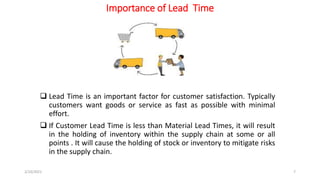
Importance of Lead Time
 Lead Time is an important factor for customer satisfaction. Typically
customers want goods or service as fast as possible with minimal
effort.
 If Customer Lead Time is less than Material Lead Times, it will result
in the holding of inventory within the supply chain at some or all
points . It will cause the holding of stock or inventory to mitigate risks
in the supply chain.
2/10/2021 7
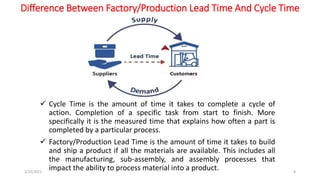
Difference Between Factory/Production Lead Time And Cycle Time
 Cycle Time is the amount of time it takes to complete a cycle of
action. Completion of a specific task from start to finish. More
specifically it is the measured time that explains how often a part is
completed by a particular process.
 Factory/Production Lead Time is the amount of time it takes to build
and ship a product if all the materials are available. This includes all
the manufacturing, sub-assembly, and assembly processes that
impact the ability to process material into a product.
2/10/2021 8
2/10/2021 9
Components of Lead Time
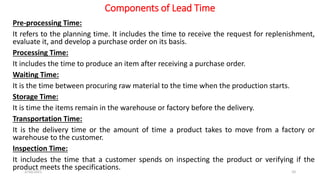
Pre-processing Time:
It refers to the planning time. It includes the time to receive the request for replenishment,
evaluate it, and develop a purchase order on its basis.
Processing Time:
It includes the time to produce an item after receiving a purchase order.
Waiting Time:
It is the time between procuring raw material to the time when the production starts.
Storage Time:
It is time the items remain in the warehouse or factory before the delivery.
Transportation Time:
It is the delivery time or the amount of time a product takes to move from a factory or
warehouse to the customer.
Inspection Time:
It includes the time that a customer spends on inspecting the product or verifying if the
product meets the specifications.
2/10/2021 10
How to Improve Lead Times?
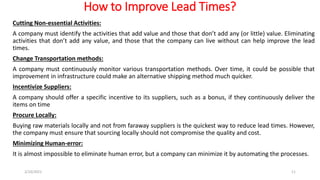
Cutting Non-essential Activities:
A company must identify the activities that add value and those that don’t add any (or little) value. Eliminating
activities that don’t add any value, and those that the company can live without can help improve the lead
times.
Change Transportation methods:
A company must continuously monitor various transportation methods. Over time, it could be possible that
improvement in infrastructure could make an alternative shipping method much quicker.
Incentivize Suppliers:
A company should offer a specific incentive to its suppliers, such as a bonus, if they continuously deliver the
items on time
Procure Locally:
Buying raw materials locally and not from faraway suppliers is the quickest way to reduce lead times. However,
the company must ensure that sourcing locally should not compromise the quality and cost.
Minimizing Human-error:
It is almost impossible to eliminate human error, but a company can minimize it by automating the processes.
2/10/2021 11
An Example of Lead Times?
Imagine a large festival that takes place during the first week of August every year that
attracts 100,000 people on average and typically sells 15,000 festival T-shirts. The vendor
that supplies the T-shirts needs one business day to complete the shirt design, one business
day to have it proofed and make any necessary fixes, one business day to print the shirts,
and two business days to ship the items. The lead time in this example would be five
business days. In other words, the festival organizers need to place their order with the T-
shirt supplier at least five business days before the opening of the festival in order to get
the shirts on time.
2/10/2021 12
Average Lead Times?
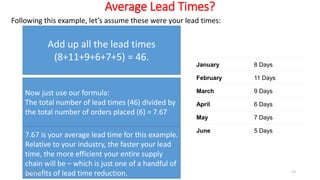
Following this example, let’s assume these were your lead times:
January 8 Days
February 11 Days
March 9 Days
April 6 Days
May 7 Days
June 5 Days
Add up all the lead times
(8+11+9+6+7+5) = 46.
Now just use our formula:
The total number of lead times (46) divided by
the total number of orders placed (6) = 7.67
7.67 is your average lead time for this example.
Relative to your industry, the faster your lead
time, the more efficient your entire supply
chain will be – which is just one of a handful of
benefits of lead time reduction.
2/10/2021 13
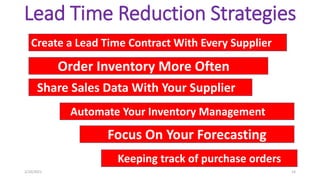
Lead Time Reduction Strategies
Create a Lead Time Contract With Every Supplier
Share Sales Data With Your Supplier
Automate Your Inventory Management
Focus On Your Forecasting
Keeping track of purchase orders
Order Inventory More Often
2/10/2021 14
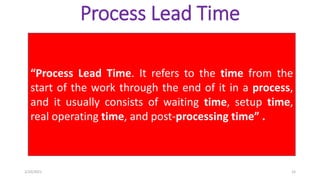
Process Lead Time
“Process Lead Time. It refers to the time from the
start of the work through the end of it in a process,
and it usually consists of waiting time, setup time,
real operating time, and post-processing time” .
2/10/2021 15
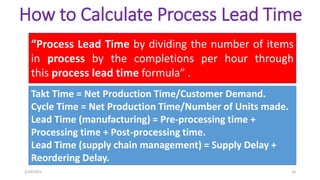
How to Calculate Process Lead Time
“Process Lead Time by dividing the number of items
in process by the completions per hour through
this process lead time formula” .
Takt Time = Net Production Time/Customer Demand.
Cycle Time = Net Production Time/Number of Units made.
Lead Time (manufacturing) = Pre-processing time +
Processing time + Post-processing time.
Lead Time (supply chain management) = Supply Delay +
Reordering Delay.
2/10/2021 16
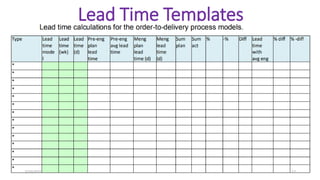
Lead Time Templates
2/10/2021 17
Time and Time Action Plan (TNA):
To chase that delivery date smoothly a
merchandiser should make Critical path or TNA
chart. This method helps to make sure an order
delivery within lead time. Time and Action Plan is a
most common tool for merchandiser to execute a
bulk order in garment industry.
2/10/2021 18
Purpose of Time Action Plan (TNA):
“An action plan is a detailed plan outlining actions
needed to reach one or more goals. Alternatively, it
can be defined as a "sequence of steps that must be
taken, or activities that must be performed well, for a
strategy to succeed".
2/10/2021 19
Preparation of Time Action Plan (TNA):
• Got confirmation of an
export order
• Received master L/C from
Buyer
• Getting invoice (PI) from
fabric, accessories and
other suppliers
• Opening B/B L/C to fabric
supplier
• Opening B/B L/C to thread
supplier
• Opening B/B L/C to accessories supplier
• Submitting photo sample to buyer.
• Getting sample from buyer on photo sample
• Getting sample yardage from fabric supplier.
• Getting sample of fabric, trims and accessories.
2/10/2021 20
Preparation of Time Action Plan (TNA):
• Submitting fit sample to buyer.
• Getting comments on fit sample
from buyer.
• Submitting size set sample to
buyer.
• Starting pilot production.
• Going for bulk production.
• In house of finishing
accessories
• Finishing of garments will complete.
• Final inspection Date.
• Loading of Truck.
• Shipments of goods.
• Submitting shipment confirmation
documents to buyer.
2/10/2021 21
Re-Confirm dates
Remind them that a meeting has been scheduled.
Mention the date, time, and location. Ask them
to confirm their attendance within a time frame. For
example: " I appreciate that you reply to this email or
call to confirm the meeting no later than 12 PM so that
we can make the proper arrangement
2/10/2021 22
Follow up For Marketing Booking
Here are five simple steps to effectively follow-up after a sale.
Send a note to say thank you. Some companies send emails. ...
Check in. It's a good strategy to call clients a week or two after the
sale and find out how everything is going. ...
Keep the lines of communication open. ...
Think second sale. ...
Ask for referrals.
2/10/2021 23
Self Assessment
Mr. Unknown Received an Order on 10-Feb-2021 from ABC Brand to
make 2000 Pieces {500 for Sports,1000 Plain , 500 2 Piece Suit of XL
Jackets till 25 Feb-2021.Calculate Material , Lead Time , Process Time.
2/10/2021 24
 Sports Jacket = 2.0 Yards (1.7 Meters)
 Plain Cloth 2.25 Yards (2.0 Meters)
 Trousers = 1.5 Yards (1.3 Meters)
 2 Piece Suit = 3.5 Yards (3.2 Meters)
Need Help?
Research Paper Writing Services, Research analysis , PPT , Project
Presentation , All kind of services 101% Assurance on Quality
2/10/2021 25
Contact
+923124511312
hrmpak12@gmail.com
www.myteachers.pk

Material Lead time Calculation , Process Lead Time Calculation

  • 1.
    2/10/2021 1 Calculate MaterialLead Time & Process Lead Time in PPC QAMAR MAQSOOD BBA HONS , LLB , MS PROJECT MANAGEMENT +923124511312 www.myteachers.pk
  • 2.
    LU -1 CalculateMaterial Lead Time Material Lead Time: The time elapsing between placing an order and having goods in stock. Lead time equals the total time it takes from receiving an order to delivering an item. 2/10/2021 2
  • 3.
    LU -1 CalculateMaterial Lead Time Types Types of lead times differ based on the product or customer but for the purpose of manufacturing or assembly, the primary four lead times are: • Customer lead time. • Material lead time. • Production or manufacturing lead time. • Cumulative lead time. 2/10/2021 3
  • 4.
    LU -1 WhatIs Material Lead Time? Material Lead Time – the amount of time it takes to place an order with a supplier and receive it, from confirmed order to having it on hand. Factory/Production Lead Time – the amount of time it takes to build and ship a product if all the materials are available 2/10/2021 4
  • 5.
    LU -1 HowReduce Supply Chain Lead Times ? 8 Ways to Reduce Supply Chain Lead Times • Use a Domestic Supplier. • Increase Order Frequency. • Provide Sales Forecasts. • Convert to Standard Components. • Consolidate Suppliers. • Consider Kitting Services. • Create an Incentive. • Communicate with your Certain Person. 2/10/2021 5
  • 6.
    LU -1 HowReduce Supply Chain Lead Times ? Calculate The Process Lead Time By Dividing The Number Of Items In Process By The Completions Per Hour Through This Process Lead Time Formula. For Example, If It Takes Two Hours On Average To Complete Each Purchase Order, Then There Are 0.5 Completions Per Hour. 2/10/2021 6
  • 7.
    Importance of LeadTime  Lead Time is an important factor for customer satisfaction. Typically customers want goods or service as fast as possible with minimal effort.  If Customer Lead Time is less than Material Lead Times, it will result in the holding of inventory within the supply chain at some or all points . It will cause the holding of stock or inventory to mitigate risks in the supply chain. 2/10/2021 7
  • 8.
    Difference Between Factory/ProductionLead Time And Cycle Time  Cycle Time is the amount of time it takes to complete a cycle of action. Completion of a specific task from start to finish. More specifically it is the measured time that explains how often a part is completed by a particular process.  Factory/Production Lead Time is the amount of time it takes to build and ship a product if all the materials are available. This includes all the manufacturing, sub-assembly, and assembly processes that impact the ability to process material into a product. 2/10/2021 8
  • 9.
  • 10.
    Components of LeadTime Pre-processing Time: It refers to the planning time. It includes the time to receive the request for replenishment, evaluate it, and develop a purchase order on its basis. Processing Time: It includes the time to produce an item after receiving a purchase order. Waiting Time: It is the time between procuring raw material to the time when the production starts. Storage Time: It is time the items remain in the warehouse or factory before the delivery. Transportation Time: It is the delivery time or the amount of time a product takes to move from a factory or warehouse to the customer. Inspection Time: It includes the time that a customer spends on inspecting the product or verifying if the product meets the specifications. 2/10/2021 10
  • 11.
    How to ImproveLead Times? Cutting Non-essential Activities: A company must identify the activities that add value and those that don’t add any (or little) value. Eliminating activities that don’t add any value, and those that the company can live without can help improve the lead times. Change Transportation methods: A company must continuously monitor various transportation methods. Over time, it could be possible that improvement in infrastructure could make an alternative shipping method much quicker. Incentivize Suppliers: A company should offer a specific incentive to its suppliers, such as a bonus, if they continuously deliver the items on time Procure Locally: Buying raw materials locally and not from faraway suppliers is the quickest way to reduce lead times. However, the company must ensure that sourcing locally should not compromise the quality and cost. Minimizing Human-error: It is almost impossible to eliminate human error, but a company can minimize it by automating the processes. 2/10/2021 11
  • 12.
    An Example ofLead Times? Imagine a large festival that takes place during the first week of August every year that attracts 100,000 people on average and typically sells 15,000 festival T-shirts. The vendor that supplies the T-shirts needs one business day to complete the shirt design, one business day to have it proofed and make any necessary fixes, one business day to print the shirts, and two business days to ship the items. The lead time in this example would be five business days. In other words, the festival organizers need to place their order with the T- shirt supplier at least five business days before the opening of the festival in order to get the shirts on time. 2/10/2021 12
  • 13.
    Average Lead Times? Followingthis example, let’s assume these were your lead times: January 8 Days February 11 Days March 9 Days April 6 Days May 7 Days June 5 Days Add up all the lead times (8+11+9+6+7+5) = 46. Now just use our formula: The total number of lead times (46) divided by the total number of orders placed (6) = 7.67 7.67 is your average lead time for this example. Relative to your industry, the faster your lead time, the more efficient your entire supply chain will be – which is just one of a handful of benefits of lead time reduction. 2/10/2021 13
  • 14.
    Lead Time ReductionStrategies Create a Lead Time Contract With Every Supplier Share Sales Data With Your Supplier Automate Your Inventory Management Focus On Your Forecasting Keeping track of purchase orders Order Inventory More Often 2/10/2021 14
  • 15.
    Process Lead Time “ProcessLead Time. It refers to the time from the start of the work through the end of it in a process, and it usually consists of waiting time, setup time, real operating time, and post-processing time” . 2/10/2021 15
  • 16.
    How to CalculateProcess Lead Time “Process Lead Time by dividing the number of items in process by the completions per hour through this process lead time formula” . Takt Time = Net Production Time/Customer Demand. Cycle Time = Net Production Time/Number of Units made. Lead Time (manufacturing) = Pre-processing time + Processing time + Post-processing time. Lead Time (supply chain management) = Supply Delay + Reordering Delay. 2/10/2021 16
  • 17.
  • 18.
    Time and TimeAction Plan (TNA): To chase that delivery date smoothly a merchandiser should make Critical path or TNA chart. This method helps to make sure an order delivery within lead time. Time and Action Plan is a most common tool for merchandiser to execute a bulk order in garment industry. 2/10/2021 18
  • 19.
    Purpose of TimeAction Plan (TNA): “An action plan is a detailed plan outlining actions needed to reach one or more goals. Alternatively, it can be defined as a "sequence of steps that must be taken, or activities that must be performed well, for a strategy to succeed". 2/10/2021 19
  • 20.
    Preparation of TimeAction Plan (TNA): • Got confirmation of an export order • Received master L/C from Buyer • Getting invoice (PI) from fabric, accessories and other suppliers • Opening B/B L/C to fabric supplier • Opening B/B L/C to thread supplier • Opening B/B L/C to accessories supplier • Submitting photo sample to buyer. • Getting sample from buyer on photo sample • Getting sample yardage from fabric supplier. • Getting sample of fabric, trims and accessories. 2/10/2021 20
  • 21.
    Preparation of TimeAction Plan (TNA): • Submitting fit sample to buyer. • Getting comments on fit sample from buyer. • Submitting size set sample to buyer. • Starting pilot production. • Going for bulk production. • In house of finishing accessories • Finishing of garments will complete. • Final inspection Date. • Loading of Truck. • Shipments of goods. • Submitting shipment confirmation documents to buyer. 2/10/2021 21
  • 22.
    Re-Confirm dates Remind themthat a meeting has been scheduled. Mention the date, time, and location. Ask them to confirm their attendance within a time frame. For example: " I appreciate that you reply to this email or call to confirm the meeting no later than 12 PM so that we can make the proper arrangement 2/10/2021 22
  • 23.
    Follow up ForMarketing Booking Here are five simple steps to effectively follow-up after a sale. Send a note to say thank you. Some companies send emails. ... Check in. It's a good strategy to call clients a week or two after the sale and find out how everything is going. ... Keep the lines of communication open. ... Think second sale. ... Ask for referrals. 2/10/2021 23
  • 24.
    Self Assessment Mr. UnknownReceived an Order on 10-Feb-2021 from ABC Brand to make 2000 Pieces {500 for Sports,1000 Plain , 500 2 Piece Suit of XL Jackets till 25 Feb-2021.Calculate Material , Lead Time , Process Time. 2/10/2021 24  Sports Jacket = 2.0 Yards (1.7 Meters)  Plain Cloth 2.25 Yards (2.0 Meters)  Trousers = 1.5 Yards (1.3 Meters)  2 Piece Suit = 3.5 Yards (3.2 Meters)
  • 25.
    Need Help? Research PaperWriting Services, Research analysis , PPT , Project Presentation , All kind of services 101% Assurance on Quality 2/10/2021 25 Contact +923124511312 hrmpak12@gmail.com www.myteachers.pk