STRATEGIC LEAD-TIME
MANAGEMENT
INTERNATIONAL SUPPLY CHAIN MANAGEMENT
EDMUND SIAH-ARMA
CARINTHIA UNIVERSITY OF APPLIED SCIEN
AGENDA
WHAT IS LEAD TIME?
Lead Time/Throughput Time:- number of minutes, hours, or days that must be allowed
for the completion of an operation or process, or must elapse before a desired action takes
place.
COMPONENTS OF LEAD-TIME
PROCUREMENT LEAD TIME
MANUFACTURING LEAD TIME
DISTRIBUTION LEAD TIME
LOGISTICS LEAD TIME
SETUP TIMES
WAITING TIMES
DECISION-MAKING TIMES
CONCEPT AND CATEGORIES OF LEAD-TIMES
SCP Lead-Time:- clock time spent by the supply chain to convert raw materials into final
products and to place them in the hands of distributors or customers
ODP Lead-Time:- time elapsed from when customer places an order till the instant he is
delivered the product
 Value-added lead time:-the time required to actually manufacture a unit of a product.
 Non-value-added lead time:- the time that a unit of product sits in inventories or moves
unnecessarily.
CAUSES OF LONG LEAD-TIMES
Long setup times (the effort required to prepare an operation for a new production run)
Move time
Queue time/Work-in-precess
Waiting time
Viswanadham, N. (2000): Analysis of Manufacturing Enterprises: An Approach to Leveraging Value Delivery Processes to Competitive Advantage. Massachussets: Kluwer Academic Publishers.p. 242ff.
Product-Oriented Layout / Product Cells:- Organizing work around the products
Process-Oriented Layout:- organizing work around processes
Employee involvement:- The use of teams organized in product cells, rather than just
efforts of isolated individuals
Pull Manufacturing / Kanban:- Producing items only as they are needed by the customer
Zero Defects:- Poor quality results in increased need for inspection, more production
interruptions, an increased need for rework
DEALING WITH LONG LEAD TIMES
Time Elasticity of Price:- the price that customers are prepared to pay is often related to the
delivery speed.
 P-Time (Production time):- the time it takes for a product or service to go through a SC
pipeline
D-Time (Demand time):- the time for which a customer is willing to wait to have their
demand fulfilled
P:D RATIOS
Stalk, G/Hout, T. (1990):Time management; Delivery of goods; Competition, International; Comparative advantage (International trade). New York:Free Press
P-Time = customer makes order deliver product to customer
WHEN P-TIME IS GREATER THAN D-
TIME
Source Make Delivery
Customer’s order cycle
Order fulfillment: D-time
Logistics lead time: P-time
P-time - D-time
Assembly and Test
Harrison, A/Van Hoek, R. (2008):Logistics management and strategy: competing through the supply chain. 3rd ed., England: Pearson Education Ltd. p.150ff
WHEN P-TIME IS GREATER THAN D-
TIME
Harrison, A/Van Hoek, R. (2008):Logistics management and strategy: competing through the supply chain. 3ed., England: Pearson Education Ltd. p.150ff
Short Term
•Make-to-order
•Make-to-stock
Strategy When P-Time > D-
Time
Long Term
•Marketing
•Product development
•Process improvement
•Control
•Simplify
•Compress
•Integrate
•Coordinate
•Automate
 Optimizing throughput and improving process capability
 Untangling process flows and reducing product complexity
 straightening process flows and reducing batch sizes
 Improving communications and implementing teams
 Adding customer-specific parts as late as possible
 Using robots and IT systems
1. Create a task force
2. Select the section of the SC pipeline to map
3. Observe and collect data from the current state map
4. Visualize/flow chart the process
5. Identify value-adding and non-value-adding processes
6. Construct a time based process map
7. Generate a solutions for a future state map
HOW TO MEASURE TIME IN A SUPPLY CHAIN
PIPELINE
CURRENT STATE MAP OF A SAMPLE SC PIPELINE
How can we
shorten our
lead-time?
0.8
D1
D2
G1
G2
TOTAL TIME 4.2 HRS/UNIT
G3
 OPERATING TIME= 8 HRS/DAY
 OUTPUT = 5 UNITS/DAY
HOW MANY SECTIONS DO WE NEED IN THE PIPELINE?
TOTAL TIME = 4.2 HRS
CYCLE TIME = 1.6 HRS/UNIT/PIPELINE SECTION
CALCULATIONS: REDUCING LEADTIME BY LINE
BALANCING
1.6 HRS/UNIT/PIPELINE SECTION CYCLE TIME
2.6 PIPELINES Nmin (theoretical minimum) 3
PIPELINES (rounded)
RULE OF THUMB: Longest task to the work station first
PIPELINE #1
1.6 HRS
PIPELINE #2
1.6 HRS
PIPELINE #3
1.6 HRS
PROCESS TIME SPENT TIME LEFT PROCESS TIME SPENT TIME LEFT PROCESS TIME SPENT TIME LEFT
A 0.3 1.3 E 1.1 0.5 G2 0.5 1.1
F 0.6 0.7 D1 0.1 0.4 G3 0.8 0.3
B 0.4 0.2 D2 0.1 0.3
C 0.2 0 G1 0.1 0.2
IDLE TIME of 0.5
PROPOSED FUTURE STATE MAP OF SAMPLE SC
PIPELINE
SUM OF ALL TASK TIMES
ACTUAL NUMBER OF PIPELINES
4.2 HRS
11 PIPELINE SECTIONS
EFFICIENCY, E CYCLE TIME
CURRENT EFFICIENCY Ec 1.6 61.10%
100%
FUTURE EFFICIENCY, Ef
4.2 HRS
3 PIPELINE SECTIONS
1.6 224%
B
A F
D2
E
D1
G2
G3
C
G1
A
C
B
CUSTOMER
SUMMARY (1)
High quality and low cost is not enough
First and fast in getting products and services to customers
Successor tasks should begin simultaneously or before conclusion of a predecessor task
(strategic lead time management)
Reducing cycle time increases capacity/production volume/sales
To increase capacity/production volume/sales, reduce the cycle time by reducing the
bottle neck
Cutting lead time does not always increase capacity/production volume/sales
To reduce lead time, cut order processing times, work in process, inventory
Reduces queuing/waiting time of customers
Increases customer satisfaction
SUMMARY (2)
The longer the pipeline form the source of materials to the final user the less responsive
to changes in demand the system will be
Delivering products and services on time
Receiving payments on time
Dealing with customer queries and complaints on time
Lead-time is directly proportional to inventory
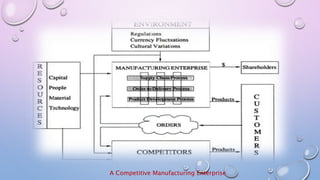
A Competitive Manufacturing Enterprise

Strategic Lead Time Management

  • 1.
    STRATEGIC LEAD-TIME MANAGEMENT INTERNATIONAL SUPPLYCHAIN MANAGEMENT EDMUND SIAH-ARMA CARINTHIA UNIVERSITY OF APPLIED SCIEN
  • 2.
  • 3.
    WHAT IS LEADTIME? Lead Time/Throughput Time:- number of minutes, hours, or days that must be allowed for the completion of an operation or process, or must elapse before a desired action takes place. COMPONENTS OF LEAD-TIME PROCUREMENT LEAD TIME MANUFACTURING LEAD TIME DISTRIBUTION LEAD TIME LOGISTICS LEAD TIME SETUP TIMES WAITING TIMES DECISION-MAKING TIMES
  • 4.
    CONCEPT AND CATEGORIESOF LEAD-TIMES SCP Lead-Time:- clock time spent by the supply chain to convert raw materials into final products and to place them in the hands of distributors or customers ODP Lead-Time:- time elapsed from when customer places an order till the instant he is delivered the product  Value-added lead time:-the time required to actually manufacture a unit of a product.  Non-value-added lead time:- the time that a unit of product sits in inventories or moves unnecessarily. CAUSES OF LONG LEAD-TIMES Long setup times (the effort required to prepare an operation for a new production run) Move time Queue time/Work-in-precess Waiting time Viswanadham, N. (2000): Analysis of Manufacturing Enterprises: An Approach to Leveraging Value Delivery Processes to Competitive Advantage. Massachussets: Kluwer Academic Publishers.p. 242ff.
  • 5.
    Product-Oriented Layout /Product Cells:- Organizing work around the products Process-Oriented Layout:- organizing work around processes Employee involvement:- The use of teams organized in product cells, rather than just efforts of isolated individuals Pull Manufacturing / Kanban:- Producing items only as they are needed by the customer Zero Defects:- Poor quality results in increased need for inspection, more production interruptions, an increased need for rework DEALING WITH LONG LEAD TIMES
  • 6.
    Time Elasticity ofPrice:- the price that customers are prepared to pay is often related to the delivery speed.  P-Time (Production time):- the time it takes for a product or service to go through a SC pipeline D-Time (Demand time):- the time for which a customer is willing to wait to have their demand fulfilled P:D RATIOS Stalk, G/Hout, T. (1990):Time management; Delivery of goods; Competition, International; Comparative advantage (International trade). New York:Free Press P-Time = customer makes order deliver product to customer
  • 7.
    WHEN P-TIME ISGREATER THAN D- TIME Source Make Delivery Customer’s order cycle Order fulfillment: D-time Logistics lead time: P-time P-time - D-time Assembly and Test Harrison, A/Van Hoek, R. (2008):Logistics management and strategy: competing through the supply chain. 3rd ed., England: Pearson Education Ltd. p.150ff
  • 8.
    WHEN P-TIME ISGREATER THAN D- TIME Harrison, A/Van Hoek, R. (2008):Logistics management and strategy: competing through the supply chain. 3ed., England: Pearson Education Ltd. p.150ff Short Term •Make-to-order •Make-to-stock Strategy When P-Time > D- Time Long Term •Marketing •Product development •Process improvement •Control •Simplify •Compress •Integrate •Coordinate •Automate  Optimizing throughput and improving process capability  Untangling process flows and reducing product complexity  straightening process flows and reducing batch sizes  Improving communications and implementing teams  Adding customer-specific parts as late as possible  Using robots and IT systems
  • 9.
    1. Create atask force 2. Select the section of the SC pipeline to map 3. Observe and collect data from the current state map 4. Visualize/flow chart the process 5. Identify value-adding and non-value-adding processes 6. Construct a time based process map 7. Generate a solutions for a future state map HOW TO MEASURE TIME IN A SUPPLY CHAIN PIPELINE
  • 10.
    CURRENT STATE MAPOF A SAMPLE SC PIPELINE How can we shorten our lead-time? 0.8 D1 D2 G1 G2 TOTAL TIME 4.2 HRS/UNIT G3
  • 11.
     OPERATING TIME=8 HRS/DAY  OUTPUT = 5 UNITS/DAY HOW MANY SECTIONS DO WE NEED IN THE PIPELINE? TOTAL TIME = 4.2 HRS CYCLE TIME = 1.6 HRS/UNIT/PIPELINE SECTION CALCULATIONS: REDUCING LEADTIME BY LINE BALANCING 1.6 HRS/UNIT/PIPELINE SECTION CYCLE TIME 2.6 PIPELINES Nmin (theoretical minimum) 3 PIPELINES (rounded) RULE OF THUMB: Longest task to the work station first PIPELINE #1 1.6 HRS PIPELINE #2 1.6 HRS PIPELINE #3 1.6 HRS PROCESS TIME SPENT TIME LEFT PROCESS TIME SPENT TIME LEFT PROCESS TIME SPENT TIME LEFT A 0.3 1.3 E 1.1 0.5 G2 0.5 1.1 F 0.6 0.7 D1 0.1 0.4 G3 0.8 0.3 B 0.4 0.2 D2 0.1 0.3 C 0.2 0 G1 0.1 0.2 IDLE TIME of 0.5
  • 12.
    PROPOSED FUTURE STATEMAP OF SAMPLE SC PIPELINE SUM OF ALL TASK TIMES ACTUAL NUMBER OF PIPELINES 4.2 HRS 11 PIPELINE SECTIONS EFFICIENCY, E CYCLE TIME CURRENT EFFICIENCY Ec 1.6 61.10% 100% FUTURE EFFICIENCY, Ef 4.2 HRS 3 PIPELINE SECTIONS 1.6 224% B A F D2 E D1 G2 G3 C G1 A C B CUSTOMER
  • 13.
    SUMMARY (1) High qualityand low cost is not enough First and fast in getting products and services to customers Successor tasks should begin simultaneously or before conclusion of a predecessor task (strategic lead time management) Reducing cycle time increases capacity/production volume/sales To increase capacity/production volume/sales, reduce the cycle time by reducing the bottle neck Cutting lead time does not always increase capacity/production volume/sales To reduce lead time, cut order processing times, work in process, inventory Reduces queuing/waiting time of customers Increases customer satisfaction
  • 14.
    SUMMARY (2) The longerthe pipeline form the source of materials to the final user the less responsive to changes in demand the system will be Delivering products and services on time Receiving payments on time Dealing with customer queries and complaints on time Lead-time is directly proportional to inventory
  • 16.