Arif Rahman – The Production Systems 1
Slide 4
Material Handling
Arif Rahman, ST MT
Arif Rahman – The Production Systems
Conveyors
2
Arif Rahman – The Production Systems
Large family of material transport equipment
designed to move materials over fixed paths,
usually in large quantities or volumes
Non powered‑
¤ Materials moved by human workers or by gravity
Powered
¤ Power mechanism for transporting materials is
contained in the fixed path, using chains, belts,
rollers or other mechanical devices
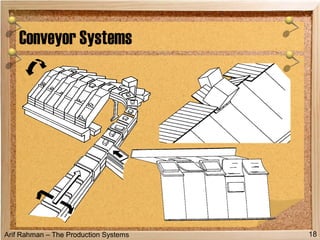
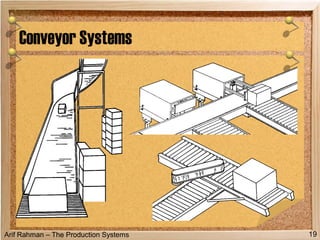
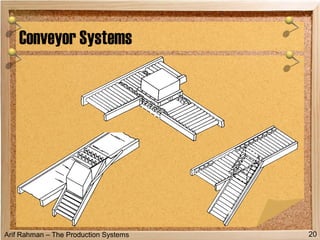
Conveyors Systems
3
Arif Rahman – The Production Systems
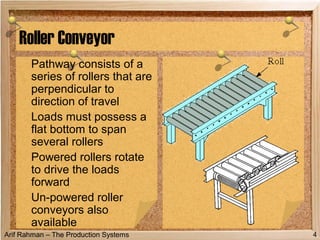
Roller Conveyor
Pathway consists of a
series of rollers that are
perpendicular to
direction of travel
Loads must possess a
flat bottom to span
several rollers
Powered rollers rotate
to drive the loads
forward
Un-powered roller
conveyors also
available
4
Arif Rahman – The Production Systems
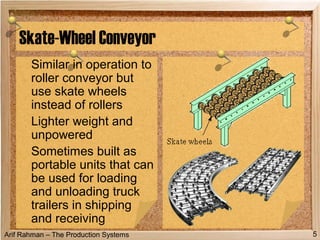
Skate-Wheel Conveyor
Similar in operation to
roller conveyor but
use skate wheels
instead of rollers
Lighter weight and
unpowered
Sometimes built as
portable units that can
be used for loading
and unloading truck
trailers in shipping
and receiving
5
Arif Rahman – The Production Systems
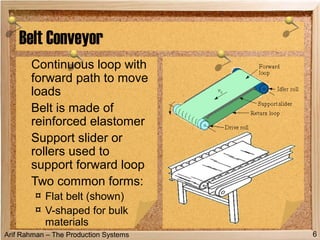
Belt Conveyor
Continuous loop with
forward path to move
loads
Belt is made of
reinforced elastomer
Support slider or
rollers used to
support forward loop
Two common forms:
¤ Flat belt (shown)
¤ V-shaped for bulk
materials
6
Arif Rahman – The Production Systems
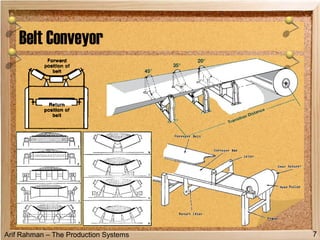
Belt Conveyor
7
Arif Rahman – The Production Systems
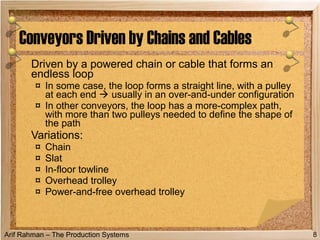
Driven by a powered chain or cable that forms an
endless loop
¤ In some case, the loop forms a straight line, with a pulley
at each end  usually in an over-and-under configuration
¤ In other conveyors, the loop has a more-complex path,
with more than two pulleys needed to define the shape of
the path
Variations:
¤ Chain
¤ Slat
¤ In-floor towline
¤ Overhead trolley
¤ Power-and-free overhead trolley
Conveyors Driven by Chains and Cables
8
Arif Rahman – The Production Systems
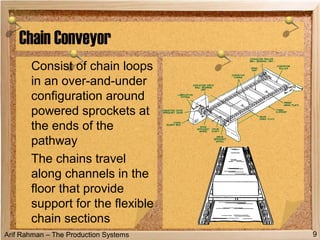
Chain Conveyor
Consist of chain loops
in an over-and-under
configuration around
powered sprockets at
the ends of the
pathway
The chains travel
along channels in the
floor that provide
support for the flexible
chain sections
9
Arif Rahman – The Production Systems
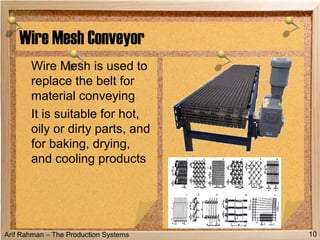
Wire Mesh Conveyor
Wire Mesh is used to
replace the belt for
material conveying
It is suitable for hot,
oily or dirty parts, and
for baking, drying,
and cooling products
10
Arif Rahman – The Production Systems
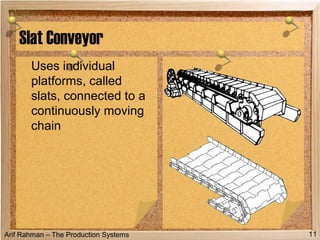
Slat Conveyor
Uses individual
platforms, called
slats, connected to a
continuously moving
chain
11
Arif Rahman – The Production Systems
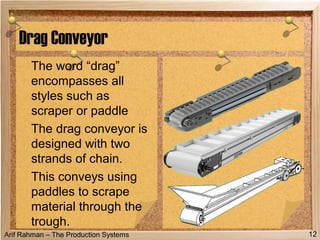
Drag Conveyor
The word “drag”
encompasses all
styles such as
scraper or paddle
The drag conveyor is
designed with two
strands of chain.
This conveys using
paddles to scrape
material through the
trough.
12
Arif Rahman – The Production Systems
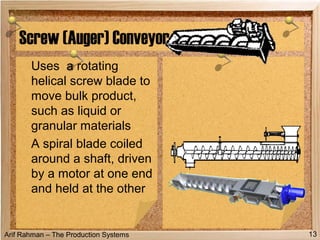
Screw (Auger) Conveyor
Uses a rotating
helical screw blade to
move bulk product,
such as liquid or
granular materials
A spiral blade coiled
around a shaft, driven
by a motor at one end
and held at the other
13
Arif Rahman – The Production Systems
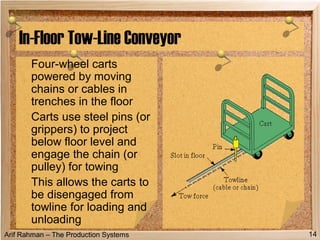
In-Floor Tow-Line Conveyor
Four-wheel carts
powered by moving
chains or cables in
trenches in the floor
Carts use steel pins (or
grippers) to project
below floor level and
engage the chain (or
pulley) for towing
This allows the carts to
be disengaged from
towline for loading and
unloading
14
Arif Rahman – The Production Systems
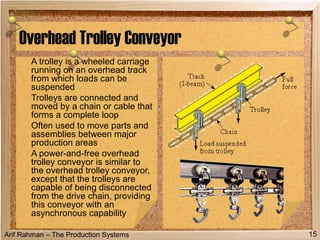
Overhead Trolley Conveyor
A trolley is a wheeled carriage
running on an overhead track
from which loads can be
suspended
Trolleys are connected and
moved by a chain or cable that
forms a complete loop
Often used to move parts and
assemblies between major
production areas
A power-and-free overhead
trolley conveyor is similar to
the overhead trolley conveyor,
except that the trolleys are
capable of being disconnected
from the drive chain, providing
this conveyor with an
asynchronous capability
15
Arif Rahman – The Production Systems
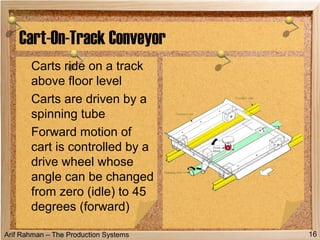
Cart-On-Track Conveyor
Carts ride on a track
above floor level
Carts are driven by a
spinning tube
Forward motion of
cart is controlled by a
drive wheel whose
angle can be changed
from zero (idle) to 45
degrees (forward)
16
Arif Rahman – The Production Systems
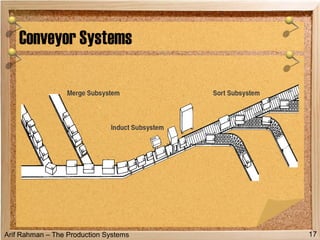
Conveyor Systems
17
Arif Rahman – The Production Systems
Conveyor Systems
18
Arif Rahman – The Production Systems
Conveyor Systems
19
Arif Rahman – The Production Systems
Conveyor Systems
20
Arif Rahman – The Production Systems
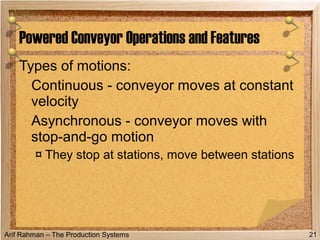
Types of motions:
Continuous - conveyor moves at constant
velocity
Asynchronous - conveyor moves with
stop-and-go motion
¤ They stop at stations, move between stations
Powered Conveyor Operations and Features
21
Arif Rahman – The Production Systems
Another classification of conveyors:
Single direction
Continuous loop
Recirculating
Powered Conveyor Operations and Features
22
Arif Rahman – The Production Systems
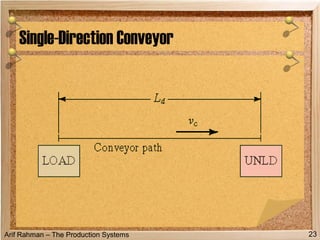
Single-Direction Conveyor
23
Arif Rahman – The Production Systems
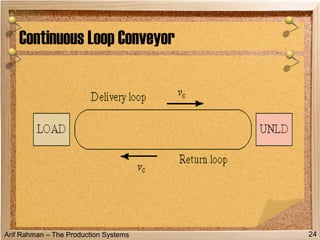
Continuous Loop Conveyor
24
Arif Rahman – The Production Systems
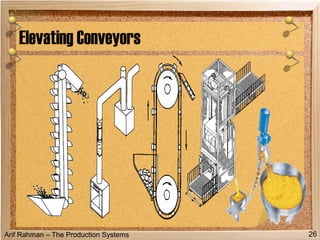
Conveyors usually move materials on horizontal
path. With a sloping angle, several conveyors can
elevate materials on vertical path. Some
conveyors elevate materials perpendicularly.
Bucket elevator
Pneumatic elevator
Magnetic elevator
Mechanical elevator
Screw elevator
Elevating Conveyors
25
Arif Rahman – The Production Systems
Elevating Conveyors
26
Arif Rahman – The Production Systems
Conveyor Safety Warning
27
Arif Rahman – The Production Systems
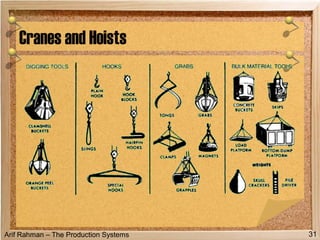
Cranes and Hoists
28
Arif Rahman – The Production Systems
Handling devices for lifting, lowering and
transporting materials, often as heavy loads
Cranes
¤ Used for horizontal movement of materials
Hoists
¤ Used for vertical lifting of materials
Cranes usually include hoists so that the
crane-and-hoist combination provides
¤ Horizontal transport
¤ Vertical lifting and lowering
Cranes and Hoists
29
Arif Rahman – The Production Systems
Cranes and Hoists
30
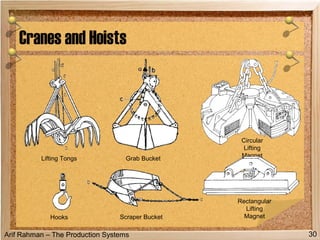
Lifting Tongs
Circular
Lifting
Magnet
Rectangular
Lifting
Magnet
Grab Bucket
Hooks Scraper Bucket
Arif Rahman – The Production Systems
Cranes and Hoists
31
Arif Rahman – The Production Systems
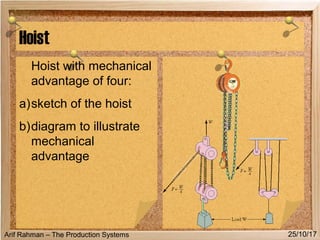
Hoist
Hoist with mechanical
advantage of four:
a)sketch of the hoist
b)diagram to illustrate
mechanical
advantage
25/10/17
Arif Rahman – The Production Systems
Overhead / Beam / Monorail Crane
Bridge Crane
Gantry Crane
Jib Crane
Truck-mounted Crane
Types of Cranes
33
Arif Rahman – The Production Systems
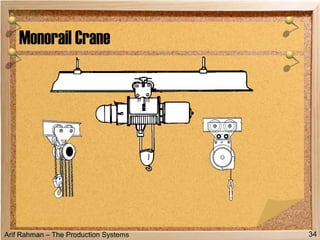
Monorail Crane
34
Arif Rahman – The Production Systems
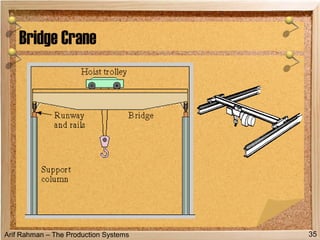
Bridge Crane
35
Arif Rahman – The Production Systems
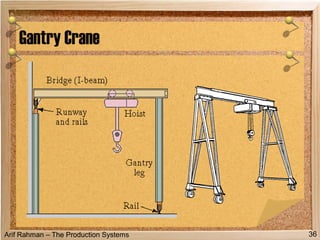
Gantry Crane
36
Arif Rahman – The Production Systems
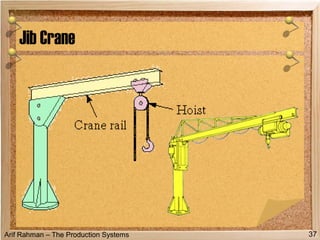
Jib Crane
37
Arif Rahman – The Production Systems
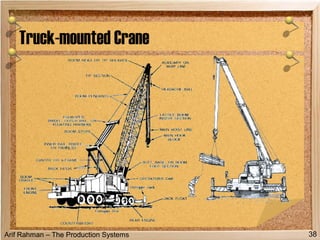
Truck-mounted Crane
38
Arif Rahman – The Production Systems
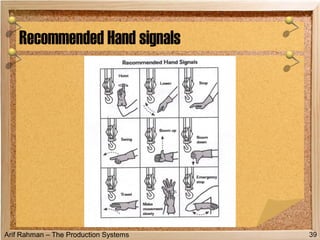
Recommended Hand signals
39
Arif Rahman – The Production Systems
Analysis of
Material Transport
Systems
40
Arif Rahman – The Production Systems
Analysis of vehicle-based systems
¤ From-to charts and network diagrams
¤ Types of systems: industrial trucks, AGVS,
rail-guided vehicles, and asynchronous
conveyor operations
Conveyor analysis
¤ Single-direction conveyors
¤ Closed loop conveyors
¤ Recirculating conveyor systems
Analysis of Material Transport Systems
41
Arif Rahman – The Production Systems
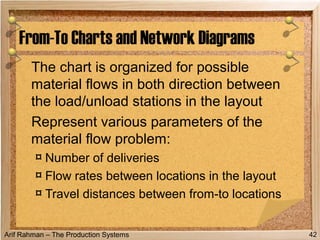
The chart is organized for possible
material flows in both direction between
the load/unload stations in the layout
Represent various parameters of the
material flow problem:
¤ Number of deliveries
¤ Flow rates between locations in the layout
¤ Travel distances between from-to locations
From-To Charts and Network Diagrams
42
Arif Rahman – The Production Systems
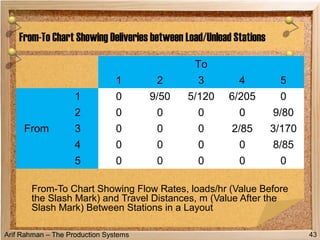
To
1 2 3 4 5
From
1 0 9/50 5/120 6/205 0
2 0 0 0 0 9/80
3 0 0 0 2/85 3/170
4 0 0 0 0 8/85
5 0 0 0 0 0
From-To Chart Showing Deliveries between Load/Unload Stations
43
From-To Chart Showing Flow Rates, loads/hr (Value Before
the Slash Mark) and Travel Distances, m (Value After the
Slash Mark) Between Stations in a Layout
Arif Rahman – The Production Systems
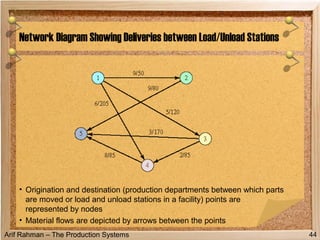
Network Diagram Showing Deliveries between Load/Unload Stations
44
• Origination and destination (production departments between which parts
are moved or load and unload stations in a facility) points are
represented by nodes
• Material flows are depicted by arrows between the points
Arif Rahman – The Production Systems
Mathematical equations can be developed
to describe the operation of vehicle-based
material transport systems
We assume that the vehicle operates at a
constant velocity throughout its operation
and ignore effects of acceleration,
deceleration, and other speed differences
that might depend on whether the vehicle
is travelling loaded or empty or other
reasons
Analysis of Vehicle-Based Systems
45
Arif Rahman – The Production Systems
The time for a typical delivery cycle in the
operation of a vehicle-based transport
system consists of :
¤ Loading at the pickup station
¤ Travel time to the drop-off station
¤ Unloading at the drop-off station
¤ Empty travel time of the vehicle between
deliveries
Analysis of Vehicle-Based Systems
46
Arif Rahman – The Production Systems
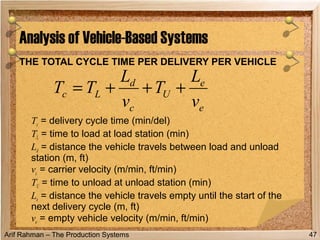
THE TOTAL CYCLE TIME PER DELIVERY PER VEHICLE
Tc = delivery cycle time (min/del)
TL = time to load at load station (min)
Ld = distance the vehicle travels between load and unload
station (m, ft)
vc = carrier velocity (m/min, ft/min)
TU = time to unload at unload station (min)
Le = distance the vehicle travels empty until the start of the
next delivery cycle (m, ft)
ve = empty vehicle velocity (m/min, ft/min)
Analysis of Vehicle-Based Systems
47
e
e
U
c
d
Lc
v
L
T
v
L
TT +++=
Arif Rahman – The Production Systems
Tc must be considered an ideal value, because it
ignores any time losses due to reliability problems,
traffic congestion, and other factors that may slow
down a delivery.
In addition, not all delivery cycles are the same.
Originations and destinations may be different
from one delivery to the next, which will affect the
Ld and Le terms in preceding equation.
Accordingly, these terms are considered to be
average values for the population of loaded and
empty distances travelled by the vehicle during the
course of a shift or other period of analysis.
Analysis of Vehicle-Based Systems
48
Arif Rahman – The Production Systems
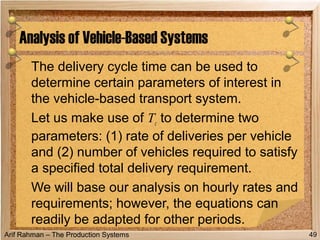
The delivery cycle time can be used to
determine certain parameters of interest in
the vehicle-based transport system.
Let us make use of Tc to determine two
parameters: (1) rate of deliveries per vehicle
and (2) number of vehicles required to satisfy
a specified total delivery requirement.
We will base our analysis on hourly rates and
requirements; however, the equations can
readily be adapted for other periods.
Analysis of Vehicle-Based Systems
49
Arif Rahman – The Production Systems
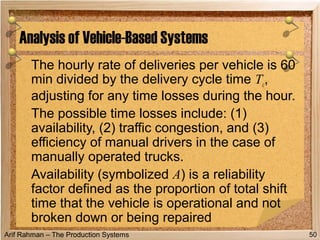
The hourly rate of deliveries per vehicle is 60
min divided by the delivery cycle time Tc,
adjusting for any time losses during the hour.
The possible time losses include: (1)
availability, (2) traffic congestion, and (3)
efficiency of manual drivers in the case of
manually operated trucks.
Availability (symbolized A) is a reliability
factor defined as the proportion of total shift
time that the vehicle is operational and not
broken down or being repaired
Analysis of Vehicle-Based Systems
50
Arif Rahman – The Production Systems
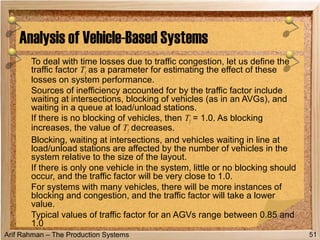
To deal with time losses due to traffic congestion, let us define the
traffic factor Tf as a parameter for estimating the effect of these
losses on system performance.
Sources of inefficiency accounted for by the traffic factor include
waiting at intersections, blocking of vehicles (as in an AVGs), and
waiting in a queue at load/unload stations.
If there is no blocking of vehicles, then Tf = 1.0. As blocking
increases, the value of Tf decreases.
Blocking, waiting at intersections, and vehicles waiting in line at
load/unload stations are affected by the number of vehicles in the
system relative to the size of the layout.
If there is only one vehicle in the system, little or no blocking should
occur, and the traffic factor will be very close to 1.0.
For systems with many vehicles, there will be more instances of
blocking and congestion, and the traffic factor will take a lower
value.
Typical values of traffic factor for an AGVs range between 0.85 and
1.0
Analysis of Vehicle-Based Systems
51
Arif Rahman – The Production Systems
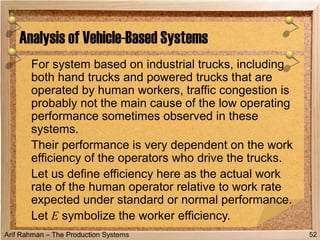
For system based on industrial trucks, including
both hand trucks and powered trucks that are
operated by human workers, traffic congestion is
probably not the main cause of the low operating
performance sometimes observed in these
systems.
Their performance is very dependent on the work
efficiency of the operators who drive the trucks.
Let us define efficiency here as the actual work
rate of the human operator relative to work rate
expected under standard or normal performance.
Let E symbolize the worker efficiency.
Analysis of Vehicle-Based Systems
52
Arif Rahman – The Production Systems
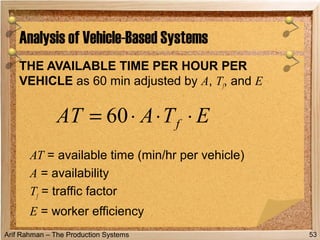
THE AVAILABLE TIME PER HOUR PER
VEHICLE as 60 min adjusted by A, Tf, and E
AT = available time (min/hr per vehicle)
A = availability
Tf = traffic factor
E = worker efficiency
Analysis of Vehicle-Based Systems
53
ETAAT f ⋅⋅⋅= 60
Arif Rahman – The Production Systems
The parameters A, Tf, and E do not take
into account poor vehicle routing, poor
guidepath layout, or poor management of
the vehicles in the system
These factors should be minimized, but if
present they are accounted for in the
values of Ld and Le.
We now can write equations for the two
performance parameters of interest.
Analysis of Vehicle-Based Systems
54
Arif Rahman – The Production Systems
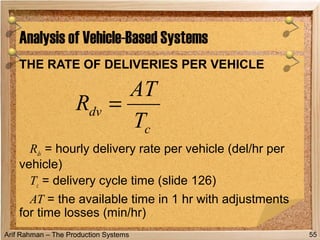
THE RATE OF DELIVERIES PER VEHICLE
Rdv = hourly delivery rate per vehicle (del/hr per
vehicle)
Tc = delivery cycle time (slide 126)
AT = the available time in 1 hr with adjustments
for time losses (min/hr)
Analysis of Vehicle-Based Systems
55
c
dv
T
AT
R =
Arif Rahman – The Production Systems
The total number of vehicles (trucks, AGVs,
trolleys, carts, etc.) needed to satisfy a
specified total delivery schedule Rf in the
system can be estimated by first calculating
the total workload required and then dividing
by the available time per vehicle.
Workload is defined as the total amount of
work, expressed in terms of time, that must
be accomplished by the material transport
system in 1 hr.
Analysis of Vehicle-Based Systems
56
Arif Rahman – The Production Systems
WORKLOAD
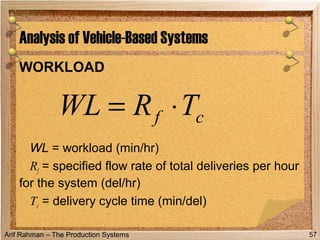
WL = workload (min/hr)
Rf = specified flow rate of total deliveries per hour
for the system (del/hr)
Tc = delivery cycle time (min/del)
Analysis of Vehicle-Based Systems
57
cf TRWL ⋅=
Arif Rahman – The Production Systems
THE NUMBER OF VEHICLES REQUIRED
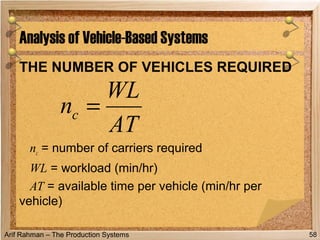
nc = number of carriers required
WL = workload (min/hr)
AT = available time per vehicle (min/hr per
vehicle)
Analysis of Vehicle-Based Systems
58
AT
WL
nc =
Arif Rahman – The Production Systems
THE NUMBER OF VEHICLES REQUIRED
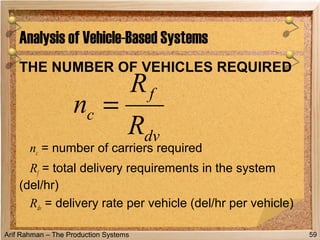
nc = number of carriers required
Rf = total delivery requirements in the system
(del/hr)
Rdv = delivery rate per vehicle (del/hr per vehicle)
Analysis of Vehicle-Based Systems
59
dv
f
c
R
R
n =
Arif Rahman – The Production Systems
Although the traffic factor accounts for delays experienced by
the vehicles, it does not include delays encountered by a
load/unload station that must wait for the arrival of a vehicle.
Because of the random nature of the load/unload demands,
workstations are likely to experience waiting time while
vehicles are busy with other deliveries.
the preceding equations do not consider this idle time or its
impact on operating cost
If station idle time is to be minimized, then more vehicles may
be needed
Mathematical models based on queuing theory are
appropriate to analyze this more-complex stochastic situation
Analysis of Vehicle-Based Systems
60
Arif Rahman – The Production Systems
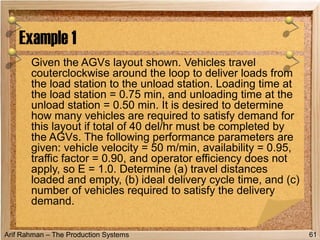
Given the AGVs layout shown. Vehicles travel
couterclockwise around the loop to deliver loads from
the load station to the unload station. Loading time at
the load station = 0.75 min, and unloading time at the
unload station = 0.50 min. It is desired to determine
how many vehicles are required to satisfy demand for
this layout if total of 40 del/hr must be completed by
the AGVs. The following performance parameters are
given: vehicle velocity = 50 m/min, availability = 0.95,
traffic factor = 0.90, and operator efficiency does not
apply, so E = 1.0. Determine (a) travel distances
loaded and empty, (b) ideal delivery cycle time, and (c)
number of vehicles required to satisfy the delivery
demand.
Example 1
61
Arif Rahman – The Production Systems
Example 1
62
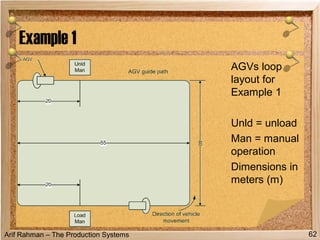
AGVs loop
layout for
Example 1
Unld = unload
Man = manual
operation
Dimensions in
meters (m)
Arif Rahman – The Production Systems
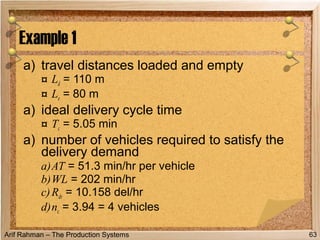
a) travel distances loaded and empty
¤ Ld = 110 m
¤ Le = 80 m
a) ideal delivery cycle time
¤ Tc = 5.05 min
a) number of vehicles required to satisfy the
delivery demand
a)AT = 51.3 min/hr per vehicle
b)WL = 202 min/hr
c)Rdv = 10.158 del/hr
d)nc = 3.94 = 4 vehicles
Example 1
63
Arif Rahman – The Production Systems
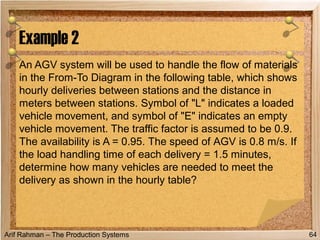
An AGV system will be used to handle the flow of materials
in the From-To Diagram in the following table, which shows
hourly deliveries between stations and the distance in
meters between stations. Symbol of "L" indicates a loaded
vehicle movement, and symbol of "E" indicates an empty
vehicle movement. The traffic factor is assumed to be 0.9.
The availability is A = 0.95. The speed of AGV is 0.8 m/s. If
the load handling time of each delivery = 1.5 minutes,
determine how many vehicles are needed to meet the
delivery as shown in the hourly table?
Example 2
64
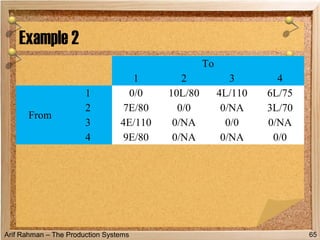
Arif Rahman – The Production Systems
To
1 2 3 4
From
1 0/0 10L/80 4L/110 6L/75
2 7E/80 0/0 0/NA 3L/70
3 4E/110 0/NA 0/0 0/NA
4 9E/80 0/NA 0/NA 0/0
Example 2
65
Arif Rahman – The Production Systems
Three basic types of conveyor operations:
Single direction conveyors
Continuous loop conveyors
Recirculating conveyors
Conveyor Analysis
66
Arif Rahman – The Production Systems
Consider the case of a single direction
powered conveyor with one load station at
the upstream end and one unload station
at the downstream end.
Materials are loaded at one end and
unloaded at the other.
The materials may be parts, cartons,
pallet loads, or other unit loads.
Conveyor Analysis: Single Direction Conveyors
67
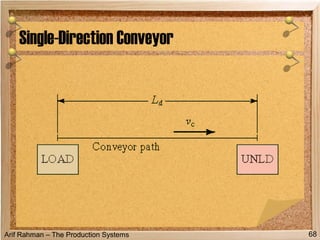
Arif Rahman – The Production Systems
Single-Direction Conveyor
68
Arif Rahman – The Production Systems
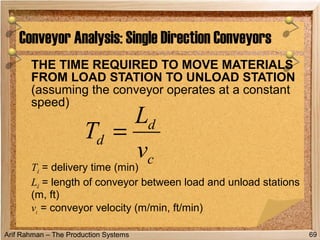
THE TIME REQUIRED TO MOVE MATERIALS
FROM LOAD STATION TO UNLOAD STATION
(assuming the conveyor operates at a constant
speed)
Td = delivery time (min)
Ld = length of conveyor between load and unload stations
(m, ft)
vc = conveyor velocity (m/min, ft/min)
Conveyor Analysis: Single Direction Conveyors
69
c
d
d
v
L
T =
Arif Rahman – The Production Systems
The flow rate of materials on the conveyor
is determined by the rate of loading at the
load station.
The loading rate is limited by the
reciprocal of the time required to load the
materials.
Given the conveyor speed, the loading
rate establishes the spacing of materials
on the conveyor.
Conveyor Analysis: Single Direction Conveyors
70
Arif Rahman – The Production Systems
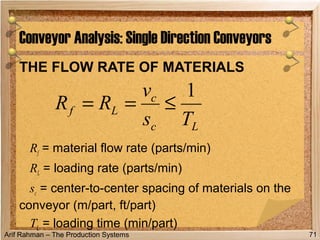
THE FLOW RATE OF MATERIALS
Rf = material flow rate (parts/min)
RL = loading rate (parts/min)
sc = center-to-center spacing of materials on the
conveyor (m/part, ft/part)
TL = loading time (min/part)
Conveyor Analysis: Single Direction Conveyors
71
Lc
c
Lf
Ts
v
RR
1
≤==
Arif Rahman – The Production Systems
One might be tempted to think that the
loading rate RL is the reciprocal of the loading
time TL. However, RL is set by the flow rate
requirement Rf, while TL is determined by
ergonomic factors.
The worker who loads the conveyor may be
capable of performing the loading task at a
rate that is faster than the required flow rate.
On the other hand, the flow rate requirement
cannot be set faster than it is humanly
possible to perform the loading task.
Conveyor Analysis: Single Direction Conveyors
72
Arif Rahman – The Production Systems
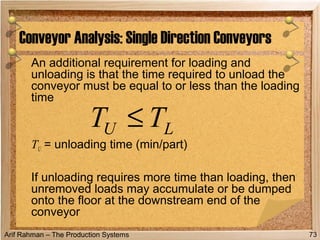
An additional requirement for loading and
unloading is that the time required to unload the
conveyor must be equal to or less than the loading
time
TU = unloading time (min/part)
If unloading requires more time than loading, then
unremoved loads may accumulate or be dumped
onto the floor at the downstream end of the
conveyor
Conveyor Analysis: Single Direction Conveyors
73
LU TT ≤
Arif Rahman – The Production Systems
We are using parts as the material in
previous slides, but the relationships apply
to other unit loads as well
The advantages of the unit load principle
can be demonstrated by transporting np
parts in a carrier rather than a single part
Conveyor Analysis: Single Direction Conveyors
7425/10/17
Arif Rahman – The Production Systems
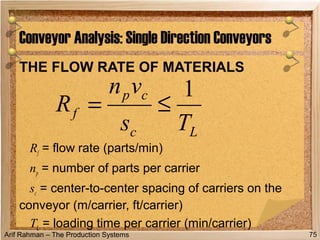
THE FLOW RATE OF MATERIALS
Rf = flow rate (parts/min)
np = number of parts per carrier
sc = center-to-center spacing of carriers on the
conveyor (m/carrier, ft/carrier)
TL = loading time per carrier (min/carrier)
Conveyor Analysis: Single Direction Conveyors
75
Lc
cp
f
Ts
vn
R
1
≤=
Arif Rahman – The Production Systems
The flow rate of parts transported by the
conveyor is potentially much greater in this
case
However, loading time is still a limitation,
and TL may consist of not only the time to
load the carrier onto the conveyor but also
the time to load parts into the carrier
The preceding equations must be
interpreted and perhaps adjusted for the
given application
Conveyor Analysis: Single Direction Conveyors
76
Arif Rahman – The Production Systems
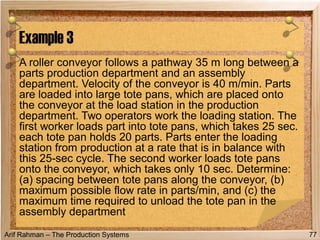
A roller conveyor follows a pathway 35 m long between a
parts production department and an assembly
department. Velocity of the conveyor is 40 m/min. Parts
are loaded into large tote pans, which are placed onto
the conveyor at the load station in the production
department. Two operators work the loading station. The
first worker loads part into tote pans, which takes 25 sec.
each tote pan holds 20 parts. Parts enter the loading
station from production at a rate that is in balance with
this 25-sec cycle. The second worker loads tote pans
onto the conveyor, which takes only 10 sec. Determine:
(a) spacing between tote pans along the conveyor, (b)
maximum possible flow rate in parts/min, and (c) the
maximum time required to unload the tote pan in the
assembly department
Example 3
77
Arif Rahman – The Production Systems
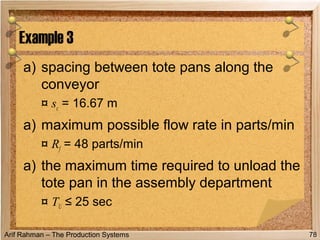
a) spacing between tote pans along the
conveyor
¤ sc = 16.67 m
a) maximum possible flow rate in parts/min
¤ Rf = 48 parts/min
a) the maximum time required to unload the
tote pan in the assembly department
¤ TU ≤ 25 sec
Example 3
78
Arif Rahman – The Production Systems
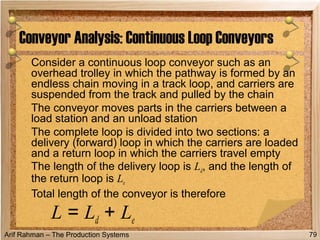
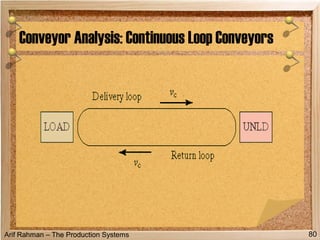
Consider a continuous loop conveyor such as an
overhead trolley in which the pathway is formed by an
endless chain moving in a track loop, and carriers are
suspended from the track and pulled by the chain
The conveyor moves parts in the carriers between a
load station and an unload station
The complete loop is divided into two sections: a
delivery (forward) loop in which the carriers are loaded
and a return loop in which the carriers travel empty
The length of the delivery loop is Ld, and the length of
the return loop is Le
Total length of the conveyor is therefore
L = Ld + Le
Conveyor Analysis: Continuous Loop Conveyors
79
Arif Rahman – The Production Systems
Conveyor Analysis: Continuous Loop Conveyors
80
Arif Rahman – The Production Systems
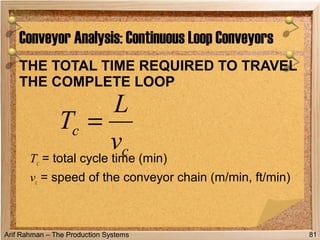
THE TOTAL TIME REQUIRED TO TRAVEL
THE COMPLETE LOOP
Tc = total cycle time (min)
vc = speed of the conveyor chain (m/min, ft/min)
Conveyor Analysis: Continuous Loop Conveyors
81
c
c
v
L
T =
Arif Rahman – The Production Systems
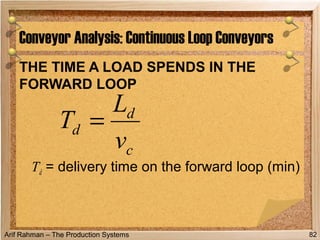
THE TIME A LOAD SPENDS IN THE
FORWARD LOOP
Td = delivery time on the forward loop (min)
Conveyor Analysis: Continuous Loop Conveyors
82
c
d
d
v
L
T =
Arif Rahman – The Production Systems
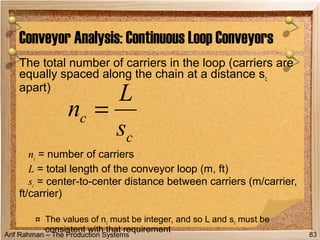
The total number of carriers in the loop (carriers are
equally spaced along the chain at a distance sc
apart)
nc = number of carriers
L = total length of the conveyor loop (m, ft)
sc = center-to-center distance between carriers (m/carrier,
ft/carrier)
¤ The values of nc must be integer, and so L and sc must be
consistent with that requirement
Conveyor Analysis: Continuous Loop Conveyors
83
c
c
s
L
n =
Arif Rahman – The Production Systems
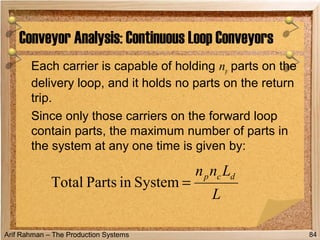
Each carrier is capable of holding np parts on the
delivery loop, and it holds no parts on the return
trip.
Since only those carriers on the forward loop
contain parts, the maximum number of parts in
the system at any one time is given by:
Conveyor Analysis: Continuous Loop Conveyors
84
L
Lnn dcp
=SysteminPartsTotal
Arif Rahman – The Production Systems
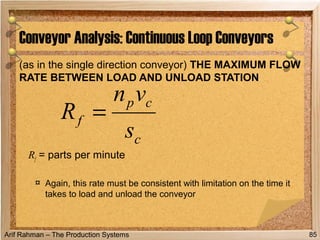
(as in the single direction conveyor) THE MAXIMUM FLOW
RATE BETWEEN LOAD AND UNLOAD STATION
Rf = parts per minute
¤ Again, this rate must be consistent with limitation on the time it
takes to load and unload the conveyor
Conveyor Analysis: Continuous Loop Conveyors
85
c
cp
f
s
vn
R =
Arif Rahman – The Production Systems
Recall “conveyor operations and features” and the
two problems complicating the operation of a
recirculating conveyor system: (1) the possibility
that no empty carriers are immediately available at
the loading station when needed and (2) the
possibility that no loaded carriers are immediately
available at the unloading station when needed
There are three basic principles that must be
obeyed in designing such a conveyor system
(Kwo’s principles):
¤ Speed rule
¤ Capacity constraint
¤ Uniformity principle
Conveyor Analysis: Recirculating Conveyors
86
Arif Rahman – The Production Systems
This principle states that the operating speed
of the conveyor must be within a certain
range
The lower limit of the range is determined by
the required loading and unloading rates at
the respective stations
These rates are dictated by the external
systems served by the conveyor
Let RL and RU represent the required loading
and unloading rates at the two station,
respectively
Conveyor Analysis: Recirculating Conveyors - Speed Rule
87
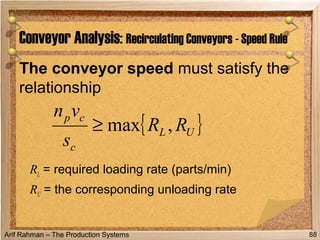
Arif Rahman – The Production Systems
The conveyor speed must satisfy the
relationship
RL = required loading rate (parts/min)
RU = the corresponding unloading rate
Conveyor Analysis: Recirculating Conveyors - Speed Rule
88
{ }UL
c
cp
RR
s
vn
,max≥
Arif Rahman – The Production Systems
The upper speed limit is determined by
the physical capabilities of the material
handlers to perform the loading and
unloading tasks
Their capabilities are defined by the time
required to load and unload the carriers
Conveyor Analysis: Recirculating Conveyors - Speed Rule
89
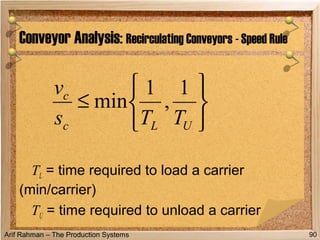
Arif Rahman – The Production Systems
TL = time required to load a carrier
(min/carrier)
TU = time required to unload a carrier
Conveyor Analysis: Recirculating Conveyors - Speed Rule
90






≤
ULc
c
TTs
v 1
,
1
min
Arif Rahman – The Production Systems
Another limitation is of course that the
speed must not exceed the technological
limits of the mechanical conveyor itself
Conveyor Analysis: Recirculating Conveyors - Speed Rule
91
Arif Rahman – The Production Systems
The flow rate capacity of the conveyor
system must be at least equal to the flow
rate requirement to accommodate reserve
stock and allow for the time elapsed
between loading and unloading due to
delivery distance
Conveyor Analysis: Recirculating Conveyors - Capacity Constraint
92
Arif Rahman – The Production Systems
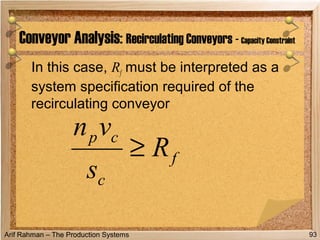
In this case, Rf must be interpreted as a
system specification required of the
recirculating conveyor
Conveyor Analysis: Recirculating Conveyors - Capacity Constraint
93
f
c
cp
R
s
vn
≥
Arif Rahman – The Production Systems
This principle states that parts (loads)
should be uniformly distributed throughout
the length of the conveyor, so that there
will be no sections of the conveyor in
which every carrier is full while other
sections are virtually empty
The reason for the uniformity principle is
to avoid unusually long waiting times at
the load or unload stations for empty or full
carriers (respectively) to arrive
Conveyor Analysis: Recirculating Conveyors -Uniformity Principle
94
Arif Rahman – The Production Systems
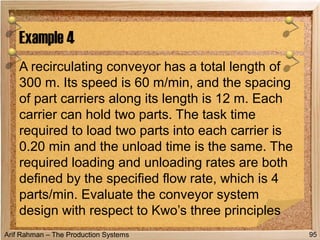
A recirculating conveyor has a total length of
300 m. Its speed is 60 m/min, and the spacing
of part carriers along its length is 12 m. Each
carrier can hold two parts. The task time
required to load two parts into each carrier is
0.20 min and the unload time is the same. The
required loading and unloading rates are both
defined by the specified flow rate, which is 4
parts/min. Evaluate the conveyor system
design with respect to Kwo’s three principles
Example 4
95
Arif Rahman – The Production Systems 96
It’s end of slides…It’s end of slides…
…… Any question ?Any question ?

04 material handling - part3

  • 1.
    Arif Rahman –The Production Systems 1 Slide 4 Material Handling Arif Rahman, ST MT
  • 2.
    Arif Rahman –The Production Systems Conveyors 2
  • 3.
    Arif Rahman –The Production Systems Large family of material transport equipment designed to move materials over fixed paths, usually in large quantities or volumes Non powered‑ ¤ Materials moved by human workers or by gravity Powered ¤ Power mechanism for transporting materials is contained in the fixed path, using chains, belts, rollers or other mechanical devices Conveyors Systems 3
  • 4.
    Arif Rahman –The Production Systems Roller Conveyor Pathway consists of a series of rollers that are perpendicular to direction of travel Loads must possess a flat bottom to span several rollers Powered rollers rotate to drive the loads forward Un-powered roller conveyors also available 4
  • 5.
    Arif Rahman –The Production Systems Skate-Wheel Conveyor Similar in operation to roller conveyor but use skate wheels instead of rollers Lighter weight and unpowered Sometimes built as portable units that can be used for loading and unloading truck trailers in shipping and receiving 5
  • 6.
    Arif Rahman –The Production Systems Belt Conveyor Continuous loop with forward path to move loads Belt is made of reinforced elastomer Support slider or rollers used to support forward loop Two common forms: ¤ Flat belt (shown) ¤ V-shaped for bulk materials 6
  • 7.
    Arif Rahman –The Production Systems Belt Conveyor 7
  • 8.
    Arif Rahman –The Production Systems Driven by a powered chain or cable that forms an endless loop ¤ In some case, the loop forms a straight line, with a pulley at each end  usually in an over-and-under configuration ¤ In other conveyors, the loop has a more-complex path, with more than two pulleys needed to define the shape of the path Variations: ¤ Chain ¤ Slat ¤ In-floor towline ¤ Overhead trolley ¤ Power-and-free overhead trolley Conveyors Driven by Chains and Cables 8
  • 9.
    Arif Rahman –The Production Systems Chain Conveyor Consist of chain loops in an over-and-under configuration around powered sprockets at the ends of the pathway The chains travel along channels in the floor that provide support for the flexible chain sections 9
  • 10.
    Arif Rahman –The Production Systems Wire Mesh Conveyor Wire Mesh is used to replace the belt for material conveying It is suitable for hot, oily or dirty parts, and for baking, drying, and cooling products 10
  • 11.
    Arif Rahman –The Production Systems Slat Conveyor Uses individual platforms, called slats, connected to a continuously moving chain 11
  • 12.
    Arif Rahman –The Production Systems Drag Conveyor The word “drag” encompasses all styles such as scraper or paddle The drag conveyor is designed with two strands of chain. This conveys using paddles to scrape material through the trough. 12
  • 13.
    Arif Rahman –The Production Systems Screw (Auger) Conveyor Uses a rotating helical screw blade to move bulk product, such as liquid or granular materials A spiral blade coiled around a shaft, driven by a motor at one end and held at the other 13
  • 14.
    Arif Rahman –The Production Systems In-Floor Tow-Line Conveyor Four-wheel carts powered by moving chains or cables in trenches in the floor Carts use steel pins (or grippers) to project below floor level and engage the chain (or pulley) for towing This allows the carts to be disengaged from towline for loading and unloading 14
  • 15.
    Arif Rahman –The Production Systems Overhead Trolley Conveyor A trolley is a wheeled carriage running on an overhead track from which loads can be suspended Trolleys are connected and moved by a chain or cable that forms a complete loop Often used to move parts and assemblies between major production areas A power-and-free overhead trolley conveyor is similar to the overhead trolley conveyor, except that the trolleys are capable of being disconnected from the drive chain, providing this conveyor with an asynchronous capability 15
  • 16.
    Arif Rahman –The Production Systems Cart-On-Track Conveyor Carts ride on a track above floor level Carts are driven by a spinning tube Forward motion of cart is controlled by a drive wheel whose angle can be changed from zero (idle) to 45 degrees (forward) 16
  • 17.
    Arif Rahman –The Production Systems Conveyor Systems 17
  • 18.
    Arif Rahman –The Production Systems Conveyor Systems 18
  • 19.
    Arif Rahman –The Production Systems Conveyor Systems 19
  • 20.
    Arif Rahman –The Production Systems Conveyor Systems 20
  • 21.
    Arif Rahman –The Production Systems Types of motions: Continuous - conveyor moves at constant velocity Asynchronous - conveyor moves with stop-and-go motion ¤ They stop at stations, move between stations Powered Conveyor Operations and Features 21
  • 22.
    Arif Rahman –The Production Systems Another classification of conveyors: Single direction Continuous loop Recirculating Powered Conveyor Operations and Features 22
  • 23.
    Arif Rahman –The Production Systems Single-Direction Conveyor 23
  • 24.
    Arif Rahman –The Production Systems Continuous Loop Conveyor 24
  • 25.
    Arif Rahman –The Production Systems Conveyors usually move materials on horizontal path. With a sloping angle, several conveyors can elevate materials on vertical path. Some conveyors elevate materials perpendicularly. Bucket elevator Pneumatic elevator Magnetic elevator Mechanical elevator Screw elevator Elevating Conveyors 25
  • 26.
    Arif Rahman –The Production Systems Elevating Conveyors 26
  • 27.
    Arif Rahman –The Production Systems Conveyor Safety Warning 27
  • 28.
    Arif Rahman –The Production Systems Cranes and Hoists 28
  • 29.
    Arif Rahman –The Production Systems Handling devices for lifting, lowering and transporting materials, often as heavy loads Cranes ¤ Used for horizontal movement of materials Hoists ¤ Used for vertical lifting of materials Cranes usually include hoists so that the crane-and-hoist combination provides ¤ Horizontal transport ¤ Vertical lifting and lowering Cranes and Hoists 29
  • 30.
    Arif Rahman –The Production Systems Cranes and Hoists 30 Lifting Tongs Circular Lifting Magnet Rectangular Lifting Magnet Grab Bucket Hooks Scraper Bucket
  • 31.
    Arif Rahman –The Production Systems Cranes and Hoists 31
  • 32.
    Arif Rahman –The Production Systems Hoist Hoist with mechanical advantage of four: a)sketch of the hoist b)diagram to illustrate mechanical advantage 25/10/17
  • 33.
    Arif Rahman –The Production Systems Overhead / Beam / Monorail Crane Bridge Crane Gantry Crane Jib Crane Truck-mounted Crane Types of Cranes 33
  • 34.
    Arif Rahman –The Production Systems Monorail Crane 34
  • 35.
    Arif Rahman –The Production Systems Bridge Crane 35
  • 36.
    Arif Rahman –The Production Systems Gantry Crane 36
  • 37.
    Arif Rahman –The Production Systems Jib Crane 37
  • 38.
    Arif Rahman –The Production Systems Truck-mounted Crane 38
  • 39.
    Arif Rahman –The Production Systems Recommended Hand signals 39
  • 40.
    Arif Rahman –The Production Systems Analysis of Material Transport Systems 40
  • 41.
    Arif Rahman –The Production Systems Analysis of vehicle-based systems ¤ From-to charts and network diagrams ¤ Types of systems: industrial trucks, AGVS, rail-guided vehicles, and asynchronous conveyor operations Conveyor analysis ¤ Single-direction conveyors ¤ Closed loop conveyors ¤ Recirculating conveyor systems Analysis of Material Transport Systems 41
  • 42.
    Arif Rahman –The Production Systems The chart is organized for possible material flows in both direction between the load/unload stations in the layout Represent various parameters of the material flow problem: ¤ Number of deliveries ¤ Flow rates between locations in the layout ¤ Travel distances between from-to locations From-To Charts and Network Diagrams 42
  • 43.
    Arif Rahman –The Production Systems To 1 2 3 4 5 From 1 0 9/50 5/120 6/205 0 2 0 0 0 0 9/80 3 0 0 0 2/85 3/170 4 0 0 0 0 8/85 5 0 0 0 0 0 From-To Chart Showing Deliveries between Load/Unload Stations 43 From-To Chart Showing Flow Rates, loads/hr (Value Before the Slash Mark) and Travel Distances, m (Value After the Slash Mark) Between Stations in a Layout
  • 44.
    Arif Rahman –The Production Systems Network Diagram Showing Deliveries between Load/Unload Stations 44 • Origination and destination (production departments between which parts are moved or load and unload stations in a facility) points are represented by nodes • Material flows are depicted by arrows between the points
  • 45.
    Arif Rahman –The Production Systems Mathematical equations can be developed to describe the operation of vehicle-based material transport systems We assume that the vehicle operates at a constant velocity throughout its operation and ignore effects of acceleration, deceleration, and other speed differences that might depend on whether the vehicle is travelling loaded or empty or other reasons Analysis of Vehicle-Based Systems 45
  • 46.
    Arif Rahman –The Production Systems The time for a typical delivery cycle in the operation of a vehicle-based transport system consists of : ¤ Loading at the pickup station ¤ Travel time to the drop-off station ¤ Unloading at the drop-off station ¤ Empty travel time of the vehicle between deliveries Analysis of Vehicle-Based Systems 46
  • 47.
    Arif Rahman –The Production Systems THE TOTAL CYCLE TIME PER DELIVERY PER VEHICLE Tc = delivery cycle time (min/del) TL = time to load at load station (min) Ld = distance the vehicle travels between load and unload station (m, ft) vc = carrier velocity (m/min, ft/min) TU = time to unload at unload station (min) Le = distance the vehicle travels empty until the start of the next delivery cycle (m, ft) ve = empty vehicle velocity (m/min, ft/min) Analysis of Vehicle-Based Systems 47 e e U c d Lc v L T v L TT +++=
  • 48.
    Arif Rahman –The Production Systems Tc must be considered an ideal value, because it ignores any time losses due to reliability problems, traffic congestion, and other factors that may slow down a delivery. In addition, not all delivery cycles are the same. Originations and destinations may be different from one delivery to the next, which will affect the Ld and Le terms in preceding equation. Accordingly, these terms are considered to be average values for the population of loaded and empty distances travelled by the vehicle during the course of a shift or other period of analysis. Analysis of Vehicle-Based Systems 48
  • 49.
    Arif Rahman –The Production Systems The delivery cycle time can be used to determine certain parameters of interest in the vehicle-based transport system. Let us make use of Tc to determine two parameters: (1) rate of deliveries per vehicle and (2) number of vehicles required to satisfy a specified total delivery requirement. We will base our analysis on hourly rates and requirements; however, the equations can readily be adapted for other periods. Analysis of Vehicle-Based Systems 49
  • 50.
    Arif Rahman –The Production Systems The hourly rate of deliveries per vehicle is 60 min divided by the delivery cycle time Tc, adjusting for any time losses during the hour. The possible time losses include: (1) availability, (2) traffic congestion, and (3) efficiency of manual drivers in the case of manually operated trucks. Availability (symbolized A) is a reliability factor defined as the proportion of total shift time that the vehicle is operational and not broken down or being repaired Analysis of Vehicle-Based Systems 50
  • 51.
    Arif Rahman –The Production Systems To deal with time losses due to traffic congestion, let us define the traffic factor Tf as a parameter for estimating the effect of these losses on system performance. Sources of inefficiency accounted for by the traffic factor include waiting at intersections, blocking of vehicles (as in an AVGs), and waiting in a queue at load/unload stations. If there is no blocking of vehicles, then Tf = 1.0. As blocking increases, the value of Tf decreases. Blocking, waiting at intersections, and vehicles waiting in line at load/unload stations are affected by the number of vehicles in the system relative to the size of the layout. If there is only one vehicle in the system, little or no blocking should occur, and the traffic factor will be very close to 1.0. For systems with many vehicles, there will be more instances of blocking and congestion, and the traffic factor will take a lower value. Typical values of traffic factor for an AGVs range between 0.85 and 1.0 Analysis of Vehicle-Based Systems 51
  • 52.
    Arif Rahman –The Production Systems For system based on industrial trucks, including both hand trucks and powered trucks that are operated by human workers, traffic congestion is probably not the main cause of the low operating performance sometimes observed in these systems. Their performance is very dependent on the work efficiency of the operators who drive the trucks. Let us define efficiency here as the actual work rate of the human operator relative to work rate expected under standard or normal performance. Let E symbolize the worker efficiency. Analysis of Vehicle-Based Systems 52
  • 53.
    Arif Rahman –The Production Systems THE AVAILABLE TIME PER HOUR PER VEHICLE as 60 min adjusted by A, Tf, and E AT = available time (min/hr per vehicle) A = availability Tf = traffic factor E = worker efficiency Analysis of Vehicle-Based Systems 53 ETAAT f ⋅⋅⋅= 60
  • 54.
    Arif Rahman –The Production Systems The parameters A, Tf, and E do not take into account poor vehicle routing, poor guidepath layout, or poor management of the vehicles in the system These factors should be minimized, but if present they are accounted for in the values of Ld and Le. We now can write equations for the two performance parameters of interest. Analysis of Vehicle-Based Systems 54
  • 55.
    Arif Rahman –The Production Systems THE RATE OF DELIVERIES PER VEHICLE Rdv = hourly delivery rate per vehicle (del/hr per vehicle) Tc = delivery cycle time (slide 126) AT = the available time in 1 hr with adjustments for time losses (min/hr) Analysis of Vehicle-Based Systems 55 c dv T AT R =
  • 56.
    Arif Rahman –The Production Systems The total number of vehicles (trucks, AGVs, trolleys, carts, etc.) needed to satisfy a specified total delivery schedule Rf in the system can be estimated by first calculating the total workload required and then dividing by the available time per vehicle. Workload is defined as the total amount of work, expressed in terms of time, that must be accomplished by the material transport system in 1 hr. Analysis of Vehicle-Based Systems 56
  • 57.
    Arif Rahman –The Production Systems WORKLOAD WL = workload (min/hr) Rf = specified flow rate of total deliveries per hour for the system (del/hr) Tc = delivery cycle time (min/del) Analysis of Vehicle-Based Systems 57 cf TRWL ⋅=
  • 58.
    Arif Rahman –The Production Systems THE NUMBER OF VEHICLES REQUIRED nc = number of carriers required WL = workload (min/hr) AT = available time per vehicle (min/hr per vehicle) Analysis of Vehicle-Based Systems 58 AT WL nc =
  • 59.
    Arif Rahman –The Production Systems THE NUMBER OF VEHICLES REQUIRED nc = number of carriers required Rf = total delivery requirements in the system (del/hr) Rdv = delivery rate per vehicle (del/hr per vehicle) Analysis of Vehicle-Based Systems 59 dv f c R R n =
  • 60.
    Arif Rahman –The Production Systems Although the traffic factor accounts for delays experienced by the vehicles, it does not include delays encountered by a load/unload station that must wait for the arrival of a vehicle. Because of the random nature of the load/unload demands, workstations are likely to experience waiting time while vehicles are busy with other deliveries. the preceding equations do not consider this idle time or its impact on operating cost If station idle time is to be minimized, then more vehicles may be needed Mathematical models based on queuing theory are appropriate to analyze this more-complex stochastic situation Analysis of Vehicle-Based Systems 60
  • 61.
    Arif Rahman –The Production Systems Given the AGVs layout shown. Vehicles travel couterclockwise around the loop to deliver loads from the load station to the unload station. Loading time at the load station = 0.75 min, and unloading time at the unload station = 0.50 min. It is desired to determine how many vehicles are required to satisfy demand for this layout if total of 40 del/hr must be completed by the AGVs. The following performance parameters are given: vehicle velocity = 50 m/min, availability = 0.95, traffic factor = 0.90, and operator efficiency does not apply, so E = 1.0. Determine (a) travel distances loaded and empty, (b) ideal delivery cycle time, and (c) number of vehicles required to satisfy the delivery demand. Example 1 61
  • 62.
    Arif Rahman –The Production Systems Example 1 62 AGVs loop layout for Example 1 Unld = unload Man = manual operation Dimensions in meters (m)
  • 63.
    Arif Rahman –The Production Systems a) travel distances loaded and empty ¤ Ld = 110 m ¤ Le = 80 m a) ideal delivery cycle time ¤ Tc = 5.05 min a) number of vehicles required to satisfy the delivery demand a)AT = 51.3 min/hr per vehicle b)WL = 202 min/hr c)Rdv = 10.158 del/hr d)nc = 3.94 = 4 vehicles Example 1 63
  • 64.
    Arif Rahman –The Production Systems An AGV system will be used to handle the flow of materials in the From-To Diagram in the following table, which shows hourly deliveries between stations and the distance in meters between stations. Symbol of "L" indicates a loaded vehicle movement, and symbol of "E" indicates an empty vehicle movement. The traffic factor is assumed to be 0.9. The availability is A = 0.95. The speed of AGV is 0.8 m/s. If the load handling time of each delivery = 1.5 minutes, determine how many vehicles are needed to meet the delivery as shown in the hourly table? Example 2 64
  • 65.
    Arif Rahman –The Production Systems To 1 2 3 4 From 1 0/0 10L/80 4L/110 6L/75 2 7E/80 0/0 0/NA 3L/70 3 4E/110 0/NA 0/0 0/NA 4 9E/80 0/NA 0/NA 0/0 Example 2 65
  • 66.
    Arif Rahman –The Production Systems Three basic types of conveyor operations: Single direction conveyors Continuous loop conveyors Recirculating conveyors Conveyor Analysis 66
  • 67.
    Arif Rahman –The Production Systems Consider the case of a single direction powered conveyor with one load station at the upstream end and one unload station at the downstream end. Materials are loaded at one end and unloaded at the other. The materials may be parts, cartons, pallet loads, or other unit loads. Conveyor Analysis: Single Direction Conveyors 67
  • 68.
    Arif Rahman –The Production Systems Single-Direction Conveyor 68
  • 69.
    Arif Rahman –The Production Systems THE TIME REQUIRED TO MOVE MATERIALS FROM LOAD STATION TO UNLOAD STATION (assuming the conveyor operates at a constant speed) Td = delivery time (min) Ld = length of conveyor between load and unload stations (m, ft) vc = conveyor velocity (m/min, ft/min) Conveyor Analysis: Single Direction Conveyors 69 c d d v L T =
  • 70.
    Arif Rahman –The Production Systems The flow rate of materials on the conveyor is determined by the rate of loading at the load station. The loading rate is limited by the reciprocal of the time required to load the materials. Given the conveyor speed, the loading rate establishes the spacing of materials on the conveyor. Conveyor Analysis: Single Direction Conveyors 70
  • 71.
    Arif Rahman –The Production Systems THE FLOW RATE OF MATERIALS Rf = material flow rate (parts/min) RL = loading rate (parts/min) sc = center-to-center spacing of materials on the conveyor (m/part, ft/part) TL = loading time (min/part) Conveyor Analysis: Single Direction Conveyors 71 Lc c Lf Ts v RR 1 ≤==
  • 72.
    Arif Rahman –The Production Systems One might be tempted to think that the loading rate RL is the reciprocal of the loading time TL. However, RL is set by the flow rate requirement Rf, while TL is determined by ergonomic factors. The worker who loads the conveyor may be capable of performing the loading task at a rate that is faster than the required flow rate. On the other hand, the flow rate requirement cannot be set faster than it is humanly possible to perform the loading task. Conveyor Analysis: Single Direction Conveyors 72
  • 73.
    Arif Rahman –The Production Systems An additional requirement for loading and unloading is that the time required to unload the conveyor must be equal to or less than the loading time TU = unloading time (min/part) If unloading requires more time than loading, then unremoved loads may accumulate or be dumped onto the floor at the downstream end of the conveyor Conveyor Analysis: Single Direction Conveyors 73 LU TT ≤
  • 74.
    Arif Rahman –The Production Systems We are using parts as the material in previous slides, but the relationships apply to other unit loads as well The advantages of the unit load principle can be demonstrated by transporting np parts in a carrier rather than a single part Conveyor Analysis: Single Direction Conveyors 7425/10/17
  • 75.
    Arif Rahman –The Production Systems THE FLOW RATE OF MATERIALS Rf = flow rate (parts/min) np = number of parts per carrier sc = center-to-center spacing of carriers on the conveyor (m/carrier, ft/carrier) TL = loading time per carrier (min/carrier) Conveyor Analysis: Single Direction Conveyors 75 Lc cp f Ts vn R 1 ≤=
  • 76.
    Arif Rahman –The Production Systems The flow rate of parts transported by the conveyor is potentially much greater in this case However, loading time is still a limitation, and TL may consist of not only the time to load the carrier onto the conveyor but also the time to load parts into the carrier The preceding equations must be interpreted and perhaps adjusted for the given application Conveyor Analysis: Single Direction Conveyors 76
  • 77.
    Arif Rahman –The Production Systems A roller conveyor follows a pathway 35 m long between a parts production department and an assembly department. Velocity of the conveyor is 40 m/min. Parts are loaded into large tote pans, which are placed onto the conveyor at the load station in the production department. Two operators work the loading station. The first worker loads part into tote pans, which takes 25 sec. each tote pan holds 20 parts. Parts enter the loading station from production at a rate that is in balance with this 25-sec cycle. The second worker loads tote pans onto the conveyor, which takes only 10 sec. Determine: (a) spacing between tote pans along the conveyor, (b) maximum possible flow rate in parts/min, and (c) the maximum time required to unload the tote pan in the assembly department Example 3 77
  • 78.
    Arif Rahman –The Production Systems a) spacing between tote pans along the conveyor ¤ sc = 16.67 m a) maximum possible flow rate in parts/min ¤ Rf = 48 parts/min a) the maximum time required to unload the tote pan in the assembly department ¤ TU ≤ 25 sec Example 3 78
  • 79.
    Arif Rahman –The Production Systems Consider a continuous loop conveyor such as an overhead trolley in which the pathway is formed by an endless chain moving in a track loop, and carriers are suspended from the track and pulled by the chain The conveyor moves parts in the carriers between a load station and an unload station The complete loop is divided into two sections: a delivery (forward) loop in which the carriers are loaded and a return loop in which the carriers travel empty The length of the delivery loop is Ld, and the length of the return loop is Le Total length of the conveyor is therefore L = Ld + Le Conveyor Analysis: Continuous Loop Conveyors 79
  • 80.
    Arif Rahman –The Production Systems Conveyor Analysis: Continuous Loop Conveyors 80
  • 81.
    Arif Rahman –The Production Systems THE TOTAL TIME REQUIRED TO TRAVEL THE COMPLETE LOOP Tc = total cycle time (min) vc = speed of the conveyor chain (m/min, ft/min) Conveyor Analysis: Continuous Loop Conveyors 81 c c v L T =
  • 82.
    Arif Rahman –The Production Systems THE TIME A LOAD SPENDS IN THE FORWARD LOOP Td = delivery time on the forward loop (min) Conveyor Analysis: Continuous Loop Conveyors 82 c d d v L T =
  • 83.
    Arif Rahman –The Production Systems The total number of carriers in the loop (carriers are equally spaced along the chain at a distance sc apart) nc = number of carriers L = total length of the conveyor loop (m, ft) sc = center-to-center distance between carriers (m/carrier, ft/carrier) ¤ The values of nc must be integer, and so L and sc must be consistent with that requirement Conveyor Analysis: Continuous Loop Conveyors 83 c c s L n =
  • 84.
    Arif Rahman –The Production Systems Each carrier is capable of holding np parts on the delivery loop, and it holds no parts on the return trip. Since only those carriers on the forward loop contain parts, the maximum number of parts in the system at any one time is given by: Conveyor Analysis: Continuous Loop Conveyors 84 L Lnn dcp =SysteminPartsTotal
  • 85.
    Arif Rahman –The Production Systems (as in the single direction conveyor) THE MAXIMUM FLOW RATE BETWEEN LOAD AND UNLOAD STATION Rf = parts per minute ¤ Again, this rate must be consistent with limitation on the time it takes to load and unload the conveyor Conveyor Analysis: Continuous Loop Conveyors 85 c cp f s vn R =
  • 86.
    Arif Rahman –The Production Systems Recall “conveyor operations and features” and the two problems complicating the operation of a recirculating conveyor system: (1) the possibility that no empty carriers are immediately available at the loading station when needed and (2) the possibility that no loaded carriers are immediately available at the unloading station when needed There are three basic principles that must be obeyed in designing such a conveyor system (Kwo’s principles): ¤ Speed rule ¤ Capacity constraint ¤ Uniformity principle Conveyor Analysis: Recirculating Conveyors 86
  • 87.
    Arif Rahman –The Production Systems This principle states that the operating speed of the conveyor must be within a certain range The lower limit of the range is determined by the required loading and unloading rates at the respective stations These rates are dictated by the external systems served by the conveyor Let RL and RU represent the required loading and unloading rates at the two station, respectively Conveyor Analysis: Recirculating Conveyors - Speed Rule 87
  • 88.
    Arif Rahman –The Production Systems The conveyor speed must satisfy the relationship RL = required loading rate (parts/min) RU = the corresponding unloading rate Conveyor Analysis: Recirculating Conveyors - Speed Rule 88 { }UL c cp RR s vn ,max≥
  • 89.
    Arif Rahman –The Production Systems The upper speed limit is determined by the physical capabilities of the material handlers to perform the loading and unloading tasks Their capabilities are defined by the time required to load and unload the carriers Conveyor Analysis: Recirculating Conveyors - Speed Rule 89
  • 90.
    Arif Rahman –The Production Systems TL = time required to load a carrier (min/carrier) TU = time required to unload a carrier Conveyor Analysis: Recirculating Conveyors - Speed Rule 90       ≤ ULc c TTs v 1 , 1 min
  • 91.
    Arif Rahman –The Production Systems Another limitation is of course that the speed must not exceed the technological limits of the mechanical conveyor itself Conveyor Analysis: Recirculating Conveyors - Speed Rule 91
  • 92.
    Arif Rahman –The Production Systems The flow rate capacity of the conveyor system must be at least equal to the flow rate requirement to accommodate reserve stock and allow for the time elapsed between loading and unloading due to delivery distance Conveyor Analysis: Recirculating Conveyors - Capacity Constraint 92
  • 93.
    Arif Rahman –The Production Systems In this case, Rf must be interpreted as a system specification required of the recirculating conveyor Conveyor Analysis: Recirculating Conveyors - Capacity Constraint 93 f c cp R s vn ≥
  • 94.
    Arif Rahman –The Production Systems This principle states that parts (loads) should be uniformly distributed throughout the length of the conveyor, so that there will be no sections of the conveyor in which every carrier is full while other sections are virtually empty The reason for the uniformity principle is to avoid unusually long waiting times at the load or unload stations for empty or full carriers (respectively) to arrive Conveyor Analysis: Recirculating Conveyors -Uniformity Principle 94
  • 95.
    Arif Rahman –The Production Systems A recirculating conveyor has a total length of 300 m. Its speed is 60 m/min, and the spacing of part carriers along its length is 12 m. Each carrier can hold two parts. The task time required to load two parts into each carrier is 0.20 min and the unload time is the same. The required loading and unloading rates are both defined by the specified flow rate, which is 4 parts/min. Evaluate the conveyor system design with respect to Kwo’s three principles Example 4 95
  • 96.
    Arif Rahman –The Production Systems 96 It’s end of slides…It’s end of slides… …… Any question ?Any question ?