Tero-Technology
and Tribology
Maintenance Management
Tero Technology
Maintenance Management
Introduction
Terotechnology is a kind of applied science for measuring the operational
values of physical assets.
It is concerned with things such as the installation, maintenance and
replacement of those assets.
Professionals who are involved in terotechnology look at tangible assets of
a company or business such as buildings, equipment and vehicles.
They measure how these items will provide a net value for certain years
until they need to be replaced.
Life-Cycle Costing
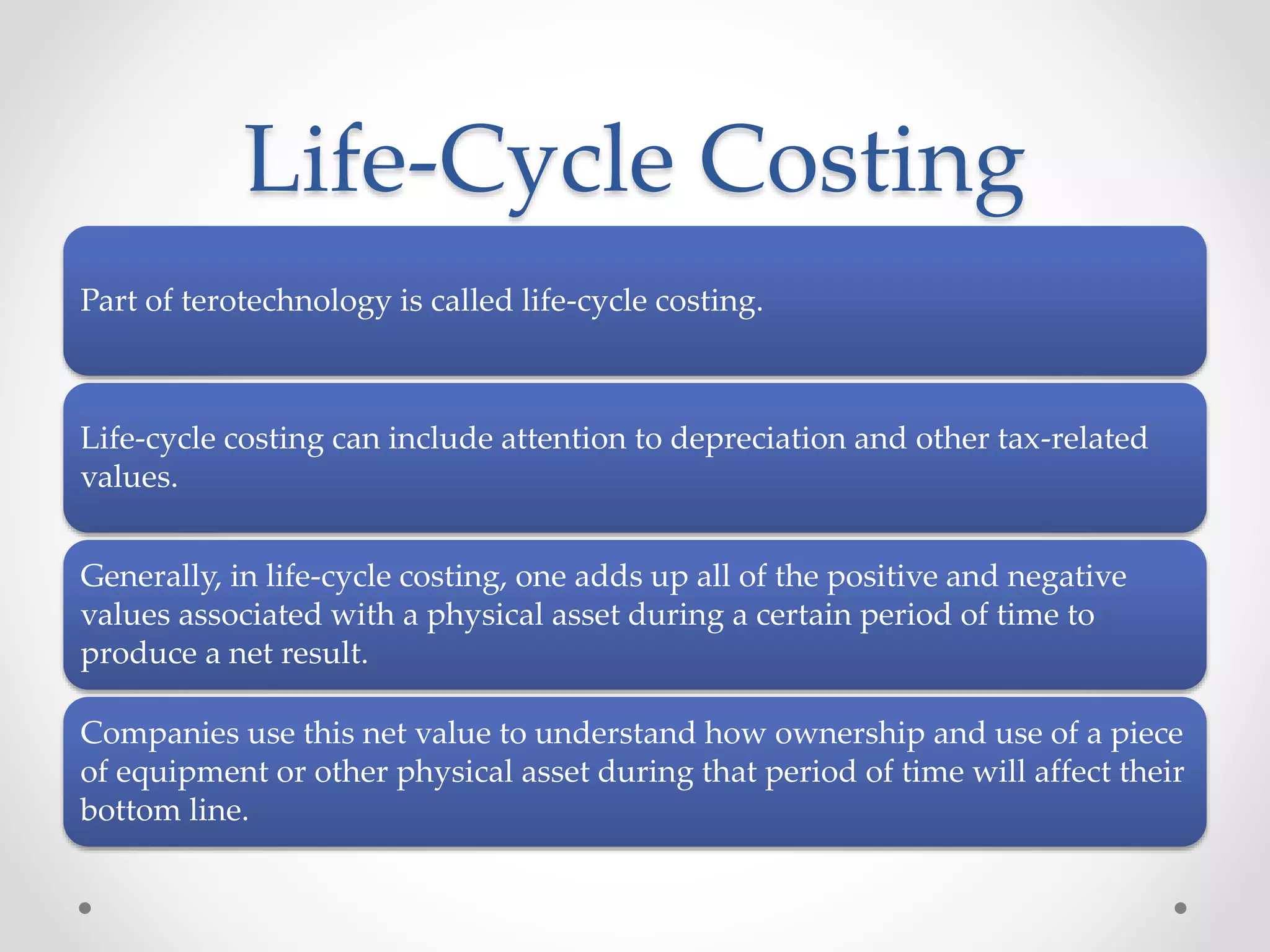
Part of terotechnology is called life-cycle costing.
Life-cycle costing can include attention to depreciation and other tax-related
values.
Generally, in life-cycle costing, one adds up all of the positive and negative
values associated with a physical asset during a certain period of time to
produce a net result.
Companies use this net value to understand how ownership and use of a piece
of equipment or other physical asset during that period of time will affect their
bottom line.
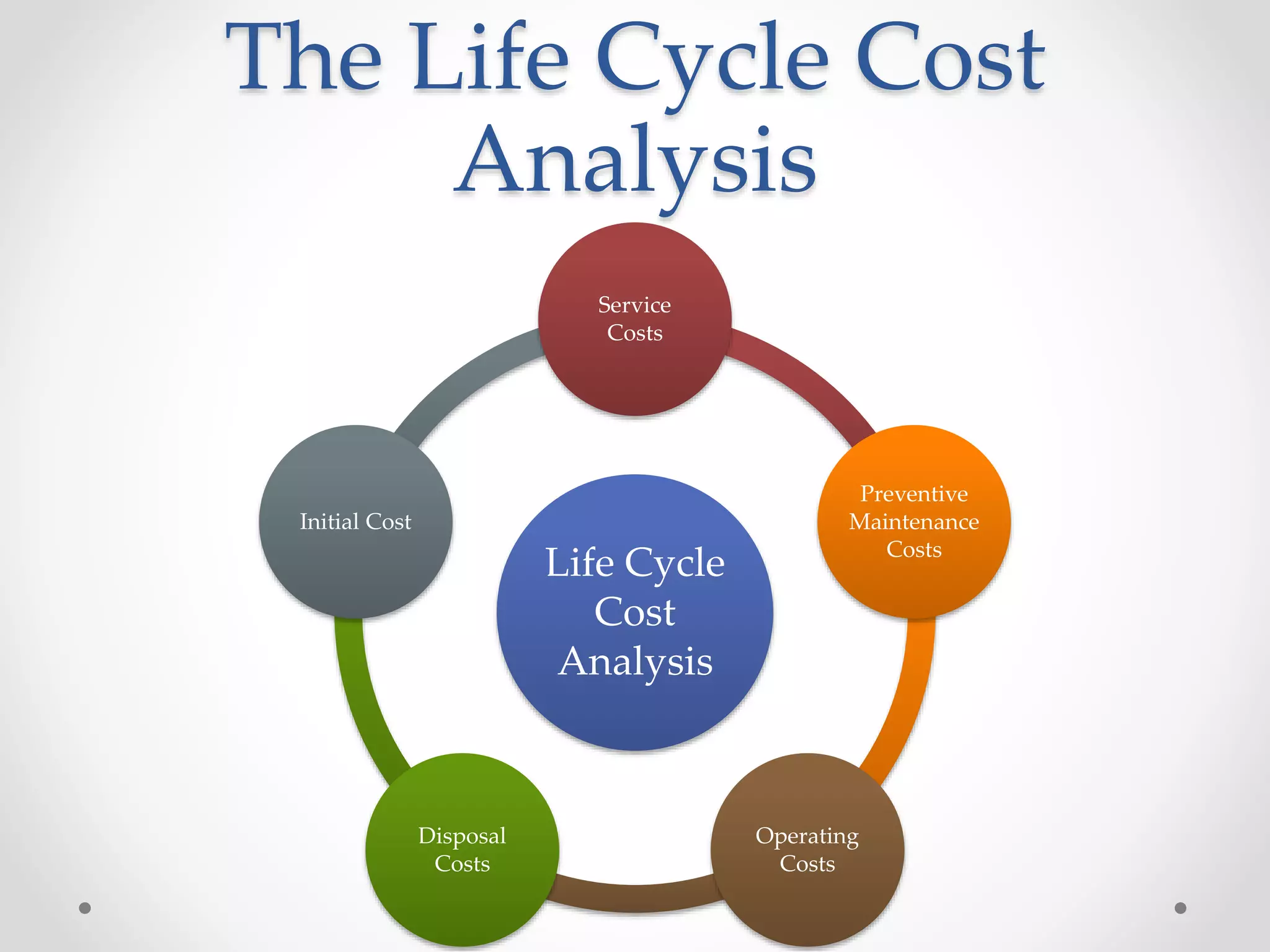
The Life Cycle Cost
Analysis
Life Cycle
Cost
Analysis
Service
Costs
Preventive
Maintenance
Costs
Operating
Costs
Disposal
Costs
Initial Cost
The Life Cycle Cost Curve
Relation with
Maintenance
A big part of
terotechnology is in
understanding the role of
maintenance and the
value of a warranty.
Many larger pieces of
equipment and other
physical assets come with
warranties offered by the
manufacturer or vendor.
In terotechnology, the way
in which these warranties
provide value relative to
projected costs is
examined.
The Bath-Tub Curve
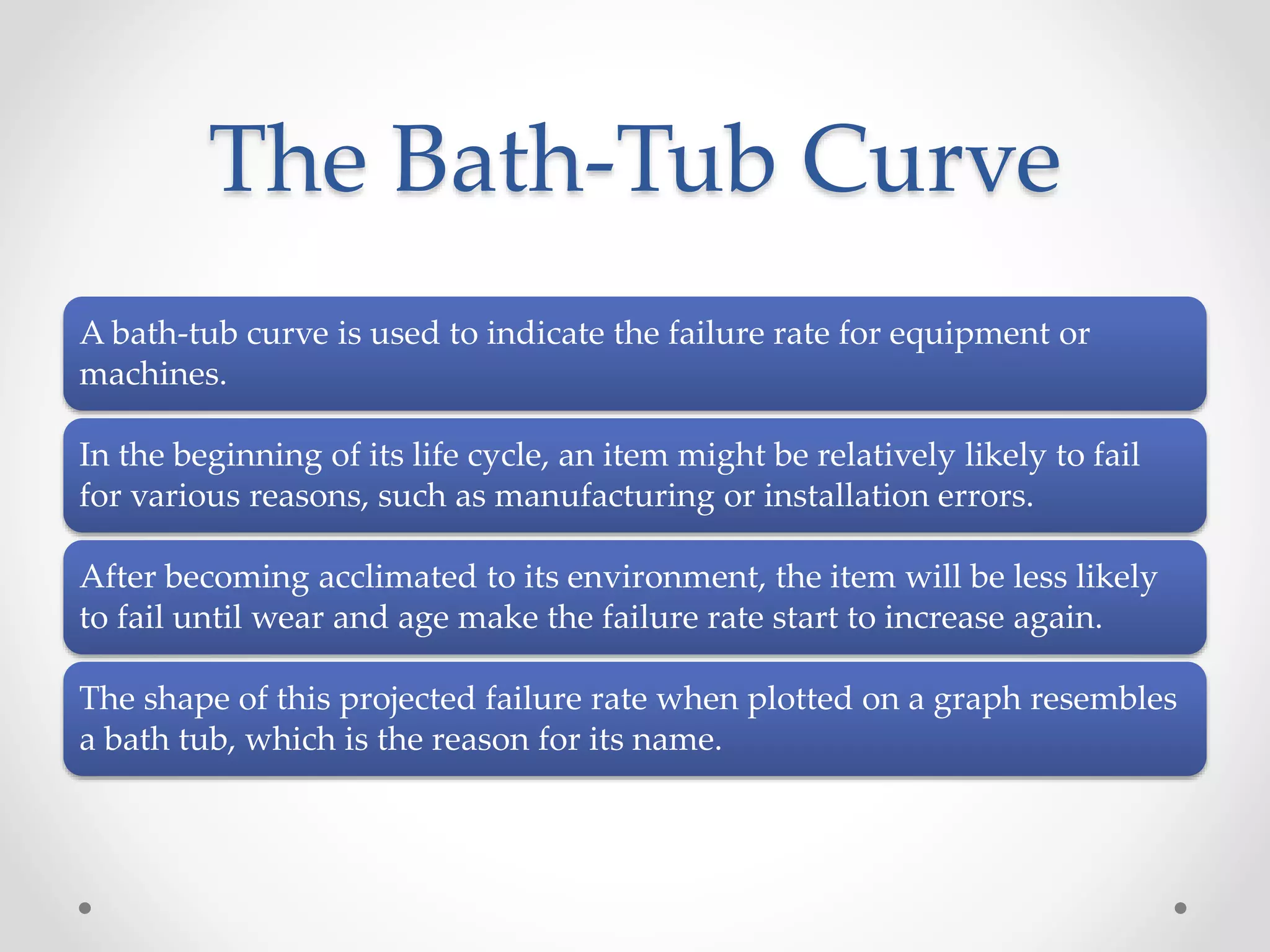
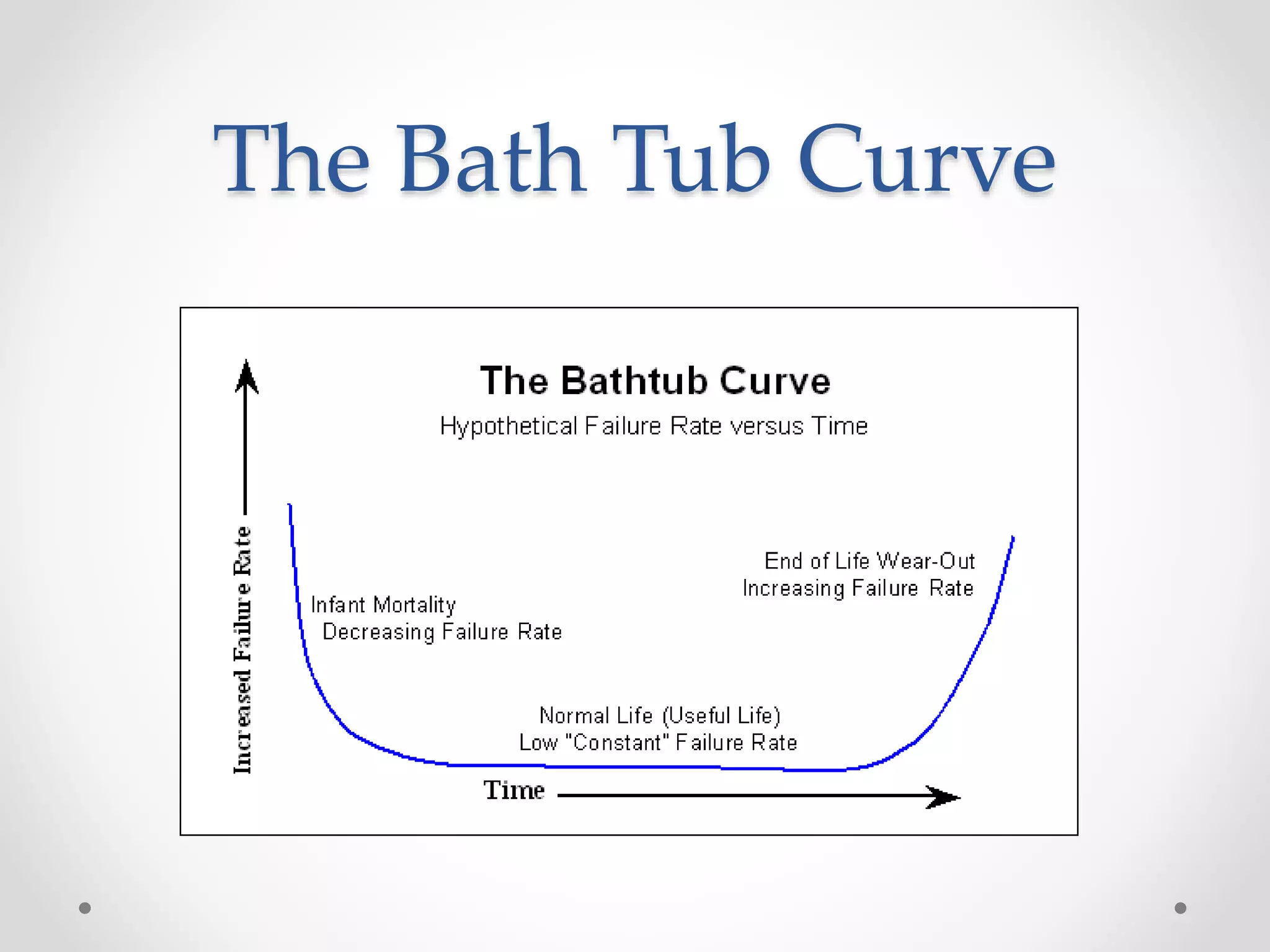
A bath-tub curve is used to indicate the failure rate for equipment or
machines.
In the beginning of its life cycle, an item might be relatively likely to fail
for various reasons, such as manufacturing or installation errors.
After becoming acclimated to its environment, the item will be less likely
to fail until wear and age make the failure rate start to increase again.
The shape of this projected failure rate when plotted on a graph resembles
a bath tub, which is the reason for its name.
The Bath Tub Curve
Tero Technology
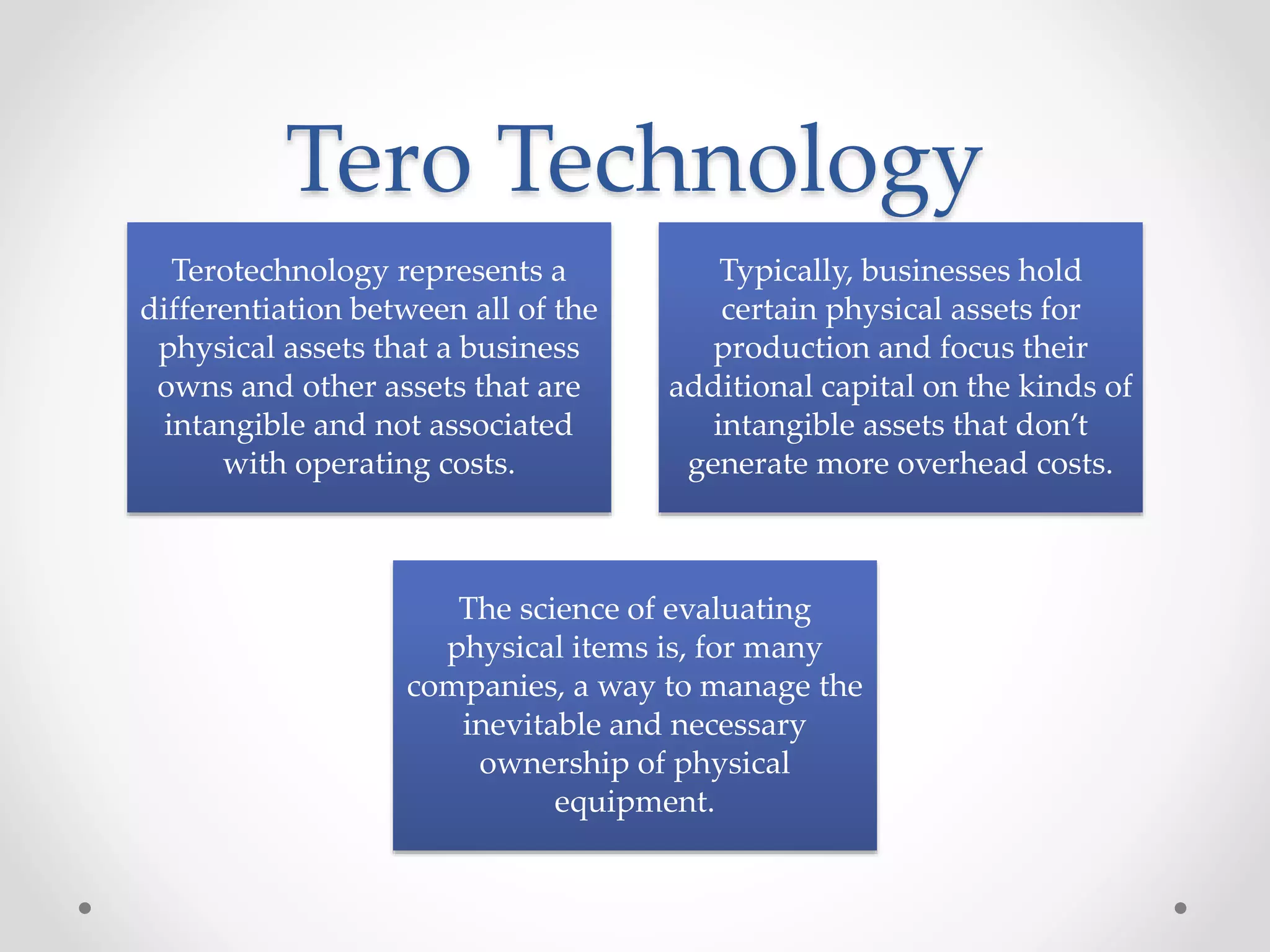
Terotechnology represents a
differentiation between all of the
physical assets that a business
owns and other assets that are
intangible and not associated
with operating costs.
Typically, businesses hold
certain physical assets for
production and focus their
additional capital on the kinds of
intangible assets that don’t
generate more overhead costs.
The science of evaluating
physical items is, for many
companies, a way to manage the
inevitable and necessary
ownership of physical
equipment.
Tero Technology
Vendors’ Use
Vendors also apply terotechnology to their products.
These are the same products that will become assets for buyers, so
vendors also can benefit from the same observational science to know
more about the value of their products in the hands of others.
Overall, this kind of analysis is a way for businesses to keep tabs on
the expenses involved in owning large machines or other gear, as well
as office space and other physical parts of their business.
Tribology
Maintenance Management
Introduction
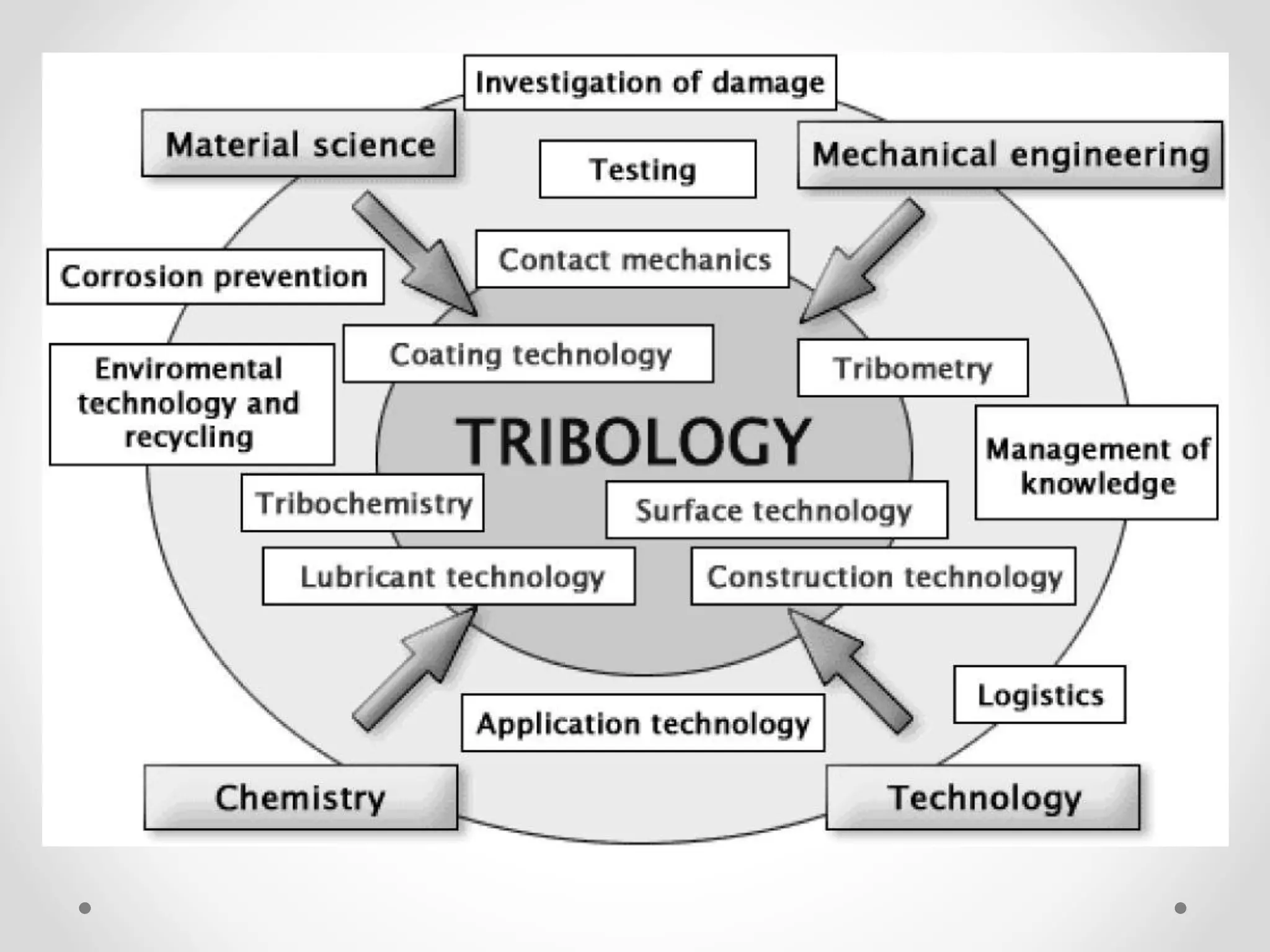
Tribology is the science and
engineering of interacting surfaces
in relative motion.
It includes the study and
application of the principles
of friction, lubrication and wear.
Tribology is a branch
of mechanical
engineering and materials science.
Etymology
The word tribology derives from the Greek root τριβ- of
the verb τρίβω, tribo, "I rub" in classic Greek; and the
suffix -logy from -λογία, -logia "study of", "knowledge
of".
It was coined by the British physicist David Tabor, and
also by Peter Jost in 1964, a lubrication expert who
noticed the problems with increasing friction on
machines, and started the new discipline of tribology.
Applications and Fields
Tribology
Individual Components
Assemblies or Products
Manufacturing Processes
Construction/Exploration
Natural Phenomena
Fundamentals
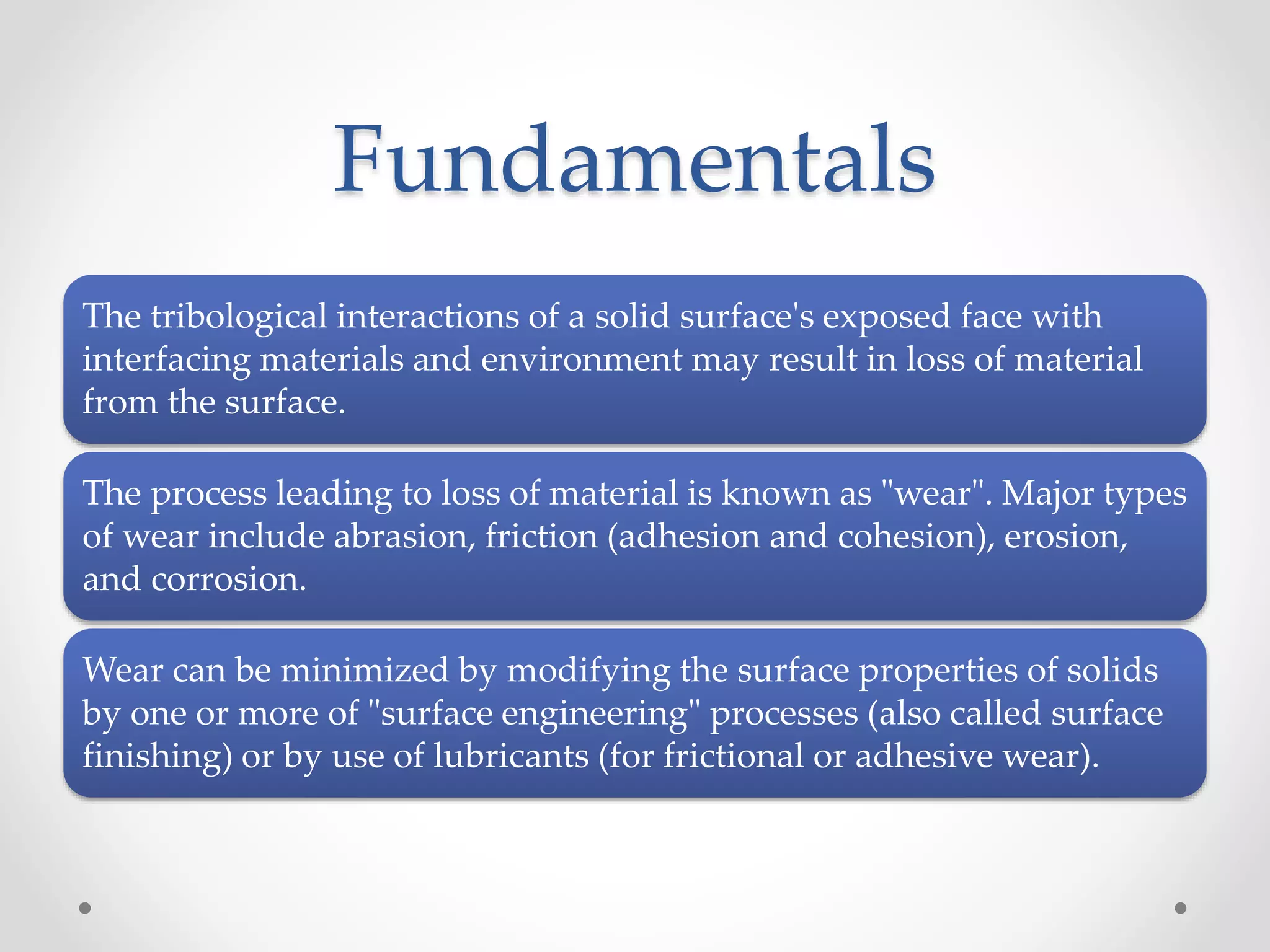
The tribological interactions of a solid surface's exposed face with
interfacing materials and environment may result in loss of material
from the surface.
The process leading to loss of material is known as "wear". Major types
of wear include abrasion, friction (adhesion and cohesion), erosion,
and corrosion.
Wear can be minimized by modifying the surface properties of solids
by one or more of "surface engineering" processes (also called surface
finishing) or by use of lubricants (for frictional or adhesive wear).
Fundamentals
Fundamentals
Estimated direct and consequential annual loss to industries in the
USA due to wear is approximately 1-2% of GDP. (Heinz, 1987).
Engineered surfaces extend the working life of both original and
recycled and resurfaced equipment, thus saving large sums of money
and leading to conservation of material, energy and the environment.
Methodologies to minimize wear include systematic approaches to
diagnose the wear and to prescribe appropriate solutions.
Important Methods
Point like contact theory
was established by
Heinrich Hertz in 1880s.
Fluid lubrication
dynamics was established
by Arnold Johannes
Sommerfeld in 1900s.
Important Methods
Terotechnology, where
multidisciplinary engineering and
management techniques are used to
protect equipment and machinery from
degradation (Peter Jost, 1972)
Horst Czichos's systems approach,
where appropriate material is selected
by checking properties against
tribological requirements under
operating environment (H.
Czichos,1978)
Important Methods
Asset Management by Material Prognosis - a
concept similar to terotechnology which has
been introduced by the US Military (DARPA)
for upkeep of equipment in good health and
start-ready condition for 24 hours. Good health
monitoring systems combined with appropriate
remedies at maintenance and repair stages have
led to improved performance, reliability and
extended life cycle of the assets, such as
advanced military hardware and civil aircraft.
Fundamentals
• 1. Solid/boundary friction
• 2. Mixed friction
• 3. Fluid friction
• on the basis of the “Stribeck curve”.
These curves clearly show the minimum
value of friction as the demarcation
between full fluid-film lubrication and
some solid asperity interactions.
Friction
regimes for
sliding
lubricated
surfaces have
been broadly
categorized
into:
Fundamentals
Stribeck and others
systematically studied the
variation of friction between
two liquid lubricated surfaces
as a function of a dimensionless
lubrication parameter
ηN/P,
where η is the dynamic viscosity, N
the speed (e.g. revolutions per
minute of a bearing) and P the load
projected on to the geometrical
surface.
Stibeck Curve
New Areas of Tribology
Since the 1990s, new areas of
tribology have emerged,
including
the nanotribology, biotribology,
and green tribology.
These interdisciplinary areas
study the friction, wear and
lubrication at the nanoscale, in
biomedical applications (e.g.,
human joint prosthetics, dental
materials), and ecological aspects
of friction, lubrication and wear.
Harsh Thagela
Himanshu Ahlawat
Pulkit Sharma
DFT - VI
Thank You!

Tero technology and Tribology - Maintenance Management

  • 1.
  • 2.
  • 3.
    Introduction Terotechnology is akind of applied science for measuring the operational values of physical assets. It is concerned with things such as the installation, maintenance and replacement of those assets. Professionals who are involved in terotechnology look at tangible assets of a company or business such as buildings, equipment and vehicles. They measure how these items will provide a net value for certain years until they need to be replaced.
  • 4.
    Life-Cycle Costing Part ofterotechnology is called life-cycle costing. Life-cycle costing can include attention to depreciation and other tax-related values. Generally, in life-cycle costing, one adds up all of the positive and negative values associated with a physical asset during a certain period of time to produce a net result. Companies use this net value to understand how ownership and use of a piece of equipment or other physical asset during that period of time will affect their bottom line.
  • 5.
    The Life CycleCost Analysis Life Cycle Cost Analysis Service Costs Preventive Maintenance Costs Operating Costs Disposal Costs Initial Cost
  • 6.
    The Life CycleCost Curve
  • 7.
    Relation with Maintenance A bigpart of terotechnology is in understanding the role of maintenance and the value of a warranty. Many larger pieces of equipment and other physical assets come with warranties offered by the manufacturer or vendor. In terotechnology, the way in which these warranties provide value relative to projected costs is examined.
  • 8.
    The Bath-Tub Curve Abath-tub curve is used to indicate the failure rate for equipment or machines. In the beginning of its life cycle, an item might be relatively likely to fail for various reasons, such as manufacturing or installation errors. After becoming acclimated to its environment, the item will be less likely to fail until wear and age make the failure rate start to increase again. The shape of this projected failure rate when plotted on a graph resembles a bath tub, which is the reason for its name.
  • 9.
  • 10.
    Tero Technology Terotechnology representsa differentiation between all of the physical assets that a business owns and other assets that are intangible and not associated with operating costs. Typically, businesses hold certain physical assets for production and focus their additional capital on the kinds of intangible assets that don’t generate more overhead costs. The science of evaluating physical items is, for many companies, a way to manage the inevitable and necessary ownership of physical equipment.
  • 11.
  • 12.
    Vendors’ Use Vendors alsoapply terotechnology to their products. These are the same products that will become assets for buyers, so vendors also can benefit from the same observational science to know more about the value of their products in the hands of others. Overall, this kind of analysis is a way for businesses to keep tabs on the expenses involved in owning large machines or other gear, as well as office space and other physical parts of their business.
  • 13.
  • 14.
    Introduction Tribology is thescience and engineering of interacting surfaces in relative motion. It includes the study and application of the principles of friction, lubrication and wear. Tribology is a branch of mechanical engineering and materials science.
  • 16.
    Etymology The word tribologyderives from the Greek root τριβ- of the verb τρίβω, tribo, "I rub" in classic Greek; and the suffix -logy from -λογία, -logia "study of", "knowledge of". It was coined by the British physicist David Tabor, and also by Peter Jost in 1964, a lubrication expert who noticed the problems with increasing friction on machines, and started the new discipline of tribology.
  • 17.
  • 18.
  • 19.
  • 20.
  • 21.
  • 22.
  • 23.
    Fundamentals The tribological interactionsof a solid surface's exposed face with interfacing materials and environment may result in loss of material from the surface. The process leading to loss of material is known as "wear". Major types of wear include abrasion, friction (adhesion and cohesion), erosion, and corrosion. Wear can be minimized by modifying the surface properties of solids by one or more of "surface engineering" processes (also called surface finishing) or by use of lubricants (for frictional or adhesive wear).
  • 24.
  • 25.
    Fundamentals Estimated direct andconsequential annual loss to industries in the USA due to wear is approximately 1-2% of GDP. (Heinz, 1987). Engineered surfaces extend the working life of both original and recycled and resurfaced equipment, thus saving large sums of money and leading to conservation of material, energy and the environment. Methodologies to minimize wear include systematic approaches to diagnose the wear and to prescribe appropriate solutions.
  • 26.
    Important Methods Point likecontact theory was established by Heinrich Hertz in 1880s. Fluid lubrication dynamics was established by Arnold Johannes Sommerfeld in 1900s.
  • 27.
    Important Methods Terotechnology, where multidisciplinaryengineering and management techniques are used to protect equipment and machinery from degradation (Peter Jost, 1972) Horst Czichos's systems approach, where appropriate material is selected by checking properties against tribological requirements under operating environment (H. Czichos,1978)
  • 28.
    Important Methods Asset Managementby Material Prognosis - a concept similar to terotechnology which has been introduced by the US Military (DARPA) for upkeep of equipment in good health and start-ready condition for 24 hours. Good health monitoring systems combined with appropriate remedies at maintenance and repair stages have led to improved performance, reliability and extended life cycle of the assets, such as advanced military hardware and civil aircraft.
  • 29.
    Fundamentals • 1. Solid/boundaryfriction • 2. Mixed friction • 3. Fluid friction • on the basis of the “Stribeck curve”. These curves clearly show the minimum value of friction as the demarcation between full fluid-film lubrication and some solid asperity interactions. Friction regimes for sliding lubricated surfaces have been broadly categorized into:
  • 30.
    Fundamentals Stribeck and others systematicallystudied the variation of friction between two liquid lubricated surfaces as a function of a dimensionless lubrication parameter ηN/P, where η is the dynamic viscosity, N the speed (e.g. revolutions per minute of a bearing) and P the load projected on to the geometrical surface.
  • 31.
  • 32.
    New Areas ofTribology Since the 1990s, new areas of tribology have emerged, including the nanotribology, biotribology, and green tribology. These interdisciplinary areas study the friction, wear and lubrication at the nanoscale, in biomedical applications (e.g., human joint prosthetics, dental materials), and ecological aspects of friction, lubrication and wear.
  • 33.
    Harsh Thagela Himanshu Ahlawat PulkitSharma DFT - VI Thank You!