IOSR Journal of Mathematics (IOSR-JM)
e-ISSN: 2278-5728, p-ISSN: 2319-765X. Volume 11, Issue 6 Ver. III (Nov. - Dec. 2015), PP 44-49
www.iosrjournals.org
DOI: 10.9790/5728-11634449 www.iosrjournals.org 44 | Page
On Certain Classess of Multivalent Functions
P. N. Kamble, M.G.Shrigan
1
Department of Mathematics Dr. Babasaheb Ambedkar Marathwada University, Aurangabad – 431004, (M.S.),
India
2
Department of Mathematics Dr D Y Patil School of Engineering & Technology, Pune - 412205, (M.S.), India
Abstract: In this we defined certain analytic p-valent function with negative type denoted by 𝜏 𝑝 . We obtained
sharp results concerning coefficient bounds, distortion theorem belonging to the class 𝜏 𝑝 .
Keywords: p-valent function, distortion theorem, convexity.
Mathematics Subject Classification (2000): 30C45, 30C50
I. Introduction
Let A (p) denote the class of f normalized univalent functions of the form
f z = zp
+ an+pzn+p
∞
n=1
, (an+p ≥ 0, p ∈ ℕ = {1,2,3, … }) (1.1)
analytic and p-valent in the unit disc E = {z : z  C;|z| < 1}.
A function f(z) Є A (p) is said to in the class of Sp
∗
() p-valently starlike function of order α (0 ≤ α < p)
if it satisfies, for z  E, the condition
1.2)(





f(z)
(z)fz
Re
'
Furthermore, a function f(z)  A (p) is said to in the class 𝒦p() of p-valently convex function of
order α (0 ≤ α < p) if it satisfies, for z  E, the condition
1.3)(1 








(z)f
(z)fz
Re '
''
It follows from the definition (1.2) and (1.3) that
f(z) 𝒦p() ⇔
zf ′ z
p
 Sp
∗
() (0 ≤ α < p) (1.4)
whose special case, when  = 0 is the familiar Alexander theorem (see for example [1] p.43, Theorem 2.12). We
also note that
𝒦p   Sp
∗
 (0 ≤ α < p)
Sp
∗
  Sp
∗
0  Sp
∗
( 0 ≤ α < p)
and
𝒦p   𝒦p 0  𝒦p (0 ≤ α < p)
Where Sp
∗
and 𝒦p denote the subclasses of A (p) consisting of p-valently starlike and convex functions
in unit disk E respectively.
Let τp(, ) denote the subclass of A (p) consisting of functions analytic and p-valent which can be express in
the form
f z = zp
− an+pzn+p
∞
n=1
, an+p ≥ 0
The subclass τp ,  of p-valent functions with negative coefficients is studied by H. M. Srivastava
and M. K. Auof [2].
Following S. Owa [3], we say that a function f(z) τp is in the subclass τp(, ) if and only if
On Certain Classess of Multivalent Functions
DOI: 10.9790/5728-11634449 www.iosrjournals.org 45 | Page
f′
z − pz1−p
f′ z + pz1−p(1 − 2α)
< β
The subclass τp ,  was studied by Goel and Sohi [4]. Moreover S. Owa studied several
interesting results on radius of convexity for p-valent function with negative coefficients. In this present paper
we investigate sharp results concerning coefficient inequalities, distortion theorem and radius of convexity for
class the τp ,  .
II. Main Result
Theorem 2.1 A function
f z = zp
− an+pzn+p
∞
n=1
, an+p ≥ 0
is in the class τp ,  if and only if
n + p (1 + β) an+p
∞
n=1
≤ 2β 1 − α p (2.1)
The result is sharp.
Proof: Assume (2.1) holds. We show that f z  τp(α, β).
Let z = 1. We have,
f z = zp
− an+pzn+p
∞
n=1
(2.2)
f′ z = pzp−1
− an+p n + p zn+p−1
∞
n=1
(2.3)
Now,
f′
z − pzp−1
= pzp−1
− an+p n + p zn+p−1
∞
n=1
− pzp−1
= − an+p n + p zn+p−1
∞
n=1
Also,
β f′
z + pzp−1
(1 − 2α)
= βpzp−1
−  an+p n + p zn+p−1
∞
n=1
+ βpzp−1
(1 − 2α)
= − an+p n + p zn+p−1
∞
n=1
+ 2βpzp−1
− 2αβpzp−1
Then,
f′
z − pzp−1
− β f′
z + pzp−1
(1 − 2α)
= − an+p n + p zn+p−1
∞
n=1
− − an+p n + p zn+p−1
∞
n=1
+ 2βpzp−1
− 2αβpzp−1
since 𝑧 = 1
𝑓′
𝑧 − 𝑝𝑧 𝑝−1
− 𝛽 𝑓′
𝑧 + 𝑝𝑧 𝑝−1
(1 − 2𝛼)
≤ 𝑛 + 𝑝 𝑎 𝑛+𝑝 + 
∞
𝑛=1
𝑛 + 𝑝 𝑎 𝑛+𝑝
∞
𝑛=1
− 2𝛽𝑝 + 2𝛼 𝑝
≤ (1 +  ) 𝑛 + 𝑝 𝑎 𝑛+𝑝
∞
𝑛=1
− 2𝛽𝑝 + 2𝛼𝛽𝑝
≤ (1 +  ) 𝑛 + 𝑝 𝑎 𝑛+𝑝
∞
𝑛=1
− 2𝛽(1 − )𝑝
≤ 0
On Certain Classess of Multivalent Functions
DOI: 10.9790/5728-11634449 www.iosrjournals.org 46 | Page
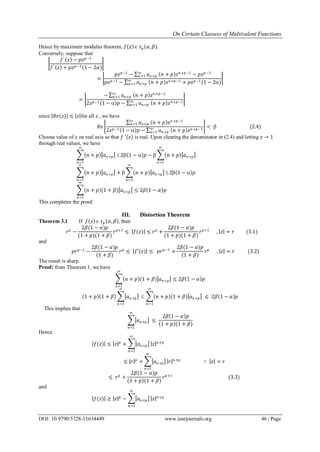
Hence by maximum modulus theorem, 𝑓 𝑧  𝜏 𝑝(𝛼, 𝛽).
Conversely, suppose that
𝑓′
𝑧 − 𝑝𝑧 𝑝−1
𝑓′ 𝑧 + 𝑝𝑧 𝑝−1(1 − 2𝛼)
=
𝑝𝑧 𝑝−1
− 𝑎 𝑛+𝑝 𝑛 + 𝑝 𝑧 𝑛+𝑝−1∞
𝑛=1 − 𝑝𝑧 𝑝−1
𝑝𝑧 𝑝−1 − 𝑎 𝑛+𝑝 𝑛 + 𝑝 𝑧 𝑛+𝑝−1∞
𝑛=1 + 𝑝𝑧 𝑝−1(1 − 2)
=
− 𝑎 𝑛+𝑝 𝑛 + 𝑝 𝑧 𝑛+𝑝−1∞
𝑛=1
2𝑧 𝑝−1 1 −  𝑝 − 𝑎 𝑛+𝑝 𝑛 + 𝑝 𝑧 𝑛+𝑝−1∞
𝑛=1
since 𝑅𝑒(𝑧) ≤ 𝑧 for all z , we have
𝑅𝑒
𝑎 𝑛+𝑝 𝑛 + 𝑝 𝑧 𝑛+𝑝−1∞
𝑛=1
2𝑧 𝑝−1 1 −  𝑝 − 𝑎 𝑛+𝑝 𝑛 + 𝑝 𝑧 𝑛+𝑝−1∞
𝑛=1
<  (2.4)
Choose value of z on real axis so that 𝑓 ′ 𝑧 is real. Upon clearing the denominator in (2.4) and letting 𝑧 → 1
through real values, we have
𝑛 + 𝑝 𝑎 𝑛+𝑝 
∞
𝑛=1
2 1 −  𝑝 −  𝑛 + 𝑝 𝑎 𝑛+𝑝
∞
𝑛=1
𝑛 + 𝑝 𝑎 𝑛+𝑝 +  𝑛 + 𝑝 𝑎 𝑛+𝑝
∞
𝑛=1

∞
𝑛=1
2 1 −  𝑝
𝑛 + 𝑝 (1 + 𝛽) 𝑎 𝑛+𝑝
∞
𝑛=1
≤ 2𝛽 1 − 𝛼 𝑝
This completes the proof.
III. Distortion Theorem
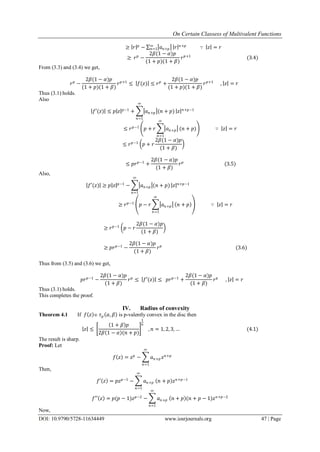
Theorem 3.1 If 𝑓 𝑧  𝜏 𝑝 𝛼, 𝛽 , then
𝑟 𝑝
−
2𝛽(1 − 𝛼)𝑝
(1 + 𝑝)(1 + 𝛽)
𝑟 𝑝+1
≤ 𝑓(𝑧) ≤ 𝑟 𝑝
+
2𝛽(1 − 𝛼)𝑝
(1 + 𝑝)(1 + 𝛽)
𝑟 𝑝+1
, 𝑧 = 𝑟 (3.1)
and
𝑝𝑟 𝑝−1
−
2𝛽(1 − 𝛼)𝑝
(1 + 𝛽)
𝑟 𝑝
≤ 𝑓′(𝑧) ≤ 𝑝𝑟 𝑝−1
+
2𝛽(1 − 𝛼)𝑝
(1 + 𝛽)
𝑟 𝑝
, 𝑧 = 𝑟 (3.2)
The result is sharp.
Proof: from Theorem 1, we have
𝑛 + 𝑝 (1 + 𝛽) 𝑎 𝑛+𝑝
∞
𝑛=1
≤ 2𝛽 1 − 𝛼 𝑝
1 + 𝑝 1 + 𝛽 𝑎 𝑛+𝑝
∞
𝑛=1
 𝑛 + 𝑝 (1 + 𝛽) 𝑎 𝑛+𝑝
∞
𝑛=1
≤ 2𝛽 1 − 𝛼 𝑝
This implies that
𝑎 𝑛+𝑝
∞
𝑛=1
≤
2𝛽 1 − 𝛼 𝑝
1 + 𝑝 (1 + 𝛽)
Hence
𝑓(𝑧) ≤ 𝑧 𝑝
+ 𝑎 𝑛+𝑝
∞
𝑛=1
𝑧 𝑛+𝑝
≤ 𝑟 𝑝
+ 𝑎 𝑛+𝑝
∞
𝑛=1
𝑟 𝑛+𝑝
∵ 𝑧 = 𝑟
≤ 𝑟 𝑝
+
2𝛽(1 − 𝛼)𝑝
(1 + 𝑝)(1 + 𝛽)
𝑟 𝑝+1
(3.3)
and
𝑓(𝑧) ≥ 𝑧 𝑝
− 𝑎 𝑛+𝑝
∞
𝑛=1
𝑧 𝑛+𝑝
On Certain Classess of Multivalent Functions
DOI: 10.9790/5728-11634449 www.iosrjournals.org 47 | Page
≥ 𝑟 𝑝
− 𝑎 𝑛+𝑝
∞
𝑛=1 𝑟 𝑛+𝑝
∵ 𝑧 = 𝑟
≥ 𝑟 𝑝
−
2𝛽(1 − 𝛼)𝑝
(1 + 𝑝)(1 + 𝛽)
𝑟 𝑝+1
(3.4)
From (3.3) and (3.4) we get,
𝑟 𝑝
−
2𝛽(1 − 𝛼)𝑝
(1 + 𝑝)(1 + 𝛽)
𝑟 𝑝+1
≤ 𝑓(𝑧) ≤ 𝑟 𝑝
+
2𝛽(1 − 𝛼)𝑝
(1 + 𝑝)(1 + 𝛽)
𝑟 𝑝+1
, 𝑧 = 𝑟
Thus (3.1) holds.
Also
𝑓′(𝑧) ≤ 𝑝 𝑧 𝑝−1
+ 𝑎 𝑛+𝑝 (𝑛 + 𝑝)
∞
𝑛=1
𝑧 𝑛+p−1
≤ 𝑟 𝑝−1
𝑝 + 𝑟 𝑎 𝑛+𝑝
∞
𝑛=1
(𝑛 + 𝑝) ∵ 𝑧 = 𝑟
≤ 𝑟 𝑝−1
𝑝 + 𝑟
2𝛽(1 − 𝛼)𝑝
(1 + 𝛽)
≤ 𝑝𝑟 𝑝−1
+
2𝛽(1 − 𝛼)𝑝
(1 + 𝛽)
𝑟 𝑝
(3.5)
Also,
𝑓′(𝑧) ≥ 𝑝 𝑧 𝑝−1
− 𝑎 𝑛+𝑝 (𝑛 + 𝑝)
∞
𝑛=1
𝑧 𝑛+𝑝−1
≥ 𝑟 𝑝−1
𝑝 − 𝑟 𝑎 𝑛+𝑝
∞
𝑛=1
𝑛 + 𝑝 ∵ 𝑧 = 𝑟
≥ 𝑟 𝑝−1
𝑝 − 𝑟
2𝛽(1 − 𝛼)𝑝
(1 + 𝛽)
≥ 𝑝𝑟 𝑝−1
−
2𝛽(1 − 𝛼)𝑝
(1 + 𝛽)
𝑟 𝑝
(3.6)
Thus from (3.5) and (3.6) we get,
𝑝𝑟 𝑝−1
−
2𝛽(1 − 𝛼)𝑝
(1 + 𝛽)
𝑟 𝑝
≤ 𝑓′(𝑧) ≤ 𝑝𝑟 𝑝−1
+
2𝛽(1 − 𝛼)𝑝
(1 + 𝛽)
𝑟 𝑝
, 𝑧 = 𝑟
Thus (3.1) holds.
This completes the proof.
IV. Radius of convexity
Theorem 4.1 If 𝑓 𝑧  𝜏 𝑝 𝛼, 𝛽 is p-valently convex in the disc then
𝑧 ≤
1 + 𝛽 𝑝
2𝛽 1 − 𝛼 (𝑛 + 𝑝)
1
𝑛
, 𝑛 = 1, 2, 3, … (4.1)
The result is sharp.
Proof: Let
𝑓 𝑧 = 𝑧 𝑝
− 𝑎 𝑛+𝑝 𝑧 𝑛+𝑝
∞
𝑛=1
Then,
𝑓′ 𝑧 = 𝑝𝑧 𝑝−1
− 𝑎 𝑛+𝑝 𝑛 + 𝑝 𝑧 𝑛+𝑝−1
∞
𝑛=1
𝑓′′ 𝑧 = 𝑝(𝑝 − 1)𝑧 𝑝−2
− 𝑎 𝑛+𝑝 𝑛 + 𝑝 (𝑛 + 𝑝 − 1)𝑧 𝑛+𝑝−2
∞
𝑛=1
Now,
On Certain Classess of Multivalent Functions
DOI: 10.9790/5728-11634449 www.iosrjournals.org 48 | Page
1 +
𝑧𝑓′′
(𝑧)
𝑓′ (𝑧)
= 1 +
𝑝(𝑝 − 1)𝑧 𝑝−1
− 𝑎 𝑛+𝑝 𝑛 + 𝑝 (𝑛 + 𝑝 − 1)𝑧 𝑛+𝑝−1∞
𝑛=1
𝑝𝑧 𝑝−1 − 𝑎 𝑛+𝑝 𝑛 + 𝑝 𝑧 𝑛+𝑝−1∞
𝑛=1
=
𝑝𝑧 𝑝−1
− 𝑎 𝑛+𝑝 𝑛 + 𝑝 𝑧 𝑛+𝑝−1∞
𝑛=1 + 𝑝(𝑝 − 1)𝑧 𝑝−1
− 𝑎 𝑛+𝑝 𝑛 + 𝑝 (𝑛 + 𝑝 − 1)𝑧 𝑛+𝑝−1∞
𝑛=1
𝑝𝑧 𝑝−1 − 𝑎 𝑛+𝑝 𝑛 + 𝑝 𝑧 𝑛+𝑝−1∞
𝑛=1
=
𝑝2
𝑧 𝑝−1
− 𝑎 𝑛+𝑝 𝑛 + 𝑝 2
𝑧 𝑛+𝑝−1∞
𝑛=1
𝑝𝑧 𝑝−1 − 𝑎 𝑛+𝑝 𝑛 + 𝑝 𝑧 𝑛+𝑝−1∞
𝑛=1
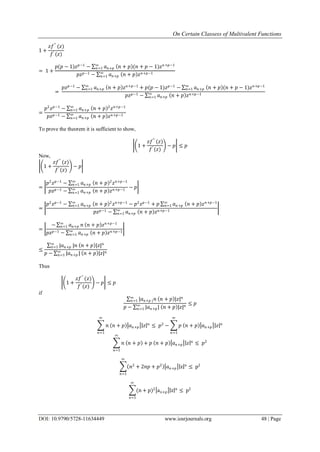
To prove the theorem it is sufficient to show,
1 +
𝑧𝑓′′
(𝑧)
𝑓′ (𝑧)
− 𝑝 ≤ 𝑝
Now,
1 +
𝑧𝑓′′
(𝑧)
𝑓′ (𝑧)
− 𝑝
=
𝑝2
𝑧 𝑝−1
− 𝑎 𝑛+𝑝 𝑛 + 𝑝 2
𝑧 𝑛+𝑝−1∞
𝑛=1
𝑝𝑧 𝑝−1 − 𝑎 𝑛+𝑝 𝑛 + 𝑝 𝑧 𝑛+𝑝−1∞
𝑛=1
− 𝑝
=
𝑝2
𝑧 𝑝−1
− 𝑎 𝑛+𝑝 𝑛 + 𝑝 2
𝑧 𝑛+𝑝−1
− 𝑝2
𝑧 𝑝−1
+ 𝑝 𝑎 𝑛+𝑝 𝑛 + 𝑝 𝑧 𝑛+𝑝−1∞
𝑛=1
∞
𝑛=1
𝑝𝑧 𝑝−1 − 𝑎 𝑛+𝑝 𝑛 + 𝑝 𝑧 𝑛+𝑝−1∞
𝑛=1
=
− 𝑎 𝑛+𝑝 𝑛 𝑛 + 𝑝 𝑧 𝑛+𝑝−1∞
𝑛=1
𝑝𝑧 𝑝−1 − 𝑎 𝑛+𝑝 𝑛 + 𝑝 𝑧 𝑛+𝑝−1∞
𝑛=1
≤
|𝑎 𝑛+𝑝 |𝑛 𝑛 + 𝑝 |𝑧| 𝑛∞
𝑛=1
𝑝 − |𝑎 𝑛+𝑝 | 𝑛 + 𝑝 |𝑧| 𝑛∞
𝑛=1
Thus
1 +
𝑧𝑓′′
(𝑧)
𝑓′ (𝑧)
− 𝑝 ≤ 𝑝
if
|𝑎 𝑛+𝑝 | 𝑛 𝑛 + 𝑝 |𝑧| 𝑛∞
𝑛=1
𝑝 − |𝑎 𝑛+𝑝| 𝑛 + 𝑝 |𝑧| 𝑛∞
𝑛=1
≤ 𝑝
𝑛 𝑛 + 𝑝 𝑎 𝑛+𝑝 𝑧 𝑛
∞
𝑛=1
≤ 𝑝2
− 𝑝 𝑛 + 𝑝 𝑎 𝑛+𝑝 𝑧 𝑛
∞
𝑛=1
𝑛 𝑛 + 𝑝 + 𝑝 𝑛 + 𝑝 𝑎 𝑛+𝑝 𝑧 𝑛
∞
𝑛=1
≤ 𝑝2
𝑛2
+ 2𝑛𝑝 + 𝑝2
𝑎 𝑛+𝑝 z n
∞
𝑛=1
≤ p2
(n + p)2
an+p z n
∞
n=1
≤ p2
On Certain Classess of Multivalent Functions
DOI: 10.9790/5728-11634449 www.iosrjournals.org 49 | Page
n + p
p
2
an+p z n
∞
n=1
≤ 1
But from Theorem 1, we get
n + p (1 + β) an+p
2β(1 − α)p
∞
n=1
≤ 1
hence f(z) is p-valently convex if
n + p
p
2
an+p z n
≤
n + p (1 + β) an+p
2β(1 − α)p
n + p
p
2
z n
≤
n + p (1 + β)
2β(1 − α)p
or
z ≤
1 + β p
2β 1 − α (n + p)
1
n
, n = 1, 2, 3, …
This completes the proof.
References
[1]. P. L. Duren, Univalent Functions, Grundlehren Math. Wiss., Vol. 259, Springer, New York 1983.
[2]. H. M. Srivastava, M. K. Aouf, A certain derivative operator and its applications to a new class of analytic and multivalent functions
with negative coefficients, J. Math. Anal.Appl.171, (1992),1-13.
[3]. S. Owa, On certain subclasses of analytic p-valent functions, J. Korean Math. Soc. 20, (1983), 41-58.
[4]. R. M. Goel, N. S. Sohi, Multivalent functions with negative coefficients, Indian J. Pure Appl. Math. 12(7), (1981), 844-853.

On Certain Classess of Multivalent Functions

  • 1.
    IOSR Journal ofMathematics (IOSR-JM) e-ISSN: 2278-5728, p-ISSN: 2319-765X. Volume 11, Issue 6 Ver. III (Nov. - Dec. 2015), PP 44-49 www.iosrjournals.org DOI: 10.9790/5728-11634449 www.iosrjournals.org 44 | Page On Certain Classess of Multivalent Functions P. N. Kamble, M.G.Shrigan 1 Department of Mathematics Dr. Babasaheb Ambedkar Marathwada University, Aurangabad – 431004, (M.S.), India 2 Department of Mathematics Dr D Y Patil School of Engineering & Technology, Pune - 412205, (M.S.), India Abstract: In this we defined certain analytic p-valent function with negative type denoted by 𝜏 𝑝 . We obtained sharp results concerning coefficient bounds, distortion theorem belonging to the class 𝜏 𝑝 . Keywords: p-valent function, distortion theorem, convexity. Mathematics Subject Classification (2000): 30C45, 30C50 I. Introduction Let A (p) denote the class of f normalized univalent functions of the form f z = zp + an+pzn+p ∞ n=1 , (an+p ≥ 0, p ∈ ℕ = {1,2,3, … }) (1.1) analytic and p-valent in the unit disc E = {z : z  C;|z| < 1}. A function f(z) Є A (p) is said to in the class of Sp ∗ () p-valently starlike function of order α (0 ≤ α < p) if it satisfies, for z  E, the condition 1.2)(      f(z) (z)fz Re ' Furthermore, a function f(z)  A (p) is said to in the class 𝒦p() of p-valently convex function of order α (0 ≤ α < p) if it satisfies, for z  E, the condition 1.3)(1          (z)f (z)fz Re ' '' It follows from the definition (1.2) and (1.3) that f(z) 𝒦p() ⇔ zf ′ z p  Sp ∗ () (0 ≤ α < p) (1.4) whose special case, when  = 0 is the familiar Alexander theorem (see for example [1] p.43, Theorem 2.12). We also note that 𝒦p   Sp ∗  (0 ≤ α < p) Sp ∗   Sp ∗ 0  Sp ∗ ( 0 ≤ α < p) and 𝒦p   𝒦p 0  𝒦p (0 ≤ α < p) Where Sp ∗ and 𝒦p denote the subclasses of A (p) consisting of p-valently starlike and convex functions in unit disk E respectively. Let τp(, ) denote the subclass of A (p) consisting of functions analytic and p-valent which can be express in the form f z = zp − an+pzn+p ∞ n=1 , an+p ≥ 0 The subclass τp ,  of p-valent functions with negative coefficients is studied by H. M. Srivastava and M. K. Auof [2]. Following S. Owa [3], we say that a function f(z) τp is in the subclass τp(, ) if and only if
  • 2.
    On Certain Classessof Multivalent Functions DOI: 10.9790/5728-11634449 www.iosrjournals.org 45 | Page f′ z − pz1−p f′ z + pz1−p(1 − 2α) < β The subclass τp ,  was studied by Goel and Sohi [4]. Moreover S. Owa studied several interesting results on radius of convexity for p-valent function with negative coefficients. In this present paper we investigate sharp results concerning coefficient inequalities, distortion theorem and radius of convexity for class the τp ,  . II. Main Result Theorem 2.1 A function f z = zp − an+pzn+p ∞ n=1 , an+p ≥ 0 is in the class τp ,  if and only if n + p (1 + β) an+p ∞ n=1 ≤ 2β 1 − α p (2.1) The result is sharp. Proof: Assume (2.1) holds. We show that f z  τp(α, β). Let z = 1. We have, f z = zp − an+pzn+p ∞ n=1 (2.2) f′ z = pzp−1 − an+p n + p zn+p−1 ∞ n=1 (2.3) Now, f′ z − pzp−1 = pzp−1 − an+p n + p zn+p−1 ∞ n=1 − pzp−1 = − an+p n + p zn+p−1 ∞ n=1 Also, β f′ z + pzp−1 (1 − 2α) = βpzp−1 −  an+p n + p zn+p−1 ∞ n=1 + βpzp−1 (1 − 2α) = − an+p n + p zn+p−1 ∞ n=1 + 2βpzp−1 − 2αβpzp−1 Then, f′ z − pzp−1 − β f′ z + pzp−1 (1 − 2α) = − an+p n + p zn+p−1 ∞ n=1 − − an+p n + p zn+p−1 ∞ n=1 + 2βpzp−1 − 2αβpzp−1 since 𝑧 = 1 𝑓′ 𝑧 − 𝑝𝑧 𝑝−1 − 𝛽 𝑓′ 𝑧 + 𝑝𝑧 𝑝−1 (1 − 2𝛼) ≤ 𝑛 + 𝑝 𝑎 𝑛+𝑝 +  ∞ 𝑛=1 𝑛 + 𝑝 𝑎 𝑛+𝑝 ∞ 𝑛=1 − 2𝛽𝑝 + 2𝛼 𝑝 ≤ (1 +  ) 𝑛 + 𝑝 𝑎 𝑛+𝑝 ∞ 𝑛=1 − 2𝛽𝑝 + 2𝛼𝛽𝑝 ≤ (1 +  ) 𝑛 + 𝑝 𝑎 𝑛+𝑝 ∞ 𝑛=1 − 2𝛽(1 − )𝑝 ≤ 0
  • 3.
    On Certain Classessof Multivalent Functions DOI: 10.9790/5728-11634449 www.iosrjournals.org 46 | Page Hence by maximum modulus theorem, 𝑓 𝑧  𝜏 𝑝(𝛼, 𝛽). Conversely, suppose that 𝑓′ 𝑧 − 𝑝𝑧 𝑝−1 𝑓′ 𝑧 + 𝑝𝑧 𝑝−1(1 − 2𝛼) = 𝑝𝑧 𝑝−1 − 𝑎 𝑛+𝑝 𝑛 + 𝑝 𝑧 𝑛+𝑝−1∞ 𝑛=1 − 𝑝𝑧 𝑝−1 𝑝𝑧 𝑝−1 − 𝑎 𝑛+𝑝 𝑛 + 𝑝 𝑧 𝑛+𝑝−1∞ 𝑛=1 + 𝑝𝑧 𝑝−1(1 − 2) = − 𝑎 𝑛+𝑝 𝑛 + 𝑝 𝑧 𝑛+𝑝−1∞ 𝑛=1 2𝑧 𝑝−1 1 −  𝑝 − 𝑎 𝑛+𝑝 𝑛 + 𝑝 𝑧 𝑛+𝑝−1∞ 𝑛=1 since 𝑅𝑒(𝑧) ≤ 𝑧 for all z , we have 𝑅𝑒 𝑎 𝑛+𝑝 𝑛 + 𝑝 𝑧 𝑛+𝑝−1∞ 𝑛=1 2𝑧 𝑝−1 1 −  𝑝 − 𝑎 𝑛+𝑝 𝑛 + 𝑝 𝑧 𝑛+𝑝−1∞ 𝑛=1 <  (2.4) Choose value of z on real axis so that 𝑓 ′ 𝑧 is real. Upon clearing the denominator in (2.4) and letting 𝑧 → 1 through real values, we have 𝑛 + 𝑝 𝑎 𝑛+𝑝  ∞ 𝑛=1 2 1 −  𝑝 −  𝑛 + 𝑝 𝑎 𝑛+𝑝 ∞ 𝑛=1 𝑛 + 𝑝 𝑎 𝑛+𝑝 +  𝑛 + 𝑝 𝑎 𝑛+𝑝 ∞ 𝑛=1  ∞ 𝑛=1 2 1 −  𝑝 𝑛 + 𝑝 (1 + 𝛽) 𝑎 𝑛+𝑝 ∞ 𝑛=1 ≤ 2𝛽 1 − 𝛼 𝑝 This completes the proof. III. Distortion Theorem Theorem 3.1 If 𝑓 𝑧  𝜏 𝑝 𝛼, 𝛽 , then 𝑟 𝑝 − 2𝛽(1 − 𝛼)𝑝 (1 + 𝑝)(1 + 𝛽) 𝑟 𝑝+1 ≤ 𝑓(𝑧) ≤ 𝑟 𝑝 + 2𝛽(1 − 𝛼)𝑝 (1 + 𝑝)(1 + 𝛽) 𝑟 𝑝+1 , 𝑧 = 𝑟 (3.1) and 𝑝𝑟 𝑝−1 − 2𝛽(1 − 𝛼)𝑝 (1 + 𝛽) 𝑟 𝑝 ≤ 𝑓′(𝑧) ≤ 𝑝𝑟 𝑝−1 + 2𝛽(1 − 𝛼)𝑝 (1 + 𝛽) 𝑟 𝑝 , 𝑧 = 𝑟 (3.2) The result is sharp. Proof: from Theorem 1, we have 𝑛 + 𝑝 (1 + 𝛽) 𝑎 𝑛+𝑝 ∞ 𝑛=1 ≤ 2𝛽 1 − 𝛼 𝑝 1 + 𝑝 1 + 𝛽 𝑎 𝑛+𝑝 ∞ 𝑛=1  𝑛 + 𝑝 (1 + 𝛽) 𝑎 𝑛+𝑝 ∞ 𝑛=1 ≤ 2𝛽 1 − 𝛼 𝑝 This implies that 𝑎 𝑛+𝑝 ∞ 𝑛=1 ≤ 2𝛽 1 − 𝛼 𝑝 1 + 𝑝 (1 + 𝛽) Hence 𝑓(𝑧) ≤ 𝑧 𝑝 + 𝑎 𝑛+𝑝 ∞ 𝑛=1 𝑧 𝑛+𝑝 ≤ 𝑟 𝑝 + 𝑎 𝑛+𝑝 ∞ 𝑛=1 𝑟 𝑛+𝑝 ∵ 𝑧 = 𝑟 ≤ 𝑟 𝑝 + 2𝛽(1 − 𝛼)𝑝 (1 + 𝑝)(1 + 𝛽) 𝑟 𝑝+1 (3.3) and 𝑓(𝑧) ≥ 𝑧 𝑝 − 𝑎 𝑛+𝑝 ∞ 𝑛=1 𝑧 𝑛+𝑝
  • 4.
    On Certain Classessof Multivalent Functions DOI: 10.9790/5728-11634449 www.iosrjournals.org 47 | Page ≥ 𝑟 𝑝 − 𝑎 𝑛+𝑝 ∞ 𝑛=1 𝑟 𝑛+𝑝 ∵ 𝑧 = 𝑟 ≥ 𝑟 𝑝 − 2𝛽(1 − 𝛼)𝑝 (1 + 𝑝)(1 + 𝛽) 𝑟 𝑝+1 (3.4) From (3.3) and (3.4) we get, 𝑟 𝑝 − 2𝛽(1 − 𝛼)𝑝 (1 + 𝑝)(1 + 𝛽) 𝑟 𝑝+1 ≤ 𝑓(𝑧) ≤ 𝑟 𝑝 + 2𝛽(1 − 𝛼)𝑝 (1 + 𝑝)(1 + 𝛽) 𝑟 𝑝+1 , 𝑧 = 𝑟 Thus (3.1) holds. Also 𝑓′(𝑧) ≤ 𝑝 𝑧 𝑝−1 + 𝑎 𝑛+𝑝 (𝑛 + 𝑝) ∞ 𝑛=1 𝑧 𝑛+p−1 ≤ 𝑟 𝑝−1 𝑝 + 𝑟 𝑎 𝑛+𝑝 ∞ 𝑛=1 (𝑛 + 𝑝) ∵ 𝑧 = 𝑟 ≤ 𝑟 𝑝−1 𝑝 + 𝑟 2𝛽(1 − 𝛼)𝑝 (1 + 𝛽) ≤ 𝑝𝑟 𝑝−1 + 2𝛽(1 − 𝛼)𝑝 (1 + 𝛽) 𝑟 𝑝 (3.5) Also, 𝑓′(𝑧) ≥ 𝑝 𝑧 𝑝−1 − 𝑎 𝑛+𝑝 (𝑛 + 𝑝) ∞ 𝑛=1 𝑧 𝑛+𝑝−1 ≥ 𝑟 𝑝−1 𝑝 − 𝑟 𝑎 𝑛+𝑝 ∞ 𝑛=1 𝑛 + 𝑝 ∵ 𝑧 = 𝑟 ≥ 𝑟 𝑝−1 𝑝 − 𝑟 2𝛽(1 − 𝛼)𝑝 (1 + 𝛽) ≥ 𝑝𝑟 𝑝−1 − 2𝛽(1 − 𝛼)𝑝 (1 + 𝛽) 𝑟 𝑝 (3.6) Thus from (3.5) and (3.6) we get, 𝑝𝑟 𝑝−1 − 2𝛽(1 − 𝛼)𝑝 (1 + 𝛽) 𝑟 𝑝 ≤ 𝑓′(𝑧) ≤ 𝑝𝑟 𝑝−1 + 2𝛽(1 − 𝛼)𝑝 (1 + 𝛽) 𝑟 𝑝 , 𝑧 = 𝑟 Thus (3.1) holds. This completes the proof. IV. Radius of convexity Theorem 4.1 If 𝑓 𝑧  𝜏 𝑝 𝛼, 𝛽 is p-valently convex in the disc then 𝑧 ≤ 1 + 𝛽 𝑝 2𝛽 1 − 𝛼 (𝑛 + 𝑝) 1 𝑛 , 𝑛 = 1, 2, 3, … (4.1) The result is sharp. Proof: Let 𝑓 𝑧 = 𝑧 𝑝 − 𝑎 𝑛+𝑝 𝑧 𝑛+𝑝 ∞ 𝑛=1 Then, 𝑓′ 𝑧 = 𝑝𝑧 𝑝−1 − 𝑎 𝑛+𝑝 𝑛 + 𝑝 𝑧 𝑛+𝑝−1 ∞ 𝑛=1 𝑓′′ 𝑧 = 𝑝(𝑝 − 1)𝑧 𝑝−2 − 𝑎 𝑛+𝑝 𝑛 + 𝑝 (𝑛 + 𝑝 − 1)𝑧 𝑛+𝑝−2 ∞ 𝑛=1 Now,
  • 5.
    On Certain Classessof Multivalent Functions DOI: 10.9790/5728-11634449 www.iosrjournals.org 48 | Page 1 + 𝑧𝑓′′ (𝑧) 𝑓′ (𝑧) = 1 + 𝑝(𝑝 − 1)𝑧 𝑝−1 − 𝑎 𝑛+𝑝 𝑛 + 𝑝 (𝑛 + 𝑝 − 1)𝑧 𝑛+𝑝−1∞ 𝑛=1 𝑝𝑧 𝑝−1 − 𝑎 𝑛+𝑝 𝑛 + 𝑝 𝑧 𝑛+𝑝−1∞ 𝑛=1 = 𝑝𝑧 𝑝−1 − 𝑎 𝑛+𝑝 𝑛 + 𝑝 𝑧 𝑛+𝑝−1∞ 𝑛=1 + 𝑝(𝑝 − 1)𝑧 𝑝−1 − 𝑎 𝑛+𝑝 𝑛 + 𝑝 (𝑛 + 𝑝 − 1)𝑧 𝑛+𝑝−1∞ 𝑛=1 𝑝𝑧 𝑝−1 − 𝑎 𝑛+𝑝 𝑛 + 𝑝 𝑧 𝑛+𝑝−1∞ 𝑛=1 = 𝑝2 𝑧 𝑝−1 − 𝑎 𝑛+𝑝 𝑛 + 𝑝 2 𝑧 𝑛+𝑝−1∞ 𝑛=1 𝑝𝑧 𝑝−1 − 𝑎 𝑛+𝑝 𝑛 + 𝑝 𝑧 𝑛+𝑝−1∞ 𝑛=1 To prove the theorem it is sufficient to show, 1 + 𝑧𝑓′′ (𝑧) 𝑓′ (𝑧) − 𝑝 ≤ 𝑝 Now, 1 + 𝑧𝑓′′ (𝑧) 𝑓′ (𝑧) − 𝑝 = 𝑝2 𝑧 𝑝−1 − 𝑎 𝑛+𝑝 𝑛 + 𝑝 2 𝑧 𝑛+𝑝−1∞ 𝑛=1 𝑝𝑧 𝑝−1 − 𝑎 𝑛+𝑝 𝑛 + 𝑝 𝑧 𝑛+𝑝−1∞ 𝑛=1 − 𝑝 = 𝑝2 𝑧 𝑝−1 − 𝑎 𝑛+𝑝 𝑛 + 𝑝 2 𝑧 𝑛+𝑝−1 − 𝑝2 𝑧 𝑝−1 + 𝑝 𝑎 𝑛+𝑝 𝑛 + 𝑝 𝑧 𝑛+𝑝−1∞ 𝑛=1 ∞ 𝑛=1 𝑝𝑧 𝑝−1 − 𝑎 𝑛+𝑝 𝑛 + 𝑝 𝑧 𝑛+𝑝−1∞ 𝑛=1 = − 𝑎 𝑛+𝑝 𝑛 𝑛 + 𝑝 𝑧 𝑛+𝑝−1∞ 𝑛=1 𝑝𝑧 𝑝−1 − 𝑎 𝑛+𝑝 𝑛 + 𝑝 𝑧 𝑛+𝑝−1∞ 𝑛=1 ≤ |𝑎 𝑛+𝑝 |𝑛 𝑛 + 𝑝 |𝑧| 𝑛∞ 𝑛=1 𝑝 − |𝑎 𝑛+𝑝 | 𝑛 + 𝑝 |𝑧| 𝑛∞ 𝑛=1 Thus 1 + 𝑧𝑓′′ (𝑧) 𝑓′ (𝑧) − 𝑝 ≤ 𝑝 if |𝑎 𝑛+𝑝 | 𝑛 𝑛 + 𝑝 |𝑧| 𝑛∞ 𝑛=1 𝑝 − |𝑎 𝑛+𝑝| 𝑛 + 𝑝 |𝑧| 𝑛∞ 𝑛=1 ≤ 𝑝 𝑛 𝑛 + 𝑝 𝑎 𝑛+𝑝 𝑧 𝑛 ∞ 𝑛=1 ≤ 𝑝2 − 𝑝 𝑛 + 𝑝 𝑎 𝑛+𝑝 𝑧 𝑛 ∞ 𝑛=1 𝑛 𝑛 + 𝑝 + 𝑝 𝑛 + 𝑝 𝑎 𝑛+𝑝 𝑧 𝑛 ∞ 𝑛=1 ≤ 𝑝2 𝑛2 + 2𝑛𝑝 + 𝑝2 𝑎 𝑛+𝑝 z n ∞ 𝑛=1 ≤ p2 (n + p)2 an+p z n ∞ n=1 ≤ p2
  • 6.
    On Certain Classessof Multivalent Functions DOI: 10.9790/5728-11634449 www.iosrjournals.org 49 | Page n + p p 2 an+p z n ∞ n=1 ≤ 1 But from Theorem 1, we get n + p (1 + β) an+p 2β(1 − α)p ∞ n=1 ≤ 1 hence f(z) is p-valently convex if n + p p 2 an+p z n ≤ n + p (1 + β) an+p 2β(1 − α)p n + p p 2 z n ≤ n + p (1 + β) 2β(1 − α)p or z ≤ 1 + β p 2β 1 − α (n + p) 1 n , n = 1, 2, 3, … This completes the proof. References [1]. P. L. Duren, Univalent Functions, Grundlehren Math. Wiss., Vol. 259, Springer, New York 1983. [2]. H. M. Srivastava, M. K. Aouf, A certain derivative operator and its applications to a new class of analytic and multivalent functions with negative coefficients, J. Math. Anal.Appl.171, (1992),1-13. [3]. S. Owa, On certain subclasses of analytic p-valent functions, J. Korean Math. Soc. 20, (1983), 41-58. [4]. R. M. Goel, N. S. Sohi, Multivalent functions with negative coefficients, Indian J. Pure Appl. Math. 12(7), (1981), 844-853.