Presented by:
Zafrin Hossain Orpa
Roll: 21103419
Session: 2020-21
1st year, 2nd semester.
Dept. of Environmental Science and
Engineering
Jatiya Kabi Kaji Nazrul Islam University.
Presented to:
Dr. Ashraf Ali Seddique
Professor &
Head of the Department,
Dept. of Environmental Science and
Engineering
Jatiya Kabi Kaji Nazrul Islam University.
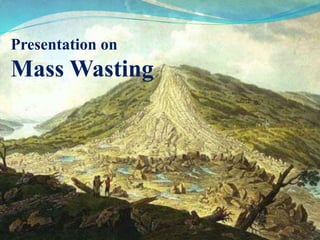
Presentation on
Mass Wasting
We will learn-
 About mass wasting
 Causes of mass wasting
 Factors
 Different Types
 Prevention &
 Creation
Introduction
Mass – the amount of matter in a material.
Wasting – gradual decrease in strength or quality.
Weathering: Weathering describes the breaking down or
dissolving of rocks and minerals on the surface of the Earth.
Gravity: Gravity is the force by which a planet or other body
draws objects toward its center.
So the term mass wasting is related with mass , wasting,
weathering and gravity.
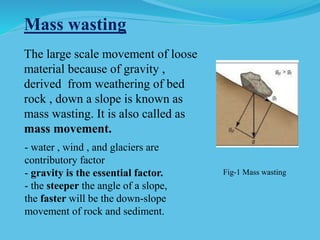
Mass wasting
The large scale movement of loose
material because of gravity ,
derived from weathering of bed
rock , down a slope is known as
mass wasting. It is also called as
mass movement.
- water , wind , and glaciers are
contributory factor
- gravity is the essential factor.
- the steeper the angle of a slope,
the faster will be the down-slope
movement of rock and sediment.
Fig-1 Mass wasting
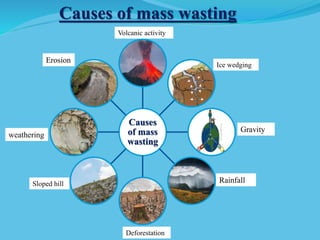
Causes
of mass
wasting
Ice wedging
Volcanic activity
Erosion
weathering
Sloped hill
Deforestation
Rainfall
Gravity
Causes of mass wasting
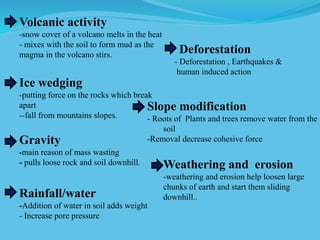
Volcanic activity
-snow cover of a volcano melts in the heat
- mixes with the soil to form mud as the
magma in the volcano stirs.
Ice wedging
-putting force on the rocks which break
apart
--fall from mountains slopes.
Rainfall/water
-Addition of water in soil adds weight
- Increase pore pressure
Slope modification
- Roots of Plants and trees remove water from the
soil
-Removal decrease cohesive force
Weathering and erosion
-weathering and erosion help loosen large
chunks of earth and start them sliding
downhill..
Deforestation
- Deforestation , Earthquakes &
human induced action
Gravity
-main reason of mass wasting
- pulls loose rock and soil downhill.
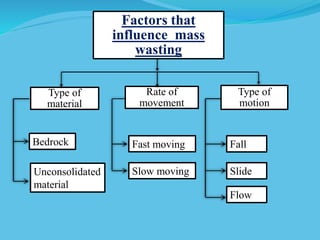
Type of
material
Rate of
movement
Factors that
influence mass
wasting
Type of
motion
Bedrock
Unconsolidated
material
Slow moving
Fast moving Fall
Flow
Slide
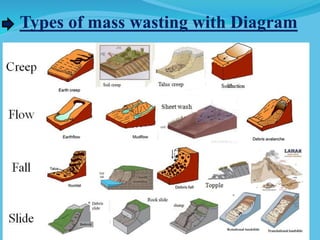
Types of mass wasting with Diagram
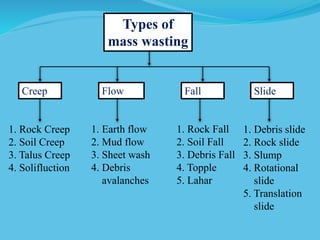
Types of
mass wasting
Creep Flow Fall Slide
1. Rock Creep
2. Soil Creep
3. Talus Creep
4. Solifluction
1. Earth flow
2. Mud flow
3. Sheet wash
4. Debris
avalanches
1. Rock Fall
2. Soil Fall
3. Debris Fall
4. Topple
5. Lahar
1. Debris slide
2. Rock slide
3. Slump
4. Rotational
slide
5. Translation
slide
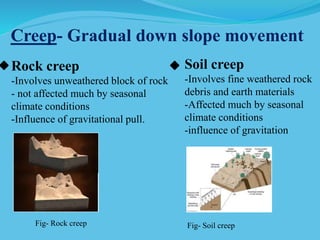
Creep- Gradual down slope movement
Rock creep
-Involves unweathered block of rock
- not affected much by seasonal
climate conditions
-Influence of gravitational pull.
Soil creep
-Involves fine weathered rock
debris and earth materials
-Affected much by seasonal
climate conditions
-influence of gravitation
Fig- Rock creep Fig- Soil creep
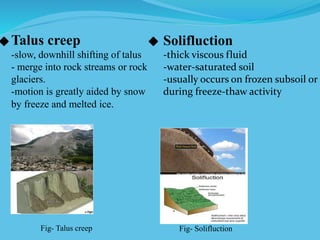
Solifluction
-thick viscous fluid
-water-saturated soil
-usually occurs on frozen subsoil or
during freeze-thaw activity
Talus creep
-slow, downhill shifting of talus
- merge into rock streams or rock
glaciers.
-motion is greatly aided by snow
by freeze and melted ice.
Fig- Solifluction
Fig- Talus creep
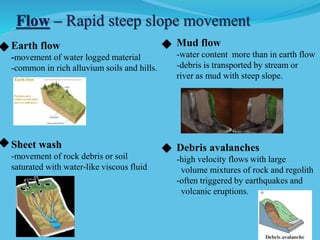
Earth flow
-movement of water logged material
-common in rich alluvium soils and hills.
Mud flow
-water content more than in earth flow
-debris is transported by stream or
river as mud with steep slope.
Debris avalanches
-high velocity flows with large
volume mixtures of rock and regolith
-often triggered by earthquakes and
volcanic eruptions.
Sheet wash
-movement of rock debris or soil
saturated with water-like viscous fluid
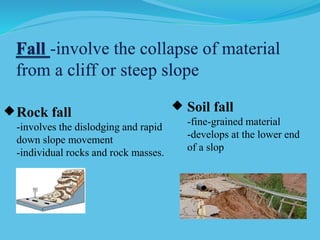
Soil fall
-fine-grained material
-develops at the lower end
of a slop
Rock fall
-involves the dislodging and rapid
down slope movement
-individual rocks and rock masses.
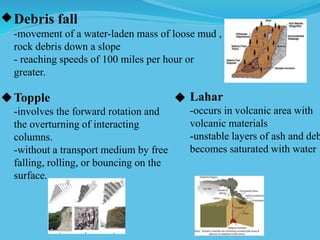
Topple
-involves the forward rotation and
the overturning of interacting
columns.
-without a transport medium by free
falling, rolling, or bouncing on the
surface.
Lahar
-occurs in volcanic area with
volcanic materials
-unstable layers of ash and deb
becomes saturated with water
Debris fall
-movement of a water-laden mass of loose mud ,
rock debris down a slope
- reaching speeds of 100 miles per hour or
greater.
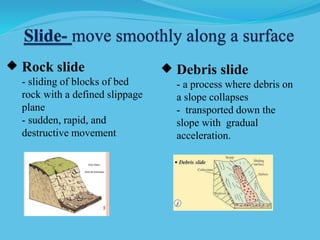
Debris slide
- a process where debris on
a slope collapses
- transported down the
slope with gradual
acceleration.
Rock slide
- sliding of blocks of bed
rock with a defined slippage
plane
- sudden, rapid, and
destructive movement
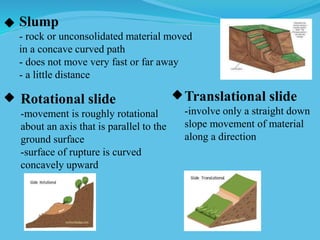
Rotational slide
-movement is roughly rotational
about an axis that is parallel to the
ground surface
-surface of rupture is curved
concavely upward
Translational slide
-involve only a straight down
slope movement of material
along a direction
Slump
- rock or unconsolidated material moved
in a concave curved path
- does not move very fast or far away
- a little distance
Preventions
•Prevent flooding
•Plant vegetation
•protest deforestation
•build barriers and retaining walls
•don't over steepen slope
Any
question?
Mass wasting.pptx

Mass wasting.pptx

  • 1.
    Presented by: Zafrin HossainOrpa Roll: 21103419 Session: 2020-21 1st year, 2nd semester. Dept. of Environmental Science and Engineering Jatiya Kabi Kaji Nazrul Islam University. Presented to: Dr. Ashraf Ali Seddique Professor & Head of the Department, Dept. of Environmental Science and Engineering Jatiya Kabi Kaji Nazrul Islam University.
  • 2.
  • 3.
    We will learn- About mass wasting  Causes of mass wasting  Factors  Different Types  Prevention &  Creation
  • 4.
    Introduction Mass – theamount of matter in a material. Wasting – gradual decrease in strength or quality. Weathering: Weathering describes the breaking down or dissolving of rocks and minerals on the surface of the Earth. Gravity: Gravity is the force by which a planet or other body draws objects toward its center. So the term mass wasting is related with mass , wasting, weathering and gravity.
  • 5.
    Mass wasting The largescale movement of loose material because of gravity , derived from weathering of bed rock , down a slope is known as mass wasting. It is also called as mass movement. - water , wind , and glaciers are contributory factor - gravity is the essential factor. - the steeper the angle of a slope, the faster will be the down-slope movement of rock and sediment. Fig-1 Mass wasting
  • 6.
    Causes of mass wasting Ice wedging Volcanicactivity Erosion weathering Sloped hill Deforestation Rainfall Gravity Causes of mass wasting
  • 7.
    Volcanic activity -snow coverof a volcano melts in the heat - mixes with the soil to form mud as the magma in the volcano stirs. Ice wedging -putting force on the rocks which break apart --fall from mountains slopes. Rainfall/water -Addition of water in soil adds weight - Increase pore pressure Slope modification - Roots of Plants and trees remove water from the soil -Removal decrease cohesive force Weathering and erosion -weathering and erosion help loosen large chunks of earth and start them sliding downhill.. Deforestation - Deforestation , Earthquakes & human induced action Gravity -main reason of mass wasting - pulls loose rock and soil downhill.
  • 8.
    Type of material Rate of movement Factorsthat influence mass wasting Type of motion Bedrock Unconsolidated material Slow moving Fast moving Fall Flow Slide
  • 9.
    Types of masswasting with Diagram
  • 10.
    Types of mass wasting CreepFlow Fall Slide 1. Rock Creep 2. Soil Creep 3. Talus Creep 4. Solifluction 1. Earth flow 2. Mud flow 3. Sheet wash 4. Debris avalanches 1. Rock Fall 2. Soil Fall 3. Debris Fall 4. Topple 5. Lahar 1. Debris slide 2. Rock slide 3. Slump 4. Rotational slide 5. Translation slide
  • 11.
    Creep- Gradual downslope movement Rock creep -Involves unweathered block of rock - not affected much by seasonal climate conditions -Influence of gravitational pull. Soil creep -Involves fine weathered rock debris and earth materials -Affected much by seasonal climate conditions -influence of gravitation Fig- Rock creep Fig- Soil creep
  • 12.
    Solifluction -thick viscous fluid -water-saturatedsoil -usually occurs on frozen subsoil or during freeze-thaw activity Talus creep -slow, downhill shifting of talus - merge into rock streams or rock glaciers. -motion is greatly aided by snow by freeze and melted ice. Fig- Solifluction Fig- Talus creep
  • 13.
    Earth flow -movement ofwater logged material -common in rich alluvium soils and hills. Mud flow -water content more than in earth flow -debris is transported by stream or river as mud with steep slope. Debris avalanches -high velocity flows with large volume mixtures of rock and regolith -often triggered by earthquakes and volcanic eruptions. Sheet wash -movement of rock debris or soil saturated with water-like viscous fluid
  • 14.
    Soil fall -fine-grained material -developsat the lower end of a slop Rock fall -involves the dislodging and rapid down slope movement -individual rocks and rock masses.
  • 15.
    Topple -involves the forwardrotation and the overturning of interacting columns. -without a transport medium by free falling, rolling, or bouncing on the surface. Lahar -occurs in volcanic area with volcanic materials -unstable layers of ash and deb becomes saturated with water Debris fall -movement of a water-laden mass of loose mud , rock debris down a slope - reaching speeds of 100 miles per hour or greater.
  • 16.
    Debris slide - aprocess where debris on a slope collapses - transported down the slope with gradual acceleration. Rock slide - sliding of blocks of bed rock with a defined slippage plane - sudden, rapid, and destructive movement
  • 17.
    Rotational slide -movement isroughly rotational about an axis that is parallel to the ground surface -surface of rupture is curved concavely upward Translational slide -involve only a straight down slope movement of material along a direction Slump - rock or unconsolidated material moved in a concave curved path - does not move very fast or far away - a little distance
  • 18.
    Preventions •Prevent flooding •Plant vegetation •protestdeforestation •build barriers and retaining walls •don't over steepen slope
  • 19.