Blood Transfusion
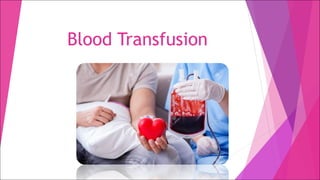
A Blood Transfusion is the infusion of whole
blood or a blood component such as plasma,
red blood cells, or platelets into the patient’s
venous circulation.
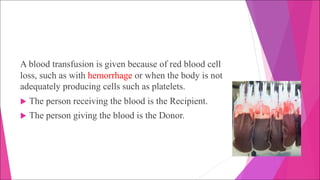
A blood transfusion is given because of red blood cell
loss, such as with hemorrhage or when the body is not
adequately producing cells such as platelets.
u The person receiving the blood is the Recipient.
u The person giving the blood is the Donor.
Blood Groups
u An Individual’s blood is commonly classified into one of the four main groups
(A, B, AB, and O).
u The surface of an individual’s red blood cells contains a number of proteins
known as Antigens that are unique for each person.
u Many blood antigens have been identified, but the antigens A, B, and Rh are
the most important in determining blood group or type. Because antigens
promote agglutination of blood cells, they also known as Agglutinogens.
u The A antigen or agglutinogen is present on the RBCs of people
with blood group A.
u The B antigen is present in people with blood group B.
u Both A and B antigens are found on the RBC surface in people
with group AB blood.
u Neither antigen is present in people with group O blood
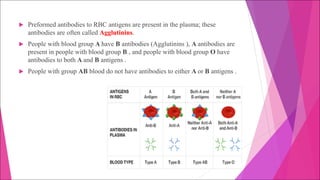
u Preformed antibodies to RBC antigens are present in the plasma; these
antibodies are often called Agglutinins.
u People with blood group A have B antibodies (Agglutinins ), A antibodies are
present in people with blood group B , and people with blood group O have
antibodies to both A and B antigens .
u People with group AB blood do not have antibodies to either A or B antigens .
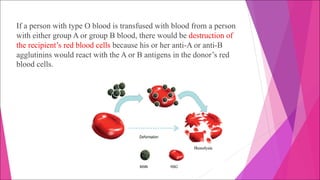
If a person with type O blood is transfused with blood from a person
with either group A or group B blood, there would be destruction of
the recipient’s red blood cells because his or her anti-A or anti-B
agglutinins would react with the A or B antigens in the donor’s red
blood cells.
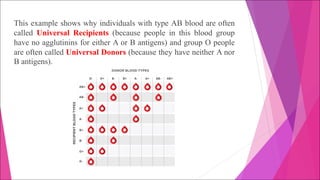
This example shows why individuals with type AB blood are often
called Universal Recipients (because people in this blood group
have no agglutinins for either A or B antigens) and group O people
are often called Universal Donors (because they have neither A nor
B antigens).
Rh factor
Ø The Rh factor is an inherited antigen in human blood.
u Blood that contains the Rh factor is known as Rh-positive, when
it is not present the blood is said to be Rh-negative.
u Rh blood does not naturally contain Rh antibodies.
u If Rh-positive blood is injected into an Rh-negative person, the
recipient develops Rh antibodies.
u Subsequent transfusion with Rh-positive blood may cause serious
reactions with clumping and hemolysis of red blood cells
Typing and Cross Matching
u Before any blood can be given to a
patient, it must be determined that the
blood of the donor is compatible with
the patient.
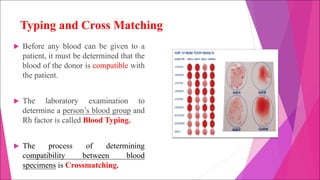
u The laboratory examination to
determine a person’s blood group and
Rh factor is called Blood Typing.
u The process of determining
compatibility between blood
specimens is Crossmatching.
u RBCs from the donor blood are mixed with serum from the
recipient, a reagent (Coombs’ serum) is added, and the
mixture is examined for visible agglutination.
u Coombs Serum: Antiglobulin testing, also known as the
Coombs test, is an immunology laboratory procedure used
to detect the presence of antibodies against circulating red
blood cells (RBCs) in the body
u If no antibodies to the donated RBCs are present in the
recipient’s serum, agglutination does not occur and the risk
of transfusion reaction is small.
Selection of Blood Donors
u Blood donors must be selected with care. Not only must the
donor’s blood be accurately typed, but It is also important to
determine that the donor is free from diseases.
u The primary tests recommended by WHO are the following:
1. Surface antigen for hepatitis B( HbsAg)
2. Antibody to Hepatitis C
3. HIV antibody (Subtypes 1 & 2)
4. Serology tests for Syphilis
DONOR SELECTION
Donor history and risk factor assessment
Infectious disease testing
ABO and Rh typing
Cross matching
Noting post donation information
u LABORATORY EXAMINATION :
Haemoglobin : not less than 12.0 gm/dl
Hematocrit : not less than 36%
GENERAL INDICATIONS OF BLOOD TRANSFUSION
1. External bleeding
2. Internal bleeding (i) non-traumatic (ii) traumatic
3. RBC lysis : e.g. malaria, HIV
4. Anemia
5. Bleeding disorders
6. Burns
6. Anticipated need for blood
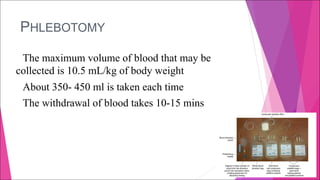
PHLEBOTOMY
The maximum volume of blood that may be
collected is 10.5 mL/kg of body weight
About 350- 450 ml is taken each time
The withdrawal of blood takes 10-15 mins
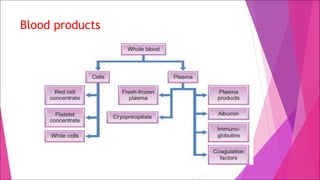
Blood products
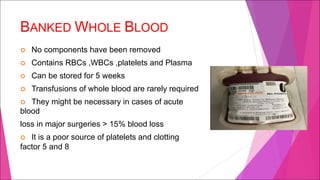
BANKED WHOLE BLOOD
¢ No components have been removed
¢ Contains RBCs ,WBCs ,platelets and Plasma
¢ Can be stored for 5 weeks
¢ Transfusions of whole blood are rarely required
¢ They might be necessary in cases of acute
blood
loss in major surgeries > 15% blood loss
¢ It is a poor source of platelets and clotting
factor 5 and 8
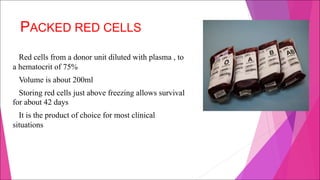
PACKED RED CELLS
Red cells from a donor unit diluted with plasma , to
a hematocrit of 75%
Volume is about 200ml
Storing red cells just above freezing allows survival
for about 42 days
It is the product of choice for most clinical
situations
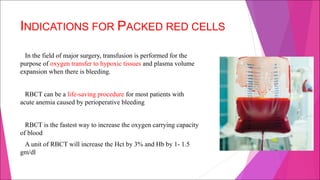
INDICATIONS FOR PACKED RED CELLS
In the field of major surgery, transfusion is performed for the
purpose of oxygen transfer to hypoxic tissues and plasma volume
expansion when there is bleeding.
RBCT can be a life-saving procedure for most patients with
acute anemia caused by perioperative bleeding
RBCT is the fastest way to increase the oxygen carrying capacity
of blood
A unit of RBCT will increase the Hct by 3% and Hb by 1- 1.5
gm/dl
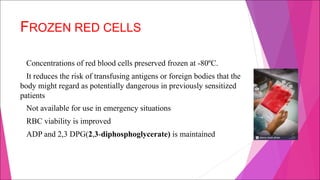
FROZEN RED CELLS
Concentrations of red blood cells preserved frozen at -80ºC.
It reduces the risk of transfusing antigens or foreign bodies that the
body might regard as potentially dangerous in previously sensitized
patients
Not available for use in emergency situations
RBC viability is improved
ADP and 2,3 DPG(2,3-diphosphoglycerate) is maintained
PLATELET CONCENTRATES
Composed of platelets and 50 ml plasma
Contains cellular components that help in the clotting
process
Platelets can be stored up to 5 days in room temperature
Indicated in :
a) Platelet disorders
b) When massive blood loss has occurred
One unit will usually raise the count to 5-10k / micro liter
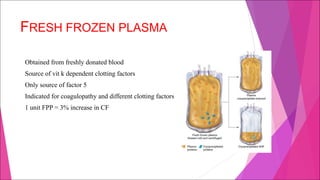
FRESH FROZEN PLASMA
Obtained from freshly donated blood
Source of vit k dependent clotting factors
Only source of factor 5
Indicated for coagulopathy and different clotting factors
1 unit FPP = 3% increase in CF
PRINCIPLES OF BLOOD TRANSFUSION
1. Transfusion is only one part of the patient’s management.
2. Blood loss should be minimized to reduce the patient’s need for
transfusion.
3. Acute blood loss should be given effective resuscitation while the
need for transfusion is being assessed.
4. The nurse should be aware of the risks of transfusion- transmissible
infections
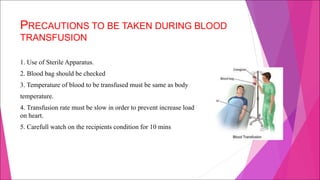
PRECAUTIONS TO BE TAKEN DURING BLOOD
TRANSFUSION
1. Use of Sterile Apparatus.
2. Blood bag should be checked
3. Temperature of blood to be transfused must be same as body
temperature.
4. Transfusion rate must be slow in order to prevent increase load
on heart.
5. Carefull watch on the recipients condition for 10 mins
COMPLICATIONS OF BLOOD TRANSFUSION
A carefully prepared and supervised blood transfusion is quite safe
However 5-6% of transfusions , untoward complications occur, some of which
are minor while others are more serious and at times fatal
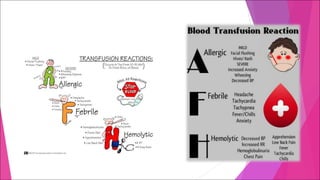
Adverse reactions of blood transfusion can be classified into:
a. Immunological complications
b. Non immunological complications
Based on duration taken for the symptoms to occur they can be classified as:
1. Acute
2. Delayed
They can also be classified as
a. Non infectious complications
b. Infectious complications
NON INFECTIOUS COMPLICATIONS
Reactions associated with high morbidity
i. Transfusion related acute lung injury
ii. Transfusion associated circulatory overload
iii. Hemolytic reactions
iv. Anaphylaxis
v. Transfusion associated graft vs. host disease
vi. Post transfusion purpura
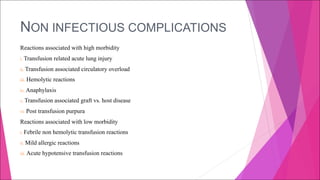
Reactions associated with low morbidity
i. Febrile non hemolytic transfusion reactions
ii. Mild allergic reactions
iii. Acute hypotensive transfusion reactions

Blood transfusion 2.pdf

  • 1.
  • 2.
    A Blood Transfusionis the infusion of whole blood or a blood component such as plasma, red blood cells, or platelets into the patient’s venous circulation.
  • 3.
    A blood transfusionis given because of red blood cell loss, such as with hemorrhage or when the body is not adequately producing cells such as platelets. u The person receiving the blood is the Recipient. u The person giving the blood is the Donor.
  • 5.
    Blood Groups u AnIndividual’s blood is commonly classified into one of the four main groups (A, B, AB, and O). u The surface of an individual’s red blood cells contains a number of proteins known as Antigens that are unique for each person. u Many blood antigens have been identified, but the antigens A, B, and Rh are the most important in determining blood group or type. Because antigens promote agglutination of blood cells, they also known as Agglutinogens.
  • 6.
    u The Aantigen or agglutinogen is present on the RBCs of people with blood group A. u The B antigen is present in people with blood group B. u Both A and B antigens are found on the RBC surface in people with group AB blood. u Neither antigen is present in people with group O blood
  • 7.
    u Preformed antibodiesto RBC antigens are present in the plasma; these antibodies are often called Agglutinins. u People with blood group A have B antibodies (Agglutinins ), A antibodies are present in people with blood group B , and people with blood group O have antibodies to both A and B antigens . u People with group AB blood do not have antibodies to either A or B antigens .
  • 8.
    If a personwith type O blood is transfused with blood from a person with either group A or group B blood, there would be destruction of the recipient’s red blood cells because his or her anti-A or anti-B agglutinins would react with the A or B antigens in the donor’s red blood cells.
  • 9.
    This example showswhy individuals with type AB blood are often called Universal Recipients (because people in this blood group have no agglutinins for either A or B antigens) and group O people are often called Universal Donors (because they have neither A nor B antigens).
  • 10.
    Rh factor Ø TheRh factor is an inherited antigen in human blood. u Blood that contains the Rh factor is known as Rh-positive, when it is not present the blood is said to be Rh-negative. u Rh blood does not naturally contain Rh antibodies. u If Rh-positive blood is injected into an Rh-negative person, the recipient develops Rh antibodies. u Subsequent transfusion with Rh-positive blood may cause serious reactions with clumping and hemolysis of red blood cells
  • 11.
    Typing and CrossMatching u Before any blood can be given to a patient, it must be determined that the blood of the donor is compatible with the patient. u The laboratory examination to determine a person’s blood group and Rh factor is called Blood Typing. u The process of determining compatibility between blood specimens is Crossmatching.
  • 12.
    u RBCs fromthe donor blood are mixed with serum from the recipient, a reagent (Coombs’ serum) is added, and the mixture is examined for visible agglutination. u Coombs Serum: Antiglobulin testing, also known as the Coombs test, is an immunology laboratory procedure used to detect the presence of antibodies against circulating red blood cells (RBCs) in the body u If no antibodies to the donated RBCs are present in the recipient’s serum, agglutination does not occur and the risk of transfusion reaction is small.
  • 13.
    Selection of BloodDonors u Blood donors must be selected with care. Not only must the donor’s blood be accurately typed, but It is also important to determine that the donor is free from diseases. u The primary tests recommended by WHO are the following: 1. Surface antigen for hepatitis B( HbsAg) 2. Antibody to Hepatitis C 3. HIV antibody (Subtypes 1 & 2) 4. Serology tests for Syphilis
  • 14.
    DONOR SELECTION Donor historyand risk factor assessment Infectious disease testing ABO and Rh typing Cross matching Noting post donation information u LABORATORY EXAMINATION : Haemoglobin : not less than 12.0 gm/dl Hematocrit : not less than 36%
  • 15.
    GENERAL INDICATIONS OFBLOOD TRANSFUSION 1. External bleeding 2. Internal bleeding (i) non-traumatic (ii) traumatic 3. RBC lysis : e.g. malaria, HIV 4. Anemia 5. Bleeding disorders 6. Burns 6. Anticipated need for blood
  • 16.
    PHLEBOTOMY The maximum volumeof blood that may be collected is 10.5 mL/kg of body weight About 350- 450 ml is taken each time The withdrawal of blood takes 10-15 mins
  • 17.
  • 18.
    BANKED WHOLE BLOOD ¢No components have been removed ¢ Contains RBCs ,WBCs ,platelets and Plasma ¢ Can be stored for 5 weeks ¢ Transfusions of whole blood are rarely required ¢ They might be necessary in cases of acute blood loss in major surgeries > 15% blood loss ¢ It is a poor source of platelets and clotting factor 5 and 8
  • 19.
    PACKED RED CELLS Redcells from a donor unit diluted with plasma , to a hematocrit of 75% Volume is about 200ml Storing red cells just above freezing allows survival for about 42 days It is the product of choice for most clinical situations
  • 20.
    INDICATIONS FOR PACKEDRED CELLS In the field of major surgery, transfusion is performed for the purpose of oxygen transfer to hypoxic tissues and plasma volume expansion when there is bleeding. RBCT can be a life-saving procedure for most patients with acute anemia caused by perioperative bleeding RBCT is the fastest way to increase the oxygen carrying capacity of blood A unit of RBCT will increase the Hct by 3% and Hb by 1- 1.5 gm/dl
  • 21.
    FROZEN RED CELLS Concentrationsof red blood cells preserved frozen at -80ºC. It reduces the risk of transfusing antigens or foreign bodies that the body might regard as potentially dangerous in previously sensitized patients Not available for use in emergency situations RBC viability is improved ADP and 2,3 DPG(2,3-diphosphoglycerate) is maintained
  • 22.
    PLATELET CONCENTRATES Composed ofplatelets and 50 ml plasma Contains cellular components that help in the clotting process Platelets can be stored up to 5 days in room temperature Indicated in : a) Platelet disorders b) When massive blood loss has occurred One unit will usually raise the count to 5-10k / micro liter
  • 23.
    FRESH FROZEN PLASMA Obtainedfrom freshly donated blood Source of vit k dependent clotting factors Only source of factor 5 Indicated for coagulopathy and different clotting factors 1 unit FPP = 3% increase in CF
  • 24.
    PRINCIPLES OF BLOODTRANSFUSION 1. Transfusion is only one part of the patient’s management. 2. Blood loss should be minimized to reduce the patient’s need for transfusion. 3. Acute blood loss should be given effective resuscitation while the need for transfusion is being assessed. 4. The nurse should be aware of the risks of transfusion- transmissible infections
  • 25.
    PRECAUTIONS TO BETAKEN DURING BLOOD TRANSFUSION 1. Use of Sterile Apparatus. 2. Blood bag should be checked 3. Temperature of blood to be transfused must be same as body temperature. 4. Transfusion rate must be slow in order to prevent increase load on heart. 5. Carefull watch on the recipients condition for 10 mins
  • 26.
    COMPLICATIONS OF BLOODTRANSFUSION A carefully prepared and supervised blood transfusion is quite safe However 5-6% of transfusions , untoward complications occur, some of which are minor while others are more serious and at times fatal Adverse reactions of blood transfusion can be classified into: a. Immunological complications b. Non immunological complications Based on duration taken for the symptoms to occur they can be classified as: 1. Acute 2. Delayed They can also be classified as a. Non infectious complications b. Infectious complications
  • 28.
    NON INFECTIOUS COMPLICATIONS Reactionsassociated with high morbidity i. Transfusion related acute lung injury ii. Transfusion associated circulatory overload iii. Hemolytic reactions iv. Anaphylaxis v. Transfusion associated graft vs. host disease vi. Post transfusion purpura Reactions associated with low morbidity i. Febrile non hemolytic transfusion reactions ii. Mild allergic reactions iii. Acute hypotensive transfusion reactions