Massive transfusion protocol
Presenter - Dr Ram Kishore Singh
Classification of hemorrhagic shock
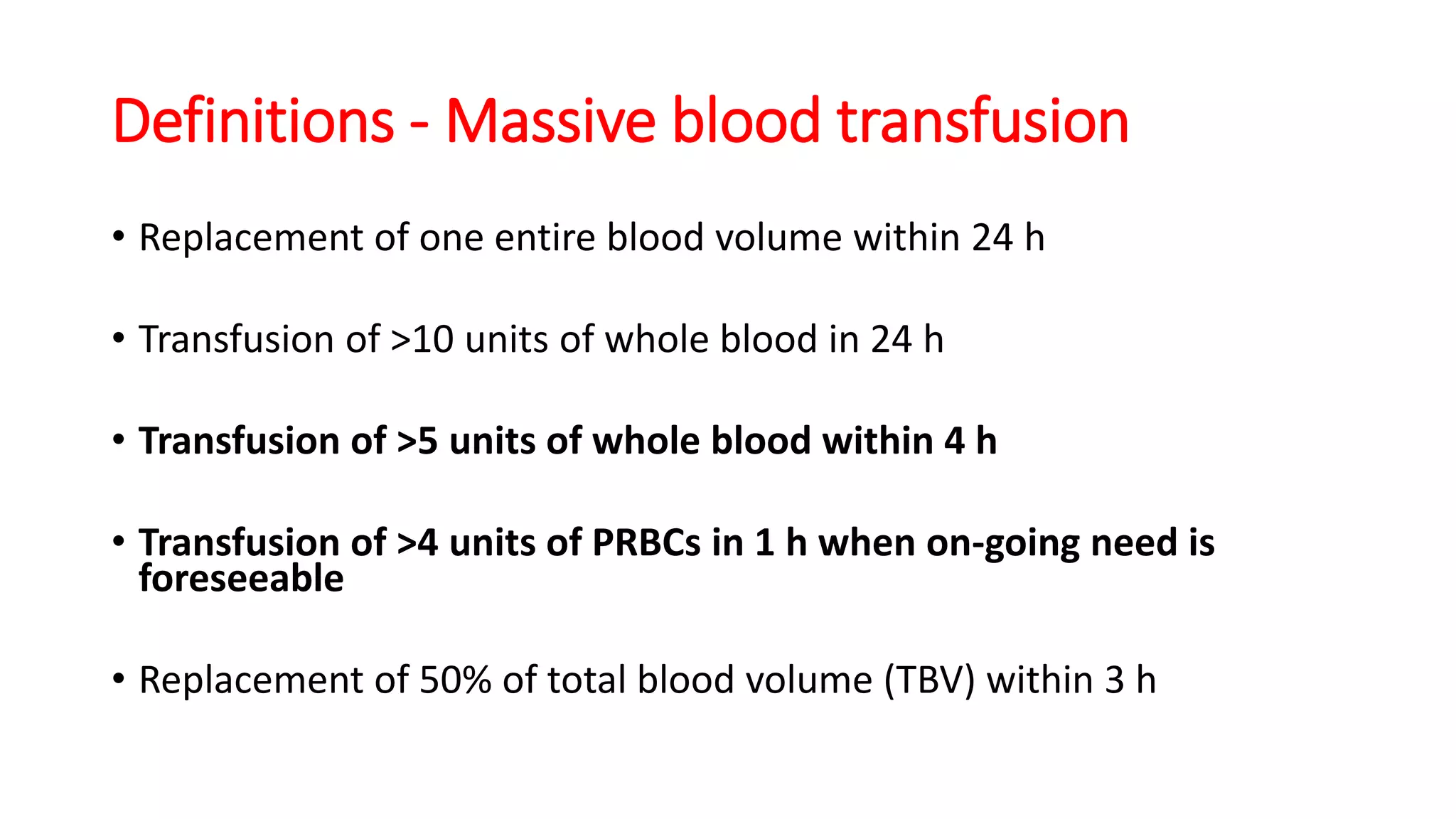
Definitions - Massive blood transfusion
• Replacement of one entire blood volume within 24 h
• Transfusion of >10 units of whole blood in 24 h
• Transfusion of >5 units of whole blood within 4 h
• Transfusion of >4 units of PRBCs in 1 h when on-going need is
foreseeable
• Replacement of 50% of total blood volume (TBV) within 3 h
Metabolic abnormality
• In bleeding patients, there would be hypoxia and acidosis due to
blood loss
• Blood loss also leads to-
-loss of clotting factors and,
-hypothermia due to heat loss
• Acidosis impair the ability of blood to clot which may worsen
coagulopathy
Triad - Acidosis, hypothermia and, coagulopathy
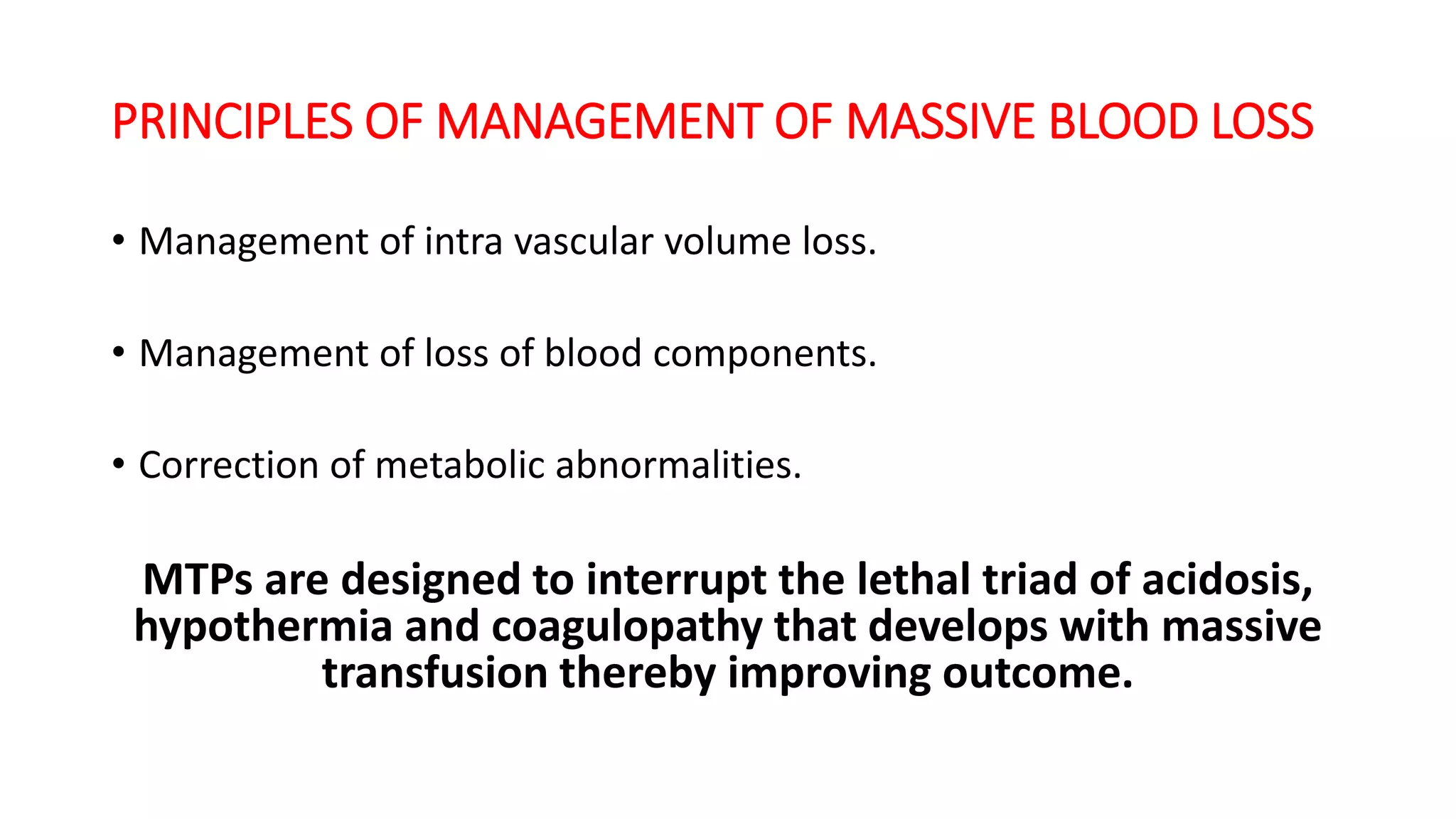
PRINCIPLES OF MANAGEMENT OF MASSIVE BLOOD LOSS
• Management of intra vascular volume loss.
• Management of loss of blood components.
• Correction of metabolic abnormalities.
MTPs are designed to interrupt the lethal triad of acidosis,
hypothermia and coagulopathy that develops with massive
transfusion thereby improving outcome.
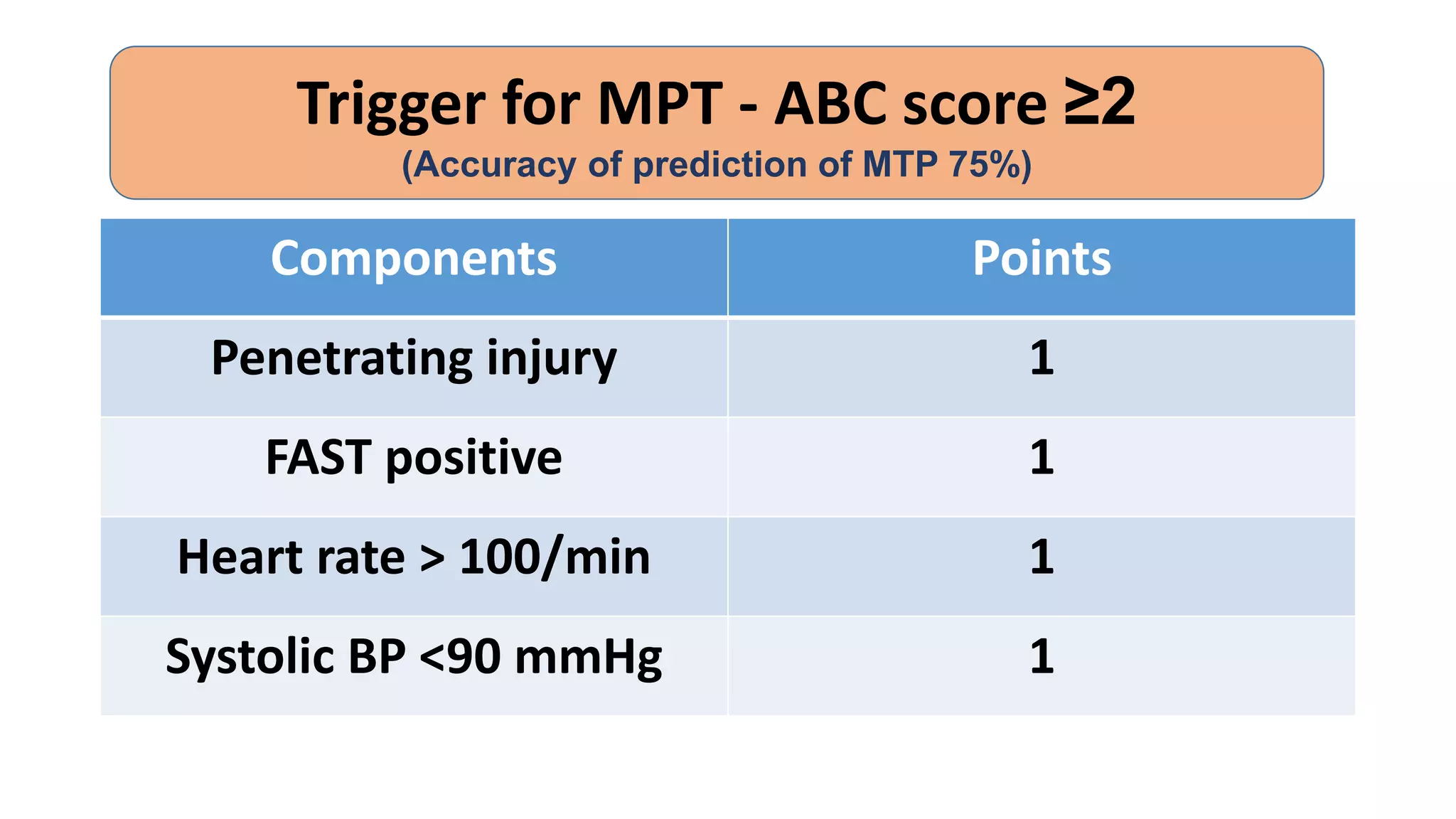
Assessment of blood component (ABC) score
Components Points
Penetrating injury 1
FAST positive 1
Heart rate > 100/min 1
Systolic BP <90 mmHg 1
Trigger for MPT - ABC score ≥2
(Accuracy of prediction of MTP 75%)
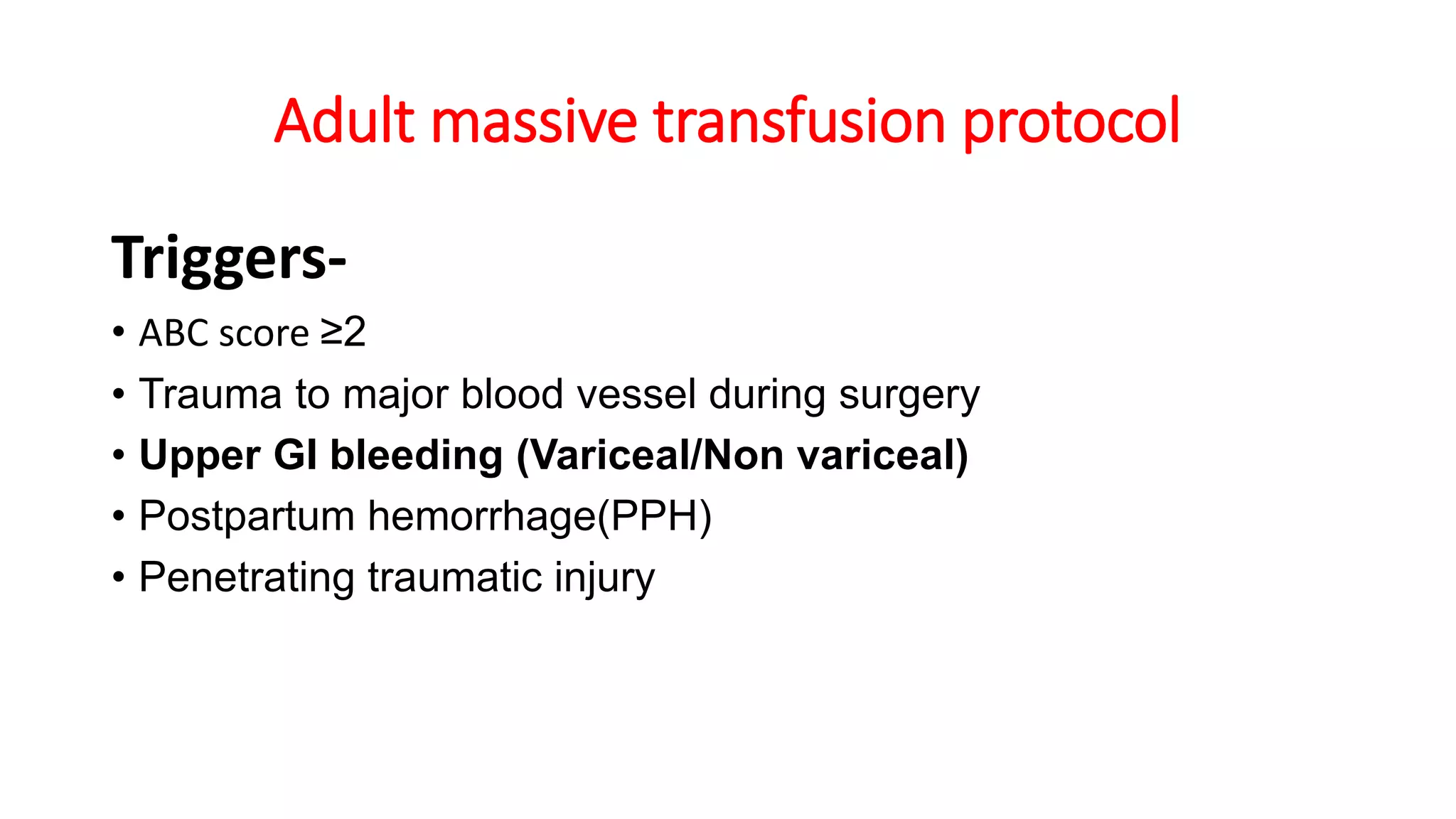
Adult massive transfusion protocol
Triggers-
• ABC score ≥2
• Trauma to major blood vessel during surgery
• Upper GI bleeding (Variceal/Non variceal)
• Postpartum hemorrhage(PPH)
• Penetrating traumatic injury
Massive transfusion protocol
• Call blood bank & inform MTP to be initiated
• Divide teams into ABC, assign each team to do specific task
• Team A - Administer blood components
• Team B - Record keeping, sampling, labeling, writing notes
• Team C - Go to blood bank and get blood components to hospital
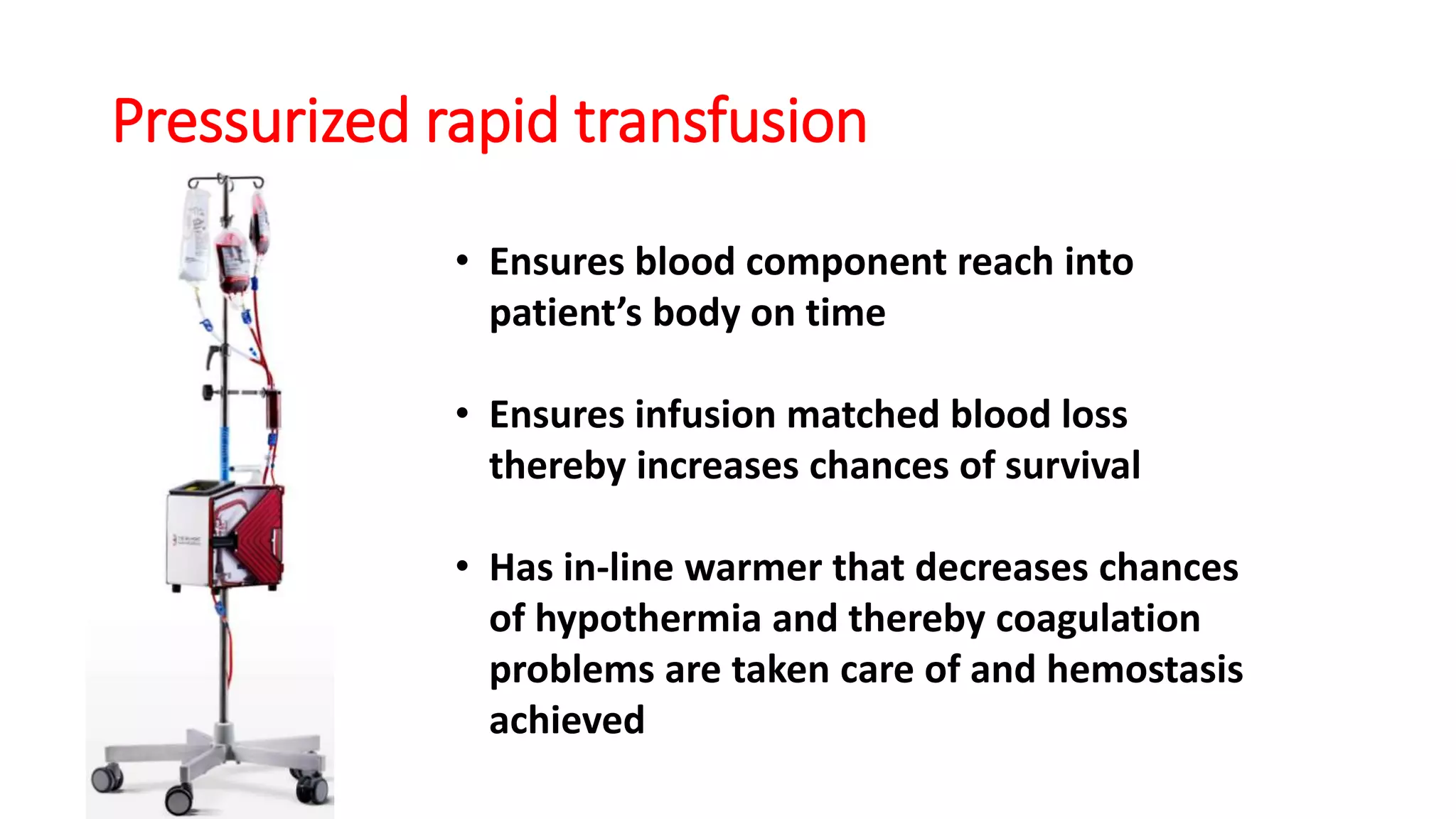
Pressurized rapid transfusion
• Ensures blood component reach into
patient’s body on time
• Ensures infusion matched blood loss
thereby increases chances of survival
• Has in-line warmer that decreases chances
of hypothermia and thereby coagulation
problems are taken care of and hemostasis
achieved
Round 1
• Give Inj tranexamic acid 1gm IV stat and then 8 hourly
• Send CBC, coagulation profile, fibrinogen level and ABG
• Connect pressurized rapid transfuser
• Transfuse -
-4 units PRBC (saline cross matched - O -ve) and
-2 units FFP (AB+ve)
Reassess the patient, if no improvement then start round 2
Round 2
• Transfuse-
-4 units PRBC
-4 units FFP
-1 unit SDP or 6 units PRP
• Collect lab report to evaluate coagulopathy and acidosis
• Give Inj 10% Calcium gluconate 10ml slow IV to prevent tetany
• Cryoprecipitate infusion if fibrinogen level <100 mg/L
Reassess the patient, if no improvement then start round 3
Round 3
• Repeat round 2 + Factor VIIa
Indications to give Factor VIIa -
• Surgical hemostasis
• Temperature(37℃) and PH has been stabilized but patient
is still bleeding
Complications of massive transfusion protocol
• Coagulopathy
• TRALI (Non cardiogenic pulmonary edema)
• TACO (Cardiogenic pulmonary edema)
• Hyperkalemia
• Hypocalecemia
Note
Identify the reason for respiratory distress after massive transfusion protocol
Thank You

Massive transfusion protocol.pptx

  • 1.
  • 2.
  • 3.
    Definitions - Massiveblood transfusion • Replacement of one entire blood volume within 24 h • Transfusion of >10 units of whole blood in 24 h • Transfusion of >5 units of whole blood within 4 h • Transfusion of >4 units of PRBCs in 1 h when on-going need is foreseeable • Replacement of 50% of total blood volume (TBV) within 3 h
  • 4.
    Metabolic abnormality • Inbleeding patients, there would be hypoxia and acidosis due to blood loss • Blood loss also leads to- -loss of clotting factors and, -hypothermia due to heat loss • Acidosis impair the ability of blood to clot which may worsen coagulopathy Triad - Acidosis, hypothermia and, coagulopathy
  • 5.
    PRINCIPLES OF MANAGEMENTOF MASSIVE BLOOD LOSS • Management of intra vascular volume loss. • Management of loss of blood components. • Correction of metabolic abnormalities. MTPs are designed to interrupt the lethal triad of acidosis, hypothermia and coagulopathy that develops with massive transfusion thereby improving outcome.
  • 6.
    Assessment of bloodcomponent (ABC) score Components Points Penetrating injury 1 FAST positive 1 Heart rate > 100/min 1 Systolic BP <90 mmHg 1 Trigger for MPT - ABC score ≥2 (Accuracy of prediction of MTP 75%)
  • 7.
    Adult massive transfusionprotocol Triggers- • ABC score ≥2 • Trauma to major blood vessel during surgery • Upper GI bleeding (Variceal/Non variceal) • Postpartum hemorrhage(PPH) • Penetrating traumatic injury
  • 8.
    Massive transfusion protocol •Call blood bank & inform MTP to be initiated • Divide teams into ABC, assign each team to do specific task • Team A - Administer blood components • Team B - Record keeping, sampling, labeling, writing notes • Team C - Go to blood bank and get blood components to hospital
  • 9.
    Pressurized rapid transfusion •Ensures blood component reach into patient’s body on time • Ensures infusion matched blood loss thereby increases chances of survival • Has in-line warmer that decreases chances of hypothermia and thereby coagulation problems are taken care of and hemostasis achieved
  • 10.
    Round 1 • GiveInj tranexamic acid 1gm IV stat and then 8 hourly • Send CBC, coagulation profile, fibrinogen level and ABG • Connect pressurized rapid transfuser • Transfuse - -4 units PRBC (saline cross matched - O -ve) and -2 units FFP (AB+ve) Reassess the patient, if no improvement then start round 2
  • 11.
    Round 2 • Transfuse- -4units PRBC -4 units FFP -1 unit SDP or 6 units PRP • Collect lab report to evaluate coagulopathy and acidosis • Give Inj 10% Calcium gluconate 10ml slow IV to prevent tetany • Cryoprecipitate infusion if fibrinogen level <100 mg/L Reassess the patient, if no improvement then start round 3
  • 12.
    Round 3 • Repeatround 2 + Factor VIIa Indications to give Factor VIIa - • Surgical hemostasis • Temperature(37℃) and PH has been stabilized but patient is still bleeding
  • 13.
    Complications of massivetransfusion protocol • Coagulopathy • TRALI (Non cardiogenic pulmonary edema) • TACO (Cardiogenic pulmonary edema) • Hyperkalemia • Hypocalecemia Note Identify the reason for respiratory distress after massive transfusion protocol
  • 14.

Editor's Notes

  • #3 If there is 150ml blood loss per min, then in 20 min patient will land up in decompensated shock which may lead to death.
  • #4 The definitions that use the period of 24 h are not useful during active management of blood loss.
  • #6 Hemodynamic compensatory mechanisms maintain vital organ perfusion till about 30% TBV loss, beyond which there is risk of critical hypo-perfusion. Mild to moderate blood loss can be managed with crystalloids or colloid infusions alone. Complications such as respiratory and renal, were seen in more than 50% of patients when more than 5 units were transfused, this is associated with increased mortality even after BT
  • #14 1. Coagulopathy - minimized with pressurized rapid transfusion within in-line warmer 2. TRALI- SOB + normal BP + normal ProBNP 3. TACO-Transfusion associated circulatory overload----SOB + raised BP + raised ProBNP 4. Hyperkalemia - When RBC are stored at low temp near expiry date, Na/K pumps shut down leads to hyperkalemia 5. Hypocalecemia - citrate used to store PRBC causes chelation of calcium