Mass and Volume
   By: Tessa
Mass (Definition)
• Mass- The amount of matter in an object.

• All things are made up of matter. Mass does not change with gravity.

• If you were to stand on top of Mt. Everest, your mass would stay the same.
  Even though there is a gravitational pull in high places such as Mt. Everest,
  you would weigh less but still remain the same mass.
1st Way to Calculate Mass
• There are two different ways to measure Mass.

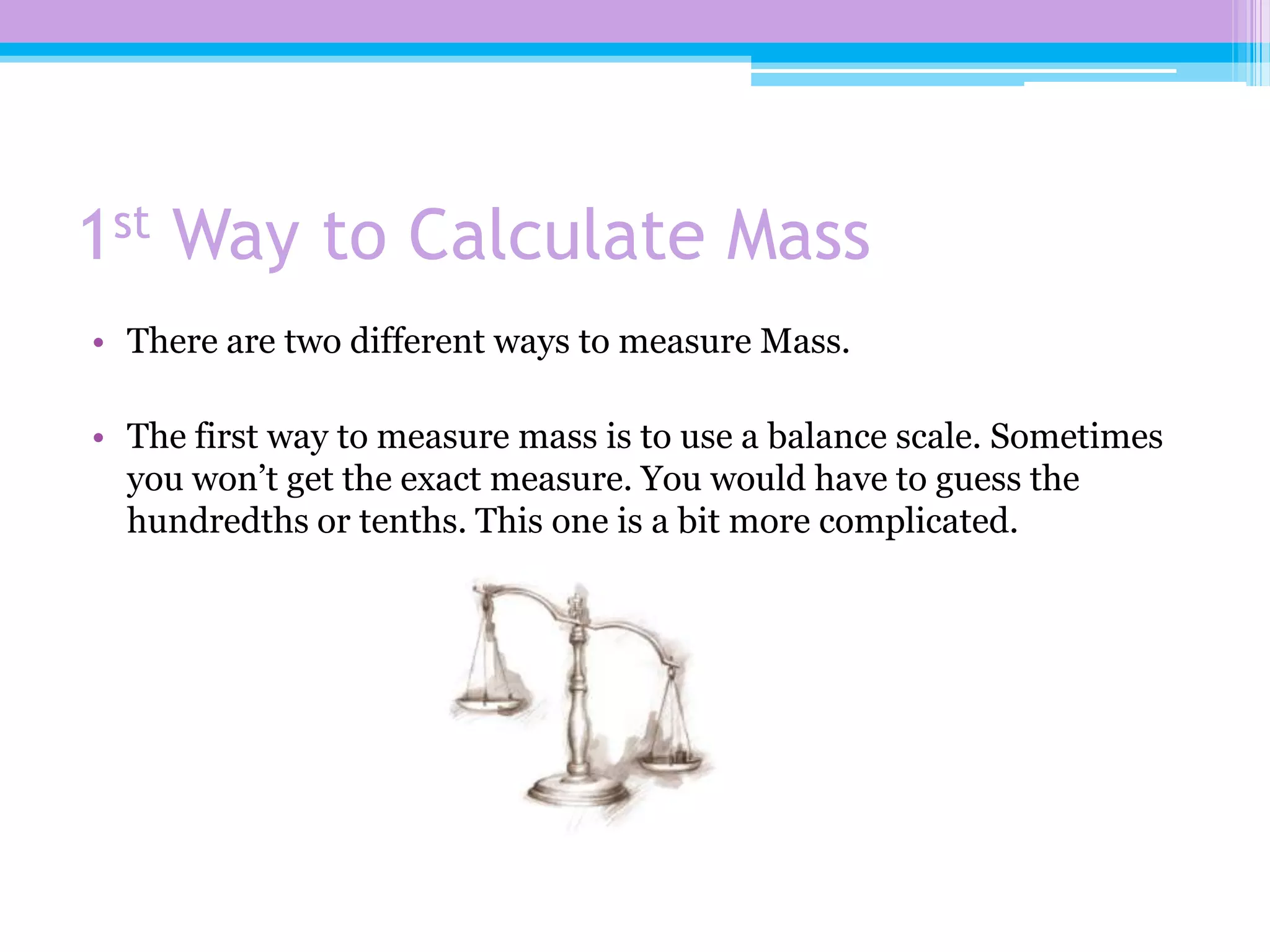
• The first way to measure mass is to use a balance scale. Sometimes
  you won’t get the exact measure. You would have to guess the
  hundredths or tenths. This one is a bit more complicated.
2nd Way to Calculate Mass
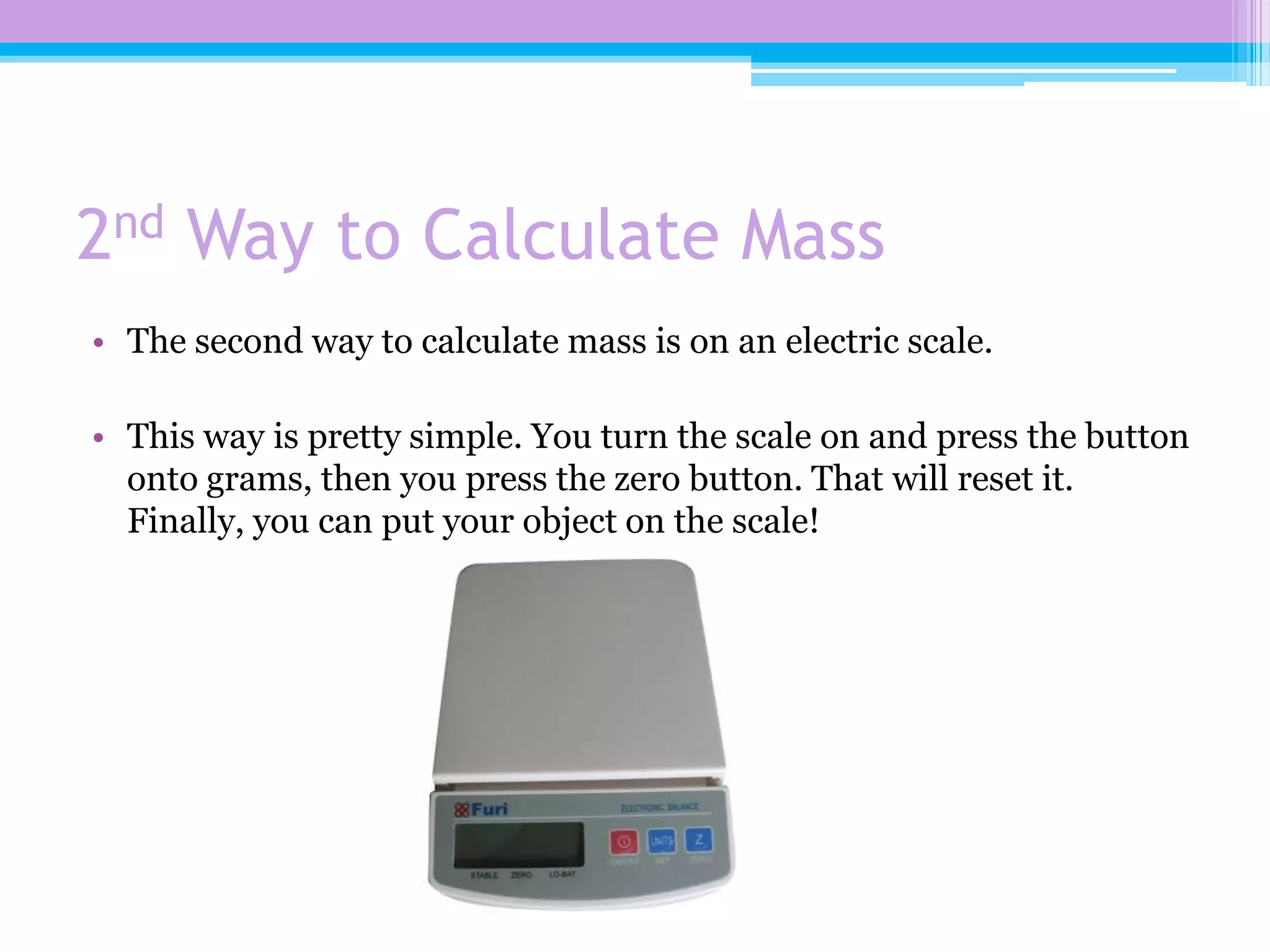
• The second way to calculate mass is on an electric scale.

• This way is pretty simple. You turn the scale on and press the button
  onto grams, then you press the zero button. That will reset it.
  Finally, you can put your object on the scale!
Volume
• Volume-The amount of matter a three dimensional
  object can contain or hold.

• Volume can be found in anything, from cardboard boxes
  to building blocks. But it doesn’t have to be rectangular
  prisms, it can be anything.
1st Way to Calculate Volume
• The first way to calculate volume is to use a ruler, tape
  measurer, or any other device that uses length(distance).

• Measuring the height, length, and width, you can
  determine the volume of the object.
2nd Way to Calculate Volume
• The second way to measure volume is to use water
  displacement.

• For example, if you are measuring the volume of an irregular shape,
  such as a 12-sided object, you fill the graduated cylinder or beaker
  with water or any other liquid, preferably water. Then, you put in
  the irregular shape into the beaker and you measure how much the
  water rises (milliliters). Then you can express the volume of the
  water displaced by the object in cubic centimeters.

Mass and volume

  • 1.
  • 2.
    Mass (Definition) • Mass-The amount of matter in an object. • All things are made up of matter. Mass does not change with gravity. • If you were to stand on top of Mt. Everest, your mass would stay the same. Even though there is a gravitational pull in high places such as Mt. Everest, you would weigh less but still remain the same mass.
  • 3.
    1st Way toCalculate Mass • There are two different ways to measure Mass. • The first way to measure mass is to use a balance scale. Sometimes you won’t get the exact measure. You would have to guess the hundredths or tenths. This one is a bit more complicated.
  • 4.
    2nd Way toCalculate Mass • The second way to calculate mass is on an electric scale. • This way is pretty simple. You turn the scale on and press the button onto grams, then you press the zero button. That will reset it. Finally, you can put your object on the scale!
  • 5.
    Volume • Volume-The amountof matter a three dimensional object can contain or hold. • Volume can be found in anything, from cardboard boxes to building blocks. But it doesn’t have to be rectangular prisms, it can be anything.
  • 6.
    1st Way toCalculate Volume • The first way to calculate volume is to use a ruler, tape measurer, or any other device that uses length(distance). • Measuring the height, length, and width, you can determine the volume of the object.
  • 7.
    2nd Way toCalculate Volume • The second way to measure volume is to use water displacement. • For example, if you are measuring the volume of an irregular shape, such as a 12-sided object, you fill the graduated cylinder or beaker with water or any other liquid, preferably water. Then, you put in the irregular shape into the beaker and you measure how much the water rises (milliliters). Then you can express the volume of the water displaced by the object in cubic centimeters.