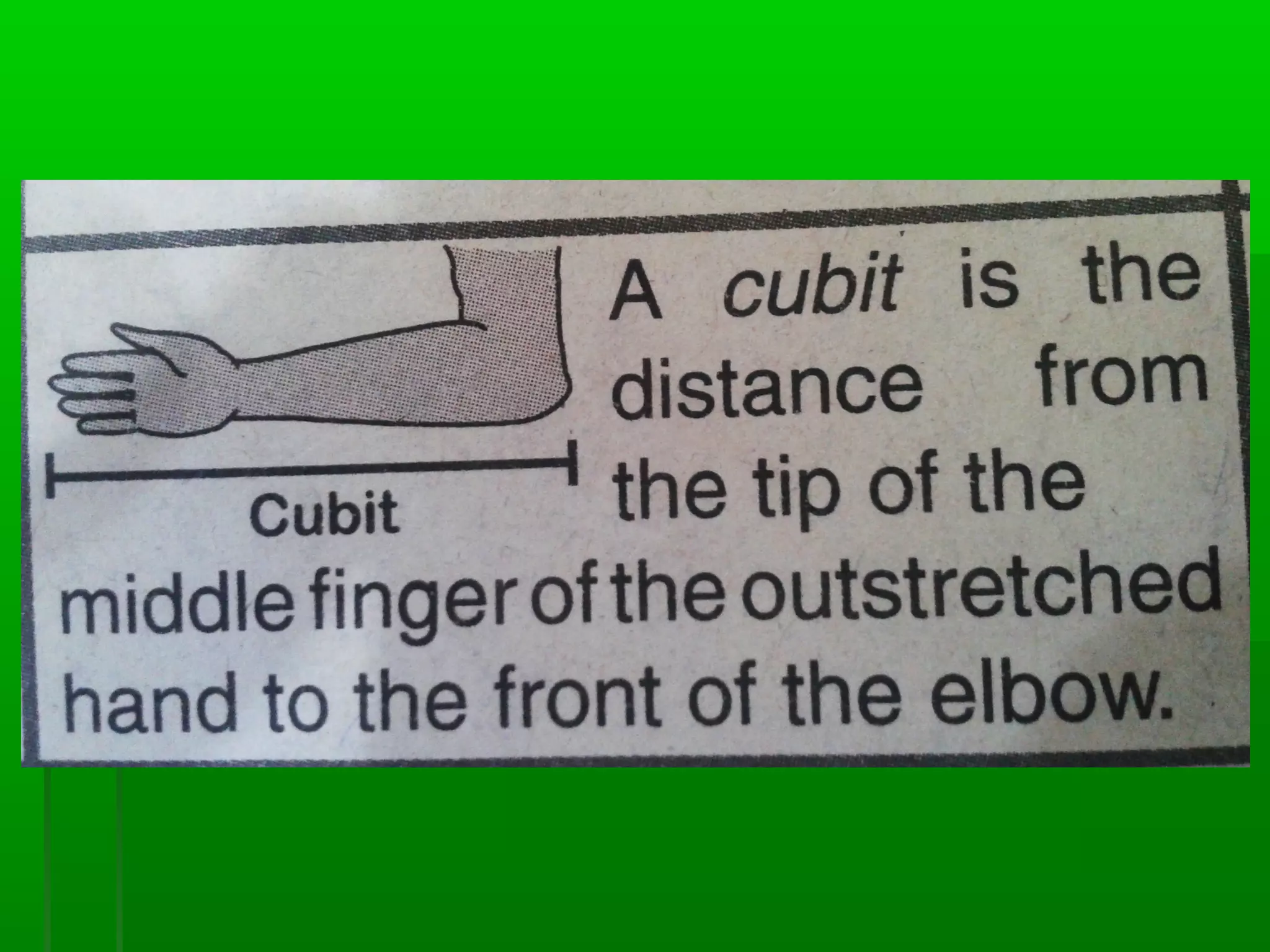
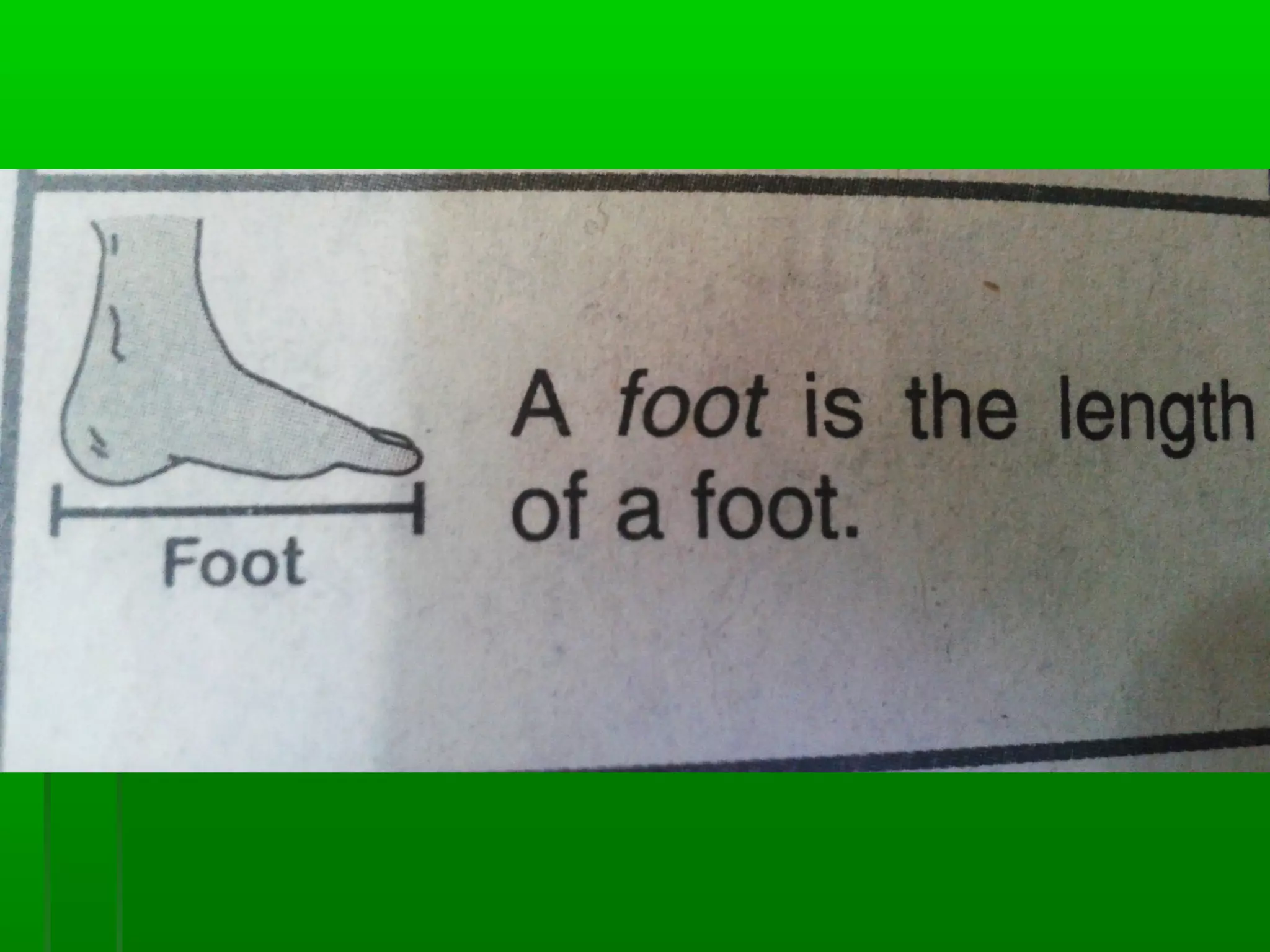
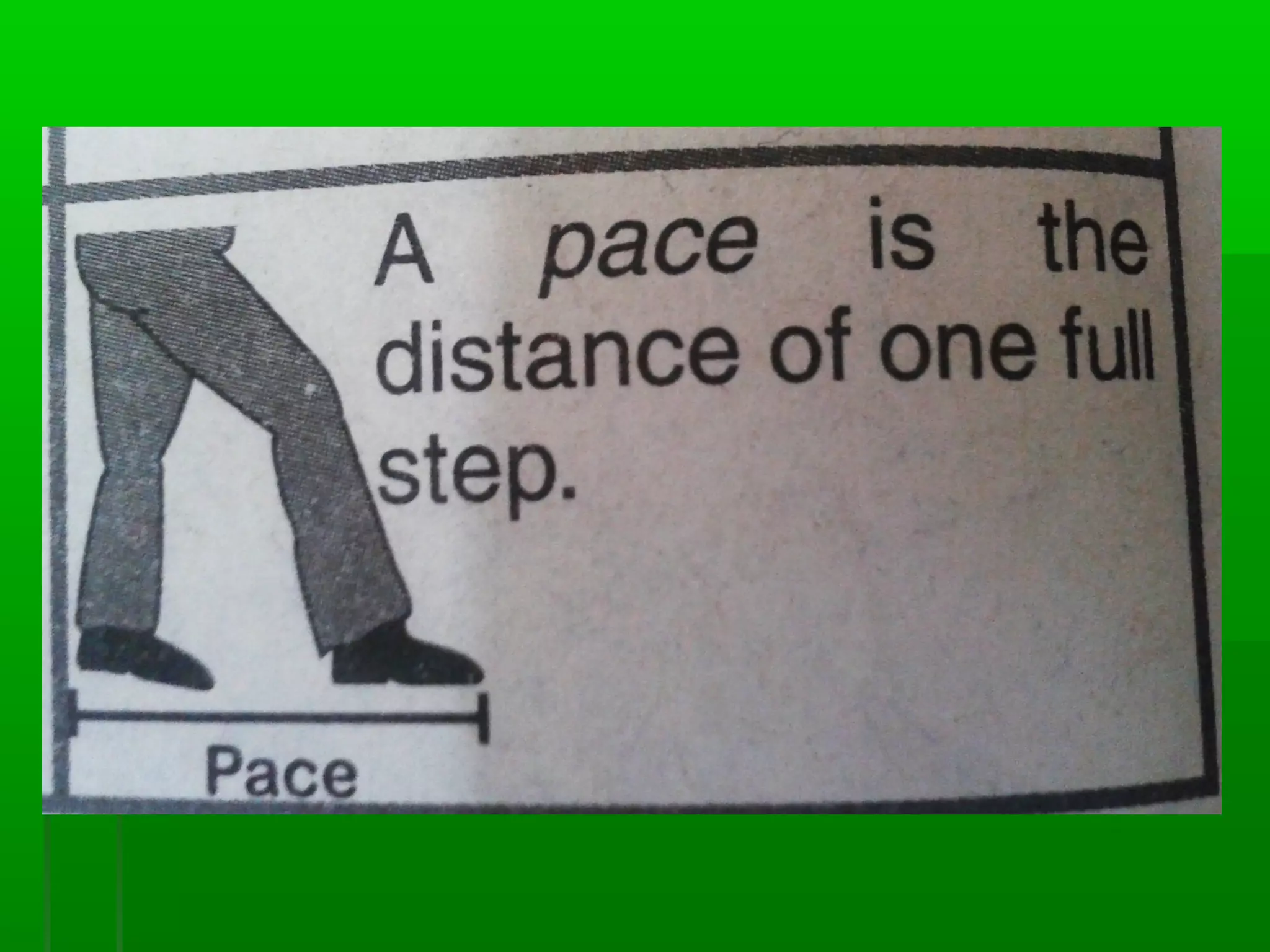
IntroductionIntroduction
toto
MeasuremenMeasuremen
tt
ExplorationExploration
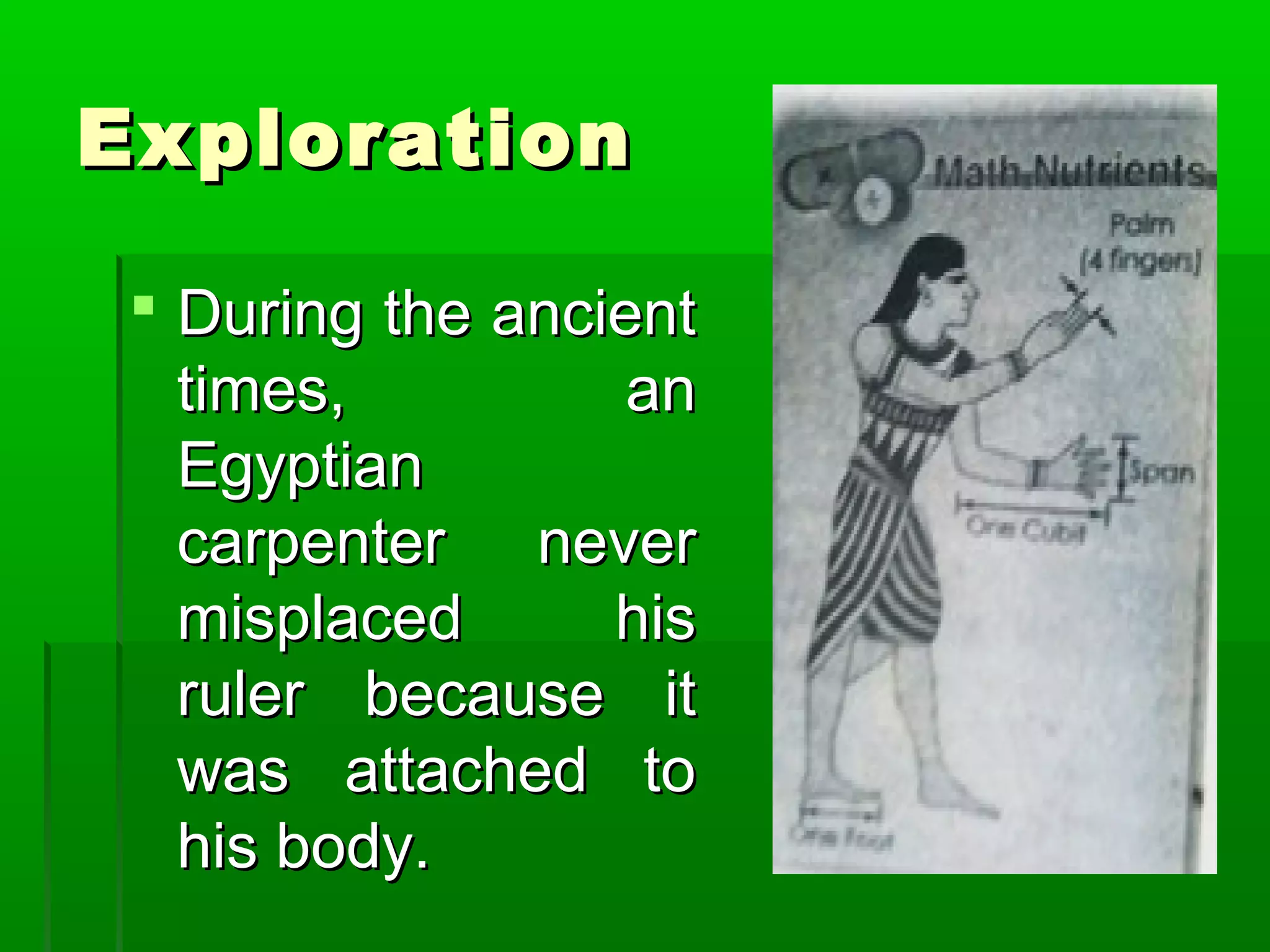
 During the ancientDuring the ancient
times, antimes, an
EgyptianEgyptian
carpenter nevercarpenter never
misplaced hismisplaced his
ruler because itruler because it
was attached towas attached to
his body.his body.
What you need to knowWhat you need to know
 First things first, you need toFirst things first, you need to
understand the basicsunderstand the basics
 There are two systems ofThere are two systems of
measurementmeasurement
 US/Customary System which we useUS/Customary System which we use
herehere
 Then there is the metric system whichThen there is the metric system which
is used all over the worldis used all over the world
Measurement SystemsMeasurement Systems
Two types of measurement systems.Two types of measurement systems.
Standard (Customary)
Based on Whole Numbers and Fractional
part
Metric (International System)
Based on the number 10 (Power of 10)
BackgroundBackground
InformationInformation
 AllAll countries have adopted the metriccountries have adopted the metric
system, including the United States.system, including the United States.
However, in nearly all countries peopleHowever, in nearly all countries people
still usestill use traditional unitstraditional units..
 For a country to switch to metric is aFor a country to switch to metric is a
process that happens over time. Only 3process that happens over time. Only 3
countries in the world, havecountries in the world, have not officiallynot officially
adopted metric as their primary systemadopted metric as their primary system
of measuring.of measuring.
BackgroundBackground
InformationInformation
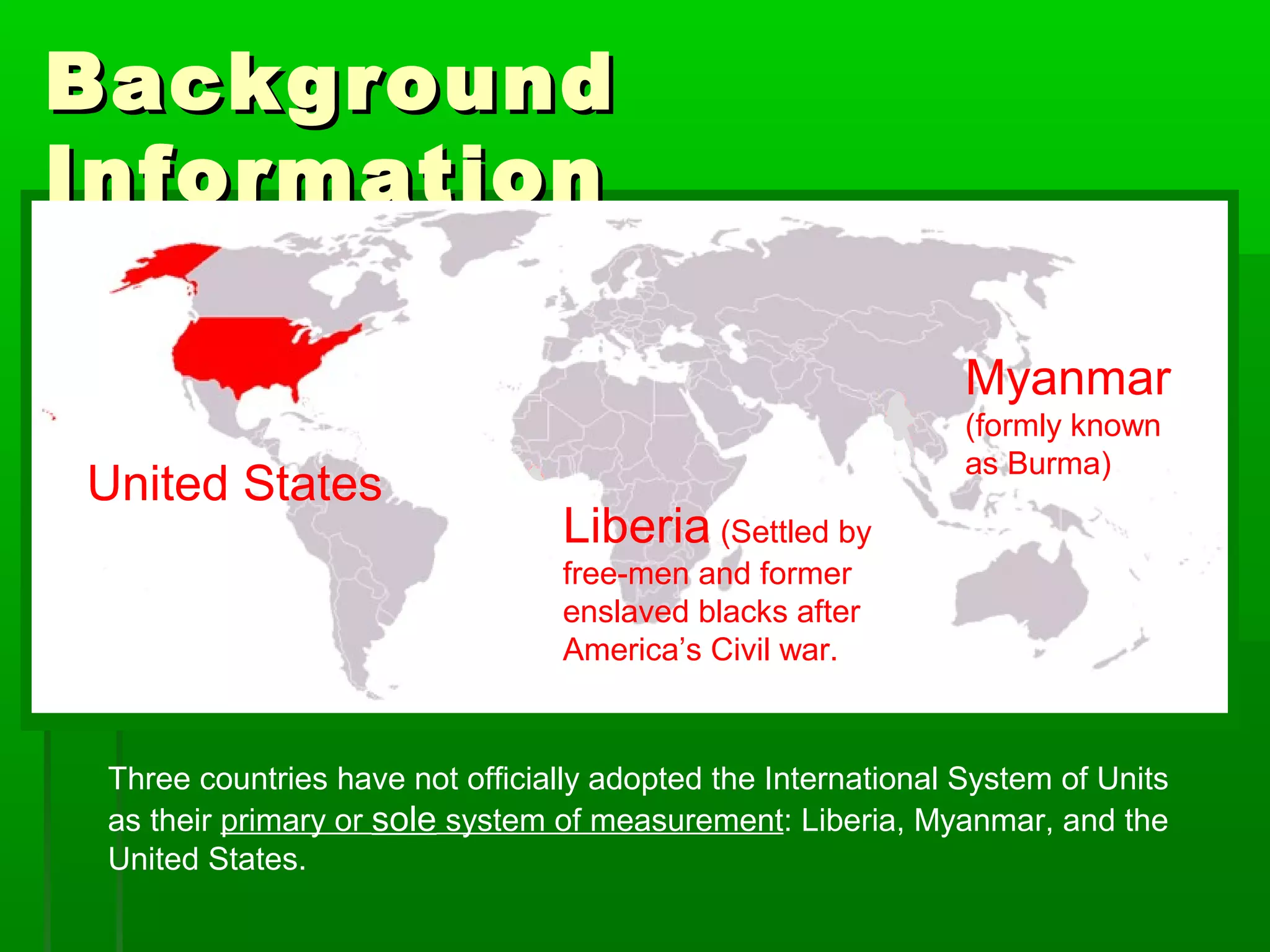
Three countries have not officially adopted the International System of Units
as their primary or sole system of measurement: Liberia, Myanmar, and the
United States.
United States
Myanmar
(formly known
as Burma)
Liberia (Settled by
free-men and former
enslaved blacks after
America’s Civil war.
Measurement BasicsMeasurement Basics
 Length: is the distance of somethingLength: is the distance of something
measuredmeasured
 Volume/Capacity: how much somethingVolume/Capacity: how much something
can hold ( generally liquid)can hold ( generally liquid)
 Weight: how much something weighsWeight: how much something weighs
 Mass: how much space something takesMass: how much space something takes
upup
US/Customary SystemUS/Customary System
 The US/Customary system hasThe US/Customary system has
many different units of measurementmany different units of measurement
 Each unit has a completely differentEach unit has a completely different
namename
 They also have completely differentThey also have completely different
conversion factorsconversion factors
Metric SystemMetric System
The metric system hasThe metric system has
base unit and manybase unit and many
different prefixesdifferent prefixes
Metric Units ofMetric Units of
MeasurementMeasurement
 Meters: Measures lengthMeters: Measures length
 Liters: Measures volume or capacityLiters: Measures volume or capacity
 Grams: measures weight/massGrams: measures weight/mass
Units of MeasurementUnits of Measurement
VolumeVolume
 US SystemUS System
 CupsCups
 PintsPints
 QuartsQuarts
 GallonsGallons
 Fluid OuncesFluid Ounces
 Metric SystemMetric System
 LitersLiters
Units of MeasurementUnits of Measurement
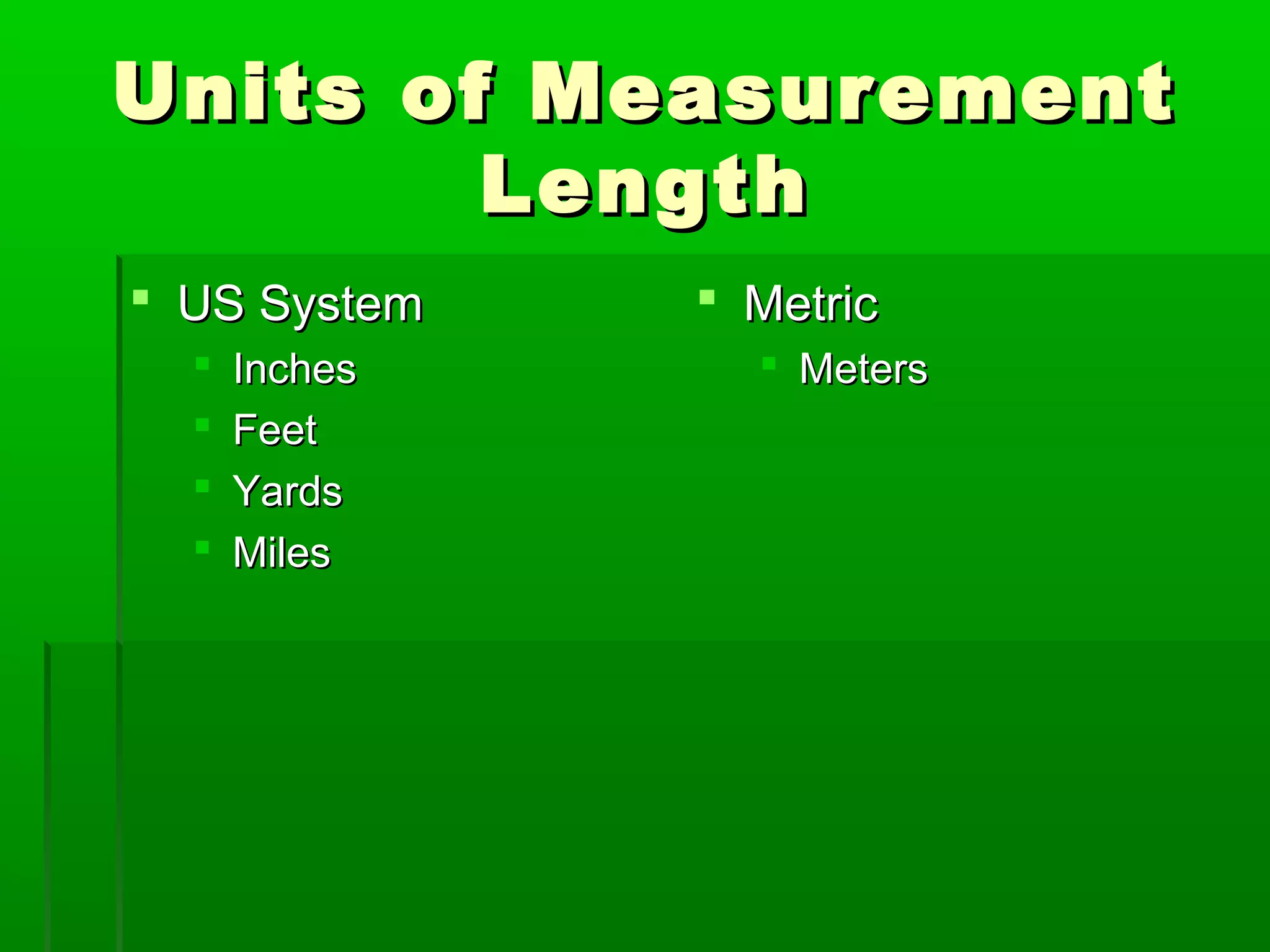
LengthLength
 US SystemUS System
 InchesInches
 FeetFeet
 YardsYards
 MilesMiles
 MetricMetric
 MetersMeters
Units of MeasurementUnits of Measurement
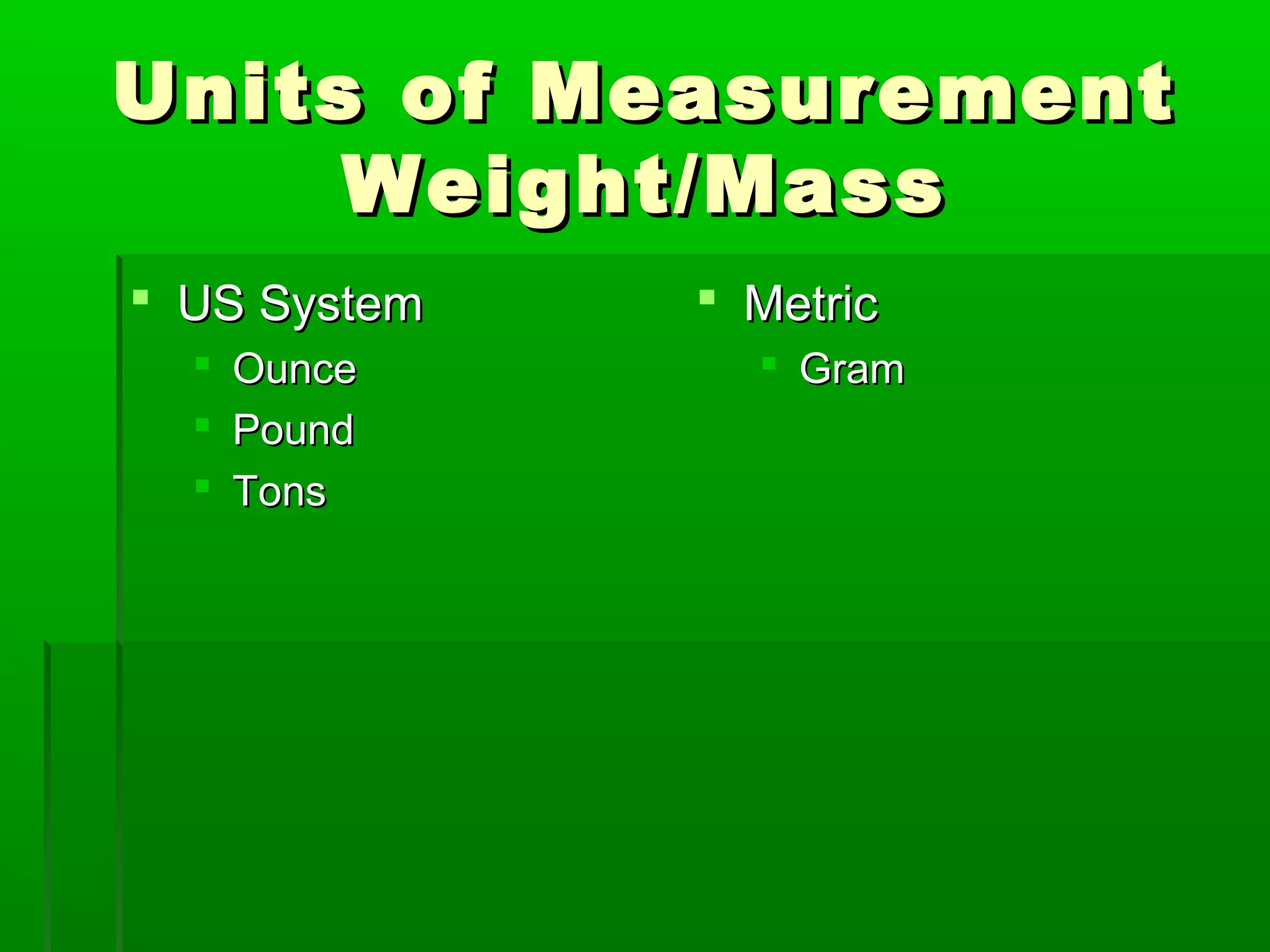
Weight/MassWeight/Mass
 US SystemUS System
 OunceOunce
 PoundPound
 TonsTons
 MetricMetric
 GramGram
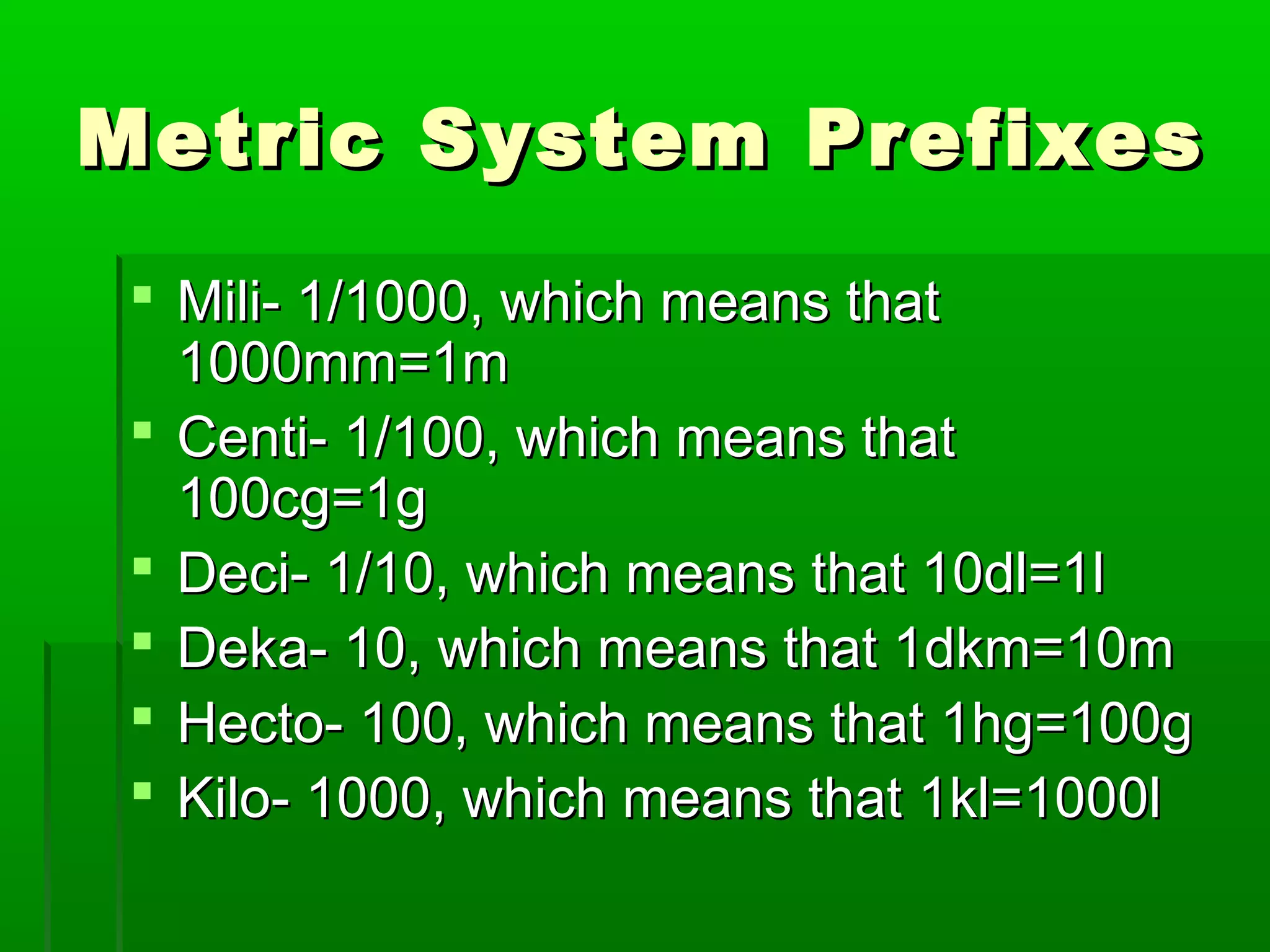
Metric System PrefixesMetric System Prefixes
 Mili- 1/1000, which means thatMili- 1/1000, which means that
1000mm=1m1000mm=1m
 Centi- 1/100, which means thatCenti- 1/100, which means that
100cg=1g100cg=1g
 Deci- 1/10, which means that 10dl=1lDeci- 1/10, which means that 10dl=1l
 Deka- 10, which means that 1dkm=10mDeka- 10, which means that 1dkm=10m
 Hecto- 100, which means that 1hg=100gHecto- 100, which means that 1hg=100g
 Kilo- 1000, which means that 1kl=1000lKilo- 1000, which means that 1kl=1000l
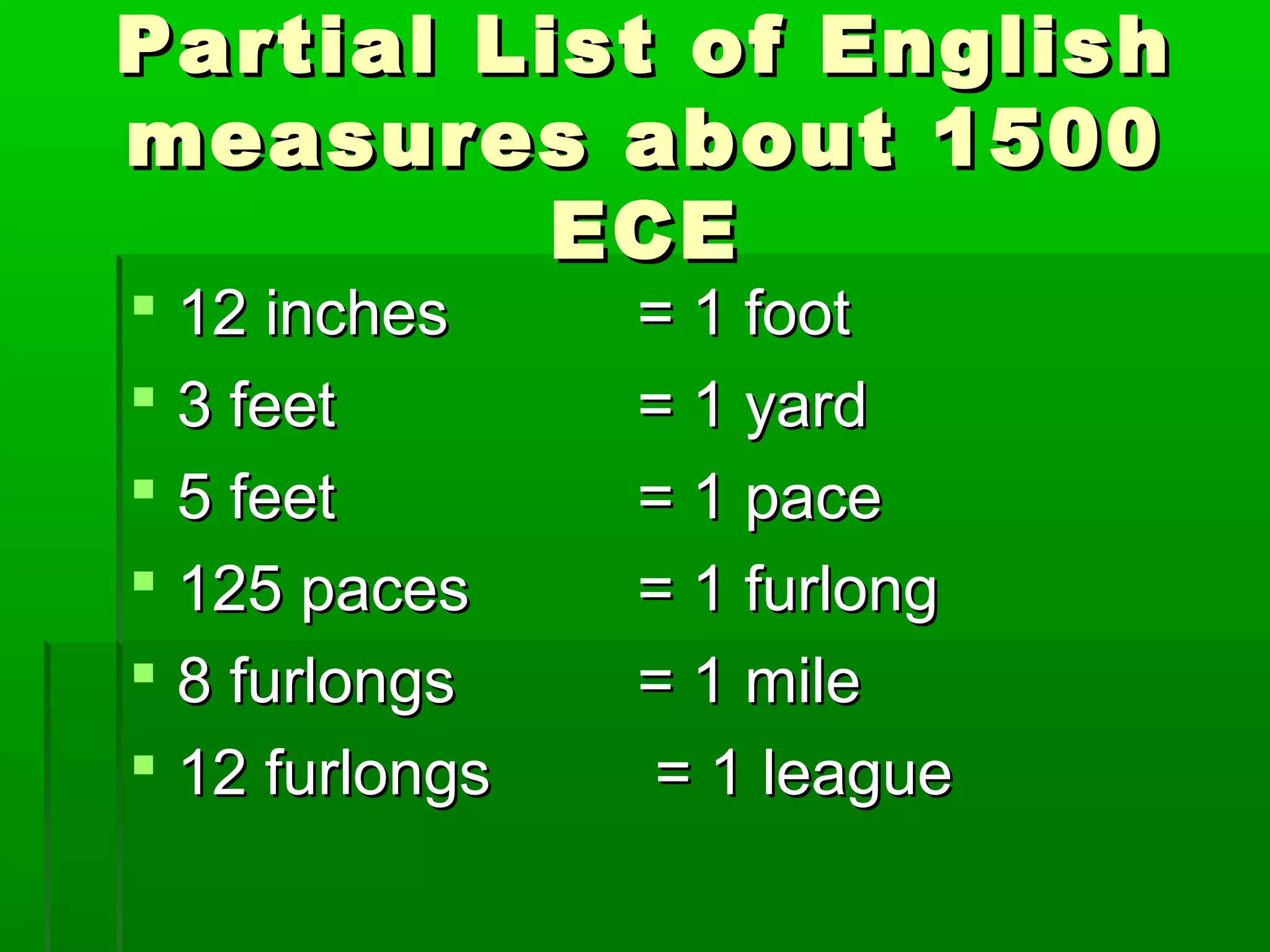
Partial List of EnglishPartial List of English
measures about 1500measures about 1500
ECEECE
 12 inches12 inches = 1 foot= 1 foot
 3 feet3 feet = 1 yard= 1 yard
 5 feet5 feet = 1 pace= 1 pace
 125 paces125 paces = 1 furlong= 1 furlong
 8 furlongs8 furlongs = 1 mile= 1 mile
 12 furlongs12 furlongs = 1 league= 1 league
Why Learn toWhy Learn to
Measure?Measure?
Valuable skill for a
job
Valuable skill for hobbies
Valuable skill for everyday life
BackgroundBackground
InformationInformation
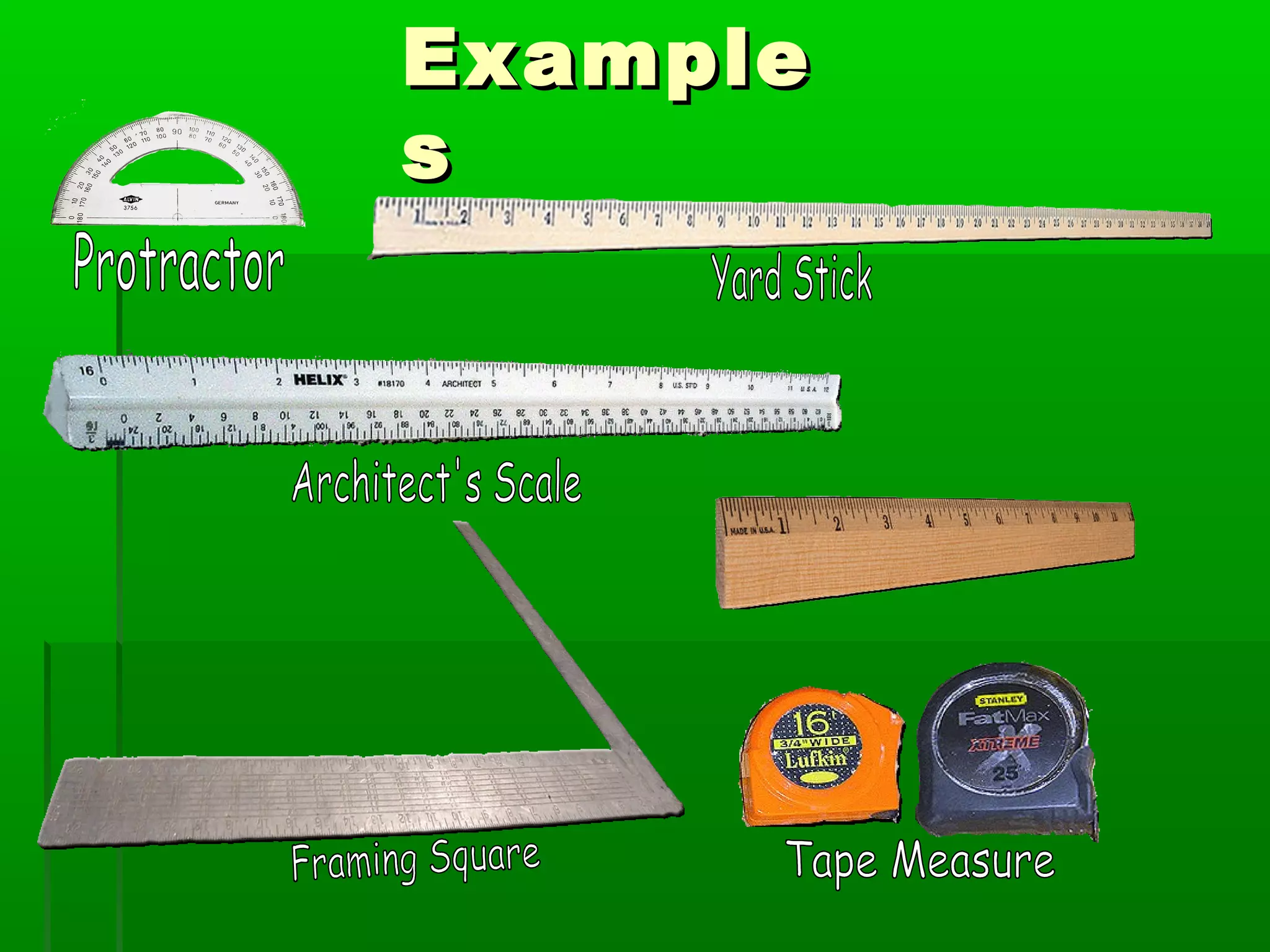
 Devices that can be used to measure.Devices that can be used to measure.
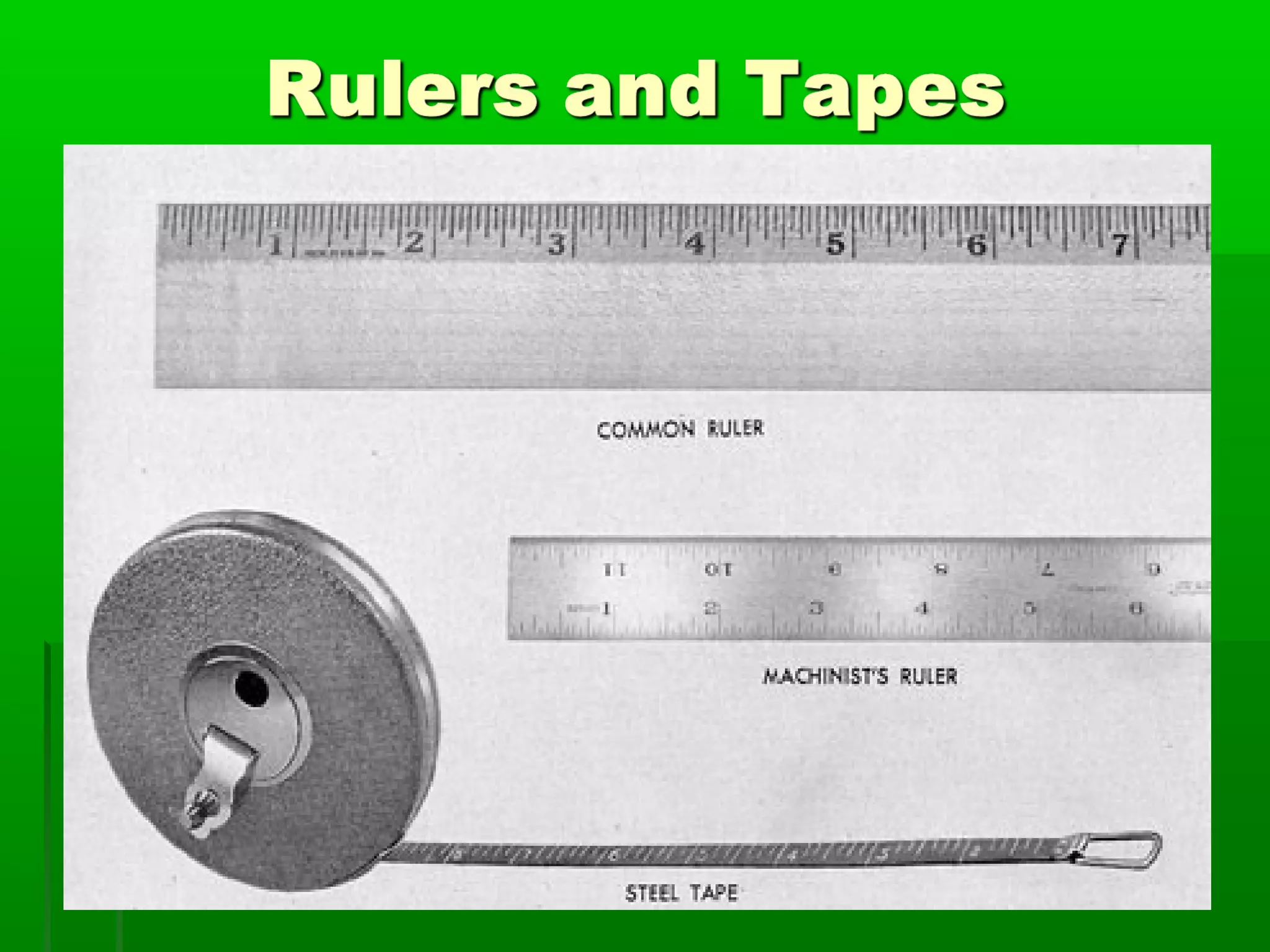
 RulerRuler
 Yard StickYard Stick
 Meter StickMeter Stick
 Tape MeasureTape Measure
 ProtractorProtractor
 Framing SquareFraming Square
 Architect and Engineering ScalesArchitect and Engineering Scales
ExampleExample
ss
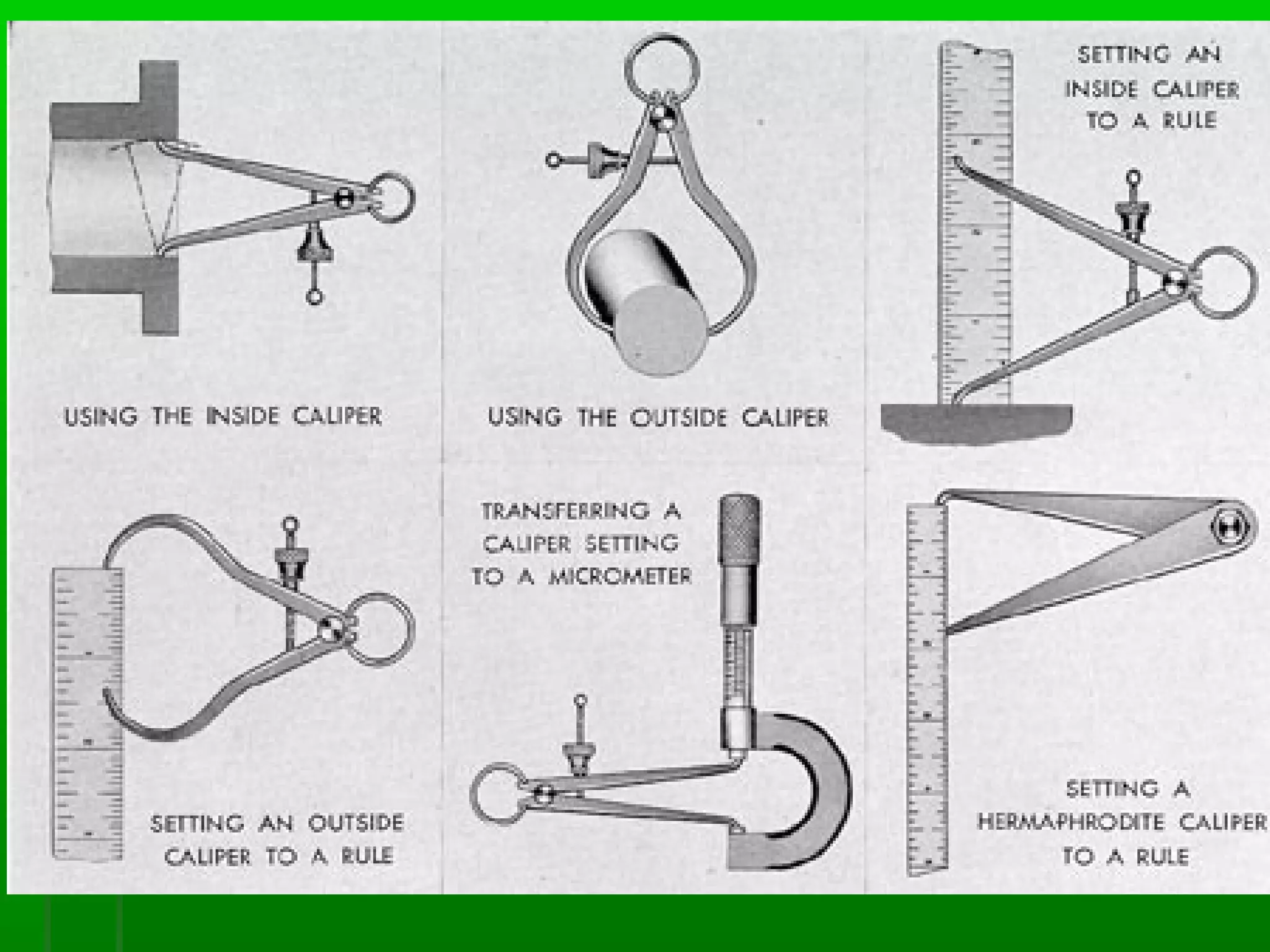
CalipersCalipers
 CalipersCalipers. Engineers and machinists. Engineers and machinists
frequently use calipers to securefrequently use calipers to secure
accurate measurements of insideaccurate measurements of inside
and outside diameters.and outside diameters.
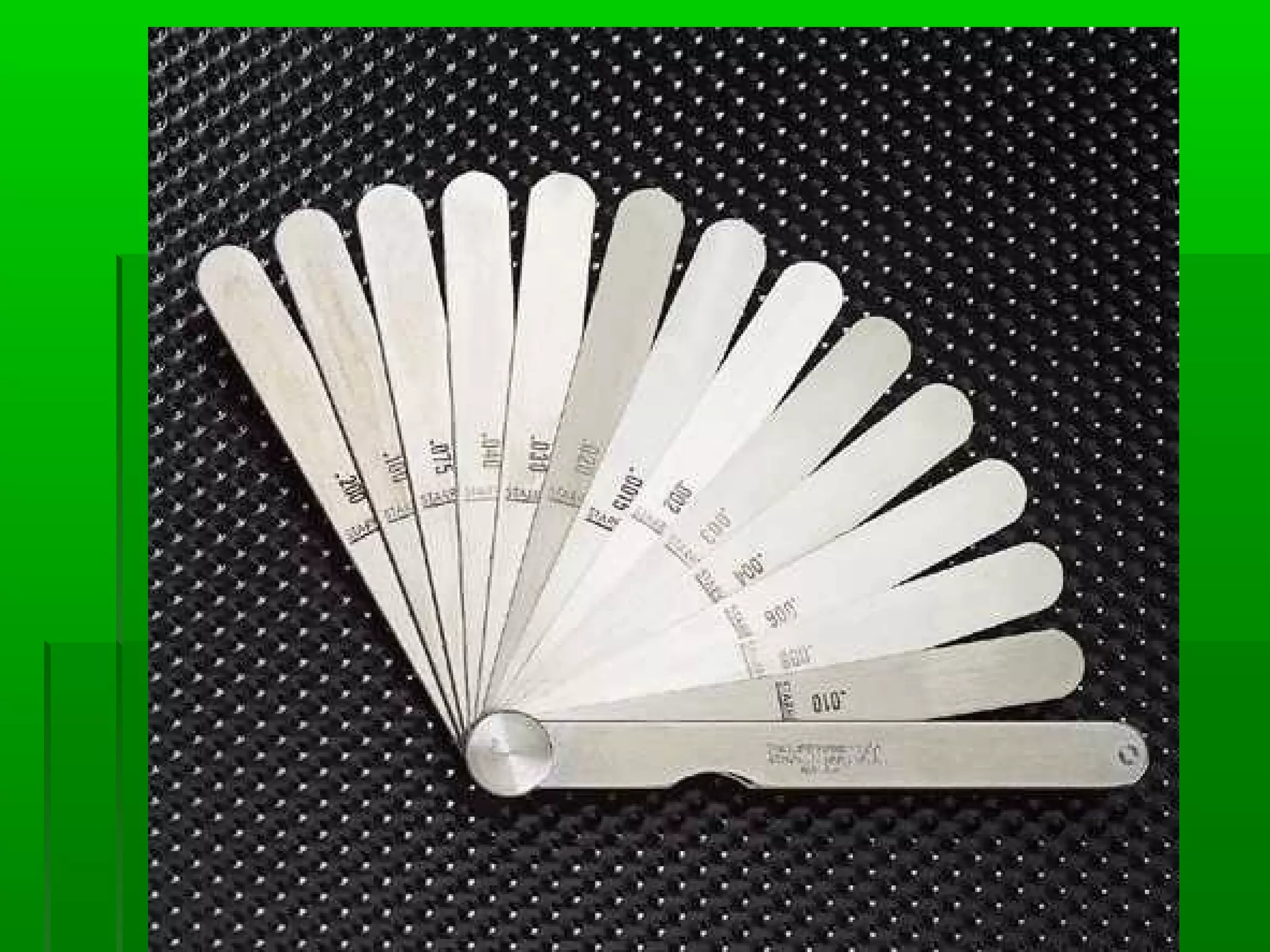
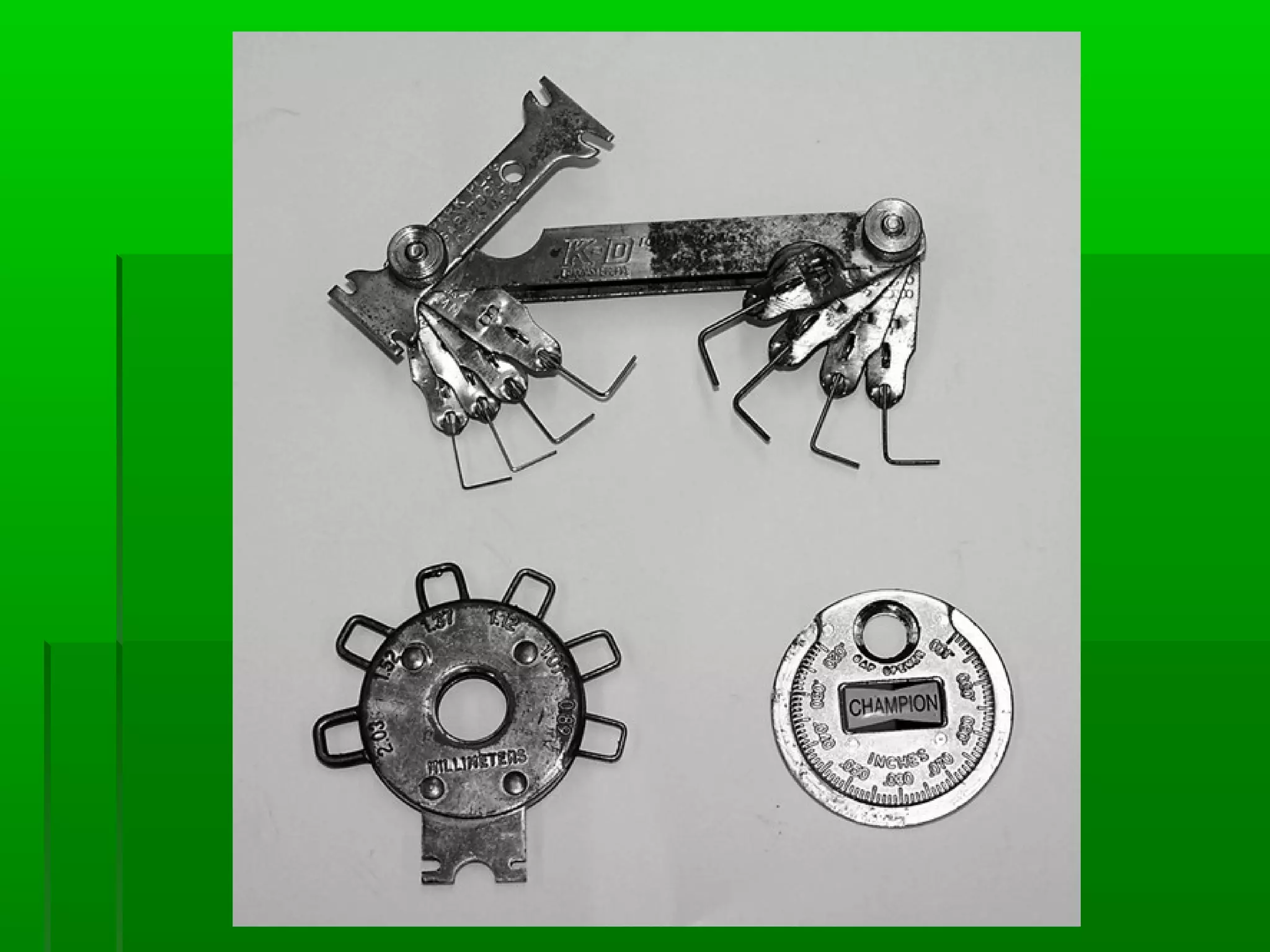
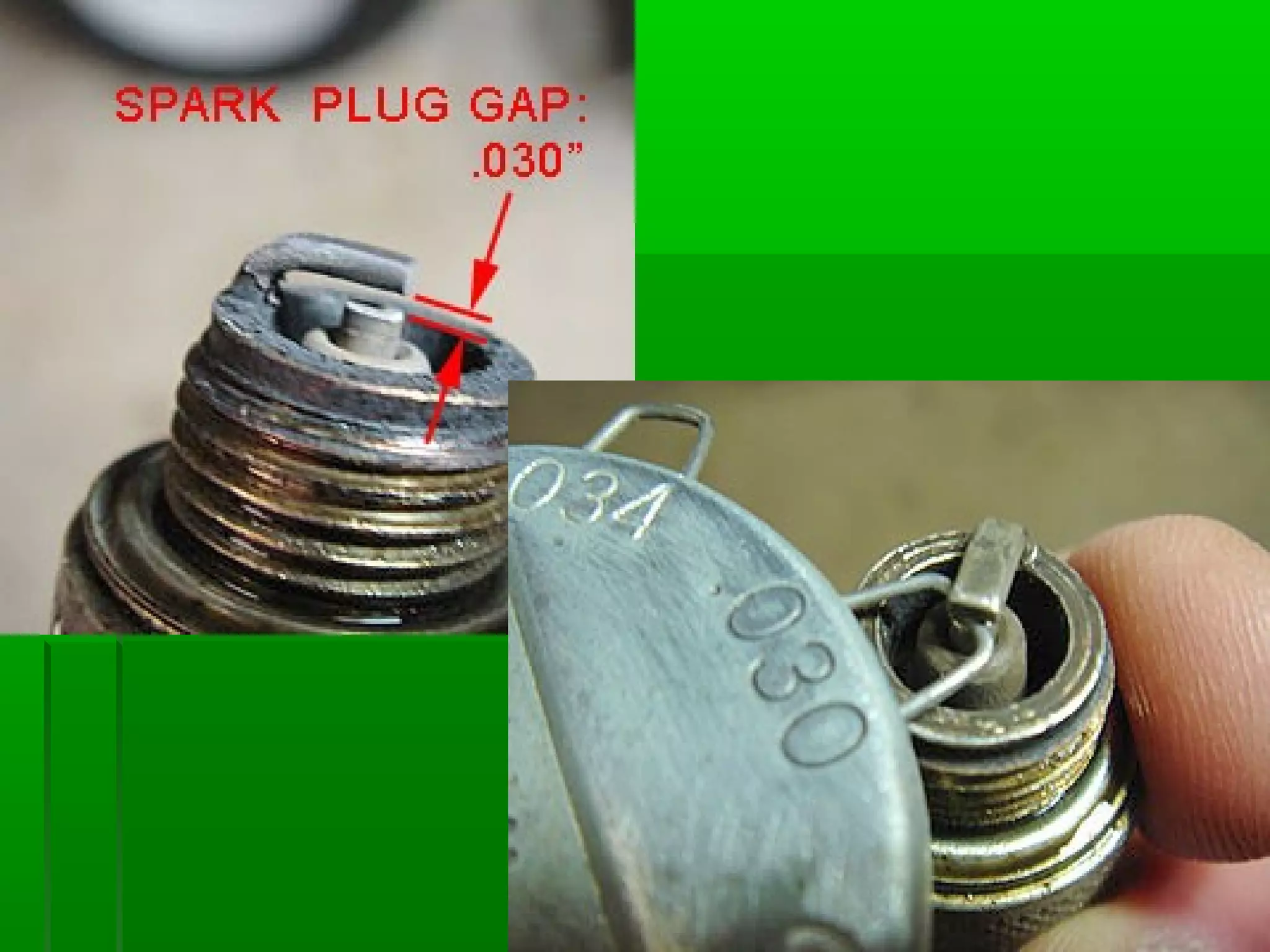
Feeler GaugesFeeler Gauges
 Measure spark plug gapMeasure spark plug gap
 Head flatnessHead flatness
 Thrust distance in CrankshaftThrust distance in Crankshaft
 Ignition point gap (Old Vehicles)Ignition point gap (Old Vehicles)
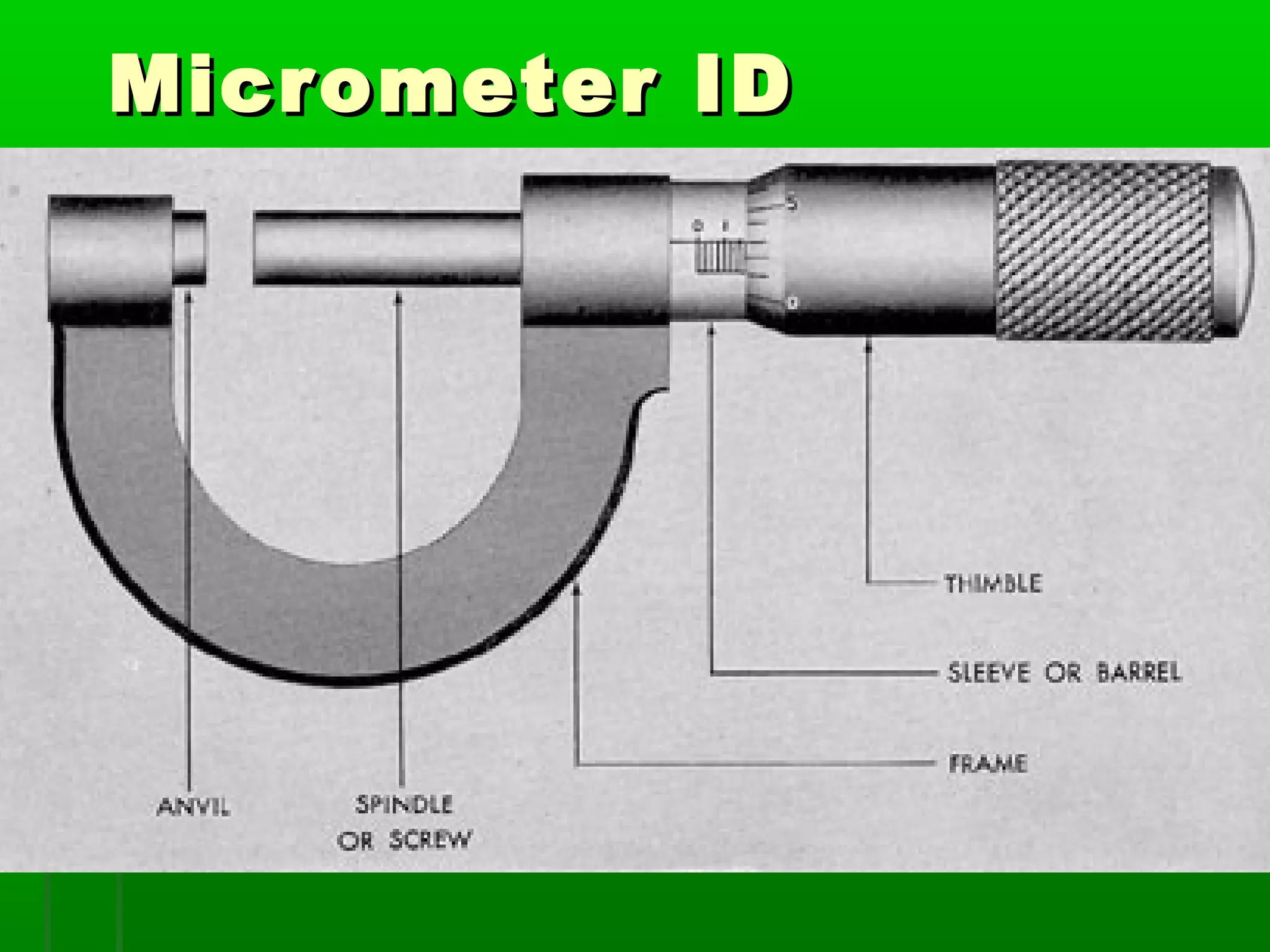
Micrometer IDMicrometer ID
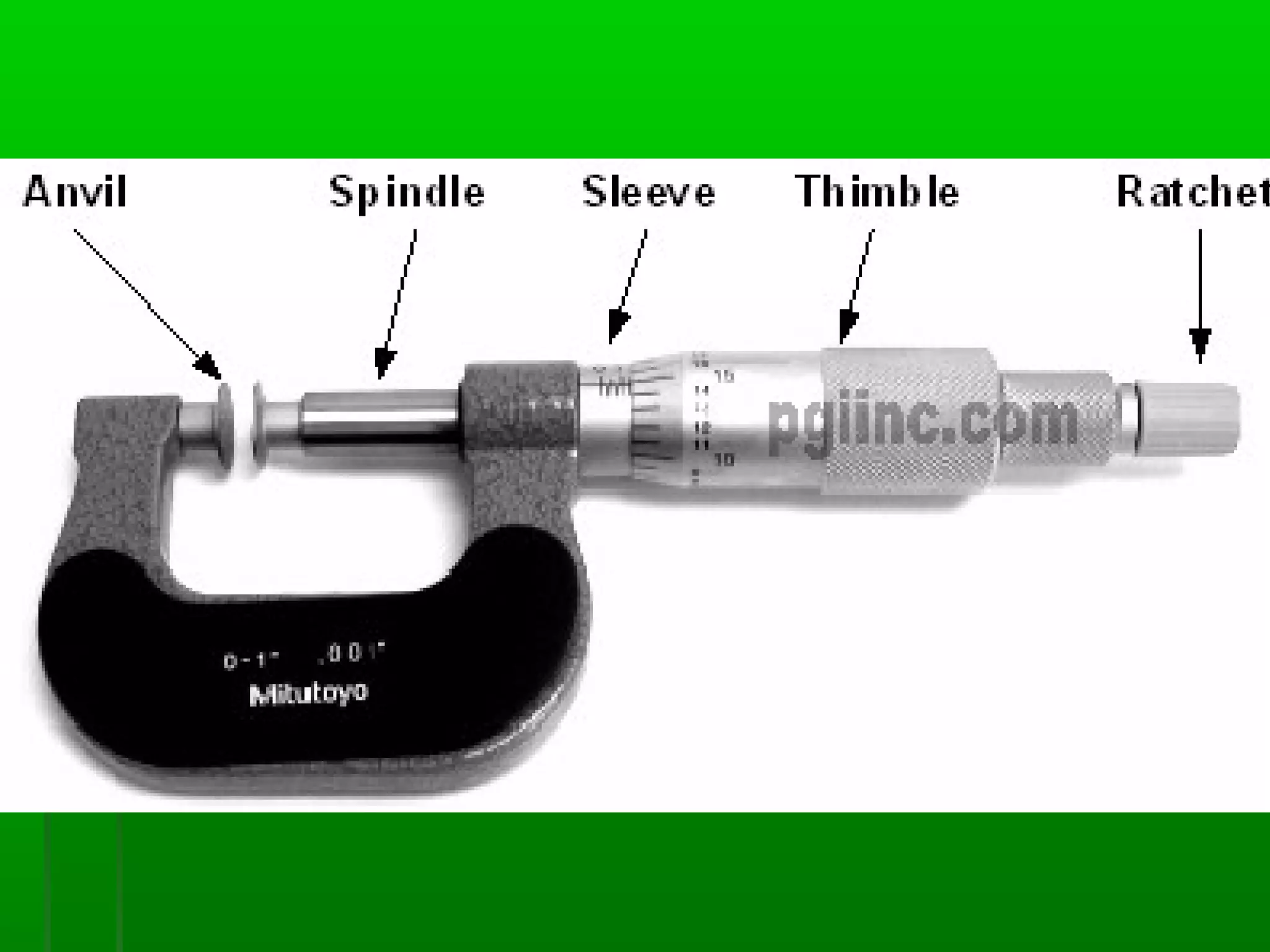
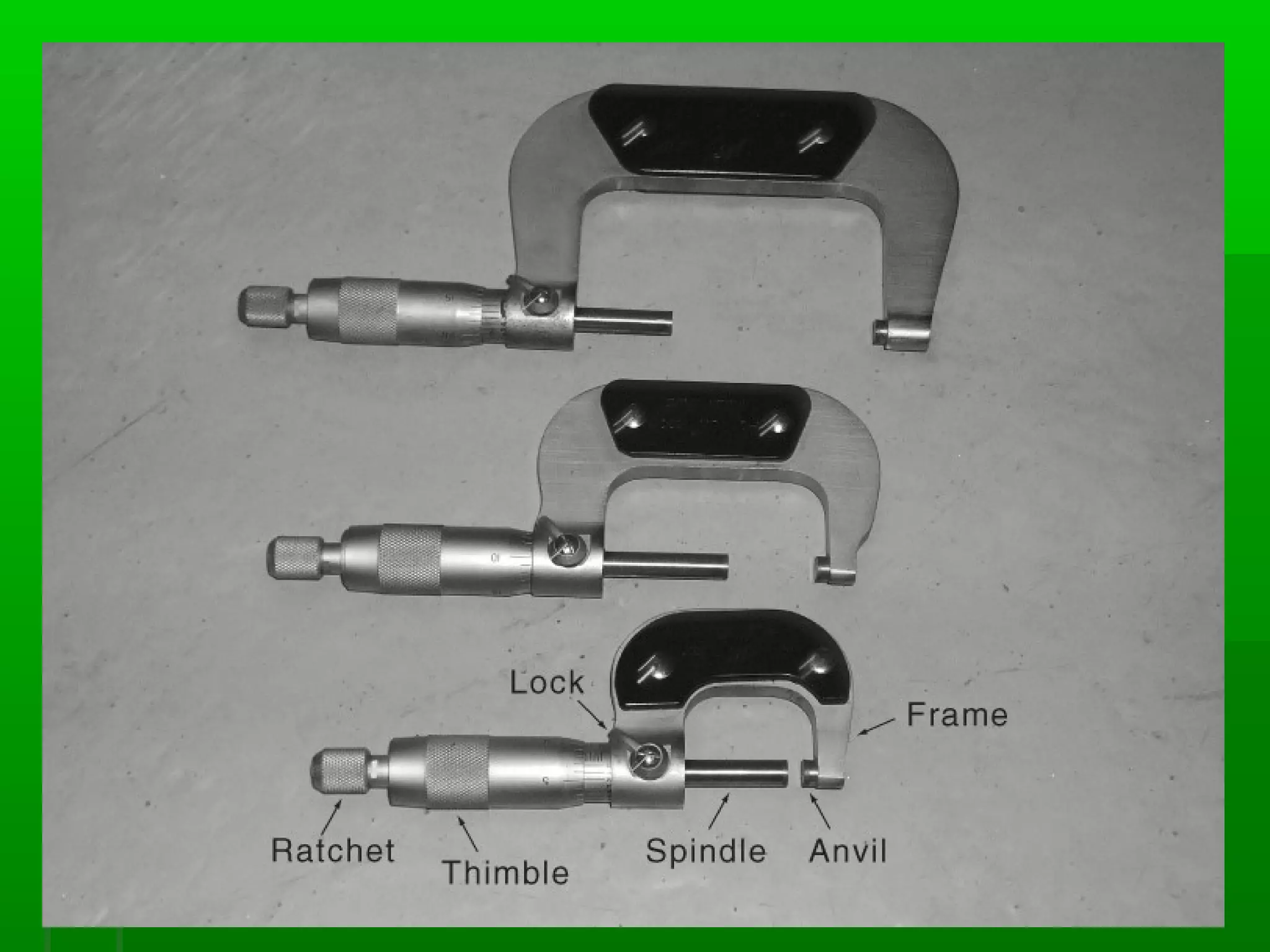
MicrometersMicrometers
 Micrometers precisely measureMicrometers precisely measure
different shapes of a componentdifferent shapes of a component
 Outside micrometersOutside micrometers
 Resembles a clamp to measure linearResembles a clamp to measure linear
distancesdistances
 Proper use requires practice and studyingProper use requires practice and studying
the markings of the instrumentthe markings of the instrument
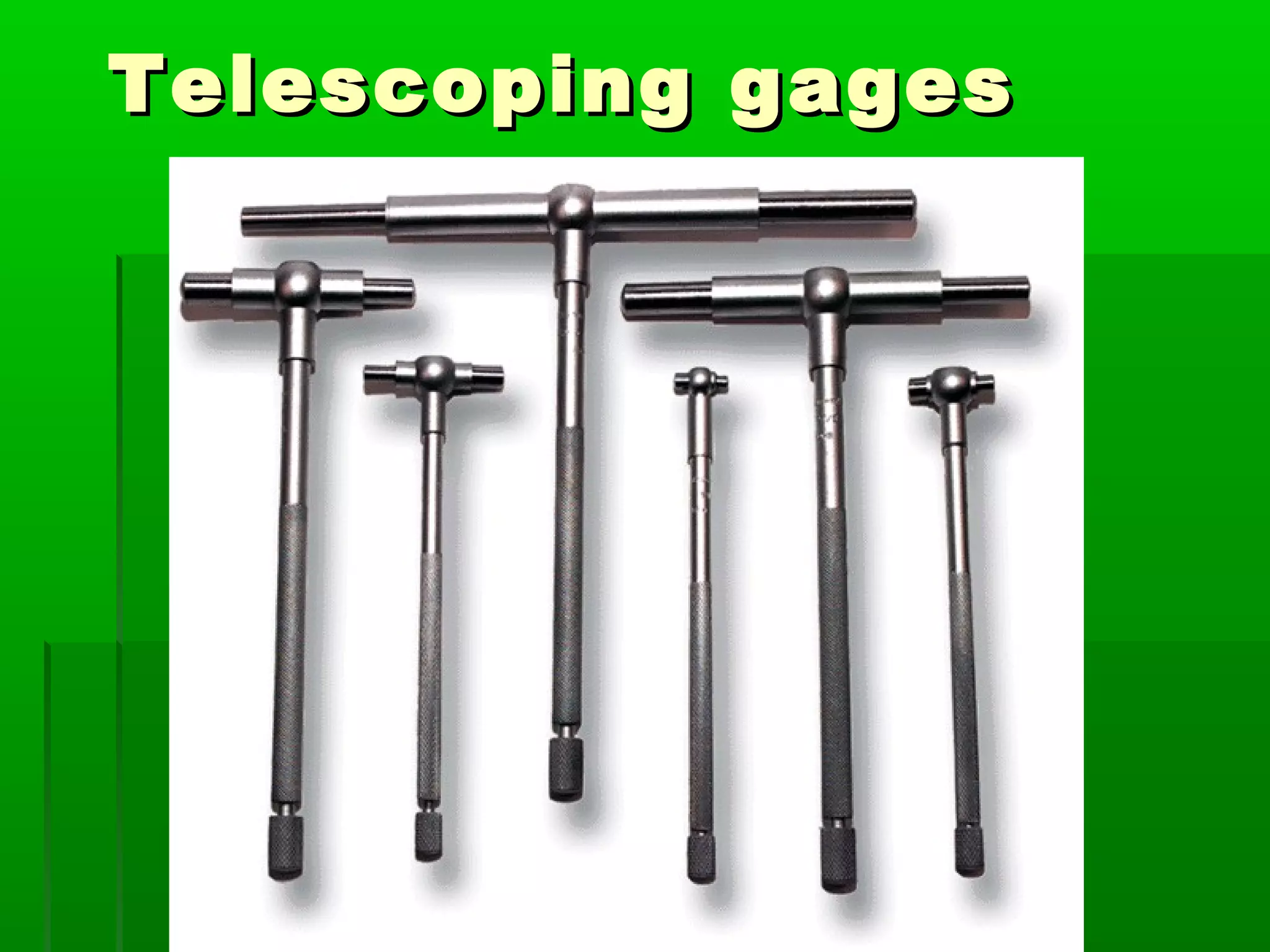
Telescopic GaugesTelescopic Gauges
 Used with outside micrometers toUsed with outside micrometers to
measure inside diametersmeasure inside diameters
 Various lengths and T-shapedVarious lengths and T-shaped
 Extensions are spring-loadedExtensions are spring-loaded
Telescoping gagesTelescoping gages
Inside MicrometersInside Micrometers
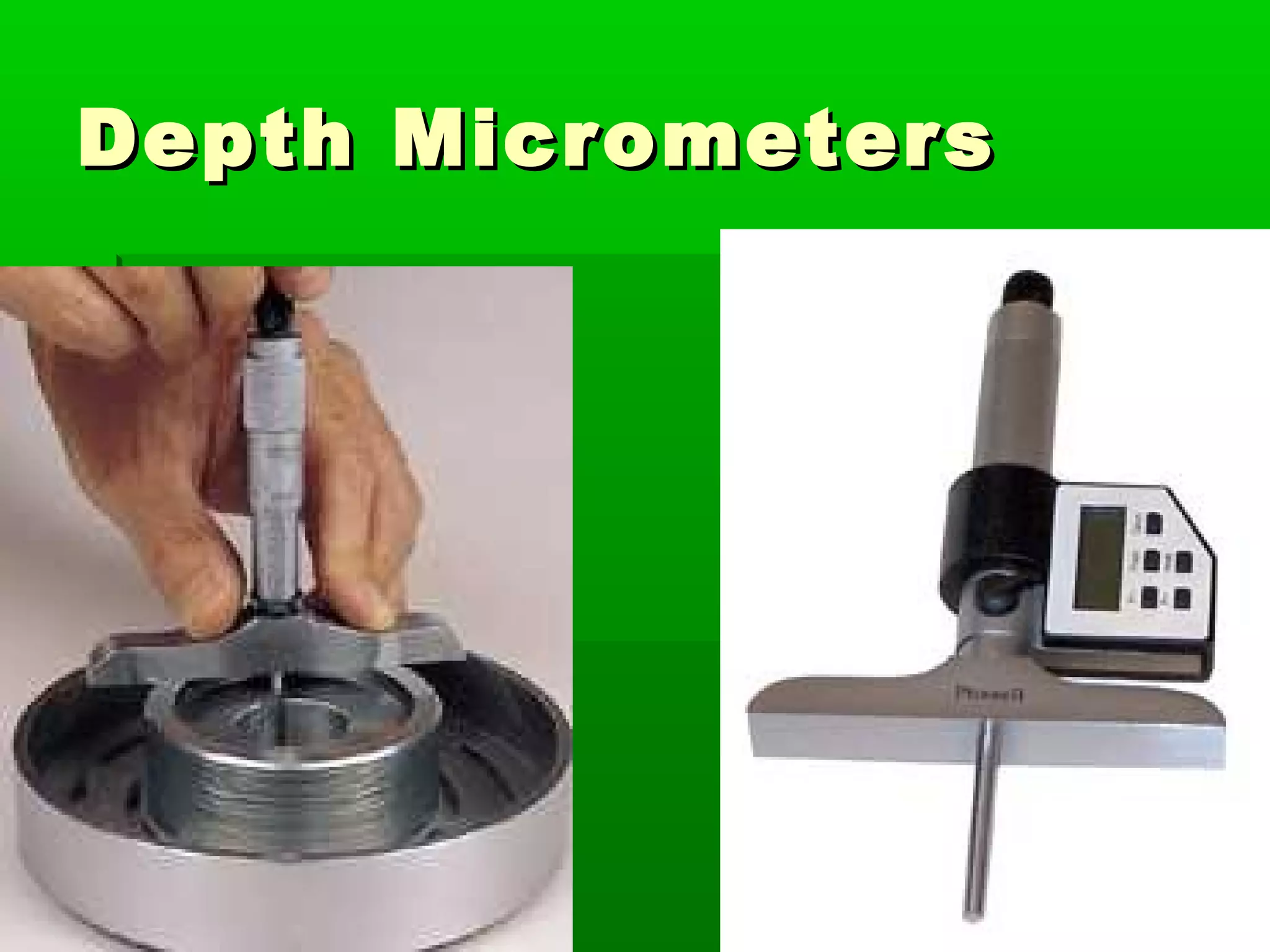
Depth MicrometersDepth Micrometers
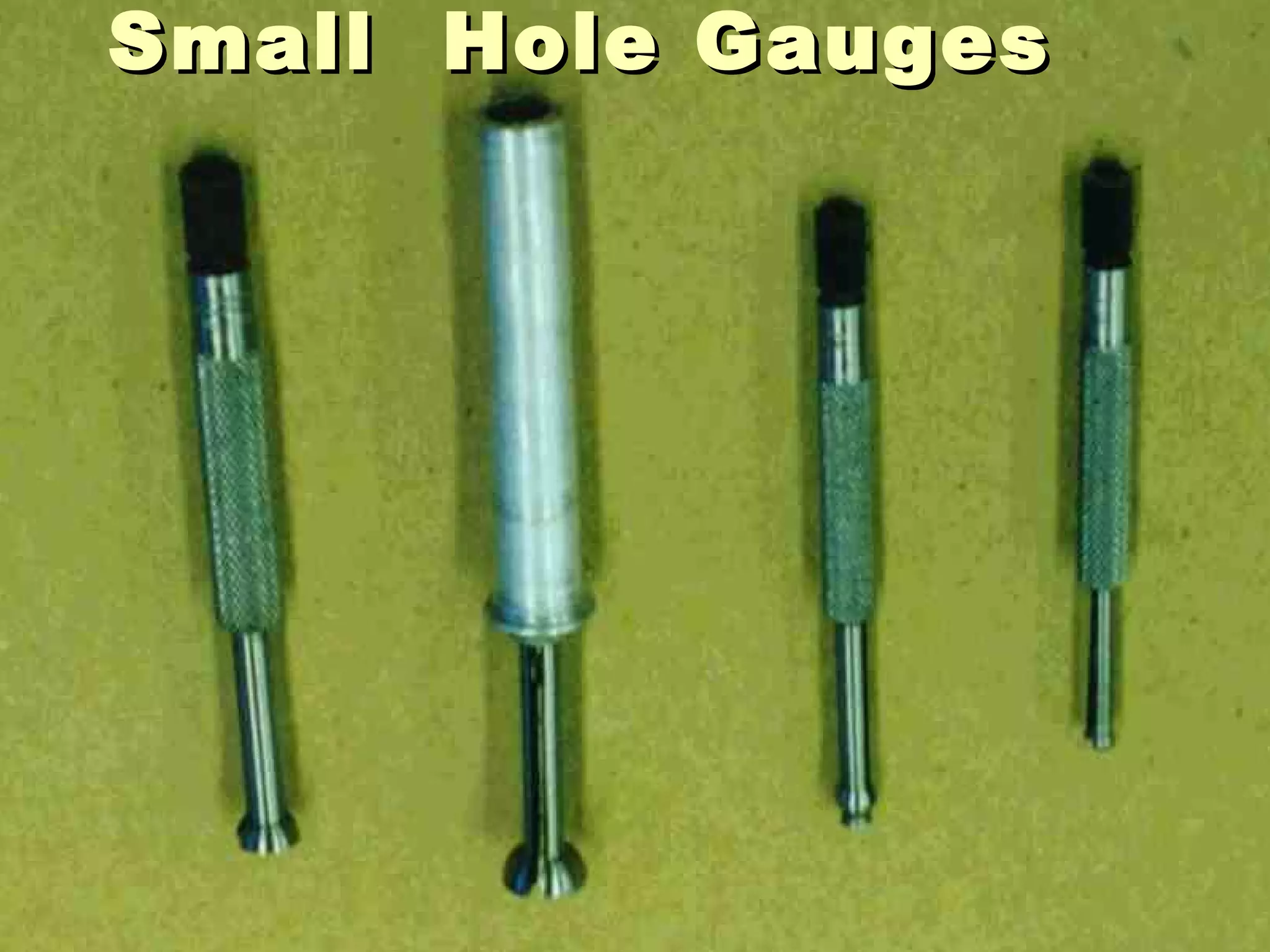
Small Hole GaugesSmall Hole Gauges
 To measure small holesTo measure small holes
 Gauge is straight with a screw handle onGauge is straight with a screw handle on
one end and a split ball on otherone end and a split ball on other
 Handle is turned to expand ballHandle is turned to expand ball
 Removed and measured with a micrometerRemoved and measured with a micrometer
Small Hole GaugesSmall Hole Gauges
Dial IndicatorsDial Indicators
 Dial CalipersDial Calipers
 For inside, outside, and depthFor inside, outside, and depth
measurementsmeasurements
 Manual scales or digitalManual scales or digital
 USC can measure in 0.001 inch incrementsUSC can measure in 0.001 inch increments
 Metric can measure in 2-millimeterMetric can measure in 2-millimeter
incrementsincrements
Dial IndicatorsDial Indicators
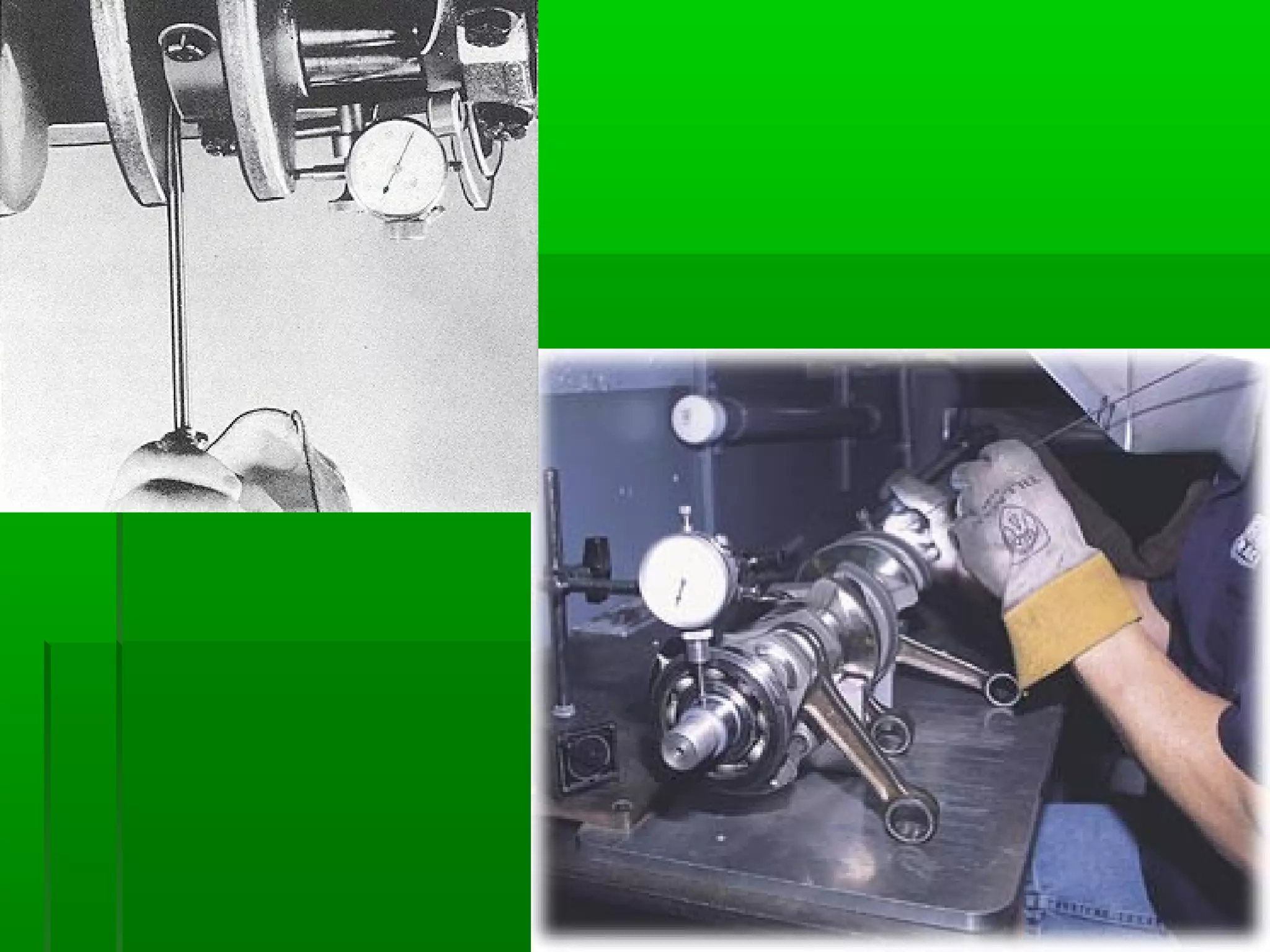
 Dial IndicatorsDial Indicators
 To check how far components can moveTo check how far components can move
 Scale can be USC or metricScale can be USC or metric
 Face can be balanced or continuousFace can be balanced or continuous
 To check runout or end playTo check runout or end play
Pressure and VacuumPressure and Vacuum
MeasurementsMeasurements
 Pressure GaugesPressure Gauges
 Measure amount of pressure applied to aMeasure amount of pressure applied to a
closed, sealed systemclosed, sealed system
 Fitted into pressure line with appropriateFitted into pressure line with appropriate
fittingsfittings
Pressure and VacuumPressure and Vacuum
MeasurementsMeasurements
 Vacuum GaugesVacuum Gauges
 Mechanical gauge measures differenceMechanical gauge measures difference
between atmospheric pressure and currentbetween atmospheric pressure and current
state of systemstate of system
Introduction to Measurement

Introduction to Measurement

  • 1.
  • 2.
    ExplorationExploration  During theancientDuring the ancient times, antimes, an EgyptianEgyptian carpenter nevercarpenter never misplaced hismisplaced his ruler because itruler because it was attached towas attached to his body.his body.
  • 9.
    What you needto knowWhat you need to know  First things first, you need toFirst things first, you need to understand the basicsunderstand the basics  There are two systems ofThere are two systems of measurementmeasurement  US/Customary System which we useUS/Customary System which we use herehere  Then there is the metric system whichThen there is the metric system which is used all over the worldis used all over the world
  • 10.
    Measurement SystemsMeasurement Systems Twotypes of measurement systems.Two types of measurement systems. Standard (Customary) Based on Whole Numbers and Fractional part Metric (International System) Based on the number 10 (Power of 10)
  • 11.
    BackgroundBackground InformationInformation  AllAll countrieshave adopted the metriccountries have adopted the metric system, including the United States.system, including the United States. However, in nearly all countries peopleHowever, in nearly all countries people still usestill use traditional unitstraditional units..  For a country to switch to metric is aFor a country to switch to metric is a process that happens over time. Only 3process that happens over time. Only 3 countries in the world, havecountries in the world, have not officiallynot officially adopted metric as their primary systemadopted metric as their primary system of measuring.of measuring.
  • 12.
    BackgroundBackground InformationInformation Three countries havenot officially adopted the International System of Units as their primary or sole system of measurement: Liberia, Myanmar, and the United States. United States Myanmar (formly known as Burma) Liberia (Settled by free-men and former enslaved blacks after America’s Civil war.
  • 13.
    Measurement BasicsMeasurement Basics Length: is the distance of somethingLength: is the distance of something measuredmeasured  Volume/Capacity: how much somethingVolume/Capacity: how much something can hold ( generally liquid)can hold ( generally liquid)  Weight: how much something weighsWeight: how much something weighs  Mass: how much space something takesMass: how much space something takes upup
  • 14.
    US/Customary SystemUS/Customary System The US/Customary system hasThe US/Customary system has many different units of measurementmany different units of measurement  Each unit has a completely differentEach unit has a completely different namename  They also have completely differentThey also have completely different conversion factorsconversion factors
  • 15.
    Metric SystemMetric System Themetric system hasThe metric system has base unit and manybase unit and many different prefixesdifferent prefixes
  • 16.
    Metric Units ofMetricUnits of MeasurementMeasurement  Meters: Measures lengthMeters: Measures length  Liters: Measures volume or capacityLiters: Measures volume or capacity  Grams: measures weight/massGrams: measures weight/mass
  • 17.
    Units of MeasurementUnitsof Measurement VolumeVolume  US SystemUS System  CupsCups  PintsPints  QuartsQuarts  GallonsGallons  Fluid OuncesFluid Ounces  Metric SystemMetric System  LitersLiters
  • 18.
    Units of MeasurementUnitsof Measurement LengthLength  US SystemUS System  InchesInches  FeetFeet  YardsYards  MilesMiles  MetricMetric  MetersMeters
  • 19.
    Units of MeasurementUnitsof Measurement Weight/MassWeight/Mass  US SystemUS System  OunceOunce  PoundPound  TonsTons  MetricMetric  GramGram
  • 20.
    Metric System PrefixesMetricSystem Prefixes  Mili- 1/1000, which means thatMili- 1/1000, which means that 1000mm=1m1000mm=1m  Centi- 1/100, which means thatCenti- 1/100, which means that 100cg=1g100cg=1g  Deci- 1/10, which means that 10dl=1lDeci- 1/10, which means that 10dl=1l  Deka- 10, which means that 1dkm=10mDeka- 10, which means that 1dkm=10m  Hecto- 100, which means that 1hg=100gHecto- 100, which means that 1hg=100g  Kilo- 1000, which means that 1kl=1000lKilo- 1000, which means that 1kl=1000l
  • 21.
    Partial List ofEnglishPartial List of English measures about 1500measures about 1500 ECEECE  12 inches12 inches = 1 foot= 1 foot  3 feet3 feet = 1 yard= 1 yard  5 feet5 feet = 1 pace= 1 pace  125 paces125 paces = 1 furlong= 1 furlong  8 furlongs8 furlongs = 1 mile= 1 mile  12 furlongs12 furlongs = 1 league= 1 league
  • 22.
    Why Learn toWhyLearn to Measure?Measure? Valuable skill for a job Valuable skill for hobbies Valuable skill for everyday life
  • 23.
    BackgroundBackground InformationInformation  Devices thatcan be used to measure.Devices that can be used to measure.  RulerRuler  Yard StickYard Stick  Meter StickMeter Stick  Tape MeasureTape Measure  ProtractorProtractor  Framing SquareFraming Square  Architect and Engineering ScalesArchitect and Engineering Scales
  • 24.
  • 26.
    CalipersCalipers  CalipersCalipers. Engineersand machinists. Engineers and machinists frequently use calipers to securefrequently use calipers to secure accurate measurements of insideaccurate measurements of inside and outside diameters.and outside diameters.
  • 28.
    Feeler GaugesFeeler Gauges Measure spark plug gapMeasure spark plug gap  Head flatnessHead flatness  Thrust distance in CrankshaftThrust distance in Crankshaft  Ignition point gap (Old Vehicles)Ignition point gap (Old Vehicles)
  • 32.
  • 35.
    MicrometersMicrometers  Micrometers preciselymeasureMicrometers precisely measure different shapes of a componentdifferent shapes of a component  Outside micrometersOutside micrometers  Resembles a clamp to measure linearResembles a clamp to measure linear distancesdistances  Proper use requires practice and studyingProper use requires practice and studying the markings of the instrumentthe markings of the instrument
  • 36.
    Telescopic GaugesTelescopic Gauges Used with outside micrometers toUsed with outside micrometers to measure inside diametersmeasure inside diameters  Various lengths and T-shapedVarious lengths and T-shaped  Extensions are spring-loadedExtensions are spring-loaded
  • 37.
  • 38.
  • 39.
  • 40.
    Small Hole GaugesSmallHole Gauges  To measure small holesTo measure small holes  Gauge is straight with a screw handle onGauge is straight with a screw handle on one end and a split ball on otherone end and a split ball on other  Handle is turned to expand ballHandle is turned to expand ball  Removed and measured with a micrometerRemoved and measured with a micrometer
  • 41.
  • 42.
    Dial IndicatorsDial Indicators Dial CalipersDial Calipers  For inside, outside, and depthFor inside, outside, and depth measurementsmeasurements  Manual scales or digitalManual scales or digital  USC can measure in 0.001 inch incrementsUSC can measure in 0.001 inch increments  Metric can measure in 2-millimeterMetric can measure in 2-millimeter incrementsincrements
  • 43.
    Dial IndicatorsDial Indicators Dial IndicatorsDial Indicators  To check how far components can moveTo check how far components can move  Scale can be USC or metricScale can be USC or metric  Face can be balanced or continuousFace can be balanced or continuous  To check runout or end playTo check runout or end play
  • 45.
    Pressure and VacuumPressureand Vacuum MeasurementsMeasurements  Pressure GaugesPressure Gauges  Measure amount of pressure applied to aMeasure amount of pressure applied to a closed, sealed systemclosed, sealed system  Fitted into pressure line with appropriateFitted into pressure line with appropriate fittingsfittings
  • 46.
    Pressure and VacuumPressureand Vacuum MeasurementsMeasurements  Vacuum GaugesVacuum Gauges  Mechanical gauge measures differenceMechanical gauge measures difference between atmospheric pressure and currentbetween atmospheric pressure and current state of systemstate of system

Editor's Notes

  • #11 Three countries have not officially adopted the International System of Units as their primary or sole system of measurement: Liberia, Myanmar, and the United States. The U. S. has switched to Metric with Sporting Events - Olympics Military Medicine Scientific studies At this time, Manufacturing; Transportation; and Construction Industries; are primarily using the U.S. Customary system. In certain sectors, the conversion is obvious (i.e. – Automobiles). However, in these industry areas the changes have not been as complete. This is the reasoning for studying both measurement systems used in the United States.
  • #23 “Although you are probably familiar with rulers, yard sticks, tape rules, folding rules, and tape measures, you will also find rulers on many machines that you use such as saws, sewing machines, photocopiers, and computer scanners. Computer programs like Microsoft Word and Adobe PhotoShop have electronic rulers that you can turn on to help you with the exact placement of items. As you can tell, reading a ruler is a valuable skill that you will use almost every day both on and off the job.” http://www.rickyspears.com/rulergame/