MatterPhysical and Chemical ChangesStates of Matter
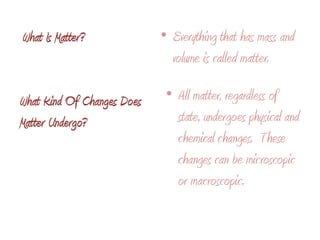
Everything that has mass and volume is called matter.What Is Matter?All matter, regardless of state, undergoes physical and chemical changes.  These changes can be microscopic or macroscopic.What Kind Of Changes Does Matter Undergo?
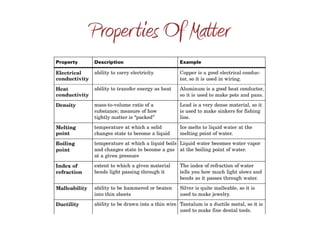
Properties Of Matter
What Is A Physical Change?A physical change occurs when the substance changes state but does not change its chemical composition.  For example:  water freezing into ice, cutting a piece of wood into smaller pieces, etc.  The form or appearance has changed, but the properties of that substance are the same (i.e. it has the same melting point, boiling point, chemical composition, etc.)
Characteristics Of Physical ChangesMelting pointBoiling pointVapor pressureColorState of matterDensity Electrical conductivitySolubilityAdsorption to a surfaceHardness
What Are Chemical Changes?A chemical change occurs when a substance changes into something new.  This occurs due to heating, chemical reaction, etc.  You can tell a chemical change has occurred if the density, melting point or freezing point of the original substance changes.  Many common signs of a chemical change can be seen (bubbles forming, mass changed, etc).
Characteristics Of Chemical ChangesReaction with acidsReaction with bases (alkalis)Reaction with oxygen (combustion)Ability to act as oxidizing agentAbility to act as reducing agentReaction with other elementsDecomposition into simpler substancesCorrosion
Physical properties are those that we can determine without changing the identity of the substance we are studying. How Can We Identify Physical Properties?Examples Of Physical PropertiesThe physical properties of sodium metal can be observed or measured.  It is a soft, lustrous, silver-colored metal with a relatively low melting point and low density. Hardness, color, melting point and density are all physical properties.
What Are Chemical Properties?Chemical properties describe the way a substance can change or react to form other substances. These properties, then, must be determined using a process that changes the identity of the substance of interest. We have to define chemical properties of a substance by the chemical changes it undergoes.How Can We Identify Chemical Properties?
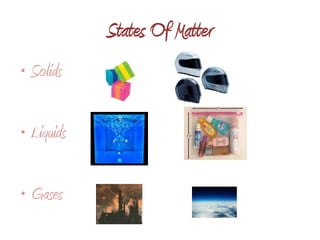
States Of MatterSolids
Liquids

Matter

  • 1.
    MatterPhysical and ChemicalChangesStates of Matter
  • 2.
    Everything that hasmass and volume is called matter.What Is Matter?All matter, regardless of state, undergoes physical and chemical changes. These changes can be microscopic or macroscopic.What Kind Of Changes Does Matter Undergo?
  • 3.
  • 4.
    What Is APhysical Change?A physical change occurs when the substance changes state but does not change its chemical composition. For example: water freezing into ice, cutting a piece of wood into smaller pieces, etc. The form or appearance has changed, but the properties of that substance are the same (i.e. it has the same melting point, boiling point, chemical composition, etc.)
  • 5.
    Characteristics Of PhysicalChangesMelting pointBoiling pointVapor pressureColorState of matterDensity Electrical conductivitySolubilityAdsorption to a surfaceHardness
  • 6.
    What Are ChemicalChanges?A chemical change occurs when a substance changes into something new. This occurs due to heating, chemical reaction, etc. You can tell a chemical change has occurred if the density, melting point or freezing point of the original substance changes. Many common signs of a chemical change can be seen (bubbles forming, mass changed, etc).
  • 7.
    Characteristics Of ChemicalChangesReaction with acidsReaction with bases (alkalis)Reaction with oxygen (combustion)Ability to act as oxidizing agentAbility to act as reducing agentReaction with other elementsDecomposition into simpler substancesCorrosion
  • 8.
    Physical properties arethose that we can determine without changing the identity of the substance we are studying. How Can We Identify Physical Properties?Examples Of Physical PropertiesThe physical properties of sodium metal can be observed or measured. It is a soft, lustrous, silver-colored metal with a relatively low melting point and low density. Hardness, color, melting point and density are all physical properties.
  • 9.
    What Are ChemicalProperties?Chemical properties describe the way a substance can change or react to form other substances. These properties, then, must be determined using a process that changes the identity of the substance of interest. We have to define chemical properties of a substance by the chemical changes it undergoes.How Can We Identify Chemical Properties?
  • 10.
  • 11.