WHAT IS MOTIVATION? Motivation is derived from Latin words  movere  which means “to move”  Motivation is the result of processes, internal or external to the individual,  that arouse enthusiasm and persistence to pursue a certain course of action.
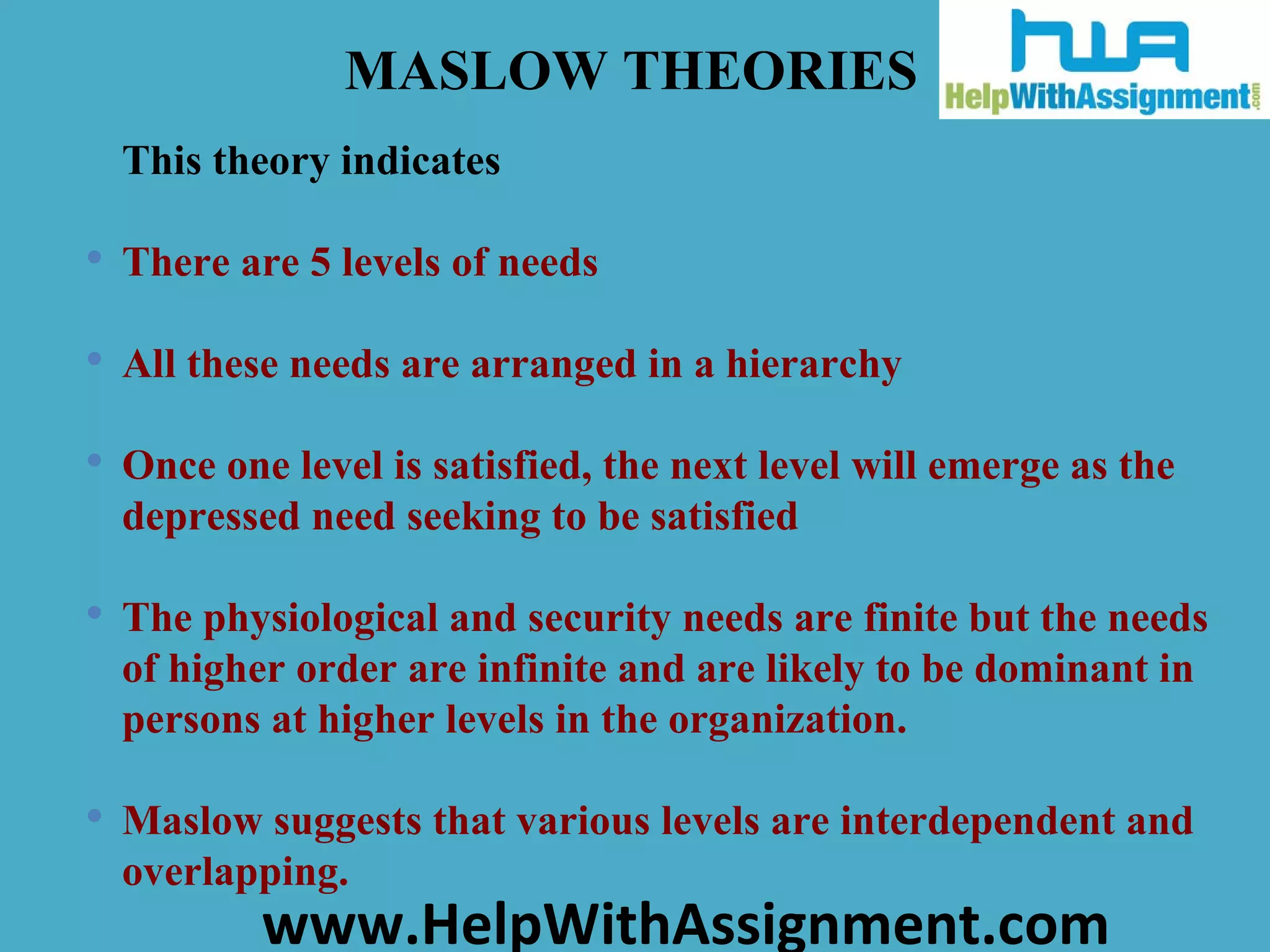
Who was ABRAHAM MASLOW? Abraham was born in Brooklyn since 1908 – 1970. Maslow was a psychologist who studied the lives and activities of individuals that he found considered them to be  “successful and productive”. Maslow is a famous theorist which encompass everything from basic needs to self-actualization in order to demonstrate what motivates people. 
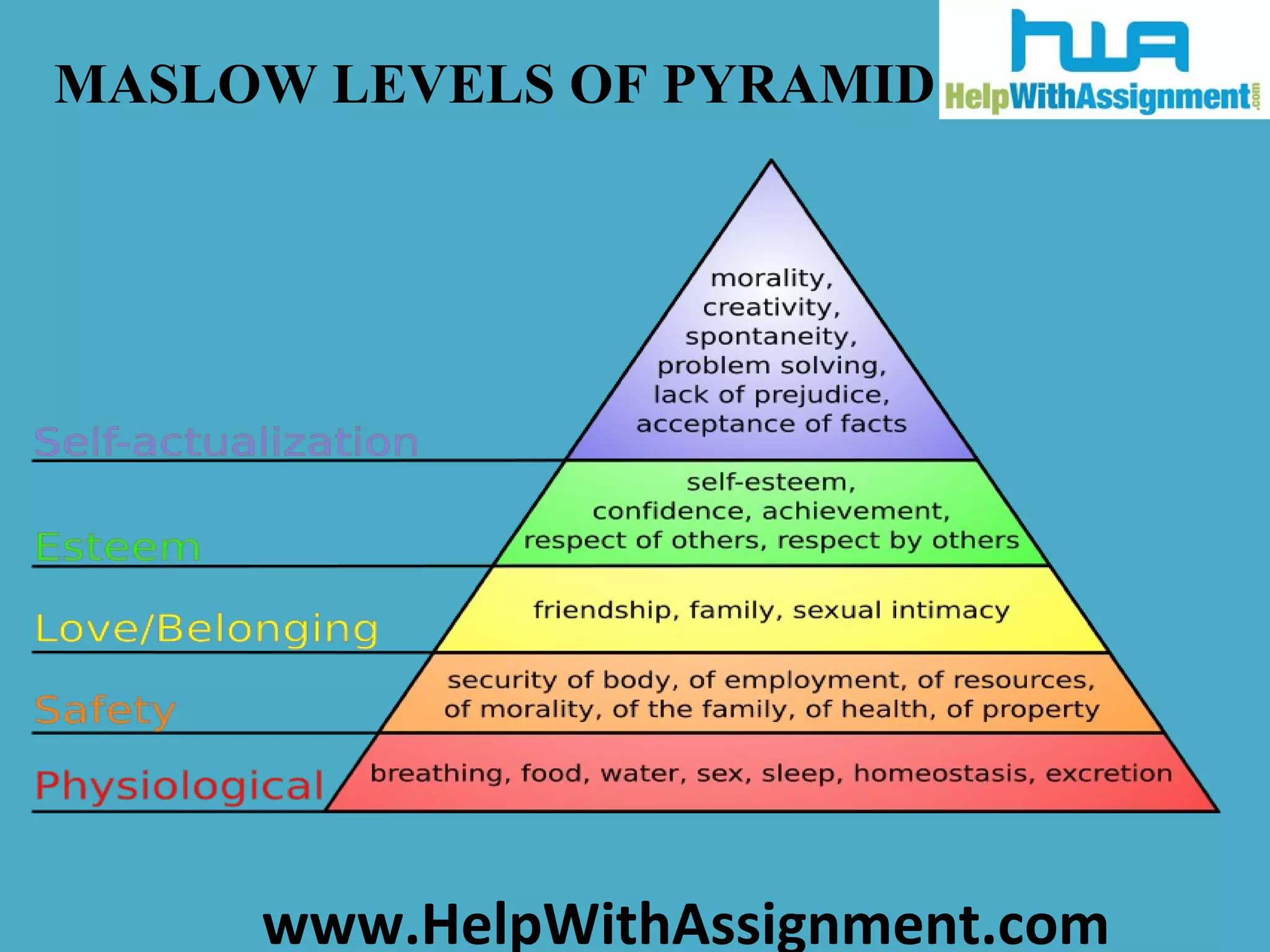
This theory indicates  There are 5 levels of needs All these needs are arranged in a hierarchy Once one level is satisfied, the next level will emerge as the depressed need seeking to be satisfied The physiological and security needs are finite but the needs of higher order are infinite and are likely to be dominant in persons at higher levels in the organization.  Maslow suggests that various levels are interdependent and overlapping.   MASLOW THEORIES
MASLOW LEVELS OF PYRAMID
Physical Needs LEVEL ONE
Air
Water
FOOD
rest
Exercise
These are the basic human needs including food, clothing, shelter and other necessities of life.  Air Water Food  Rest Exercise According to Maslow’s theory, if such needs are not satisfied then one’s motivation will arise from the quest to satisfy them. Higher needs such as social needs and esteem are not felt until one has met the need’s basic to one’s bodily functioning . Physical needs -  LEVEL ONE :
LEVEL TWO Safety Needs
Safety
Security
Protection
freedom from fear
Safety needs:  These includes economic security, protection from physical dangers. Safety Security Protection Freedom from Fear According to Maslow’s hierarchy, if a person  feels that he or she is in harm’s way, higher needs will not receive much attention. Safety needs - LEVEL TWO:
LEVEL THREE Social   Needs
Love
Belongingness
affection
Social needs - LEVEL THREE: Social needs:  Need for love, affection, emotional needs, warmth and friendship. Love Belongingness Affection Once a person has met the lower level physiological and safety needs, higher level motivators awaken. Social needs are those related to interaction with others .
Esteem Needs LEVEL FOUR
Strength
Status
Self-esteem:  Ego or self esteem, self respect, self confidence, recognition. Strength (esteem) Status (esteem) Maslow later refined his model to include a level between esteem needs and self – actualization the need for knowledge and aesthetics. Esteem needs - LEVEL FOUR:
Self-actualization LEVEL FIVE
Self actualization needs:  desire for personal achievement or mission of his life. Self – actualized persons have frequent occurrence of peak experiences, which are energized moments of profound happiness and harmony. According to Maslow, only a small percentage of the population reaches the level of self- actualization. Self Actualization-  LEVEL FIVE
Researchers have proved that there is lack  of hierarchical structure of needs as suggested by Maslow.  Some people may have deprived of lower level  needs but strive for self actualization.  There is lack of direct cause and effect relationship  between need and behavior.  Sometimes peoples are not aware of their own needs.  Measurement of satisfaction of needs is not possible.  Criticism
CONCLUSION The basis of Maslow's motivation theory is that human beings are motivated by unsatisfied needs, and that certain lower factors need to be satisfied before higher needs can be satisfied. According to Maslow, there are general types of needs (physiological, survival, safety, love, and esteem) that must be satisfied before a person can act unselfishly.  He called these needs "deficiency needs." As long as we are motivated to satisfy these cravings, we are moving towards growth, toward self-actualization. Satisfying needs is healthy, while preventing gratification makes us sick or act evilly.
Thank You

Maslow's theory hrm_assignment_help

  • 1.
  • 2.
    WHAT IS MOTIVATION?Motivation is derived from Latin words movere which means “to move” Motivation is the result of processes, internal or external to the individual, that arouse enthusiasm and persistence to pursue a certain course of action.
  • 3.
    Who was ABRAHAMMASLOW? Abraham was born in Brooklyn since 1908 – 1970. Maslow was a psychologist who studied the lives and activities of individuals that he found considered them to be “successful and productive”. Maslow is a famous theorist which encompass everything from basic needs to self-actualization in order to demonstrate what motivates people. 
  • 4.
    This theory indicates There are 5 levels of needs All these needs are arranged in a hierarchy Once one level is satisfied, the next level will emerge as the depressed need seeking to be satisfied The physiological and security needs are finite but the needs of higher order are infinite and are likely to be dominant in persons at higher levels in the organization. Maslow suggests that various levels are interdependent and overlapping. MASLOW THEORIES
  • 5.
  • 6.
  • 7.
  • 8.
  • 9.
  • 10.
  • 11.
  • 12.
    These are thebasic human needs including food, clothing, shelter and other necessities of life. Air Water Food Rest Exercise According to Maslow’s theory, if such needs are not satisfied then one’s motivation will arise from the quest to satisfy them. Higher needs such as social needs and esteem are not felt until one has met the need’s basic to one’s bodily functioning . Physical needs - LEVEL ONE :
  • 13.
  • 14.
  • 15.
  • 16.
  • 17.
  • 18.
    Safety needs: These includes economic security, protection from physical dangers. Safety Security Protection Freedom from Fear According to Maslow’s hierarchy, if a person feels that he or she is in harm’s way, higher needs will not receive much attention. Safety needs - LEVEL TWO:
  • 19.
  • 20.
  • 21.
  • 22.
  • 23.
    Social needs -LEVEL THREE: Social needs: Need for love, affection, emotional needs, warmth and friendship. Love Belongingness Affection Once a person has met the lower level physiological and safety needs, higher level motivators awaken. Social needs are those related to interaction with others .
  • 24.
  • 25.
  • 26.
  • 27.
    Self-esteem: Egoor self esteem, self respect, self confidence, recognition. Strength (esteem) Status (esteem) Maslow later refined his model to include a level between esteem needs and self – actualization the need for knowledge and aesthetics. Esteem needs - LEVEL FOUR:
  • 28.
  • 29.
    Self actualization needs: desire for personal achievement or mission of his life. Self – actualized persons have frequent occurrence of peak experiences, which are energized moments of profound happiness and harmony. According to Maslow, only a small percentage of the population reaches the level of self- actualization. Self Actualization- LEVEL FIVE
  • 30.
    Researchers have provedthat there is lack of hierarchical structure of needs as suggested by Maslow. Some people may have deprived of lower level needs but strive for self actualization. There is lack of direct cause and effect relationship between need and behavior. Sometimes peoples are not aware of their own needs. Measurement of satisfaction of needs is not possible. Criticism
  • 31.
    CONCLUSION The basisof Maslow's motivation theory is that human beings are motivated by unsatisfied needs, and that certain lower factors need to be satisfied before higher needs can be satisfied. According to Maslow, there are general types of needs (physiological, survival, safety, love, and esteem) that must be satisfied before a person can act unselfishly. He called these needs "deficiency needs." As long as we are motivated to satisfy these cravings, we are moving towards growth, toward self-actualization. Satisfying needs is healthy, while preventing gratification makes us sick or act evilly.
  • 32.