Our Objective
1. Togive language to the writing patterns and
movements used by scholars to analyze and interpret
literature with the goal to write our understanding of
themes and larger ideas presented in literature
What is aLens ?
● A lens is a literary theory through which we read and
understand a text.
● The lens will act as a filter, removing unnecessary or
irrelevant information in order to gain a richer
perspective and view of text (it helps see you more).
● When reading literature with a lens, think about how the
lens will grant you a change in perspective and may even
shed new (or different) truths on certain ideas.
5.
● Societal roles/Gender
Theory
● Psycho-Analytical
● Marxist (Class Theory)
● Post-Structural
● Historical
The lenses
Disclaimer:
Keep in mind. These are theories!
They are toolboxes used to
examine the world and you must
keep in mind that it isn’t the ONLY
way to view the world.
These theories are neutral and
don’t focus on ideologies (they can
even be used to study ideology)
6.
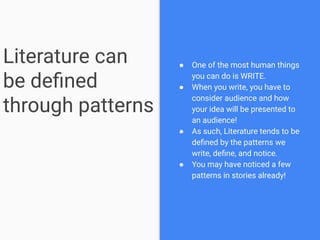
Literature can
be defined
throughpatterns
● One of the most human things
you can do is WRITE.
● When you write, you have to
consider audience and how
your idea will be presented to
an audience!
● As such, Literature tends to be
defined by the patterns we
write, define, and notice.
● You may have noticed a few
patterns in stories already!
7.
Tell me RIGHT
NOW.What are
some “patterns”
you have observed
in stories!
8.
Who is the“GOOD GUY?”
Who is the “BAD GUY?”
How do you know?
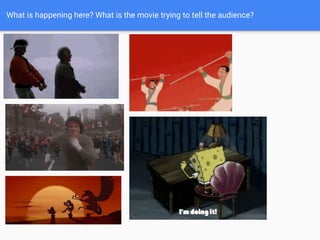
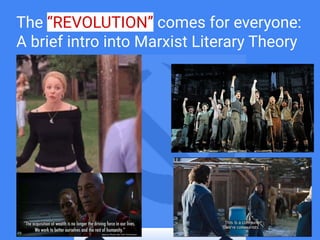
What is happeninghere? What is the movie trying to tell the audience?
11.
A small polaroidfor anyone who can tell me the joke behind for this slide.
12.
What does ANYof that have to do with Literary
Theory?
● Settle down there kid!
● These are tropes, tools authors use
when writing their stories.
● However! While writing patterns
exist (metaphor, symbols, etc) one
must also think about cultural,
political, and societal patterns
which can be observed in a story!
● Literary theory are the toolboxes
used to dismantle, observe, and
analyze these patterns!
● For example:
In “Star Wars,” Luke Skywalker dismantles
ideas of toxic masculinity and the
corruptive influence of pursuing selfish
power by NOT killing his father. Instead, he
sticks to the Jedi code and lays down his
weapon. This act of kindness and
forgiveness allows Anakin Skywalker to lift
up and destroy the Emperor. Traditional
masculine values would tell Luke to kill
without though. However, Lucas wished to
CHALLENGE that idea by having Luke
choose peace over violence. Revolution
doesn’t always require violence.
What is Societal
roles/Gender
Theory?
● Societal roles / Gender
Literary Theory is a lens
which examine patterns
related to gendered
expectations, roles,
relationships, and often
focuses on the treatment
women and men roles in a
story.
15.
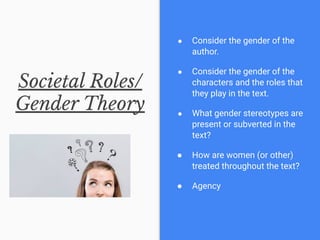
Societal Roles/
Gender Theory
(orhow does gender influence the way a
character moves through a story!
When thinking about this
theory one needs to think
about certain patterns
concerning how we treat
men and women, how we
them, what expectations
are placed upon them, and
why these expectations
and societal concerns even
exist.
Consider the following ->
1. When is it acceptable for men to cry?
Why only in those situations?
2. How often are the roles of women
reduced to their relationship to a man
(wife, daughter, girlfriend)
3. Why is the “chick flick” or “romance
movie” not given that same respect or
gravity of importance as a war movie?
4. What stereotypes exist for women and
how harmful can they be in comparison
to the stereotypes which exist for men?
5. What story is taken more seriously, a
woman’s story or a man’s story?
16.
Societal Roles/
Gender Theory
●Consider the gender of the
author.
● Consider the gender of the
characters and the roles that
they play in the text.
● What gender stereotypes are
present or subverted in the
text?
● How are women (or other)
treated throughout the text?
● Agency
17.
Questions to ask
1.How does gender impact the story events or character?
2. How is power distributed on the basis of sex or gender and dow
does this impact the way characters interact?
3. How does the piece of literature comment on a system dominated
by men or other male voices/presence (patriarchy)?
4. How is masculinity and/or femininity explored in the literature?
5. How are certain roles for men or women reinforced, subverted, or
challenged in the piece of literature?
18.
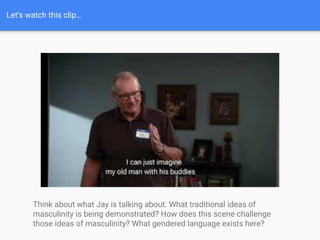
Let’s watch thisclip…
Think about what Jay is talking about. What traditional ideas of
masculinity is being demonstrated? How does this scene challenge
those ideas of masculinity? What gendered language exists here?
19.
Limitations of SocietalRoles - Gender Theory
● While socio-economic discussions can be had under Gender Theory, the
language tool set provided is not best equipped to discuss economic disparity
or the struggle of class outside gender.
● Discussions under this theory can sometimes exclude or isn’t properly
equipped to tackle issues of race. This theory tend to have a Western white
woman focus instead of including OTHER women.
● While theory may focus on the effects of oppression and other traumas women
or men, it isn’t the best equipped to discuss psychological effects or
psychological approaches to a story outside of gender.
● It focuses a on the struggle or lack of representation of women, it can
sometimes ignore issues in stories that exist outside the binary of Man vs
Woman.
What is Marxist
LiteraryTheory?
We can also refer to this as
class conflict theory.
1. Marxist Literary Theory seeks
to identify patterns of class
conflict, alienation, and themes
of oppression as imposed by
the pursuit of wealth.
23.
Marxist Theory 1.In a story, how often do the elite use
violence (usually through government
means) to make sure no one is allowed
to move upward?
2. How does a character or group of
characters become “alienated” by their
work and products of their work?
3. Why is a character unable to rise through
the ranks to a “better life?”
4. How does the class struggle in a story
highlight themes and ideas presented in
the story?
5. How can the story be used as a way to
observe societal/cultural issues?
Especially on issues of money.
6. What solutions or problems are being
highlighted in this story?
This Literary theory wants
you to consider the conflicts
between the poor working
class and the (usually)
politically powerful upper
class. With this theory, a
toolbox is given to observe
how capital gives power to a
certain group of people and
then how that power is
denied to others, access to
power is (violently) denied,
how that power is
maintained, and then asks
the question, “why?”
Consider the following ->
24.
Review
Answer the questionsabout the
critical literary theories
discussed in yesterday’s classes
not using any notes.
What are lenses?
What is social roles/
gender theory?
Name one limitation of
societal roles/gender
theory?
What is marxist theory?
25.
For more infocheck these people out!
They know way more than me…
● Karl Marx and Conflict Theory
● PhilosophyTube: Marx Part 1: Labor and Class Conflict
26.
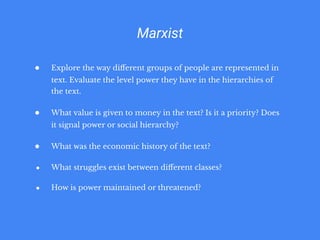
Marxist
● Explore theway different groups of people are represented in
text. Evaluate the level power they have in the hierarchies of
the text.
● What value is given to money in the text? Is it a priority? Does
it signal power or social hierarchy?
● What was the economic history of the text?
● What struggles exist between different classes?
● How is power maintained or threatened?
27.
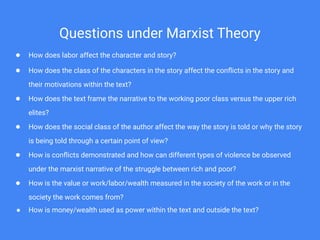
Questions under MarxistTheory
● How does labor affect the character and story?
● How does the class of the characters in the story affect the conflicts in the story and
their motivations within the text?
● How does the text frame the narrative to the working poor class versus the upper rich
elites?
● How does the social class of the author affect the way the story is told or why the story
is being told through a certain point of view?
● How is conflicts demonstrated and how can different types of violence be observed
under the marxist narrative of the struggle between rich and poor?
● How is the value or work/labor/wealth measured in the society of the work or in the
society the work comes from?
● How is money/wealth used as power within the text and outside the text?
28.
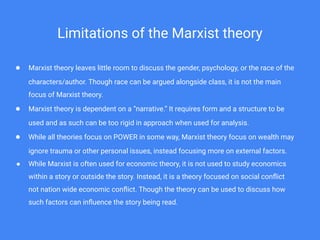
Limitations of theMarxist theory
● Marxist theory leaves little room to discuss the gender, psychology, or the race of the
characters/author. Though race can be argued alongside class, it is not the main
focus of Marxist theory.
● Marxist theory is dependent on a “narrative.” It requires form and a structure to be
used and as such can be too rigid in approach when used for analysis.
● While all theories focus on POWER in some way, Marxist theory focus on wealth may
ignore trauma or other personal issues, instead focusing more on external factors.
● While Marxist is often used for economic theory, it is not used to study economics
within a story or outside the story. Instead, it is a theory focused on social conflict
not nation wide economic conflict. Though the theory can be used to discuss how
such factors can influence the story being read.
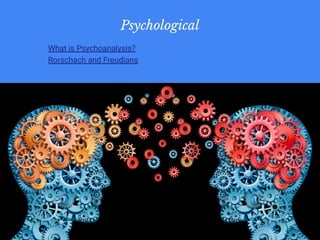
Psychological
● How doesthe author’s experiences or life trauma reflect his
or her text?
● How might symbols in the story reflect deep seeded anxieties
or desires of the character?
● How might the life experiences or relationships with others
explain the characters actions?
● How can unconscious desire or trauma influence the
decisions made by characters…or what agency/power is
taken away/informed because of it?
31.
Review
Answer the questionsabout the
critical literary theories
discussed in yesterday’s classes
not using any notes.
What is a limitation of
marxist theory?
Name an example from a
story of marxist theory?
What is psychological
theory?
Name one example of
psychological theory?
32.
Questions to askunder Psychoanalytic Theory
1. How does the piece of literature expose certain traumas or issues of the author?
2. How is the repressed feelings or desires come to light in the story for certain
characters?
3. How is the ID, EGO, and SUPEREGO explored in the story within certain characters
or groups of characters?
4. How are certain fears and desires addressed in the story or through the journey
of a character? How can that also inform motivation within story?
5. What are prominent words, phrases, or images which appear often in a story and
how might it explain the mental state of characters or even the author?
6. How are ARCHETYPES used and explored within the work? How are roles within
archetypes reinforced, subverted, or challenged within the work?
33.
Limitations of PsychoanalyticTheory
● While psychoanalytic theory focuses on the mental state of characters or author, it
isn’t equipped to explain or address issues brought up due to gender, race, or class.
It may hint at it, but isn’t the language used to address such issues.
● Psychoanalytic theory can address the effects of power but rarely does it discuss
the root of power or how power is exercised.
● Psychoanalytic theory isn’t the best equipped to address issues of class since it may
focus on ‘universal’ concepts of archetypes or even family trauma, rather than how
class structure affect the character. Not always.
● In especially complex stories, certain archetypes or narrative structures don’t fit
neatly under psychoanalytic theory.
● Much of the theory is focused on a Western Male view of the world and thus may
not be the most effective theory to study certain stories or characters outside the
west.
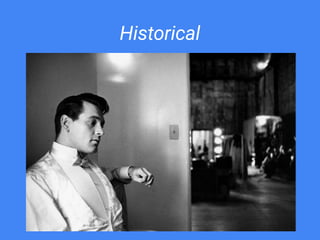
Historical
● Identify historicalindicators within the text.
● Think of the presence of historical objects within the text and
their importance.
● Consider how the time period in which the text was constructed
might have impacted the text.
● Treats a piece of literature like an historical document similar to
how historians study.
36.
...
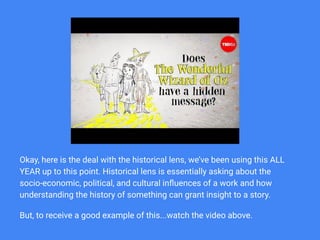
Okay, here isthe deal with the historical lens, we’ve been using this ALL
YEAR up to this point. Historical lens is essentially asking about the
socio-economic, political, and cultural influences of a work and how
understanding the history of something can grant insight to a story.
But, to receive a good example of this...watch the video above.