MARS ORBITER MISSION
The Planet Mars 
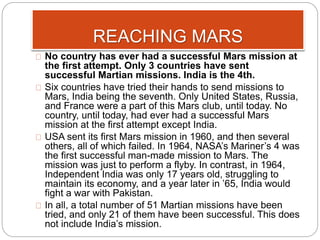
Mars is the fourth planet from the Sun. 
Named after the Roman god of war, and 
often described as the “Red Planet” due to 
its reddish appearance. Mars is a terrestrial 
planet with a thin atmosphere composed 
primarily of carbon dioxide. 
Mass: 641,693,000,000,000 billion kg (0.107 x 
Earth) 
Notable Moons: Phobos & Deimos 
Orbit Distance: 227,943,824 km (1.38 AU) 
Orbit Period: 686.98 Earth days (1.88 Earth 
years) 
Surface Temperature: -87 to -5 °C 
First Record: 2nd millennium BC 
Recorded By: Egyptian astronomers
REACHING MARS 
No country has ever had a successful Mars mission at 
the first attempt. Only 3 countries have sent 
successful Martian missions. India is the 4th. 
Six countries have tried their hands to send missions to 
Mars, India being the seventh. Only United States, Russia, 
and France were a part of this Mars club, until today. No 
country, until today, had ever had a successful Mars 
mission at the first attempt except India. 
USA sent its first Mars mission in 1960, and then several 
others, all of which failed. In 1964, NASA’s Mariner’s 4 was 
the first successful man-made mission to Mars. The 
mission was just to perform a flyby. In contrast, in 1964, 
Independent India was only 17 years old, struggling to 
maintain its economy, and a year later in ’65, India would 
fight a war with Pakistan. 
In all, a total number of 51 Martian missions have been 
tried, and only 21 of them have been successful. This does 
not include India’s mission.
MISSION POSSIBLE 
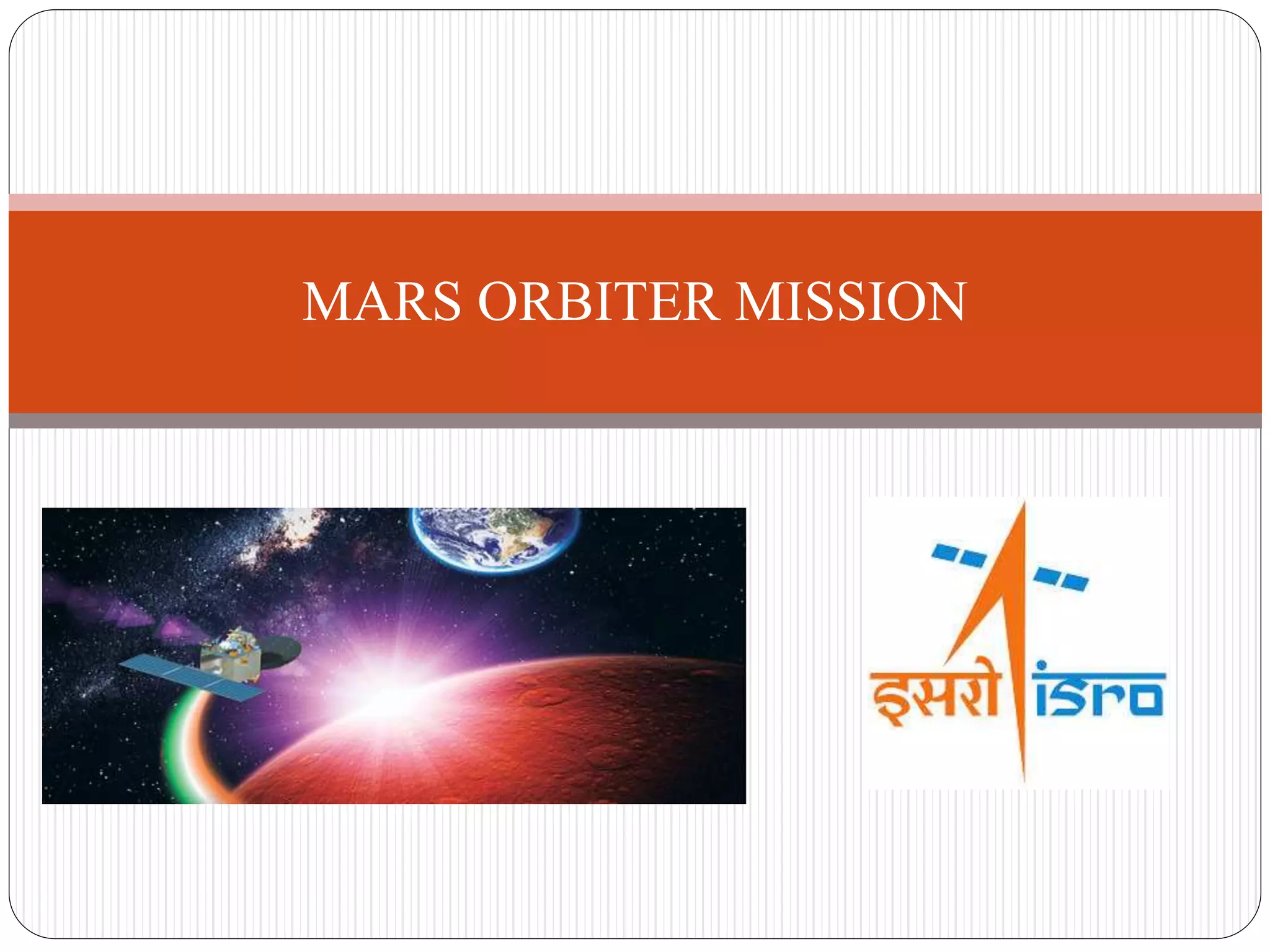
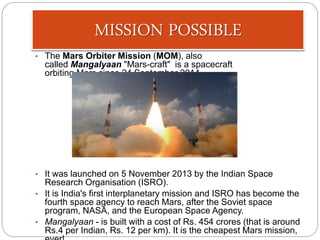
• The Mars Orbiter Mission (MOM), also 
called Mangalyaan "Mars-craft" is a spacecraft 
orbiting Mars since 24 September 2014. 
• It was launched on 5 November 2013 by the Indian Space 
Research Organisation (ISRO). 
• It is India's first interplanetary mission and ISRO has become the 
fourth space agency to reach Mars, after the Soviet space 
program, NASA, and the European Space Agency. 
• Mangalyaan - is built with a cost of Rs. 454 crores (that is around 
Rs.4 per Indian, Rs. 12 per km). It is the cheapest Mars mission, 
ever!
OBJECTIVES 
The primary objective of the Mars Orbiter Mission 
is to showcase India's rocket launch systems, 
spacecraft-building and operations capabilities. 
The secondary objective is to explore Mars' 
surface 
features, morphology, mineralogy and Martian 
atmosphere using indigenous scientific 
instruments. 
To determine the quantities of water in Martian 
atmosphere that will help scientists around the 
world understand the history of Mars and how 
much water has been lost to Martian atmosphere 
in the past. The mission will also be to determine 
quantities of methane in the atmosphere, another 
key element for life.
TRAJECTORY
COMPONENTS 
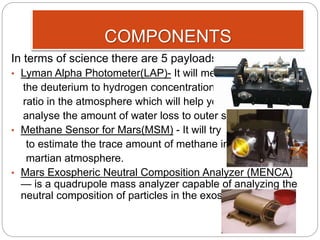
In terms of science there are 5 payloads – 
• Lyman Alpha Photometer(LAP)- It will measure 
the deuterium to hydrogen concentration 
ratio in the atmosphere which will help you to 
analyse the amount of water loss to outer space. 
• Methane Sensor for Mars(MSM) - It will try 
to estimate the trace amount of methane in the 
martian atmosphere. 
• Mars Exospheric Neutral Composition Analyzer (MENCA) 
— is a quadrupole mass analyzer capable of analyzing the 
neutral composition of particles in the exosphere.
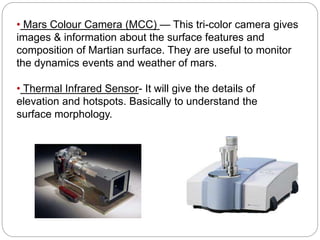
• Mars Colour Camera (MCC) — This tri-color camera gives 
images & information about the surface features and 
composition of Martian surface. They are useful to monitor 
the dynamics events and weather of mars. 
• Thermal Infrared Sensor- It will give the details of 
elevation and hotspots. Basically to understand the 
surface morphology.
Cheapest, yes. Useless? No. 
While there have been several critics of the mission given the 
low-profile objectives of the mission, Mars Orbiter Mission is 
in fact a significant one for ISRO and India. 
Apart from scientific benefits, the mission 
will also serve to advance scientific temper 
in the country and to inspire children to take 
up space exploration. 
Isro uses its technology to help other 
countries put their equipment in space. The 
success of the Mars mission could transform 
India into a big hub for cheap yet high-quality 
space projects.
SPACE ODYSSEY 
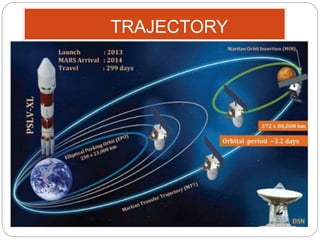
Nov 5, 2013: PSLV-C25 launched from 
Sriharikota in an elliptical orbit around the earth 
Dec 1: Trans Mars Injection, a propulsive 
manoeuvre used to set a spacecraft on a 
trajectory, completed at 00:49am 
Dec 4: The spacecraft finally left the influence of 
the earth and began travelling along a chalked 
out heliocentric path 
Sep 22, 2014: Liquid Apogee Motor engine 
awakened after 300 days, performs final path 
correction 
Sep 24: Orbiter enters Mars orbit
NASA’s incredible support to the 
mission. 
American space agency has been incredibly 
supportive of our Mars Orbiter Mission. NASA’s 
futuristic Deep Space Network (a collection of huge 
satellite antennas around the world that allow for 
navigation in interplanetary space) has been crucial to 
the mission, helping the Mangalyaan navigate the 
space where India’s own Deep Space Network has no 
reach. Around the time when MOM was to be 
launched, American Government was facing a 
government shutdown and despite that, NASA stood 
by its word of providing communications and 
navigation facilities for the mission. 
Two weeks after MOM’s launch, NASA’s MAVEN, the 
mission of which is to study the upper Martian 
atmosphere, was launched and it made its orbital 
insertion two days ago. ISRO & NASA now plan to 
work closely together, sharing findings of either 
missions.
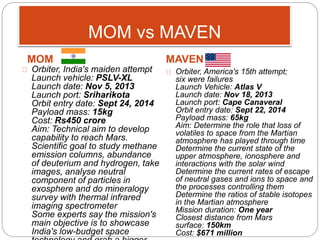
MOM vs MAVEN 
MOM MAVEN 
Orbiter, India's maiden attempt 
Launch vehicle: PSLV-XL 
Launch date: Nov 5, 2013 
Launch port: Sriharikota 
Orbit entry date: Sept 24, 2014 
Payload mass: 15kg 
Cost: Rs450 crore 
Aim: Technical aim to develop 
capability to reach Mars. 
Scientific goal to study methane 
emission columns, abundance 
of deuterium and hydrogen, take 
images, analyse neutral 
component of particles in 
exosphere and do mineralogy 
survey with thermal infrared 
imaging spectrometer 
Some experts say the mission's 
main objective is to showcase 
India's low-budget space 
technology and grab a bigger 
Orbiter, America's 15th attempt; 
six were failures 
Launch Vehicle: Atlas V 
Launch date: Nov 18, 2013 
Launch port: Cape Canaveral 
Orbit entry date: Sept 22, 2014 
Payload mass: 65kg 
Aim: Determine the role that loss of 
volatiles to space from the Martian 
atmosphere has played through time 
Determine the current state of the 
upper atmosphere, ionosphere and 
interactions with the solar wind 
Determine the current rates of escape 
of neutral gases and ions to space and 
the processes controlling them 
Determine the ratios of stable isotopes 
in the Martian atmosphere 
Mission duration: One year 
Closest distance from Mars 
surface: 150km 
Cost: $671 million
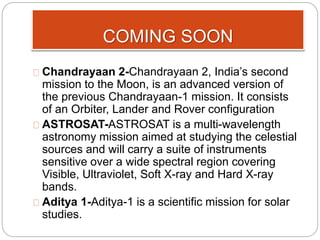
COMING SOON 
Chandrayaan 2-Chandrayaan 2, India’s second 
mission to the Moon, is an advanced version of 
the previous Chandrayaan-1 mission. It consists 
of an Orbiter, Lander and Rover configuration 
ASTROSAT-ASTROSAT is a multi-wavelength 
astronomy mission aimed at studying the celestial 
sources and will carry a suite of instruments 
sensitive over a wide spectral region covering 
Visible, Ultraviolet, Soft X-ray and Hard X-ray 
bands. 
Aditya 1-Aditya-1 is a scientific mission for solar 
studies.
THANKYOU

Mars orbiter mission

  • 1.
  • 2.
    The Planet Mars Mars is the fourth planet from the Sun. Named after the Roman god of war, and often described as the “Red Planet” due to its reddish appearance. Mars is a terrestrial planet with a thin atmosphere composed primarily of carbon dioxide. Mass: 641,693,000,000,000 billion kg (0.107 x Earth) Notable Moons: Phobos & Deimos Orbit Distance: 227,943,824 km (1.38 AU) Orbit Period: 686.98 Earth days (1.88 Earth years) Surface Temperature: -87 to -5 °C First Record: 2nd millennium BC Recorded By: Egyptian astronomers
  • 3.
    REACHING MARS Nocountry has ever had a successful Mars mission at the first attempt. Only 3 countries have sent successful Martian missions. India is the 4th. Six countries have tried their hands to send missions to Mars, India being the seventh. Only United States, Russia, and France were a part of this Mars club, until today. No country, until today, had ever had a successful Mars mission at the first attempt except India. USA sent its first Mars mission in 1960, and then several others, all of which failed. In 1964, NASA’s Mariner’s 4 was the first successful man-made mission to Mars. The mission was just to perform a flyby. In contrast, in 1964, Independent India was only 17 years old, struggling to maintain its economy, and a year later in ’65, India would fight a war with Pakistan. In all, a total number of 51 Martian missions have been tried, and only 21 of them have been successful. This does not include India’s mission.
  • 4.
    MISSION POSSIBLE •The Mars Orbiter Mission (MOM), also called Mangalyaan "Mars-craft" is a spacecraft orbiting Mars since 24 September 2014. • It was launched on 5 November 2013 by the Indian Space Research Organisation (ISRO). • It is India's first interplanetary mission and ISRO has become the fourth space agency to reach Mars, after the Soviet space program, NASA, and the European Space Agency. • Mangalyaan - is built with a cost of Rs. 454 crores (that is around Rs.4 per Indian, Rs. 12 per km). It is the cheapest Mars mission, ever!
  • 5.
    OBJECTIVES The primaryobjective of the Mars Orbiter Mission is to showcase India's rocket launch systems, spacecraft-building and operations capabilities. The secondary objective is to explore Mars' surface features, morphology, mineralogy and Martian atmosphere using indigenous scientific instruments. To determine the quantities of water in Martian atmosphere that will help scientists around the world understand the history of Mars and how much water has been lost to Martian atmosphere in the past. The mission will also be to determine quantities of methane in the atmosphere, another key element for life.
  • 6.
  • 7.
    COMPONENTS In termsof science there are 5 payloads – • Lyman Alpha Photometer(LAP)- It will measure the deuterium to hydrogen concentration ratio in the atmosphere which will help you to analyse the amount of water loss to outer space. • Methane Sensor for Mars(MSM) - It will try to estimate the trace amount of methane in the martian atmosphere. • Mars Exospheric Neutral Composition Analyzer (MENCA) — is a quadrupole mass analyzer capable of analyzing the neutral composition of particles in the exosphere.
  • 8.
    • Mars ColourCamera (MCC) — This tri-color camera gives images & information about the surface features and composition of Martian surface. They are useful to monitor the dynamics events and weather of mars. • Thermal Infrared Sensor- It will give the details of elevation and hotspots. Basically to understand the surface morphology.
  • 9.
    Cheapest, yes. Useless?No. While there have been several critics of the mission given the low-profile objectives of the mission, Mars Orbiter Mission is in fact a significant one for ISRO and India. Apart from scientific benefits, the mission will also serve to advance scientific temper in the country and to inspire children to take up space exploration. Isro uses its technology to help other countries put their equipment in space. The success of the Mars mission could transform India into a big hub for cheap yet high-quality space projects.
  • 10.
    SPACE ODYSSEY Nov5, 2013: PSLV-C25 launched from Sriharikota in an elliptical orbit around the earth Dec 1: Trans Mars Injection, a propulsive manoeuvre used to set a spacecraft on a trajectory, completed at 00:49am Dec 4: The spacecraft finally left the influence of the earth and began travelling along a chalked out heliocentric path Sep 22, 2014: Liquid Apogee Motor engine awakened after 300 days, performs final path correction Sep 24: Orbiter enters Mars orbit
  • 11.
    NASA’s incredible supportto the mission. American space agency has been incredibly supportive of our Mars Orbiter Mission. NASA’s futuristic Deep Space Network (a collection of huge satellite antennas around the world that allow for navigation in interplanetary space) has been crucial to the mission, helping the Mangalyaan navigate the space where India’s own Deep Space Network has no reach. Around the time when MOM was to be launched, American Government was facing a government shutdown and despite that, NASA stood by its word of providing communications and navigation facilities for the mission. Two weeks after MOM’s launch, NASA’s MAVEN, the mission of which is to study the upper Martian atmosphere, was launched and it made its orbital insertion two days ago. ISRO & NASA now plan to work closely together, sharing findings of either missions.
  • 12.
    MOM vs MAVEN MOM MAVEN Orbiter, India's maiden attempt Launch vehicle: PSLV-XL Launch date: Nov 5, 2013 Launch port: Sriharikota Orbit entry date: Sept 24, 2014 Payload mass: 15kg Cost: Rs450 crore Aim: Technical aim to develop capability to reach Mars. Scientific goal to study methane emission columns, abundance of deuterium and hydrogen, take images, analyse neutral component of particles in exosphere and do mineralogy survey with thermal infrared imaging spectrometer Some experts say the mission's main objective is to showcase India's low-budget space technology and grab a bigger Orbiter, America's 15th attempt; six were failures Launch Vehicle: Atlas V Launch date: Nov 18, 2013 Launch port: Cape Canaveral Orbit entry date: Sept 22, 2014 Payload mass: 65kg Aim: Determine the role that loss of volatiles to space from the Martian atmosphere has played through time Determine the current state of the upper atmosphere, ionosphere and interactions with the solar wind Determine the current rates of escape of neutral gases and ions to space and the processes controlling them Determine the ratios of stable isotopes in the Martian atmosphere Mission duration: One year Closest distance from Mars surface: 150km Cost: $671 million
  • 13.
    COMING SOON Chandrayaan2-Chandrayaan 2, India’s second mission to the Moon, is an advanced version of the previous Chandrayaan-1 mission. It consists of an Orbiter, Lander and Rover configuration ASTROSAT-ASTROSAT is a multi-wavelength astronomy mission aimed at studying the celestial sources and will carry a suite of instruments sensitive over a wide spectral region covering Visible, Ultraviolet, Soft X-ray and Hard X-ray bands. Aditya 1-Aditya-1 is a scientific mission for solar studies.
  • 14.