CHANDRAYAAN 2
By Aishwarya A
INDEX
What Is Chandrayaan 2
The Timeline
Development And Science
Chandrayaan-2 Orbiter
List of Instruments on the orbiter
The Vikram(Lander)
List Of Instruments In Lander
The Pragyaan(Lunar Rover)
The Challenges
WHAT IS CHANDRAYAAN 2
It is India's planned second mission to the moon
India's Orbiter-Lander-Rover Mission
It is a follow-up mission from the Chandrayaan-1 mission that
assisted in confirming the presence of water/hydroxyl on the moon in
2009
Chandrayaan-2 Was launched from the Satish Dhawan Space Center
in Sriharikota, India, aboard a Geosynchronous Satellite Launch
Vehicle (GSLV) rocket
According to the Indian Space Research Organization (ISRO), this
mission consist of an orbiter, a lander and a rover. The orbiter will
perform mapping from an altitude of 100 kilometers (62 miles), while
the lander will make a soft landing on the surface and send out the
THE TIMELINE
Chandrayaan-2, conceived way back in November 2007
November 12, 2007- Representatives of the Russian Federal Space
Agency and ISRO sign an agreement for the two agencies to work
together on the Chandrayaan-2 project
August 2009 - ISRO and Roscosmos complete the design
of Chandrayaan-2 and it is reviewed by India and Russia
2013 - India decides to go it alone in the mission after Russia
informed of its inability to provide the lander even by 2015. The
project is rescheduled to 2016
2018 - The spacecraft's launch had been scheduled for March 2018,
but was delayed to conduct further tests on the vehicle
THE TIMELINE
June 29, 2019 - Rover after completion of all tests
integrated with lander Vikram
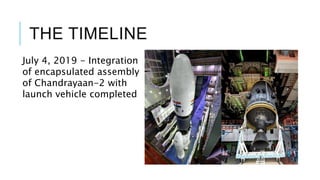
THE TIMELINE
July 4, 2019 - Integration
of encapsulated assembly
of Chandrayaan-2 with
launch vehicle completed
THE TIMELINE
July 15, 2019 - Chandrayaan-2 was scheduled to be launched, but it
was put off due to technical snag
July 22, 2019 - India successfully launches Chandrayaan 2 from
Satish Dhawan Space Centre in Sriharikota
July 24, 2019 - First orbit raising manoeuvre performed successfully
August 14, 2019 - Chandrayaan-2 leaves earth's orbit
August 20, 2019 - Chandrayaan 2 successfully enters orbit around
Moon
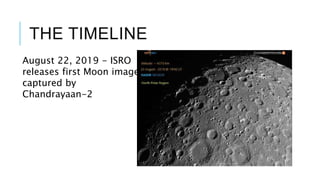
THE TIMELINE
August 22, 2019 - ISRO
releases first Moon image
captured by
Chandrayaan-2
THE TIMELINE
September 4, 2019 - Chandrayaan-2's second de-orbiting maneuver
executed
September 7, 2019: Chandrayaan 2's Vikram Rover starts its descent.
ISRO loses communication during fine braking phase
DEVELOPMENT AND
SCIENCE
Initially, ISRO planned to partner with Russia to perform Chandrayaan-2 The two
agencies signed an agreement in 2007 to launch the orbiter and lander in 2013.
Russia later pulled out of the agreement
Russia subsequently pulled out of Chandrayaan-2 altogether, citing financial
issues. Some reports stated that NASA and the European Space Agency were
interested in participating, but ISRO proceeded with the mission on its own
The Chandrayaan-2 orbiter will circle the moon and provide information about its
surface, ISRO stated. "The payloads will collect scientific information on lunar
topography, mineralogy, elemental abundance, lunar exosphere and signatures of
hydroxyl and water-ice,“
The mission will also send a small, 20-kilogram (44 lbs.), six-wheeled rover to the
surface; the rover will move semi-autonomously, examining the lunar regolith's
composition.
CHANDRAYAAN-2 SPACECRAFT
(BOTTOM) AND ITS VIKRAM LANDER
(TOP) ARE PREPARED TO BE
ENCAPSULATED BY A PAYLOAD FAIRING
CHANDRAYAAN-2 ORBITER
The Chandrayaan-2 orbiter, which weighed 2,379 kilograms at launch, carried a
propulsion module including a liquid propulsion engine and onboard fuel for raising
its orbit from the initial elliptical earth parking orbit in which it will be placed after
launch
A series of burns lowered its orbit to a 100-kilometer circular lunar orbit
The orbiter carried the lander-rover module and release it for its soft landing. A
high-resolution camera aboard Chandrayaan-2 will image the planned landing site
to help fine-tune the landing phase of the mission. It will also carry communication
equipment to facilitate communications between the lander and rover, and the
mission control center on earth. The orbiter's primary mission will last 1 year.
SCREENSHOT FROM AN ISRO VIDEO SHOWS
CHANDRAYAAN-2 CRUISING ABOVE THE MOON.
THE VIKRAM LANDER (TOP SECTION) IS STILL
CONNECTED TO THE ORBITER AT THIS POINT IN
THE MISSION.
LIST OF INSTRUMENTS ON
THE ORBITER
Terrain Mapping Camera 2 (TMC-2), which will map the lunar surface in three
dimensions using two on-board cameras. A predecessor instrument called TMC
flew on Chandrayaan-1.
Collimated Large Array Soft X-ray Spectrometer (CLASS), which will map the
abundance of minerals on the surface. A predecessor instrument called CIXS
(sometimes written as C1XS) flew on Chandrayaan-1.
Solar X-ray Monitor (XSM), which looks at emissions of solar X-rays.
Chandra's Atmospheric Composition Explorer (ChACE-2), which is a neutral mass
spectrometer. A predecessor instrument called CHACE flew on Chandrayaan-1's
Moon Impact Probe.
LIST OF INSTRUMENTS ON
THE ORBITER
Synthetic Aperture Radar (SAR), which will map the surface in radio waves. Some
of its design is based on Chandrayaan-1's MiniSAR.
Imaging Infra-Red Spectrometer (IIRS), which will measure the abundance of
water/hydroxl on the surface.
Orbiter High Resolution Camera (OHRC) to examine the surface, particularly the
landing site of the lander and rover.
VIKRAM LANDER
The Vikram lander is named after the founder of ISRO and the Indian space
program, Dr. Vikram Sarabhai
It will weigh 1,471 kilograms at launch, and will carry the Pragyan rover. After
separation from the orbiter, Vikram will conduct a set of burns to de-boost from
lunar orbit, and conduct a soft-landing on the surface
The lander has two roles in the rover part of the mission: to carry the rover to the
Moon’s surface, and to serve as a communication relay between the rover, orbiter,
and Earth
Additionally, the lander carries instruments to conduct three scientific experiments
and take measurements for 14 Earth days ater landing
CHANDRAYAAN-2 VIKRAM LANDER DEPLOYING
ROVER
LIST OF INSTRUMENTS IN
LANDER
Instrument for Lunar Seismic Activity (ILSA), to look for moonquakes.
Chandra's Surface Thermophysical Experiment (ChaSTE), to examine the
surface's thermal properties.
Radio Anatomy of Moon Bound Hypersensitive ionosphere and Atmosphere
(RAMBHA-Langmuir Probe), to look at plasma density on the surface.
PRAGYAN ROVER
The Pragyan (Sanskrit for wisdom) rover is a 27 kilogram, 6-wheeled robotic
vehicle with the ability to move autonomously within a 500m radius of the landing
site
It has a 50-watt solar panel for powering its propulsion system, scientific
instruments and communication equipment. Its mission life is one lunar day, or 14
earth days, during which it will explore the area around the landing site with its
instruments
Chandrayaan-2's lander and rover are targeted for a location about 600
kilometers (375 miles) from the south pole, which would be the first time any
mission touched down so far from the equator
CHANDRAYAAN-2 PRAGYAN ROVER
PRAGYAN ROVER INCLUDES
Laser-Induced Breakdown Spectroscope (LIBS)
Alpha Particle X-Ray Spectrometer (APXS).
CHALLENGES FACED BY ISRO
CHANDRAYAAN 2 MISSION
Trajectory Accuracy
The distance between moon and earth is around 3.844 lakh kilometers.
kilometers. Therefore, ensuring trajectory accuracy while navigating such a large
large distance poses several challenges as trajectory is influenced by various
various factors such as gravitational pull from astronomical bodies, solar radiation
radiation pressure, and non-uniform gravity of the earth and moon.
Deep Space Communication
Distance between earth and moon could again play hindrance
hindrance as there would be weak on-board power and radio signals used for
for communication bombarded with heavy background noise. Large antennas
antennas would need to pick up the limited signals.
CHALLENGES FACED BY ISRO
CHANDRAYAAN 2 MISSION
Keeping on-board electronics safe: The ISRO Chandrayaan 2 mission will carry
various instruments on-board such as Large Area Soft X-ray Spectrometer (LASS,
Solar X-ray monitor (XSM), NAVCAMs, and so on. Therefore, precise knowledge of
the thermal environment at the orbital altitude is necessary for keeping on-board
electronics safe.
Vikram Lander on the moon: The landing site landscape features should not
result in a communication shadow area and the onboard NGC and propulsion
system has to work is unison, automatically and autonomously for a successful
landing.
Lunar dust may affect instruments: Lunar dust which is minuscule and hard
barbed, could stick to surfaces and cause disruptions in deployment mechanisms,
solar panel performance and NGC sensor performance.
Temperature and vacuum could impact ISRO Chandrayaan 2: Extreme
surface temperature and vacuum makes the lunar surface an extremely hostile
environment for Vikram lander and Pragyan rover operations.
THANK YOU

Chandryaan 2

  • 1.
  • 2.
    INDEX What Is Chandrayaan2 The Timeline Development And Science Chandrayaan-2 Orbiter List of Instruments on the orbiter The Vikram(Lander) List Of Instruments In Lander The Pragyaan(Lunar Rover) The Challenges
  • 3.
    WHAT IS CHANDRAYAAN2 It is India's planned second mission to the moon India's Orbiter-Lander-Rover Mission It is a follow-up mission from the Chandrayaan-1 mission that assisted in confirming the presence of water/hydroxyl on the moon in 2009 Chandrayaan-2 Was launched from the Satish Dhawan Space Center in Sriharikota, India, aboard a Geosynchronous Satellite Launch Vehicle (GSLV) rocket According to the Indian Space Research Organization (ISRO), this mission consist of an orbiter, a lander and a rover. The orbiter will perform mapping from an altitude of 100 kilometers (62 miles), while the lander will make a soft landing on the surface and send out the
  • 4.
    THE TIMELINE Chandrayaan-2, conceivedway back in November 2007 November 12, 2007- Representatives of the Russian Federal Space Agency and ISRO sign an agreement for the two agencies to work together on the Chandrayaan-2 project August 2009 - ISRO and Roscosmos complete the design of Chandrayaan-2 and it is reviewed by India and Russia 2013 - India decides to go it alone in the mission after Russia informed of its inability to provide the lander even by 2015. The project is rescheduled to 2016 2018 - The spacecraft's launch had been scheduled for March 2018, but was delayed to conduct further tests on the vehicle
  • 5.
    THE TIMELINE June 29,2019 - Rover after completion of all tests integrated with lander Vikram
  • 6.
    THE TIMELINE July 4,2019 - Integration of encapsulated assembly of Chandrayaan-2 with launch vehicle completed
  • 7.
    THE TIMELINE July 15,2019 - Chandrayaan-2 was scheduled to be launched, but it was put off due to technical snag July 22, 2019 - India successfully launches Chandrayaan 2 from Satish Dhawan Space Centre in Sriharikota July 24, 2019 - First orbit raising manoeuvre performed successfully August 14, 2019 - Chandrayaan-2 leaves earth's orbit August 20, 2019 - Chandrayaan 2 successfully enters orbit around Moon
  • 8.
    THE TIMELINE August 22,2019 - ISRO releases first Moon image captured by Chandrayaan-2
  • 9.
    THE TIMELINE September 4,2019 - Chandrayaan-2's second de-orbiting maneuver executed September 7, 2019: Chandrayaan 2's Vikram Rover starts its descent. ISRO loses communication during fine braking phase
  • 10.
    DEVELOPMENT AND SCIENCE Initially, ISROplanned to partner with Russia to perform Chandrayaan-2 The two agencies signed an agreement in 2007 to launch the orbiter and lander in 2013. Russia later pulled out of the agreement Russia subsequently pulled out of Chandrayaan-2 altogether, citing financial issues. Some reports stated that NASA and the European Space Agency were interested in participating, but ISRO proceeded with the mission on its own The Chandrayaan-2 orbiter will circle the moon and provide information about its surface, ISRO stated. "The payloads will collect scientific information on lunar topography, mineralogy, elemental abundance, lunar exosphere and signatures of hydroxyl and water-ice,“ The mission will also send a small, 20-kilogram (44 lbs.), six-wheeled rover to the surface; the rover will move semi-autonomously, examining the lunar regolith's composition.
  • 11.
    CHANDRAYAAN-2 SPACECRAFT (BOTTOM) ANDITS VIKRAM LANDER (TOP) ARE PREPARED TO BE ENCAPSULATED BY A PAYLOAD FAIRING
  • 12.
    CHANDRAYAAN-2 ORBITER The Chandrayaan-2orbiter, which weighed 2,379 kilograms at launch, carried a propulsion module including a liquid propulsion engine and onboard fuel for raising its orbit from the initial elliptical earth parking orbit in which it will be placed after launch A series of burns lowered its orbit to a 100-kilometer circular lunar orbit The orbiter carried the lander-rover module and release it for its soft landing. A high-resolution camera aboard Chandrayaan-2 will image the planned landing site to help fine-tune the landing phase of the mission. It will also carry communication equipment to facilitate communications between the lander and rover, and the mission control center on earth. The orbiter's primary mission will last 1 year.
  • 13.
    SCREENSHOT FROM ANISRO VIDEO SHOWS CHANDRAYAAN-2 CRUISING ABOVE THE MOON. THE VIKRAM LANDER (TOP SECTION) IS STILL CONNECTED TO THE ORBITER AT THIS POINT IN THE MISSION.
  • 14.
    LIST OF INSTRUMENTSON THE ORBITER Terrain Mapping Camera 2 (TMC-2), which will map the lunar surface in three dimensions using two on-board cameras. A predecessor instrument called TMC flew on Chandrayaan-1. Collimated Large Array Soft X-ray Spectrometer (CLASS), which will map the abundance of minerals on the surface. A predecessor instrument called CIXS (sometimes written as C1XS) flew on Chandrayaan-1. Solar X-ray Monitor (XSM), which looks at emissions of solar X-rays. Chandra's Atmospheric Composition Explorer (ChACE-2), which is a neutral mass spectrometer. A predecessor instrument called CHACE flew on Chandrayaan-1's Moon Impact Probe.
  • 15.
    LIST OF INSTRUMENTSON THE ORBITER Synthetic Aperture Radar (SAR), which will map the surface in radio waves. Some of its design is based on Chandrayaan-1's MiniSAR. Imaging Infra-Red Spectrometer (IIRS), which will measure the abundance of water/hydroxl on the surface. Orbiter High Resolution Camera (OHRC) to examine the surface, particularly the landing site of the lander and rover.
  • 16.
    VIKRAM LANDER The Vikramlander is named after the founder of ISRO and the Indian space program, Dr. Vikram Sarabhai It will weigh 1,471 kilograms at launch, and will carry the Pragyan rover. After separation from the orbiter, Vikram will conduct a set of burns to de-boost from lunar orbit, and conduct a soft-landing on the surface The lander has two roles in the rover part of the mission: to carry the rover to the Moon’s surface, and to serve as a communication relay between the rover, orbiter, and Earth Additionally, the lander carries instruments to conduct three scientific experiments and take measurements for 14 Earth days ater landing
  • 17.
  • 18.
    LIST OF INSTRUMENTSIN LANDER Instrument for Lunar Seismic Activity (ILSA), to look for moonquakes. Chandra's Surface Thermophysical Experiment (ChaSTE), to examine the surface's thermal properties. Radio Anatomy of Moon Bound Hypersensitive ionosphere and Atmosphere (RAMBHA-Langmuir Probe), to look at plasma density on the surface.
  • 19.
    PRAGYAN ROVER The Pragyan(Sanskrit for wisdom) rover is a 27 kilogram, 6-wheeled robotic vehicle with the ability to move autonomously within a 500m radius of the landing site It has a 50-watt solar panel for powering its propulsion system, scientific instruments and communication equipment. Its mission life is one lunar day, or 14 earth days, during which it will explore the area around the landing site with its instruments Chandrayaan-2's lander and rover are targeted for a location about 600 kilometers (375 miles) from the south pole, which would be the first time any mission touched down so far from the equator
  • 20.
  • 21.
    PRAGYAN ROVER INCLUDES Laser-InducedBreakdown Spectroscope (LIBS) Alpha Particle X-Ray Spectrometer (APXS).
  • 22.
    CHALLENGES FACED BYISRO CHANDRAYAAN 2 MISSION Trajectory Accuracy The distance between moon and earth is around 3.844 lakh kilometers. kilometers. Therefore, ensuring trajectory accuracy while navigating such a large large distance poses several challenges as trajectory is influenced by various various factors such as gravitational pull from astronomical bodies, solar radiation radiation pressure, and non-uniform gravity of the earth and moon. Deep Space Communication Distance between earth and moon could again play hindrance hindrance as there would be weak on-board power and radio signals used for for communication bombarded with heavy background noise. Large antennas antennas would need to pick up the limited signals.
  • 23.
    CHALLENGES FACED BYISRO CHANDRAYAAN 2 MISSION Keeping on-board electronics safe: The ISRO Chandrayaan 2 mission will carry various instruments on-board such as Large Area Soft X-ray Spectrometer (LASS, Solar X-ray monitor (XSM), NAVCAMs, and so on. Therefore, precise knowledge of the thermal environment at the orbital altitude is necessary for keeping on-board electronics safe. Vikram Lander on the moon: The landing site landscape features should not result in a communication shadow area and the onboard NGC and propulsion system has to work is unison, automatically and autonomously for a successful landing. Lunar dust may affect instruments: Lunar dust which is minuscule and hard barbed, could stick to surfaces and cause disruptions in deployment mechanisms, solar panel performance and NGC sensor performance. Temperature and vacuum could impact ISRO Chandrayaan 2: Extreme surface temperature and vacuum makes the lunar surface an extremely hostile environment for Vikram lander and Pragyan rover operations.
  • 24.