Presented by
Sri Rakesh
Satellite
We can categorize satellites in two types, namely
Passive Satellites and Active satellites
• The word satellite originated from the Latin word “Satellit”-
meaning an attendant, one who is constantly hovering around
& attending to a “master” or big man.
• A satellite is an artificial object which has been intentionally
placed into orbit. Such objects are sometimes called artificial
satellites to distinguish them from natural satellites such as
Earth's Moon.
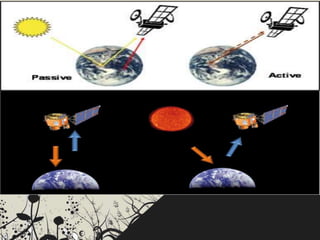
Passive satellite
In a satellite communications system, a satellite that only reflects signals
from one Earth station to another, or from several Earth stations to several others.
An active satellite may perform signal processing functions such as
amplification, regeneration, frequency translation, and link switching, to make the
signals suitable for retransmission.
Active satellite
History of Satellites
 Early in October 1957 communications stations started picking up a regular
beeping noise coming from space.
 It was January 1958, before a Jupiter rocket successfully launched Explorer 1,
the first American satellite
 On October 4, 1957, the Soviet Union successfully launched Sputnik I. The
world's first artificial satellite was about the size of a basketball, weighed only
183 pounds, and took about 98 minutes to orbit the Earth on its elliptical path
 on November 3, Sputnik II was launched
 On January 31, 1958, the United States successfully launched Explorer I
The first satellite that was used for communication purpose in INDIA
was ARYABHATTA and it was launched in 19th April.1975. APPLE was launched in
space which was the first Indian Experimental communication satellite.
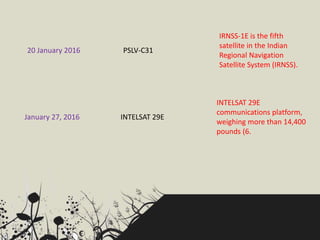
20 January 2016 PSLV-C31
IRNSS-1E is the fifth
satellite in the Indian
Regional Navigation
Satellite System (IRNSS).
January 27, 2016 INTELSAT 29E
INTELSAT 29E
communications platform,
weighing more than 14,400
pounds (6.
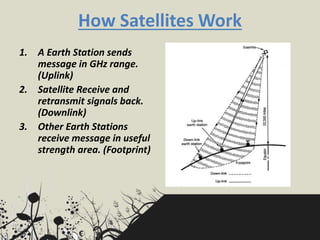
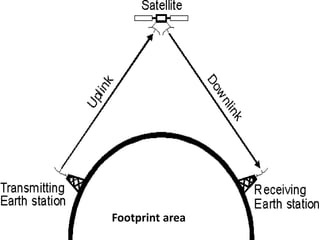
How Satellites Work
1. A Earth Station sends
message in GHz range.
(Uplink)
2. Satellite Receive and
retransmit signals back.
(Downlink)
3. Other Earth Stations
receive message in useful
strength area. (Footprint)
Footprint area
16.10
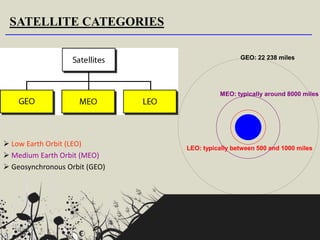
SATELLITE CATEGORIES
 Low Earth Orbit (LEO)
 Medium Earth Orbit (MEO)
 Geosynchronous Orbit (GEO)
GEO: 22 238 miles
MEO: typically around 8000 miles
LEO: typically between 500 and 1000 miles
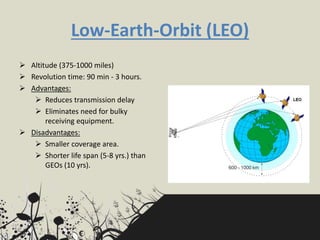
Low-Earth-Orbit (LEO)
 Altitude (375-1000 miles)
 Revolution time: 90 min - 3 hours.
 Advantages:
 Reduces transmission delay
 Eliminates need for bulky
receiving equipment.
 Disadvantages:
 Smaller coverage area.
 Shorter life span (5-8 yrs.) than
GEOs (10 yrs).
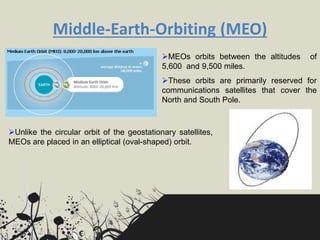
Middle-Earth-Orbiting (MEO)
MEOs orbits between the altitudes of
5,600 and 9,500 miles.
These orbits are primarily reserved for
communications satellites that cover the
North and South Pole.
Unlike the circular orbit of the geostationary satellites,
MEOs are placed in an elliptical (oval-shaped) orbit.
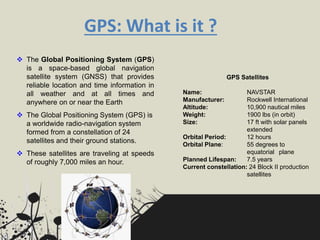
GPS: What is it ?
 The Global Positioning System (GPS)
is a space-based global navigation
satellite system (GNSS) that provides
reliable location and time information in
all weather and at all times and
anywhere on or near the Earth
 The Global Positioning System (GPS) is
a worldwide radio-navigation system
formed from a constellation of 24
satellites and their ground stations.
 These satellites are traveling at speeds
of roughly 7,000 miles an hour.
GPS Satellites
Name: NAVSTAR
Manufacturer: Rockwell International
Altitude: 10,900 nautical miles
Weight: 1900 lbs (in orbit)
Size: 17 ft with solar panels
extended
Orbital Period: 12 hours
Orbital Plane: 55 degrees to
equatorial plane
Planned Lifespan: 7.5 years
Current constellation: 24 Block II production
satellites
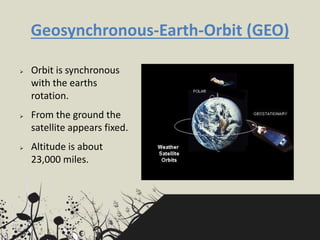
Geosynchronous-Earth-Orbit (GEO)
 Orbit is synchronous
with the earths
rotation.
 From the ground the
satellite appears fixed.
 Altitude is about
23,000 miles.
15
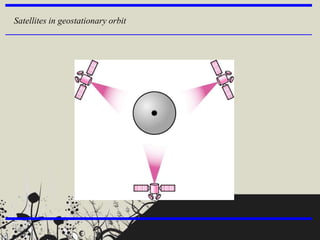
Satellites in geostationary orbit
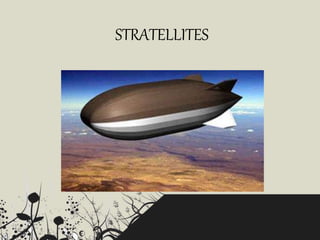
STRATELLITES
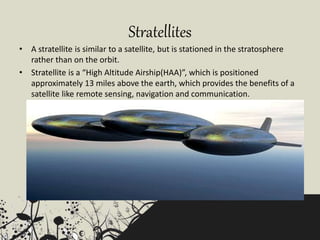
Stratellites
• A stratellite is similar to a satellite, but is stationed in the stratosphere
rather than on the orbit.
• Stratellite is a “High Altitude Airship(HAA)”, which is positioned
approximately 13 miles above the earth, which provides the benefits of a
satellite like remote sensing, navigation and communication.
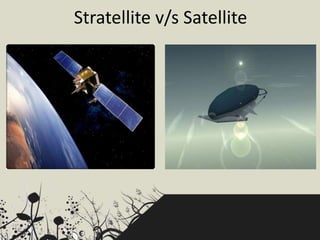
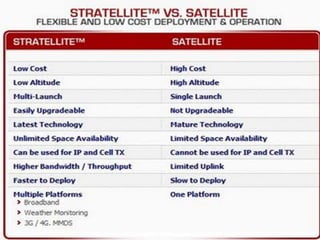
Stratellite v/s Satellite
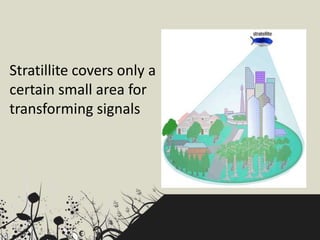
Stratillite covers only a
certain small area for
transforming signals
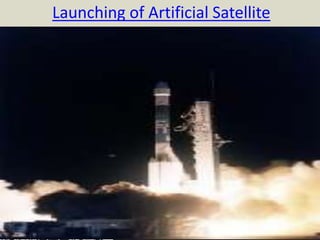
Launching of Artificial Satellite
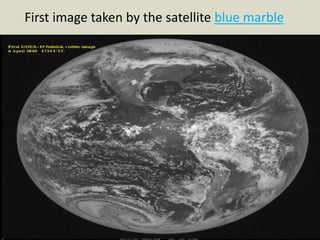
First image taken by the satellite blue marble
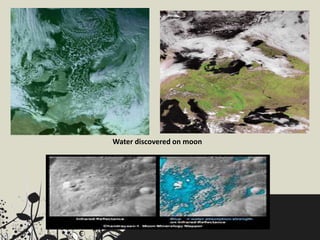
Water discovered on moon
Applications
• Communication
• Forecasting
• Water Resources Management
• Natural Disaster Forecasting
• Radio Networking
• Meteorological Imaging
• This satellite is used by Airtel Digital TV and Sun
Direct DTH to broadcast their DTH services.
Manufacturing of a satellite
ANY QUIRIES

Satellite

  • 1.
  • 2.
    Satellite We can categorizesatellites in two types, namely Passive Satellites and Active satellites • The word satellite originated from the Latin word “Satellit”- meaning an attendant, one who is constantly hovering around & attending to a “master” or big man. • A satellite is an artificial object which has been intentionally placed into orbit. Such objects are sometimes called artificial satellites to distinguish them from natural satellites such as Earth's Moon.
  • 3.
    Passive satellite In asatellite communications system, a satellite that only reflects signals from one Earth station to another, or from several Earth stations to several others. An active satellite may perform signal processing functions such as amplification, regeneration, frequency translation, and link switching, to make the signals suitable for retransmission. Active satellite
  • 5.
    History of Satellites Early in October 1957 communications stations started picking up a regular beeping noise coming from space.  It was January 1958, before a Jupiter rocket successfully launched Explorer 1, the first American satellite  On October 4, 1957, the Soviet Union successfully launched Sputnik I. The world's first artificial satellite was about the size of a basketball, weighed only 183 pounds, and took about 98 minutes to orbit the Earth on its elliptical path  on November 3, Sputnik II was launched  On January 31, 1958, the United States successfully launched Explorer I The first satellite that was used for communication purpose in INDIA was ARYABHATTA and it was launched in 19th April.1975. APPLE was launched in space which was the first Indian Experimental communication satellite.
  • 6.
    20 January 2016PSLV-C31 IRNSS-1E is the fifth satellite in the Indian Regional Navigation Satellite System (IRNSS). January 27, 2016 INTELSAT 29E INTELSAT 29E communications platform, weighing more than 14,400 pounds (6.
  • 7.
    How Satellites Work 1.A Earth Station sends message in GHz range. (Uplink) 2. Satellite Receive and retransmit signals back. (Downlink) 3. Other Earth Stations receive message in useful strength area. (Footprint)
  • 8.
  • 10.
    16.10 SATELLITE CATEGORIES  LowEarth Orbit (LEO)  Medium Earth Orbit (MEO)  Geosynchronous Orbit (GEO) GEO: 22 238 miles MEO: typically around 8000 miles LEO: typically between 500 and 1000 miles
  • 11.
    Low-Earth-Orbit (LEO)  Altitude(375-1000 miles)  Revolution time: 90 min - 3 hours.  Advantages:  Reduces transmission delay  Eliminates need for bulky receiving equipment.  Disadvantages:  Smaller coverage area.  Shorter life span (5-8 yrs.) than GEOs (10 yrs).
  • 12.
    Middle-Earth-Orbiting (MEO) MEOs orbitsbetween the altitudes of 5,600 and 9,500 miles. These orbits are primarily reserved for communications satellites that cover the North and South Pole. Unlike the circular orbit of the geostationary satellites, MEOs are placed in an elliptical (oval-shaped) orbit.
  • 13.
    GPS: What isit ?  The Global Positioning System (GPS) is a space-based global navigation satellite system (GNSS) that provides reliable location and time information in all weather and at all times and anywhere on or near the Earth  The Global Positioning System (GPS) is a worldwide radio-navigation system formed from a constellation of 24 satellites and their ground stations.  These satellites are traveling at speeds of roughly 7,000 miles an hour. GPS Satellites Name: NAVSTAR Manufacturer: Rockwell International Altitude: 10,900 nautical miles Weight: 1900 lbs (in orbit) Size: 17 ft with solar panels extended Orbital Period: 12 hours Orbital Plane: 55 degrees to equatorial plane Planned Lifespan: 7.5 years Current constellation: 24 Block II production satellites
  • 14.
    Geosynchronous-Earth-Orbit (GEO)  Orbitis synchronous with the earths rotation.  From the ground the satellite appears fixed.  Altitude is about 23,000 miles.
  • 15.
  • 16.
  • 17.
    Stratellites • A stratelliteis similar to a satellite, but is stationed in the stratosphere rather than on the orbit. • Stratellite is a “High Altitude Airship(HAA)”, which is positioned approximately 13 miles above the earth, which provides the benefits of a satellite like remote sensing, navigation and communication.
  • 18.
  • 20.
    Stratillite covers onlya certain small area for transforming signals
  • 21.
  • 22.
    First image takenby the satellite blue marble
  • 23.
  • 25.
    Applications • Communication • Forecasting •Water Resources Management • Natural Disaster Forecasting • Radio Networking • Meteorological Imaging • This satellite is used by Airtel Digital TV and Sun Direct DTH to broadcast their DTH services.
  • 26.
  • 28.