CODING AND MARKING
MACHINES
DEFINITION
Are machines which apply a code (including bar code ) dates and other variable
or unique information to a package or transit container.
There are two basic methods,
contact or non contact and programmable and non programmable.
TYPES OF MACHINES THAT ARE USED FOR
CODING AND MARKING
1. INK JET
2. LASER CODER
HOW INK JET WORKS
In a thermal inkjet printer, tiny resistance create heat, this heat evaporate ink
create bubble. As this bubble expand some of the ink is pushed out of the nozzle
onto the paper. When the bubble ‘pops’’ (collapses) a vacuum is created. This
pushes more ink into the print head from the cartridge.
PRINCIPLES OF INK JET PRINTERS
 It uses non contact system during on going production and also uses very fast
drying inks.
 It is reliable because it prevents inks from drying in the print head and from
clogging the nozzle, this eliminates time consuming of cleaning work when
starting up or during production.
 Industrial ink jet printers from LEIBINGER are at best for coding and marking
due to their versatility, flexibility and efficiency continuous ink jet printers
are the perfect solution.
 Continuous ink jet printers from LEIBINGER are used for printing text,
graphics, data matrix codes on virtually every surface including plastic, card
board, glass, metal and wood.
HOW LASER CODER WORKS
 Laser coders work by changing the surface of the substrate, either by
ablation, etching or foaming,
 In the etching process the heat of the laser beam melts the surface of the
substrate which expands to leave a raised mark.
 Laser coders are mostly preferred because of their capabilities and qualities
not only convenient and compact but also the quality market produces.
TYPICAL MARKINGS
 Expiration dates
 Batch numbers or lot numbers
 Characteristics and text
 Company logos
 Bar codes
 Lottery codes or numbers
 Graphics
MATERIAL USED FOR MARKING AND
CODINGS
 Paper
 Cardboard
 Plastics like PET,PP,Films,Bags
 Glass
 Ceramic
 Metal (aluminium cans), tin cans and crown caps
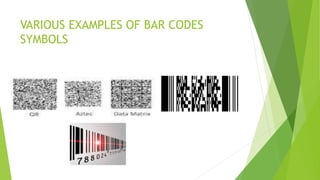
VARIOUS EXAMPLES OF BAR CODES
SYMBOLS
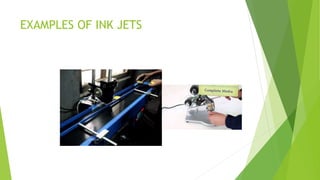
EXAMPLES OF INK JETS
REFERENCE
Neal S. Hirani (2006). Scheduling Parallel Batch Processing Machines to Minimise
Makespan Using Genetic Algorithms.

CODING AND MARKING MACHINES.pptx

  • 1.
  • 2.
    DEFINITION Are machines whichapply a code (including bar code ) dates and other variable or unique information to a package or transit container. There are two basic methods, contact or non contact and programmable and non programmable.
  • 3.
    TYPES OF MACHINESTHAT ARE USED FOR CODING AND MARKING 1. INK JET 2. LASER CODER HOW INK JET WORKS In a thermal inkjet printer, tiny resistance create heat, this heat evaporate ink create bubble. As this bubble expand some of the ink is pushed out of the nozzle onto the paper. When the bubble ‘pops’’ (collapses) a vacuum is created. This pushes more ink into the print head from the cartridge.
  • 4.
    PRINCIPLES OF INKJET PRINTERS  It uses non contact system during on going production and also uses very fast drying inks.  It is reliable because it prevents inks from drying in the print head and from clogging the nozzle, this eliminates time consuming of cleaning work when starting up or during production.  Industrial ink jet printers from LEIBINGER are at best for coding and marking due to their versatility, flexibility and efficiency continuous ink jet printers are the perfect solution.  Continuous ink jet printers from LEIBINGER are used for printing text, graphics, data matrix codes on virtually every surface including plastic, card board, glass, metal and wood.
  • 5.
    HOW LASER CODERWORKS  Laser coders work by changing the surface of the substrate, either by ablation, etching or foaming,  In the etching process the heat of the laser beam melts the surface of the substrate which expands to leave a raised mark.  Laser coders are mostly preferred because of their capabilities and qualities not only convenient and compact but also the quality market produces.
  • 6.
    TYPICAL MARKINGS  Expirationdates  Batch numbers or lot numbers  Characteristics and text  Company logos  Bar codes  Lottery codes or numbers  Graphics
  • 7.
    MATERIAL USED FORMARKING AND CODINGS  Paper  Cardboard  Plastics like PET,PP,Films,Bags  Glass  Ceramic  Metal (aluminium cans), tin cans and crown caps
  • 8.
    VARIOUS EXAMPLES OFBAR CODES SYMBOLS
  • 9.
  • 10.
    REFERENCE Neal S. Hirani(2006). Scheduling Parallel Batch Processing Machines to Minimise Makespan Using Genetic Algorithms.