PACKAGING LAW
Adam Watson
William Pelletier
PKG 3001 - FALL 2014
CHAPTER 19 – PACKAGING LAW
Complying with Legal Requirements
World of packaging is complex and diverse so attempting to summarize
the legal and regulatory requirements has essentially 2 problems:
1. Some of the material will be of intense interest to only a subset of
the packaging industries while being irrelevant to others, or,
2. The information will be too broad and general to provide very
much specific assistance to anyone.
As a result, it is necessary to becomes familiar with the questions to ask
in order to know where to look for applicable legal requirements.
So where to start to look for information?
Well that depends but a good place to start is…
PKG 3001
CHAPTER 19 – PACKAGING LAW
There are a variety of regulatory agencies and departments of the
government that provide requirements for packaging materials.
However, there is a single federal agency that regulates products that
make up a very large percentage, perhaps a majority, of packaging
businesses. Created under the Federal Food, Drug and Cosmetic Act in
1938 The Food & Drug Administration (FDA) regulates the following:
• Food (Including dietary supplements, but not meat & poultry)
• Drugs
• Cosmetics
• Medical devices
• Animal foods & drugs
• Radiological products
• Biological products
FDA regulations cover many packaging materials, but not all.
PKG 3001
CHAPTER 19 – PACKAGING LAW
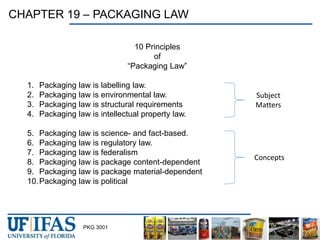
10 Principles
of
“Packaging Law”
1. Packaging law is labelling law.
2. Packaging law is environmental law.
3. Packaging law is structural requirements
4. Packaging law is intellectual property law.
5. Packaging law is science- and fact-based.
6. Packaging law is regulatory law.
7. Packaging law is federalism
8. Packaging law is package content-dependent
9. Packaging law is package material-dependent
10.Packaging law is political
Concepts
Subject
Matters
PKG 3001
CHAPTER 19 – PACKAGING LAW
1. Packaging Law is Labeling Law
A significant component of the law applicable to packaging involves what
goes on the labelling of the product, usually a consumer product, but also
on wholesale-level and transport containers.
A first step to approaching labelling requirements is to determine which
agency of the government has authority over a given product.
That is typically done by determining the use for which the product is
intended.
PKG 3001
CHAPTER 19 – PACKAGING LAW
Certainly the substance the product is made of is an important factor in
determining how it will be regulated. However, for many agencies the
intended use of a product is as important.
Example 1: A product intended to be ingested for taste, aroma, or
nutritive value will be labelled as food, but if, on the other hand, it is
labeled with an assertion that the product “helps prevent disease,” the
FDA will regulate it as a drug.
Example 2: A product that is labeled as a household cleaner may be
treated by the EPA as a pesticide requiring specialized labeling and other
steps the moment it claims on its labelling to be “antimicrobial”.
CHAPTER 19 – PACKAGING LAW
Consumer products generally are regulated under a law called the Fair
Packaging and Labelling Act, administered by the Federal Trade
Commission (FTC). That Act requires consumer products to bear a label
containing:
• A statement of identity of the product.
• Its net contents and weight.
• The identity of the manufacturer, packer or distributor.
The Act also provides that any information on the label must be truthful
and not misleading.
Truthful: The statements made explicitly are demonstrated to be
accurate.
Not misleading: Requires the party responsible for the product to assure
the words, graphics and other material on the labeling does not make
implications that would lead consumers to reach incorrect conclusions
about the products characteristics or benefits.
CHAPTER 19 – PACKAGING LAW
The structure of the Federal Food, Drug and Cosmetic Act which includes
a long list of “prohibited acts” is applicable to essentially anyone in the
chain of commerce including those who manufacturer the products, those
who deliver and introduce it into commerce as well as any who may
adulterate the product and so on.
The word “person” appears in the language and in the eyes of the law, a
“person” includes individuals as well as entities such as corporations.
Straw Ballot Question
Examples of violations and thus misbranded:
• A product does not contain all labelling information required.
• If the information appears but is not presented in a manner or location
required.
• If it is a food and contains an unlawful health claim.
CHAPTER 19 – PACKAGING LAW
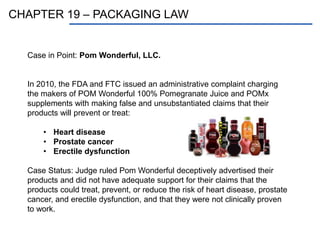
Case in Point: Pom Wonderful, LLC.
In 2010, the FDA and FTC issued an administrative complaint charging
the makers of POM Wonderful 100% Pomegranate Juice and POMx
supplements with making false and unsubstantiated claims that their
products will prevent or treat:
• Heart disease
• Prostate cancer
• Erectile dysfunction
Case Status: Judge ruled Pom Wonderful deceptively advertised their
products and did not have adequate support for their claims that the
products could treat, prevent, or reduce the risk of heart disease, prostate
cancer, and erectile dysfunction, and that they were not clinically proven
to work.
CHAPTER 19 – PACKAGING LAW
2. Packaging Law is Environmental Law
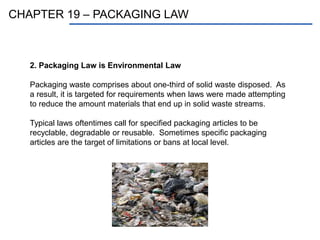
Packaging waste comprises about one-third of solid waste disposed. As
a result, it is targeted for requirements when laws were made attempting
to reduce the amount materials that end up in solid waste streams.
Typical laws oftentimes call for specified packaging articles to be
recyclable, degradable or reusable. Sometimes specific packaging
articles are the target of limitations or bans at local level.
CHAPTER 19 – PACKAGING LAW
Case in Point: California Bill SB 270.
SB 270 would:
• Prohibit, beginning July 1st, 2015, grocery stores and pharmacies
from making available single-use plastic bags
• Prohibit, beginning July 1st, 2016, convenience stores and liquor
stores from making available single-use plastic bags
• Grandfather in existing local ordinances
• Provide up to $2 million in competitive loans to businesses
transitioning to the manufacture of reusable bags.
On August 28th, 2014 the California Assembly passed a ban and on
August 29th, the California Senate approved the measure to ban the use
of all plastic grocery bags.
Case Status: Gov. Jerry Brown signed nation’s 1st statewide ban.
CHAPTER 19 – PACKAGING LAW
3. Packaging Law is Structural Requirements
Sometimes products or packages are required to have specific structures
for particular purposes.
Examples include:
• Requirements for “special” packaging, such as child-resistant
packaging under the Poison Prevention Packaging Act of 1970
• Requirements for tamper-evident structures for OTC drugs and
two-piece hard gelatin capsules
• Hazardous material containers subject to specific structural
parameters
Structural requirements generally are associated with product type.
CHAPTER 19 – PACKAGING LAW
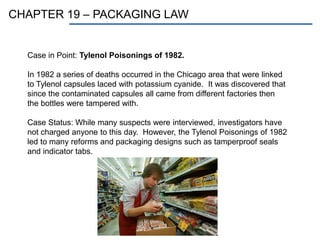
Case in Point: Tylenol Poisonings of 1982.
In 1982 a series of deaths occurred in the Chicago area that were linked
to Tylenol capsules laced with potassium cyanide. It was discovered that
since the contaminated capsules all came from different factories then
the bottles were tampered with.
Case Status: While many suspects were interviewed, investigators have
not charged anyone to this day. However, the Tylenol Poisonings of 1982
led to many reforms and packaging designs such as tamperproof seals
and indicator tabs.
CHAPTER 19 – PACKAGING LAW
Subject Matter of Packaging Law
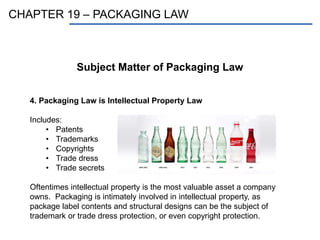
4. Packaging Law is Intellectual Property Law
Includes:
• Patents
• Trademarks
• Copyrights
• Trade dress
• Trade secrets
Oftentimes intellectual property is the most valuable asset a company
owns. Packaging is intimately involved in intellectual property, as
package label contents and structural designs can be the subject of
trademark or trade dress protection, or even copyright protection.
CHAPTER 19 – PACKAGING LAW
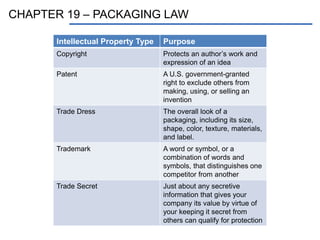
Intellectual Property Type Purpose
Copyright Protects an author’s work and
expression of an idea
Patent A U.S. government-granted
right to exclude others from
making, using, or selling an
invention
Trade Dress The overall look of a
packaging, including its size,
shape, color, texture, materials,
and label.
Trademark A word or symbol, or a
combination of words and
symbols, that distinguishes one
competitor from another
Trade Secret Just about any secretive
information that gives your
company its value by virtue of
your keeping it secret from
others can qualify for protection
CHAPTER 19 – PACKAGING LAW
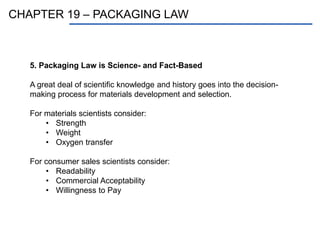
5. Packaging Law is Science- and Fact-Based
A great deal of scientific knowledge and history goes into the decision-
making process for materials development and selection.
For materials scientists consider:
• Strength
• Weight
• Oxygen transfer
For consumer sales scientists consider:
• Readability
• Commercial Acceptability
• Willingness to Pay
CHAPTER 19 – PACKAGING LAW
Ideally, regulators make decisions about which materials to approve, or
ban, for food contact based on valid scientific evaluations of their safety
when used as intended. However, many times public perception
outstrips science and materials end up banned from use, not because
they are unsafe, but because the public fears them.
Case in Point: Bisphenol-A (BPA)
In 2010 the FDA identified possible hazards to fetuses, infants and young
adults exposed to products manufactured using BPA. However, in 2013
the FDA revised their statement claiming that BPA is safe at very low
levels. In 2014, the FDA confirmed that, “BPA is safe at the current levels
occurring in foods”, based on extensive research.
CHAPTER 19 – PACKAGING LAW
6. Packaging Law is Regulatory Law
“Law” refers to statutes passed by the legislature and signed by the
President (or state government counterpart).
For packaging law, it’s regulations that have the most relevance.
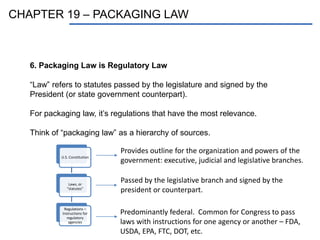
Think of “packaging law” as a hierarchy of sources.
U.S. Constitution
Laws, or
“statutes”
Regulations –
Instructions for
regulatory
agencies
Provides outline for the organization and powers of the
government: executive, judicial and legislative branches.
Passed by the legislative branch and signed by the
president or counterpart.
Predominantly federal. Common for Congress to pass
laws with instructions for one agency or another – FDA,
USDA, EPA, FTC, DOT, etc.
CHAPTER 19 – PACKAGING LAW
7. Packaging Law is Federalism
Refers to the relationship between the U.S. states and the federal
government. As a result, states too play a role in packaging law.
Example: Coalition of Northeastern Governors (CONEG) Model Toxins
This legislation caused packaging makers worldwide to change away
from heavy metals components even though the law existed in only a
handful of states in the U.S.
Example: California’s “Proposition 65”
Requires those who expose others to toxins to provide clear and
reasonable warnings of the exposure, unless it falls below a “safe harbor”
limit.
Sometimes state and local governments are prohibited from imposing
legal burdens if federal requirements override them.
CHAPTER 19 – PACKAGING LAW
8. Packaging Law is Content-Dependent
You must know the content of the package in order to know the exact
legal requirements. This includes:
• Articles in the package
• What is said or implied
Also consider conceptually the identity of the package contents in terms
of its place in commerce. Is the package:
• Retail
• Wholesale
• Component for another product
CHAPTER 19 – PACKAGING LAW
9. Packaging Law is Material-Dependent
Especially true for food contact materials and environmental
requirements. Need to know what a package is made of to know exactly
what legal requirement to apply.
For example, components of packaging materials that contact food, if
they migrate in significant amounts into that food, must be cleared by the
FDA as “food additives”. This is required unless those components
maintain the status as Generally Recognized As Safe (GRAS).
Whether food or not, when packaging is in violation of applicable laws the
costs associated with rectifying that violation can be extensive.
CHAPTER 19 – PACKAGING LAW
10. Packaging Law is Political
Important to understand that laws, regulations, and guidance documents
all reflect the effects of political pressures. While science guides
government decision-making, in reality laws oftentimes apply to some
products or materials but not to others (e.g. surgeon general warnings for
cigarettes).
Some businesses are exempt in the eyes of the law, while others face
penalties and prosecution for some activities. Remembering that these
statements can sometimes be true may help in understanding an illogical
legal requirement.
PKG 3001
CHAPTER 19 – PACKAGING LAW
Questions?

Chapter 19 Packaging Law - JAW

  • 1.
    PACKAGING LAW Adam Watson WilliamPelletier PKG 3001 - FALL 2014
  • 2.
    CHAPTER 19 –PACKAGING LAW Complying with Legal Requirements World of packaging is complex and diverse so attempting to summarize the legal and regulatory requirements has essentially 2 problems: 1. Some of the material will be of intense interest to only a subset of the packaging industries while being irrelevant to others, or, 2. The information will be too broad and general to provide very much specific assistance to anyone. As a result, it is necessary to becomes familiar with the questions to ask in order to know where to look for applicable legal requirements. So where to start to look for information? Well that depends but a good place to start is…
  • 3.
    PKG 3001 CHAPTER 19– PACKAGING LAW There are a variety of regulatory agencies and departments of the government that provide requirements for packaging materials. However, there is a single federal agency that regulates products that make up a very large percentage, perhaps a majority, of packaging businesses. Created under the Federal Food, Drug and Cosmetic Act in 1938 The Food & Drug Administration (FDA) regulates the following: • Food (Including dietary supplements, but not meat & poultry) • Drugs • Cosmetics • Medical devices • Animal foods & drugs • Radiological products • Biological products FDA regulations cover many packaging materials, but not all.
  • 4.
    PKG 3001 CHAPTER 19– PACKAGING LAW 10 Principles of “Packaging Law” 1. Packaging law is labelling law. 2. Packaging law is environmental law. 3. Packaging law is structural requirements 4. Packaging law is intellectual property law. 5. Packaging law is science- and fact-based. 6. Packaging law is regulatory law. 7. Packaging law is federalism 8. Packaging law is package content-dependent 9. Packaging law is package material-dependent 10.Packaging law is political Concepts Subject Matters
  • 5.
    PKG 3001 CHAPTER 19– PACKAGING LAW 1. Packaging Law is Labeling Law A significant component of the law applicable to packaging involves what goes on the labelling of the product, usually a consumer product, but also on wholesale-level and transport containers. A first step to approaching labelling requirements is to determine which agency of the government has authority over a given product. That is typically done by determining the use for which the product is intended.
  • 6.
    PKG 3001 CHAPTER 19– PACKAGING LAW Certainly the substance the product is made of is an important factor in determining how it will be regulated. However, for many agencies the intended use of a product is as important. Example 1: A product intended to be ingested for taste, aroma, or nutritive value will be labelled as food, but if, on the other hand, it is labeled with an assertion that the product “helps prevent disease,” the FDA will regulate it as a drug. Example 2: A product that is labeled as a household cleaner may be treated by the EPA as a pesticide requiring specialized labeling and other steps the moment it claims on its labelling to be “antimicrobial”.
  • 7.
    CHAPTER 19 –PACKAGING LAW Consumer products generally are regulated under a law called the Fair Packaging and Labelling Act, administered by the Federal Trade Commission (FTC). That Act requires consumer products to bear a label containing: • A statement of identity of the product. • Its net contents and weight. • The identity of the manufacturer, packer or distributor. The Act also provides that any information on the label must be truthful and not misleading. Truthful: The statements made explicitly are demonstrated to be accurate. Not misleading: Requires the party responsible for the product to assure the words, graphics and other material on the labeling does not make implications that would lead consumers to reach incorrect conclusions about the products characteristics or benefits.
  • 8.
    CHAPTER 19 –PACKAGING LAW The structure of the Federal Food, Drug and Cosmetic Act which includes a long list of “prohibited acts” is applicable to essentially anyone in the chain of commerce including those who manufacturer the products, those who deliver and introduce it into commerce as well as any who may adulterate the product and so on. The word “person” appears in the language and in the eyes of the law, a “person” includes individuals as well as entities such as corporations. Straw Ballot Question Examples of violations and thus misbranded: • A product does not contain all labelling information required. • If the information appears but is not presented in a manner or location required. • If it is a food and contains an unlawful health claim.
  • 9.
    CHAPTER 19 –PACKAGING LAW Case in Point: Pom Wonderful, LLC. In 2010, the FDA and FTC issued an administrative complaint charging the makers of POM Wonderful 100% Pomegranate Juice and POMx supplements with making false and unsubstantiated claims that their products will prevent or treat: • Heart disease • Prostate cancer • Erectile dysfunction Case Status: Judge ruled Pom Wonderful deceptively advertised their products and did not have adequate support for their claims that the products could treat, prevent, or reduce the risk of heart disease, prostate cancer, and erectile dysfunction, and that they were not clinically proven to work.
  • 10.
    CHAPTER 19 –PACKAGING LAW 2. Packaging Law is Environmental Law Packaging waste comprises about one-third of solid waste disposed. As a result, it is targeted for requirements when laws were made attempting to reduce the amount materials that end up in solid waste streams. Typical laws oftentimes call for specified packaging articles to be recyclable, degradable or reusable. Sometimes specific packaging articles are the target of limitations or bans at local level.
  • 11.
    CHAPTER 19 –PACKAGING LAW Case in Point: California Bill SB 270. SB 270 would: • Prohibit, beginning July 1st, 2015, grocery stores and pharmacies from making available single-use plastic bags • Prohibit, beginning July 1st, 2016, convenience stores and liquor stores from making available single-use plastic bags • Grandfather in existing local ordinances • Provide up to $2 million in competitive loans to businesses transitioning to the manufacture of reusable bags. On August 28th, 2014 the California Assembly passed a ban and on August 29th, the California Senate approved the measure to ban the use of all plastic grocery bags. Case Status: Gov. Jerry Brown signed nation’s 1st statewide ban.
  • 12.
    CHAPTER 19 –PACKAGING LAW 3. Packaging Law is Structural Requirements Sometimes products or packages are required to have specific structures for particular purposes. Examples include: • Requirements for “special” packaging, such as child-resistant packaging under the Poison Prevention Packaging Act of 1970 • Requirements for tamper-evident structures for OTC drugs and two-piece hard gelatin capsules • Hazardous material containers subject to specific structural parameters Structural requirements generally are associated with product type.
  • 13.
    CHAPTER 19 –PACKAGING LAW Case in Point: Tylenol Poisonings of 1982. In 1982 a series of deaths occurred in the Chicago area that were linked to Tylenol capsules laced with potassium cyanide. It was discovered that since the contaminated capsules all came from different factories then the bottles were tampered with. Case Status: While many suspects were interviewed, investigators have not charged anyone to this day. However, the Tylenol Poisonings of 1982 led to many reforms and packaging designs such as tamperproof seals and indicator tabs.
  • 14.
    CHAPTER 19 –PACKAGING LAW Subject Matter of Packaging Law 4. Packaging Law is Intellectual Property Law Includes: • Patents • Trademarks • Copyrights • Trade dress • Trade secrets Oftentimes intellectual property is the most valuable asset a company owns. Packaging is intimately involved in intellectual property, as package label contents and structural designs can be the subject of trademark or trade dress protection, or even copyright protection.
  • 15.
    CHAPTER 19 –PACKAGING LAW Intellectual Property Type Purpose Copyright Protects an author’s work and expression of an idea Patent A U.S. government-granted right to exclude others from making, using, or selling an invention Trade Dress The overall look of a packaging, including its size, shape, color, texture, materials, and label. Trademark A word or symbol, or a combination of words and symbols, that distinguishes one competitor from another Trade Secret Just about any secretive information that gives your company its value by virtue of your keeping it secret from others can qualify for protection
  • 16.
    CHAPTER 19 –PACKAGING LAW 5. Packaging Law is Science- and Fact-Based A great deal of scientific knowledge and history goes into the decision- making process for materials development and selection. For materials scientists consider: • Strength • Weight • Oxygen transfer For consumer sales scientists consider: • Readability • Commercial Acceptability • Willingness to Pay
  • 17.
    CHAPTER 19 –PACKAGING LAW Ideally, regulators make decisions about which materials to approve, or ban, for food contact based on valid scientific evaluations of their safety when used as intended. However, many times public perception outstrips science and materials end up banned from use, not because they are unsafe, but because the public fears them. Case in Point: Bisphenol-A (BPA) In 2010 the FDA identified possible hazards to fetuses, infants and young adults exposed to products manufactured using BPA. However, in 2013 the FDA revised their statement claiming that BPA is safe at very low levels. In 2014, the FDA confirmed that, “BPA is safe at the current levels occurring in foods”, based on extensive research.
  • 18.
    CHAPTER 19 –PACKAGING LAW 6. Packaging Law is Regulatory Law “Law” refers to statutes passed by the legislature and signed by the President (or state government counterpart). For packaging law, it’s regulations that have the most relevance. Think of “packaging law” as a hierarchy of sources. U.S. Constitution Laws, or “statutes” Regulations – Instructions for regulatory agencies Provides outline for the organization and powers of the government: executive, judicial and legislative branches. Passed by the legislative branch and signed by the president or counterpart. Predominantly federal. Common for Congress to pass laws with instructions for one agency or another – FDA, USDA, EPA, FTC, DOT, etc.
  • 19.
    CHAPTER 19 –PACKAGING LAW 7. Packaging Law is Federalism Refers to the relationship between the U.S. states and the federal government. As a result, states too play a role in packaging law. Example: Coalition of Northeastern Governors (CONEG) Model Toxins This legislation caused packaging makers worldwide to change away from heavy metals components even though the law existed in only a handful of states in the U.S. Example: California’s “Proposition 65” Requires those who expose others to toxins to provide clear and reasonable warnings of the exposure, unless it falls below a “safe harbor” limit. Sometimes state and local governments are prohibited from imposing legal burdens if federal requirements override them.
  • 20.
    CHAPTER 19 –PACKAGING LAW 8. Packaging Law is Content-Dependent You must know the content of the package in order to know the exact legal requirements. This includes: • Articles in the package • What is said or implied Also consider conceptually the identity of the package contents in terms of its place in commerce. Is the package: • Retail • Wholesale • Component for another product
  • 21.
    CHAPTER 19 –PACKAGING LAW 9. Packaging Law is Material-Dependent Especially true for food contact materials and environmental requirements. Need to know what a package is made of to know exactly what legal requirement to apply. For example, components of packaging materials that contact food, if they migrate in significant amounts into that food, must be cleared by the FDA as “food additives”. This is required unless those components maintain the status as Generally Recognized As Safe (GRAS). Whether food or not, when packaging is in violation of applicable laws the costs associated with rectifying that violation can be extensive.
  • 22.
    CHAPTER 19 –PACKAGING LAW 10. Packaging Law is Political Important to understand that laws, regulations, and guidance documents all reflect the effects of political pressures. While science guides government decision-making, in reality laws oftentimes apply to some products or materials but not to others (e.g. surgeon general warnings for cigarettes). Some businesses are exempt in the eyes of the law, while others face penalties and prosecution for some activities. Remembering that these statements can sometimes be true may help in understanding an illogical legal requirement.
  • 23.
    PKG 3001 CHAPTER 19– PACKAGING LAW Questions?

Editor's Notes

  • #10 http://www.fda.gov/iceci/enforcementactions/warningletters/ucm202785.htm http://www.ftc.gov/news-events/press-releases/2010/09/ftc-complaint-charges-deceptive-advertising-pom-wonderful
  • #12 http://www.fda.gov/iceci/enforcementactions/warningletters/ucm202785.htm http://www.ftc.gov/news-events/press-releases/2010/09/ftc-complaint-charges-deceptive-advertising-pom-wonderful
  • #14 http://www.fda.gov/iceci/enforcementactions/warningletters/ucm202785.htm http://www.ftc.gov/news-events/press-releases/2010/09/ftc-complaint-charges-deceptive-advertising-pom-wonderful
  • #16 http://www.fda.gov/iceci/enforcementactions/warningletters/ucm202785.htm http://www.ftc.gov/news-events/press-releases/2010/09/ftc-complaint-charges-deceptive-advertising-pom-wonderful