Marketing Bootcamp Thom Poole April 2011
Agenda What is marketing Marketing - basic concepts Marketing mix Marketing planning Conclusions
Why me? International marketing director with 25 years experience Developed the first MSc in digital marketing Written papers on ‘Data Privacy’, ‘The Marketing Art of the Opt-in’ and ‘Trust in Business and Marketing’ Written many books, including ‘a guide to ethical digital marketing’ called ‘Play It By Trust’ Held senior marketing positions at O2, Black & Decker and Hilti A Fellow of the Chartered Institute of Marketing, and Chartered Marketer. Member of the Worshipful Company of Marketors Consultant & business mentor for marketing strategy and implementation
What is marketing? Some definitions © Jack Marketing Solutions 2011 All rights reserved
Definitions 1 Marketing is the management process responsible for identifying, anticipating and satisfying customer requirements profitably. Chartered Institute of Marketing (CIM) Marketing is the activity, set of institutions, and processes for creating, communicating, delivering, and exchanging offerings that have value for customers, clients, partners, and society at large. American Marketing Association (AMA)
Definitions 2 Marketing is all about exploitation! You learn everything you can about your customers, marketplace, competitors, etc... and you exploit your knowledge... to give your customers what they want, think they want, or you can persuade them they want! Thom Poole
Marketing? The basic concept © Jack Marketing Solutions 2011 All rights reserved
Role of marketing marketing provides the ammunition for the front-line of sales that ammunition could be the right product, competitive pricing, inspiring collateral, intuitive training, etc...
Provides much more… The voice of an organisation – public relations The interactivity of the organisation – digital marketing The eyes and ears of the organisation – research The managers of the organisation – customer-centric processes The trackers of success – marketing and business metrics Marketers shape and develop new products; develop and track strategic and tactical plans; assign and control budgets; and build knowledge about the organisation’s customers.
Critical business function Marketing is critical for organic growth of a business and its central role is in creating, communicating, capturing and sustaining value for an organisation. Marketing helps a company create value through better understanding of the needs of its customers and providing them with innovative products and services. This value is communicated through a variety of channels as well as through the firm's branding strategy. Effective management of customers and pricing allows the firm to capture part of the value it has created. Finally, by building an effective customer-centric organisation a business attempts to sustain value over time. Source: Harvard Business School
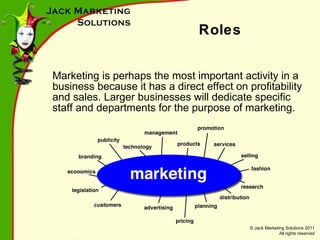
Roles Marketing is perhaps the most important activity in a business because it has a direct effect on profitability and sales. Larger businesses will dedicate specific staff and departments for the purpose of marketing.
SME marketing Look bigger Improve the chance of procuring venture capital or other investments Attract more clients Brand yourself Convey that you are a business Provide a sense of business stability Be more memorable Explains your business name/ values Endear your company name and identity to your clients Explains unusual lines of business Demonstrates how you differentiate Stand out in your field Comply with expectations Demonstrate commitment and personal pride in your business Source: Yahoo! small business advice
Marketing mix The elements of marketing © Jack Marketing Solutions 2011 All rights reserved
The mix The marketing mix was coined by Neil Borden in 1965 and used a cookery analogy. Originally, the mix comprised of product, price, promotion and place (distribution). The mix was extended to the ‘7 P’s’: Product or service Price Promotion Place (distribution) People Process Physical evidence
Product Design Technology Usefulness Convenience Value Quality Packaging Branding Accessories/consumables Warranties
Pricing Premium pricing Price skimming Penetration pricing Psychological pricing Cost-plus pricing Loss-leader pricing Economic pricing Product line pricing Optional product pricing Captive product pricing Product bundle pricing Promotional pricing Geographic pricing Value pricing Pricing strategies
Promotion Special offers Advertising Endorsements User trials Direct marketing Collateral, such as leaflets, posters and brochures Merchandising, such as gifts Competitions Joint ventures Digital marketing, such as websites, email marketing, etc
Place (distribution) Retail Wholesale Mail order Internet Direct sales Peer to peer Multi-channel Point of sale
People Employees Management Culture Customer service Environment Community
Processes In service organisations, processes are traceable and demonstrate capability and competence. At each stage of the process, marketers must demonstrate: Delivery of value through all elements of the  marketing  mix Feedback is acknowledged and the mix be altered as appropriate Customers are retained, and other services or products are extended and marketed to them The process itself can be customised to the needs of different individuals, experiencing a similar service concurrently
Physical evidence Physical evidence is vital to demonstrate quality and trustworthiness. Internet/web pages Paperwork (such as invoices, tickets and despatch notes) Brochures Furnishings and decoration Signage (e.g. on buildings and vehicles) Uniforms Business cards The facilities Quality marks Recommendations and testimonials Service delivery
Marketing plan Planning for marketing © Jack Marketing Solutions 2011 All rights reserved
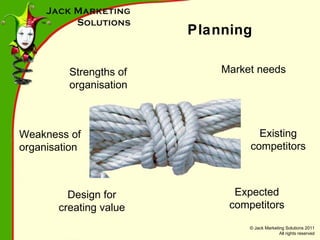
Planning Strengths of organisation Market needs Weakness of organisation Design for creating value Existing competitors Expected competitors
The plan Describe your market and the characteristics and size of each market segment R esearch what customers value Compare the distribution channels for reaching customers Profile your competitors and what they're offering Identify other key factors influencing your business environment Review the effectiveness of previous marketing initiatives Assess the profitability and sales potential of different customers and market segments Decide who to target among both existing and potential customers Set SMART objectives Decide how you will price each product or service
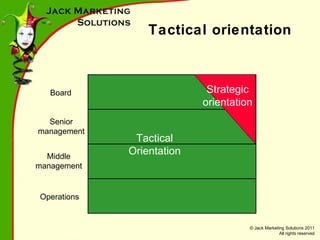
Tactical orientation Tactical Orientation Strategic orientation Board Senior management Middle management Operations
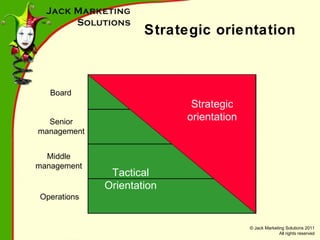
Strategic orientation Tactical Orientation Strategic orientation Board Senior management Middle management Operations
Contents Executive summary Mission statement Financial summary of revenue, expenses and earnings Marketing audit SWOT analysis Assumption of key determinants Overall marketing objectives and strategies Expected results Contingency plan Budget
Conclusion Just the start of the journey © Jack Marketing Solutions 2011 All rights reserved
Marketing matters more Markets are incredibly complex and competitive Competitive intensity has tripled in most markets Typical market segmentation models now have 400 clusters Product lifecycles have reduced by 70% over the last decade Source: Peter Fisk – Marketing Genius
Customers are important Customers are much more powerful than ever  Consumers now receive 1500 messages per day 54% of consumers have registered for  ‘do  not call ’ Purchase decisions are typically made in 2.6 seconds Source: Peter Fisk – Marketing Genius
Shareholders demands Shareholders demand higher, faster returns  Intangible assets make up 78% of the Fortune 500 company values 60% of brand investment impacts future years 21% of CEOs are marketers delivering 5% better total systems resourcing Source: Peter Fisk – Marketing Genius
Thank you Questions Thom Poole www.jack-marketing.com © Jack Marketing Solutions 2011 All rights reserved

Marketing Bootcamp

  • 1.
    Marketing Bootcamp ThomPoole April 2011
  • 2.
    Agenda What ismarketing Marketing - basic concepts Marketing mix Marketing planning Conclusions
  • 3.
    Why me? Internationalmarketing director with 25 years experience Developed the first MSc in digital marketing Written papers on ‘Data Privacy’, ‘The Marketing Art of the Opt-in’ and ‘Trust in Business and Marketing’ Written many books, including ‘a guide to ethical digital marketing’ called ‘Play It By Trust’ Held senior marketing positions at O2, Black & Decker and Hilti A Fellow of the Chartered Institute of Marketing, and Chartered Marketer. Member of the Worshipful Company of Marketors Consultant & business mentor for marketing strategy and implementation
  • 4.
    What is marketing?Some definitions © Jack Marketing Solutions 2011 All rights reserved
  • 5.
    Definitions 1 Marketingis the management process responsible for identifying, anticipating and satisfying customer requirements profitably. Chartered Institute of Marketing (CIM) Marketing is the activity, set of institutions, and processes for creating, communicating, delivering, and exchanging offerings that have value for customers, clients, partners, and society at large. American Marketing Association (AMA)
  • 6.
    Definitions 2 Marketingis all about exploitation! You learn everything you can about your customers, marketplace, competitors, etc... and you exploit your knowledge... to give your customers what they want, think they want, or you can persuade them they want! Thom Poole
  • 7.
    Marketing? The basicconcept © Jack Marketing Solutions 2011 All rights reserved
  • 8.
    Role of marketingmarketing provides the ammunition for the front-line of sales that ammunition could be the right product, competitive pricing, inspiring collateral, intuitive training, etc...
  • 9.
    Provides much more…The voice of an organisation – public relations The interactivity of the organisation – digital marketing The eyes and ears of the organisation – research The managers of the organisation – customer-centric processes The trackers of success – marketing and business metrics Marketers shape and develop new products; develop and track strategic and tactical plans; assign and control budgets; and build knowledge about the organisation’s customers.
  • 10.
    Critical business functionMarketing is critical for organic growth of a business and its central role is in creating, communicating, capturing and sustaining value for an organisation. Marketing helps a company create value through better understanding of the needs of its customers and providing them with innovative products and services. This value is communicated through a variety of channels as well as through the firm's branding strategy. Effective management of customers and pricing allows the firm to capture part of the value it has created. Finally, by building an effective customer-centric organisation a business attempts to sustain value over time. Source: Harvard Business School
  • 11.
    Roles Marketing isperhaps the most important activity in a business because it has a direct effect on profitability and sales. Larger businesses will dedicate specific staff and departments for the purpose of marketing.
  • 12.
    SME marketing Lookbigger Improve the chance of procuring venture capital or other investments Attract more clients Brand yourself Convey that you are a business Provide a sense of business stability Be more memorable Explains your business name/ values Endear your company name and identity to your clients Explains unusual lines of business Demonstrates how you differentiate Stand out in your field Comply with expectations Demonstrate commitment and personal pride in your business Source: Yahoo! small business advice
  • 13.
    Marketing mix Theelements of marketing © Jack Marketing Solutions 2011 All rights reserved
  • 14.
    The mix Themarketing mix was coined by Neil Borden in 1965 and used a cookery analogy. Originally, the mix comprised of product, price, promotion and place (distribution). The mix was extended to the ‘7 P’s’: Product or service Price Promotion Place (distribution) People Process Physical evidence
  • 15.
    Product Design TechnologyUsefulness Convenience Value Quality Packaging Branding Accessories/consumables Warranties
  • 16.
    Pricing Premium pricingPrice skimming Penetration pricing Psychological pricing Cost-plus pricing Loss-leader pricing Economic pricing Product line pricing Optional product pricing Captive product pricing Product bundle pricing Promotional pricing Geographic pricing Value pricing Pricing strategies
  • 17.
    Promotion Special offersAdvertising Endorsements User trials Direct marketing Collateral, such as leaflets, posters and brochures Merchandising, such as gifts Competitions Joint ventures Digital marketing, such as websites, email marketing, etc
  • 18.
    Place (distribution) RetailWholesale Mail order Internet Direct sales Peer to peer Multi-channel Point of sale
  • 19.
    People Employees ManagementCulture Customer service Environment Community
  • 20.
    Processes In serviceorganisations, processes are traceable and demonstrate capability and competence. At each stage of the process, marketers must demonstrate: Delivery of value through all elements of the marketing mix Feedback is acknowledged and the mix be altered as appropriate Customers are retained, and other services or products are extended and marketed to them The process itself can be customised to the needs of different individuals, experiencing a similar service concurrently
  • 21.
    Physical evidence Physicalevidence is vital to demonstrate quality and trustworthiness. Internet/web pages Paperwork (such as invoices, tickets and despatch notes) Brochures Furnishings and decoration Signage (e.g. on buildings and vehicles) Uniforms Business cards The facilities Quality marks Recommendations and testimonials Service delivery
  • 22.
    Marketing plan Planningfor marketing © Jack Marketing Solutions 2011 All rights reserved
  • 23.
    Planning Strengths oforganisation Market needs Weakness of organisation Design for creating value Existing competitors Expected competitors
  • 24.
    The plan Describeyour market and the characteristics and size of each market segment R esearch what customers value Compare the distribution channels for reaching customers Profile your competitors and what they're offering Identify other key factors influencing your business environment Review the effectiveness of previous marketing initiatives Assess the profitability and sales potential of different customers and market segments Decide who to target among both existing and potential customers Set SMART objectives Decide how you will price each product or service
  • 25.
    Tactical orientation TacticalOrientation Strategic orientation Board Senior management Middle management Operations
  • 26.
    Strategic orientation TacticalOrientation Strategic orientation Board Senior management Middle management Operations
  • 27.
    Contents Executive summaryMission statement Financial summary of revenue, expenses and earnings Marketing audit SWOT analysis Assumption of key determinants Overall marketing objectives and strategies Expected results Contingency plan Budget
  • 28.
    Conclusion Just thestart of the journey © Jack Marketing Solutions 2011 All rights reserved
  • 29.
    Marketing matters moreMarkets are incredibly complex and competitive Competitive intensity has tripled in most markets Typical market segmentation models now have 400 clusters Product lifecycles have reduced by 70% over the last decade Source: Peter Fisk – Marketing Genius
  • 30.
    Customers are importantCustomers are much more powerful than ever Consumers now receive 1500 messages per day 54% of consumers have registered for ‘do not call ’ Purchase decisions are typically made in 2.6 seconds Source: Peter Fisk – Marketing Genius
  • 31.
    Shareholders demands Shareholdersdemand higher, faster returns Intangible assets make up 78% of the Fortune 500 company values 60% of brand investment impacts future years 21% of CEOs are marketers delivering 5% better total systems resourcing Source: Peter Fisk – Marketing Genius
  • 32.
    Thank you QuestionsThom Poole www.jack-marketing.com © Jack Marketing Solutions 2011 All rights reserved