The business case for CRM How can you get the investment for CRM? Thom Poole Managing Consultant February 2007
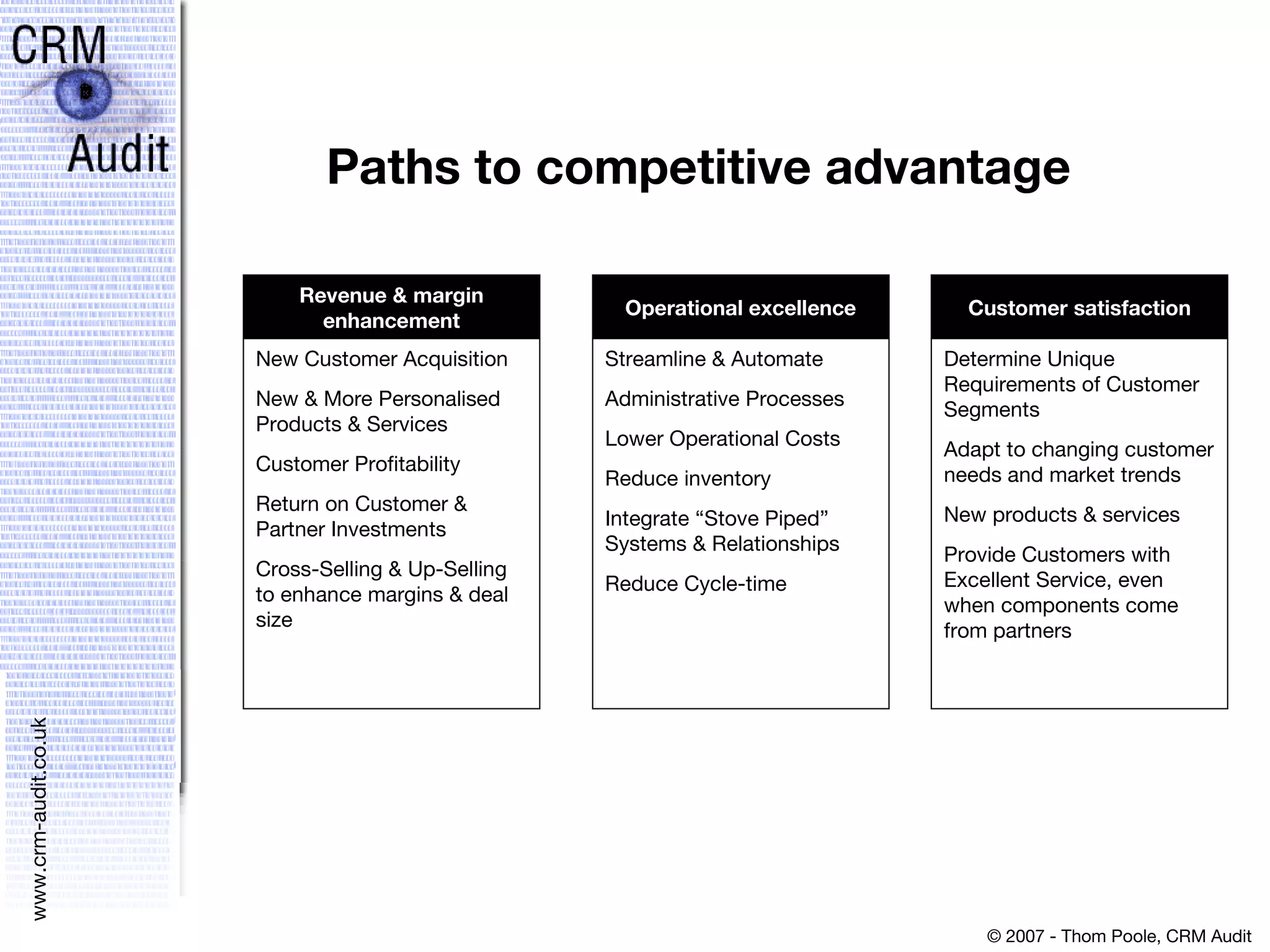
Paths to competitive advantage Customer satisfaction Operational excellence Revenue & margin enhancement New Customer Acquisition  New & More Personalised Products & Services  Customer Profitability  Return on Customer & Partner Investments  Cross-Selling & Up-Selling to enhance margins & deal size  Streamline & Automate  Administrative Processes  Lower Operational Costs  Reduce inventory  Integrate “Stove Piped” Systems & Relationships  Reduce Cycle-time  Determine Unique Requirements of Customer Segments  Adapt to changing customer needs and market trends  New products & services  Provide Customers with Excellent Service, even when components come  from partners
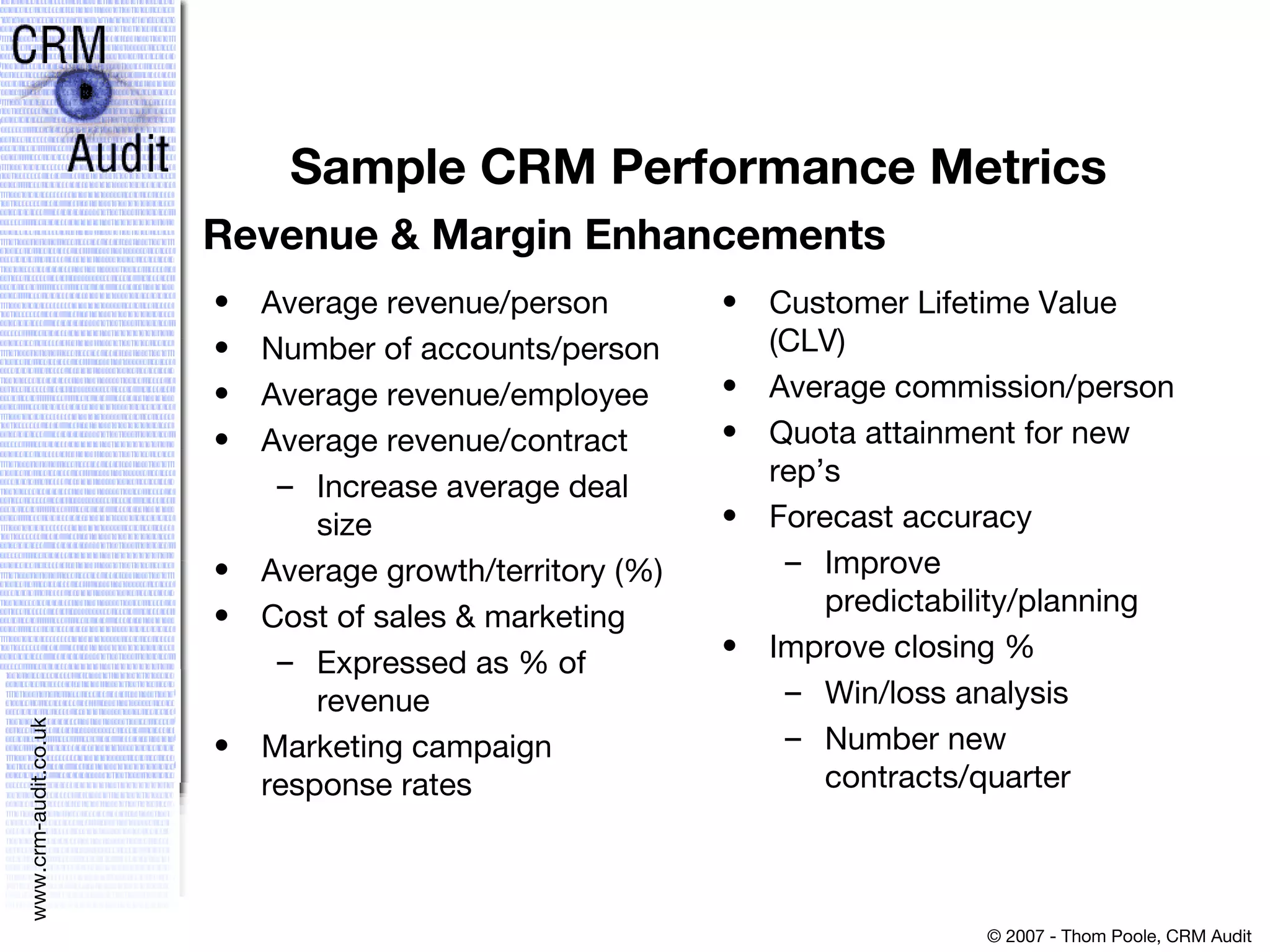
Sample CRM Performance Metrics Average revenue/person Number of accounts/person  Average revenue/employee  Average revenue/contract  Increase average deal size  Average growth/territory (%)  Cost of sales & marketing  Expressed as % of revenue  Marketing campaign response rates  Customer Lifetime Value (CLV) Average commission/person  Quota attainment for new rep’s  Forecast accuracy  Improve predictability/planning  Improve closing %  Win/loss analysis  Number new contracts/quarter Revenue & Margin Enhancements
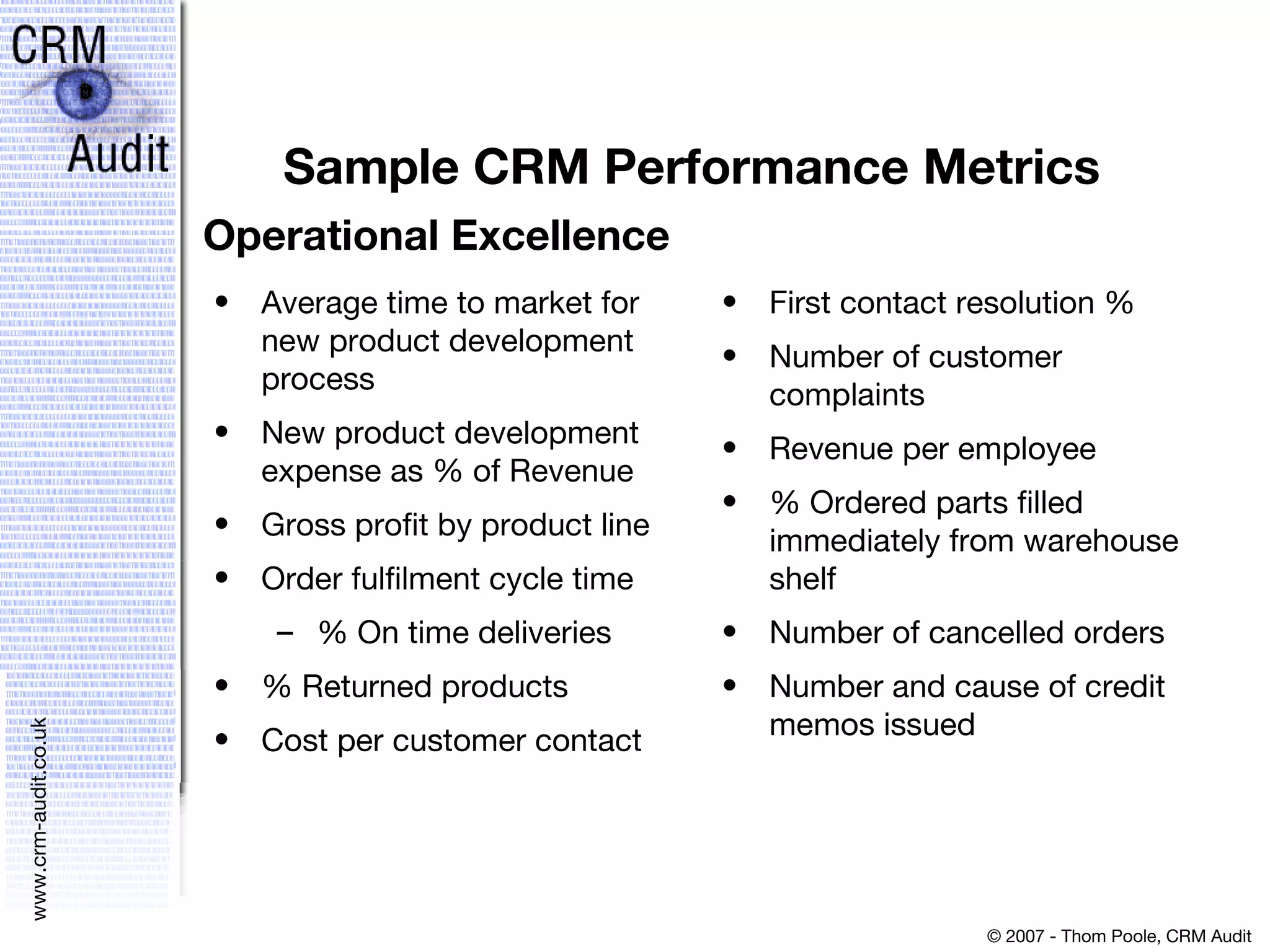
Sample CRM Performance Metrics  Average time to market for new product development process New product development expense as % of Revenue Gross profit by product line Order fulfilment cycle time % On time deliveries % Returned products Cost per customer contact  First contact resolution % Number of customer complaints Revenue per employee % Ordered parts filled immediately from warehouse shelf Number of cancelled orders Number and cause of credit memos issued Operational Excellence
Sample CRM Performance Metrics %  ‘ On-Time ’  deliveries Mean response time to customer service incident Customer complaints Customer satisfaction index Share of key customers ’  purchases Customer Lifetime Value (CLV)  Number of repeat customers Shopping cart abandonment rate Number of referrals to other customers % Revenue to new versus existing customers Customer Satisfaction & Retention
The corporate requirement Individual view of each customer Increase the customer interaction Increase cross-sell and up-sell opportunities Improve direct selling performance and efficiency Develop/source products that are relevant to your customers
CRM implementation teams Team member selection Political lubrication Dedicated resources Task delimitation
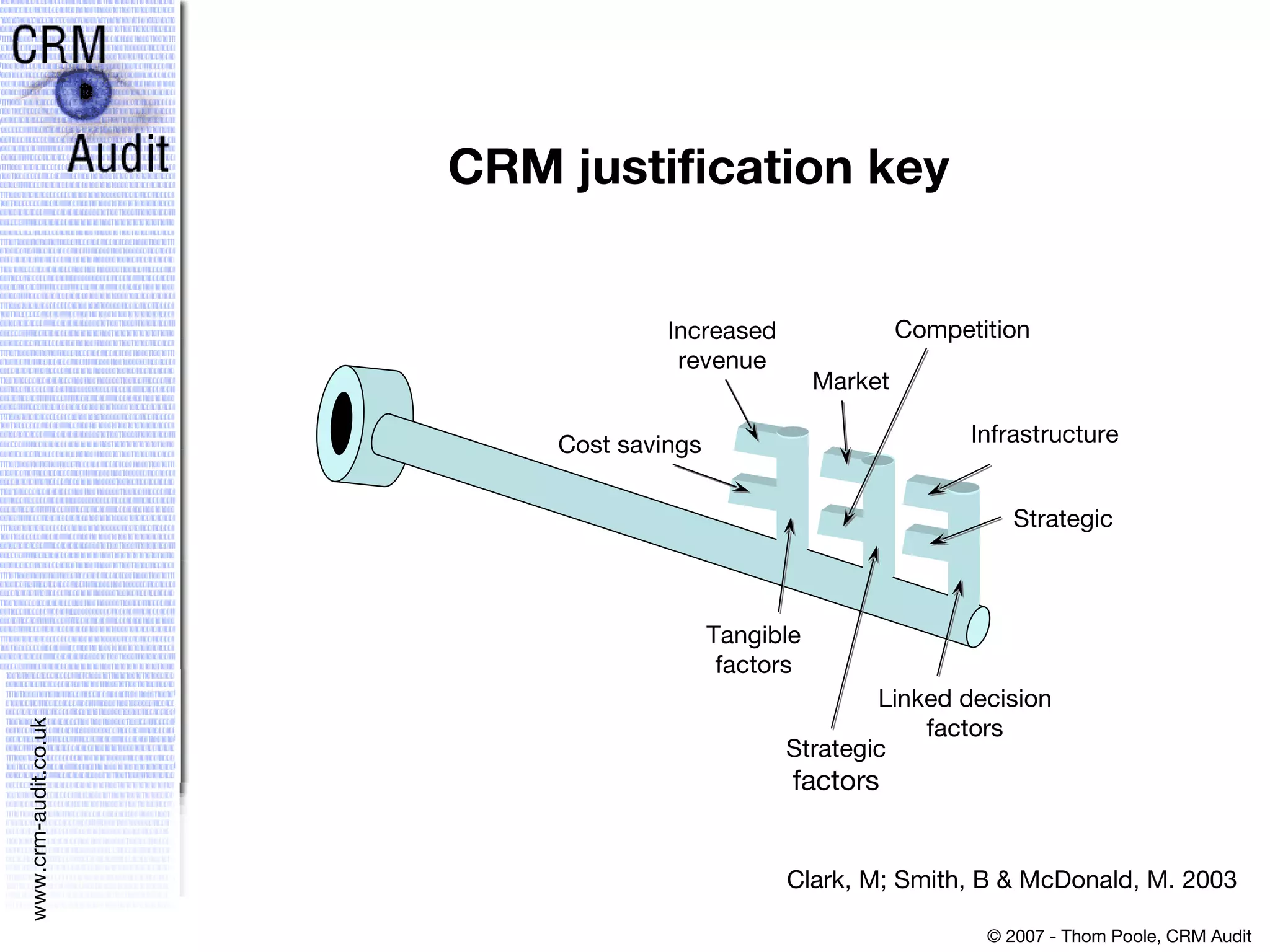
Justification Tangible factors Customer retention Market penetration Cross-selling opportunities Strategic factors Competitive pressures Loss of core product differentiation Strategic fit Linked decision factors Resource allocation Salesforce automation Finance system integration or replacement
CRM justification key Linked decision factors Strategic factors Tangible factors Infrastructure Strategic Competition Market Increased revenue Cost savings Clark, M; Smith, B & McDonald, M. 2003
A CRM results measurement system The primary building blocks of CRM results measurement
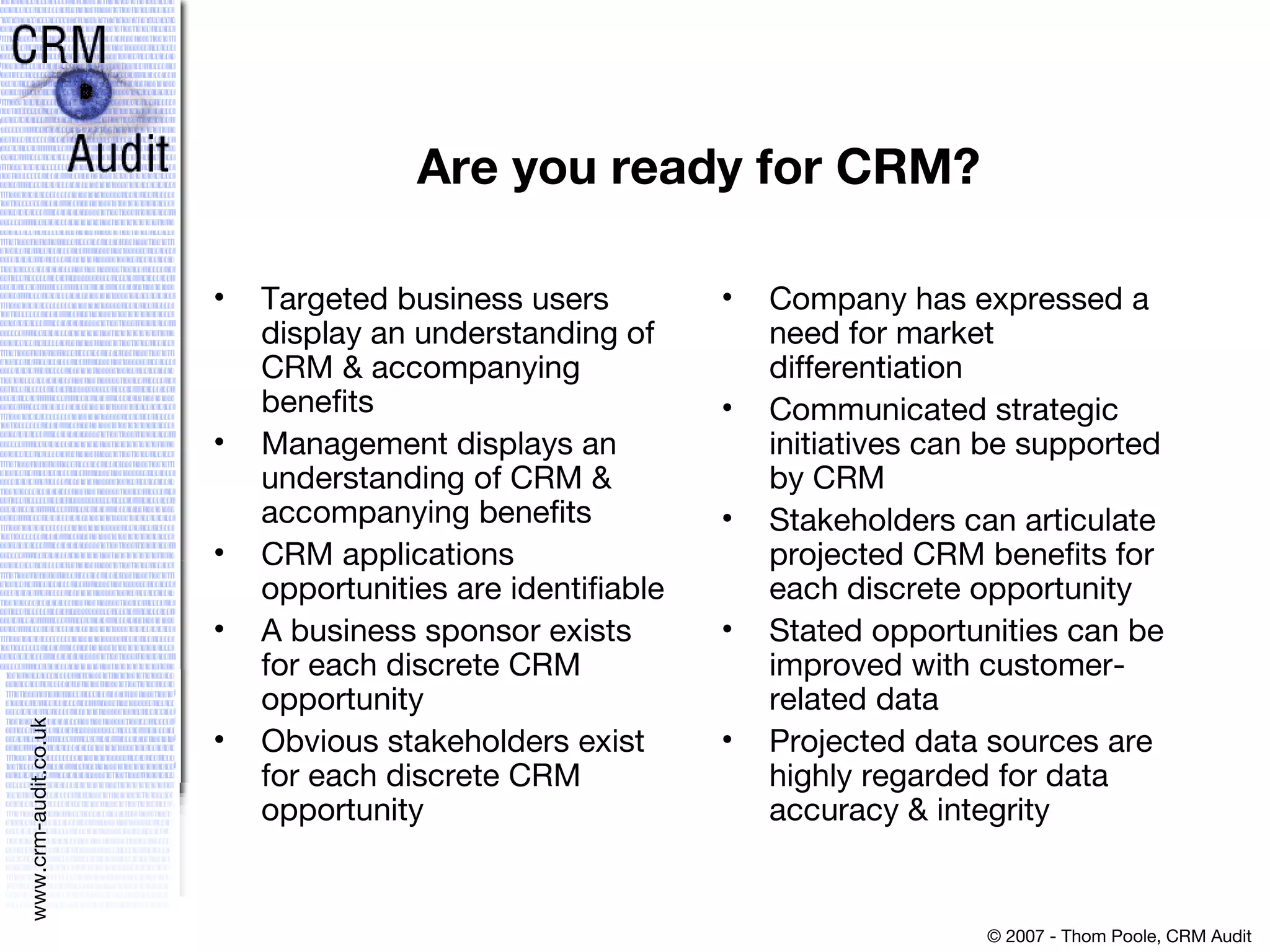
Are you ready for CRM? Targeted business users display an understanding of CRM & accompanying benefits Management displays an understanding of CRM & accompanying benefits CRM applications opportunities are identifiable A business sponsor exists for each discrete CRM opportunity Obvious stakeholders exist for each discrete CRM opportunity Company has expressed a need for market differentiation Communicated strategic initiatives can be supported by CRM Stakeholders can articulate projected CRM benefits for each discrete opportunity Stated opportunities can be improved with customer-related data Projected data sources are highly regarded for data accuracy & integrity
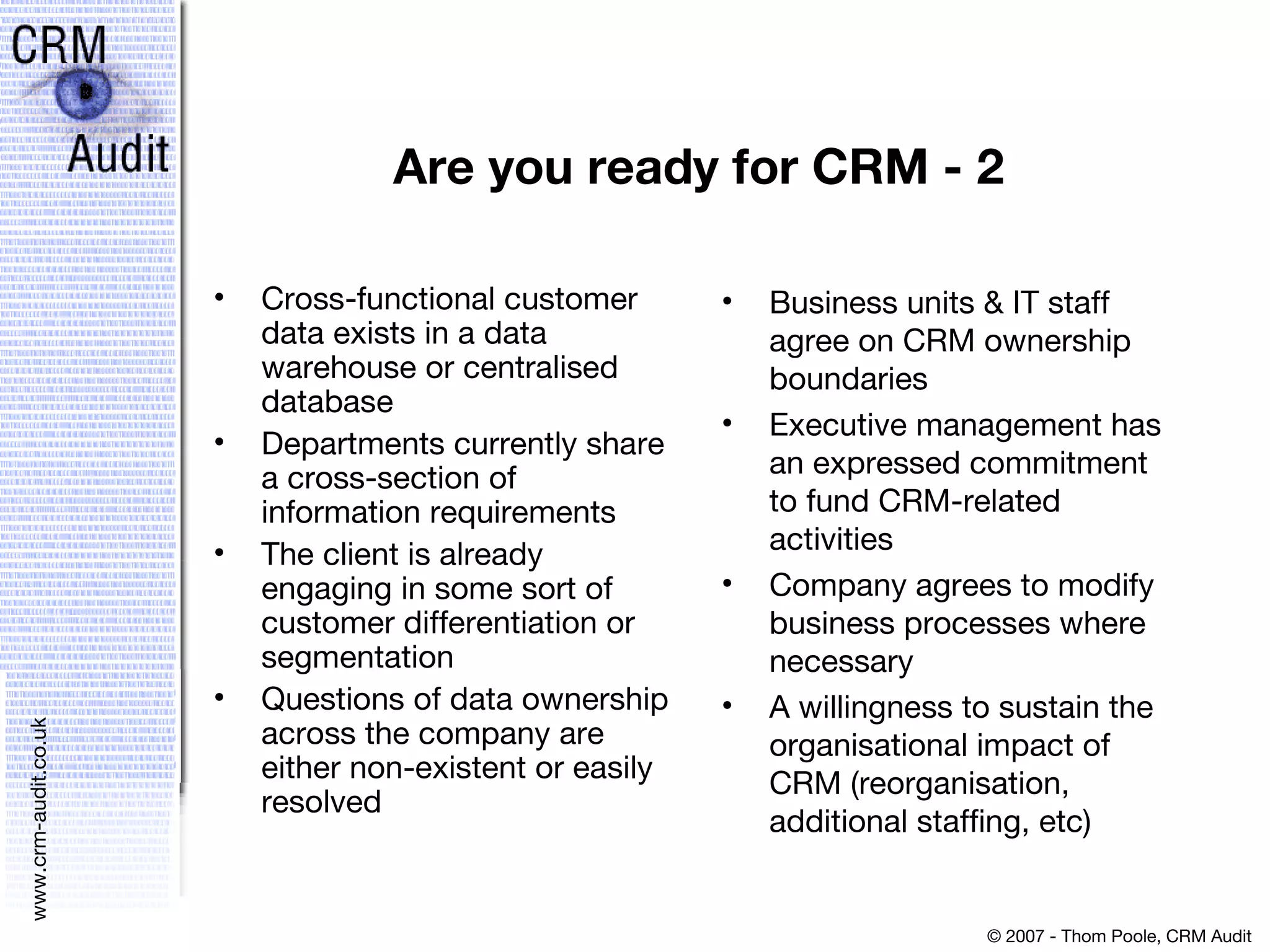
Are you ready for CRM - 2 Cross-functional customer data exists in a data warehouse or centralised database Departments currently share a cross-section of information requirements The client is already engaging in some sort of customer differentiation or segmentation Questions of data ownership across the company are either non-existent or easily resolved Business units & IT staff agree on CRM ownership boundaries Executive management has an expressed commitment to fund CRM-related activities Company agrees to modify business processes where necessary A willingness to sustain the organisational impact of CRM (reorganisation, additional staffing, etc)
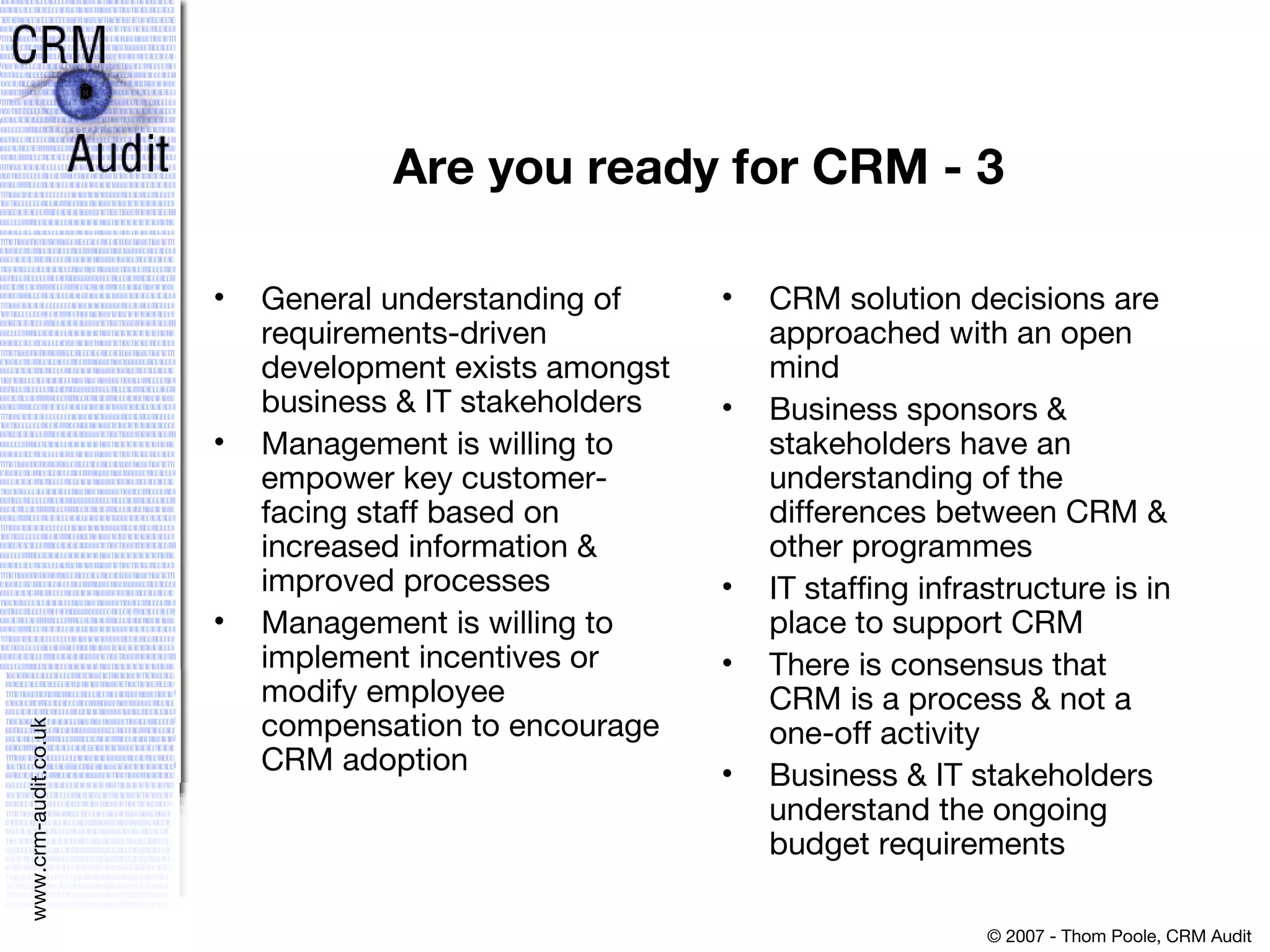
Are you ready for CRM - 3 General understanding of requirements-driven development exists amongst business & IT stakeholders Management is willing to empower key customer-facing staff based on increased information & improved processes Management is willing to implement incentives or modify employee compensation to encourage CRM adoption CRM solution decisions are approached with an open mind Business sponsors & stakeholders have an understanding of the differences between CRM & other programmes IT staffing infrastructure is in place to support CRM There is consensus that CRM is a process & not a one-off activity Business & IT stakeholders understand the ongoing budget requirements
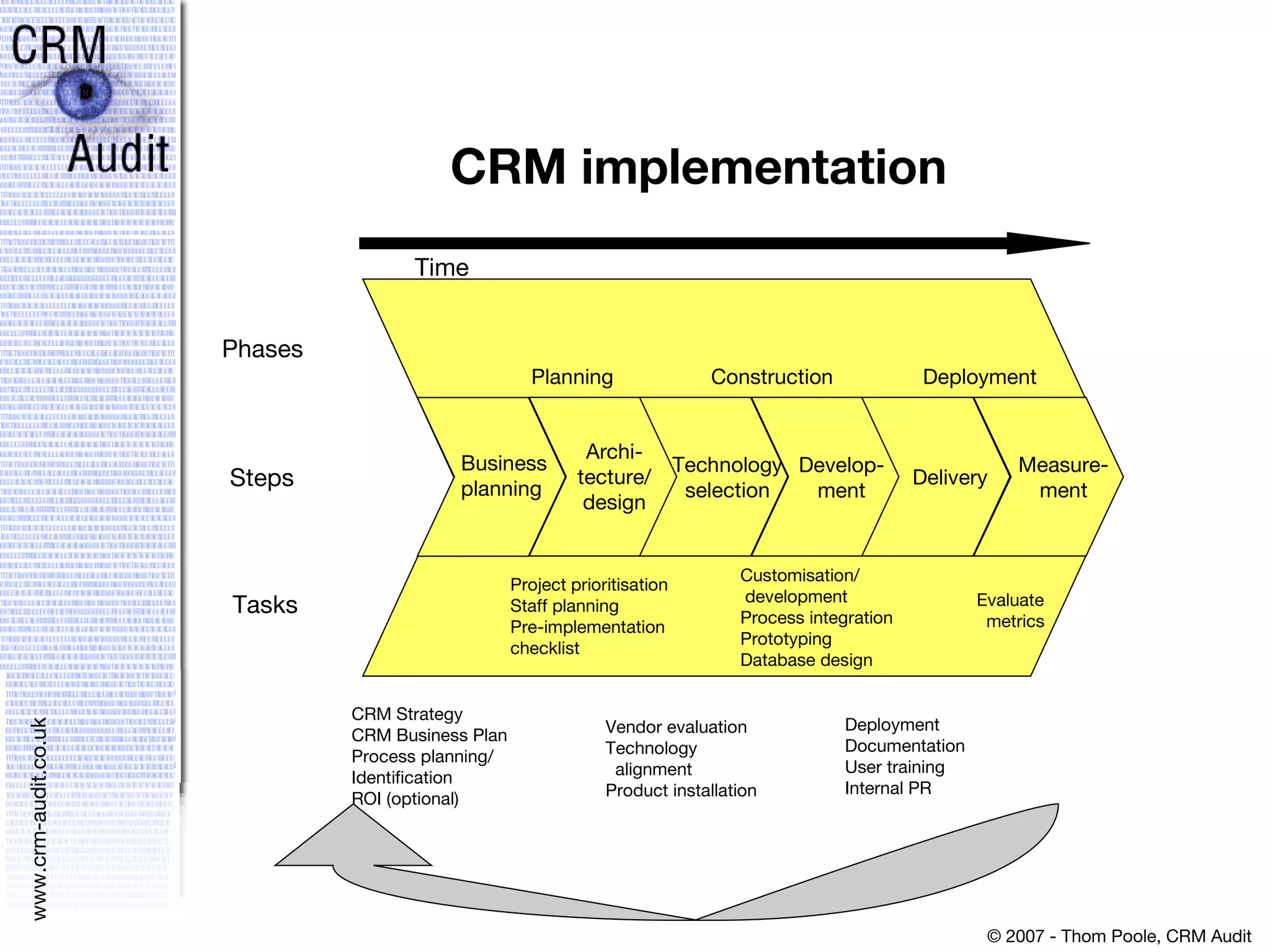
CRM implementation Planning Construction Deployment Business planning Archi- tecture/ design Technology selection Develop- ment Delivery Measure- ment Time Phases Steps Tasks CRM Strategy CRM Business Plan Process planning/ Identification ROI (optional) Project prioritisation Staff planning Pre-implementation checklist Vendor evaluation Technology alignment Product installation Customisation/ development Process integration Prototyping Database design Deployment Documentation User training Internal PR Evaluate   metrics
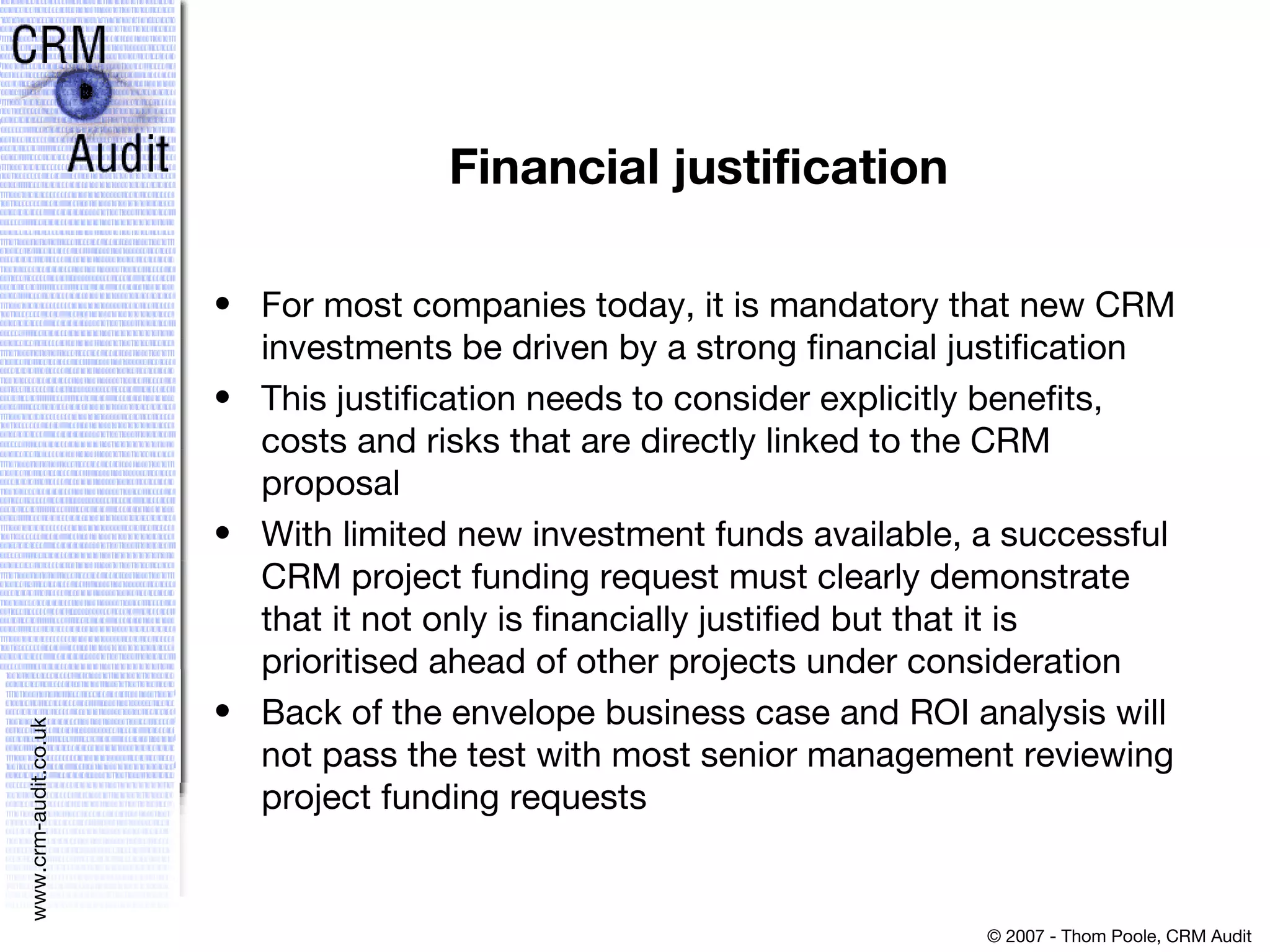
Financial justification For most companies today, it is mandatory that new CRM investments be driven by a strong financial justification  This justification needs to consider explicitly benefits, costs and risks that are directly linked to the CRM proposal  With limited new investment funds available, a successful CRM project funding request must clearly demonstrate that it not only is financially justified but that it is prioritised ahead of other projects under consideration  Back of the envelope business case and ROI analysis will not pass the test with most senior management reviewing project funding requests
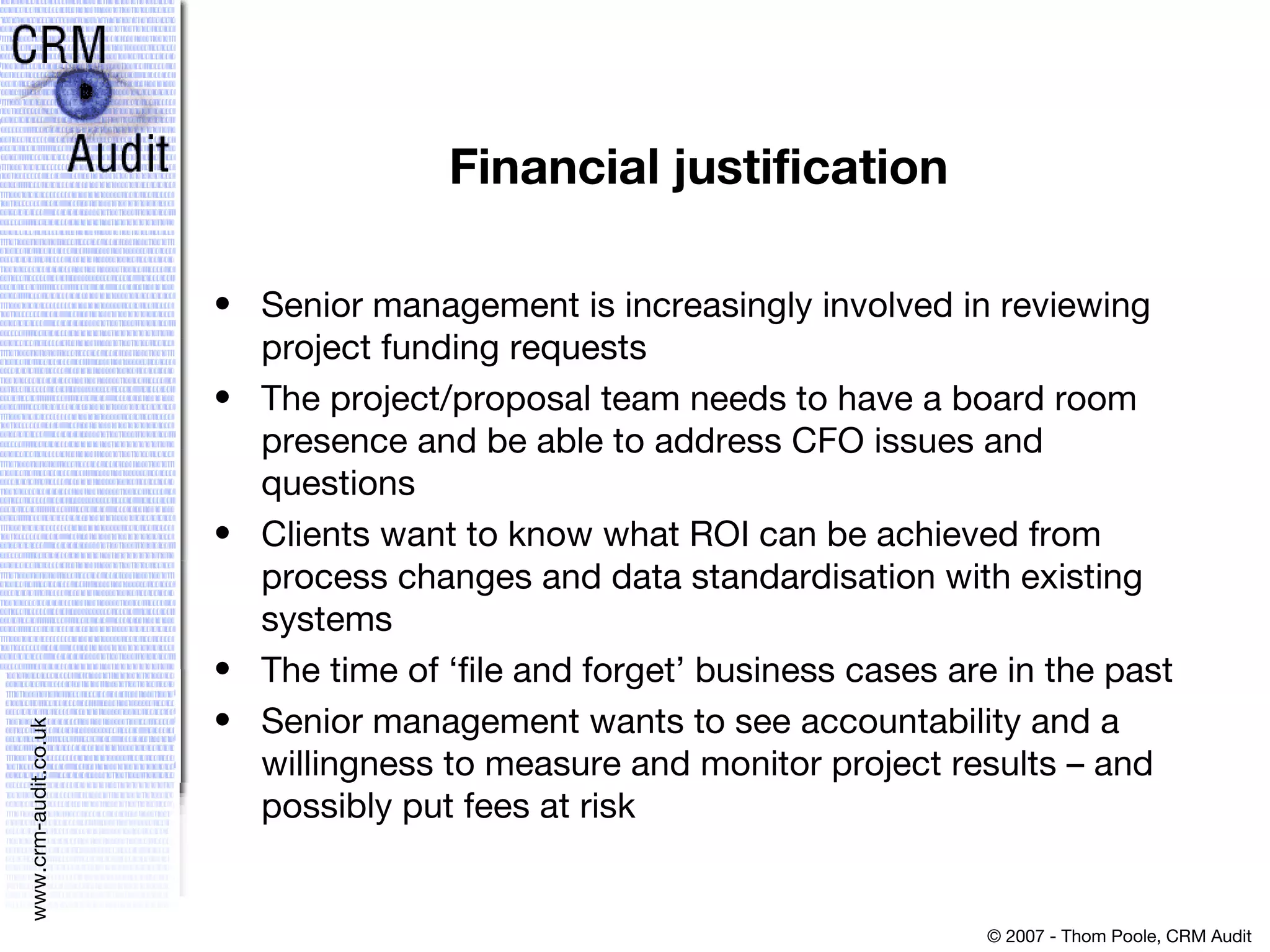
Financial justification Senior management is increasingly involved in reviewing project funding requests  The project/proposal team needs to have a board room presence and be able to address CFO issues and questions  Clients want to know what ROI can be achieved from process changes and data standardisation with existing systems  The time of ‘file and forget’ business cases are in the past  Senior management wants to see accountability and a willingness to measure and monitor project results – and possibly put fees at risk
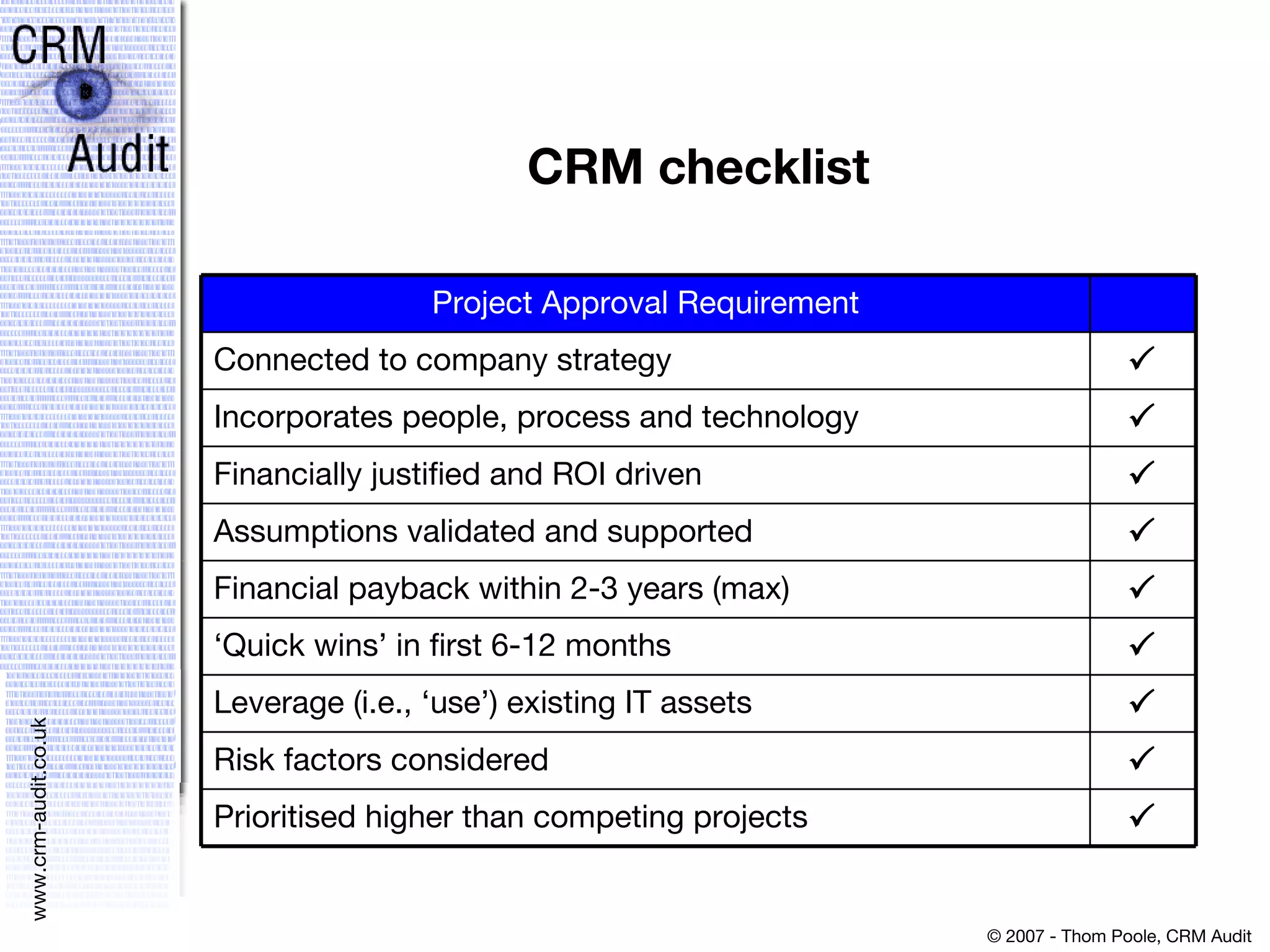
CRM checklist  Prioritised higher than competing projects  Risk factors considered  Leverage (i.e., ‘use’) existing IT assets  ‘ Quick wins’ in first 6-12 months  Financial payback within 2-3 years (max)  Assumptions validated and supported  Financially justified and ROI driven  Incorporates people, process and technology  Connected to company strategy Project Approval Requirement
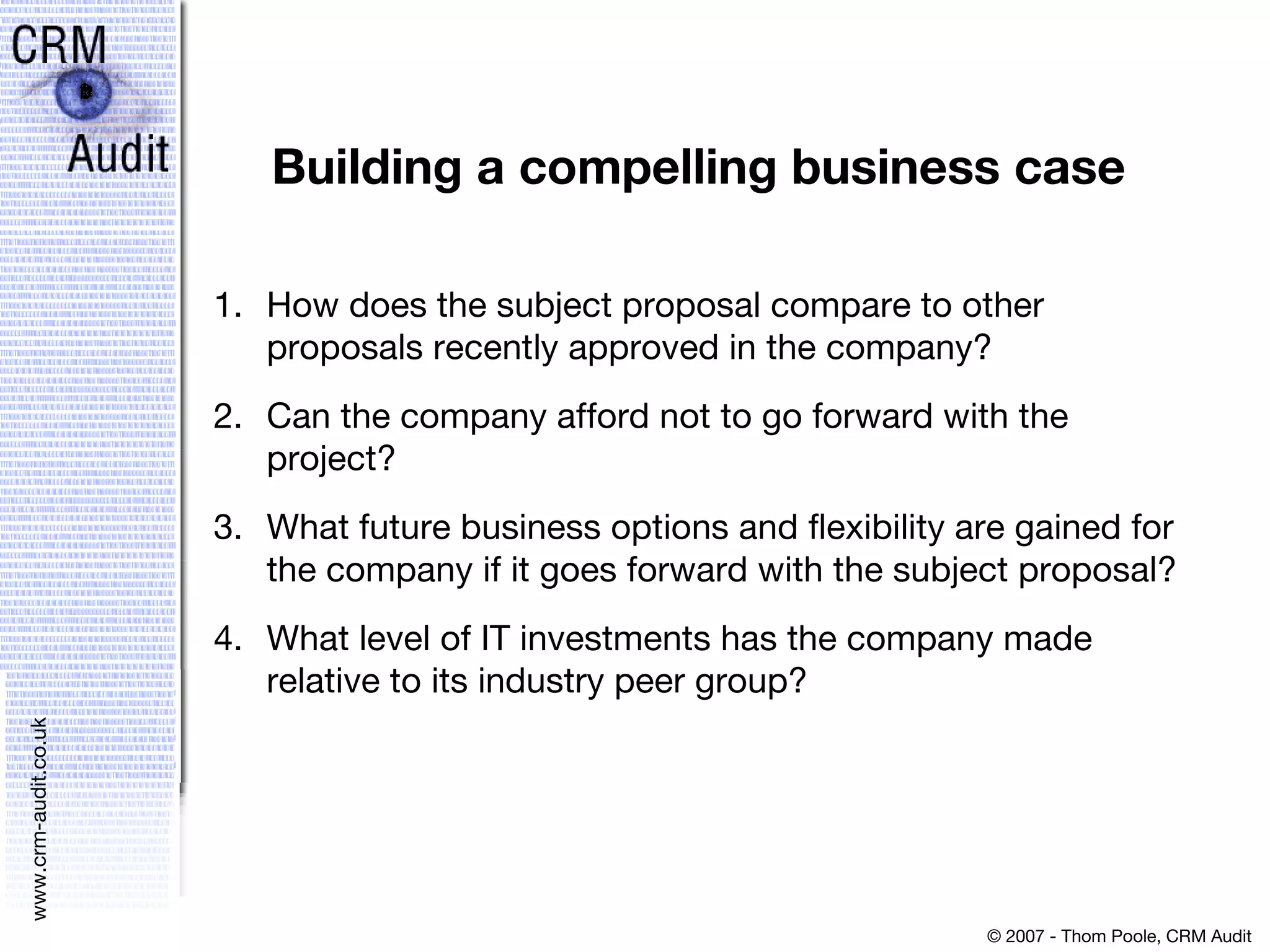
Building a compelling business case How does the subject proposal compare to other proposals recently approved in the company?  Can the company afford not to go forward with the project?  What future business options and flexibility are gained for the company if it goes forward with the subject proposal?  What level of IT investments has the company made relative to its industry peer group?
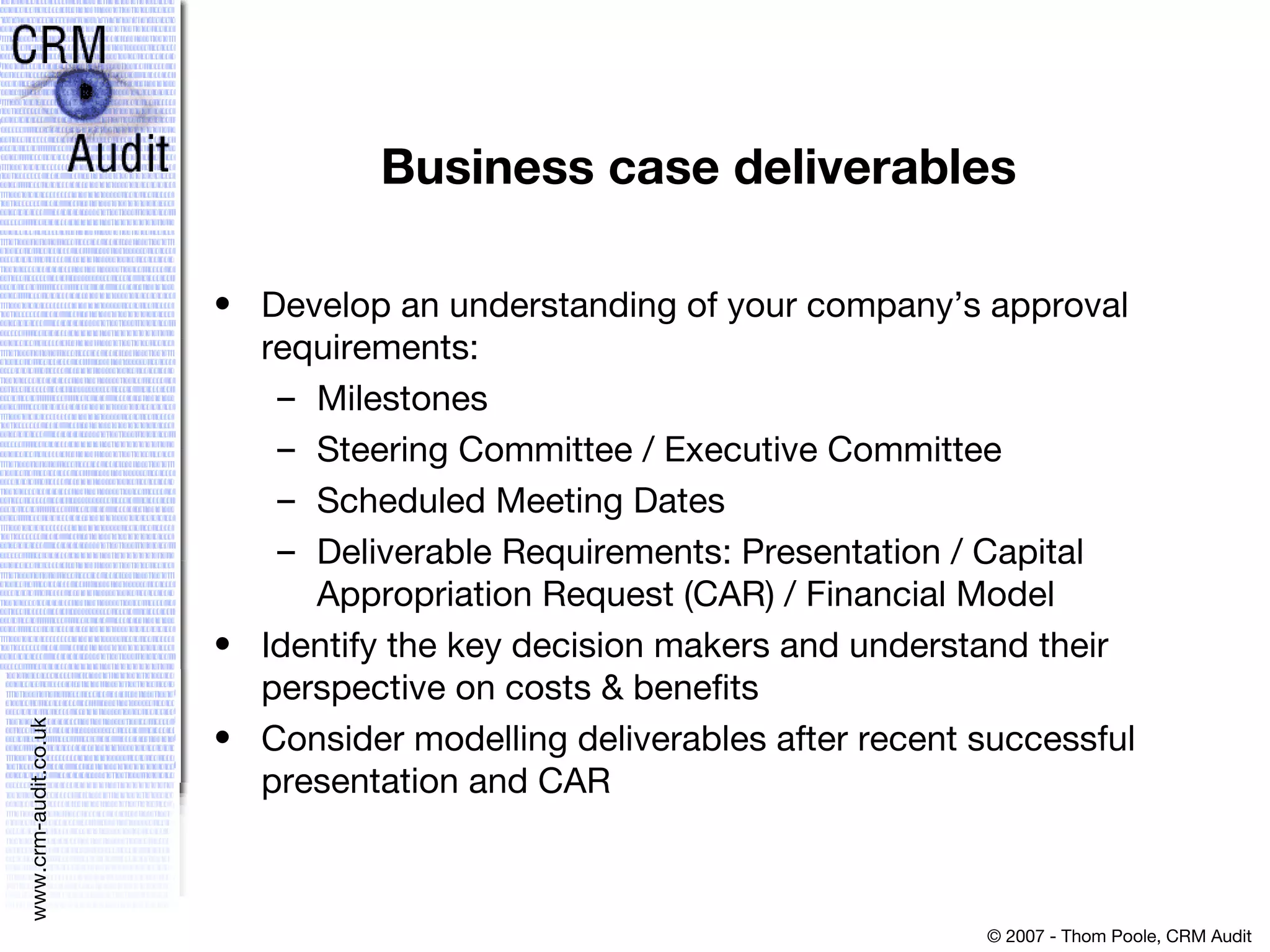
Business case deliverables Develop an understanding of your company’s approval requirements:  Milestones  Steering Committee / Executive Committee  Scheduled Meeting Dates  Deliverable Requirements: Presentation / Capital Appropriation Request (CAR) / Financial Model  Identify the key decision makers and understand their perspective on costs & benefits  Consider modelling deliverables after recent successful presentation and CAR
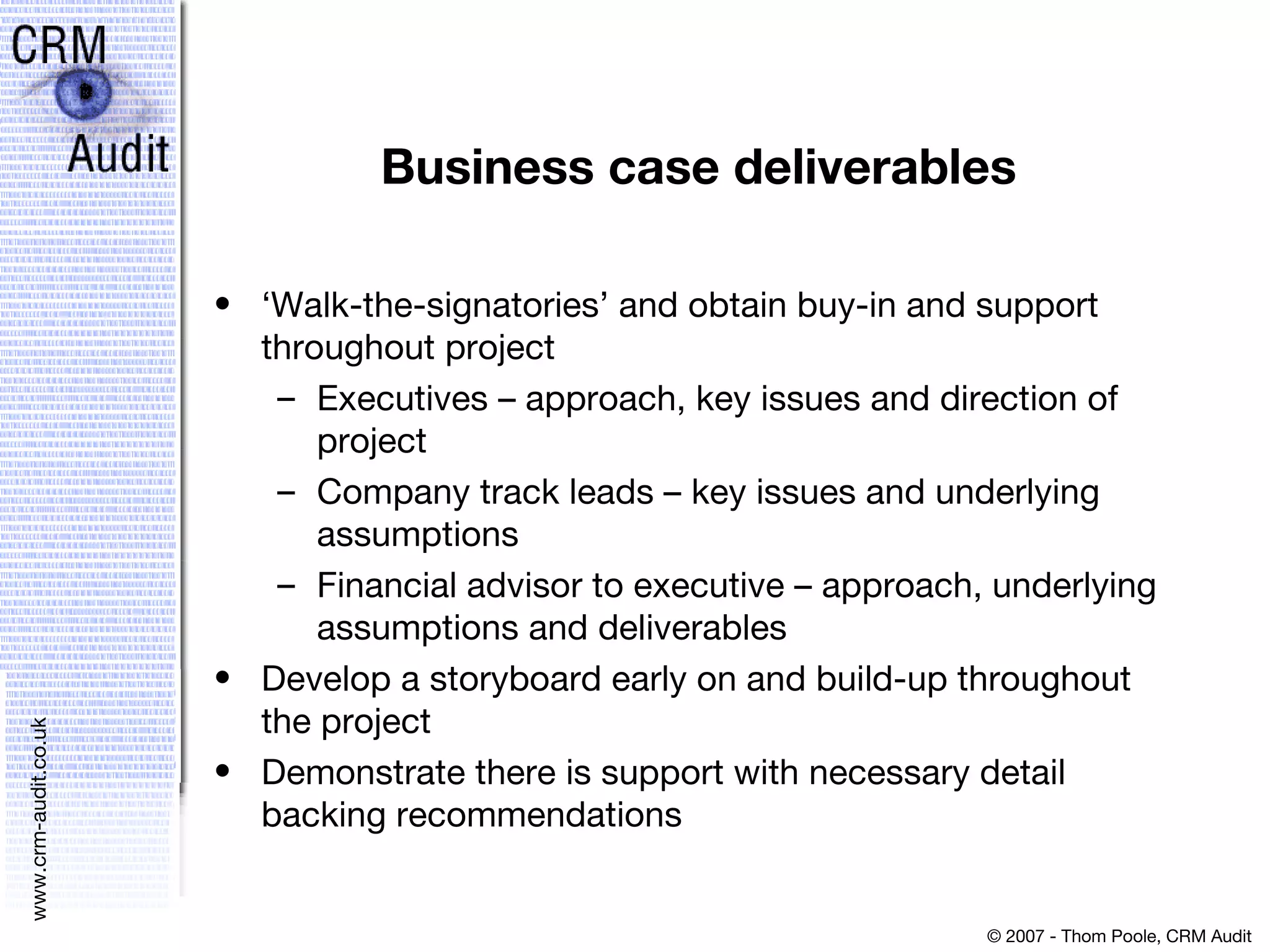
Business case deliverables ‘Walk-the-signatories’ and obtain buy-in and support throughout project  Executives – approach, key issues and direction of project  Company track leads – key issues and underlying assumptions  Financial advisor to executive – approach, underlying assumptions and deliverables  Develop a storyboard early on and build-up throughout the project  Demonstrate there is support with necessary detail backing recommendations
Thank you [email_address]

The Business Case for CRM

  • 1.
    The business casefor CRM How can you get the investment for CRM? Thom Poole Managing Consultant February 2007
  • 2.
    Paths to competitiveadvantage Customer satisfaction Operational excellence Revenue & margin enhancement New Customer Acquisition New & More Personalised Products & Services Customer Profitability Return on Customer & Partner Investments Cross-Selling & Up-Selling to enhance margins & deal size Streamline & Automate Administrative Processes Lower Operational Costs Reduce inventory Integrate “Stove Piped” Systems & Relationships Reduce Cycle-time Determine Unique Requirements of Customer Segments Adapt to changing customer needs and market trends New products & services Provide Customers with Excellent Service, even when components come from partners
  • 3.
    Sample CRM PerformanceMetrics Average revenue/person Number of accounts/person Average revenue/employee Average revenue/contract Increase average deal size Average growth/territory (%) Cost of sales & marketing Expressed as % of revenue Marketing campaign response rates Customer Lifetime Value (CLV) Average commission/person Quota attainment for new rep’s Forecast accuracy Improve predictability/planning Improve closing % Win/loss analysis Number new contracts/quarter Revenue & Margin Enhancements
  • 4.
    Sample CRM PerformanceMetrics Average time to market for new product development process New product development expense as % of Revenue Gross profit by product line Order fulfilment cycle time % On time deliveries % Returned products Cost per customer contact First contact resolution % Number of customer complaints Revenue per employee % Ordered parts filled immediately from warehouse shelf Number of cancelled orders Number and cause of credit memos issued Operational Excellence
  • 5.
    Sample CRM PerformanceMetrics % ‘ On-Time ’ deliveries Mean response time to customer service incident Customer complaints Customer satisfaction index Share of key customers ’ purchases Customer Lifetime Value (CLV) Number of repeat customers Shopping cart abandonment rate Number of referrals to other customers % Revenue to new versus existing customers Customer Satisfaction & Retention
  • 6.
    The corporate requirementIndividual view of each customer Increase the customer interaction Increase cross-sell and up-sell opportunities Improve direct selling performance and efficiency Develop/source products that are relevant to your customers
  • 7.
    CRM implementation teamsTeam member selection Political lubrication Dedicated resources Task delimitation
  • 8.
    Justification Tangible factorsCustomer retention Market penetration Cross-selling opportunities Strategic factors Competitive pressures Loss of core product differentiation Strategic fit Linked decision factors Resource allocation Salesforce automation Finance system integration or replacement
  • 9.
    CRM justification keyLinked decision factors Strategic factors Tangible factors Infrastructure Strategic Competition Market Increased revenue Cost savings Clark, M; Smith, B & McDonald, M. 2003
  • 10.
    A CRM resultsmeasurement system The primary building blocks of CRM results measurement
  • 11.
    Are you readyfor CRM? Targeted business users display an understanding of CRM & accompanying benefits Management displays an understanding of CRM & accompanying benefits CRM applications opportunities are identifiable A business sponsor exists for each discrete CRM opportunity Obvious stakeholders exist for each discrete CRM opportunity Company has expressed a need for market differentiation Communicated strategic initiatives can be supported by CRM Stakeholders can articulate projected CRM benefits for each discrete opportunity Stated opportunities can be improved with customer-related data Projected data sources are highly regarded for data accuracy & integrity
  • 12.
    Are you readyfor CRM - 2 Cross-functional customer data exists in a data warehouse or centralised database Departments currently share a cross-section of information requirements The client is already engaging in some sort of customer differentiation or segmentation Questions of data ownership across the company are either non-existent or easily resolved Business units & IT staff agree on CRM ownership boundaries Executive management has an expressed commitment to fund CRM-related activities Company agrees to modify business processes where necessary A willingness to sustain the organisational impact of CRM (reorganisation, additional staffing, etc)
  • 13.
    Are you readyfor CRM - 3 General understanding of requirements-driven development exists amongst business & IT stakeholders Management is willing to empower key customer-facing staff based on increased information & improved processes Management is willing to implement incentives or modify employee compensation to encourage CRM adoption CRM solution decisions are approached with an open mind Business sponsors & stakeholders have an understanding of the differences between CRM & other programmes IT staffing infrastructure is in place to support CRM There is consensus that CRM is a process & not a one-off activity Business & IT stakeholders understand the ongoing budget requirements
  • 14.
    CRM implementation PlanningConstruction Deployment Business planning Archi- tecture/ design Technology selection Develop- ment Delivery Measure- ment Time Phases Steps Tasks CRM Strategy CRM Business Plan Process planning/ Identification ROI (optional) Project prioritisation Staff planning Pre-implementation checklist Vendor evaluation Technology alignment Product installation Customisation/ development Process integration Prototyping Database design Deployment Documentation User training Internal PR Evaluate metrics
  • 15.
    Financial justification Formost companies today, it is mandatory that new CRM investments be driven by a strong financial justification This justification needs to consider explicitly benefits, costs and risks that are directly linked to the CRM proposal With limited new investment funds available, a successful CRM project funding request must clearly demonstrate that it not only is financially justified but that it is prioritised ahead of other projects under consideration Back of the envelope business case and ROI analysis will not pass the test with most senior management reviewing project funding requests
  • 16.
    Financial justification Seniormanagement is increasingly involved in reviewing project funding requests The project/proposal team needs to have a board room presence and be able to address CFO issues and questions Clients want to know what ROI can be achieved from process changes and data standardisation with existing systems The time of ‘file and forget’ business cases are in the past Senior management wants to see accountability and a willingness to measure and monitor project results – and possibly put fees at risk
  • 17.
    CRM checklist Prioritised higher than competing projects  Risk factors considered  Leverage (i.e., ‘use’) existing IT assets  ‘ Quick wins’ in first 6-12 months  Financial payback within 2-3 years (max)  Assumptions validated and supported  Financially justified and ROI driven  Incorporates people, process and technology  Connected to company strategy Project Approval Requirement
  • 18.
    Building a compellingbusiness case How does the subject proposal compare to other proposals recently approved in the company? Can the company afford not to go forward with the project? What future business options and flexibility are gained for the company if it goes forward with the subject proposal? What level of IT investments has the company made relative to its industry peer group?
  • 19.
    Business case deliverablesDevelop an understanding of your company’s approval requirements: Milestones Steering Committee / Executive Committee Scheduled Meeting Dates Deliverable Requirements: Presentation / Capital Appropriation Request (CAR) / Financial Model Identify the key decision makers and understand their perspective on costs & benefits Consider modelling deliverables after recent successful presentation and CAR
  • 20.
    Business case deliverables‘Walk-the-signatories’ and obtain buy-in and support throughout project Executives – approach, key issues and direction of project Company track leads – key issues and underlying assumptions Financial advisor to executive – approach, underlying assumptions and deliverables Develop a storyboard early on and build-up throughout the project Demonstrate there is support with necessary detail backing recommendations
  • 21.

Editor's Notes

  • #8 Team member selection Strong team members - don’t let managers offload weak team members to the project Needs some technical competency and non-technical ‘boundary-spanning’ skills Political lubrication Cross-functional project, so there are many touchpoints Identify the barriers in advance, or work on them Dedicated resources Dedication and focus - could also be incentivised Problem of ‘ivory tower’ syndrome Less chance of redeployment Dedicated resource = project is focused, skilled Task delimitation Break the project down into clear, achievable milestones Removes functional boundary constraints
  • #9 Looking at a purely financial case is misleading, and does not reflect the reality of the complex strategic decisions. Build the management concensus
  • #10 Tangible factors Customer retention Market penetration Cross-selling opportunities Strategic factors Competitive pressures Loss of core product differentiation Strategic fit Linked decision factors Resource allocation Salesforce automation Finance system integration or replacement