







Lessons From A Serial Entrepreneur
Schools Presentation
Thom Poole
October 2015© Leo Hidalgo 2013
Why Believe Me?
•  Developed small money making
enterprises from the age of 9
•  Created my own successful company for
over ten years
•  Mentored small businesses to
phenomenal growth
•  Built international start-up brands
•  Innovated new products, packaging &
systems
What We Will Be Covering
•  The Rules
•  Some
Considerations
•  Why Bother
•  Process/Skills
•  Where Next?
© Paul 2015
THE RULES
Recreating success
© Derrick Tyson 2006
1. Don’t Try To Do It All
•  You may be the best resource in a
number of fields
•  But not when you juggle
•  Partner with others
– Mentors & experts – listen to what they
advise
– Equally committed partners
2. Plan
•  What,Where,When, How,Who,With
what,With whom, How much
•  Use milestones or checkpoints to monitor
progress
•  Have ab idea of your end-game
3. UnderstandYour Market
•  Set out what you are doing, or offering,
who you are offering it to
•  Know your customers, their desires &
motivations
Do not deviate from this unless you (all)
agree that it's not working, in which case
replan before going forward.
4. Know The Numbers
•  No excuses – It is your business
•  Know what money you have, where its
come from, where its going.
•  Where can you raise more money.
•  Who is buying your products/service &
when
5. KnowYour Competition
•  Who sells the same, similar or substitute?
•  Who has a similar name?
•  Is someone doing the same overseas
– What are the chances they will challenge
you in your markets?
6. KnowYour Worth
•  If someone comes in to buy you out - how
much is your business really worth?
•  Can you prove or back up your
valuation?
7. BuildYour Business
•  Are you planning to stay small?
•  How will you manage growth?
•  How will you grow?
•  What skillsets are needed at different
points in your business lifecycle?
SOME CONSIDERATIONS
The Skills, Determination, Luck of an Entrepreneur
©PaulInkles2011
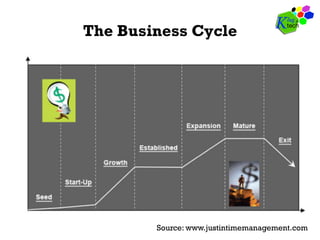
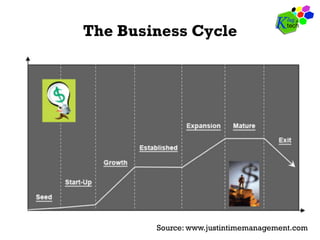
The Business Cycle
Source: www.justintimemanagement.com
Seed Stage
This is when your business is just a thought or an idea.
This is the very conception or birth of a new business.
–  Challenge: Market acceptance and pursue one niche
opportunity.
Do not spread money and time resources too thin..
–  Focus: Match the business opportunity with your skills,
experience and passions.
Other focal points include: deciding on a business
ownership structure, finding professional advisors, and
business planning.
–  Money Sources: You have no proven market or
customers, so the business will rely on cash from owners,
friends and family.
Other potential sources include suppliers, customers,
government grants and banks.
Start-up Stage
Your business is born and now exists legally. Products
or services are in production and you have your first
customers.
–  Challenge: If your business is in the start-up life cycle
stage, it is likely you have overestimated money needs
and the time to market.The main challenge is not to burn
through what little cash you have.You need to learn what
profitable needs your clients have and do a reality check
to see if your business is on the right track.
–  Focus: Start-ups require establishing a customer base
and market presence along with tracking and
conserving cash flow.
–  Money Sources: Owner, friends, family, suppliers,
customers, grants, and banks.
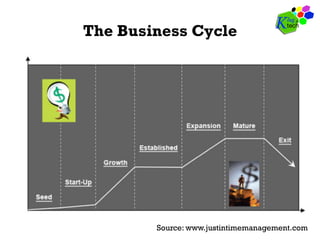
The Business Cycle
Source: www.justintimemanagement.com
Growth Stage
Revenues and customers are increasing with many new
opportunities & issues. Profits are strong, but
competition is surfacing.
–  Challenge: Dealing with the constant range of issues
bidding for more time and money.
Effective management is required and a possible new
business plan.
Learn how to train and delegate to conquer this stage of
development.
–  Focus: Run the business in a more formal fashion to deal
with the increased sales and customers.
Better accounting & management systems will have to be
set-up. New employees will have to be hired to deal with
the influx of business.
–  Money Sources: Banks, profits, partnerships, grants and
leasing options.
Established Stage
Your business has now matured into a thriving
company with a place in the market and loyal
customers. Sales growth is not explosive but
manageable. Business life has become more routine.
–  Challenge: Stay focused on the bigger picture.
Issues like the economy, competitors or changing
customer tastes can quickly end all you have work for.
–  Focus: … on improvement and productivity.
To compete in an established market, you will require
better business practices along with automation and
outsourcing to improve productivity.
–  Money Sources: Profits, banks, investors and
government.
The Business Cycle
Source: www.justintimemanagement.com
Expansion Stage
This provides a new period of growth into new markets
and distribution channels.This stage is often the choice
of the business owner to gain a larger market share and
find new revenue and profit channels.
–  Challenge: Moving into new markets requires the
planning and research of a seed or start-up stage
business.
Focus should be on businesses that complement your
existing experience and capabilities.
Moving into unrelated businesses can be disastrous.
–  Focus: Add new products or services to existing markets
or expand existing business into new markets and
customer types.
–  Money Sources: Joint ventures, banks, licensing, new
investors and partners, profits, banks, investors and
government.
Mature Stage
Year-on-year sales and profits tend to be stable, however
competition remains fierce. Eventually sales start to fall
off and a decision is needed whether to expand or exit
the company.
–  Challenge: Signified by dropping sales, profits, and negative
cash flow.
The biggest issue is how long the business can support a
negative cash flow.
Ask is it time to move back to the expansion stage or move on
to the final life cycle stage...exit.
–  Focus: Search for new opportunities and business ventures.
Cutting costs and finding ways to sustain cash flow are vital for
the mature stage.
–  Money Sources: Suppliers, customers, owners, and banks.
Profits, banks, investors and government.
Exit Stage
This is the big opportunity for your business to cash out on all
the effort and years of hard work. Or it can mean shutting down
the business.
–  Challenge: Selling a business requires your realistic
valuation.
It may have been years of hard work to build the company, but
what is its real value in the current market place.
If you decide to close your business, the challenge is to deal
with the financial and psychological aspects of a business loss.
–  Focus: Get a proper valuation on your company.
Look at your business operations, management and
competitive barriers to make the company worth more to the
buyer.
Set-up legal buy-sell agreements along with a business
transition plan.
–  Money Sources: Find a business valuation partner.
Consult with your accountant and financial advisors for the
best tax strategy to sell or close-out down business.
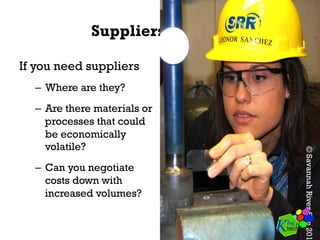
Suppliers
If you need suppliers
–  Where are they?
–  Are there materials or
processes that could
be economically
volatile?
–  Can you negotiate
costs down with
increased volumes?
©SavannahRiverSite201
WHY BOTHER?
You’ve got the idea, know the market… Why not just go?
©DeanHochman2014
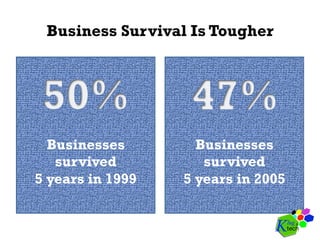
Business Survival Is Tougher
Businesses
survived
5 years in 1999
Businesses
survived
5 years in 2005
PROCESS/SKILLS
What do you need to succeed?
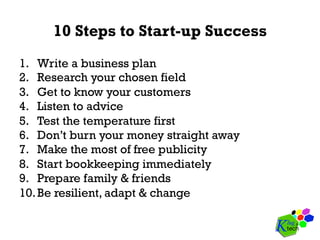
10 Steps to Start-up Success
1.  Write a business plan
2.  Research your chosen field
3.  Get to know your customers
4.  Listen to advice
5.  Test the temperature first
6.  Don’t burn your money straight away
7.  Make the most of free publicity
8.  Start bookkeeping immediately
9.  Prepare family & friends
10. Be resilient, adapt & change
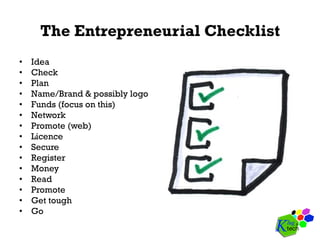
The Entrepreneurial Checklist
•  Idea
•  Check
•  Plan
•  Name/Brand & possibly logo
•  Funds (focus on this)
•  Network
•  Promote (web)
•  Licence
•  Secure
•  Register
•  Money
•  Read
•  Promote
•  Get tough
•  Go
WHERE NEXT?
© ING Nederland 2011
DoYou Have An Idea?
•  It can be an original
innovation
•  Old idea for a new
market
•  Resell someone
else’s product/
service
© Locus Research 2015
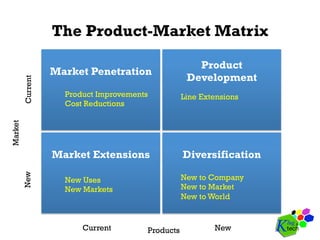
The Product-Market Matrix
Market Penetration
Product
Development
Market Extensions Diversification
Market
CurrentNew
ProductsCurrent New
Product Improvements
Cost Reductions
Line Extensions
New Uses
New Markets
New to Company
New to Market
New to World
Recap
1.  Don’t Try To Do It All
2.  Plan
3.  UnderstandYour Market
4.  Know The Numbers
5.  KnowYour Competition
6.  KnowYour Worth
7.  BuildYour Business Steadily
THANKYOU
Thom Poole
info@klugtech.com
© Dan Englander 2011

Entrepreneur

  • 1.
    Lessons From ASerial Entrepreneur Schools Presentation Thom Poole October 2015© Leo Hidalgo 2013
  • 2.
    Why Believe Me? • Developed small money making enterprises from the age of 9 •  Created my own successful company for over ten years •  Mentored small businesses to phenomenal growth •  Built international start-up brands •  Innovated new products, packaging & systems
  • 3.
    What We WillBe Covering •  The Rules •  Some Considerations •  Why Bother •  Process/Skills •  Where Next? © Paul 2015
  • 4.
  • 5.
    1. Don’t TryTo Do It All •  You may be the best resource in a number of fields •  But not when you juggle •  Partner with others – Mentors & experts – listen to what they advise – Equally committed partners
  • 6.
    2. Plan •  What,Where,When,How,Who,With what,With whom, How much •  Use milestones or checkpoints to monitor progress •  Have ab idea of your end-game
  • 7.
    3. UnderstandYour Market • Set out what you are doing, or offering, who you are offering it to •  Know your customers, their desires & motivations Do not deviate from this unless you (all) agree that it's not working, in which case replan before going forward.
  • 8.
    4. Know TheNumbers •  No excuses – It is your business •  Know what money you have, where its come from, where its going. •  Where can you raise more money. •  Who is buying your products/service & when
  • 9.
    5. KnowYour Competition • Who sells the same, similar or substitute? •  Who has a similar name? •  Is someone doing the same overseas – What are the chances they will challenge you in your markets?
  • 10.
    6. KnowYour Worth • If someone comes in to buy you out - how much is your business really worth? •  Can you prove or back up your valuation?
  • 11.
    7. BuildYour Business • Are you planning to stay small? •  How will you manage growth? •  How will you grow? •  What skillsets are needed at different points in your business lifecycle?
  • 12.
    SOME CONSIDERATIONS The Skills,Determination, Luck of an Entrepreneur ©PaulInkles2011
  • 13.
    The Business Cycle Source:www.justintimemanagement.com
  • 14.
    Seed Stage This iswhen your business is just a thought or an idea. This is the very conception or birth of a new business. –  Challenge: Market acceptance and pursue one niche opportunity. Do not spread money and time resources too thin.. –  Focus: Match the business opportunity with your skills, experience and passions. Other focal points include: deciding on a business ownership structure, finding professional advisors, and business planning. –  Money Sources: You have no proven market or customers, so the business will rely on cash from owners, friends and family. Other potential sources include suppliers, customers, government grants and banks.
  • 15.
    Start-up Stage Your businessis born and now exists legally. Products or services are in production and you have your first customers. –  Challenge: If your business is in the start-up life cycle stage, it is likely you have overestimated money needs and the time to market.The main challenge is not to burn through what little cash you have.You need to learn what profitable needs your clients have and do a reality check to see if your business is on the right track. –  Focus: Start-ups require establishing a customer base and market presence along with tracking and conserving cash flow. –  Money Sources: Owner, friends, family, suppliers, customers, grants, and banks.
  • 16.
    The Business Cycle Source:www.justintimemanagement.com
  • 17.
    Growth Stage Revenues andcustomers are increasing with many new opportunities & issues. Profits are strong, but competition is surfacing. –  Challenge: Dealing with the constant range of issues bidding for more time and money. Effective management is required and a possible new business plan. Learn how to train and delegate to conquer this stage of development. –  Focus: Run the business in a more formal fashion to deal with the increased sales and customers. Better accounting & management systems will have to be set-up. New employees will have to be hired to deal with the influx of business. –  Money Sources: Banks, profits, partnerships, grants and leasing options.
  • 18.
    Established Stage Your businesshas now matured into a thriving company with a place in the market and loyal customers. Sales growth is not explosive but manageable. Business life has become more routine. –  Challenge: Stay focused on the bigger picture. Issues like the economy, competitors or changing customer tastes can quickly end all you have work for. –  Focus: … on improvement and productivity. To compete in an established market, you will require better business practices along with automation and outsourcing to improve productivity. –  Money Sources: Profits, banks, investors and government.
  • 19.
    The Business Cycle Source:www.justintimemanagement.com
  • 20.
    Expansion Stage This providesa new period of growth into new markets and distribution channels.This stage is often the choice of the business owner to gain a larger market share and find new revenue and profit channels. –  Challenge: Moving into new markets requires the planning and research of a seed or start-up stage business. Focus should be on businesses that complement your existing experience and capabilities. Moving into unrelated businesses can be disastrous. –  Focus: Add new products or services to existing markets or expand existing business into new markets and customer types. –  Money Sources: Joint ventures, banks, licensing, new investors and partners, profits, banks, investors and government.
  • 21.
    Mature Stage Year-on-year salesand profits tend to be stable, however competition remains fierce. Eventually sales start to fall off and a decision is needed whether to expand or exit the company. –  Challenge: Signified by dropping sales, profits, and negative cash flow. The biggest issue is how long the business can support a negative cash flow. Ask is it time to move back to the expansion stage or move on to the final life cycle stage...exit. –  Focus: Search for new opportunities and business ventures. Cutting costs and finding ways to sustain cash flow are vital for the mature stage. –  Money Sources: Suppliers, customers, owners, and banks. Profits, banks, investors and government.
  • 22.
    Exit Stage This isthe big opportunity for your business to cash out on all the effort and years of hard work. Or it can mean shutting down the business. –  Challenge: Selling a business requires your realistic valuation. It may have been years of hard work to build the company, but what is its real value in the current market place. If you decide to close your business, the challenge is to deal with the financial and psychological aspects of a business loss. –  Focus: Get a proper valuation on your company. Look at your business operations, management and competitive barriers to make the company worth more to the buyer. Set-up legal buy-sell agreements along with a business transition plan. –  Money Sources: Find a business valuation partner. Consult with your accountant and financial advisors for the best tax strategy to sell or close-out down business.
  • 23.
    Suppliers If you needsuppliers –  Where are they? –  Are there materials or processes that could be economically volatile? –  Can you negotiate costs down with increased volumes? ©SavannahRiverSite201
  • 24.
    WHY BOTHER? You’ve gotthe idea, know the market… Why not just go? ©DeanHochman2014
  • 25.
    Business Survival IsTougher Businesses survived 5 years in 1999 Businesses survived 5 years in 2005
  • 26.
  • 27.
    10 Steps toStart-up Success 1.  Write a business plan 2.  Research your chosen field 3.  Get to know your customers 4.  Listen to advice 5.  Test the temperature first 6.  Don’t burn your money straight away 7.  Make the most of free publicity 8.  Start bookkeeping immediately 9.  Prepare family & friends 10. Be resilient, adapt & change
  • 28.
    The Entrepreneurial Checklist • Idea •  Check •  Plan •  Name/Brand & possibly logo •  Funds (focus on this) •  Network •  Promote (web) •  Licence •  Secure •  Register •  Money •  Read •  Promote •  Get tough •  Go
  • 29.
    WHERE NEXT? © INGNederland 2011
  • 30.
    DoYou Have AnIdea? •  It can be an original innovation •  Old idea for a new market •  Resell someone else’s product/ service © Locus Research 2015
  • 31.
    The Product-Market Matrix MarketPenetration Product Development Market Extensions Diversification Market CurrentNew ProductsCurrent New Product Improvements Cost Reductions Line Extensions New Uses New Markets New to Company New to Market New to World
  • 32.
    Recap 1.  Don’t TryTo Do It All 2.  Plan 3.  UnderstandYour Market 4.  Know The Numbers 5.  KnowYour Competition 6.  KnowYour Worth 7.  BuildYour Business Steadily
  • 33.