Customer Retention How to use digital media & eCRM to get up close and personal with YOUR customers Thom Poole Jonathan Richards September 2007
Agenda Understanding how to integrate digital media & direct marketing Practical methods for identifying & targeting the right customer Testing your offline and online methods Measuring the return on investment Objective setting
Why us? A quick biography of Thom Poole & Jonathan Richards
Thom Poole Web & digital marketing trailblazer since 1992 Taught digital marketing for 9 years  e-Commerce Web design for marketers (and the terrified!) CRM Written papers on ‘Data Privacy’, ‘The Marketing Art of the Opt-in’ and ‘Trust in Business and Marketing’ Written a book on ‘ethical e-marketing’ called ‘Play It By Trust’ Held senior marketing positions at O2, Black & Decker and Hilti Fellow of the Chartered Institute of Marketing & holder of an Individual Charter Standard in Marketing Consultant & business mentor for digital marketing strategy and implementation
Jonathan Richards Set up Centurion Management Systems in 1996 Specialising in business system implementations for mid-cap organisations CRM Human resource Business Intelligence Co-founder of Centurion Marketing Systems in 2000 Specialising in Market research software Has managed systems implementations in UK, USA, South Africa and Australia.
Understanding integration Understanding how to integrate digital media & digital marketing
Definition of Marketing - CIM Marketing is the management process responsible for identifying, anticipating and satisfying customer requirements profitably Customers are at the heart of the process It is the study of the market forces and factors, and the development of a company’s position to optimise its benefit from them
Definition of Marketing - Alternative Marketing is all about  EXPLOITATION ! You learn all about your customers Your products and technologies Your competitors Your economic environment Your customers aspirations, etc, etc And you exploit that  KNOWLEDGE  profitably You give your customers what they want What they think they want What you can convince them they want Thom Poole - 2000
Message alignment Buy This buy this Look here Register here
Communications model A linear model of communication (based on Schramm (1995) and Shannon & Weaver (1962) – from Fill (1999))
Brand identity system A consistent brand identity system should be an early high priority investment because of the impact it can have on your sales and revenue. A brand identity system includes: Conveys that you are trading viably Attracts more clients Increases your credibility Increases “memorability” Enables you to stand out Makes your business look “bigger" Improves your chance of getting venture capital or selling your business Brands your business Explains your company name Endears your company name to your clients Describes an unusual type of business Differentiates you from your competition Meets expectations Demonstrates your commitment and pride in what you do
Layers of your brand Brand foundation Brand vision Brand mission Brand values Brand basics Brand identity Brand content Brand marketing Brand offerings Brand experience Competitor comparison Brand positioning Brand differentiation Internal measures Brand environment Brand promise Brand values External measures Brand awareness Brand gap Brand maintenance Brand alignment Brand management
Characteristics of Successful Brand Identity Uniqueness Repetition Consistency Memorable Meaningful Clarity Honesty Personality Professional Trust
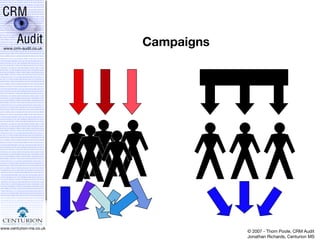
Campaigns
Extreme branding
Integrated campaigns Communication in a cross media environment is becoming a force multiplier in driving the customer relationship Create brand consistency Easier to establish an integrated approach Deliver personalised communication Leverage interactive technology Demonstrate accountability Create customer value
Integrated campaigns – the way to go
O2 Advert © Thom Poole 2005
The relationship Re -la-ti on -sh ip  (r ĭ -l ā ' sh ə n-sh ĭ p') n. The condition or fact of being related; connection or association Connection by blood or marriage; kinship A particular type of connection existing between people related to or having dealings with each other:  has a close relationship with his siblings A romantic or sexual involvement From: www.answers.com
Increase your profits! Customer acquisition Buy in lists, and communicate relevantly Follow up professionally on enquiries Customer retention Provide a relevant relationship Be and remain competitive Understand customer drivers/motivators
Customer churn/defection There are many reasons a customer or client may leave you, but the ones you will hear most often are: Customers felt your pricing was too high or unfair Customers had an unresolved complaint Customers took a competitors offer Customers left because they felt you didn't care
Value for  your  money Before you spend your time and money going after new customers and clients you do not currently
 have a relationship with consider the following statistics: Repeat customers spend 33% more than new customers Referrals among repeat customers are 107% greater than non-customers It costs six times more to sell something to a prospect than to sell that same thing to a customer
Friendship = Trust ‘ People buy from their friends’ Trust builds loyalty  Trust will drive profit Trust-focused value chain (adapted from Porter, 1998), Poole - 2002
Trust lifecycle Time Level of Trust Unaware Build Trust Confirm Trust Maintain Trust Register/Transact/Confirm Consider/Validation/Assess Browse/Search/Compare Trial Threshold Purchase Threshold Habit Threshold Untrust phase Extrinsic Intrinstic Recommendation © Poole (2005), adapted from Reynolds (2000)
Customer centricity Know your customer:  You can ’t  always know each individual customer, but you can segment customers based on common characteristics. The key theme is that each customer has a specific set of needs Align your resources:  What resources are we talking about? Becoming customer-centric includes the alignment of your people and your company ’s  structure, processes, technology, products, and services to the customer Listen and respond:  Most company’s conduct some form of customer satisfaction survey. However, simply administering a survey alone is  not   listening
Resource alignment - 1 Back-office personnel clearly recognise how they impact the customer experience. Everyone is a customer to someone else Back-office personnel detached from the customer Adopting the philosophy: “ T he customer ’s  problem is my problem, and therefore, I will facilitate resolution ” “ N ot my problem ”  syndrome Clear accountability and ownership of the customer Lack of ownership of the customer Measured based on customer success (e.g. satisfaction, retention, revenue, profitability, share of wallet) Measured on individual and departmental productivity (e.g. new revenue, calls answered) Rewarded for customer-centric behaviour. When deviation occurs outside of tolerance or a negative result occurs, coaching takes place to improve employees ’  future decision making Reprimanded for deviating from process Perform against policies and procedures, under-standing that they were designed to enable the customer to do business with you  - n ot meant to be a customer obstacle. When exceptions occur, the objective is to determine how to meet the customer ’s  need and facilitate meeting that need without placing the burden on the customer to figure it out Driven by script with no latitude to deviate on behalf of the customer All personnel are skilled in managing interpersonal relationships Not adept at managing interpersonal relationships Your people have the greatest influence on the customer experience Empower them to delight the customer People & structure Customer-Centric Requirements Realities Plaguing Non-Customer- Centric Companies Principle Resource
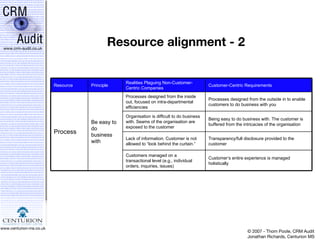
Resource alignment - 2 Customer ’s  entire experience is managed holistically Customers managed on a transactional level (e.g., individual orders, inquiries, issues) Transparency/full disclosure provided to the customer Lack of information. Customer is not allowed to  “l ook behind the curtain. ” Being easy to do business with. The customer is buffered from the intricacies of the organisation Organisation is difficult to do business with. Seams of the organisation are exposed to the customer Processes designed from the outside in to enable customers to do business with you Processes designed from the inside out, focused on intra-departmental efficiencies Be easy to do business with Process Customer-Centric Requirements Realities Plaguing Non-Customer- Centric Companies Principle Resource
Resource alignment - 3 Design the customer experience  “b efore market” Products and services When launching a product or service, the customer experience is  “d esigned ”  in advance The customer experience is considered  “a ftermarket ”  in a reactive manner Needs of existing customers and improving their experiences are the primary driving forces Designed and launched based on features/ functions anticipated to capture  “n ew revenue ”  from  “n ew customers” Implemented to enable customers to do business with you more effectively and efficiently Implemented with a focus on efficiency gains, resulting in obstacles for the customer Implemented to automate improved operating models and processes Implemented in response to business problems, automating existing bad practices Automate effective customer-focused practices Technology Customer-Centric Requirements Realities Plaguing Non-Customer- Centric Companies Principle Resource
The quest for customer-centricity Locate your starting point Customer awareness Customer focus Customer satisfaction Customer value Customer loyalty Determine if your focus is where it should be Establish a baseline Re-assess how you segment and value clients Identify profitable behaviours and the 
factors that promote them Put your face in front of the client Review your roster Flip the hierarchy Strategise and execute Source: www.destinationcrm.com
Customer-centric marketers see a higher ROI The top performers: Track customer behaviour Use customer profitability modelling Maintain centralised knowledge and data management systems Possess real-time decision support, including business intelligence tools integrated with marketing and customer data, with higher frequency than benchmarked groups Source: Aberdeen Group
Exercise List the top 5 customer touch- points with your organisation How effective are they? You have 5 minutes
Exercise 5
Exercise 4
Exercise 3
Exercise 2
Exercise 1
Presentations Please present your findings
Take a break Back in 15 minutes
Practical methods For identifying and targeting the right customer
Customer Relationship Marketing Be relevant to your customers Give your customers a reason to trust you Build a community of customers who you can test ideas on Use/exploit the knowledge you have about your customers Align your organisation behind your relationship
Customer Relationship Management Why? Build and strengthen customer relationships to keep them coming back Provide value-added services that are difficult for competitors to duplicate  Improve product and service delivery processed Increase staff awareness of customer needs Reduce customer frustration by not asking the same questions over and over
Customer Relationships This is a form of marketing that aims to create relationships with a company’s customers It involves a  process  that records all the customer interactions and their outcome Some complex systems can generate millions of lines of information each day It is one thing to collect it, it is another to know what to do with it: HEADLINE:  CRM is dead!
Types of CRM E-CRM Propensity Modelling System Complex ERM System CRM System Contact database Simple rotodex
The three aspects of joined up CRM Operational CRM  - automation of support and customer interactions that include a company’s sales or service processes Collaborative CRM  - direct communication with customers that does not include a company’s sales or service representative (“self service”) Analytical CRM  - analysis of customer data for a broad range of purposes Operational Collaborative Analytical
A word of caution! Too many projects have gone astray by trying to do too much too soon.
CRM selection Have a CRM strategy because CRM initiatives launched without a strategy invariably cause pain Choose the right CRM partner Understand the technology Focus more on business processes than technology Don ’t  try and design the perfect CRM system that will meet 100% of each and every person ’s  wish list Do not try to change the whole organisation overnight Think about the user interface and plan it carefully Get help and expect to pay for CRM system implementation Make it somebody ’s  responsibility to own the data, and to make sure that it is correct and complete User acceptance is the single most important success factor for a CRM system so invest in training Source: E-CRM Solutions Ltd (www.e-crm.co.uk )
Data collection Know what you know
What do you want to know? Are you attracting new customers What is the health of your lead qualification process How proficient is your conversion to buyers Does your marketing encourage purchase What behaviour indicates that a prospect is ready to buy How do customer segments differ What attributes describe your best customers How can they help you target other prospects How can profiling help you cross-sell and up-sell What is your churn rate How do you measure loyalty Sterne, J. WebMetrics. 2002 pp29
Know what you know! Most organisations already know their customers well They just don’t make the most of it! They are already doing business with them, so they have started to understand the customer Need to consolidate what is already known Fill in the gaps
Know what you know! Start with the basics Data provided by customer Transactional data Third party data
Know what you know! Data provided by the Customer Name & Address Telephone Numbers What ever you have asked them!
Examples of customer data Company Individual
Examples of customer data
Know what you know! Transaction and interaction Inquiries, Purchases, Service requests Web visits
Examples of transactional data Problem resolution Sales opportunities
Examples of transactional data Accounting data
Know what you know! Third party data e.g. Profile E.g. Turnover, number of employees Credit rating Demographics
Examples of 3 rd  party data
How to collect data On the fly Customer facing staff Transaction systems Web visits Periodic updates Customer surveys Credit checking Segmentation of customers
Examples of collecting data Web forms Workflow key tasks
Know what you know! When to collect and analyse data? Often  never  done Do it  once  for a bit of an insight Do it  occasionally  to continue learning Ideal is to do this  continuously
What next? Data mining “ the nontrivial extraction of implicit, previously unknown, and potentially useful information from data” “ the science of extracting useful information from large data sets or databases” Source: Wikipedia
Data mining In layman’s terms: Data mining involves sorting through large amounts of data and picking out relevant information. Data mining identifies trends within data that go beyond simple analysis. Users have the ability to identify key attributes of business processes and target opportunities.
Data mining Data facts, numbers, or text Information The patterns, associations, or relationships among all this  data  can provide  information Knowledge Information can be converted into  knowledge  about historical patterns and future trends
Data mining - example US grocery chain used buying patterns to discover: When men bought “diapers” on Thursday’s and Saturdays they tended to buy beer These shoppers tended to do the weekly grocery shop on Saturdays On Thursday’s they bought fewer items Conclusion - beer was bought for weekends
Data mining - example Possible uses Increase revenue by moving beer display closer to diapers Make sure beer and diapers are sold at full price on Thursdays
Data mining - tools Advanced reporting tools – many software products have these built in. Business intelligence tools – have been expensive and hard to use but getting better. Data Mining specific – often little more that BI. Choice depends on how much you want the tool to do for you? Microsoft Excel – now has conditional formatting
Data mining - example
Data modelling Demographic profiling Behavioural segmentation Lifetime value modelling Churn modelling Propensity modelling Basket analysis Brand profiling
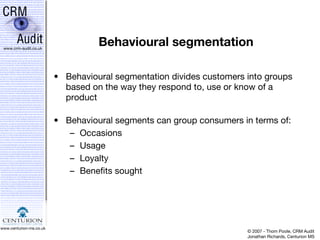
Behavioural segmentation Behavioural segmentation divides customers into groups based on the way they respond to, use or know of a product Behavioural segments can group consumers in terms of: Occasions Usage Loyalty Benefits sought
Behavioural segmentation Behavioural segmentation  identifies consumption rates of a product or service as a means of segmenting markets. For instance customers of a local leisure centre may be classified as: Frequent users (Daily visits) Less frequent users (At least once a week) Users ( Occasional visits) Non users.  I f a company can identify the characteristics of frequent users (they may live in a certain area and have other common features such as income) they can target those segments in order to increase the number of frequent users
Propensity modelling Propensity models help you to maximise  Return on Investment  by targeting the most suitable audience Fundamentally, propensity models allow you to score customers or prospects according to their likelihood to undertake a given action,  f or example; l ikelihood to become a customer likelihood to buy again likelihood to lapse l ikelihood to take up a new service
Propensity modelling Who will buy a product? Who will repay a loan? Who will display any particular behaviour with a commercial value? This type of modelling looks at choosing and modifing predictors, how to score (and re-score) individuals in a large database, how to validate and maintain your models, how to deal with the biases that can arise through repeated use of the models, how to exploit fully the opportunities (and challenges) that arise when data is available on very large numbers of customers
Propensity modelling What is prospect scoring? Prospect scoring is simply the scoring of prospects (customers you ’d  like to do business with) according to their potential value to your business. It is used for prioritising sales leads and other marketing activities e.g. media spend allocation Does it matter? Imagine an upmarket department store, aiming to boost sales of bathroom accessories, offering a free bathroom planning service. The demand for this service might quickly exceed available service capacity
Propensity modelling - example Does it matter? The store has several ways to address the problem: Stop the service - this could alienate those prospects that would have taken advantage of it, leading to lower sales Charge for the service - this might work but might not be competitively viable Prioritise the service  -  by offering the service to customers most likely to spend a high amount on the bathroom accessories following the free service, as opposed to those who might use the service and then buy somewhere cheaper
Propensity modelling - levels Prospect scoring can be achieved on three different levels: Intuitive : Niche organisations often know and understand their customers and prospects without formal profiling Simple segmentation : A single-use model is used for a specific campaign or task and is based on either a simple geo-demographic system or on basic modelling such as campaign response modelling (comparing responders to non-responders) Complete analytical framework : This involves an integrated approach where initial analysis of customers is the basis for an analytical framework, created by overlaying customer knowledge onto the prospecting process. The model is constantly updated as new factors influence the behaviour and nature of customers
Customer value What is Value? Value is not only a combination of revenue, sales and/or profit. It includes a very important aspect of any marketing relationship, that of potential. What is the real customer potential?
Case study - Issue In January 1999, after extensive TV and press advertising campaigns and a number of similar products have appeared from rival providers and so it is essential that Standard Life Bank can both consolidate and then continue to expand its share of the mortgage market. To achieve these aims the company's goals are: to identify the key attributes of clients attracted to the mortgage offer to cross sell products to the clients of other companies in the Standard Life group to develop a remortgage model which could be deployed on the group website to examine the profitability of the mortgage business being accepted by Standard Life Bank A major part of the project was to develop models that might be successful in identifying customer characteristics relevant to any mortgage product
Case study - solution Using SPSS data mining capabilities, Standard Life can address a growing number of projects enabling them to deliver better value to their customers They were able to build a propensity model for the remortgage offer showing the types of client attracted to this product This model would be easily portable and applicable to other client databases within the Standard Life group Using the propensity models, a remortgage mailing campaign was planned and executed by the Customer Data Analysis team in conjunction with Standard Life Bank The mailing included a randomly selected control cell. The model allowed the bank to focus their efforts on the best prospects for the remortgage product and create scores for each customer These scores allowed them to achieve more targeted direct mail and to score prospects with similar characteristics accessing the website
Case study - results Overall the data mining exercises undertaken enabled Standard Life to better understand the characteristics of their mortgage clients so they can more easily search for potential new clients with these characteristics They also have the capability to profile incoming prospects quickly and personalise their web experience accordingly Amongst the results that made a real difference to the business were that they: Built a propensity model for the Standard Life Bank mortgage offer identifying key customer types that can be applied across the whole group prospect pool Discovered the key drivers for purchasing a remortgage product Achieved with the model, a nine times greater response than that achieved by the control group Secured  £3 3million worth of mortgage application revenue
Break for Lunch Back promptly in an hour, please
Segmentation Dividing your market up
How to approach segmentation Step 1 : Ensure that the segmentation is directly linked to what drives value to the business Step 2 : Producing a clear and reliable segmentation Step 3 : Tailor the outputs to make the segmentation clear and useful Step 4 : Make strategic recommendations to make the segmentation practical and immediately actionable
Why segment? In a ‘global’ village of 100 people… 57 would be Asian 21 European 14 American (North & South) 8 African. 52 would be women 70 would not be ‘white’ 70 would not be Christian 89 heterosexuals • 6 people would own 59% of the wealth, and all 6 from the US • 80 would be below the poverty line • 70 would be illiterate • 50 under nourished • 1 would die • 2 would be born • 1 have a PC • 1 have an academic qualification Would you want to talk to everyone?
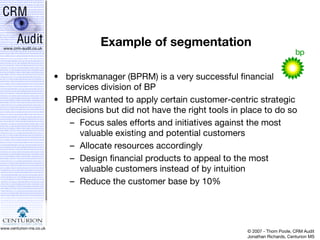
Example of segmentation bpriskmanager (BPRM) is a very successful financial services division of BP BPRM wanted to apply certain customer-centric strategic decisions but did not have the right tools in place to do so Focus sales efforts and initiatives against the most valuable existing and potential customers Allocate resources accordingly Design financial products to appeal to the most valuable customers instead of by intuition Reduce the customer base by 10%
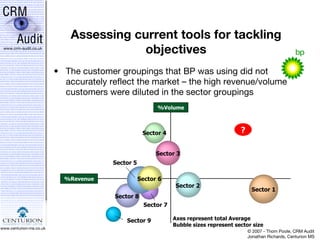
Assessing current tools for tackling objectives The customer groupings that BP was using did not accurately reflect the market – the high revenue/volume customers were diluted in the sector groupings ? Axes represent total Average Bubble sizes represent sector size Sector 7 Sector 9 Sector 8 Sector 5 Sector 6 Sector 4 Sector 3 Sector 1 Sector 2 %Volume %Revenue
Determining customer behaviours By interviewing key stakeholders within BP we identified all these customer attributes that make them valuable to BP We used BP’s CRM system to find and derive the variables that best reflected all the value drivers identified VALUE DRIVERS SEGMENTATION VARIABLES REVENUE & VOLUME BUSINESS TO OTHER DIVISIONS CUSTOMER MAINTENANCE CUSTOMER SOPHISTICATION CUSTOMER CREDITWORTHINESS Deal commission per customer Contacts per customer Deals per customer Credit rating CUSTOMER LOYALTY Volume traded per customer Sophistication index
Plotting segments Margin Lucratives (1%) Risky Volume Drivers (2%) Demanding Savvies (9%) Moderates (5%) Occasional Savvies (13%) Risky Occasionals (33%) Safe Occasionals (29%) Safe Low Traders (6%) И Axes represent all customer average Bubble sizes represent segment size 3 6 9 12 150 400 Spend per Customer 4,000 Volume per Customer
Segmentational analysis The segmentation that was based on all value drivers produced eight robust and distinct segments of BP customers with customers across sectors, regions and using a variety of products Margin Lucratives Risky Volume Drivers Demanding Savvies Moderates Occasional Savvies Risky Occasionals Safe Occasionals Safe Low Traders % of customers
The net worth of each segment 9% 19% 28% 5% 6% 11% 13% 4% 10% 33% 12% 16% 29% 8% 11% 6% 5% 40% 1% 9% 18% 2% 2% 2% Segment Size Spend Volume Safe Low Traders Safe Occasionals Risky Occasionals Occasional Savvies Moderates Demanding Savvies Risky Volume Drivers Margin Lucratives
Segmentation – an ongoing process With any segmentation project you come up with a snapshot analysis Use CRM system to capture variables and assign customers to segments User CRM sysrem to target based on segments Need to revisit segment definitions periodically to ensure still valid.
One to one customer needs At the heart of all e-CRM systems lives a knowledge base with a knowledge-management application. A knowledge base is an electronic collection of information that can be queried for answers to various questions. To understand personalisation technologies, one need only look at Amazon.com. They are well known for tailoring its product promotions to customers based on their stated individual preferences or previous buying habits Personalisation enables Amazon.com to “individualise” its offerings, meaning customers who specify an interest in books about Italian cuisine aren't bombarded with indiscriminate promotional e-mails about skydiving, mineralogy or other topics that aren't relevant to them
Amazon
Example of e-CRM
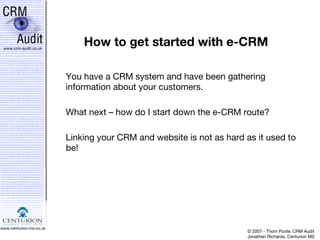
How to get started with e-CRM You have a CRM system and have been gathering information about your customers. What next – how do I start down the e-CRM route? Linking your CRM and website is not as hard as it used to be!
e-CRM example 1 Prospect fills out a form on your website and receives a ‘thank-you – we will be in touch shortly’ e-mail.
The form contents are automatically added to your CRM system e-CRM example 1
e-CRM example 1 A workflow process kicks in to allocate the lead to the most appropriate sales resource
e-CRM example 1 The salesman sees the lead on his opportunity pipeline
e-CRM example 2 Simon buys your product and can see all issues being dealt with by the support team on your website.
e-CRM example 2 The support team can view Simon’s cases against his record or their own ‘My CRM’
Exercise List the key information your business needs to sell/support customers effectively Approx. 10 points You have 15 minutes
Exercise 15 Going Home Mark Knopfler
Exercise 14 Going Home Mark Knopfler
Exercise 13 Going Home Mark Knopfler
Exercise 12 Going Home Mark Knopfler
Exercise 11 Going Home Mark Knopfler
Exercise 10 Hymn by Barclay James Harvest
Exercise 9 Hymn by Barclay James Harvest
Exercise 8 Hymn by Barclay James Harvest
Exercise 7 Hymn by Barclay James Harvest
Exercise 6 Hymn by Barclay James Harvest
Exercise 5 Hymn by Barclay James Harvest
Exercise 4 Heartbeats by Jose Gonzalez
Exercise 3 Heartbeats by Jose Gonzalez
Exercise 2 Heartbeats by Jose Gonzalez
Exercise 1 Heartbeats by Jose Gonzalez
Presentations Please present your findings
Testing Testing your methods, on- and offline
Difference between on- and offline Speed to market and of reaction Low cost A/B testing opportunities Increased reach Competitor analysis & research Partner/affiliate interface
Taking offline customers online Cheaper to service More personalisation Faster transactions (less chance of churn) Integrated approach www.domain.x/tube www.domain.x/tv
Measurement/tracking Using web metrics, you can track what is happening online Web metrics are often anonymous, but… Link outbound campaigns to your CRM & track your actual customers How often do they respond? What is their personal ROI? Do you want to keep them?
Online testing Use your e-CRM system to personalise every digital touchpoint Use A/B testing to find out which methods/media work best for each customer/segment Use control groups, effectively Monitor each method/technique for replication/ replacement
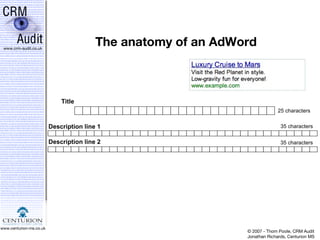
Google AdWords Very useful for A/B testing Very direct advertising method You only pay for results, so less waste Anonymous, but tracking/personalisation is possible This is an artform in its own right
The anatomy of an AdWord Title 25 characters Description line 1 Description line 2 35 characters 35 characters
Exercise Develop an AdWords campaign for one of your target audiences Use the template in your slide pack You have 10 minutes
Exercise 10 Pra Manha Da Lata
Exercise 9 Pra Manha Da Lata
Exercise 8 Pra Manha Da Lata
Exercise 7 Pra Manha Da Lata
Exercise 6 Pra Manha Da Lata
Exercise 5 Pra Manha Da Lata
Exercise 4 Pra Manha Da Lata
Exercise 3
Exercise 2
Exercise 1
Campaign segmentation Segment by: Keywords Territory Time Message Landing page
Let’s take a break Back in 15 minutes
Measuring your Return on Investment You are in business to make money
Basic marketing metrics Increase marketing ROI Decrease campaign overheads Maximise the lifetime value of the customer Improve customer interactions with the campaign
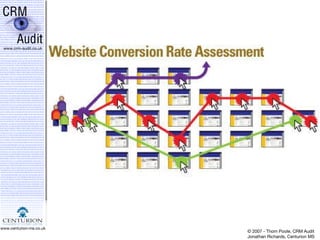
Website metrics Unique visitors Pages viewed Duration of visit Key customer journeys Conversion funnel
Web analytics applications With functional reporting for each department, from marketing to merchandising to business analysis, you can answer the questions that are most important to the overall e-business as well as each department: Get the most out of your Web 2.0 Optimise the online experience Identify which content, channels, partners and campaigns drive conversion Customise reports for the way you do business  Drive adoption across the enterprise  Easily schedule emailed reports  Optimise conversion for each page, path, and scenario on your site Run your business by the numbers


Forrester Research Web Analytics Providers
Identifying the most valuable clients  How do you identify your most valuable customers Part of the segmentation process Typical metrics: Past Customer Revenue Past Customer Value
Identifying the most valuable clients A better measure is Customer Lifetime Value (CLV) Forward looking picture However: This is a complex subject Many different ways to calculate
Customer Lifetime Value (CLV) Knowing the Lifetime Value of your customers is crucial to you and your business as it serves as a benchmark without which you'll be groping in the dark When you realise that customers are actually an ongoing stream of revenue as opposed to a one-shot sale, you can re-focus your marketing efforts
Customer Lifetime Value Most models contain the following factors: Churn rate  - The percentage of customers who end their relationship with a company in a given time period.  Discount rate  - The cost of capital used to discount future revenue from a customer.  Retention cost -  How much a company has to spend to retain an existing customer. Time period Periodic Revenue  - Revenue collected from a customer in the time period.  Profit Margin  - Profit as a percentage of revenue
Customer Lifetime Value Consider the type of relationship with your customers Contractual relationships – once gone they are ‘lost for good’ Migration relationships - where a customer not buying now might do so in the future
The Power of Customer Lifetime Value  Viewing a company as a portfolio of current and future customer relationships can provide many insightful perspectives. One is on how to nurture customer relationships – and which ones to nurture.  Such opportunities could be classified into three areas:  For current customers that are creating value:  Increase profitability and/or  Increase volume and/or  Increase duration  For current customers that are value-destroying:  Quickly achieve a value-creating relationship or  End relationship if all else fails  For potentially value-creating customers not currently served:  Identify  Acquire at a reasonable cost
Quantifying the CLV
Integrating sales and financial
E-mail campaigns Targeting  - 600% difference between best & worst lists Incentives  - 400% difference between best & worst Creative  - 35% difference between best & worst Response device  - 15% difference between best & worst Timing  - 10% difference between the best & worst
E-mail marketing lifecycle E-mails sent E-mails opened E-mails with Click-through responses E-mails forwarded E-mails bounced E-mails unsubscribed
E-mail delivery metrics Open Rate Click Through Rate Gross  Click Rate (Total Clicks/Total Delivered) Unique  Click Rate (Unique Clicks/Total Delivered) Click to Open Rate (Unique Clicks/ Total Opened) Click to Purchase/Conversion Reach
Why people unsubscribe The e-mail address collector may have collected the address under false pretences Your message may have been inartfully sent to the wrong list Your content is no longer relevant to the recipient Your content sucks!
Link to a web page Have a separate page for each content line in your e-mail Track what works well Use the tracking information to sell advertising/ sponsorship Use the tracking to define new content
 
SMS tracking SMS sent SMS received/opened SMS replies SMS bounces SMS unsubscribes SMS location of opens (if you can get the information from the network operators)
Uses of SMS Appointments Warnings Location based promotions Immediate gratification promotions …
A word of warning Combining CRM and identified web metrics can lead to a feeling of Big Brother Getting over familiar can worry your customers Use all the media & media tracking at your disposal, but remember that different departments send messages to the SAME customer - can lead to overkill
Q & A Any questions as we finish?
Thank you Thank you for your patience, interest and input. Thom Poole -  [email_address] Jonathan Richards -  [email_address]

Customer Retention

  • 1.
    Customer Retention Howto use digital media & eCRM to get up close and personal with YOUR customers Thom Poole Jonathan Richards September 2007
  • 2.
    Agenda Understanding howto integrate digital media & direct marketing Practical methods for identifying & targeting the right customer Testing your offline and online methods Measuring the return on investment Objective setting
  • 3.
    Why us? Aquick biography of Thom Poole & Jonathan Richards
  • 4.
    Thom Poole Web& digital marketing trailblazer since 1992 Taught digital marketing for 9 years e-Commerce Web design for marketers (and the terrified!) CRM Written papers on ‘Data Privacy’, ‘The Marketing Art of the Opt-in’ and ‘Trust in Business and Marketing’ Written a book on ‘ethical e-marketing’ called ‘Play It By Trust’ Held senior marketing positions at O2, Black & Decker and Hilti Fellow of the Chartered Institute of Marketing & holder of an Individual Charter Standard in Marketing Consultant & business mentor for digital marketing strategy and implementation
  • 5.
    Jonathan Richards Setup Centurion Management Systems in 1996 Specialising in business system implementations for mid-cap organisations CRM Human resource Business Intelligence Co-founder of Centurion Marketing Systems in 2000 Specialising in Market research software Has managed systems implementations in UK, USA, South Africa and Australia.
  • 6.
    Understanding integration Understandinghow to integrate digital media & digital marketing
  • 7.
    Definition of Marketing- CIM Marketing is the management process responsible for identifying, anticipating and satisfying customer requirements profitably Customers are at the heart of the process It is the study of the market forces and factors, and the development of a company’s position to optimise its benefit from them
  • 8.
    Definition of Marketing- Alternative Marketing is all about EXPLOITATION ! You learn all about your customers Your products and technologies Your competitors Your economic environment Your customers aspirations, etc, etc And you exploit that KNOWLEDGE profitably You give your customers what they want What they think they want What you can convince them they want Thom Poole - 2000
  • 9.
    Message alignment BuyThis buy this Look here Register here
  • 10.
    Communications model Alinear model of communication (based on Schramm (1995) and Shannon & Weaver (1962) – from Fill (1999))
  • 11.
    Brand identity systemA consistent brand identity system should be an early high priority investment because of the impact it can have on your sales and revenue. A brand identity system includes: Conveys that you are trading viably Attracts more clients Increases your credibility Increases “memorability” Enables you to stand out Makes your business look “bigger" Improves your chance of getting venture capital or selling your business Brands your business Explains your company name Endears your company name to your clients Describes an unusual type of business Differentiates you from your competition Meets expectations Demonstrates your commitment and pride in what you do
  • 12.
    Layers of yourbrand Brand foundation Brand vision Brand mission Brand values Brand basics Brand identity Brand content Brand marketing Brand offerings Brand experience Competitor comparison Brand positioning Brand differentiation Internal measures Brand environment Brand promise Brand values External measures Brand awareness Brand gap Brand maintenance Brand alignment Brand management
  • 13.
    Characteristics of SuccessfulBrand Identity Uniqueness Repetition Consistency Memorable Meaningful Clarity Honesty Personality Professional Trust
  • 14.
  • 15.
  • 16.
    Integrated campaigns Communicationin a cross media environment is becoming a force multiplier in driving the customer relationship Create brand consistency Easier to establish an integrated approach Deliver personalised communication Leverage interactive technology Demonstrate accountability Create customer value
  • 17.
  • 18.
    O2 Advert ©Thom Poole 2005
  • 19.
    The relationship Re-la-ti on -sh ip (r ĭ -l ā ' sh ə n-sh ĭ p') n. The condition or fact of being related; connection or association Connection by blood or marriage; kinship A particular type of connection existing between people related to or having dealings with each other: has a close relationship with his siblings A romantic or sexual involvement From: www.answers.com
  • 20.
    Increase your profits!Customer acquisition Buy in lists, and communicate relevantly Follow up professionally on enquiries Customer retention Provide a relevant relationship Be and remain competitive Understand customer drivers/motivators
  • 21.
    Customer churn/defection Thereare many reasons a customer or client may leave you, but the ones you will hear most often are: Customers felt your pricing was too high or unfair Customers had an unresolved complaint Customers took a competitors offer Customers left because they felt you didn't care
  • 22.
    Value for your money Before you spend your time and money going after new customers and clients you do not currently
 have a relationship with consider the following statistics: Repeat customers spend 33% more than new customers Referrals among repeat customers are 107% greater than non-customers It costs six times more to sell something to a prospect than to sell that same thing to a customer
  • 23.
    Friendship = Trust‘ People buy from their friends’ Trust builds loyalty Trust will drive profit Trust-focused value chain (adapted from Porter, 1998), Poole - 2002
  • 24.
    Trust lifecycle TimeLevel of Trust Unaware Build Trust Confirm Trust Maintain Trust Register/Transact/Confirm Consider/Validation/Assess Browse/Search/Compare Trial Threshold Purchase Threshold Habit Threshold Untrust phase Extrinsic Intrinstic Recommendation © Poole (2005), adapted from Reynolds (2000)
  • 25.
    Customer centricity Knowyour customer: You can ’t always know each individual customer, but you can segment customers based on common characteristics. The key theme is that each customer has a specific set of needs Align your resources: What resources are we talking about? Becoming customer-centric includes the alignment of your people and your company ’s structure, processes, technology, products, and services to the customer Listen and respond: Most company’s conduct some form of customer satisfaction survey. However, simply administering a survey alone is not listening
  • 26.
    Resource alignment -1 Back-office personnel clearly recognise how they impact the customer experience. Everyone is a customer to someone else Back-office personnel detached from the customer Adopting the philosophy: “ T he customer ’s problem is my problem, and therefore, I will facilitate resolution ” “ N ot my problem ” syndrome Clear accountability and ownership of the customer Lack of ownership of the customer Measured based on customer success (e.g. satisfaction, retention, revenue, profitability, share of wallet) Measured on individual and departmental productivity (e.g. new revenue, calls answered) Rewarded for customer-centric behaviour. When deviation occurs outside of tolerance or a negative result occurs, coaching takes place to improve employees ’ future decision making Reprimanded for deviating from process Perform against policies and procedures, under-standing that they were designed to enable the customer to do business with you - n ot meant to be a customer obstacle. When exceptions occur, the objective is to determine how to meet the customer ’s need and facilitate meeting that need without placing the burden on the customer to figure it out Driven by script with no latitude to deviate on behalf of the customer All personnel are skilled in managing interpersonal relationships Not adept at managing interpersonal relationships Your people have the greatest influence on the customer experience Empower them to delight the customer People & structure Customer-Centric Requirements Realities Plaguing Non-Customer- Centric Companies Principle Resource
  • 27.
    Resource alignment -2 Customer ’s entire experience is managed holistically Customers managed on a transactional level (e.g., individual orders, inquiries, issues) Transparency/full disclosure provided to the customer Lack of information. Customer is not allowed to “l ook behind the curtain. ” Being easy to do business with. The customer is buffered from the intricacies of the organisation Organisation is difficult to do business with. Seams of the organisation are exposed to the customer Processes designed from the outside in to enable customers to do business with you Processes designed from the inside out, focused on intra-departmental efficiencies Be easy to do business with Process Customer-Centric Requirements Realities Plaguing Non-Customer- Centric Companies Principle Resource
  • 28.
    Resource alignment -3 Design the customer experience “b efore market” Products and services When launching a product or service, the customer experience is “d esigned ” in advance The customer experience is considered “a ftermarket ” in a reactive manner Needs of existing customers and improving their experiences are the primary driving forces Designed and launched based on features/ functions anticipated to capture “n ew revenue ” from “n ew customers” Implemented to enable customers to do business with you more effectively and efficiently Implemented with a focus on efficiency gains, resulting in obstacles for the customer Implemented to automate improved operating models and processes Implemented in response to business problems, automating existing bad practices Automate effective customer-focused practices Technology Customer-Centric Requirements Realities Plaguing Non-Customer- Centric Companies Principle Resource
  • 29.
    The quest forcustomer-centricity Locate your starting point Customer awareness Customer focus Customer satisfaction Customer value Customer loyalty Determine if your focus is where it should be Establish a baseline Re-assess how you segment and value clients Identify profitable behaviours and the 
factors that promote them Put your face in front of the client Review your roster Flip the hierarchy Strategise and execute Source: www.destinationcrm.com
  • 30.
    Customer-centric marketers seea higher ROI The top performers: Track customer behaviour Use customer profitability modelling Maintain centralised knowledge and data management systems Possess real-time decision support, including business intelligence tools integrated with marketing and customer data, with higher frequency than benchmarked groups Source: Aberdeen Group
  • 31.
    Exercise List thetop 5 customer touch- points with your organisation How effective are they? You have 5 minutes
  • 32.
  • 33.
  • 34.
  • 35.
  • 36.
  • 37.
  • 38.
    Take a breakBack in 15 minutes
  • 39.
    Practical methods Foridentifying and targeting the right customer
  • 40.
    Customer Relationship MarketingBe relevant to your customers Give your customers a reason to trust you Build a community of customers who you can test ideas on Use/exploit the knowledge you have about your customers Align your organisation behind your relationship
  • 41.
    Customer Relationship ManagementWhy? Build and strengthen customer relationships to keep them coming back Provide value-added services that are difficult for competitors to duplicate Improve product and service delivery processed Increase staff awareness of customer needs Reduce customer frustration by not asking the same questions over and over
  • 42.
    Customer Relationships Thisis a form of marketing that aims to create relationships with a company’s customers It involves a process that records all the customer interactions and their outcome Some complex systems can generate millions of lines of information each day It is one thing to collect it, it is another to know what to do with it: HEADLINE: CRM is dead!
  • 43.
    Types of CRME-CRM Propensity Modelling System Complex ERM System CRM System Contact database Simple rotodex
  • 44.
    The three aspectsof joined up CRM Operational CRM - automation of support and customer interactions that include a company’s sales or service processes Collaborative CRM - direct communication with customers that does not include a company’s sales or service representative (“self service”) Analytical CRM - analysis of customer data for a broad range of purposes Operational Collaborative Analytical
  • 45.
    A word ofcaution! Too many projects have gone astray by trying to do too much too soon.
  • 46.
    CRM selection Havea CRM strategy because CRM initiatives launched without a strategy invariably cause pain Choose the right CRM partner Understand the technology Focus more on business processes than technology Don ’t try and design the perfect CRM system that will meet 100% of each and every person ’s wish list Do not try to change the whole organisation overnight Think about the user interface and plan it carefully Get help and expect to pay for CRM system implementation Make it somebody ’s responsibility to own the data, and to make sure that it is correct and complete User acceptance is the single most important success factor for a CRM system so invest in training Source: E-CRM Solutions Ltd (www.e-crm.co.uk )
  • 47.
    Data collection Knowwhat you know
  • 48.
    What do youwant to know? Are you attracting new customers What is the health of your lead qualification process How proficient is your conversion to buyers Does your marketing encourage purchase What behaviour indicates that a prospect is ready to buy How do customer segments differ What attributes describe your best customers How can they help you target other prospects How can profiling help you cross-sell and up-sell What is your churn rate How do you measure loyalty Sterne, J. WebMetrics. 2002 pp29
  • 49.
    Know what youknow! Most organisations already know their customers well They just don’t make the most of it! They are already doing business with them, so they have started to understand the customer Need to consolidate what is already known Fill in the gaps
  • 50.
    Know what youknow! Start with the basics Data provided by customer Transactional data Third party data
  • 51.
    Know what youknow! Data provided by the Customer Name & Address Telephone Numbers What ever you have asked them!
  • 52.
    Examples of customerdata Company Individual
  • 53.
  • 54.
    Know what youknow! Transaction and interaction Inquiries, Purchases, Service requests Web visits
  • 55.
    Examples of transactionaldata Problem resolution Sales opportunities
  • 56.
    Examples of transactionaldata Accounting data
  • 57.
    Know what youknow! Third party data e.g. Profile E.g. Turnover, number of employees Credit rating Demographics
  • 58.
    Examples of 3rd party data
  • 59.
    How to collectdata On the fly Customer facing staff Transaction systems Web visits Periodic updates Customer surveys Credit checking Segmentation of customers
  • 60.
    Examples of collectingdata Web forms Workflow key tasks
  • 61.
    Know what youknow! When to collect and analyse data? Often never done Do it once for a bit of an insight Do it occasionally to continue learning Ideal is to do this continuously
  • 62.
    What next? Datamining “ the nontrivial extraction of implicit, previously unknown, and potentially useful information from data” “ the science of extracting useful information from large data sets or databases” Source: Wikipedia
  • 63.
    Data mining Inlayman’s terms: Data mining involves sorting through large amounts of data and picking out relevant information. Data mining identifies trends within data that go beyond simple analysis. Users have the ability to identify key attributes of business processes and target opportunities.
  • 64.
    Data mining Datafacts, numbers, or text Information The patterns, associations, or relationships among all this data can provide information Knowledge Information can be converted into knowledge about historical patterns and future trends
  • 65.
    Data mining -example US grocery chain used buying patterns to discover: When men bought “diapers” on Thursday’s and Saturdays they tended to buy beer These shoppers tended to do the weekly grocery shop on Saturdays On Thursday’s they bought fewer items Conclusion - beer was bought for weekends
  • 66.
    Data mining -example Possible uses Increase revenue by moving beer display closer to diapers Make sure beer and diapers are sold at full price on Thursdays
  • 67.
    Data mining -tools Advanced reporting tools – many software products have these built in. Business intelligence tools – have been expensive and hard to use but getting better. Data Mining specific – often little more that BI. Choice depends on how much you want the tool to do for you? Microsoft Excel – now has conditional formatting
  • 68.
  • 69.
    Data modelling Demographicprofiling Behavioural segmentation Lifetime value modelling Churn modelling Propensity modelling Basket analysis Brand profiling
  • 70.
    Behavioural segmentation Behaviouralsegmentation divides customers into groups based on the way they respond to, use or know of a product Behavioural segments can group consumers in terms of: Occasions Usage Loyalty Benefits sought
  • 71.
    Behavioural segmentation Behaviouralsegmentation identifies consumption rates of a product or service as a means of segmenting markets. For instance customers of a local leisure centre may be classified as: Frequent users (Daily visits) Less frequent users (At least once a week) Users ( Occasional visits) Non users. I f a company can identify the characteristics of frequent users (they may live in a certain area and have other common features such as income) they can target those segments in order to increase the number of frequent users
  • 72.
    Propensity modelling Propensitymodels help you to maximise Return on Investment by targeting the most suitable audience Fundamentally, propensity models allow you to score customers or prospects according to their likelihood to undertake a given action, f or example; l ikelihood to become a customer likelihood to buy again likelihood to lapse l ikelihood to take up a new service
  • 73.
    Propensity modelling Whowill buy a product? Who will repay a loan? Who will display any particular behaviour with a commercial value? This type of modelling looks at choosing and modifing predictors, how to score (and re-score) individuals in a large database, how to validate and maintain your models, how to deal with the biases that can arise through repeated use of the models, how to exploit fully the opportunities (and challenges) that arise when data is available on very large numbers of customers
  • 74.
    Propensity modelling Whatis prospect scoring? Prospect scoring is simply the scoring of prospects (customers you ’d like to do business with) according to their potential value to your business. It is used for prioritising sales leads and other marketing activities e.g. media spend allocation Does it matter? Imagine an upmarket department store, aiming to boost sales of bathroom accessories, offering a free bathroom planning service. The demand for this service might quickly exceed available service capacity
  • 75.
    Propensity modelling -example Does it matter? The store has several ways to address the problem: Stop the service - this could alienate those prospects that would have taken advantage of it, leading to lower sales Charge for the service - this might work but might not be competitively viable Prioritise the service - by offering the service to customers most likely to spend a high amount on the bathroom accessories following the free service, as opposed to those who might use the service and then buy somewhere cheaper
  • 76.
    Propensity modelling -levels Prospect scoring can be achieved on three different levels: Intuitive : Niche organisations often know and understand their customers and prospects without formal profiling Simple segmentation : A single-use model is used for a specific campaign or task and is based on either a simple geo-demographic system or on basic modelling such as campaign response modelling (comparing responders to non-responders) Complete analytical framework : This involves an integrated approach where initial analysis of customers is the basis for an analytical framework, created by overlaying customer knowledge onto the prospecting process. The model is constantly updated as new factors influence the behaviour and nature of customers
  • 77.
    Customer value Whatis Value? Value is not only a combination of revenue, sales and/or profit. It includes a very important aspect of any marketing relationship, that of potential. What is the real customer potential?
  • 78.
    Case study -Issue In January 1999, after extensive TV and press advertising campaigns and a number of similar products have appeared from rival providers and so it is essential that Standard Life Bank can both consolidate and then continue to expand its share of the mortgage market. To achieve these aims the company's goals are: to identify the key attributes of clients attracted to the mortgage offer to cross sell products to the clients of other companies in the Standard Life group to develop a remortgage model which could be deployed on the group website to examine the profitability of the mortgage business being accepted by Standard Life Bank A major part of the project was to develop models that might be successful in identifying customer characteristics relevant to any mortgage product
  • 79.
    Case study -solution Using SPSS data mining capabilities, Standard Life can address a growing number of projects enabling them to deliver better value to their customers They were able to build a propensity model for the remortgage offer showing the types of client attracted to this product This model would be easily portable and applicable to other client databases within the Standard Life group Using the propensity models, a remortgage mailing campaign was planned and executed by the Customer Data Analysis team in conjunction with Standard Life Bank The mailing included a randomly selected control cell. The model allowed the bank to focus their efforts on the best prospects for the remortgage product and create scores for each customer These scores allowed them to achieve more targeted direct mail and to score prospects with similar characteristics accessing the website
  • 80.
    Case study -results Overall the data mining exercises undertaken enabled Standard Life to better understand the characteristics of their mortgage clients so they can more easily search for potential new clients with these characteristics They also have the capability to profile incoming prospects quickly and personalise their web experience accordingly Amongst the results that made a real difference to the business were that they: Built a propensity model for the Standard Life Bank mortgage offer identifying key customer types that can be applied across the whole group prospect pool Discovered the key drivers for purchasing a remortgage product Achieved with the model, a nine times greater response than that achieved by the control group Secured £3 3million worth of mortgage application revenue
  • 81.
    Break for LunchBack promptly in an hour, please
  • 82.
  • 83.
    How to approachsegmentation Step 1 : Ensure that the segmentation is directly linked to what drives value to the business Step 2 : Producing a clear and reliable segmentation Step 3 : Tailor the outputs to make the segmentation clear and useful Step 4 : Make strategic recommendations to make the segmentation practical and immediately actionable
  • 84.
    Why segment? Ina ‘global’ village of 100 people… 57 would be Asian 21 European 14 American (North & South) 8 African. 52 would be women 70 would not be ‘white’ 70 would not be Christian 89 heterosexuals • 6 people would own 59% of the wealth, and all 6 from the US • 80 would be below the poverty line • 70 would be illiterate • 50 under nourished • 1 would die • 2 would be born • 1 have a PC • 1 have an academic qualification Would you want to talk to everyone?
  • 85.
    Example of segmentationbpriskmanager (BPRM) is a very successful financial services division of BP BPRM wanted to apply certain customer-centric strategic decisions but did not have the right tools in place to do so Focus sales efforts and initiatives against the most valuable existing and potential customers Allocate resources accordingly Design financial products to appeal to the most valuable customers instead of by intuition Reduce the customer base by 10%
  • 86.
    Assessing current toolsfor tackling objectives The customer groupings that BP was using did not accurately reflect the market – the high revenue/volume customers were diluted in the sector groupings ? Axes represent total Average Bubble sizes represent sector size Sector 7 Sector 9 Sector 8 Sector 5 Sector 6 Sector 4 Sector 3 Sector 1 Sector 2 %Volume %Revenue
  • 87.
    Determining customer behavioursBy interviewing key stakeholders within BP we identified all these customer attributes that make them valuable to BP We used BP’s CRM system to find and derive the variables that best reflected all the value drivers identified VALUE DRIVERS SEGMENTATION VARIABLES REVENUE & VOLUME BUSINESS TO OTHER DIVISIONS CUSTOMER MAINTENANCE CUSTOMER SOPHISTICATION CUSTOMER CREDITWORTHINESS Deal commission per customer Contacts per customer Deals per customer Credit rating CUSTOMER LOYALTY Volume traded per customer Sophistication index
  • 88.
    Plotting segments MarginLucratives (1%) Risky Volume Drivers (2%) Demanding Savvies (9%) Moderates (5%) Occasional Savvies (13%) Risky Occasionals (33%) Safe Occasionals (29%) Safe Low Traders (6%) И Axes represent all customer average Bubble sizes represent segment size 3 6 9 12 150 400 Spend per Customer 4,000 Volume per Customer
  • 89.
    Segmentational analysis Thesegmentation that was based on all value drivers produced eight robust and distinct segments of BP customers with customers across sectors, regions and using a variety of products Margin Lucratives Risky Volume Drivers Demanding Savvies Moderates Occasional Savvies Risky Occasionals Safe Occasionals Safe Low Traders % of customers
  • 90.
    The net worthof each segment 9% 19% 28% 5% 6% 11% 13% 4% 10% 33% 12% 16% 29% 8% 11% 6% 5% 40% 1% 9% 18% 2% 2% 2% Segment Size Spend Volume Safe Low Traders Safe Occasionals Risky Occasionals Occasional Savvies Moderates Demanding Savvies Risky Volume Drivers Margin Lucratives
  • 91.
    Segmentation – anongoing process With any segmentation project you come up with a snapshot analysis Use CRM system to capture variables and assign customers to segments User CRM sysrem to target based on segments Need to revisit segment definitions periodically to ensure still valid.
  • 92.
    One to onecustomer needs At the heart of all e-CRM systems lives a knowledge base with a knowledge-management application. A knowledge base is an electronic collection of information that can be queried for answers to various questions. To understand personalisation technologies, one need only look at Amazon.com. They are well known for tailoring its product promotions to customers based on their stated individual preferences or previous buying habits Personalisation enables Amazon.com to “individualise” its offerings, meaning customers who specify an interest in books about Italian cuisine aren't bombarded with indiscriminate promotional e-mails about skydiving, mineralogy or other topics that aren't relevant to them
  • 93.
  • 94.
  • 95.
    How to getstarted with e-CRM You have a CRM system and have been gathering information about your customers. What next – how do I start down the e-CRM route? Linking your CRM and website is not as hard as it used to be!
  • 96.
    e-CRM example 1Prospect fills out a form on your website and receives a ‘thank-you – we will be in touch shortly’ e-mail.
  • 97.
    The form contentsare automatically added to your CRM system e-CRM example 1
  • 98.
    e-CRM example 1A workflow process kicks in to allocate the lead to the most appropriate sales resource
  • 99.
    e-CRM example 1The salesman sees the lead on his opportunity pipeline
  • 100.
    e-CRM example 2Simon buys your product and can see all issues being dealt with by the support team on your website.
  • 101.
    e-CRM example 2The support team can view Simon’s cases against his record or their own ‘My CRM’
  • 102.
    Exercise List thekey information your business needs to sell/support customers effectively Approx. 10 points You have 15 minutes
  • 103.
    Exercise 15 GoingHome Mark Knopfler
  • 104.
    Exercise 14 GoingHome Mark Knopfler
  • 105.
    Exercise 13 GoingHome Mark Knopfler
  • 106.
    Exercise 12 GoingHome Mark Knopfler
  • 107.
    Exercise 11 GoingHome Mark Knopfler
  • 108.
    Exercise 10 Hymnby Barclay James Harvest
  • 109.
    Exercise 9 Hymnby Barclay James Harvest
  • 110.
    Exercise 8 Hymnby Barclay James Harvest
  • 111.
    Exercise 7 Hymnby Barclay James Harvest
  • 112.
    Exercise 6 Hymnby Barclay James Harvest
  • 113.
    Exercise 5 Hymnby Barclay James Harvest
  • 114.
    Exercise 4 Heartbeatsby Jose Gonzalez
  • 115.
    Exercise 3 Heartbeatsby Jose Gonzalez
  • 116.
    Exercise 2 Heartbeatsby Jose Gonzalez
  • 117.
    Exercise 1 Heartbeatsby Jose Gonzalez
  • 118.
  • 119.
    Testing Testing yourmethods, on- and offline
  • 120.
    Difference between on-and offline Speed to market and of reaction Low cost A/B testing opportunities Increased reach Competitor analysis & research Partner/affiliate interface
  • 121.
    Taking offline customersonline Cheaper to service More personalisation Faster transactions (less chance of churn) Integrated approach www.domain.x/tube www.domain.x/tv
  • 122.
    Measurement/tracking Using webmetrics, you can track what is happening online Web metrics are often anonymous, but… Link outbound campaigns to your CRM & track your actual customers How often do they respond? What is their personal ROI? Do you want to keep them?
  • 123.
    Online testing Useyour e-CRM system to personalise every digital touchpoint Use A/B testing to find out which methods/media work best for each customer/segment Use control groups, effectively Monitor each method/technique for replication/ replacement
  • 124.
    Google AdWords Veryuseful for A/B testing Very direct advertising method You only pay for results, so less waste Anonymous, but tracking/personalisation is possible This is an artform in its own right
  • 125.
    The anatomy ofan AdWord Title 25 characters Description line 1 Description line 2 35 characters 35 characters
  • 126.
    Exercise Develop anAdWords campaign for one of your target audiences Use the template in your slide pack You have 10 minutes
  • 127.
    Exercise 10 PraManha Da Lata
  • 128.
    Exercise 9 PraManha Da Lata
  • 129.
    Exercise 8 PraManha Da Lata
  • 130.
    Exercise 7 PraManha Da Lata
  • 131.
    Exercise 6 PraManha Da Lata
  • 132.
    Exercise 5 PraManha Da Lata
  • 133.
    Exercise 4 PraManha Da Lata
  • 134.
  • 135.
  • 136.
  • 137.
    Campaign segmentation Segmentby: Keywords Territory Time Message Landing page
  • 138.
    Let’s take abreak Back in 15 minutes
  • 139.
    Measuring your Returnon Investment You are in business to make money
  • 140.
    Basic marketing metricsIncrease marketing ROI Decrease campaign overheads Maximise the lifetime value of the customer Improve customer interactions with the campaign
  • 141.
    Website metrics Uniquevisitors Pages viewed Duration of visit Key customer journeys Conversion funnel
  • 142.
    Web analytics applicationsWith functional reporting for each department, from marketing to merchandising to business analysis, you can answer the questions that are most important to the overall e-business as well as each department: Get the most out of your Web 2.0 Optimise the online experience Identify which content, channels, partners and campaigns drive conversion Customise reports for the way you do business Drive adoption across the enterprise Easily schedule emailed reports Optimise conversion for each page, path, and scenario on your site Run your business by the numbers
  • 143.
  • 144.
  • 145.
  • 146.
    Forrester Research WebAnalytics Providers
  • 147.
    Identifying the mostvaluable clients How do you identify your most valuable customers Part of the segmentation process Typical metrics: Past Customer Revenue Past Customer Value
  • 148.
    Identifying the mostvaluable clients A better measure is Customer Lifetime Value (CLV) Forward looking picture However: This is a complex subject Many different ways to calculate
  • 149.
    Customer Lifetime Value(CLV) Knowing the Lifetime Value of your customers is crucial to you and your business as it serves as a benchmark without which you'll be groping in the dark When you realise that customers are actually an ongoing stream of revenue as opposed to a one-shot sale, you can re-focus your marketing efforts
  • 150.
    Customer Lifetime ValueMost models contain the following factors: Churn rate - The percentage of customers who end their relationship with a company in a given time period. Discount rate - The cost of capital used to discount future revenue from a customer. Retention cost - How much a company has to spend to retain an existing customer. Time period Periodic Revenue - Revenue collected from a customer in the time period. Profit Margin - Profit as a percentage of revenue
  • 151.
    Customer Lifetime ValueConsider the type of relationship with your customers Contractual relationships – once gone they are ‘lost for good’ Migration relationships - where a customer not buying now might do so in the future
  • 152.
    The Power ofCustomer Lifetime Value Viewing a company as a portfolio of current and future customer relationships can provide many insightful perspectives. One is on how to nurture customer relationships – and which ones to nurture. Such opportunities could be classified into three areas: For current customers that are creating value: Increase profitability and/or Increase volume and/or Increase duration For current customers that are value-destroying: Quickly achieve a value-creating relationship or End relationship if all else fails For potentially value-creating customers not currently served: Identify Acquire at a reasonable cost
  • 153.
  • 154.
  • 155.
  • 156.
    E-mail campaigns Targeting - 600% difference between best & worst lists Incentives - 400% difference between best & worst Creative - 35% difference between best & worst Response device - 15% difference between best & worst Timing - 10% difference between the best & worst
  • 157.
    E-mail marketing lifecycleE-mails sent E-mails opened E-mails with Click-through responses E-mails forwarded E-mails bounced E-mails unsubscribed
  • 158.
    E-mail delivery metricsOpen Rate Click Through Rate Gross Click Rate (Total Clicks/Total Delivered) Unique Click Rate (Unique Clicks/Total Delivered) Click to Open Rate (Unique Clicks/ Total Opened) Click to Purchase/Conversion Reach
  • 159.
    Why people unsubscribeThe e-mail address collector may have collected the address under false pretences Your message may have been inartfully sent to the wrong list Your content is no longer relevant to the recipient Your content sucks!
  • 160.
    Link to aweb page Have a separate page for each content line in your e-mail Track what works well Use the tracking information to sell advertising/ sponsorship Use the tracking to define new content
  • 161.
  • 162.
    SMS tracking SMSsent SMS received/opened SMS replies SMS bounces SMS unsubscribes SMS location of opens (if you can get the information from the network operators)
  • 163.
    Uses of SMSAppointments Warnings Location based promotions Immediate gratification promotions …
  • 164.
    A word ofwarning Combining CRM and identified web metrics can lead to a feeling of Big Brother Getting over familiar can worry your customers Use all the media & media tracking at your disposal, but remember that different departments send messages to the SAME customer - can lead to overkill
  • 165.
    Q & AAny questions as we finish?
  • 166.
    Thank you Thankyou for your patience, interest and input. Thom Poole - [email_address] Jonathan Richards - [email_address]