MARKETING  CONCEPTS &  ITS ENVIRONMENT
What is Marketing…?? Selling? Advertising? Promotions? Making products available in stores? Maintaining inventories? All of  the above, plus much more!
Marketing = ? Marketing is the process of planning and executing the conception, pricing, promotion, and distribution of ideas, goods, services to create exchanges that satisfy individual and organizational goals  American Marketing Association
Marketing = ? Marketing   management  is the  art and science   of choosing target markets and getting, keeping, and growing customers through creating, delivering, and communicating superior customer value.
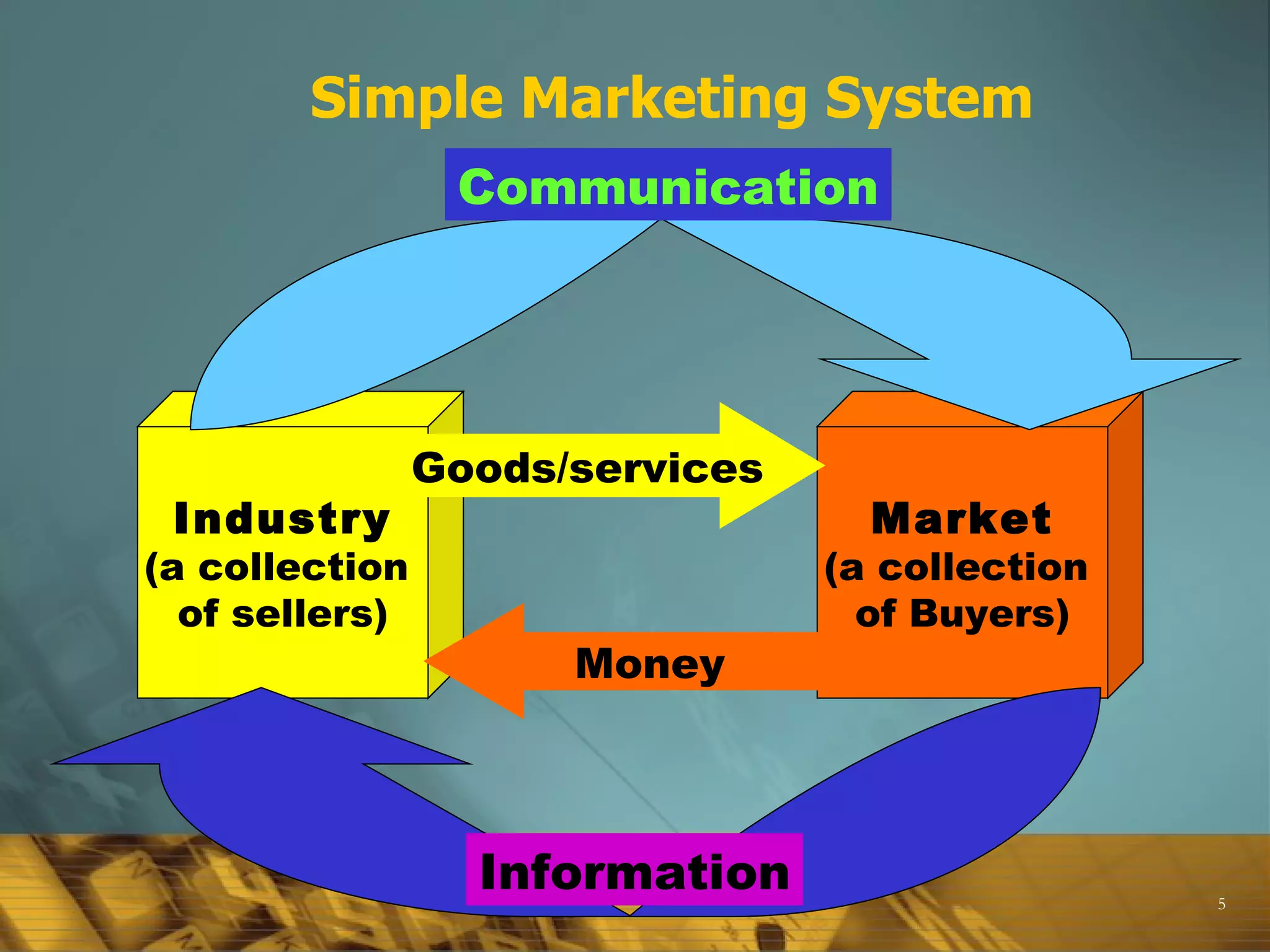
Simple Marketing System Goods/services Money Information Industry (a collection  of sellers) Market (a collection  of Buyers) Communication
Marketing = ? Marketing is the sum of all activities that take you to a sales outlet. After that sales takes over. Marketing is all about creating a pull, sales is all about push. Marketing is all about managing the four P’s –  product price  place promotion
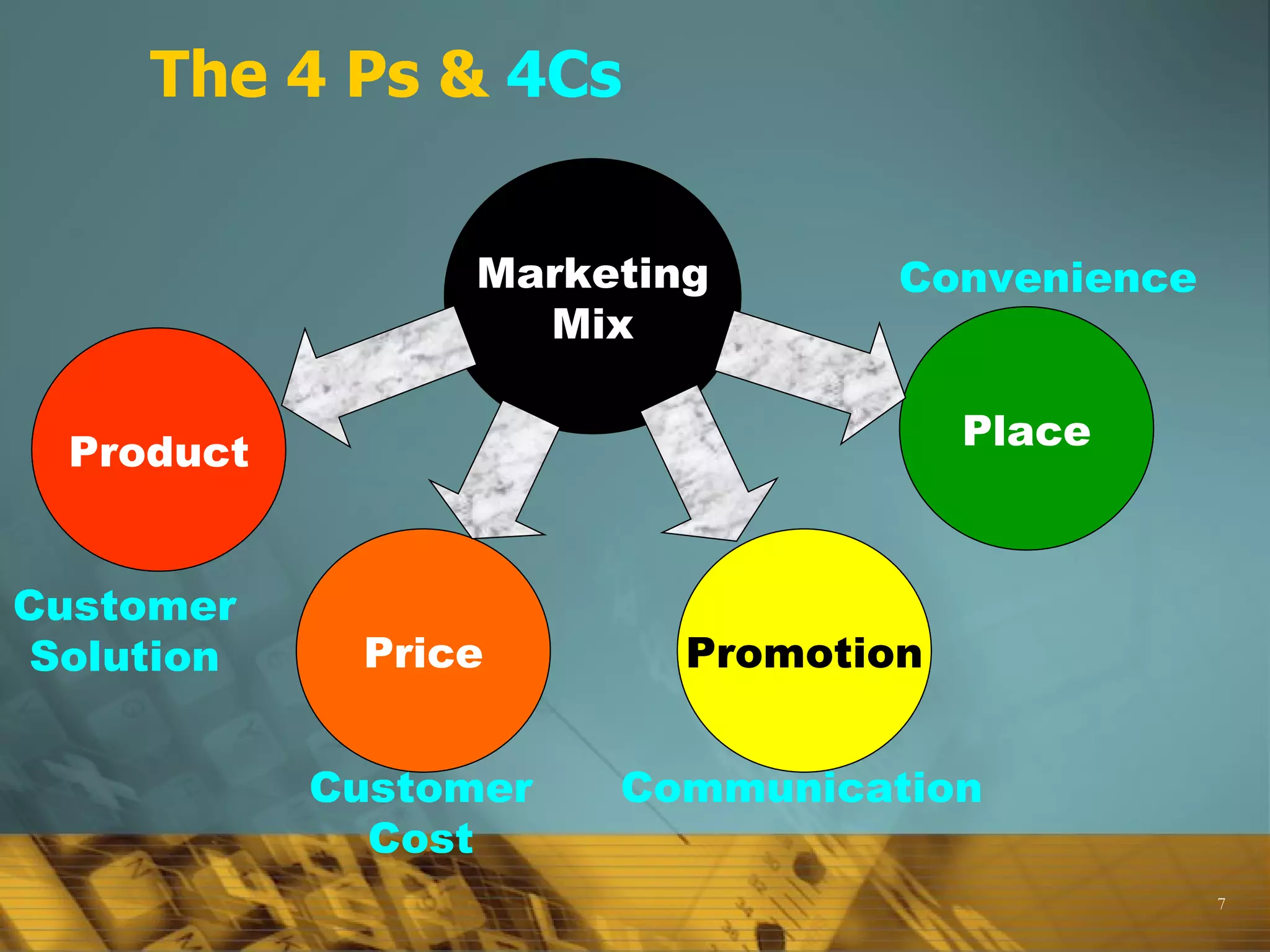
The 4 Ps &  4Cs Marketing Mix Customer Solution Customer Cost Communication Convenience Product Price Promotion Place
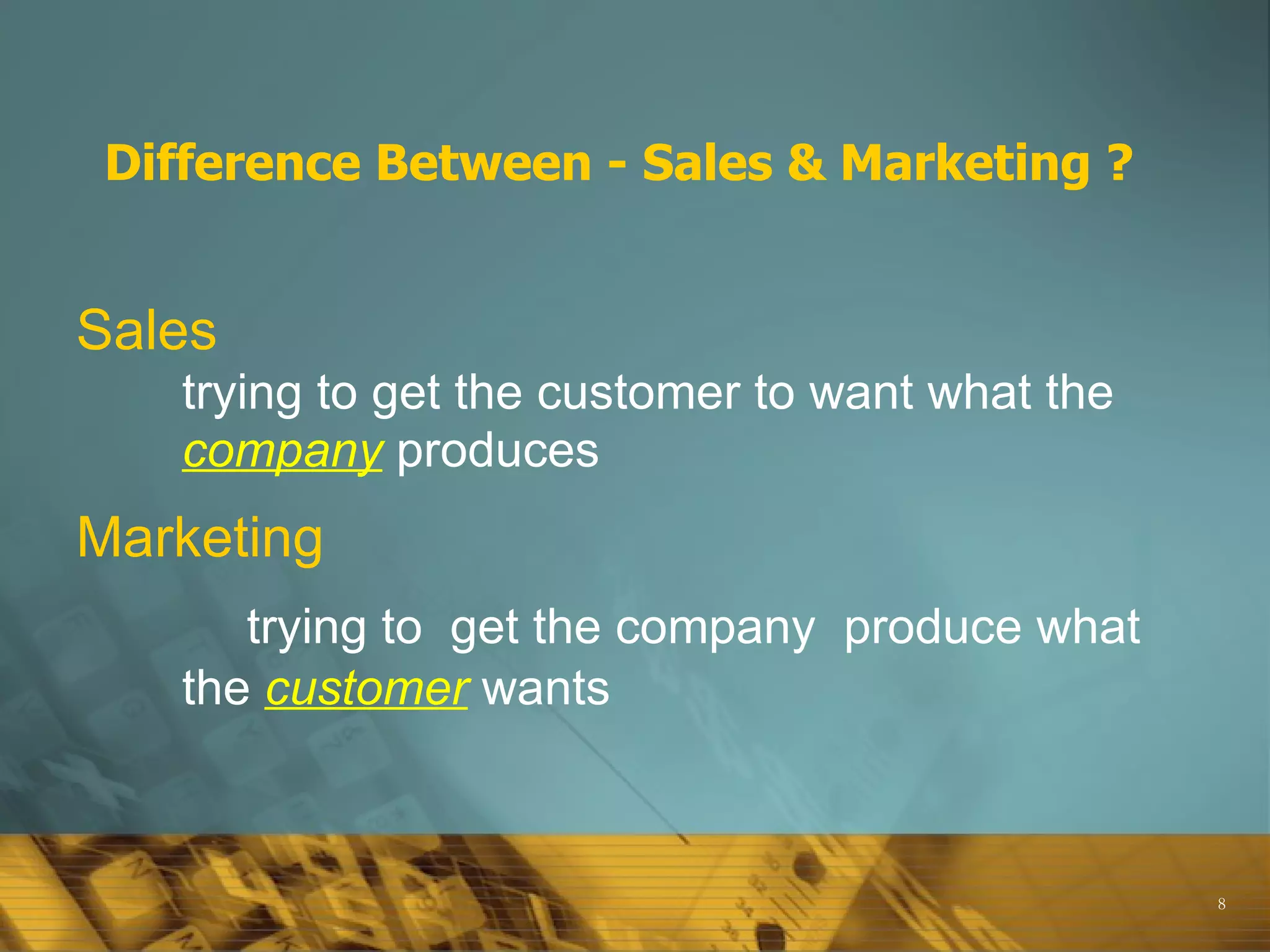
Difference Between - Sales & Marketing ? Sales trying   to get the customer to want what the   company   produces Marketing   trying to   get the company  produce what the   customer   wants
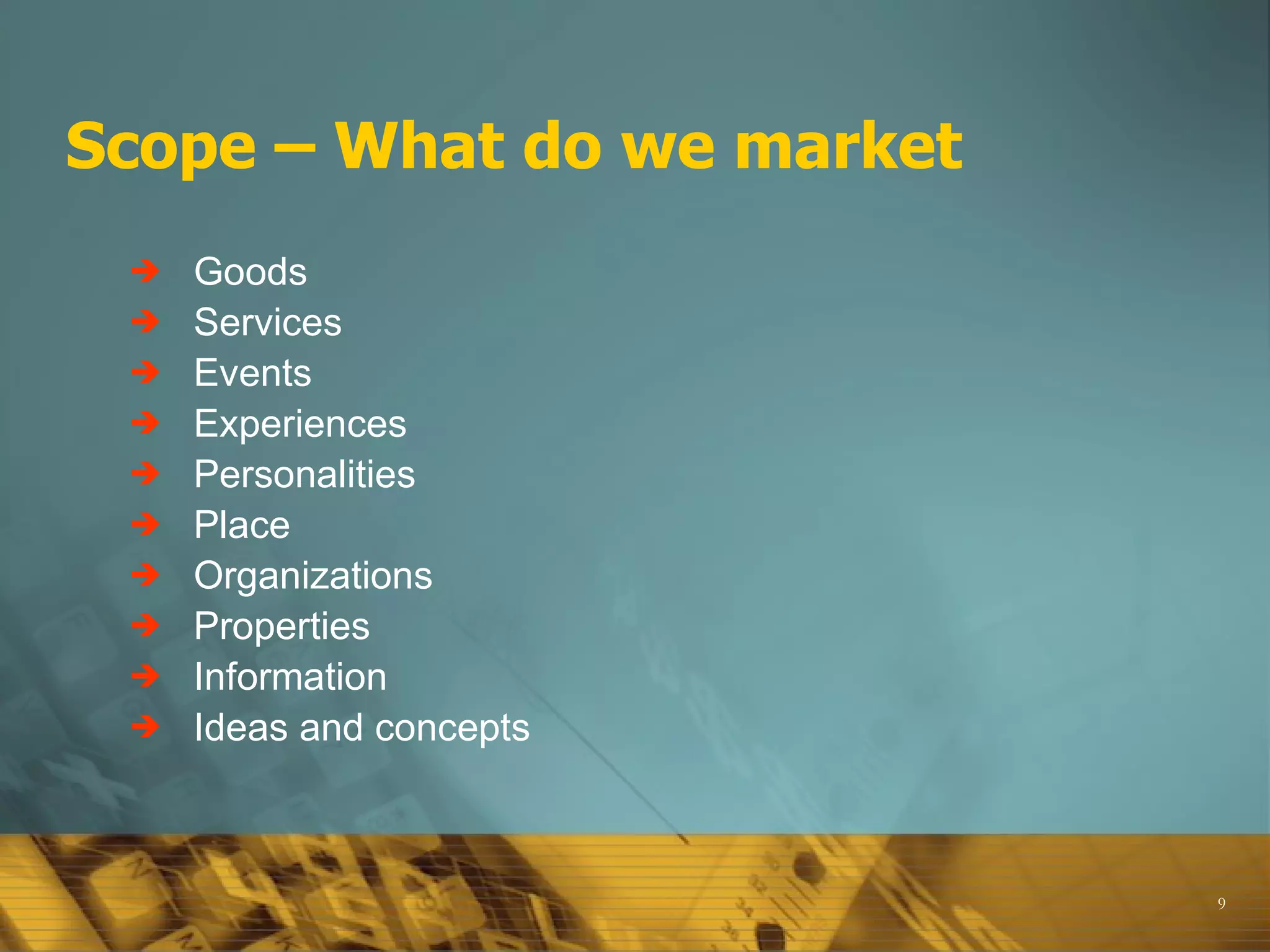
Scope – What do we market Goods  Services  Events  Experiences Personalities Place Organizations Properties Information Ideas and concepts
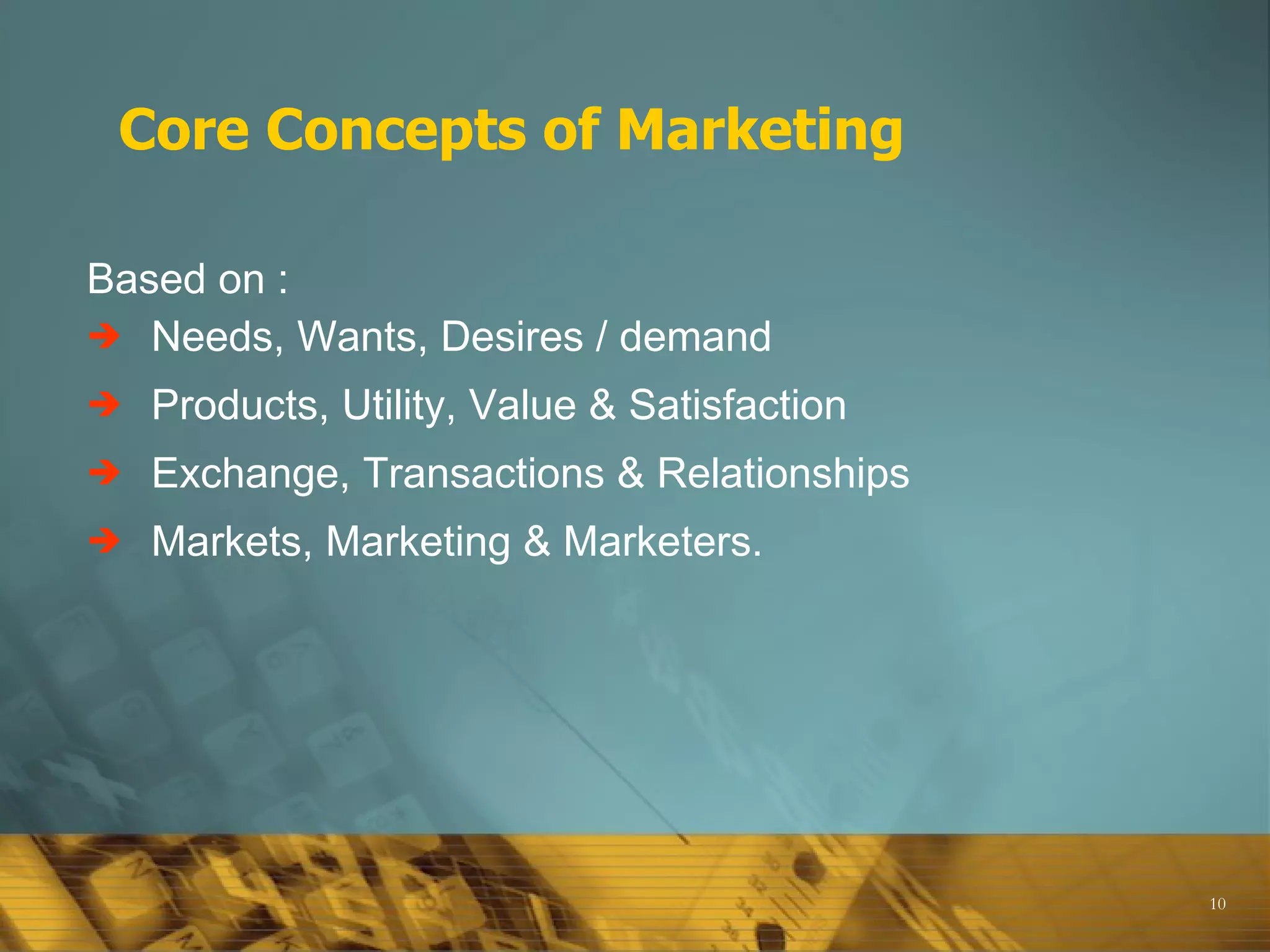
Core Concepts of Marketing Based on : Needs, Wants, Desires / demand Products, Utility, Value & Satisfaction Exchange, Transactions & Relationships Markets, Marketing & Marketers.
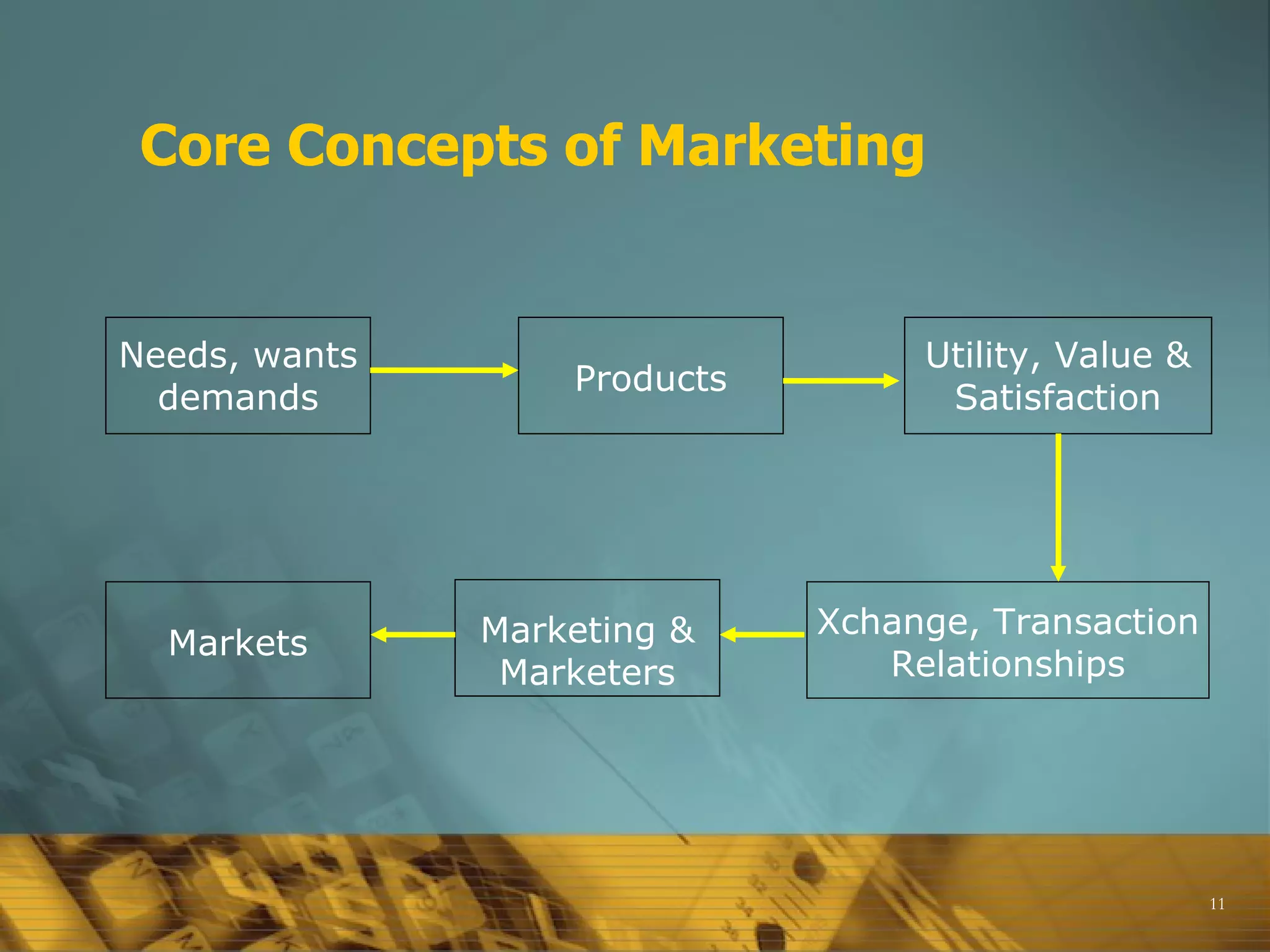
Core Concepts of Marketing Needs, wants demands Markets Marketing & Marketers Utility, Value & Satisfaction Xchange, Transaction Relationships Products
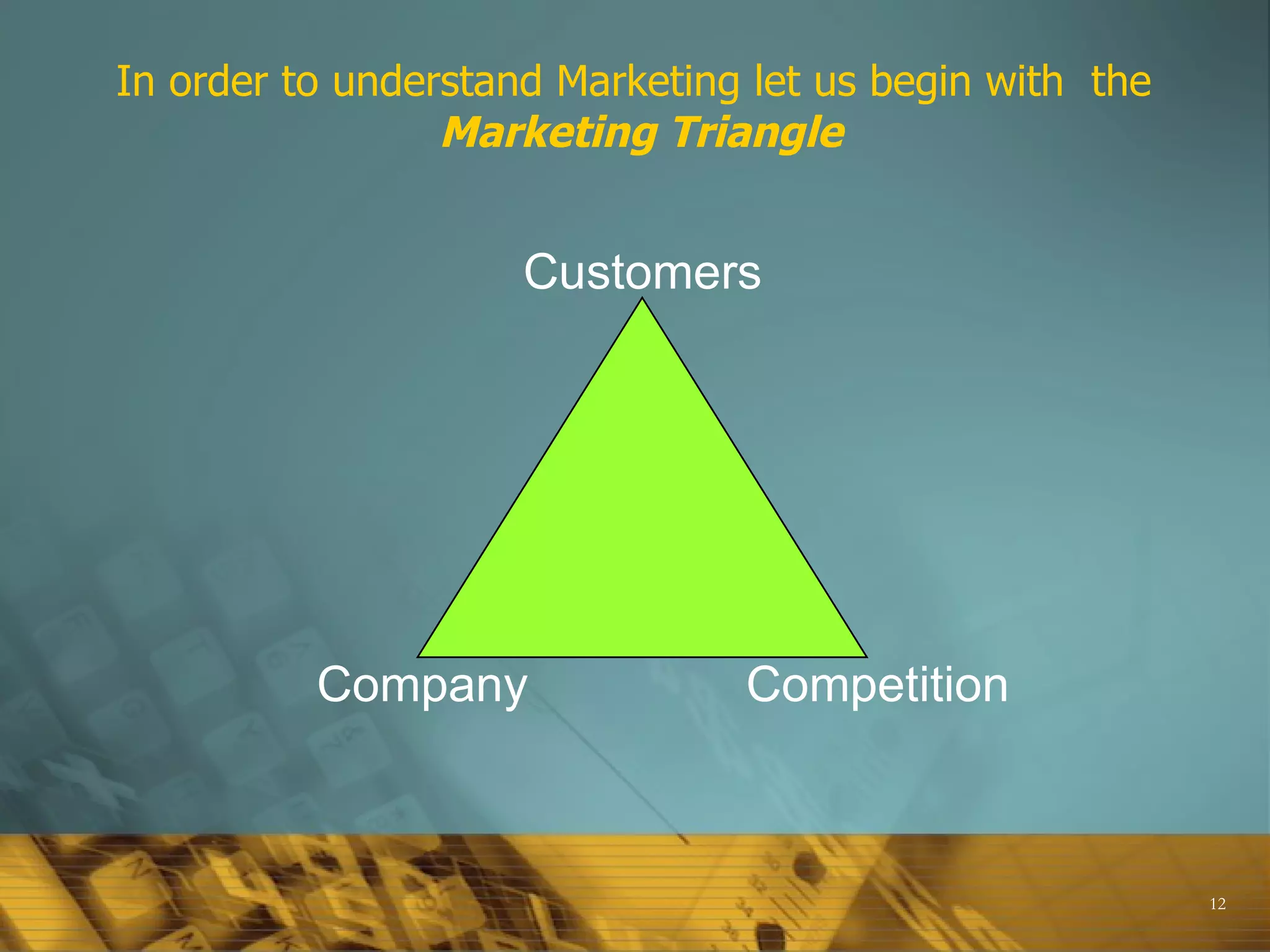
In order to understand Marketing let us begin with  the  Marketing Triangle Customers Competition Company
Who is a Customer ?? Anyone who is in the market looking at a product / service for attention, acquisition, use or consumption that   satisfies   a want or a need CUSTOMER IS . . . . .
Customer – CUSTOMER has needs, wants, demands and desires Understanding these needs is starting point of the entire marketing  These needs, wants …… arise within a framework or an ecosystem Understanding both the needs and the ecosystem is the starting point of a long term relationship
How Do Consumers Choose Among Products & Services? Value  - the value or benefits the customers gain from using the product versus the cost of obtaining the product. Satisfaction  - Based on a comparison of performance and expectations. Performance  >  Expectations  =>  Satisfaction Performance < Expectations  =>  Dissatisfaction
Customers - Problem Solution As a priority , we must bring to our customers  “ WHAT  THEY NEED ” We must be in a position to  UNDERSTAND   their problems  Or in a new situation  to give them a chance to  AVOID  the problems
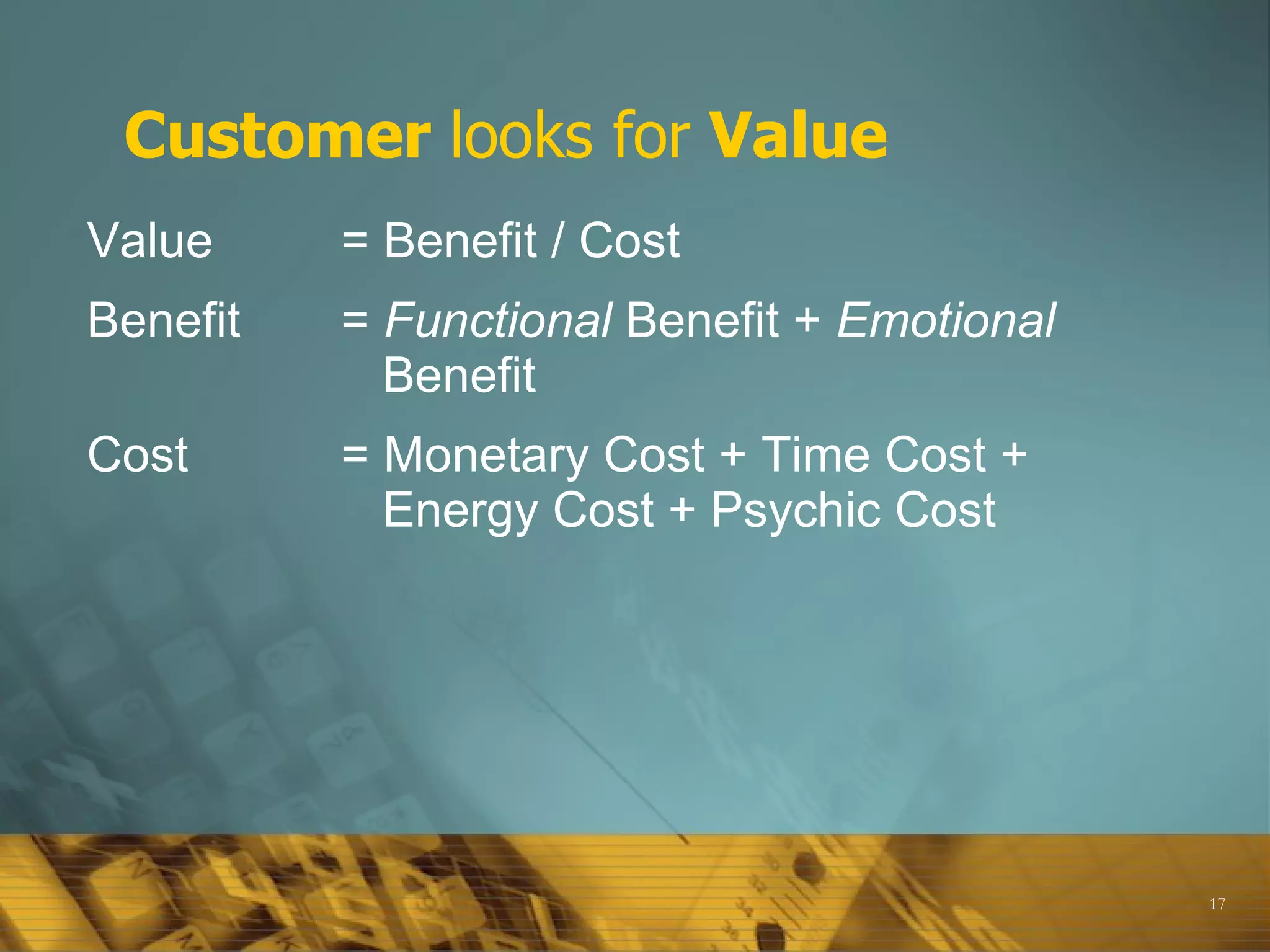
Customer  looks for  Value Value  = Benefit / Cost Benefit  =  Functional  Benefit +  Emotional       Benefit Cost  = Monetary Cost + Time Cost +      Energy Cost + Psychic Cost
The Marketing Plan A written document that acts as a guidebook of marketing activities for the marketing manager
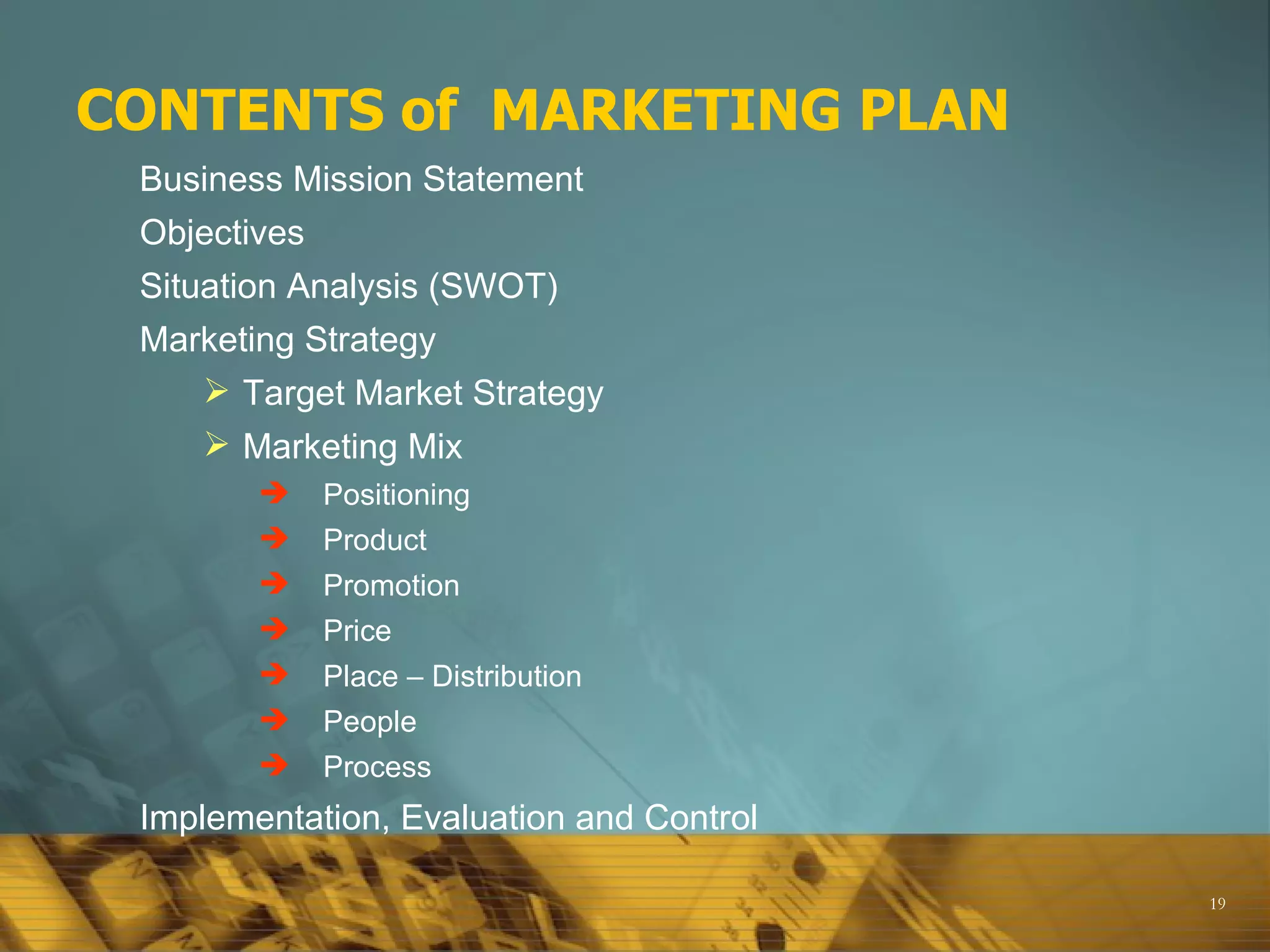
CONTENTS of  MARKETING PLAN  Business Mission Statement Objectives Situation Analysis (SWOT) Marketing Strategy Target Market Strategy Marketing Mix Positioning Product Promotion Price Place – Distribution People Process Implementation, Evaluation and Control
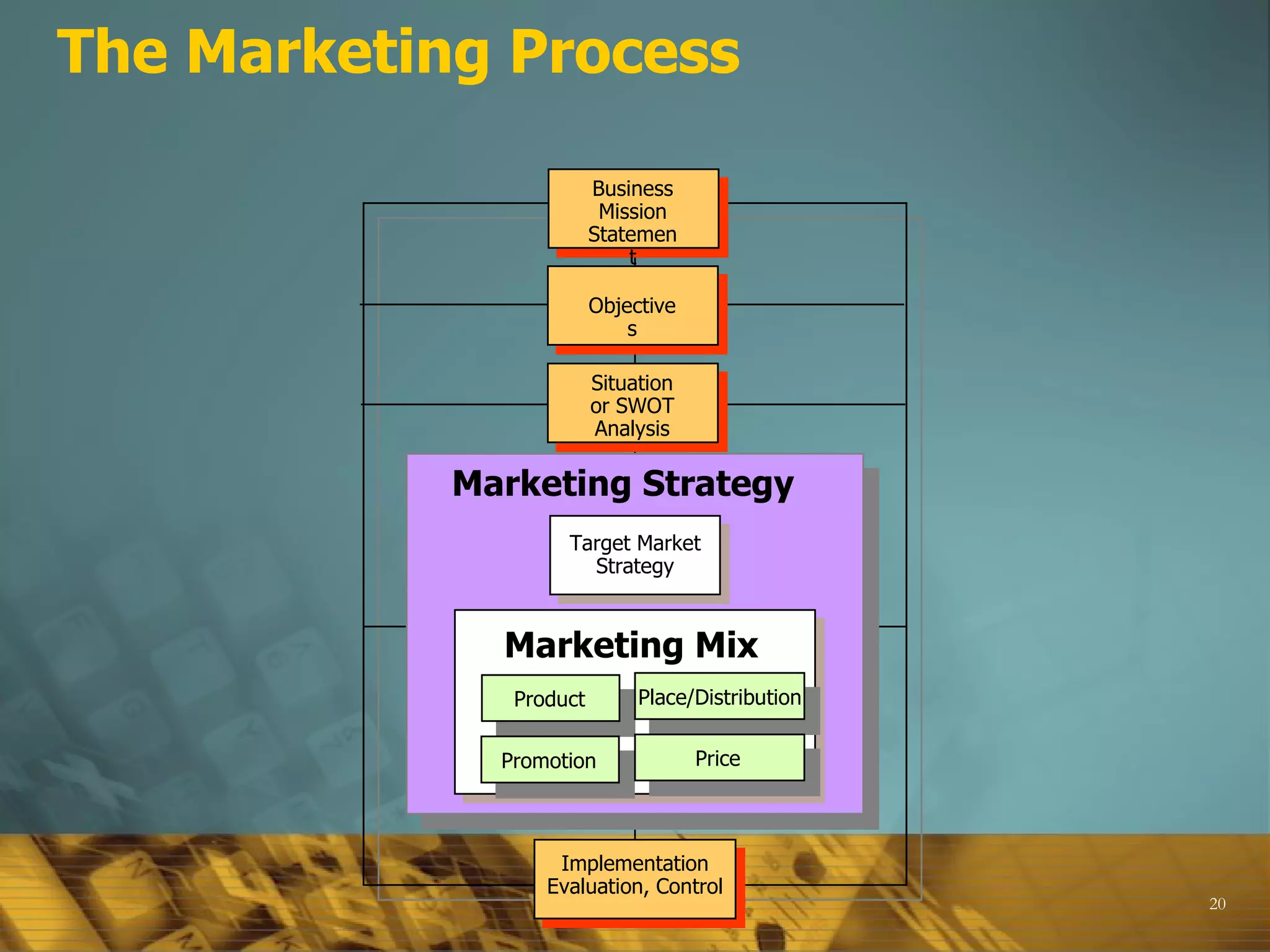
The Marketing Process Target Market Strategy Marketing Strategy Product Promotion Place/Distribution Price Marketing Mix Business Mission Statement Objectives Situation or SWOT Analysis Implementation Evaluation, Control
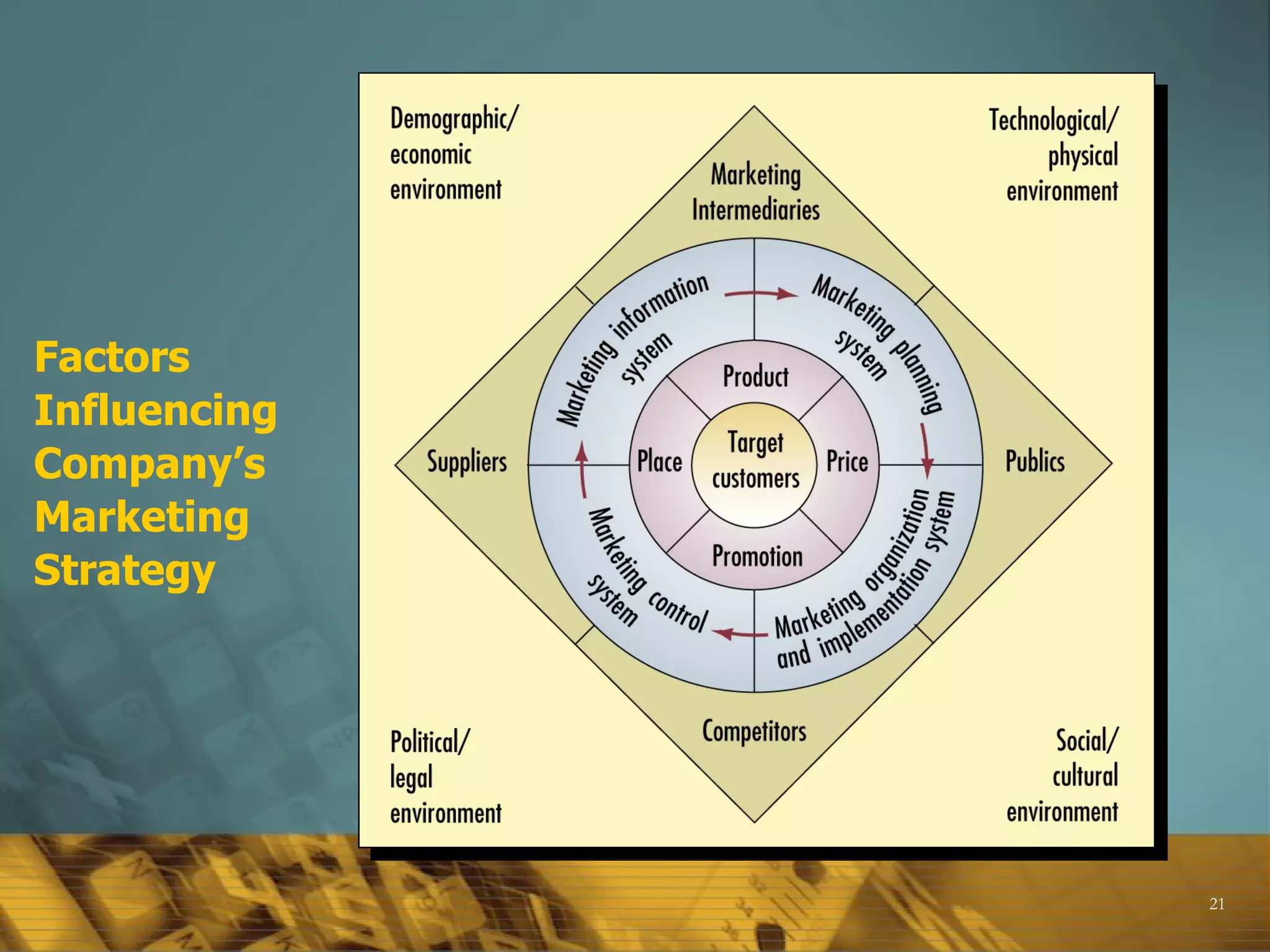
Factors Influencing Company’s Marketing Strategy
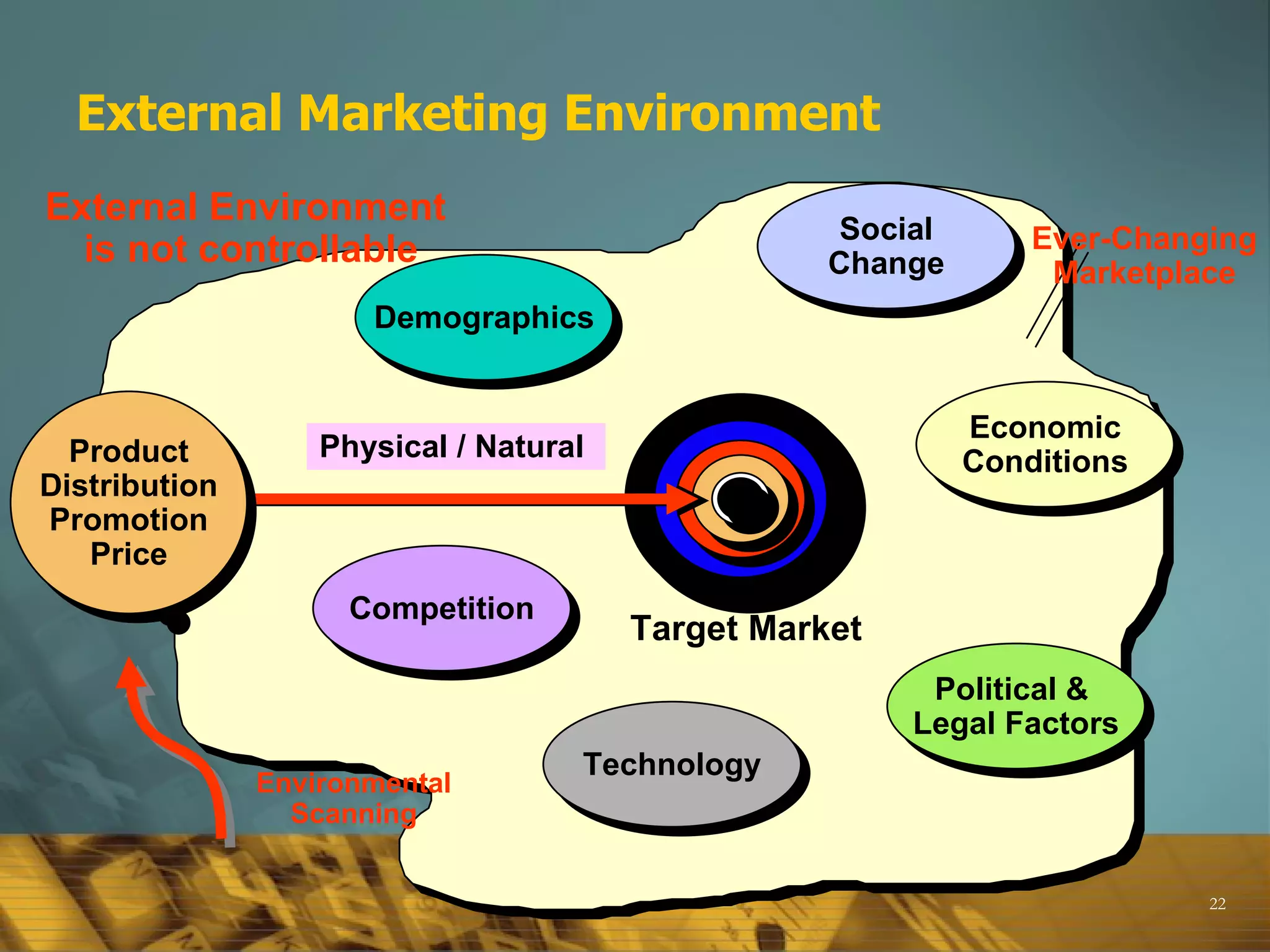
External Marketing Environment Physical / Natural  Demographics Social Change Economic Conditions Political &  Legal Factors Technology Competition Environmental Scanning Target Market Product Distribution Promotion Price External Environment  is not controllable Ever-Changing Marketplace
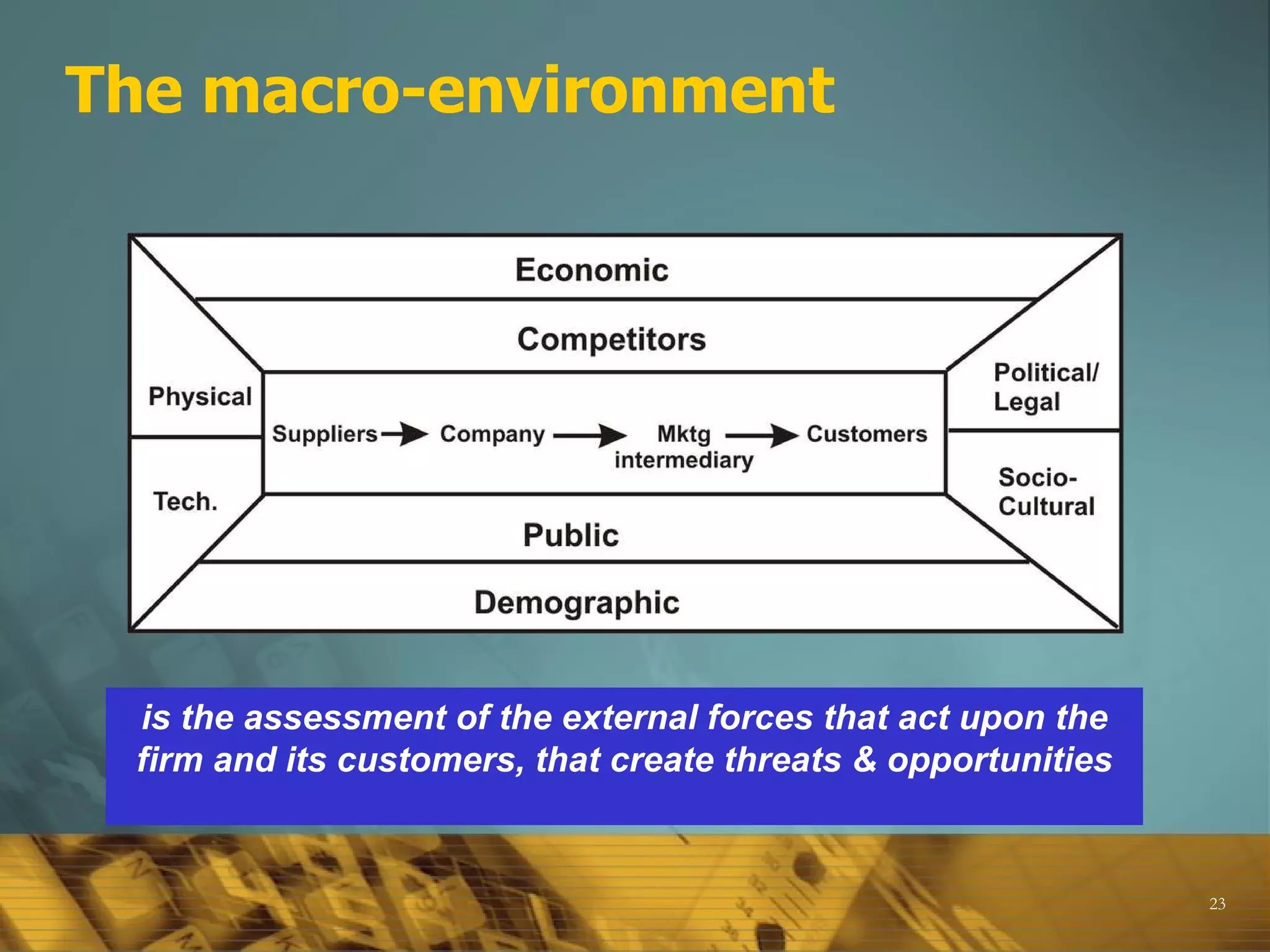
The macro-environment is the assessment of the external forces that act upon the firm and its customers, that create threats & opportunities
P r o d u c t
Anything that is offered to the market for attention, acquisition, use or consumption that satisfies a want or a need  Product is . . . . .
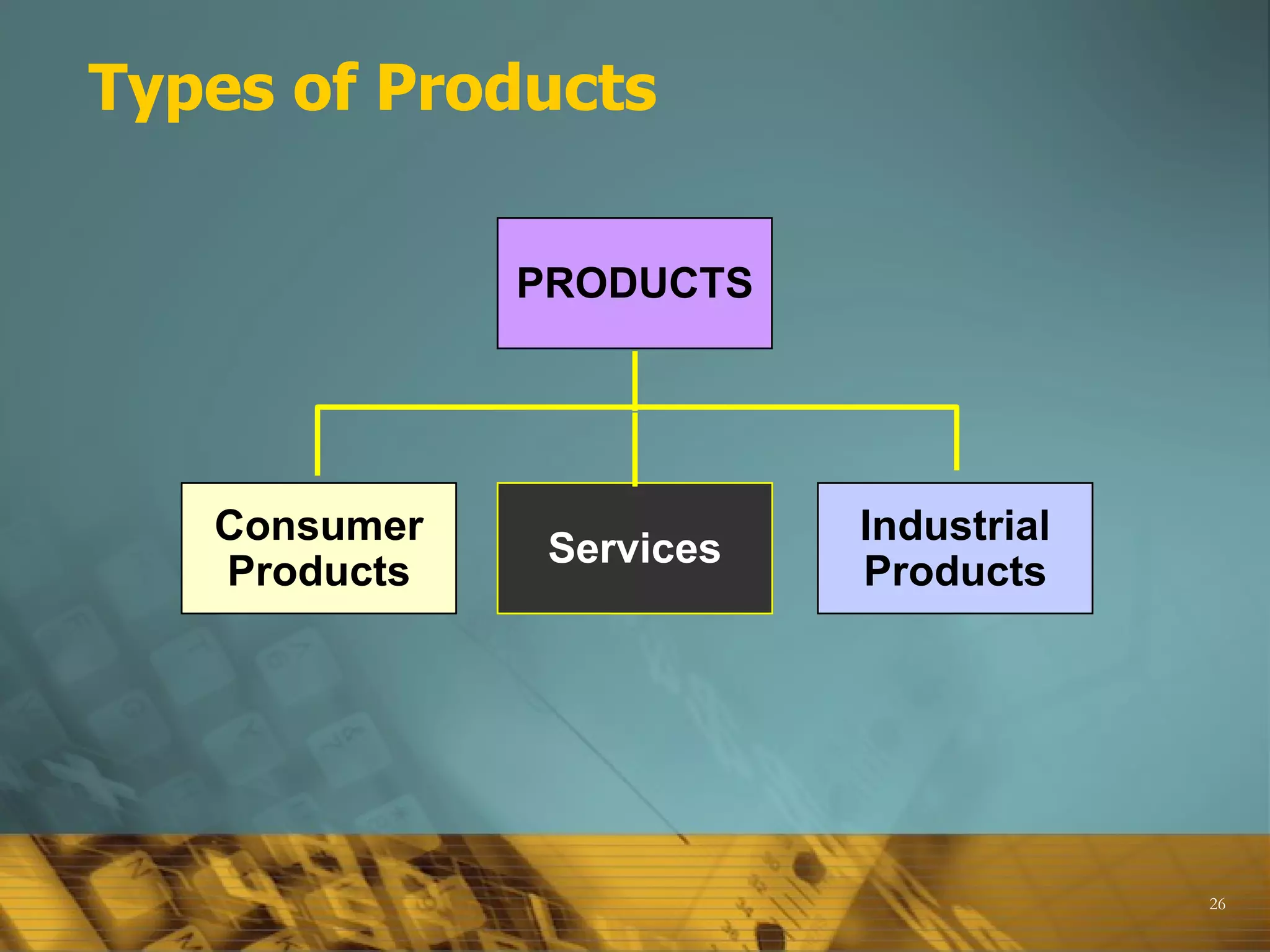
Types of Products Consumer Products Industrial Products PRODUCTS Services
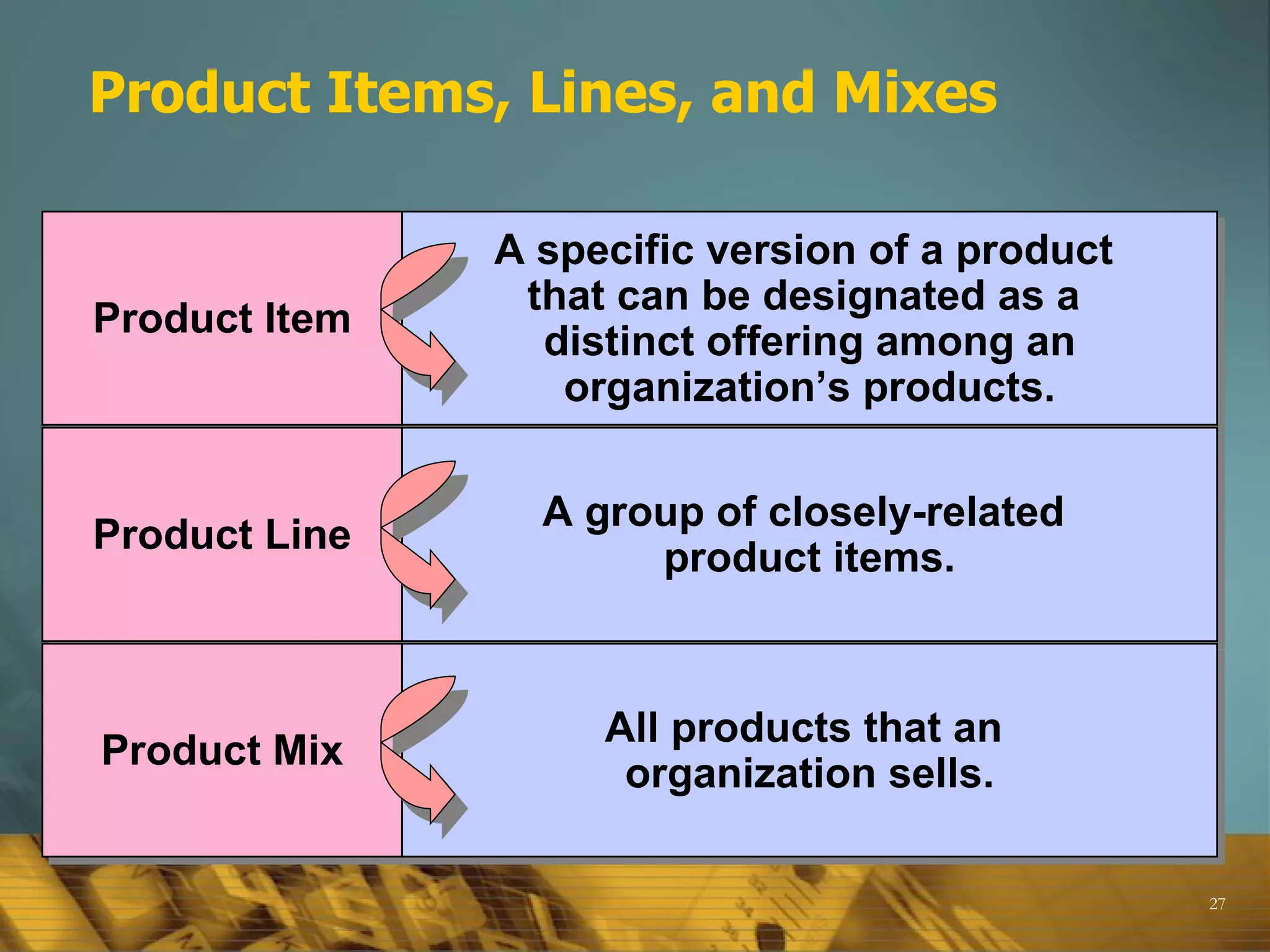
Product Items, Lines, and Mixes Product Item Product Line Product Mix A specific version of a product  that can be designated as a  distinct offering among an organization’s products. A group of closely-related  product items. All products that an  organization sells.
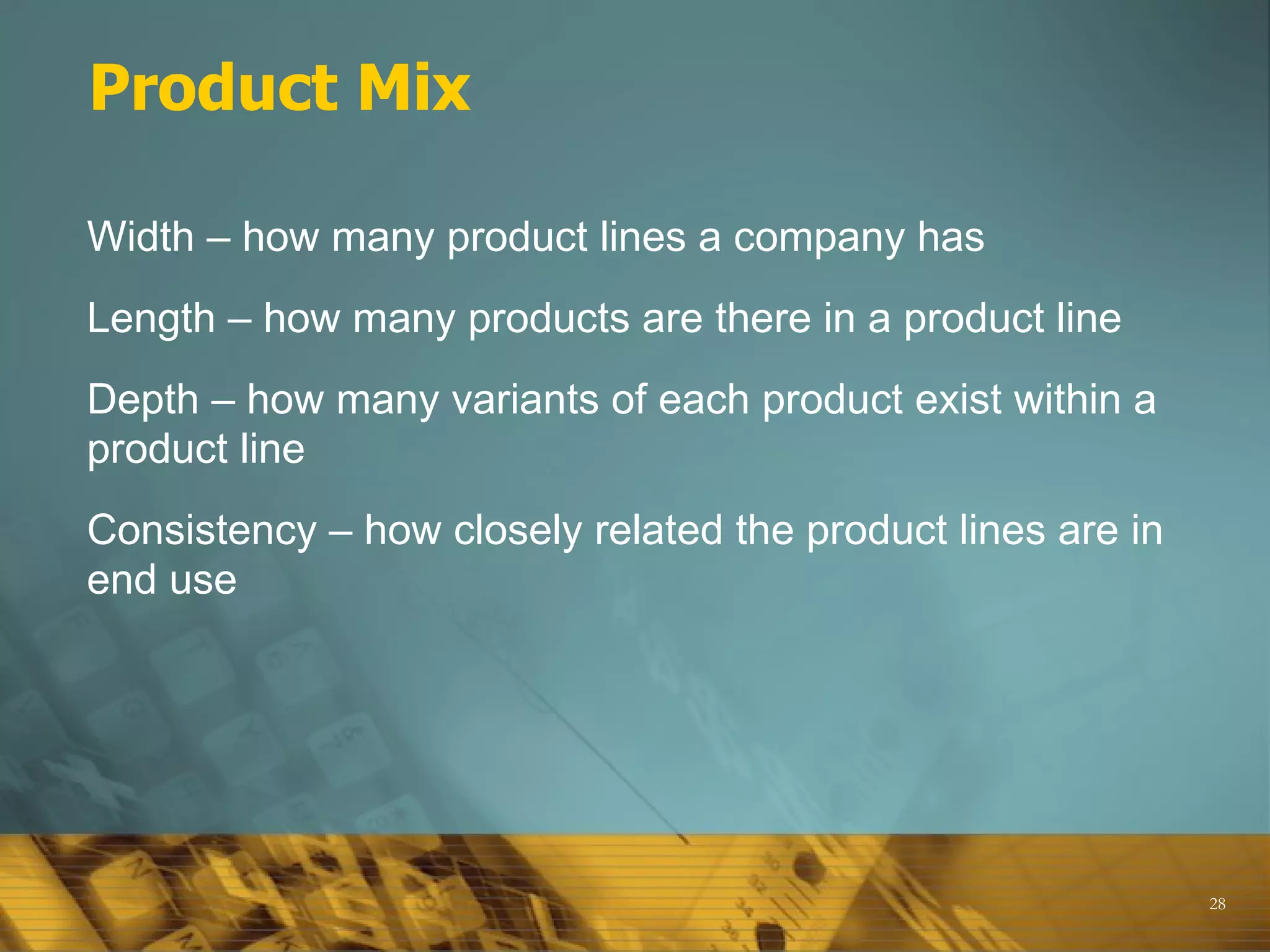
Product Mix Width – how many product lines a company has Length – how many products are there in a product line Depth – how many variants of each product exist within a product line Consistency – how closely related the product lines are in end use
The Marketing Mix The conventional view of the marketing mix consisted of four components (4 Ps):  Product, Price, Place/ distribution and Promotion . Generally acknowledged that this is too narrow today; now includes ,   P rocesses ,  P roductivity  [technology ] P eople  [employees],  P hysical evidence Marketers today are focused on virtually all aspects of the firm’s operations that have the potential to affect the  relationship  with customers.
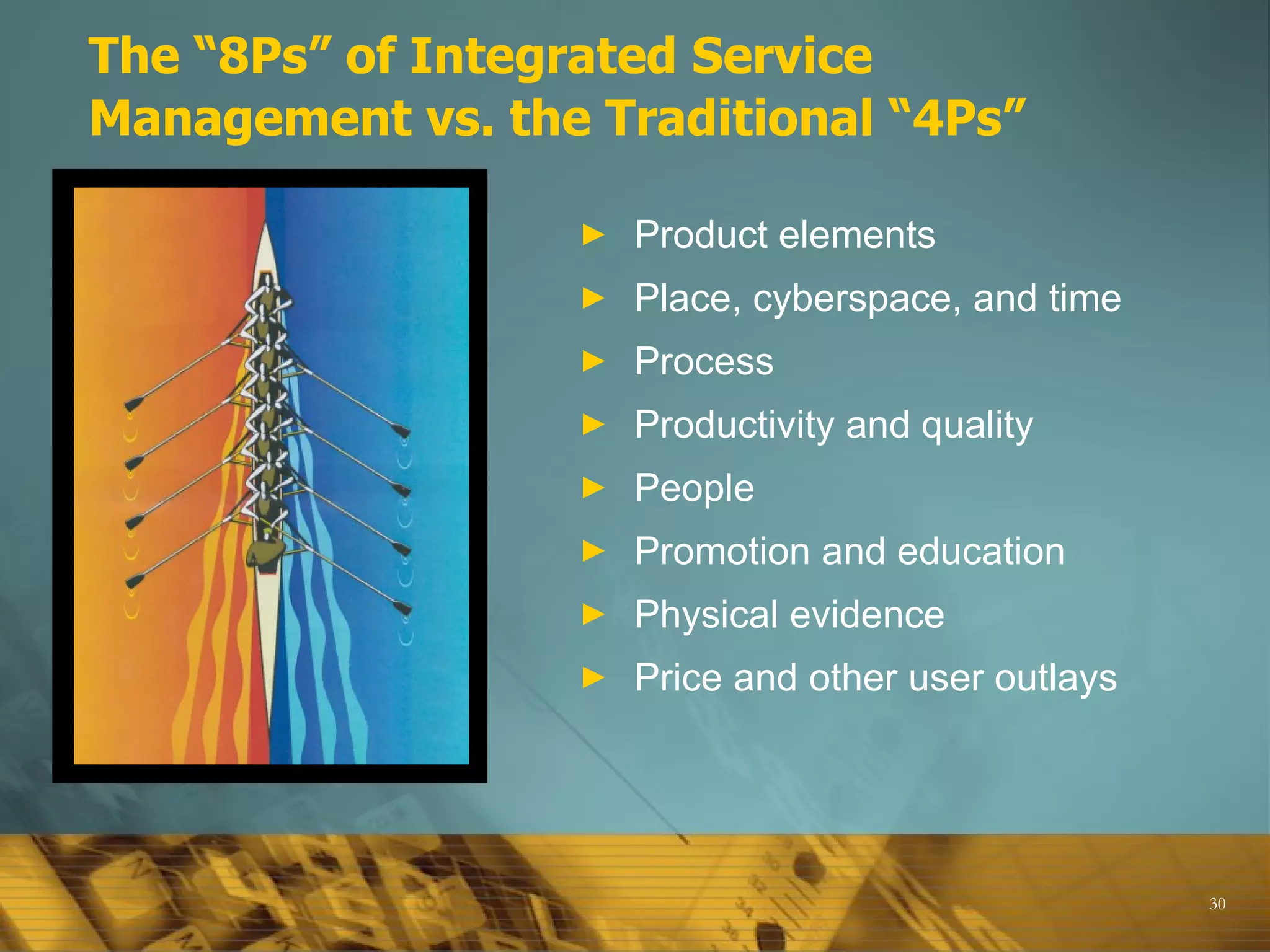
The “8Ps” of Integrated Service Management vs. the Traditional “4Ps”  Product elements Place, cyberspace, and time Process Productivity and quality People Promotion and education Physical evidence Price and other user outlays
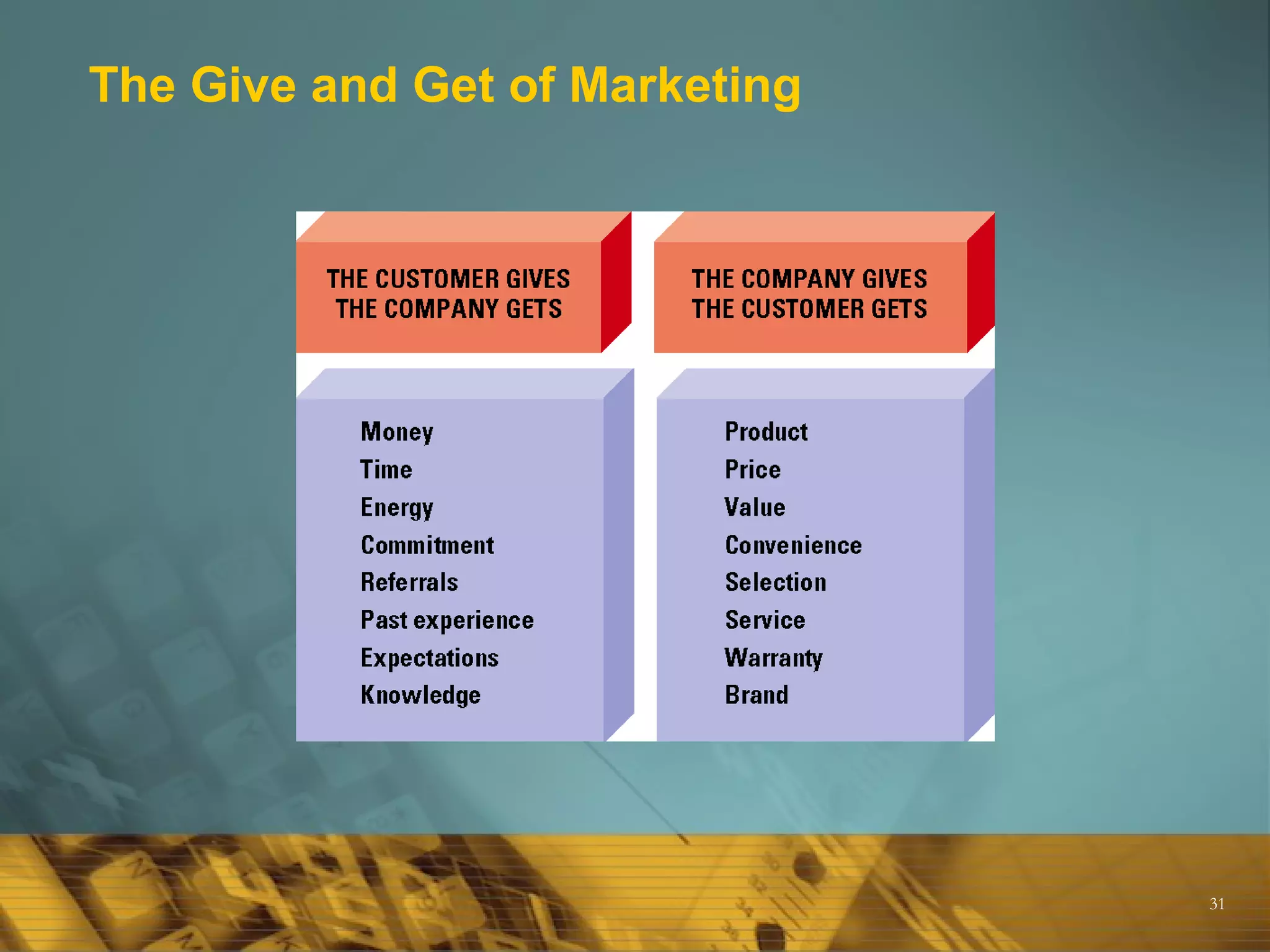
The Give and Get of Marketing
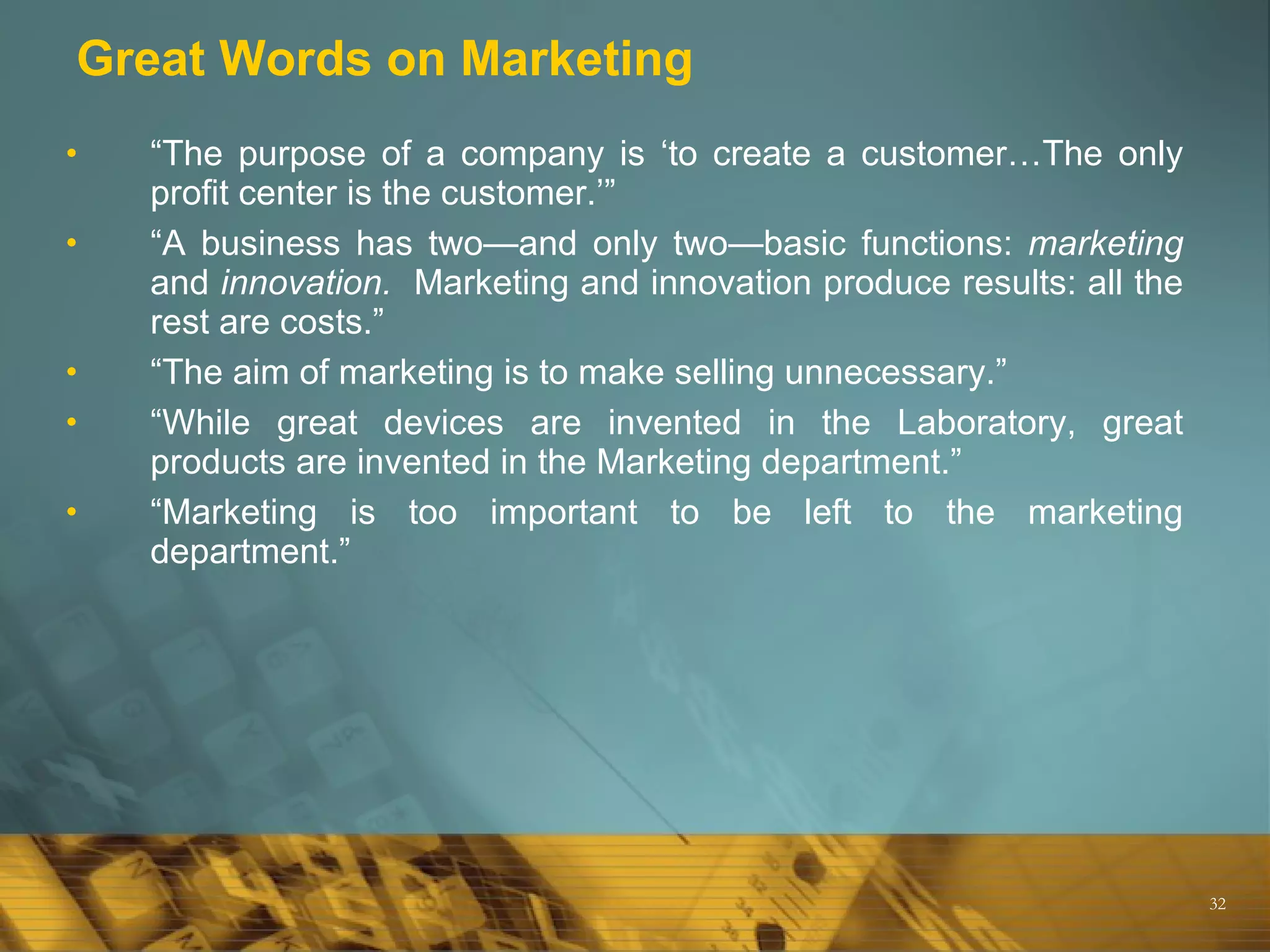
Great Words on Marketing “ The purpose of a company is ‘to create a customer…The only profit center is the customer.’” “ A business has two—and only two—basic functions:  marketing  and  innovation.   Marketing and innovation produce results: all the rest are costs.” “ The aim of marketing is to make selling unnecessary.” “ While great devices are invented in the Laboratory, great products are invented in the Marketing department.” “ Marketing is too important to be left to the marketing department.”
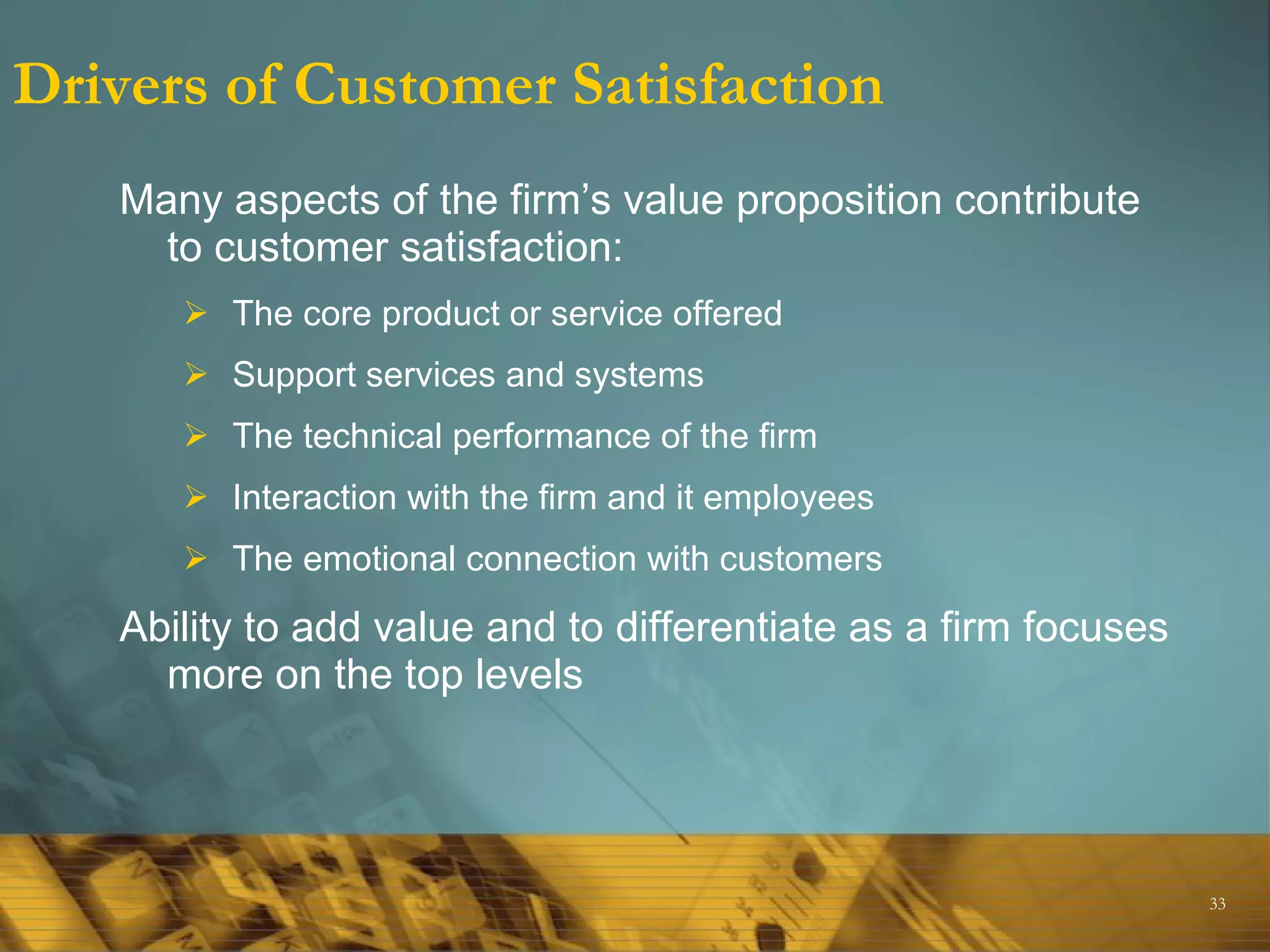
Drivers of Customer Satisfaction Many aspects of the firm’s value proposition contribute to customer satisfaction: The core product or service offered Support services and systems The technical performance of the firm Interaction with the firm and it employees The emotional connection with customers Ability to add value and to differentiate as a firm focuses more on the top levels
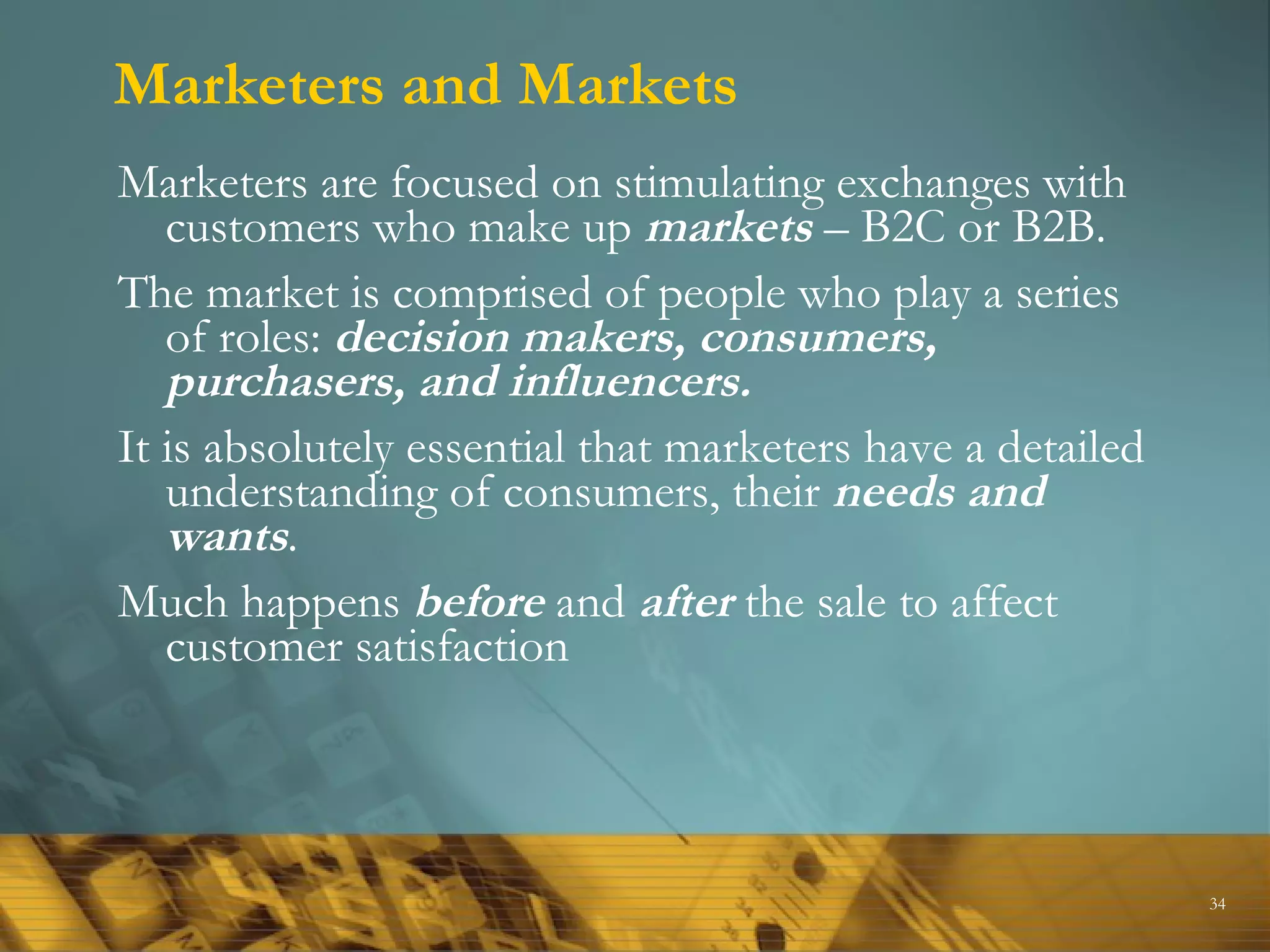
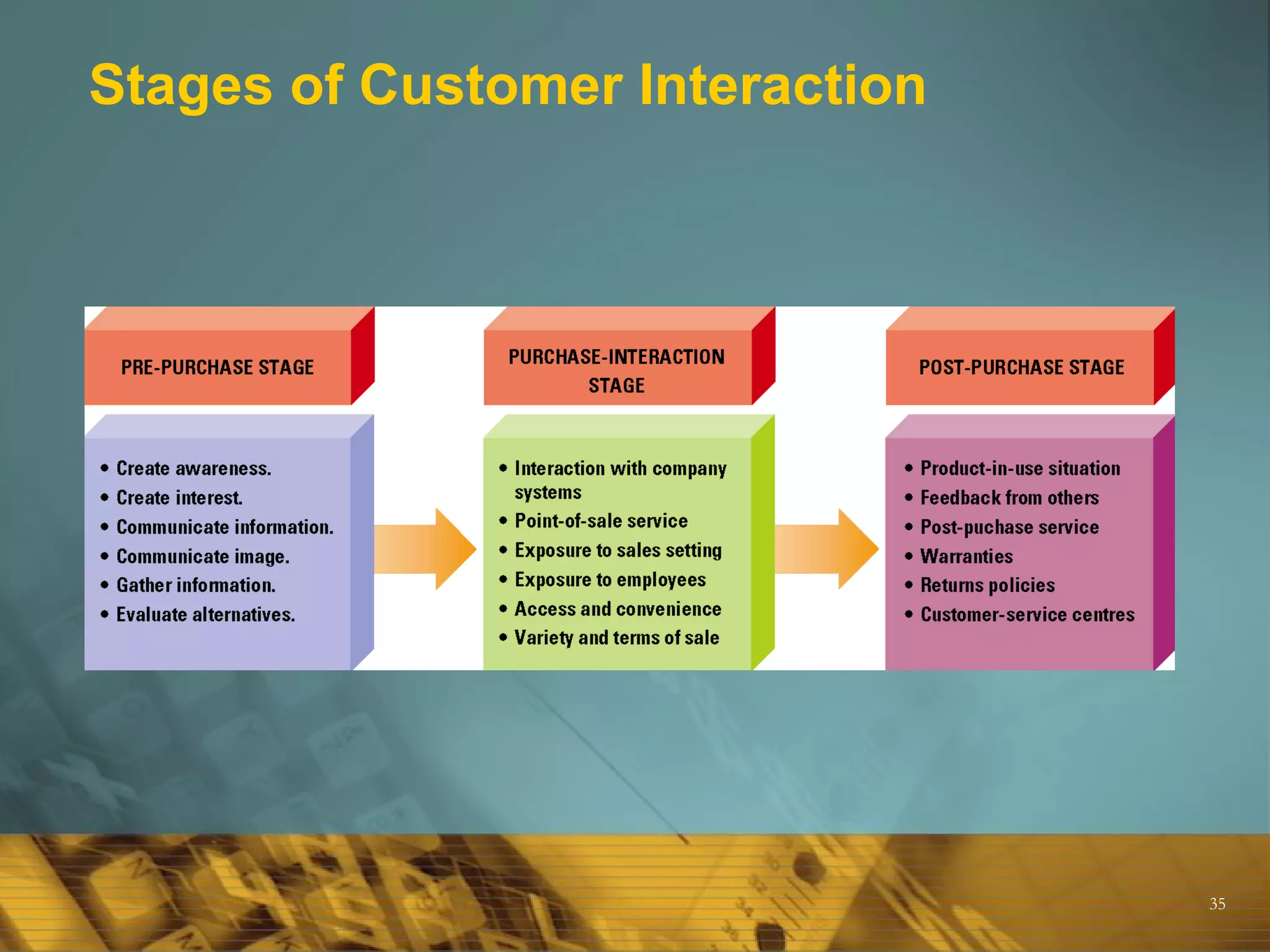
Marketers and Markets Marketers are focused on stimulating exchanges with customers who make up  markets  – B2C or B2B. The market is comprised of people who play a series of roles:  decision makers, consumers, purchasers, and influencers. It is absolutely essential that marketers have a detailed understanding of consumers, their  needs and wants . Much happens  before  and  after  the sale to affect customer satisfaction
Stages of Customer Interaction
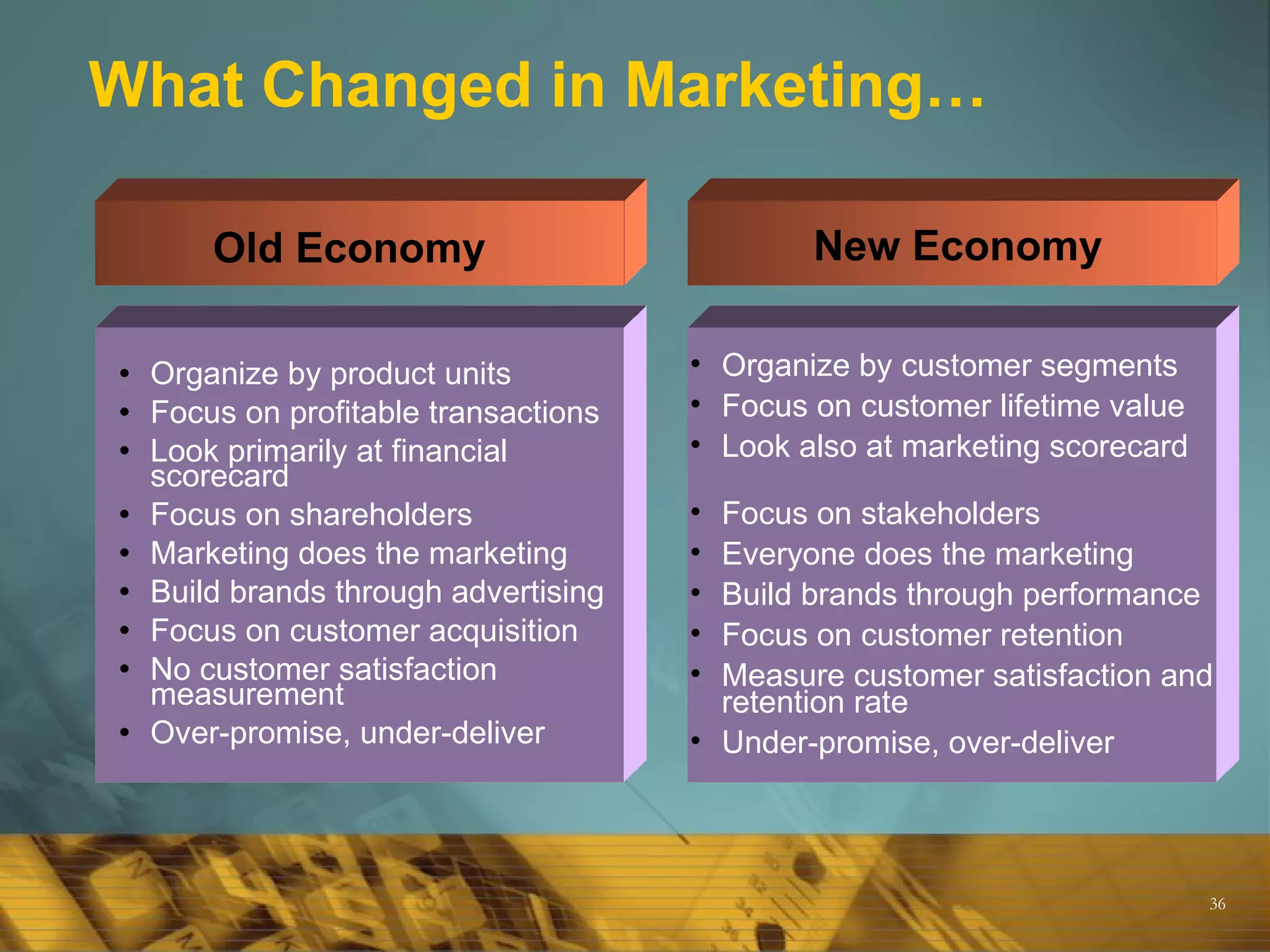
What Changed in Marketing… Organize by product units Focus on profitable transactions Look primarily at financial scorecard Focus on shareholders Marketing does the marketing Build brands through advertising Focus on customer acquisition No customer satisfaction measurement Over-promise, under-deliver Organize by customer segments Focus on customer lifetime value Look also at marketing scorecard Focus on stakeholders Everyone does the marketing Build brands through performance Focus on customer retention Measure customer satisfaction and retention rate Under-promise, over-deliver Old Economy New Economy
THANK YOU….

01 marketing concepts

  • 1.
    MARKETING CONCEPTS& ITS ENVIRONMENT
  • 2.
    What is Marketing…??Selling? Advertising? Promotions? Making products available in stores? Maintaining inventories? All of the above, plus much more!
  • 3.
    Marketing = ?Marketing is the process of planning and executing the conception, pricing, promotion, and distribution of ideas, goods, services to create exchanges that satisfy individual and organizational goals American Marketing Association
  • 4.
    Marketing = ?Marketing management is the art and science of choosing target markets and getting, keeping, and growing customers through creating, delivering, and communicating superior customer value.
  • 5.
    Simple Marketing SystemGoods/services Money Information Industry (a collection of sellers) Market (a collection of Buyers) Communication
  • 6.
    Marketing = ?Marketing is the sum of all activities that take you to a sales outlet. After that sales takes over. Marketing is all about creating a pull, sales is all about push. Marketing is all about managing the four P’s – product price place promotion
  • 7.
    The 4 Ps& 4Cs Marketing Mix Customer Solution Customer Cost Communication Convenience Product Price Promotion Place
  • 8.
    Difference Between -Sales & Marketing ? Sales trying to get the customer to want what the company produces Marketing trying to get the company produce what the customer wants
  • 9.
    Scope – Whatdo we market Goods Services Events Experiences Personalities Place Organizations Properties Information Ideas and concepts
  • 10.
    Core Concepts ofMarketing Based on : Needs, Wants, Desires / demand Products, Utility, Value & Satisfaction Exchange, Transactions & Relationships Markets, Marketing & Marketers.
  • 11.
    Core Concepts ofMarketing Needs, wants demands Markets Marketing & Marketers Utility, Value & Satisfaction Xchange, Transaction Relationships Products
  • 12.
    In order tounderstand Marketing let us begin with the Marketing Triangle Customers Competition Company
  • 13.
    Who is aCustomer ?? Anyone who is in the market looking at a product / service for attention, acquisition, use or consumption that satisfies a want or a need CUSTOMER IS . . . . .
  • 14.
    Customer – CUSTOMERhas needs, wants, demands and desires Understanding these needs is starting point of the entire marketing These needs, wants …… arise within a framework or an ecosystem Understanding both the needs and the ecosystem is the starting point of a long term relationship
  • 15.
    How Do ConsumersChoose Among Products & Services? Value - the value or benefits the customers gain from using the product versus the cost of obtaining the product. Satisfaction - Based on a comparison of performance and expectations. Performance > Expectations => Satisfaction Performance < Expectations => Dissatisfaction
  • 16.
    Customers - ProblemSolution As a priority , we must bring to our customers “ WHAT THEY NEED ” We must be in a position to UNDERSTAND their problems Or in a new situation to give them a chance to AVOID the problems
  • 17.
    Customer looksfor Value Value = Benefit / Cost Benefit = Functional Benefit + Emotional Benefit Cost = Monetary Cost + Time Cost + Energy Cost + Psychic Cost
  • 18.
    The Marketing PlanA written document that acts as a guidebook of marketing activities for the marketing manager
  • 19.
    CONTENTS of MARKETING PLAN Business Mission Statement Objectives Situation Analysis (SWOT) Marketing Strategy Target Market Strategy Marketing Mix Positioning Product Promotion Price Place – Distribution People Process Implementation, Evaluation and Control
  • 20.
    The Marketing ProcessTarget Market Strategy Marketing Strategy Product Promotion Place/Distribution Price Marketing Mix Business Mission Statement Objectives Situation or SWOT Analysis Implementation Evaluation, Control
  • 21.
  • 22.
    External Marketing EnvironmentPhysical / Natural Demographics Social Change Economic Conditions Political & Legal Factors Technology Competition Environmental Scanning Target Market Product Distribution Promotion Price External Environment is not controllable Ever-Changing Marketplace
  • 23.
    The macro-environment isthe assessment of the external forces that act upon the firm and its customers, that create threats & opportunities
  • 24.
    P r od u c t
  • 25.
    Anything that isoffered to the market for attention, acquisition, use or consumption that satisfies a want or a need Product is . . . . .
  • 26.
    Types of ProductsConsumer Products Industrial Products PRODUCTS Services
  • 27.
    Product Items, Lines,and Mixes Product Item Product Line Product Mix A specific version of a product that can be designated as a distinct offering among an organization’s products. A group of closely-related product items. All products that an organization sells.
  • 28.
    Product Mix Width– how many product lines a company has Length – how many products are there in a product line Depth – how many variants of each product exist within a product line Consistency – how closely related the product lines are in end use
  • 29.
    The Marketing MixThe conventional view of the marketing mix consisted of four components (4 Ps): Product, Price, Place/ distribution and Promotion . Generally acknowledged that this is too narrow today; now includes , P rocesses , P roductivity [technology ] P eople [employees], P hysical evidence Marketers today are focused on virtually all aspects of the firm’s operations that have the potential to affect the relationship with customers.
  • 30.
    The “8Ps” ofIntegrated Service Management vs. the Traditional “4Ps” Product elements Place, cyberspace, and time Process Productivity and quality People Promotion and education Physical evidence Price and other user outlays
  • 31.
    The Give andGet of Marketing
  • 32.
    Great Words onMarketing “ The purpose of a company is ‘to create a customer…The only profit center is the customer.’” “ A business has two—and only two—basic functions: marketing and innovation. Marketing and innovation produce results: all the rest are costs.” “ The aim of marketing is to make selling unnecessary.” “ While great devices are invented in the Laboratory, great products are invented in the Marketing department.” “ Marketing is too important to be left to the marketing department.”
  • 33.
    Drivers of CustomerSatisfaction Many aspects of the firm’s value proposition contribute to customer satisfaction: The core product or service offered Support services and systems The technical performance of the firm Interaction with the firm and it employees The emotional connection with customers Ability to add value and to differentiate as a firm focuses more on the top levels
  • 34.
    Marketers and MarketsMarketers are focused on stimulating exchanges with customers who make up markets – B2C or B2B. The market is comprised of people who play a series of roles: decision makers, consumers, purchasers, and influencers. It is absolutely essential that marketers have a detailed understanding of consumers, their needs and wants . Much happens before and after the sale to affect customer satisfaction
  • 35.
    Stages of CustomerInteraction
  • 36.
    What Changed inMarketing… Organize by product units Focus on profitable transactions Look primarily at financial scorecard Focus on shareholders Marketing does the marketing Build brands through advertising Focus on customer acquisition No customer satisfaction measurement Over-promise, under-deliver Organize by customer segments Focus on customer lifetime value Look also at marketing scorecard Focus on stakeholders Everyone does the marketing Build brands through performance Focus on customer retention Measure customer satisfaction and retention rate Under-promise, over-deliver Old Economy New Economy
  • 37.

Editor's Notes

  • #16 04/04/11
  • #33 04/04/11 Drucker, Yogi Berra, A Chinese Proverb, William Davidow, David Packard