From concept to shop:
Marketing and new product development
An interactive PowerPoint presentation
for A-level students
meatandeducation.com 2013
Welcome
Use the following buttons to guide you through this resource.
This button takes you to the main menu.
This button moves you to the next slide.
This button moves you to the previous slide.
meatandeducation.com 2013
Menu
Click on the information section you wish to read.
Click Questions, if you are ready to take the multiple choice quiz.
Information
1. Consumer market
2. New Product Development
3. Product life cycle
Questions EndExtension questions
meatandeducation.com 2013
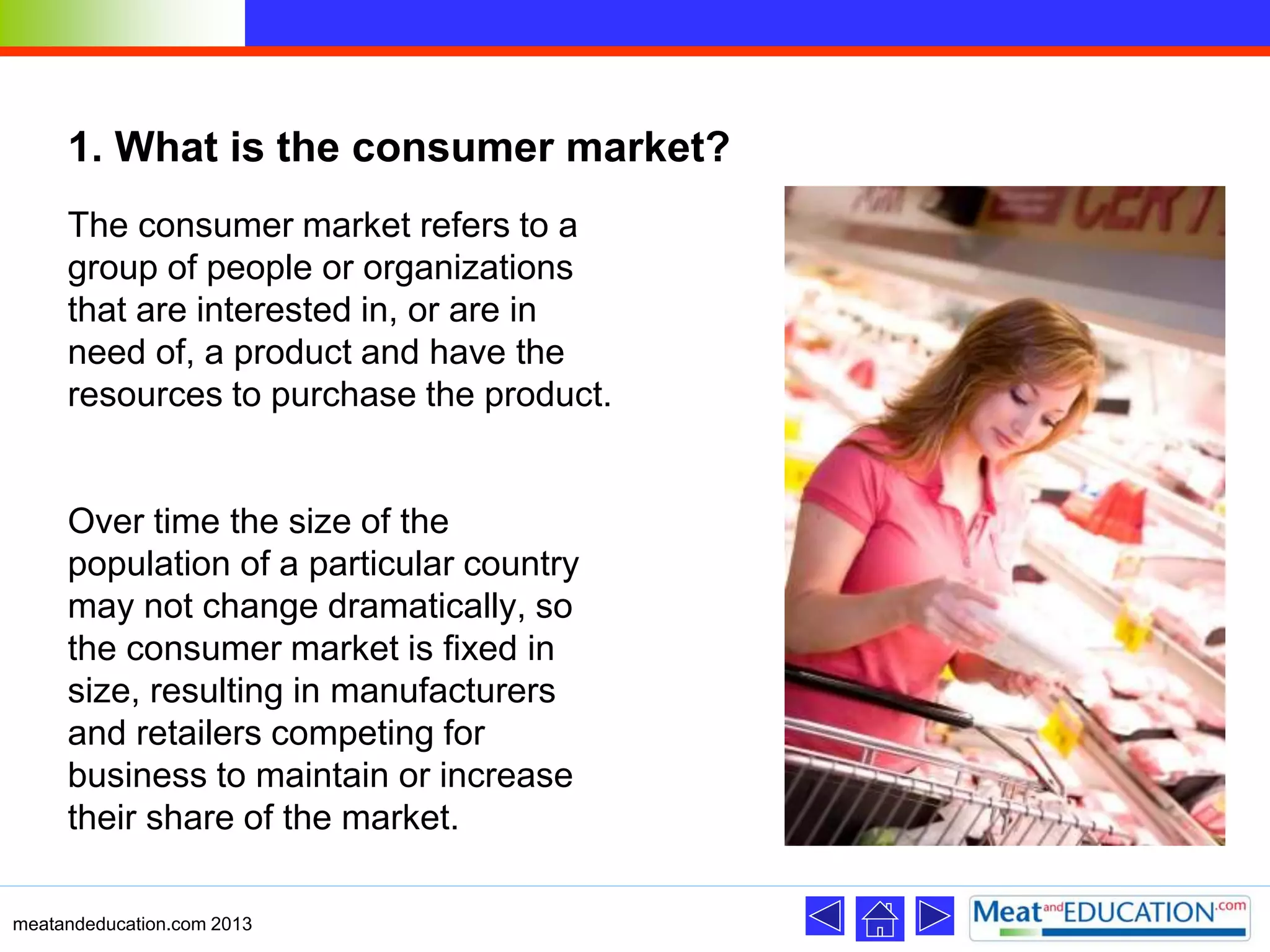
1. What is the consumer market?
The consumer market refers to a
group of people or organizations
that are interested in, or are in
need of, a product and have the
resources to purchase the product.
Over time the size of the
population of a particular country
may not change dramatically, so
the consumer market is fixed in
size, resulting in manufacturers
and retailers competing for
business to maintain or increase
their share of the market.
meatandeducation.com 2013
What is marketing?
Marketing is a process which
identifies, anticipates and satisfies
customer needs efficiently and
profitably.
It also communicates with the
customer in a way that creates
competition. This helps maintain a
fair or acceptable pricing policy.
The aim of marketing is always to
create a preference for one product
over another.
meatandeducation.com 2013
Saturated markets and segmentation
Popular food products which have been available to purchase over an
extended period of time can eventually reach a point where the sales
cannot be improved. In this situation, the market is said to have
become saturated.
Diversification of product lines with special features, e.g. beef steak
marinated in different sauces or altering the label can help to create
new markets and increase sales.
A greater selection of products with different specifications to meet
different consumer needs will reach a larger portion of the consumer
market, e.g. low fat or salt versions of a product.
meatandeducation.com 2013
Segmentation in the food market
Consumers differ widely in their particular needs,
motivations or preferences and buying capacity.
One supplier cannot provide one product suitable
for the entire market. Alternatively, one supplier
cannot provide a wide enough range of products
to suit each individual consumer’s needs within
the market.
However, the consumer market can be
segmented into groups who share similar
characteristics or purchasing needs. This allows
suppliers to create different products which would
suit different consumer needs according to their:
age, income, taste, lifestyle, health or beliefs.
meatandeducation.com 2013
Click to view the Digi Bite
Segmentation in the food market
Health –
modifications to
nutrition content
Convenience – in
response to
changing lifestyles
Indulgence – for people to
treat themselves
Currently three growth trends include health, convenience and
indulgence. Consumers will often buy products which meet all three
needs during a shopping occasion.
Other growth trends include
consumer ethics (some becoming
mainstream):
•Fair Trade
•Animal Welfare
•Sustainability
•Provenance
•Quality schemes, e.g. Red Tractor
Food Assurance
meatandeducation.com 2013
Click to view the Digi Bite
Examples of market segmentation
The market can be segmented into:
Geographic: characteristics of consumers differ across nations, states,
geographic areas reflecting cultural interests.
Demographic: variables such as age, sex, family size, income,
occupation, education, religion, race and nationality are used widely,
e.g. ethnic minority foods have increase in popularity in the UK.
Psychological: personality, lifestyle, social class
Behavioural: knowledge, attitude, use or response to a product.
meatandeducation.com 2013
Reasons for new product development
Food is an essential aspect for maintaining life. Red meat in particular
provides many nutrients essential for life.
The purpose for developing new red meat products could be due to:
• A gap in the market, e.g. organic farmed food products
• New consumer pressures, e.g. economic crisis
• Drop in customer loyalty or loss of market share
• New ideas or technology
• An emerging consumer demand, e.g. convenience, health or
indulgence.
meatandeducation.com 2013
Niche market
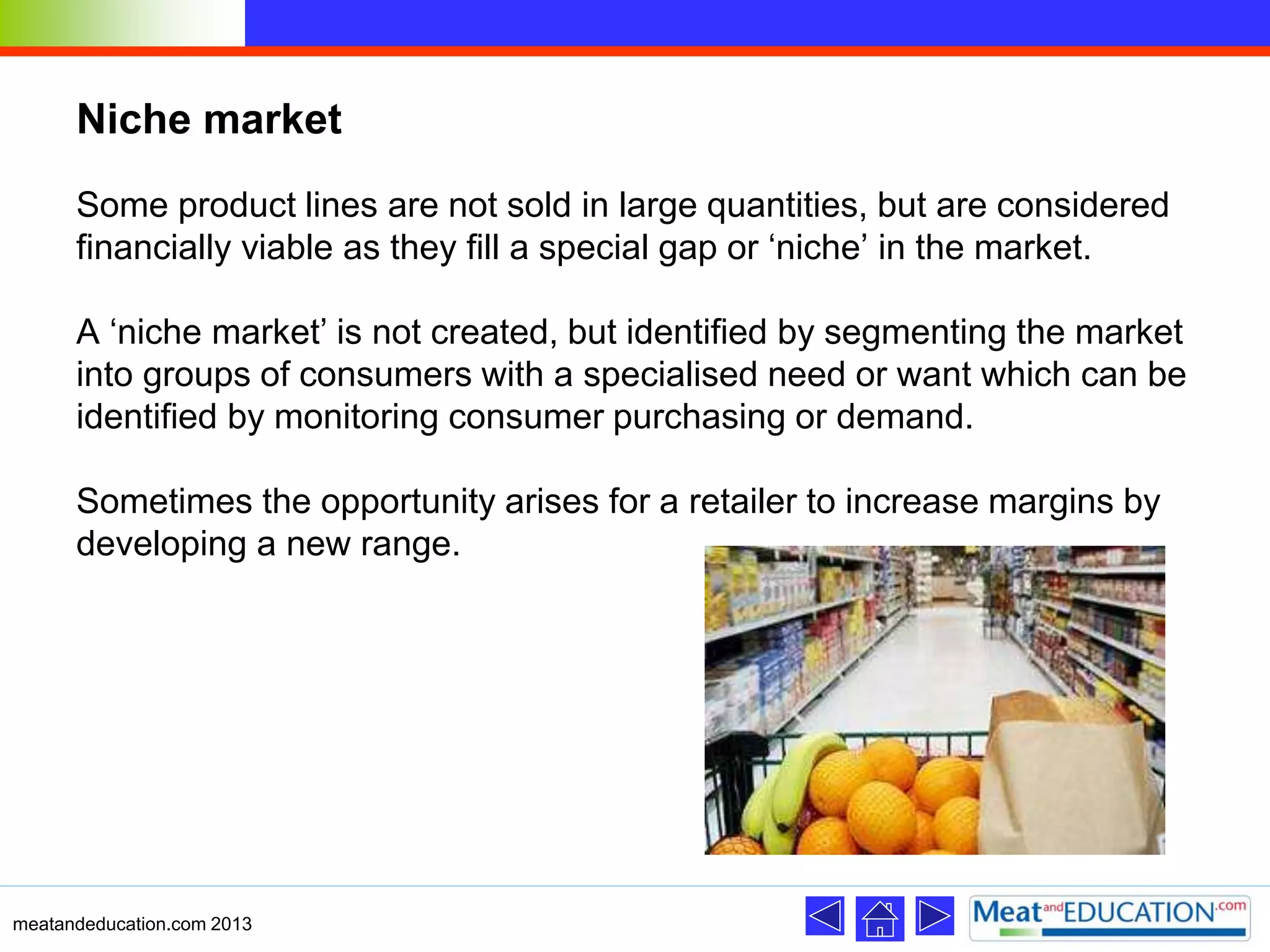
Some product lines are not sold in large quantities, but are considered
financially viable as they fill a special gap or ‘niche’ in the market.
A ‘niche market’ is not created, but identified by segmenting the market
into groups of consumers with a specialised need or want which can be
identified by monitoring consumer purchasing or demand.
Sometimes the opportunity arises for a retailer to increase margins by
developing a new range.
meatandeducation.com 2013
Niche market
A recent trend where consumers are developing a greater interest in
the way products and packaging are made, has led to many
manufacturers responding by producing organic or farm assured
ranges of food products.
Another example is, ‘premium priced’ or luxury products, being
developed to meet the need of a specific group of consumers aspiring
for status and/or have a higher disposable income. This is referred to
tiering system in order to meet different consumer needs.
meatandeducation.com 2013
Consumer decision to buy
Research suggests consumers proceed through five stages when making a
purchase. Food manufacturers need to consider the buying process, rather
than the purchase alone. The stages include:
1. Need recognition or problem awareness, e.g. an empty carton of milk.
2. Information search – passive or active research which could include:
a) internal search, e.g. past experiences
b) personal sources (friends or family), public sources (public
rating reports)
c) marketing sources (advertising).
3. Evaluation of alternatives
4. Purchase decision
5. Post purchase evaluation, e.g. a consumer could decide that an
alternative product would have been preferable and may choose to select
an alternative manufacturers product when the need arises again.
Profit and growth is achieved through repeat purchases of food
manufacturers products by loyal customers.
meatandeducation.com 2013
Increasing market share
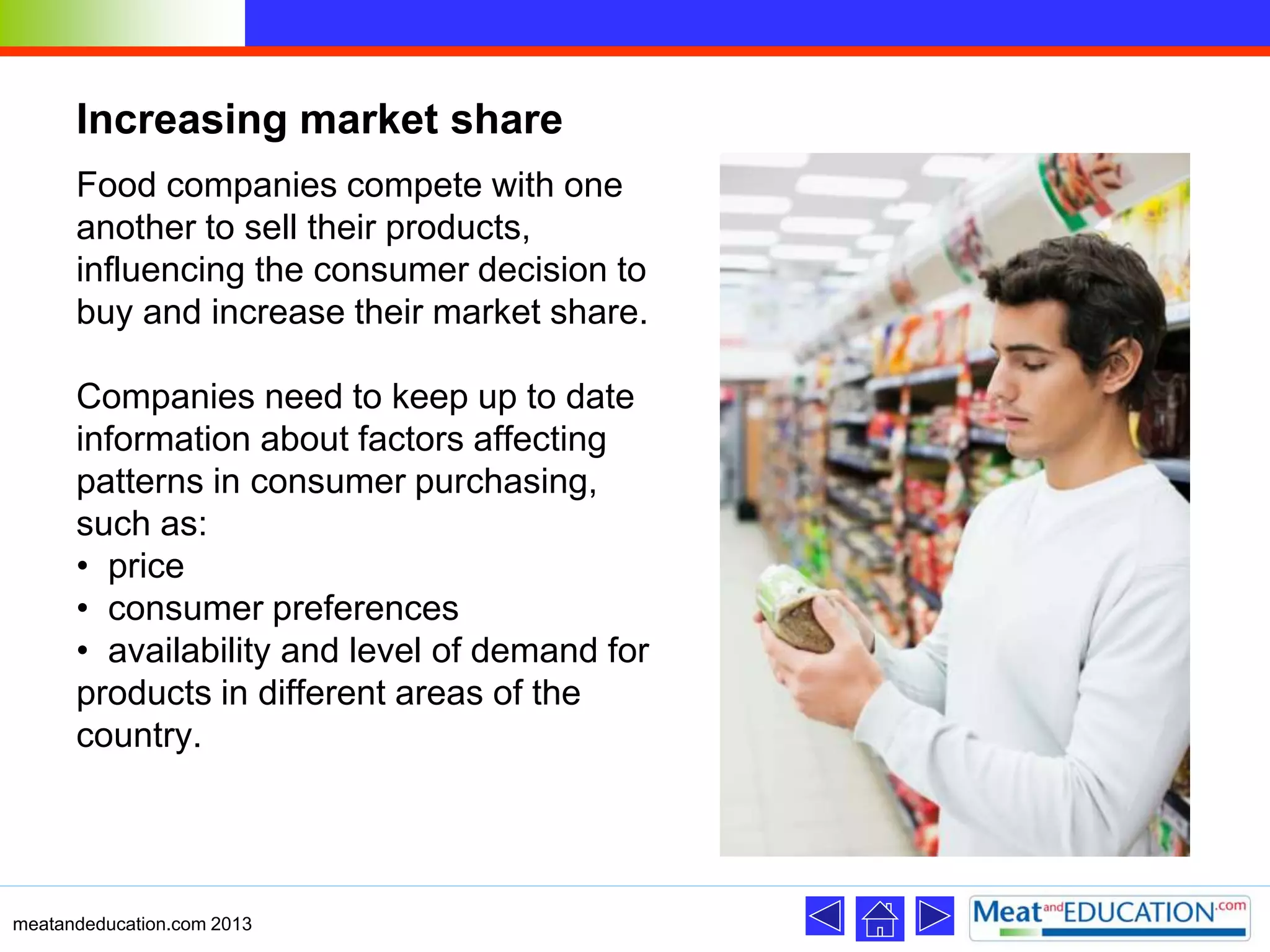
Food companies compete with one
another to sell their products,
influencing the consumer decision to
buy and increase their market share.
Companies need to keep up to date
information about factors affecting
patterns in consumer purchasing,
such as:
• price
• consumer preferences
• availability and level of demand for
products in different areas of the
country.
meatandeducation.com 2013
Increasing market share
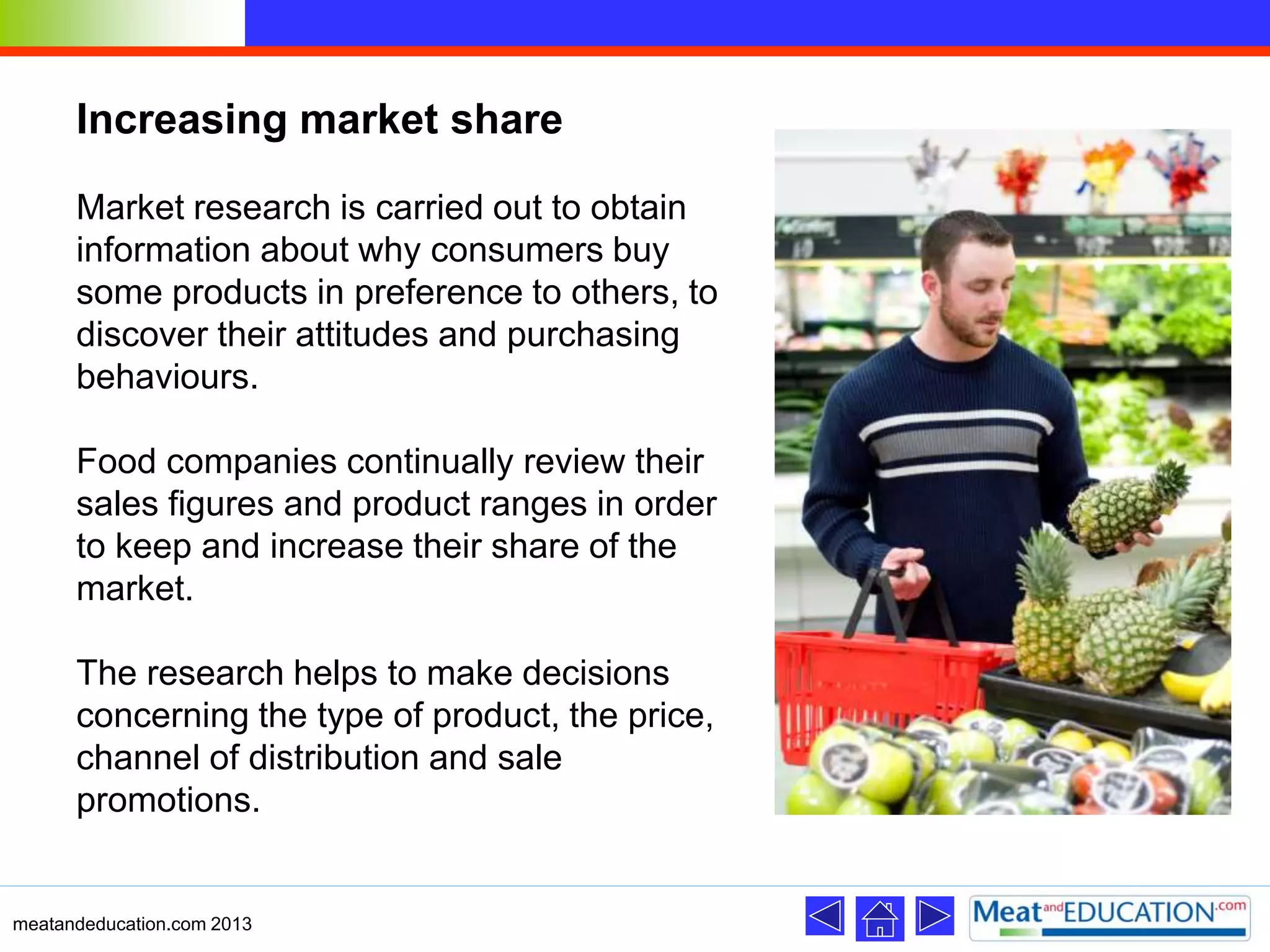
Market research is carried out to obtain
information about why consumers buy
some products in preference to others, to
discover their attitudes and purchasing
behaviours.
Food companies continually review their
sales figures and product ranges in order
to keep and increase their share of the
market.
The research helps to make decisions
concerning the type of product, the price,
channel of distribution and sale
promotions.
meatandeducation.com 2013
Market research
Market research which investigates consumer purchasing attitudes and
behaviour can include a variety of methodologies.
Different types of market research include:
•telephone or online surveys
•customer loyalty cards
•group discussions or focus groups
•home product trials
•regular household purchase monitoring
meatandeducation.com 2013
This provides information about what
customers are buying, whether they like
certain products and whether they would buy
a particular product again.
Click to view the Digi Bite
Market research
Market research can be focused on a wide variety of aspects including
the product, sales, buyer behaviour, promotion, distribution, pricing,
packaging.
meatandeducation.com 2013
Different types of quantitative surveys include:
• Focus group discussions can also be used to gain insight into
consumer attitudes, preferences, buying behaviour
• Consumer surveys “Omnibus” market research
– 1000+ adults
• Diary data: continuous research
– e.g. Family Expenditure Survey. HM Government
• Panel data: large-scale sample
– e.g. Kantar World panel researches 25,000 households who
scan bar codes of food products. This data can be extrapolated
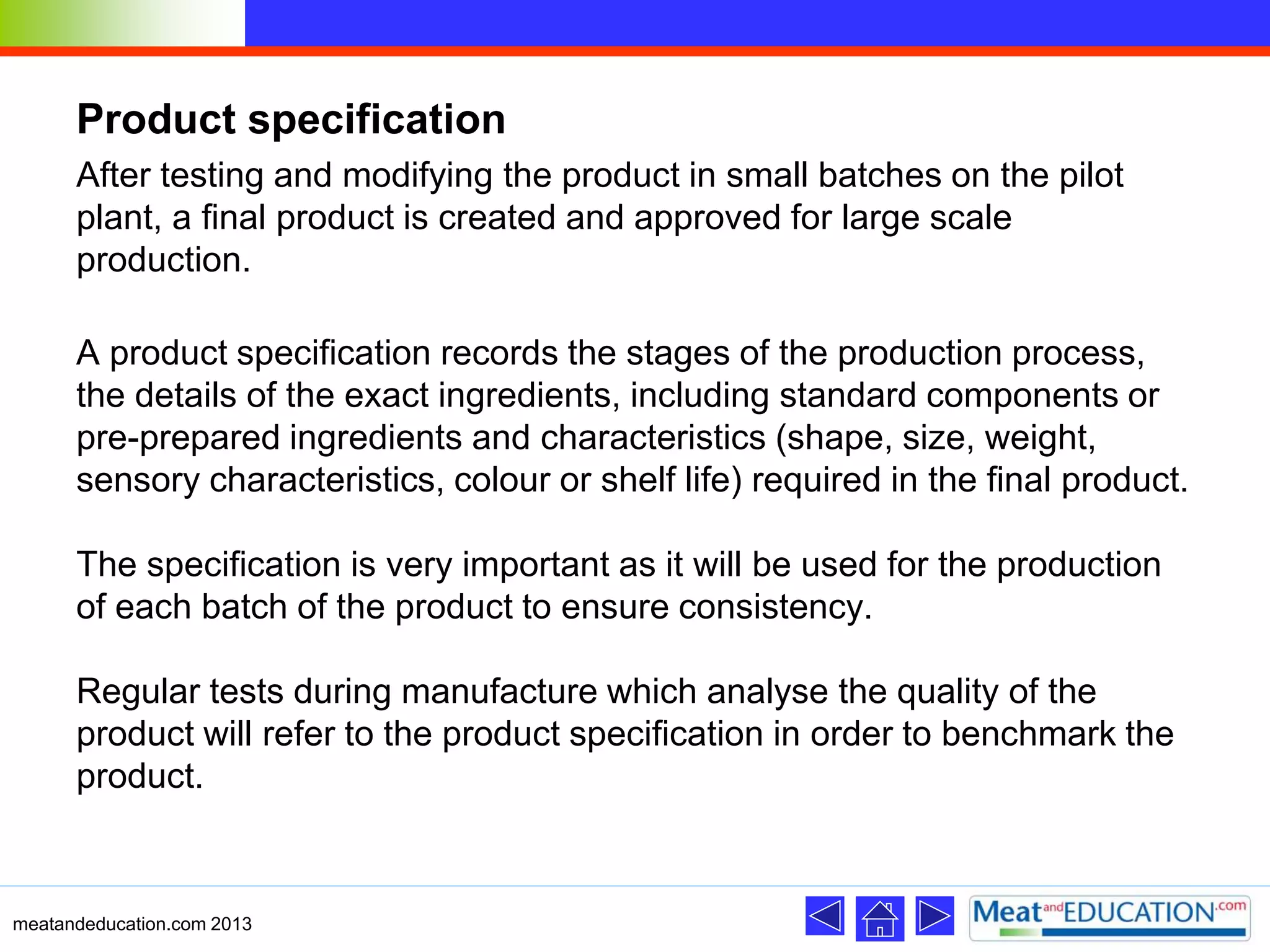
to represent the whole UK population.
– Expenditure and Food Survey (DEFRA) which provides
information on trends in food consumption.
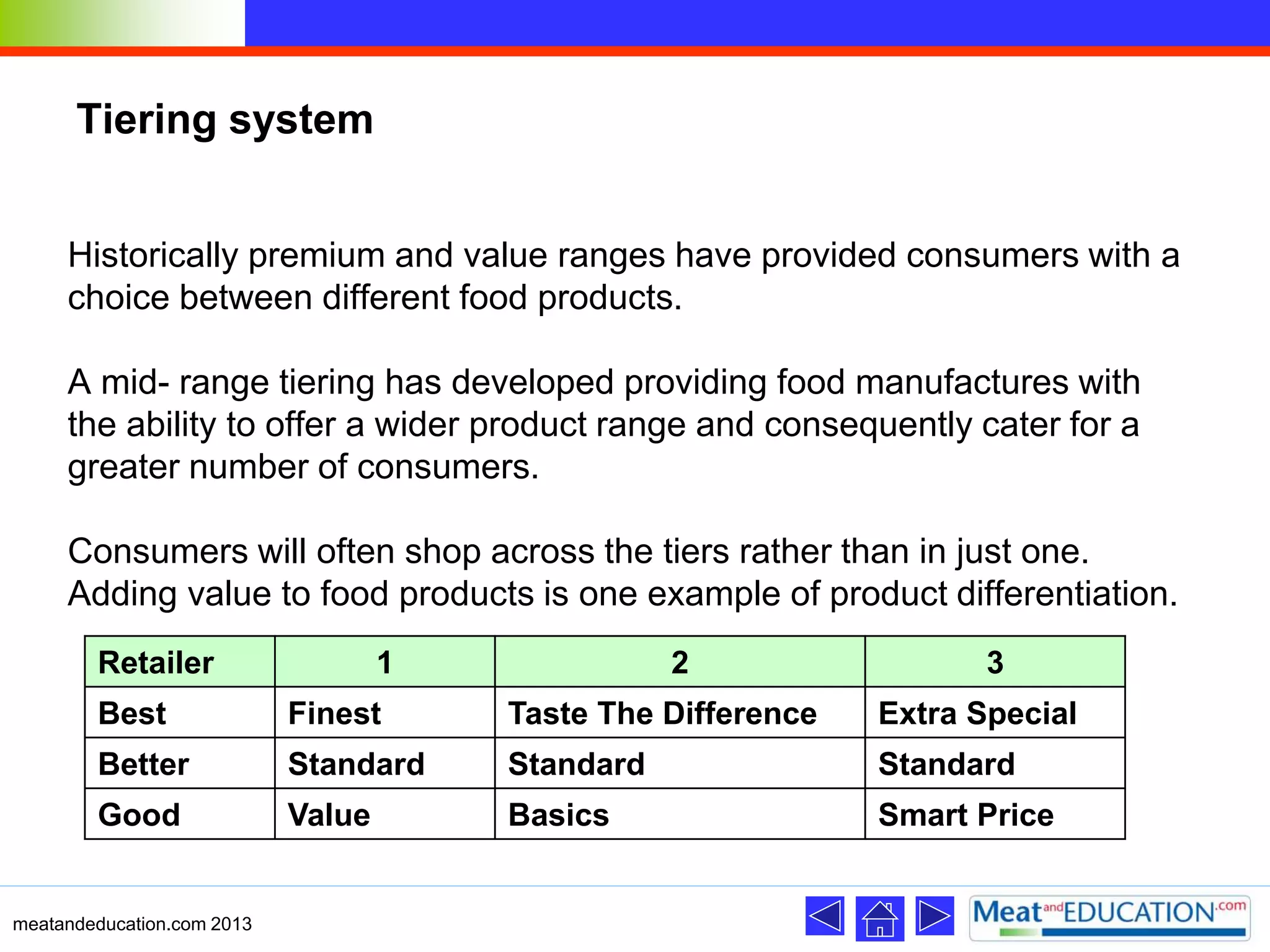
Tiering system
Historically premium and value ranges have provided consumers with a
choice between different food products.
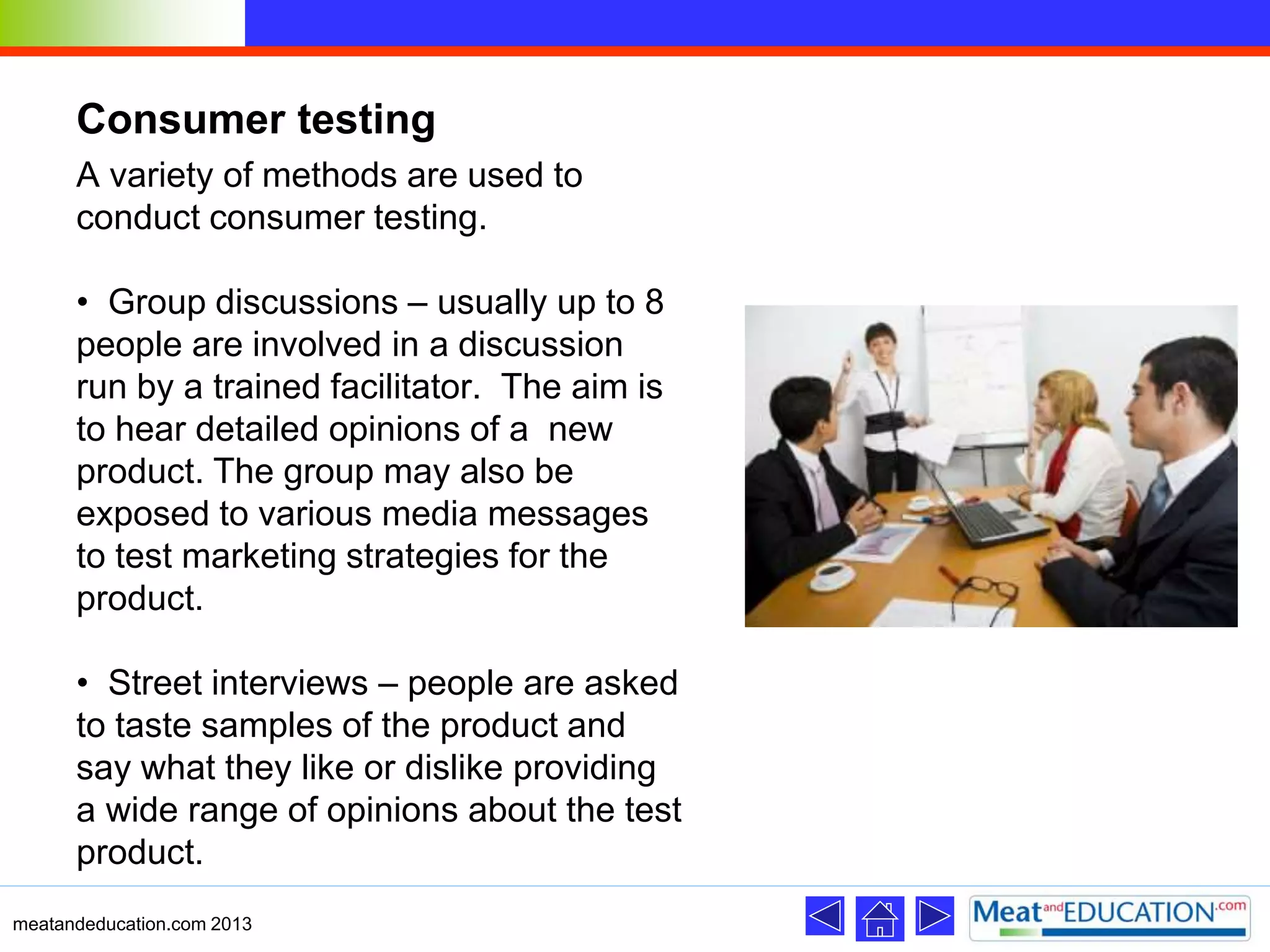
A mid- range tiering has developed providing food manufactures with
the ability to offer a wider product range and consequently cater for a
greater number of consumers.
Consumers will often shop across the tiers rather than in just one.
Adding value to food products is one example of product differentiation.
Retailer 1 2 3
Best Finest Taste The Difference Extra Special
Better Standard Standard Standard
Good Value Basics Smart Price
meatandeducation.com 2013
The marketing mix
The marketing mix explains a combination of marketing activities or
tools to ensure customer satisfaction and profits for the food company.
It is often referred to as the ‘4 P’s’.
1.Product - the product specification including packaging, branding,
quality and identifying the target consumer market.
2.Price - this must reflect the cost of production and marketing and
target profit margins. Pricing mix includes competition, cost, mark-
ups, discounts and geography.
3.Place - this includes where the product is sold including online
purchasing (type of retailers, shelf location), market exposure
(increasing the consumer awareness about the product),
transportation, distribution, coverage and location.
4.Promotion - how to promote the product in-store and out-of-store
including advertising, publicity, selling and the message conveyed.
meatandeducation.com 2013
The marketing mix
Recently a fifth ‘P’ has been raised - people.
This includes people from the fields right through to the sales areas
ensuring correct procedures and attitudes are in place.
meatandeducation.com 2013
Click to view the Digi Bite
meatandeducation.com 2013
Develop concept ideas
Accept
Test on a small scale with samples
Organoleptic analysis (sensory testing) Reject
Consumer testing
Finalise product specification
Produce product on a large scale
Promote product
Launch new product
Organoleptic analysis (sensory testing)
Accept
Reject
Modify product
Pilot plant
Reject
Accept
2. New product development
New product development
(NPD) is an important
process for food companies
to undertake in order to
meet consumer needs and
remain competitive in the
food market.
Many product ideas fail at
different stages of the
process.
Many food companies will
continuously have a variety
of products at different
stages of development.
Develop concept ideas
Concept ideas can arise from a variety of different sources.
New product concepts can be developed and informed through:
• market research
• consumer trends
• customer feedback
• new industry regulations
• new technologies available
• target customer profiles
• replacement of products at the end of their life cycle
• creating a product which will compete with a current product already
on the market.
Background research is conducted to identify opportunities for a new
product. This can include researching current products produced by
competitors or consumer attitudes and behaviour with market research.
meatandeducation.com 2013
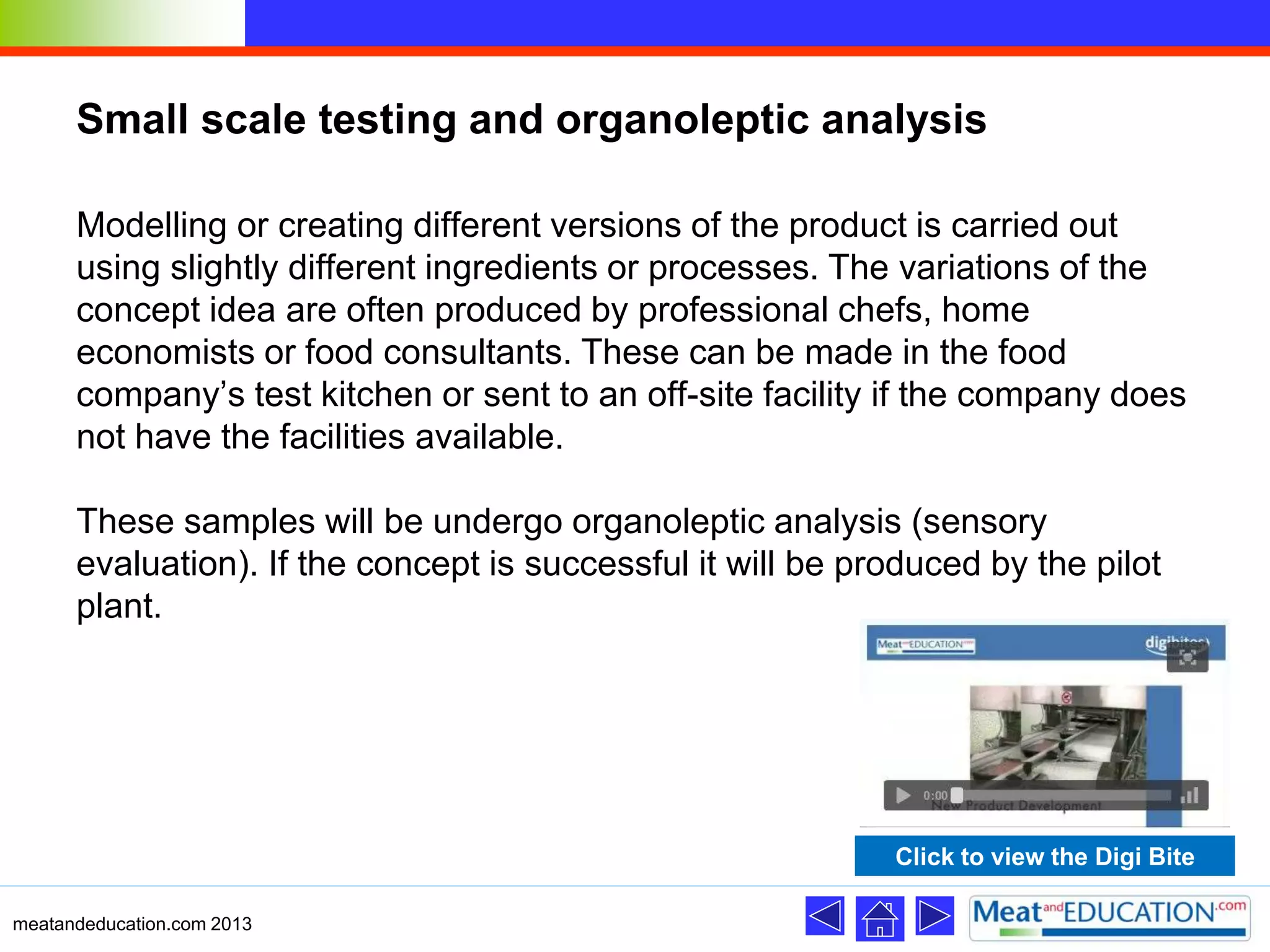
Small scale testing and organoleptic analysis
New product ideas are initially screened in order to asses:
• manufacturing practicality
• cost viability
• how it compares with competitor products
meatandeducation.com 2013
Small scale testing and organoleptic analysis
Modelling or creating different versions of the product is carried out
using slightly different ingredients or processes. The variations of the
concept idea are often produced by professional chefs, home
economists or food consultants. These can be made in the food
company’s test kitchen or sent to an off-site facility if the company does
not have the facilities available.
These samples will be undergo organoleptic analysis (sensory
evaluation). If the concept is successful it will be produced by the pilot
plant.
meatandeducation.com 2013
Click to view the Digi Bite
Pilot plant and consumer testing
Concepts that are successful in the test kitchen will proceed to the pilot
plant to be produced with small scale manufacturing equipment.
Although the product would be produced on a small scale, the same
technical processes would be applied as would happened in large
scale production.
This allows companies to test the technical viability of the product and
to conduct market research and sensory evaluation on a larger batch.
Consumers sharing particular traits will be selected if the new product
is targeted at a segment of the market, alternatively consumers with
different characteristics will be selected to conduct sensory evaluation
tests on the product.
Recipe modification can be undertaken to address sensory or technical
manufacturing problems which are identified at the pilot plant stage.
meatandeducation.com 2013
Product specification
After testing and modifying the product in small batches on the pilot
plant, a final product is created and approved for large scale
production.
A product specification records the stages of the production process,
the details of the exact ingredients, including standard components or
pre-prepared ingredients and characteristics (shape, size, weight,
sensory characteristics, colour or shelf life) required in the final product.
The specification is very important as it will be used for the production
of each batch of the product to ensure consistency.
Regular tests during manufacture which analyse the quality of the
product will refer to the product specification in order to benchmark the
product.
meatandeducation.com 2013
Consumer testing
A variety of methods are used to
conduct consumer testing.
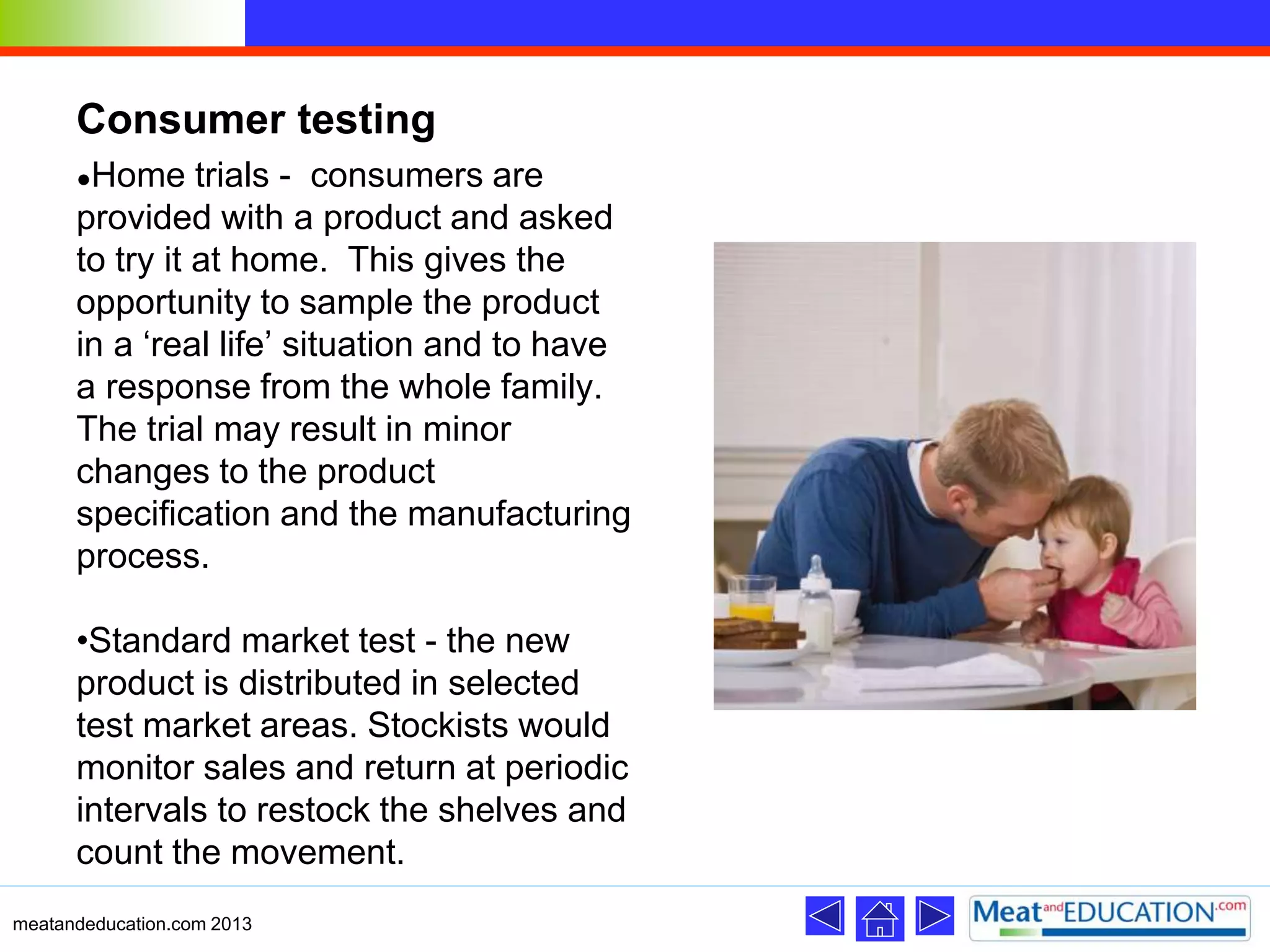
• Group discussions – usually up to 8
people are involved in a discussion
run by a trained facilitator. The aim is
to hear detailed opinions of a new
product. The group may also be
exposed to various media messages
to test marketing strategies for the
product.
• Street interviews – people are asked
to taste samples of the product and
say what they like or dislike providing
a wide range of opinions about the test
product.
meatandeducation.com 2013
Consumer testing
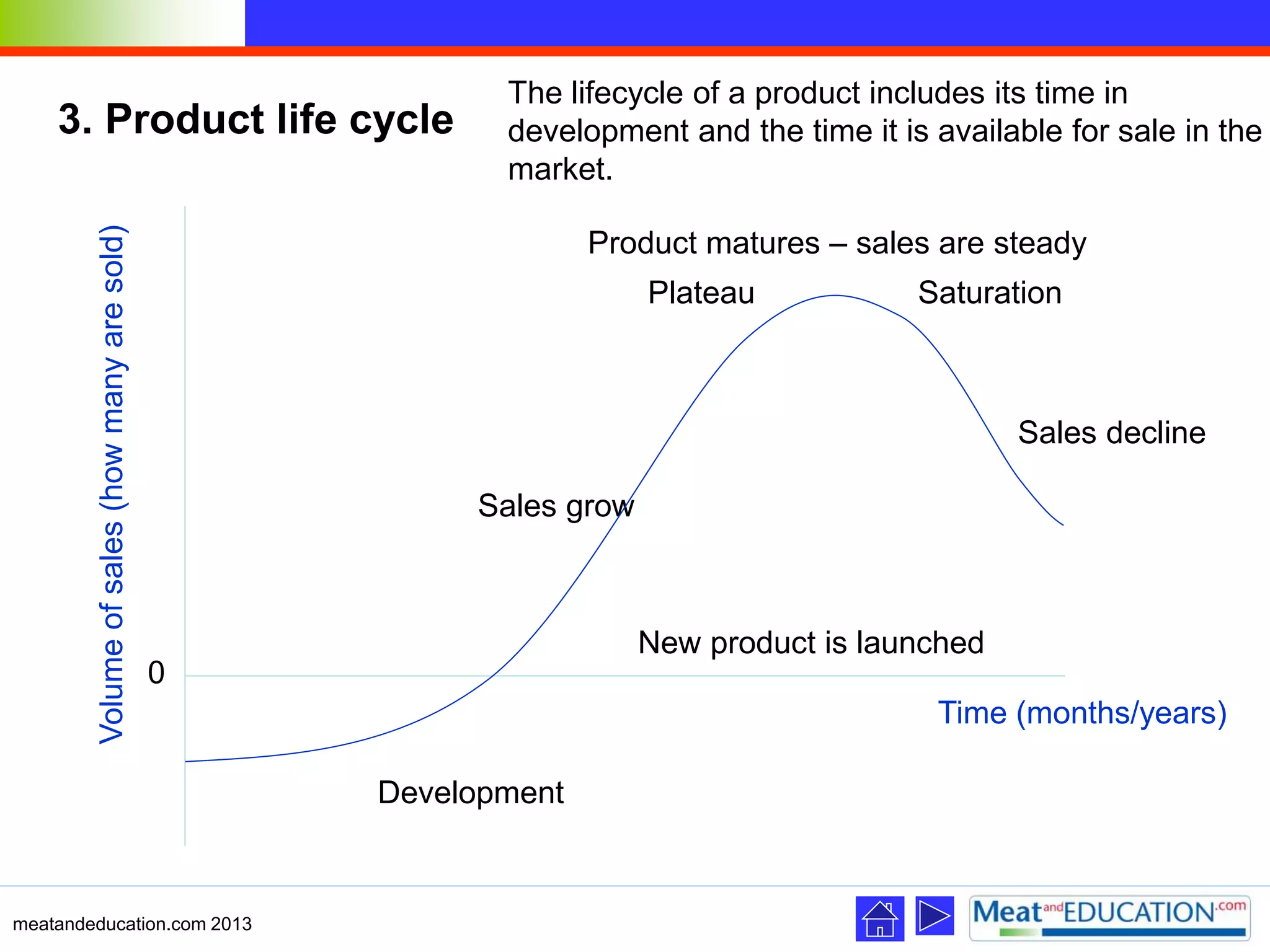
●Home trials - consumers are
provided with a product and asked
to try it at home. This gives the
opportunity to sample the product
in a ‘real life’ situation and to have
a response from the whole family.
The trial may result in minor
changes to the product
specification and the manufacturing
process.
•Standard market test - the new
product is distributed in selected
test market areas. Stockists would
monitor sales and return at periodic
intervals to restock the shelves and
count the movement.
meatandeducation.com 2013
Part 2Part 1
Production on a large scale
meatandeducation.com 2013
An artisan sausage producer provides an insight into new product
development and large scale production of sausages.
{
Click to view the Digi BiteClick to view the Digi Bite
Launch
Marketing strategies are developed alongside the product development
process. Promotion of the product begins to take place after the launch.
After a fixed period of time, products are always reviewed to see how
well they are performing.
Decisions on price must consider a variety of costs (handling,
packaging, transport, storage and processing) involved in the
manufacture of the product in order to be profitable.
Sometimes products are launched in different regions of the country to
measure their performance. This may indicate whether the product
could be launched at a national level or should be dropped from
production.
meatandeducation.com 2013
Some products do not pass the NPD process
Many products may fail at different stages of the NPD process and may
never be launched. Products which are launched may only be on sale
for a short period of time, before a new product replaces it.
Reasons for failure may include:
• tough competition
• cost of ingredients, production and packaging
• low profits
• ineffective advertising
• food scares
• poor product positioning on shelf.
Although many products may fail, the NPD process remains a crucial
part of any successful food company to ensure it remains competitive
against other companies.
meatandeducation.com 2013
3. Product life cycle
meatandeducation.com 2013
Time (months/years)
Volumeofsales(howmanyaresold)
New product is launched
Product matures – sales are steady
Plateau
Sales grow
Sales decline
Development
Saturation
0
The lifecycle of a product includes its time in
development and the time it is available for sale in the
market.
Sales boosting strategies
meatandeducation.com 2013
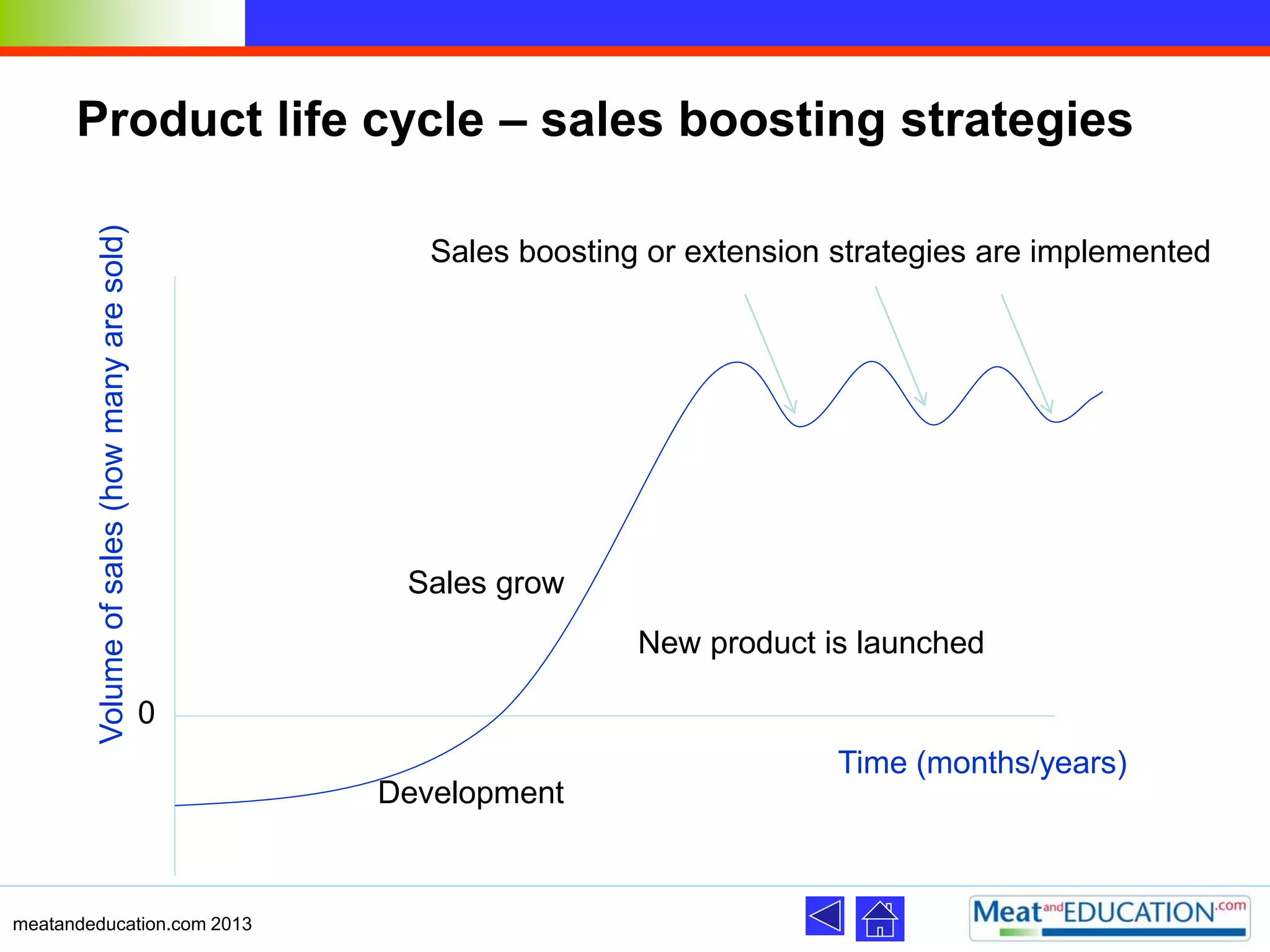
To boost sales and prevent a decline in a product life cycle, food
companies implement marketing strategies such as:
• advertising, e.g. television, billboard, online
• price reduction, e.g. vouchers or buy-one-get-one-free
• adding value – new features, e.g. limited edition varieties, new
pack sizes
• exploring new markets, e.g. international markets
• new packaging – subtle changes or completely new design
• consumer competitions.
These strategies can help the sales of particular products remain
relatively level for long periods of time.
Product life cycle – sales boosting strategies
meatandeducation.com 2013
Time (months/years)
Volumeofsales(howmanyaresold)
New product is launched
Sales boosting or extension strategies are implemented
Sales grow
Development
0
Question 1
Select the term which best represents a group of people or
organizations that are interested or are in need of a product and have
the resources to purchase the product.
3. Marketing
2. Retailers
1. Consumer market
4. Segmentation
meatandeducation.com 2013
Question 1
Correct, well done.
Click this arrow to go to try the next question.
meatandeducation.com 2013
Question 1
Incorrect, try again.
Click this arrow to go to try the next question.
Click this arrow to go to try the question again.
meatandeducation.com 2013
Question 2
Which term describes when the consumer market is
divided into groups of consumers with similar traits or
characteristics?
3. Market segmentation
2. Food product tiering
1. Value adding
4. Market channels
meatandeducation.com 2013
Question 2
Correct, well done.
Click the arrow to go to the next question.
meatandeducation.com 2013
Question 2
Incorrect, try again.
Click this arrow to go to try the next question.
Click this arrow to go to try the question again.
meatandeducation.com 2013
Question 3
True or false? Sales boosting strategies are used to extend the life
cycle of a product.
2. False
1. True
meatandeducation.com 2013
Question 3
Correct, well done.
Click the arrow to go to the next question.
meatandeducation.com 2013
Question 3
Incorrect, try again.
Click this arrow to go to try the next question.
Click this arrow to go to try the question again.
meatandeducation.com 2013
Question 4
Which of the following is not an increasing product trend?
3. Luxury/Indulgence
2. Convenience
1. Health
4. Frozen foods
meatandeducation.com 2013
Question 4
Correct, well done.
Click the arrow to go to the next question.
meatandeducation.com 2013
Question 4
Incorrect, try again.
Click this arrow to go to try the next question.
Click this arrow to go to try the question again.
meatandeducation.com 2013
Question 5
True or false? New product development process ensures that every
new concept idea will be tested and reformulated until each idea is
produced and placed on the shelf for consumers.
2. False
1. True
meatandeducation.com 2013
Question 5
Correct, well done.
Click the arrow to go to the next question.
meatandeducation.com 2013
Question 5
Incorrect, try again.
Click this arrow to go to try the next question.
Click this arrow to go to try the question again.
meatandeducation.com 2013
Question 6
Fill in the gaps.
The market is said to be saturated when a food product has been
available for a _____ period of time and sales are no longer ________.
3. long, decreasing
2. short, increasing
1. long, increasing
4. short, decreasing
meatandeducation.com 2013
Question 6
Correct, well done.
Click the arrow to go to the next question.
meatandeducation.com 2013
Question 6
Incorrect, try again.
Click this arrow to go to try the next question.
Click this arrow to go to try the question again.
meatandeducation.com 2013
Question 7
Which of the following would not be included in the product specification
records?
3. Sensory characteristics
2. Ingredient details
1. Production process details
4. Sales boosting strategies
meatandeducation.com 2013
Question 7
Correct, well done.
Click the arrow to go to the next question.
meatandeducation.com 2013
Question 7
Incorrect, try again.
Click this arrow to go to try the next question.
Click this arrow to go to try the question again.
meatandeducation.com 2013
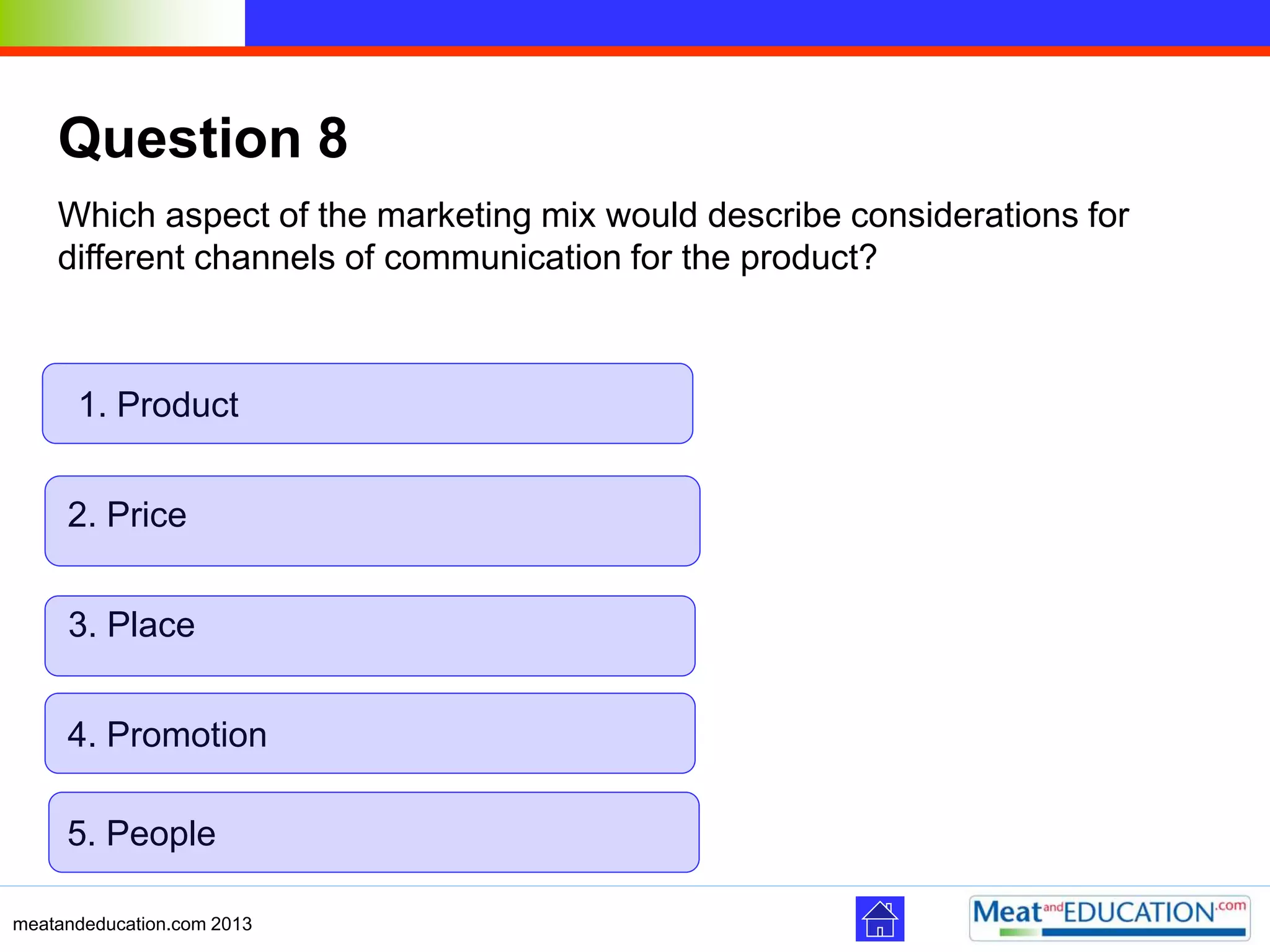
Question 8
Which aspect of the marketing mix would describe considerations for
different channels of communication for the product?
3. Place
2. Price
1. Product
4. Promotion
5. People
meatandeducation.com 2013
Question 8
Correct, well done.
Click the arrow to go to the next question.
meatandeducation.com 2013
Question 8
Incorrect, try again.
Click this arrow to go to try the next question.
Click this arrow to go to try the question again.
meatandeducation.com 2013
Question 9
What has happened at the point where the arrow is indicating on the
product lifecycle graph?
3. The product is under development.
2. The product has been launched.
1. The sales are in decline.
4. The market is saturated.
Time (months/years)
Volumeofsales(howmanyaresold)
0
meatandeducation.com 2013
Question 9
Correct, well done.
Click the arrow to go to the next question.
meatandeducation.com 2013
Question 9
Incorrect, try again.
Click this arrow to go to try the next question.
Click this arrow to go to try the question again.
meatandeducation.com 2013
Question 10
Why are products tiered to provide a basic, mid-range and premium
products for consumers?
3. To help retailers fill their shelves with products.
2. To save the food manufacturer money.
1. To provide consumers with a diverse range of products.
4. To save money when marketing products.
meatandeducation.com 2013
Question 10
Correct, well done.
Click to return to the main menu.
meatandeducation.com 2013
Question 10
Incorrect, try again.
Click this arrow to end.
Click this arrow to go to try the question again.
meatandeducation.com 2013
End of questions.
Click the home button to
return to the main menu.
Extension
Q1. Discuss how the following factors may influence
product choice.
a) Ethnic and religious groups
b) Environmental concerns
c) Current dietary guidelines
Q2. Describe the stages of food product development.
Q3. Explain the key stages in a product life cycle.
meatandeducation.com 2013
Thank you for using
Marketing and new product development.
For further information and support, go to:
www.meatandeducation.com

Marketing and Product Development

  • 1.
    From concept toshop: Marketing and new product development An interactive PowerPoint presentation for A-level students meatandeducation.com 2013
  • 2.
    Welcome Use the followingbuttons to guide you through this resource. This button takes you to the main menu. This button moves you to the next slide. This button moves you to the previous slide. meatandeducation.com 2013
  • 3.
    Menu Click on theinformation section you wish to read. Click Questions, if you are ready to take the multiple choice quiz. Information 1. Consumer market 2. New Product Development 3. Product life cycle Questions EndExtension questions meatandeducation.com 2013
  • 4.
    1. What isthe consumer market? The consumer market refers to a group of people or organizations that are interested in, or are in need of, a product and have the resources to purchase the product. Over time the size of the population of a particular country may not change dramatically, so the consumer market is fixed in size, resulting in manufacturers and retailers competing for business to maintain or increase their share of the market. meatandeducation.com 2013
  • 5.
    What is marketing? Marketingis a process which identifies, anticipates and satisfies customer needs efficiently and profitably. It also communicates with the customer in a way that creates competition. This helps maintain a fair or acceptable pricing policy. The aim of marketing is always to create a preference for one product over another. meatandeducation.com 2013
  • 6.
    Saturated markets andsegmentation Popular food products which have been available to purchase over an extended period of time can eventually reach a point where the sales cannot be improved. In this situation, the market is said to have become saturated. Diversification of product lines with special features, e.g. beef steak marinated in different sauces or altering the label can help to create new markets and increase sales. A greater selection of products with different specifications to meet different consumer needs will reach a larger portion of the consumer market, e.g. low fat or salt versions of a product. meatandeducation.com 2013
  • 7.
    Segmentation in thefood market Consumers differ widely in their particular needs, motivations or preferences and buying capacity. One supplier cannot provide one product suitable for the entire market. Alternatively, one supplier cannot provide a wide enough range of products to suit each individual consumer’s needs within the market. However, the consumer market can be segmented into groups who share similar characteristics or purchasing needs. This allows suppliers to create different products which would suit different consumer needs according to their: age, income, taste, lifestyle, health or beliefs. meatandeducation.com 2013 Click to view the Digi Bite
  • 8.
    Segmentation in thefood market Health – modifications to nutrition content Convenience – in response to changing lifestyles Indulgence – for people to treat themselves Currently three growth trends include health, convenience and indulgence. Consumers will often buy products which meet all three needs during a shopping occasion. Other growth trends include consumer ethics (some becoming mainstream): •Fair Trade •Animal Welfare •Sustainability •Provenance •Quality schemes, e.g. Red Tractor Food Assurance meatandeducation.com 2013 Click to view the Digi Bite
  • 9.
    Examples of marketsegmentation The market can be segmented into: Geographic: characteristics of consumers differ across nations, states, geographic areas reflecting cultural interests. Demographic: variables such as age, sex, family size, income, occupation, education, religion, race and nationality are used widely, e.g. ethnic minority foods have increase in popularity in the UK. Psychological: personality, lifestyle, social class Behavioural: knowledge, attitude, use or response to a product. meatandeducation.com 2013
  • 10.
    Reasons for newproduct development Food is an essential aspect for maintaining life. Red meat in particular provides many nutrients essential for life. The purpose for developing new red meat products could be due to: • A gap in the market, e.g. organic farmed food products • New consumer pressures, e.g. economic crisis • Drop in customer loyalty or loss of market share • New ideas or technology • An emerging consumer demand, e.g. convenience, health or indulgence. meatandeducation.com 2013
  • 11.
    Niche market Some productlines are not sold in large quantities, but are considered financially viable as they fill a special gap or ‘niche’ in the market. A ‘niche market’ is not created, but identified by segmenting the market into groups of consumers with a specialised need or want which can be identified by monitoring consumer purchasing or demand. Sometimes the opportunity arises for a retailer to increase margins by developing a new range. meatandeducation.com 2013
  • 12.
    Niche market A recenttrend where consumers are developing a greater interest in the way products and packaging are made, has led to many manufacturers responding by producing organic or farm assured ranges of food products. Another example is, ‘premium priced’ or luxury products, being developed to meet the need of a specific group of consumers aspiring for status and/or have a higher disposable income. This is referred to tiering system in order to meet different consumer needs. meatandeducation.com 2013
  • 13.
    Consumer decision tobuy Research suggests consumers proceed through five stages when making a purchase. Food manufacturers need to consider the buying process, rather than the purchase alone. The stages include: 1. Need recognition or problem awareness, e.g. an empty carton of milk. 2. Information search – passive or active research which could include: a) internal search, e.g. past experiences b) personal sources (friends or family), public sources (public rating reports) c) marketing sources (advertising). 3. Evaluation of alternatives 4. Purchase decision 5. Post purchase evaluation, e.g. a consumer could decide that an alternative product would have been preferable and may choose to select an alternative manufacturers product when the need arises again. Profit and growth is achieved through repeat purchases of food manufacturers products by loyal customers. meatandeducation.com 2013
  • 14.
    Increasing market share Foodcompanies compete with one another to sell their products, influencing the consumer decision to buy and increase their market share. Companies need to keep up to date information about factors affecting patterns in consumer purchasing, such as: • price • consumer preferences • availability and level of demand for products in different areas of the country. meatandeducation.com 2013
  • 15.
    Increasing market share Marketresearch is carried out to obtain information about why consumers buy some products in preference to others, to discover their attitudes and purchasing behaviours. Food companies continually review their sales figures and product ranges in order to keep and increase their share of the market. The research helps to make decisions concerning the type of product, the price, channel of distribution and sale promotions. meatandeducation.com 2013
  • 16.
    Market research Market researchwhich investigates consumer purchasing attitudes and behaviour can include a variety of methodologies. Different types of market research include: •telephone or online surveys •customer loyalty cards •group discussions or focus groups •home product trials •regular household purchase monitoring meatandeducation.com 2013 This provides information about what customers are buying, whether they like certain products and whether they would buy a particular product again. Click to view the Digi Bite
  • 17.
    Market research Market researchcan be focused on a wide variety of aspects including the product, sales, buyer behaviour, promotion, distribution, pricing, packaging. meatandeducation.com 2013 Different types of quantitative surveys include: • Focus group discussions can also be used to gain insight into consumer attitudes, preferences, buying behaviour • Consumer surveys “Omnibus” market research – 1000+ adults • Diary data: continuous research – e.g. Family Expenditure Survey. HM Government • Panel data: large-scale sample – e.g. Kantar World panel researches 25,000 households who scan bar codes of food products. This data can be extrapolated to represent the whole UK population. – Expenditure and Food Survey (DEFRA) which provides information on trends in food consumption.
  • 18.
    Tiering system Historically premiumand value ranges have provided consumers with a choice between different food products. A mid- range tiering has developed providing food manufactures with the ability to offer a wider product range and consequently cater for a greater number of consumers. Consumers will often shop across the tiers rather than in just one. Adding value to food products is one example of product differentiation. Retailer 1 2 3 Best Finest Taste The Difference Extra Special Better Standard Standard Standard Good Value Basics Smart Price meatandeducation.com 2013
  • 19.
    The marketing mix Themarketing mix explains a combination of marketing activities or tools to ensure customer satisfaction and profits for the food company. It is often referred to as the ‘4 P’s’. 1.Product - the product specification including packaging, branding, quality and identifying the target consumer market. 2.Price - this must reflect the cost of production and marketing and target profit margins. Pricing mix includes competition, cost, mark- ups, discounts and geography. 3.Place - this includes where the product is sold including online purchasing (type of retailers, shelf location), market exposure (increasing the consumer awareness about the product), transportation, distribution, coverage and location. 4.Promotion - how to promote the product in-store and out-of-store including advertising, publicity, selling and the message conveyed. meatandeducation.com 2013
  • 20.
    The marketing mix Recentlya fifth ‘P’ has been raised - people. This includes people from the fields right through to the sales areas ensuring correct procedures and attitudes are in place. meatandeducation.com 2013 Click to view the Digi Bite
  • 21.
    meatandeducation.com 2013 Develop conceptideas Accept Test on a small scale with samples Organoleptic analysis (sensory testing) Reject Consumer testing Finalise product specification Produce product on a large scale Promote product Launch new product Organoleptic analysis (sensory testing) Accept Reject Modify product Pilot plant Reject Accept 2. New product development New product development (NPD) is an important process for food companies to undertake in order to meet consumer needs and remain competitive in the food market. Many product ideas fail at different stages of the process. Many food companies will continuously have a variety of products at different stages of development.
  • 22.
    Develop concept ideas Conceptideas can arise from a variety of different sources. New product concepts can be developed and informed through: • market research • consumer trends • customer feedback • new industry regulations • new technologies available • target customer profiles • replacement of products at the end of their life cycle • creating a product which will compete with a current product already on the market. Background research is conducted to identify opportunities for a new product. This can include researching current products produced by competitors or consumer attitudes and behaviour with market research. meatandeducation.com 2013
  • 23.
    Small scale testingand organoleptic analysis New product ideas are initially screened in order to asses: • manufacturing practicality • cost viability • how it compares with competitor products meatandeducation.com 2013
  • 24.
    Small scale testingand organoleptic analysis Modelling or creating different versions of the product is carried out using slightly different ingredients or processes. The variations of the concept idea are often produced by professional chefs, home economists or food consultants. These can be made in the food company’s test kitchen or sent to an off-site facility if the company does not have the facilities available. These samples will be undergo organoleptic analysis (sensory evaluation). If the concept is successful it will be produced by the pilot plant. meatandeducation.com 2013 Click to view the Digi Bite
  • 25.
    Pilot plant andconsumer testing Concepts that are successful in the test kitchen will proceed to the pilot plant to be produced with small scale manufacturing equipment. Although the product would be produced on a small scale, the same technical processes would be applied as would happened in large scale production. This allows companies to test the technical viability of the product and to conduct market research and sensory evaluation on a larger batch. Consumers sharing particular traits will be selected if the new product is targeted at a segment of the market, alternatively consumers with different characteristics will be selected to conduct sensory evaluation tests on the product. Recipe modification can be undertaken to address sensory or technical manufacturing problems which are identified at the pilot plant stage. meatandeducation.com 2013
  • 26.
    Product specification After testingand modifying the product in small batches on the pilot plant, a final product is created and approved for large scale production. A product specification records the stages of the production process, the details of the exact ingredients, including standard components or pre-prepared ingredients and characteristics (shape, size, weight, sensory characteristics, colour or shelf life) required in the final product. The specification is very important as it will be used for the production of each batch of the product to ensure consistency. Regular tests during manufacture which analyse the quality of the product will refer to the product specification in order to benchmark the product. meatandeducation.com 2013
  • 27.
    Consumer testing A varietyof methods are used to conduct consumer testing. • Group discussions – usually up to 8 people are involved in a discussion run by a trained facilitator. The aim is to hear detailed opinions of a new product. The group may also be exposed to various media messages to test marketing strategies for the product. • Street interviews – people are asked to taste samples of the product and say what they like or dislike providing a wide range of opinions about the test product. meatandeducation.com 2013
  • 28.
    Consumer testing ●Home trials- consumers are provided with a product and asked to try it at home. This gives the opportunity to sample the product in a ‘real life’ situation and to have a response from the whole family. The trial may result in minor changes to the product specification and the manufacturing process. •Standard market test - the new product is distributed in selected test market areas. Stockists would monitor sales and return at periodic intervals to restock the shelves and count the movement. meatandeducation.com 2013
  • 29.
    Part 2Part 1 Productionon a large scale meatandeducation.com 2013 An artisan sausage producer provides an insight into new product development and large scale production of sausages. { Click to view the Digi BiteClick to view the Digi Bite
  • 30.
    Launch Marketing strategies aredeveloped alongside the product development process. Promotion of the product begins to take place after the launch. After a fixed period of time, products are always reviewed to see how well they are performing. Decisions on price must consider a variety of costs (handling, packaging, transport, storage and processing) involved in the manufacture of the product in order to be profitable. Sometimes products are launched in different regions of the country to measure their performance. This may indicate whether the product could be launched at a national level or should be dropped from production. meatandeducation.com 2013
  • 31.
    Some products donot pass the NPD process Many products may fail at different stages of the NPD process and may never be launched. Products which are launched may only be on sale for a short period of time, before a new product replaces it. Reasons for failure may include: • tough competition • cost of ingredients, production and packaging • low profits • ineffective advertising • food scares • poor product positioning on shelf. Although many products may fail, the NPD process remains a crucial part of any successful food company to ensure it remains competitive against other companies. meatandeducation.com 2013
  • 32.
    3. Product lifecycle meatandeducation.com 2013 Time (months/years) Volumeofsales(howmanyaresold) New product is launched Product matures – sales are steady Plateau Sales grow Sales decline Development Saturation 0 The lifecycle of a product includes its time in development and the time it is available for sale in the market.
  • 33.
    Sales boosting strategies meatandeducation.com2013 To boost sales and prevent a decline in a product life cycle, food companies implement marketing strategies such as: • advertising, e.g. television, billboard, online • price reduction, e.g. vouchers or buy-one-get-one-free • adding value – new features, e.g. limited edition varieties, new pack sizes • exploring new markets, e.g. international markets • new packaging – subtle changes or completely new design • consumer competitions. These strategies can help the sales of particular products remain relatively level for long periods of time.
  • 34.
    Product life cycle– sales boosting strategies meatandeducation.com 2013 Time (months/years) Volumeofsales(howmanyaresold) New product is launched Sales boosting or extension strategies are implemented Sales grow Development 0
  • 35.
    Question 1 Select theterm which best represents a group of people or organizations that are interested or are in need of a product and have the resources to purchase the product. 3. Marketing 2. Retailers 1. Consumer market 4. Segmentation meatandeducation.com 2013
  • 36.
    meatandeducation.com 2013 Question 1 Correct,well done. Click this arrow to go to try the next question.
  • 37.
    meatandeducation.com 2013 Question 1 Incorrect,try again. Click this arrow to go to try the next question. Click this arrow to go to try the question again.
  • 38.
    meatandeducation.com 2013 Question 2 Whichterm describes when the consumer market is divided into groups of consumers with similar traits or characteristics? 3. Market segmentation 2. Food product tiering 1. Value adding 4. Market channels
  • 39.
    meatandeducation.com 2013 Question 2 Correct,well done. Click the arrow to go to the next question.
  • 40.
    meatandeducation.com 2013 Question 2 Incorrect,try again. Click this arrow to go to try the next question. Click this arrow to go to try the question again.
  • 41.
    meatandeducation.com 2013 Question 3 Trueor false? Sales boosting strategies are used to extend the life cycle of a product. 2. False 1. True
  • 42.
    meatandeducation.com 2013 Question 3 Correct,well done. Click the arrow to go to the next question.
  • 43.
    meatandeducation.com 2013 Question 3 Incorrect,try again. Click this arrow to go to try the next question. Click this arrow to go to try the question again.
  • 44.
    meatandeducation.com 2013 Question 4 Whichof the following is not an increasing product trend? 3. Luxury/Indulgence 2. Convenience 1. Health 4. Frozen foods
  • 45.
    meatandeducation.com 2013 Question 4 Correct,well done. Click the arrow to go to the next question.
  • 46.
    meatandeducation.com 2013 Question 4 Incorrect,try again. Click this arrow to go to try the next question. Click this arrow to go to try the question again.
  • 47.
    meatandeducation.com 2013 Question 5 Trueor false? New product development process ensures that every new concept idea will be tested and reformulated until each idea is produced and placed on the shelf for consumers. 2. False 1. True
  • 48.
    meatandeducation.com 2013 Question 5 Correct,well done. Click the arrow to go to the next question.
  • 49.
    meatandeducation.com 2013 Question 5 Incorrect,try again. Click this arrow to go to try the next question. Click this arrow to go to try the question again.
  • 50.
    meatandeducation.com 2013 Question 6 Fillin the gaps. The market is said to be saturated when a food product has been available for a _____ period of time and sales are no longer ________. 3. long, decreasing 2. short, increasing 1. long, increasing 4. short, decreasing
  • 51.
    meatandeducation.com 2013 Question 6 Correct,well done. Click the arrow to go to the next question.
  • 52.
    meatandeducation.com 2013 Question 6 Incorrect,try again. Click this arrow to go to try the next question. Click this arrow to go to try the question again.
  • 53.
    meatandeducation.com 2013 Question 7 Whichof the following would not be included in the product specification records? 3. Sensory characteristics 2. Ingredient details 1. Production process details 4. Sales boosting strategies
  • 54.
    meatandeducation.com 2013 Question 7 Correct,well done. Click the arrow to go to the next question.
  • 55.
    meatandeducation.com 2013 Question 7 Incorrect,try again. Click this arrow to go to try the next question. Click this arrow to go to try the question again.
  • 56.
    meatandeducation.com 2013 Question 8 Whichaspect of the marketing mix would describe considerations for different channels of communication for the product? 3. Place 2. Price 1. Product 4. Promotion 5. People
  • 57.
    meatandeducation.com 2013 Question 8 Correct,well done. Click the arrow to go to the next question.
  • 58.
    meatandeducation.com 2013 Question 8 Incorrect,try again. Click this arrow to go to try the next question. Click this arrow to go to try the question again.
  • 59.
    meatandeducation.com 2013 Question 9 Whathas happened at the point where the arrow is indicating on the product lifecycle graph? 3. The product is under development. 2. The product has been launched. 1. The sales are in decline. 4. The market is saturated. Time (months/years) Volumeofsales(howmanyaresold) 0
  • 60.
    meatandeducation.com 2013 Question 9 Correct,well done. Click the arrow to go to the next question.
  • 61.
    meatandeducation.com 2013 Question 9 Incorrect,try again. Click this arrow to go to try the next question. Click this arrow to go to try the question again.
  • 62.
    meatandeducation.com 2013 Question 10 Whyare products tiered to provide a basic, mid-range and premium products for consumers? 3. To help retailers fill their shelves with products. 2. To save the food manufacturer money. 1. To provide consumers with a diverse range of products. 4. To save money when marketing products.
  • 63.
    meatandeducation.com 2013 Question 10 Correct,well done. Click to return to the main menu.
  • 64.
    meatandeducation.com 2013 Question 10 Incorrect,try again. Click this arrow to end. Click this arrow to go to try the question again.
  • 65.
    meatandeducation.com 2013 End ofquestions. Click the home button to return to the main menu.
  • 66.
    Extension Q1. Discuss howthe following factors may influence product choice. a) Ethnic and religious groups b) Environmental concerns c) Current dietary guidelines Q2. Describe the stages of food product development. Q3. Explain the key stages in a product life cycle. meatandeducation.com 2013
  • 67.
    meatandeducation.com 2013 Thank youfor using Marketing and new product development. For further information and support, go to: www.meatandeducation.com