Developing a Marketing 
Plan 
Use a good Marketing Plan to 
guide the strategic and tactical 
direction of your business
Learning Objectives 
At the end of this module, you will be able to: 
– Identify the importance and the need for a good Marketing Plan. 
– List the key components of a Marketing Plan and its details. 
– Track the Marketing Plan in tandem with your overall business plan. 
2 
Developing a Marketing Plan
About FDIC Small Business 
Resource Effort 
• The Federal Deposit Insurance Corporation (“FDIC”) recognizes the 
important contributions made by small, veteran, and minority and 
women-owned businesses to our economy. For that reason, we strive to 
provide small businesses with opportunities to contract with the FDIC. In 
furtherance of this goal, the FDIC has initiated the FDIC Small Business 
Resource Effort to assist the small vendors that provide products, services, 
and solutions to the FDIC. 
• The objective of the Small Business Resource Effort is to provide 
information and the tools small vendors need to become better 
positioned to compete for contracts and subcontracts at the FDIC. To 
achieve this objective, the Small Business Resource Effort references 
outside resources critical for qualified vendors, leverages technology to 
provide education according to perceived needs, and offers connectivity 
through resourcing, accessibility, counseling, coaching, and guidance 
where applicable. 
• This product was developed by the FDIC Office of Minority and Women 
Inclusion (OMWI). OMWI has responsibility for oversight of the Small 
Business Resource Effort. 
3 
Developing a Marketing Plan
Executive Summary 
 A Marketing Plan is at the core of directing and coordinating all marketing 
efforts within a firm. 
 It usually operates at two levels, strategic and tactical: strategic to identify 
the overall market play and tactical to execute on the marketing plan. 
 A Marketing Plan does not need to be long or expensive to put together. If 
it is carefully researched, thoughtfully considered, and evaluated, it will 
help your firm achieve its goals. 
4 
Developing a Marketing Plan
A Good Marketing Plan 
 A good Marketing Plan details what you want to accomplish and helps you 
meet your objectives. 
 A Marketing Plan should: 
– Explain (from an internal perspective) the impact and results of past marketing 
decisions. 
– Explain the external market in which the business is competing. 
– Set goals and provide direction for future marketing efforts. 
– Set clear, realistic, and measurable targets. 
– Include deadlines for meeting those targets. 
– Provide a budget for all marketing activities. 
– Specify accountability and measures for all activities. 
5 
Developing a Marketing Plan
Overall Planning Process 
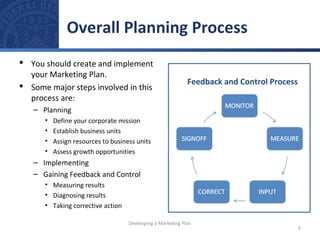
Feedback and Control Process 
 You should create and implement 
your Marketing Plan. 
 Some major steps involved in this 
process are: 
– Planning 
• Define your corporate mission 
• Establish business units 
• Assign resources to business units 
• Assess growth opportunities 
– Implementing 
– Gaining Feedback and Control 
• Measuring results 
• Diagnosing results 
• Taking corrective action 
6 
Developing a Marketing Plan
The Marketing Challenge 
Ask yourself these five critical questions: 
1. What is unique about your business idea? What is the general need that your 
product or service aims to meet? 
2. Who is your target buyer? Who buys your product or service now, and who do 
you really want to sell to? 
3. Who are your competitors? How can your small business effectively compete 
in your chosen market? 
4. What positioning message do you want to communicate to your target 
buyers? How can you position your business or product to let people know 
about your product? 
5. What is your sales strategy? How will you get your product or service in the 
hands of your customers? 
7 
Developing a Marketing Plan
The 10 Elements of a Good 
Marketing Plan 
A good Marketing Plan includes these 10 elements: 
1. Describe Your Business 
2. Conduct a Situation Analysis 
3. Define Your Customer 
4. Strategize Your Market Entry 
5. Forecast your Sales or Demand Measurement 
6. Define Your Marketing Budget 
7. Integrate Your Marketing Communication 
8. Identify Sales Channels 
9. Track Marketing Activities 
10. Evaluate Your Progress 
8 
Developing a Marketing Plan
1. Describe Your Business 
 Small business owners often describe themselves by their product or 
services; however, business must be viewed as a customer-satisfying 
process, not goods-producing. 
 Describe your business in detail and clearly identify goals and objectives. 
 Answer the following questions: 
– What is your product or service? 
– How will your product benefit the customer? 
– What is different about the product your business is offering? 
– Is it a new business, a takeover, or an expansion? 
– Why will your business be profitable? 
– What are the growth opportunities? 
– What is your geographic marketing area? 
9 
Developing a Marketing Plan
2. Conduct a Situation Analysis 
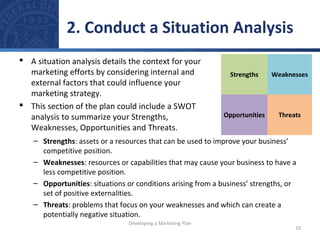
– Strengths: assets or a resources that can be used to improve your business’ 
competitive position. 
– Weaknesses: resources or capabilities that may cause your business to have a 
less competitive position. 
– Opportunities: situations or conditions arising from a business’ strengths, or 
set of positive externalities. 
– Threats: problems that focus on your weaknesses and which can create a 
potentially negative situation. 
Strengths Weaknesses 
Opportunities Threats 
 A situation analysis details the context for your 
marketing efforts by considering internal and 
external factors that could influence your 
marketing strategy. 
 This section of the plan could include a SWOT 
analysis to summarize your Strengths, 
Weaknesses, Opportunities and Threats. 
10 
Developing a Marketing Plan
3. Define Your Customers 
Defining your market does not need to be a difficult process. You do not need a 
huge market base, but you need to be realistic and your market needs to be 
well-defined. 
– Who are your competitors, and who do they target? 
– Who is your perfect customer and client base? 
– What is your current customer base (in terms of age, sex, income, and 
geographic location)? 
– What habits do your customers and potential customers share? Where do they 
shop, what do they read, watch, listen to? 
– What prospective customers are you currently not reaching? How can you reach 
them? 
– What qualities do your customers value most about your product or service? Do 
they value selection, convenience, service, reliability, availability, or affordability? 
– What qualities about your product or service do you need to improve? How can 
they be adjusted to serve your customers better? 
11 
Developing a Marketing Plan
4. Strategize Your Market Entry 
Once you have identified what is unique about your business and who 
your target buyers are, focus on your competition: 
– Identify your direct competitors and learn what they do. 
– Sharpen your decisions about the best business category and market 
segment in which to compete. 
12 
Developing a Marketing Plan
5. Forecast Sales or Demand 
Measurement 
 Sales forecasting provides the basis for comparison over a period of time. 
 Market demand is the total volume that could be bought by a defined 
customer group in, a defined geographical area, in a defined time period, 
and under a defined marketing program. 
 You should: 
– Correctly identify and estimate current demand by considering total market 
potential, market share, and expected sales. 
– Estimate future demand by considering past sales patterns, consumer trends, 
and overall market projections. 
13 
Developing a Marketing Plan
6. Define Your Marketing 
Budget (Slide 1 of 2) 
 Marketing budgets, especially in small and mid-sized businesses, are often 
arbitrarily set as either x% of planned revenue or y% over the prior year's 
marketing budget. 
 Use targeted budgeting to more intelligently set your budget based on 
company objectives. 
14 
Developing a Marketing Plan
6. Define Your Marketing 
Budget (Slide 2 of 2) 
Answer the following questions: 
– What previous marketing methods have been most effective? 
– What are your costs compared to sales? 
– What is your cost per customer? 
– What marketing methods will you use to attract new customers? 
– What percentage of profits can you allocate to your marketing campaign? 
– What marketing tools (i.e. - newspapers, magazines, Internet, direct mail, 
telemarketing, event sponsorships) can you implement within your budget? 
– What methods are you using to test your marketing ideas? 
– What methods are you using to measure results of your marketing campaign? 
15 
Developing a Marketing Plan
7. Integrate Your Marketing 
Communication 
 Integrate marketing communication to 
consolidate marketing tools, approaches, and 
resources within a company to maximize impact 
and gain edge over the competition. 
 Build on a "Marketing Mix“ and include the 
following: 
– 4P’s: Product, Price, Promotion, and Place 
– Marketing & Advertising 
• Internet 
• Events 
• Direct 
• Database 
– Public Relations 
A COLLABORATIVE 
APPROACH 
16 
Developing a Marketing Plan
8. Identify Sales Channels 
 Part of the challenge of marketing is figuring out which distribution method 
to use for your business. 
 Include all relevant distribution channels: 
– Retail: Stores selling to final consumer buyers (one store, or a chain of stores). 
– Wholesale: An intermediary distribution channel that usually sells to retail stores. 
– Direct mail: Generally catalog merchants that sell directly to consumers. 
– Telemarketing: Merchants selling directly to consumer buyers at retail via 
phones. 
– Cyber-Marketing: Merchants selling directly to consumer buyers at retail prices, 
or business-to-business products and services at wholesale prices via computer 
networks. 
– Sales force: Salaried employees of a company or independent commissioned 
representatives who usually sell products for more than one company. 
17 
Developing a Marketing Plan
9. Track Marketing Activities 
 Tracking helps monitor the effectiveness of each marketing activity and is 
especially helpful with your overall program evaluation. 
 Include procedures for tracking each type of marketing activity you are using. 
 Some examples are: 
– Display advertising: With traditional consumer publications, tracking can be done 
through the use of different phone numbers, special offers (specific to that 
advertisement or publication), or reference to a specific department. 
– Internet marketing: Usually, this is easily tracked by monitoring web traffic. 
– Trade shows: A trade show’s effectiveness can be tracked by collecting the right 
information at the show and following up on it. 
– Database: Before your Marketing Plan is kicked off, make sure you have the 
database structure in place to record this information. 
 The tabulated results and customer information is very valuable information. 
18 
Developing a Marketing Plan
10. Evaluate Your Progress 
 Identify how you will measure your success and in what ways your 
objectives have been met. Then, use these metrics to determine the 
success of your marketing efforts. 
 Answer the following questions: 
– Did we reach our goals? 
– Was the marketing campaign successful? 
– Were we able to determine Return on Investment (ROI)? 
– Did our efforts result in conversion? In other words, were we able to convert 
an inquirer to a visitor, a visitor to a customer? 
– Can we utilize our database to survey, capture additional information, or 
establish a more comprehensive customer relationship program? 
19 
Developing a Marketing Plan
Key Takeaways from This 
Module 
 Every business has marketing challenges and opportunities. 
 A Marketing Plan: 
– Allows you to analyze your current situation, describe your business, and 
define your customer base. 
– Helps you to strategize your market entry, identify your sales channels, and 
integrate your marketing communications for maximum efficiency. 
– Gives you a means of evaluating your progress. 
20 
Developing a Marketing Plan
Sources and Citations 
 Kotler & Keller, Marketing Management 
 David Cravens, Strategic Marketing 
 Business Owners Toolkit, Total Know-How for Small Businesses 
 Small Business Administration, Marketing to Federal Agencies and Prime 
Contractors 
 Shirleen Glasin, ProSidian Consulting, Developing a Marketing Plan 
 All Business, Dun & Bradstreet Company, Three Steps for Developing a 
Marketing Plan for Your Small Business 
 Entrepreneur.com, Small Business Encyclopedia, How to Create a 
Marketing Plan 
 Business Know How, Small Business and Home Business Ideas, 8 Keys to a 
Strong Marketing Strategy 
21 
Developing a Marketing Plan

Marketing plan

  • 1.
    Developing a Marketing Plan Use a good Marketing Plan to guide the strategic and tactical direction of your business
  • 2.
    Learning Objectives Atthe end of this module, you will be able to: – Identify the importance and the need for a good Marketing Plan. – List the key components of a Marketing Plan and its details. – Track the Marketing Plan in tandem with your overall business plan. 2 Developing a Marketing Plan
  • 3.
    About FDIC SmallBusiness Resource Effort • The Federal Deposit Insurance Corporation (“FDIC”) recognizes the important contributions made by small, veteran, and minority and women-owned businesses to our economy. For that reason, we strive to provide small businesses with opportunities to contract with the FDIC. In furtherance of this goal, the FDIC has initiated the FDIC Small Business Resource Effort to assist the small vendors that provide products, services, and solutions to the FDIC. • The objective of the Small Business Resource Effort is to provide information and the tools small vendors need to become better positioned to compete for contracts and subcontracts at the FDIC. To achieve this objective, the Small Business Resource Effort references outside resources critical for qualified vendors, leverages technology to provide education according to perceived needs, and offers connectivity through resourcing, accessibility, counseling, coaching, and guidance where applicable. • This product was developed by the FDIC Office of Minority and Women Inclusion (OMWI). OMWI has responsibility for oversight of the Small Business Resource Effort. 3 Developing a Marketing Plan
  • 4.
    Executive Summary A Marketing Plan is at the core of directing and coordinating all marketing efforts within a firm.  It usually operates at two levels, strategic and tactical: strategic to identify the overall market play and tactical to execute on the marketing plan.  A Marketing Plan does not need to be long or expensive to put together. If it is carefully researched, thoughtfully considered, and evaluated, it will help your firm achieve its goals. 4 Developing a Marketing Plan
  • 5.
    A Good MarketingPlan  A good Marketing Plan details what you want to accomplish and helps you meet your objectives.  A Marketing Plan should: – Explain (from an internal perspective) the impact and results of past marketing decisions. – Explain the external market in which the business is competing. – Set goals and provide direction for future marketing efforts. – Set clear, realistic, and measurable targets. – Include deadlines for meeting those targets. – Provide a budget for all marketing activities. – Specify accountability and measures for all activities. 5 Developing a Marketing Plan
  • 6.
    Overall Planning Process Feedback and Control Process  You should create and implement your Marketing Plan.  Some major steps involved in this process are: – Planning • Define your corporate mission • Establish business units • Assign resources to business units • Assess growth opportunities – Implementing – Gaining Feedback and Control • Measuring results • Diagnosing results • Taking corrective action 6 Developing a Marketing Plan
  • 7.
    The Marketing Challenge Ask yourself these five critical questions: 1. What is unique about your business idea? What is the general need that your product or service aims to meet? 2. Who is your target buyer? Who buys your product or service now, and who do you really want to sell to? 3. Who are your competitors? How can your small business effectively compete in your chosen market? 4. What positioning message do you want to communicate to your target buyers? How can you position your business or product to let people know about your product? 5. What is your sales strategy? How will you get your product or service in the hands of your customers? 7 Developing a Marketing Plan
  • 8.
    The 10 Elementsof a Good Marketing Plan A good Marketing Plan includes these 10 elements: 1. Describe Your Business 2. Conduct a Situation Analysis 3. Define Your Customer 4. Strategize Your Market Entry 5. Forecast your Sales or Demand Measurement 6. Define Your Marketing Budget 7. Integrate Your Marketing Communication 8. Identify Sales Channels 9. Track Marketing Activities 10. Evaluate Your Progress 8 Developing a Marketing Plan
  • 9.
    1. Describe YourBusiness  Small business owners often describe themselves by their product or services; however, business must be viewed as a customer-satisfying process, not goods-producing.  Describe your business in detail and clearly identify goals and objectives.  Answer the following questions: – What is your product or service? – How will your product benefit the customer? – What is different about the product your business is offering? – Is it a new business, a takeover, or an expansion? – Why will your business be profitable? – What are the growth opportunities? – What is your geographic marketing area? 9 Developing a Marketing Plan
  • 10.
    2. Conduct aSituation Analysis – Strengths: assets or a resources that can be used to improve your business’ competitive position. – Weaknesses: resources or capabilities that may cause your business to have a less competitive position. – Opportunities: situations or conditions arising from a business’ strengths, or set of positive externalities. – Threats: problems that focus on your weaknesses and which can create a potentially negative situation. Strengths Weaknesses Opportunities Threats  A situation analysis details the context for your marketing efforts by considering internal and external factors that could influence your marketing strategy.  This section of the plan could include a SWOT analysis to summarize your Strengths, Weaknesses, Opportunities and Threats. 10 Developing a Marketing Plan
  • 11.
    3. Define YourCustomers Defining your market does not need to be a difficult process. You do not need a huge market base, but you need to be realistic and your market needs to be well-defined. – Who are your competitors, and who do they target? – Who is your perfect customer and client base? – What is your current customer base (in terms of age, sex, income, and geographic location)? – What habits do your customers and potential customers share? Where do they shop, what do they read, watch, listen to? – What prospective customers are you currently not reaching? How can you reach them? – What qualities do your customers value most about your product or service? Do they value selection, convenience, service, reliability, availability, or affordability? – What qualities about your product or service do you need to improve? How can they be adjusted to serve your customers better? 11 Developing a Marketing Plan
  • 12.
    4. Strategize YourMarket Entry Once you have identified what is unique about your business and who your target buyers are, focus on your competition: – Identify your direct competitors and learn what they do. – Sharpen your decisions about the best business category and market segment in which to compete. 12 Developing a Marketing Plan
  • 13.
    5. Forecast Salesor Demand Measurement  Sales forecasting provides the basis for comparison over a period of time.  Market demand is the total volume that could be bought by a defined customer group in, a defined geographical area, in a defined time period, and under a defined marketing program.  You should: – Correctly identify and estimate current demand by considering total market potential, market share, and expected sales. – Estimate future demand by considering past sales patterns, consumer trends, and overall market projections. 13 Developing a Marketing Plan
  • 14.
    6. Define YourMarketing Budget (Slide 1 of 2)  Marketing budgets, especially in small and mid-sized businesses, are often arbitrarily set as either x% of planned revenue or y% over the prior year's marketing budget.  Use targeted budgeting to more intelligently set your budget based on company objectives. 14 Developing a Marketing Plan
  • 15.
    6. Define YourMarketing Budget (Slide 2 of 2) Answer the following questions: – What previous marketing methods have been most effective? – What are your costs compared to sales? – What is your cost per customer? – What marketing methods will you use to attract new customers? – What percentage of profits can you allocate to your marketing campaign? – What marketing tools (i.e. - newspapers, magazines, Internet, direct mail, telemarketing, event sponsorships) can you implement within your budget? – What methods are you using to test your marketing ideas? – What methods are you using to measure results of your marketing campaign? 15 Developing a Marketing Plan
  • 16.
    7. Integrate YourMarketing Communication  Integrate marketing communication to consolidate marketing tools, approaches, and resources within a company to maximize impact and gain edge over the competition.  Build on a "Marketing Mix“ and include the following: – 4P’s: Product, Price, Promotion, and Place – Marketing & Advertising • Internet • Events • Direct • Database – Public Relations A COLLABORATIVE APPROACH 16 Developing a Marketing Plan
  • 17.
    8. Identify SalesChannels  Part of the challenge of marketing is figuring out which distribution method to use for your business.  Include all relevant distribution channels: – Retail: Stores selling to final consumer buyers (one store, or a chain of stores). – Wholesale: An intermediary distribution channel that usually sells to retail stores. – Direct mail: Generally catalog merchants that sell directly to consumers. – Telemarketing: Merchants selling directly to consumer buyers at retail via phones. – Cyber-Marketing: Merchants selling directly to consumer buyers at retail prices, or business-to-business products and services at wholesale prices via computer networks. – Sales force: Salaried employees of a company or independent commissioned representatives who usually sell products for more than one company. 17 Developing a Marketing Plan
  • 18.
    9. Track MarketingActivities  Tracking helps monitor the effectiveness of each marketing activity and is especially helpful with your overall program evaluation.  Include procedures for tracking each type of marketing activity you are using.  Some examples are: – Display advertising: With traditional consumer publications, tracking can be done through the use of different phone numbers, special offers (specific to that advertisement or publication), or reference to a specific department. – Internet marketing: Usually, this is easily tracked by monitoring web traffic. – Trade shows: A trade show’s effectiveness can be tracked by collecting the right information at the show and following up on it. – Database: Before your Marketing Plan is kicked off, make sure you have the database structure in place to record this information.  The tabulated results and customer information is very valuable information. 18 Developing a Marketing Plan
  • 19.
    10. Evaluate YourProgress  Identify how you will measure your success and in what ways your objectives have been met. Then, use these metrics to determine the success of your marketing efforts.  Answer the following questions: – Did we reach our goals? – Was the marketing campaign successful? – Were we able to determine Return on Investment (ROI)? – Did our efforts result in conversion? In other words, were we able to convert an inquirer to a visitor, a visitor to a customer? – Can we utilize our database to survey, capture additional information, or establish a more comprehensive customer relationship program? 19 Developing a Marketing Plan
  • 20.
    Key Takeaways fromThis Module  Every business has marketing challenges and opportunities.  A Marketing Plan: – Allows you to analyze your current situation, describe your business, and define your customer base. – Helps you to strategize your market entry, identify your sales channels, and integrate your marketing communications for maximum efficiency. – Gives you a means of evaluating your progress. 20 Developing a Marketing Plan
  • 21.
    Sources and Citations  Kotler & Keller, Marketing Management  David Cravens, Strategic Marketing  Business Owners Toolkit, Total Know-How for Small Businesses  Small Business Administration, Marketing to Federal Agencies and Prime Contractors  Shirleen Glasin, ProSidian Consulting, Developing a Marketing Plan  All Business, Dun & Bradstreet Company, Three Steps for Developing a Marketing Plan for Your Small Business  Entrepreneur.com, Small Business Encyclopedia, How to Create a Marketing Plan  Business Know How, Small Business and Home Business Ideas, 8 Keys to a Strong Marketing Strategy 21 Developing a Marketing Plan