
Market StructureMarket Structure
Chapter 12
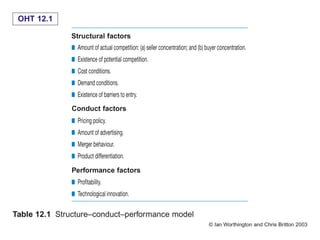
Structure-Conduct-Structure-Conduct-
Performance ModelPerformance Model
A model used for analysis of an industry
which holds that structure determines
conduct, which in turn determines
performance
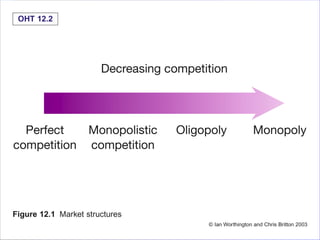
Market StructureMarket Structure
The amount of competition that exists in a
market between producers
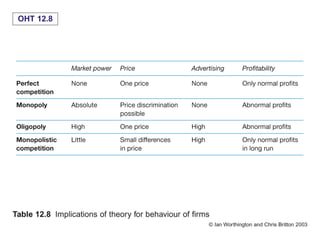
Perfect Competition
Monopoly
Oligopoly
Monopolistic Competition
PerfectPerfect
Competition:ConditionsCompetition:Conditions
So many buyers and sellers in the market,
no one of them can influence price
Homogeneous goods
Perfect knowledge
Perfect mobility
No barriers to entry or exit
Perfect Competition:PricePerfect Competition:Price
DeterminationDetermination
 Normal profit- minimum level of profits in order to stay in
business
 Abnormal profits – profits over and above normal profits
 Firms will decide what level of output to produce by
setting the cost of producing the last unit of good equal to
the revenue gained from selling the last unit (marginal cost
= marginal revenue)
 In perfect competition, as firms have perfect knowledge,
abnormal profits are unsustainable in the long run
Example of PerfectExample of Perfect
CompetitionCompetition
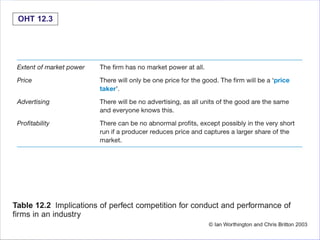
Closest example is a fruit and vegetable
market
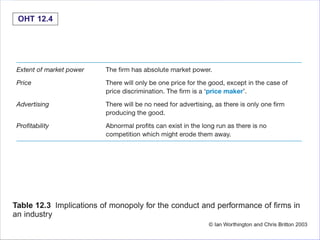
Monopoly: CharacteristicsMonopoly: Characteristics
Has market power, and can decide price OR
quantity sold (not both)
Either no substitutes for the goods, or high
barriers to entry
Monopolist may use price discrimination
Price DiscriminationPrice Discrimination
Consumers pay different prices for the same
good
Can occur when:
the producer is monopolistic and able to
control supply
there are groups of consumers with different
demand conditions
able to separate the groups
Compare and contrastCompare and contrast
monopoly and perfectmonopoly and perfect
competitioncompetition
How do these two structures affect prices?
Choice of products? Innovation?
OligopolyOligopoly
A small number of producers supply a
market in which the product is
differentiated in some way
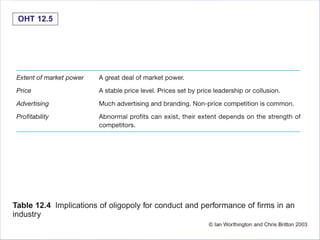
Oligopoly CharacteristicsOligopoly Characteristics
High interdependence between firms
A lack of price competition in the market
Lack of price competition leads to different
forms of non-price competition taking
place, such as branding and advertising
Price is determined by a price leader or by
collusion
Monopolistic CompetitionMonopolistic Competition
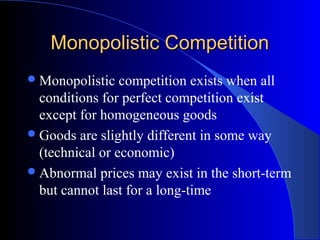
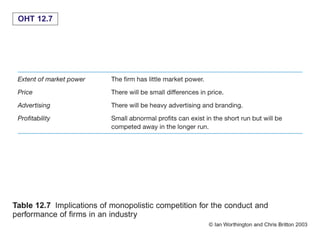
Monopolistic competition exists when all
conditions for perfect competition exist
except for homogeneous goods
Goods are slightly different in some way
(technical or economic)
Abnormal prices may exist in the short-term
but cannot last for a long-time
Are These TheoriesAre These Theories
Accurate?Accurate?
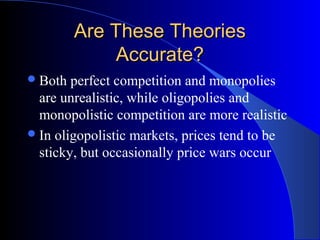
Both perfect competition and monopolies
are unrealistic, while oligopolies and
monopolistic competition are more realistic
In oligopolistic markets, prices tend to be
sticky, but occasionally price wars occur
Price Wars: Mini-Case (P.340)Price Wars: Mini-Case (P.340)
How do price wars affect firms in the
industry?
How do price wars affect buyers?
Porter’s 5 Forces ModelPorter’s 5 Forces Model
Structure of an industry and the ability of
firms to act strategically depend on the
relative strengths of five forces:
current competition
potential competition
threat of substitute products
power of buyers
power of suppliers
Current CompetitionCurrent Competition
Competition can be determined by the 4
types of markets discussed before
BUT, according to Porter’s Model, firms
may change the structure of the industry
Firms in highly competitive markets may
dislike their lack of power over various
factors and try to change the situation,
which will change the level of competition
Potential CompetitionPotential Competition
Degree of potential competition depends
upon the existence and height of barriers to
entry and exit
Natural monopolies – industries where
competition would be wasteful (like public
utilities)
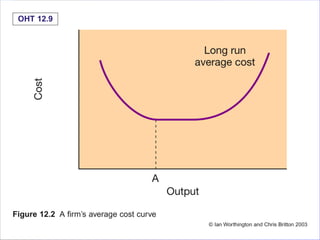
Economies of scale – cost benefits
associated with large operations
Economies of Scale:SourcesEconomies of Scale:Sources
Technical economies – come from
increased specialization and indivisibilities
Marketing economies – spreading market
costs over a larger output, so average costs
are lower (bulk buying is often used)
Financial economies – easier and cheaper to
borrow capital
Risk diversification
Other Barriers to EntryOther Barriers to Entry
Legal
Brand loyalty
High initial capital investment
Contestable MarketContestable Market
 A market in which there are no barriers to entry or
exit
 All firms have access to the same technology, so
there are no cost barriers to entry
 No unrecoverable costs to prevent firms from
leaving the market
 What regulates the market behavior is not actual
but potential competition
Threat of Substitute ProductsThreat of Substitute Products
If there are no substitutes, producer of the
good will face little competition and have
high market power
Firms often differentiate to reduce the threat
of substitute goods
Power of BuyersPower of Buyers
 Monopsony - market where there is only one
buyer, and the buyer has the market power not the
seller (example: coal industry)
 The existence of strong buyers and weak sellers
may benefit the market, or it could lead to higher
seller concentration as sellers come together to
counteract buyer power
 The existence of strong sellers and weak buyers
may result in consumer rights groups forming to
protect buyers
Power of SuppliersPower of Suppliers
Where there are few suppliers, supplier
power will be high (can affect producers
costs)
The decision of whether to produce
components needed in the production
process or to buy from a supplier is covered
by transaction cost economics
Measuring Degree of ActualMeasuring Degree of Actual
CompetitionCompetition
Level of competition is measured by
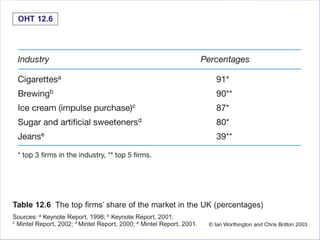
concentration ratios
These measure:
the percentage of value added
total output
or employment
that is produced by the largest firms in the
industry (3 or 5 firms)
Reasons for HighReasons for High
ConcentrationConcentration
 At the Minimum Efficient Scale of Production (MES)
point, all economies of scale have been taken by the firm
 The higher the MES relative to the total output of the
industry, the fewer the number of firms operating in the
industry and therefore the higher the level of concentration
 Firms in every industry face differing average cost curves
and therefore market structures will differ
 In services, for example, the scope of economies of scale is
small, and the MES is small relative to the size of the total
market (industries are unconcentrated)
Structure-Conduct-Structure-Conduct-
Performance Analysis:AirlinesPerformance Analysis:Airlines
 What type of market is the airline industry?
 How much market power do airlines have?
 How does the market structure affect price?
 What barriers to entry exist in the airline industry?
 What is the level of seller competition? Buyer competition?
 What demand factors affect the structure?
 Supply factors?
 How do airlines use pricing conduct to respond to industry structure?
Merger activity?
 How has market structure and conduct affected airline performance?
Homework: Due 2Homework: Due 2ndnd
ClassClass
Next WeekNext Week
Using the structure-conduct-performance
model, analyze an industry of your choice
This assignment is worth 10% of final grade

Market structure

  • 1.
  • 2.
    Structure-Conduct-Structure-Conduct- Performance ModelPerformance Model Amodel used for analysis of an industry which holds that structure determines conduct, which in turn determines performance
  • 4.
    Market StructureMarket Structure Theamount of competition that exists in a market between producers Perfect Competition Monopoly Oligopoly Monopolistic Competition
  • 6.
    PerfectPerfect Competition:ConditionsCompetition:Conditions So many buyersand sellers in the market, no one of them can influence price Homogeneous goods Perfect knowledge Perfect mobility No barriers to entry or exit
  • 7.
    Perfect Competition:PricePerfect Competition:Price DeterminationDetermination Normal profit- minimum level of profits in order to stay in business  Abnormal profits – profits over and above normal profits  Firms will decide what level of output to produce by setting the cost of producing the last unit of good equal to the revenue gained from selling the last unit (marginal cost = marginal revenue)  In perfect competition, as firms have perfect knowledge, abnormal profits are unsustainable in the long run
  • 9.
    Example of PerfectExampleof Perfect CompetitionCompetition Closest example is a fruit and vegetable market
  • 10.
    Monopoly: CharacteristicsMonopoly: Characteristics Hasmarket power, and can decide price OR quantity sold (not both) Either no substitutes for the goods, or high barriers to entry Monopolist may use price discrimination
  • 11.
    Price DiscriminationPrice Discrimination Consumerspay different prices for the same good Can occur when: the producer is monopolistic and able to control supply there are groups of consumers with different demand conditions able to separate the groups
  • 13.
    Compare and contrastCompareand contrast monopoly and perfectmonopoly and perfect competitioncompetition How do these two structures affect prices? Choice of products? Innovation?
  • 14.
    OligopolyOligopoly A small numberof producers supply a market in which the product is differentiated in some way
  • 15.
    Oligopoly CharacteristicsOligopoly Characteristics Highinterdependence between firms A lack of price competition in the market Lack of price competition leads to different forms of non-price competition taking place, such as branding and advertising Price is determined by a price leader or by collusion
  • 18.
    Monopolistic CompetitionMonopolistic Competition Monopolisticcompetition exists when all conditions for perfect competition exist except for homogeneous goods Goods are slightly different in some way (technical or economic) Abnormal prices may exist in the short-term but cannot last for a long-time
  • 20.
    Are These TheoriesAreThese Theories Accurate?Accurate? Both perfect competition and monopolies are unrealistic, while oligopolies and monopolistic competition are more realistic In oligopolistic markets, prices tend to be sticky, but occasionally price wars occur
  • 22.
    Price Wars: Mini-Case(P.340)Price Wars: Mini-Case (P.340) How do price wars affect firms in the industry? How do price wars affect buyers?
  • 23.
    Porter’s 5 ForcesModelPorter’s 5 Forces Model Structure of an industry and the ability of firms to act strategically depend on the relative strengths of five forces: current competition potential competition threat of substitute products power of buyers power of suppliers
  • 24.
    Current CompetitionCurrent Competition Competitioncan be determined by the 4 types of markets discussed before BUT, according to Porter’s Model, firms may change the structure of the industry Firms in highly competitive markets may dislike their lack of power over various factors and try to change the situation, which will change the level of competition
  • 25.
    Potential CompetitionPotential Competition Degreeof potential competition depends upon the existence and height of barriers to entry and exit Natural monopolies – industries where competition would be wasteful (like public utilities) Economies of scale – cost benefits associated with large operations
  • 27.
    Economies of Scale:SourcesEconomiesof Scale:Sources Technical economies – come from increased specialization and indivisibilities Marketing economies – spreading market costs over a larger output, so average costs are lower (bulk buying is often used) Financial economies – easier and cheaper to borrow capital Risk diversification
  • 28.
    Other Barriers toEntryOther Barriers to Entry Legal Brand loyalty High initial capital investment
  • 29.
    Contestable MarketContestable Market A market in which there are no barriers to entry or exit  All firms have access to the same technology, so there are no cost barriers to entry  No unrecoverable costs to prevent firms from leaving the market  What regulates the market behavior is not actual but potential competition
  • 30.
    Threat of SubstituteProductsThreat of Substitute Products If there are no substitutes, producer of the good will face little competition and have high market power Firms often differentiate to reduce the threat of substitute goods
  • 31.
    Power of BuyersPowerof Buyers  Monopsony - market where there is only one buyer, and the buyer has the market power not the seller (example: coal industry)  The existence of strong buyers and weak sellers may benefit the market, or it could lead to higher seller concentration as sellers come together to counteract buyer power  The existence of strong sellers and weak buyers may result in consumer rights groups forming to protect buyers
  • 32.
    Power of SuppliersPowerof Suppliers Where there are few suppliers, supplier power will be high (can affect producers costs) The decision of whether to produce components needed in the production process or to buy from a supplier is covered by transaction cost economics
  • 33.
    Measuring Degree ofActualMeasuring Degree of Actual CompetitionCompetition Level of competition is measured by concentration ratios These measure: the percentage of value added total output or employment that is produced by the largest firms in the industry (3 or 5 firms)
  • 34.
    Reasons for HighReasonsfor High ConcentrationConcentration  At the Minimum Efficient Scale of Production (MES) point, all economies of scale have been taken by the firm  The higher the MES relative to the total output of the industry, the fewer the number of firms operating in the industry and therefore the higher the level of concentration  Firms in every industry face differing average cost curves and therefore market structures will differ  In services, for example, the scope of economies of scale is small, and the MES is small relative to the size of the total market (industries are unconcentrated)
  • 35.
    Structure-Conduct-Structure-Conduct- Performance Analysis:AirlinesPerformance Analysis:Airlines What type of market is the airline industry?  How much market power do airlines have?  How does the market structure affect price?  What barriers to entry exist in the airline industry?  What is the level of seller competition? Buyer competition?  What demand factors affect the structure?  Supply factors?  How do airlines use pricing conduct to respond to industry structure? Merger activity?  How has market structure and conduct affected airline performance?
  • 36.
    Homework: Due 2Homework:Due 2ndnd ClassClass Next WeekNext Week Using the structure-conduct-performance model, analyze an industry of your choice This assignment is worth 10% of final grade