
Chapter 7Chapter 7
International Factor MovementsInternational Factor Movements
Prepared by Iordanis Petsas
To Accompany
International Economics: Theory and PolicyInternational Economics: Theory and Policy, Sixth Edition
by Paul R. Krugman and Maurice Obstfeld
 Introduction
 International Labor Mobility
 International Borrowing and Lending
 Direct Foreign Investment and Multinational Firms
 Summary
 Appendix: More on Intertemporal Trade
Chapter Organization
Introduction
 Movement of goods and services is one form of
international integration.
 Another form of integration is international
movements of factors of production (factor
movements).
 Factor movements include:
• Labor migration
• Transfer of capital via international borrowing and
lending
• International linkages involved in the formation of
multinational corporations
 A One-Good Model Without Factor Mobility
• Assumptions of the model:
– There are two countries (Home and Foreign).
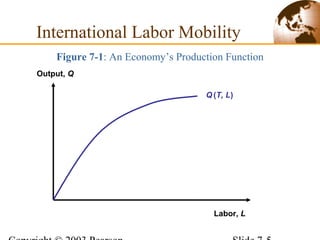
– There are two factors of production: Land (T) and Labor
(L).
– Both countries produce only one good (refer to it as
“output”).
– Both countries have the same technology but different
overall land-labor ratios.
– Home is the labor-abundant country and Foreign is the
land-abundant country.
– Perfect competition prevails in all markets.
International Labor Mobility
Labor, L
Output, Q
Q (T, L)
Figure 7-1: An Economy’s Production Function
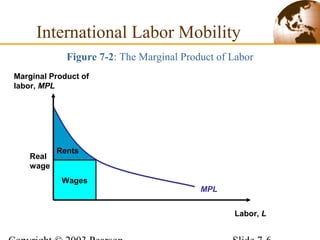
Rents
Wages
Real
wage
MPL
Labor, L
Marginal Product of
labor, MPL
International Labor Mobility
Figure 7-2: The Marginal Product of Labor
 International Labor Movement
• Suppose that workers are able to move between the
two countries.
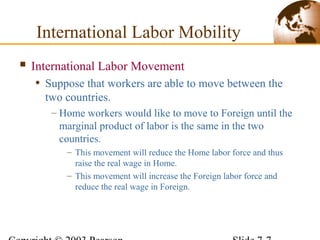
– Home workers would like to move to Foreign until the
marginal product of labor is the same in the two
countries.
– This movement will reduce the Home labor force and thus
raise the real wage in Home.
– This movement will increase the Foreign labor force and
reduce the real wage in Foreign.
International Labor Mobility
L2
International Labor Mobility
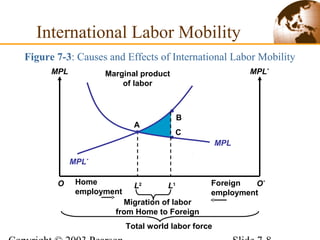
Figure 7-3: Causes and Effects of International Labor Mobility
MPL
MPL MPL*
MPL*
Home
employment
O Foreign
employment
O*
A
B
C
L1
Migration of labor
from Home to Foreign
Total world labor force
Marginal product
of labor
 The redistribution of the world’s labor force:
• Leads to a convergence of real wage rates
• Increases the world’s output as a whole
• Leaves some groups worse off
 Extending the Analysis
• Modifying the model by adding some complications:
– Suppose the countries produce two goods, one labor-
intensive and one land-intensive.
– Trade offers an alternative to factor mobility: Home can export
labor and import land by exporting the labor-intensive good
and importing the land-intensive good.
International Labor Mobility
 International movements of capital
• Refer to borrowing and lending between countries
–Example: A U.S. bank lends to a Mexican firm.
• Can be interpreted as intertemporal trade
–Refers to trade of goods today for goods in the
future
International Borrowing and Lending
 Intertemporal Production Possibilities and Trade
• Imagine an economy that consumes only one good and
will exist for only two periods, which we will call
present and future.
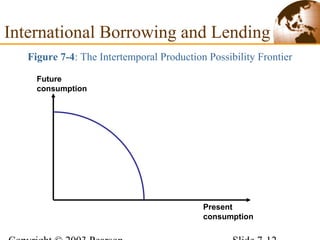
• Intertemporal production possibility frontier
– It represents a trade-off between present and future
production of the consumption good.
– Its shape will differ among countries:
– Some countries will be biased toward present output.
– Some countries will be biased toward future output.
International Borrowing and Lending
Figure 7-4: The Intertemporal Production Possibility Frontier
Present
consumption
Future
consumption
International Borrowing and Lending
 The Real Interest Rate
• How does a country trade over time?
– A country can trade over time by borrowing or lending.
– When a country borrows, it gets the right to purchase
some quantity of consumption at present in return for
repayment of some larger quantity in the future.
– The quantity of repayment in future will be (1 + r) times the
quantity borrowed in present, where r is the real interest rate
on borrowing.
– The relative price of future consumption is 1/(1 + r).
International Borrowing and Lending
 Intertemporal Comparative Advantage
• Assume that Home’s intertemporal production
possibilities are biased toward present production.
– A country that has a comparative advantage in future
production of consumption goods is one that in the
absence of international borrowing and lending would
have a low relative price of future consumption (i.e.,
high real interest rate).
– High interest rate corresponds to a high return on investment.
International Borrowing and Lending
Direct Foreign Investment
and Multinational Firms
 Direct foreign investment
• Refers to international capital flows in which a firm in
one country creates or expands a subsidiary in another
• Involves not only a transfer of resources but also the
acquisition of control
– The subsidiary does not simply have a financial
obligation to the parent company; it is part of the same
organizational structure.
 Multinational firms
• A vehicle for international borrowing and lending
• They provide financing to their foreign subsidiaries
 Why is direct foreign investment rather than some
other way of transferring funds chosen?
• To allow the formation of multinational organization
(extension of control)
 Why do firms seek to extend control?
• The answer is summarized under the theory of
multinational enterprise.
Direct Foreign Investment
and Multinational Firms
 The Theory of Multinational Enterprise
• Two elements explain the existence of a multinational:
– Location motive
– A good is produced in two (or more) different countries rather
than one because of:
» Resources
» Transport costs
» Barriers of trade
– Internalization motive
– A good is produced in different locations by the same firm
rather than by separate firms because it is more profitable to
carry transactions on technology and management.
» Technology transfer
» Vertical integration
Direct Foreign Investment
and Multinational Firms
 Multinational Firms in Practice
• Multinational firms play an important part in world
trade and investment.
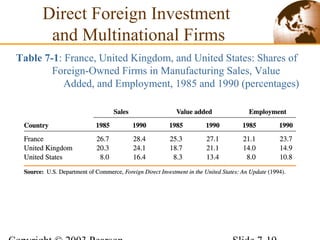
– Example: Half of U.S. imports can be regarded as
transactions between branches of multinational firms,
and 24% of U.S. assets abroad consist of the value of
foreign subsidiaries of U.S. firms.
• Multinational firms may be either domestic or foreign-
owned.
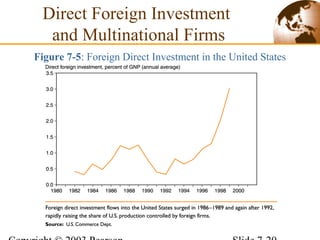
– Foreign-owned multinational firms play an important
role in most economies, especially in the United States.
Direct Foreign Investment
and Multinational Firms
Direct Foreign Investment
and Multinational Firms
Table 7-1: France, United Kingdom, and United States: Shares of
Foreign-Owned Firms in Manufacturing Sales, Value
Added, and Employment, 1985 and 1990 (percentages)
Direct Foreign Investment
and Multinational Firms
Figure 7-5: Foreign Direct Investment in the United States
Summary
 International factor movements can sometimes
substitute for trade.
 International borrowing and lending can be viewed
as a kind of international trade of present
consumption for future consumption rather than
trade of one good for another.
 Multinational firms primarily exist as ways of
extending control over activities taking place in two
or more different countries.
 Two elements explain the existence of a
multinational:
• A location motive.
• An internalization motive.
Summary
Present
consumption
Future
consumption
QP
QF
Intertemporal
production
possibility
frontier
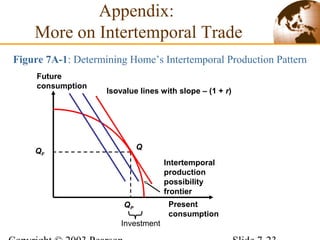
Isovalue lines with slope – (1 + r)
Investment
Appendix:
More on Intertemporal Trade
Figure 7A-1: Determining Home’s Intertemporal Production Pattern
Q
QP
QF
Indifference curves
Exports
D
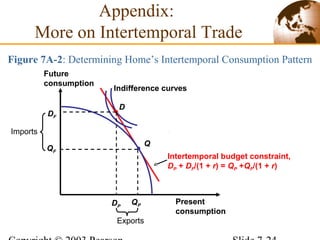
Intertemporal budget constraint,
DP + DF/(1 + r) = QP +QF/(1 + r)
Imports
Present
consumption
Future
consumption
Appendix:
More on Intertemporal Trade
Figure 7A-2: Determining Home’s Intertemporal Consumption Pattern
DP
DF
Q
D*
P
D*
F
Imports
Q*
Q*
P
Q*
F
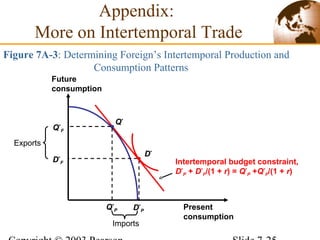
Intertemporal budget constraint,
D*
P + D*
F/(1 + r) = Q*
P +Q*
F/(1 + r)
Exports
Present
consumption
Future
consumption
D*
Appendix:
More on Intertemporal Trade
Figure 7A-3: Determining Foreign’s Intertemporal Production and
Consumption Patterns
P
F
(QP – DP) = (D*
P – Q*
P)
(Q*
F – D*
F) =
(DF – QF)
Appendix:
More on Intertemporal Trade
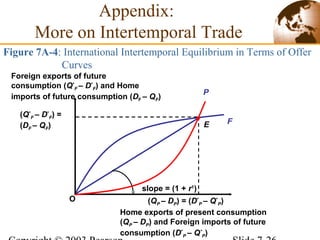
Figure 7A-4: International Intertemporal Equilibrium in Terms of Offer
Curves
E
Home exports of present consumption
(QP – DP) and Foreign imports of future
consumption (D*
P – Q*
P)
Foreign exports of future
consumption (Q*
F – D*
F) and Home
imports of future consumption (DF – QF)
O
slope = (1 + r1
)

International economic ch07

  • 1.
    Chapter 7Chapter 7 InternationalFactor MovementsInternational Factor Movements Prepared by Iordanis Petsas To Accompany International Economics: Theory and PolicyInternational Economics: Theory and Policy, Sixth Edition by Paul R. Krugman and Maurice Obstfeld
  • 2.
     Introduction  InternationalLabor Mobility  International Borrowing and Lending  Direct Foreign Investment and Multinational Firms  Summary  Appendix: More on Intertemporal Trade Chapter Organization
  • 3.
    Introduction  Movement ofgoods and services is one form of international integration.  Another form of integration is international movements of factors of production (factor movements).  Factor movements include: • Labor migration • Transfer of capital via international borrowing and lending • International linkages involved in the formation of multinational corporations
  • 4.
     A One-GoodModel Without Factor Mobility • Assumptions of the model: – There are two countries (Home and Foreign). – There are two factors of production: Land (T) and Labor (L). – Both countries produce only one good (refer to it as “output”). – Both countries have the same technology but different overall land-labor ratios. – Home is the labor-abundant country and Foreign is the land-abundant country. – Perfect competition prevails in all markets. International Labor Mobility
  • 5.
    International Labor Mobility Labor,L Output, Q Q (T, L) Figure 7-1: An Economy’s Production Function
  • 6.
    Rents Wages Real wage MPL Labor, L Marginal Productof labor, MPL International Labor Mobility Figure 7-2: The Marginal Product of Labor
  • 7.
     International LaborMovement • Suppose that workers are able to move between the two countries. – Home workers would like to move to Foreign until the marginal product of labor is the same in the two countries. – This movement will reduce the Home labor force and thus raise the real wage in Home. – This movement will increase the Foreign labor force and reduce the real wage in Foreign. International Labor Mobility
  • 8.
    L2 International Labor Mobility Figure7-3: Causes and Effects of International Labor Mobility MPL MPL MPL* MPL* Home employment O Foreign employment O* A B C L1 Migration of labor from Home to Foreign Total world labor force Marginal product of labor
  • 9.
     The redistributionof the world’s labor force: • Leads to a convergence of real wage rates • Increases the world’s output as a whole • Leaves some groups worse off  Extending the Analysis • Modifying the model by adding some complications: – Suppose the countries produce two goods, one labor- intensive and one land-intensive. – Trade offers an alternative to factor mobility: Home can export labor and import land by exporting the labor-intensive good and importing the land-intensive good. International Labor Mobility
  • 10.
     International movementsof capital • Refer to borrowing and lending between countries –Example: A U.S. bank lends to a Mexican firm. • Can be interpreted as intertemporal trade –Refers to trade of goods today for goods in the future International Borrowing and Lending
  • 11.
     Intertemporal ProductionPossibilities and Trade • Imagine an economy that consumes only one good and will exist for only two periods, which we will call present and future. • Intertemporal production possibility frontier – It represents a trade-off between present and future production of the consumption good. – Its shape will differ among countries: – Some countries will be biased toward present output. – Some countries will be biased toward future output. International Borrowing and Lending
  • 12.
    Figure 7-4: TheIntertemporal Production Possibility Frontier Present consumption Future consumption International Borrowing and Lending
  • 13.
     The RealInterest Rate • How does a country trade over time? – A country can trade over time by borrowing or lending. – When a country borrows, it gets the right to purchase some quantity of consumption at present in return for repayment of some larger quantity in the future. – The quantity of repayment in future will be (1 + r) times the quantity borrowed in present, where r is the real interest rate on borrowing. – The relative price of future consumption is 1/(1 + r). International Borrowing and Lending
  • 14.
     Intertemporal ComparativeAdvantage • Assume that Home’s intertemporal production possibilities are biased toward present production. – A country that has a comparative advantage in future production of consumption goods is one that in the absence of international borrowing and lending would have a low relative price of future consumption (i.e., high real interest rate). – High interest rate corresponds to a high return on investment. International Borrowing and Lending
  • 15.
    Direct Foreign Investment andMultinational Firms  Direct foreign investment • Refers to international capital flows in which a firm in one country creates or expands a subsidiary in another • Involves not only a transfer of resources but also the acquisition of control – The subsidiary does not simply have a financial obligation to the parent company; it is part of the same organizational structure.
  • 16.
     Multinational firms •A vehicle for international borrowing and lending • They provide financing to their foreign subsidiaries  Why is direct foreign investment rather than some other way of transferring funds chosen? • To allow the formation of multinational organization (extension of control)  Why do firms seek to extend control? • The answer is summarized under the theory of multinational enterprise. Direct Foreign Investment and Multinational Firms
  • 17.
     The Theoryof Multinational Enterprise • Two elements explain the existence of a multinational: – Location motive – A good is produced in two (or more) different countries rather than one because of: » Resources » Transport costs » Barriers of trade – Internalization motive – A good is produced in different locations by the same firm rather than by separate firms because it is more profitable to carry transactions on technology and management. » Technology transfer » Vertical integration Direct Foreign Investment and Multinational Firms
  • 18.
     Multinational Firmsin Practice • Multinational firms play an important part in world trade and investment. – Example: Half of U.S. imports can be regarded as transactions between branches of multinational firms, and 24% of U.S. assets abroad consist of the value of foreign subsidiaries of U.S. firms. • Multinational firms may be either domestic or foreign- owned. – Foreign-owned multinational firms play an important role in most economies, especially in the United States. Direct Foreign Investment and Multinational Firms
  • 19.
    Direct Foreign Investment andMultinational Firms Table 7-1: France, United Kingdom, and United States: Shares of Foreign-Owned Firms in Manufacturing Sales, Value Added, and Employment, 1985 and 1990 (percentages)
  • 20.
    Direct Foreign Investment andMultinational Firms Figure 7-5: Foreign Direct Investment in the United States
  • 21.
    Summary  International factormovements can sometimes substitute for trade.  International borrowing and lending can be viewed as a kind of international trade of present consumption for future consumption rather than trade of one good for another.  Multinational firms primarily exist as ways of extending control over activities taking place in two or more different countries.
  • 22.
     Two elementsexplain the existence of a multinational: • A location motive. • An internalization motive. Summary
  • 23.
    Present consumption Future consumption QP QF Intertemporal production possibility frontier Isovalue lines withslope – (1 + r) Investment Appendix: More on Intertemporal Trade Figure 7A-1: Determining Home’s Intertemporal Production Pattern Q
  • 24.
    QP QF Indifference curves Exports D Intertemporal budgetconstraint, DP + DF/(1 + r) = QP +QF/(1 + r) Imports Present consumption Future consumption Appendix: More on Intertemporal Trade Figure 7A-2: Determining Home’s Intertemporal Consumption Pattern DP DF Q
  • 25.
    D* P D* F Imports Q* Q* P Q* F Intertemporal budget constraint, D* P+ D* F/(1 + r) = Q* P +Q* F/(1 + r) Exports Present consumption Future consumption D* Appendix: More on Intertemporal Trade Figure 7A-3: Determining Foreign’s Intertemporal Production and Consumption Patterns
  • 26.
    P F (QP – DP)= (D* P – Q* P) (Q* F – D* F) = (DF – QF) Appendix: More on Intertemporal Trade Figure 7A-4: International Intertemporal Equilibrium in Terms of Offer Curves E Home exports of present consumption (QP – DP) and Foreign imports of future consumption (D* P – Q* P) Foreign exports of future consumption (Q* F – D* F) and Home imports of future consumption (DF – QF) O slope = (1 + r1 )