Using database marketing
techniques to enhance your oneto-one marketing initiatives
Ron Kahan
Partner, Ariss Kahan Database Marketing Group, Inc., Denver, Colorado,
USA

Despite US Constitutional reference, all consumers are not created equally.
And yet, many corporate marketing initiatives treat all customers as one
body, one intellect, or one segment en masse. Customer marketing
communication campaigns do, in many instances, send the same message,
the same offer, and use the same medium to communicate with this largely
disparate customer universe.
Using captured
information

This is contrary to the strategic goal of database marketing: to use captured
information to identify customers and prospects as individuals and build a
continuing relationship with them — to the individuals greater benefit and
the greater profit of the corporation.
In this regard, the catalog and retail industries were the pioneers of database
marketing. Prior to the development of mass marketing, merchants had truly
personal services, one-to-one relationships and recognized the customers as
individuals. The local merchant knew you and your family, what you
wanted, how and when you wanted it. The shop owner kept you as a loyal
customer by establishing a two-way communication with you while
recognizing and appreciating your business.
Information, recognition, customized services and appreciation are the
customer benefits that are fundamentals of database marketing.
In today’s world of mass advertising and “big box” retail store chains, it is
impossible for merchants to know each customer in this individualized
fashion. Only with the aid of sophisticated marketing database technology
can we capture, analyze and act on the same interpersonal marketing
opportunities first identified in these earlier and simpler times.
There are two approaches to successful database marketing: cognitive and
behavioral analysis. In this way, marketers can garner a clear understanding
of what customers and prospects “look like” (cognitive) and how they act
(behavioral).

Defining characteristic
parameters

Target marketers often go through extensive cognitive analysis of current
customers by applying third party, compiled data variables to identify
characteristic values. This can include both demographic (such as age,
income, presence of children) and psychographic (such as lifestyle and
interest) data elements. By defining characteristic parameters on current
customers, these statistical models can then be focussed on the non-customer
universe to identify “like-kinds” of consumers for marketing solicitation. In
theory, a very logical approach to refining the suspect (non-customer)
market to a more likely prospect market. This is the entry-point into the
practice of intelligent database marketing.
Despite the capacity of free thought, humanity as a whole is cursed with
repetitive behavior and the formation of habits, making behavior therefore
predictable. This is a positive human “affliction” for database marketers,

JOURNAL OF CONSUMER MARKETING, VOL. 15 NO. 5 1998, pp. 491-493 © MCB UNIVERSITY PRESS, 0736-3761

491
presenting many opportunities on which to capitalize. It is the case that there
is no greater predictor of future behavior than past behavior. This is
intuitively the true premise of behavioral analysis. The most widely used
behavioral characteristic variables for analysis include products or services
purchased, frequency of purchases, dollar amount spent, as well as
customer-related preferences.
The creation of RFM

Catalogers created behavioral analysis by accident. I believe it was Sears
Roebuck & Co. who first discovered by inserting a catalog with an outgoing
order that their most recent customers were most likely to order again. From
this simple observation, the mathematical computation that is today referred
to as RFM (recency, frequency, and monetary value) was created.
RFM is perhaps the most widely recognized behavioral analysis technique. It
certainly is the easiest and fastest methodology to implement with your
customer file.
This process requires that base customer information, such as name and
address, have been assigned a unique key, such as an account number.
Likewise, it requires that all order or sales information is stored
electronically with the unique key included with each transactional record.
A summary of each customer’s transactional history should be created,
allowing the following sorting and segmentation:
(1) date of the last or most recent purchase;
(2) total number or frequency of purchases;
(3) average amount spent per order.
The analysis can now begin once each account number has these three
variables summarized:
(1) Sort your customers by purchase dates in reverse chronological order.
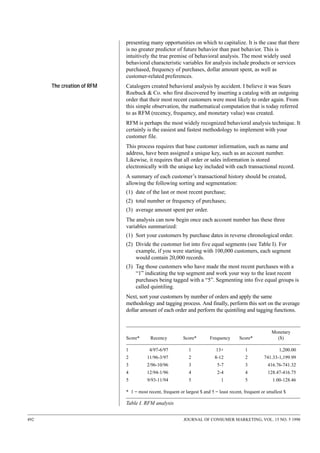
(2) Divide the customer list into five equal segments (see Table I). For
example, if you were starting with 100,000 customers, each segment
would contain 20,000 records.
(3) Tag those customers who have made the most recent purchases with a
“1” indicating the top segment and work your way to the least recent
purchases being tagged with a “5”. Segmenting into five equal groups is
called quintiling.
Next, sort your customers by number of orders and apply the same
methodology and tagging process. And finally, perform this sort on the average
dollar amount of each order and perform the quintiling and tagging functions.

Score*

Recency

Score*

Frequency

Score*

Monetary
($)

1

4/97-6/97

1

13+

1

1,200.00

2

11/96-3/97

2

8-12

2

741.33-1,199.99

3

2/96-10/96

3

5-7

3

416.76-741.32

4

12/94-1/96

4

2-4

4

128.47-416.75

5

9/93-11/94

5

1

5

1.00-128.46

* 1 = most recent, frequent or largest $ and 5 = least recent, frequent or smallest $

Table I. RFM analysis
492

JOURNAL OF CONSUMER MARKETING, VOL. 15 NO. 5 1998
You have now created RFM scores for each of your customers, from your
best customer segment (111) to your worst (555). Run some queries on the
111 segment versus the total customer population. What percentage of
cumulative sales dollars is attributed to this group? You should be able to
substantiate Paretto’s infamous 80/20 rule, where a small percentage of your
customers are attributed with the majority of revenue dollars. The major
benefit of performing this analysis is the identification of your best
customers. But, this is only the beginning.
Differentiate customers

The cognitive marketing characteristic segmentation can now be best
utilized. Instead of simply building a model of customer characteristics, we
can differentiate between our customers. Cognitive models can be built for
each customer segment, from best to worst and more emphasis can be placed
on acquiring “ look-a-likes” of best customers.
In addition, since individuals who fall into the same customer segment do so
because of their past behavior, we can now make the assumption that they
will behave in the same way in the future (or a statistically significant
percentage will). When implementing a new marketing campaign, instead of
targeting the entire customer file, target a percentage of each RFM segment,
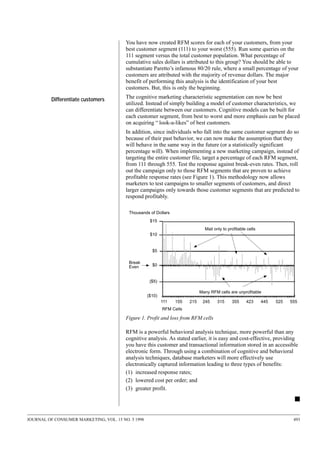
from 111 through 555. Test the response against break-even rates. Then, roll
out the campaign only to those RFM segments that are proven to achieve
profitable response rates (see Figure 1). This methodology now allows
marketers to test campaigns to smaller segments of customers, and direct
larger campaigns only towards those customer segments that are predicted to
respond profitably.
Thousands of Dollars
$15
Mail only to profitable cells
$10

$5
Break
Even

$0

($5)
Many RFM cells are unprofitable

($10)
111

155

215

245

315

355

423

445

525

555

RFM Cells

Figure 1. Profit and loss from RFM cells

RFM is a powerful behavioral analysis technique, more powerful than any
cognitive analysis. As stated earlier, it is easy and cost-effective, providing
you have this customer and transactional information stored in an accessible
electronic form. Through using a combination of cognitive and behavioral
analysis techniques, database marketers will more effectively use
electronically captured information leading to three types of benefits:
(1) increased response rates;
(2) lowered cost per order; and
(3) greater profit.

s
JOURNAL OF CONSUMER MARKETING, VOL. 15 NO. 5 1998

493

Database marketing article

  • 1.
    Using database marketing techniquesto enhance your oneto-one marketing initiatives Ron Kahan Partner, Ariss Kahan Database Marketing Group, Inc., Denver, Colorado, USA Despite US Constitutional reference, all consumers are not created equally. And yet, many corporate marketing initiatives treat all customers as one body, one intellect, or one segment en masse. Customer marketing communication campaigns do, in many instances, send the same message, the same offer, and use the same medium to communicate with this largely disparate customer universe. Using captured information This is contrary to the strategic goal of database marketing: to use captured information to identify customers and prospects as individuals and build a continuing relationship with them — to the individuals greater benefit and the greater profit of the corporation. In this regard, the catalog and retail industries were the pioneers of database marketing. Prior to the development of mass marketing, merchants had truly personal services, one-to-one relationships and recognized the customers as individuals. The local merchant knew you and your family, what you wanted, how and when you wanted it. The shop owner kept you as a loyal customer by establishing a two-way communication with you while recognizing and appreciating your business. Information, recognition, customized services and appreciation are the customer benefits that are fundamentals of database marketing. In today’s world of mass advertising and “big box” retail store chains, it is impossible for merchants to know each customer in this individualized fashion. Only with the aid of sophisticated marketing database technology can we capture, analyze and act on the same interpersonal marketing opportunities first identified in these earlier and simpler times. There are two approaches to successful database marketing: cognitive and behavioral analysis. In this way, marketers can garner a clear understanding of what customers and prospects “look like” (cognitive) and how they act (behavioral). Defining characteristic parameters Target marketers often go through extensive cognitive analysis of current customers by applying third party, compiled data variables to identify characteristic values. This can include both demographic (such as age, income, presence of children) and psychographic (such as lifestyle and interest) data elements. By defining characteristic parameters on current customers, these statistical models can then be focussed on the non-customer universe to identify “like-kinds” of consumers for marketing solicitation. In theory, a very logical approach to refining the suspect (non-customer) market to a more likely prospect market. This is the entry-point into the practice of intelligent database marketing. Despite the capacity of free thought, humanity as a whole is cursed with repetitive behavior and the formation of habits, making behavior therefore predictable. This is a positive human “affliction” for database marketers, JOURNAL OF CONSUMER MARKETING, VOL. 15 NO. 5 1998, pp. 491-493 © MCB UNIVERSITY PRESS, 0736-3761 491
  • 2.
    presenting many opportunitieson which to capitalize. It is the case that there is no greater predictor of future behavior than past behavior. This is intuitively the true premise of behavioral analysis. The most widely used behavioral characteristic variables for analysis include products or services purchased, frequency of purchases, dollar amount spent, as well as customer-related preferences. The creation of RFM Catalogers created behavioral analysis by accident. I believe it was Sears Roebuck & Co. who first discovered by inserting a catalog with an outgoing order that their most recent customers were most likely to order again. From this simple observation, the mathematical computation that is today referred to as RFM (recency, frequency, and monetary value) was created. RFM is perhaps the most widely recognized behavioral analysis technique. It certainly is the easiest and fastest methodology to implement with your customer file. This process requires that base customer information, such as name and address, have been assigned a unique key, such as an account number. Likewise, it requires that all order or sales information is stored electronically with the unique key included with each transactional record. A summary of each customer’s transactional history should be created, allowing the following sorting and segmentation: (1) date of the last or most recent purchase; (2) total number or frequency of purchases; (3) average amount spent per order. The analysis can now begin once each account number has these three variables summarized: (1) Sort your customers by purchase dates in reverse chronological order. (2) Divide the customer list into five equal segments (see Table I). For example, if you were starting with 100,000 customers, each segment would contain 20,000 records. (3) Tag those customers who have made the most recent purchases with a “1” indicating the top segment and work your way to the least recent purchases being tagged with a “5”. Segmenting into five equal groups is called quintiling. Next, sort your customers by number of orders and apply the same methodology and tagging process. And finally, perform this sort on the average dollar amount of each order and perform the quintiling and tagging functions. Score* Recency Score* Frequency Score* Monetary ($) 1 4/97-6/97 1 13+ 1 1,200.00 2 11/96-3/97 2 8-12 2 741.33-1,199.99 3 2/96-10/96 3 5-7 3 416.76-741.32 4 12/94-1/96 4 2-4 4 128.47-416.75 5 9/93-11/94 5 1 5 1.00-128.46 * 1 = most recent, frequent or largest $ and 5 = least recent, frequent or smallest $ Table I. RFM analysis 492 JOURNAL OF CONSUMER MARKETING, VOL. 15 NO. 5 1998
  • 3.
    You have nowcreated RFM scores for each of your customers, from your best customer segment (111) to your worst (555). Run some queries on the 111 segment versus the total customer population. What percentage of cumulative sales dollars is attributed to this group? You should be able to substantiate Paretto’s infamous 80/20 rule, where a small percentage of your customers are attributed with the majority of revenue dollars. The major benefit of performing this analysis is the identification of your best customers. But, this is only the beginning. Differentiate customers The cognitive marketing characteristic segmentation can now be best utilized. Instead of simply building a model of customer characteristics, we can differentiate between our customers. Cognitive models can be built for each customer segment, from best to worst and more emphasis can be placed on acquiring “ look-a-likes” of best customers. In addition, since individuals who fall into the same customer segment do so because of their past behavior, we can now make the assumption that they will behave in the same way in the future (or a statistically significant percentage will). When implementing a new marketing campaign, instead of targeting the entire customer file, target a percentage of each RFM segment, from 111 through 555. Test the response against break-even rates. Then, roll out the campaign only to those RFM segments that are proven to achieve profitable response rates (see Figure 1). This methodology now allows marketers to test campaigns to smaller segments of customers, and direct larger campaigns only towards those customer segments that are predicted to respond profitably. Thousands of Dollars $15 Mail only to profitable cells $10 $5 Break Even $0 ($5) Many RFM cells are unprofitable ($10) 111 155 215 245 315 355 423 445 525 555 RFM Cells Figure 1. Profit and loss from RFM cells RFM is a powerful behavioral analysis technique, more powerful than any cognitive analysis. As stated earlier, it is easy and cost-effective, providing you have this customer and transactional information stored in an accessible electronic form. Through using a combination of cognitive and behavioral analysis techniques, database marketers will more effectively use electronically captured information leading to three types of benefits: (1) increased response rates; (2) lowered cost per order; and (3) greater profit. s JOURNAL OF CONSUMER MARKETING, VOL. 15 NO. 5 1998 493