Introduction to Brand
Management - II
Coming up…
• Little more about “Brands”
• Brand v/s Products
• Need/ role of Brands
• Strategic Brand Management – an Introduction
• Customer-based Brand Equity
Ref: Strategic Brand Mgmt. – Kevin Kelly
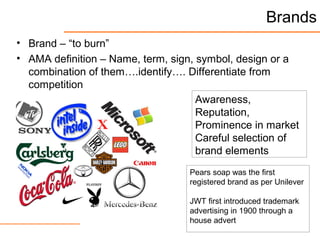
Brands
• Brand – “to burn”
• AMA definition – Name, term, sign, symbol, design or a
combination of them….identify…. Differentiate from
competition
Pears soap was the first
registered brand as per Unilever
JWT first introduced trademark
advertising in 1900 through a
house advert
Awareness,
Reputation,
Prominence in market
Careful selection of
brand elements
Brand v/s products
Kotler’s definition
• Core Benefit
• Generic Product
• Expected Product
• Augmented Product
• Potential Product
Brand:
• Product
+or- perceived
differentiator
• Rational & Tangible
• Performance based
• Symbolic, emotional
Brand = Product + customer perception
+performance + brand name + company
Ref: Strategic Brand Mgmt. – Kevin Kelly
Role of brands – for Customers
• Identification of source of product
• Assignment of responsibility to the product maker
• Risk reducer
• Search cost reduces
• Promise, bond, with maker of product (KF airlines)
• Symbolic device
• Signal of quality (arrow shirts)
Ref: Strategic Brand Mgmt. – Kevin Kelly
Role for Manufacturer
• Identification for handling
• Patenting – Legal IPR protection etc
• Signal of quality level – price ranges
• Endowing products with unique associations
• Competitive edge
• Financial returns
Ref: Strategic Brand Mgmt. – Kevin Kelly
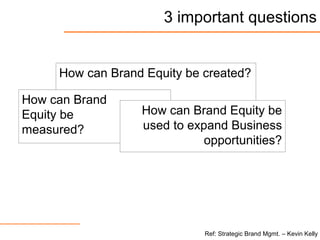
How can Brand Equity be created?
3 important questions
Ref: Strategic Brand Mgmt. – Kevin Kelly
How can Brand
Equity be
measured?
How can Brand Equity be
used to expand Business
opportunities?
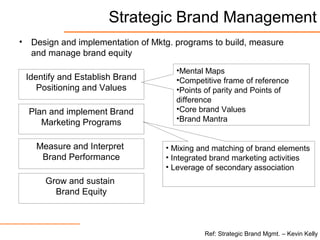
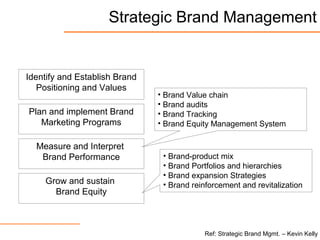
Strategic Brand Management
• Design and implementation of Mktg. programs to build, measure
and manage brand equity
Identify and Establish Brand
Positioning and Values
Plan and implement Brand
Marketing Programs
Measure and Interpret
Brand Performance
Grow and sustain
Brand Equity
•Mental Maps
•Competitive frame of reference
•Points of parity and Points of
difference
•Core brand Values
•Brand Mantra
• Mixing and matching of brand elements
• Integrated brand marketing activities
• Leverage of secondary association
Ref: Strategic Brand Mgmt. – Kevin Kelly
• Brand-product mix
• Brand Portfolios and hierarchies
• Brand expansion Strategies
• Brand reinforcement and revitalization
Strategic Brand Management
Identify and Establish Brand
Positioning and Values
Plan and implement Brand
Marketing Programs
Measure and Interpret
Brand Performance
Grow and sustain
Brand Equity
• Brand Value chain
• Brand audits
• Brand Tracking
• Brand Equity Management System
Ref: Strategic Brand Mgmt. – Kevin Kelly
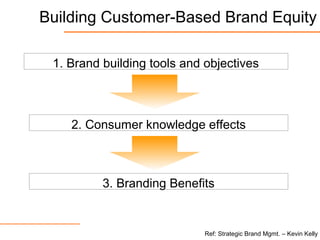
Building Customer-Based Brand Equity
1. Brand building tools and objectives
2. Consumer knowledge effects
3. Branding Benefits
Ref: Strategic Brand Mgmt. – Kevin Kelly
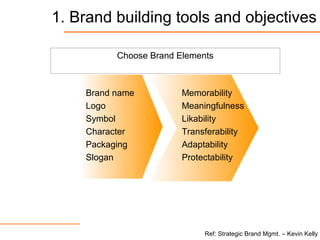
1. Brand building tools and objectives
Choose Brand Elements
Brand name
Logo
Symbol
Character
Packaging
Slogan
Memorability
Meaningfulness
Likability
Transferability
Adaptability
Protectability
Ref: Strategic Brand Mgmt. – Kevin Kelly
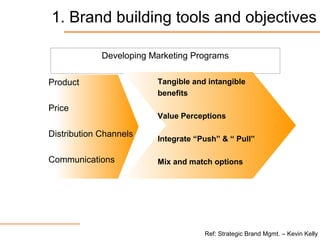
1. Brand building tools and objectives
Developing Marketing Programs
Product
Price
Distribution Channels
Communications
Tangible and intangible
benefits
Value Perceptions
Integrate “Push” & “ Pull”
Mix and match options
Ref: Strategic Brand Mgmt. – Kevin Kelly
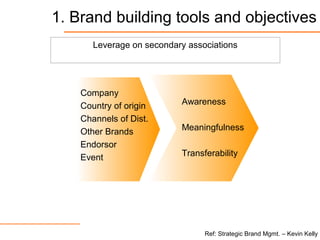
1. Brand building tools and objectives
Leverage on secondary associations
Company
Country of origin
Channels of Dist.
Other Brands
Endorsor
Event
Awareness
Meaningfulness
Transferability
Ref: Strategic Brand Mgmt. – Kevin Kelly
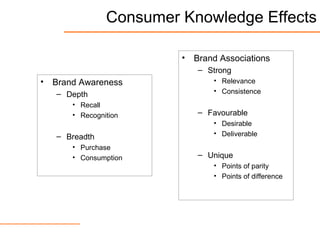
Consumer Knowledge Effects
• Brand Awareness
– Depth
• Recall
• Recognition
– Breadth
• Purchase
• Consumption
• Brand Associations
– Strong
• Relevance
• Consistence
– Favourable
• Desirable
• Deliverable
– Unique
• Points of parity
• Points of difference
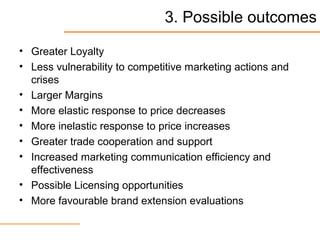
3. Possible outcomes
• Greater Loyalty
• Less vulnerability to competitive marketing actions and
crises
• Larger Margins
• More elastic response to price decreases
• More inelastic response to price increases
• Greater trade cooperation and support
• Increased marketing communication efficiency and
effectiveness
• Possible Licensing opportunities
• More favourable brand extension evaluations
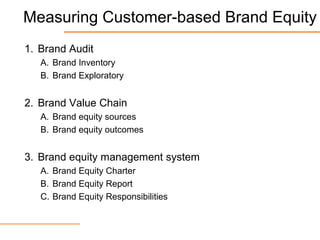
Measuring Customer-based Brand Equity
1. Brand Audit
A. Brand Inventory
B. Brand Exploratory
2. Brand Value Chain
A. Brand equity sources
B. Brand equity outcomes
3. Brand equity management system
A. Brand Equity Charter
B. Brand Equity Report
C. Brand Equity Responsibilities
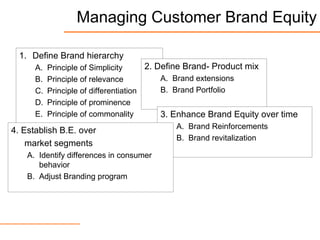
Managing Customer Brand Equity
1. Define Brand hierarchy
A. Principle of Simplicity
B. Principle of relevance
C. Principle of differentiation
D. Principle of prominence
E. Principle of commonality
2. Define Brand- Product mix
A. Brand extensions
B. Brand Portfolio
3. Enhance Brand Equity over time
A. Brand Reinforcements
B. Brand revitalization
4. Establish B.E. over
market segments
A. Identify differences in consumer
behavior
B. Adjust Branding program

Intro to brand

  • 1.
  • 2.
    Coming up… • Littlemore about “Brands” • Brand v/s Products • Need/ role of Brands • Strategic Brand Management – an Introduction • Customer-based Brand Equity Ref: Strategic Brand Mgmt. – Kevin Kelly
  • 3.
    Brands • Brand –“to burn” • AMA definition – Name, term, sign, symbol, design or a combination of them….identify…. Differentiate from competition Pears soap was the first registered brand as per Unilever JWT first introduced trademark advertising in 1900 through a house advert Awareness, Reputation, Prominence in market Careful selection of brand elements
  • 4.
    Brand v/s products Kotler’sdefinition • Core Benefit • Generic Product • Expected Product • Augmented Product • Potential Product Brand: • Product +or- perceived differentiator • Rational & Tangible • Performance based • Symbolic, emotional Brand = Product + customer perception +performance + brand name + company Ref: Strategic Brand Mgmt. – Kevin Kelly
  • 5.
    Role of brands– for Customers • Identification of source of product • Assignment of responsibility to the product maker • Risk reducer • Search cost reduces • Promise, bond, with maker of product (KF airlines) • Symbolic device • Signal of quality (arrow shirts) Ref: Strategic Brand Mgmt. – Kevin Kelly
  • 6.
    Role for Manufacturer •Identification for handling • Patenting – Legal IPR protection etc • Signal of quality level – price ranges • Endowing products with unique associations • Competitive edge • Financial returns Ref: Strategic Brand Mgmt. – Kevin Kelly
  • 7.
    How can BrandEquity be created? 3 important questions Ref: Strategic Brand Mgmt. – Kevin Kelly How can Brand Equity be measured? How can Brand Equity be used to expand Business opportunities?
  • 8.
    Strategic Brand Management •Design and implementation of Mktg. programs to build, measure and manage brand equity Identify and Establish Brand Positioning and Values Plan and implement Brand Marketing Programs Measure and Interpret Brand Performance Grow and sustain Brand Equity •Mental Maps •Competitive frame of reference •Points of parity and Points of difference •Core brand Values •Brand Mantra • Mixing and matching of brand elements • Integrated brand marketing activities • Leverage of secondary association Ref: Strategic Brand Mgmt. – Kevin Kelly
  • 9.
    • Brand-product mix •Brand Portfolios and hierarchies • Brand expansion Strategies • Brand reinforcement and revitalization Strategic Brand Management Identify and Establish Brand Positioning and Values Plan and implement Brand Marketing Programs Measure and Interpret Brand Performance Grow and sustain Brand Equity • Brand Value chain • Brand audits • Brand Tracking • Brand Equity Management System Ref: Strategic Brand Mgmt. – Kevin Kelly
  • 10.
    Building Customer-Based BrandEquity 1. Brand building tools and objectives 2. Consumer knowledge effects 3. Branding Benefits Ref: Strategic Brand Mgmt. – Kevin Kelly
  • 11.
    1. Brand buildingtools and objectives Choose Brand Elements Brand name Logo Symbol Character Packaging Slogan Memorability Meaningfulness Likability Transferability Adaptability Protectability Ref: Strategic Brand Mgmt. – Kevin Kelly
  • 12.
    1. Brand buildingtools and objectives Developing Marketing Programs Product Price Distribution Channels Communications Tangible and intangible benefits Value Perceptions Integrate “Push” & “ Pull” Mix and match options Ref: Strategic Brand Mgmt. – Kevin Kelly
  • 13.
    1. Brand buildingtools and objectives Leverage on secondary associations Company Country of origin Channels of Dist. Other Brands Endorsor Event Awareness Meaningfulness Transferability Ref: Strategic Brand Mgmt. – Kevin Kelly
  • 14.
    Consumer Knowledge Effects •Brand Awareness – Depth • Recall • Recognition – Breadth • Purchase • Consumption • Brand Associations – Strong • Relevance • Consistence – Favourable • Desirable • Deliverable – Unique • Points of parity • Points of difference
  • 15.
    3. Possible outcomes •Greater Loyalty • Less vulnerability to competitive marketing actions and crises • Larger Margins • More elastic response to price decreases • More inelastic response to price increases • Greater trade cooperation and support • Increased marketing communication efficiency and effectiveness • Possible Licensing opportunities • More favourable brand extension evaluations
  • 16.
    Measuring Customer-based BrandEquity 1. Brand Audit A. Brand Inventory B. Brand Exploratory 2. Brand Value Chain A. Brand equity sources B. Brand equity outcomes 3. Brand equity management system A. Brand Equity Charter B. Brand Equity Report C. Brand Equity Responsibilities
  • 17.
    Managing Customer BrandEquity 1. Define Brand hierarchy A. Principle of Simplicity B. Principle of relevance C. Principle of differentiation D. Principle of prominence E. Principle of commonality 2. Define Brand- Product mix A. Brand extensions B. Brand Portfolio 3. Enhance Brand Equity over time A. Brand Reinforcements B. Brand revitalization 4. Establish B.E. over market segments A. Identify differences in consumer behavior B. Adjust Branding program