Market SegmentationMarketSegmentation
Introduction…Companies cannot connect with all customers in large, broad or diverse markets.Such markets can be divided into groups or segments with distinct need and wants.A company needs to identity which segments it can serve effectively.To develop best marketing plans, managers need to understand what makes each segment unique and different.
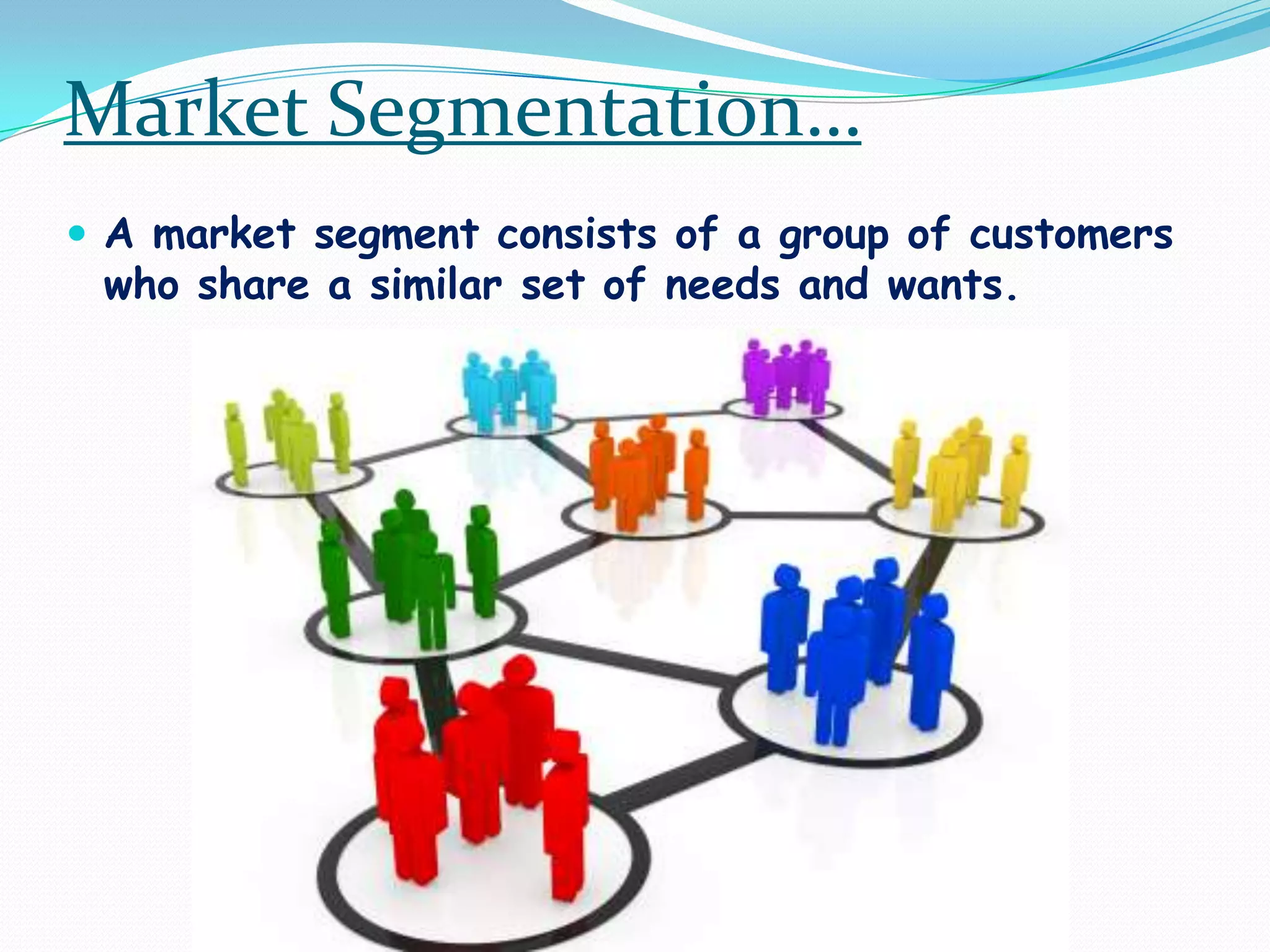
Market Segmentation…A market segment consists of a group of customers who share a similar set of needs and wants.
Concept…Segmentation means dividing the market into similar sub-markets by understanding the needs and expectations of  customers.Companies follow different marketing programs for different segments to maintain better relationship with customers.Market segmentation is the first step in applying the marketing strategy.
Definitions…“Market segmentation is the process of dividing a potential market into distinct sub markets of consumers with common needs and characteristics.”“Market segmentation consists of taking the total heterogeneous market for a product and dividing it into several sub-markets or segments each of which tends to be homogeneous in all significant steps.                                   – William J Stanton”
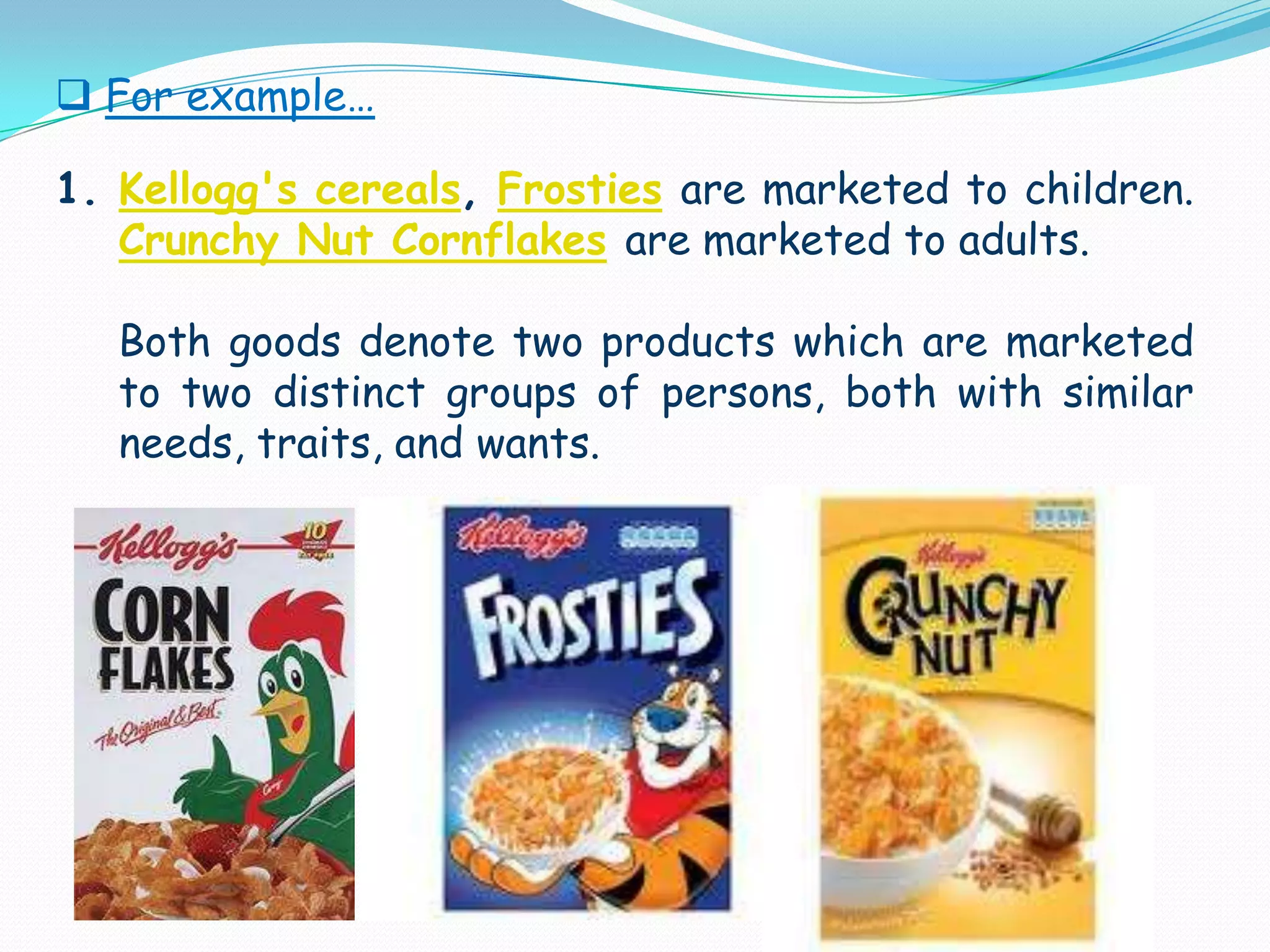
For example… Kellogg's cereals, Frostiesare marketed to children. Crunchy Nut Cornflakesare marketed to adults.      Both goods denote two products which are marketed to two distinct groups of persons, both with similar needs, traits, and wants.
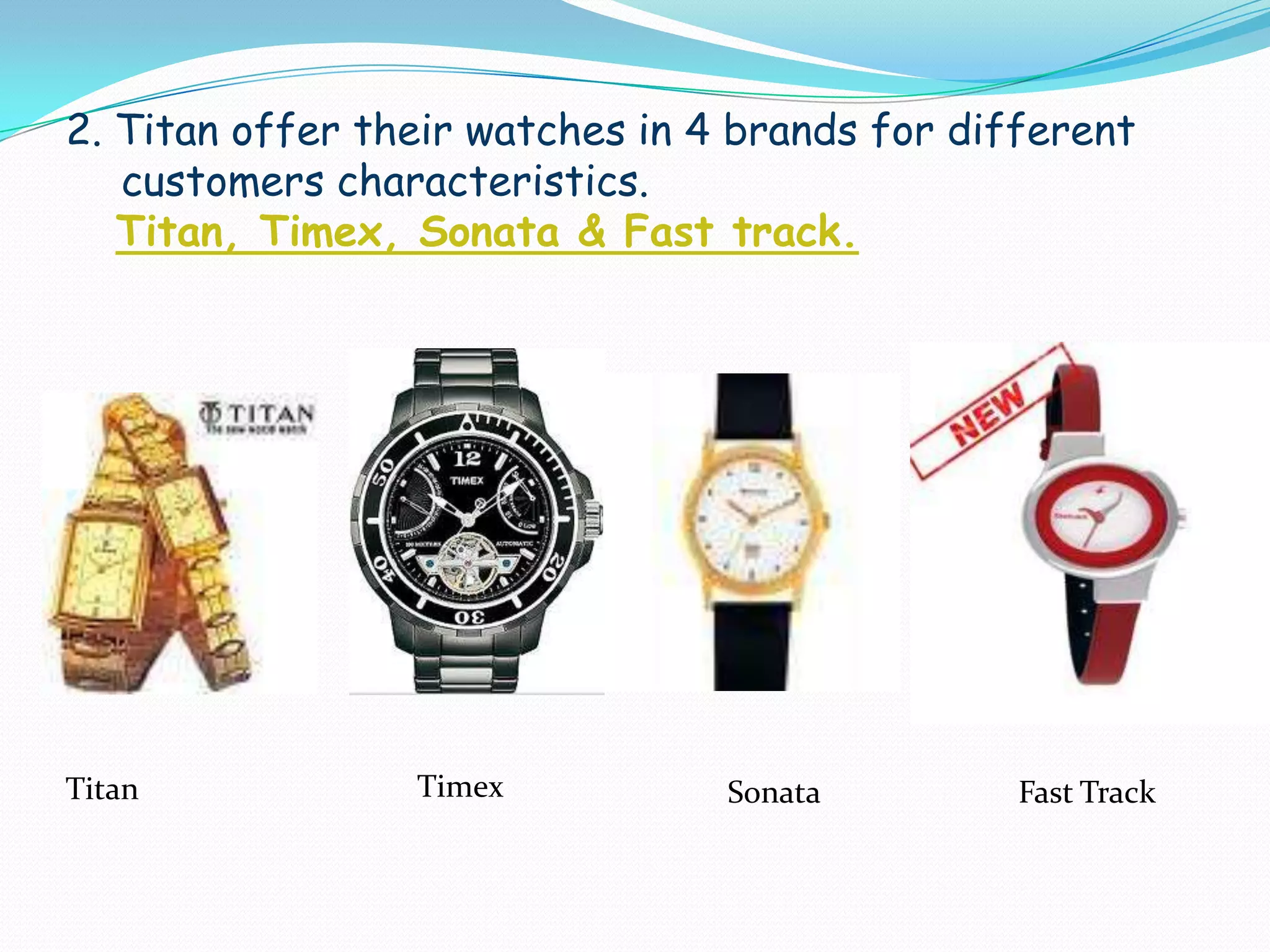
2. Titan offer their watches in 4 brands for different customers characteristics.Titan, Timex, Sonata & Fast track.TimexTitanFast TrackSonata
3. Future Group operate in 4 different store formats depending on the category of customers.Big Bazaar, Pantaloon, Central, Loot.
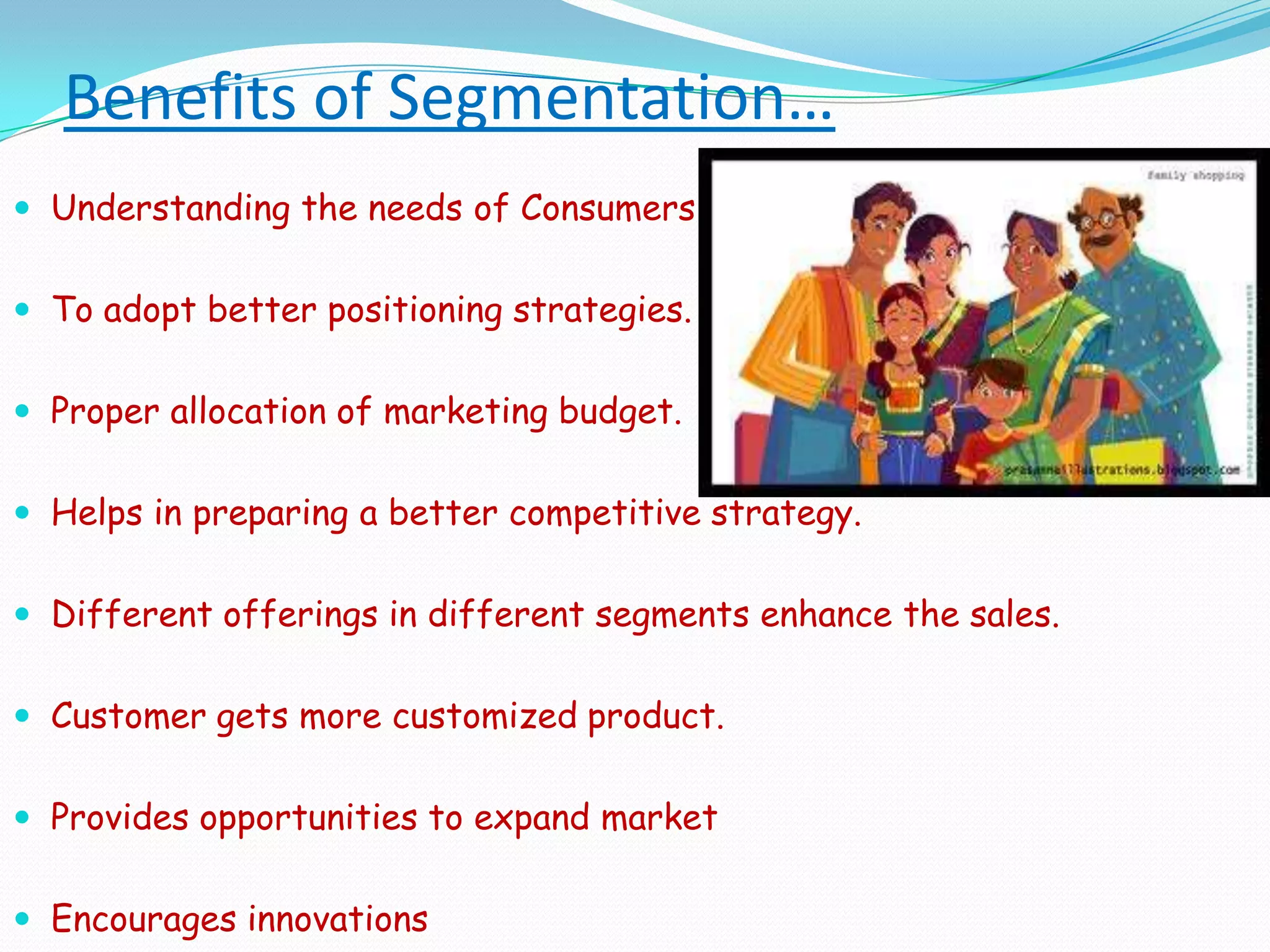
Benefits of Segmentation…Understanding the needs of Consumers To adopt better positioning strategies.Proper allocation of marketing budget.Helps in preparing a better competitive strategy.Different offerings in different segments enhance the sales.Customer gets more customized product.Provides opportunities to expand market Encourages innovations
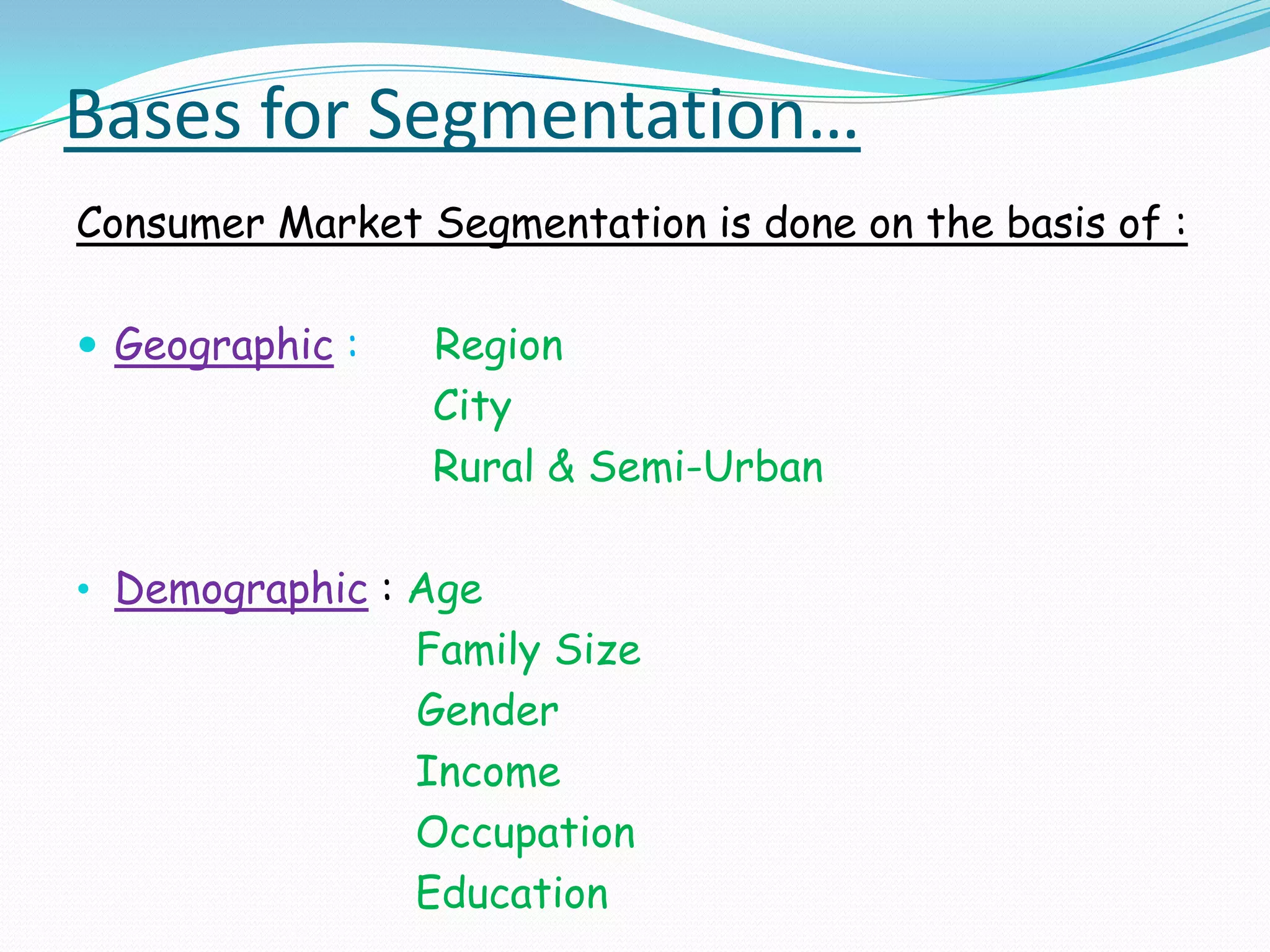
Bases for Segmentation…Consumer Market Segmentation is done on the basis of : Geographic :Region                     City                     Rural & Semi-UrbanDemographic: Age                           Family Size		                 Gender                           Income                           Occupation                           Education
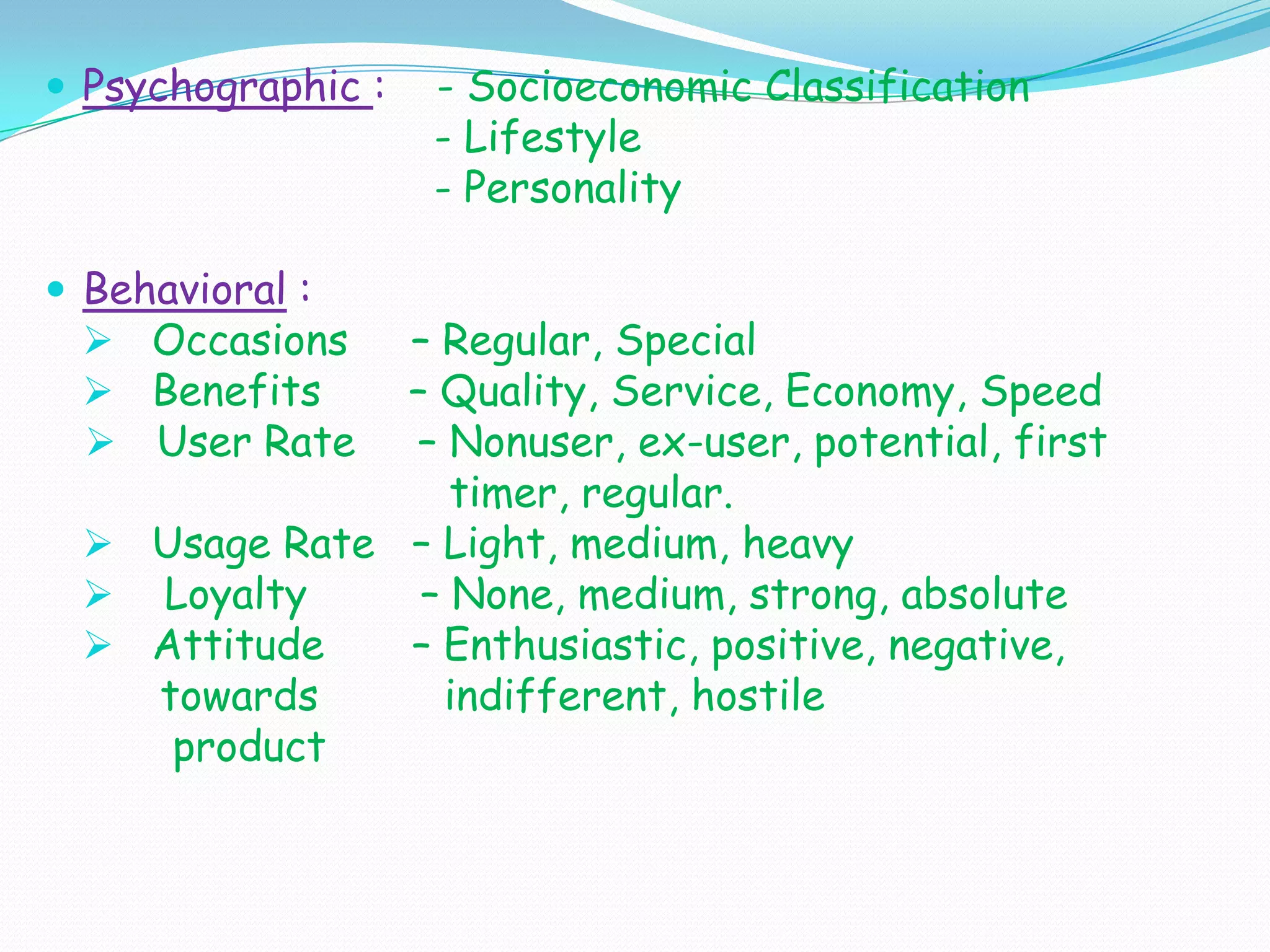
Psychographic :    - Socioeconomic Classification                               - Lifestyle                               - PersonalityBehavioral :   Occasions     – Regular, Special
   Benefits       – Quality, Service, Economy, Speed
User Rate     – Nonuser, ex-user, potential, first                               timer, regular.   Usage Rate   – Light, medium, heavy
    Loyalty         – None, medium, strong, absolute
   Attitude       – Enthusiastic, positive, negative,       towards          indifferent, hostile       product
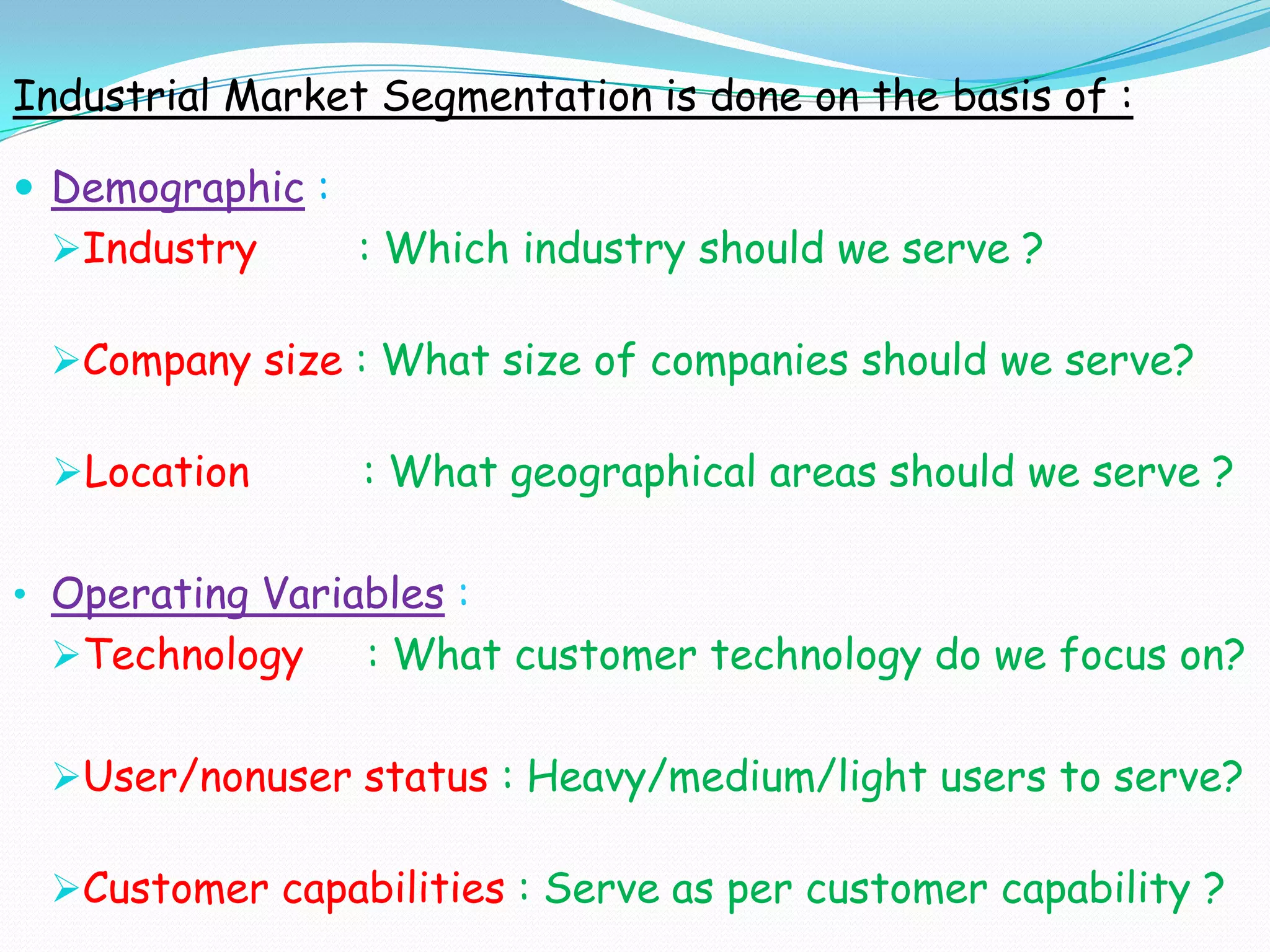
Industrial Market Segmentation is done on the basis of : Demographic :Industry        : Which industry should we serve ?
Company size : What size of companies should we serve?
Location         : What geographical areas should we serve ?
Operating Variables:
Technology     : What customer technology do we focus on?
User/nonuser status : Heavy/medium/light users to serve?
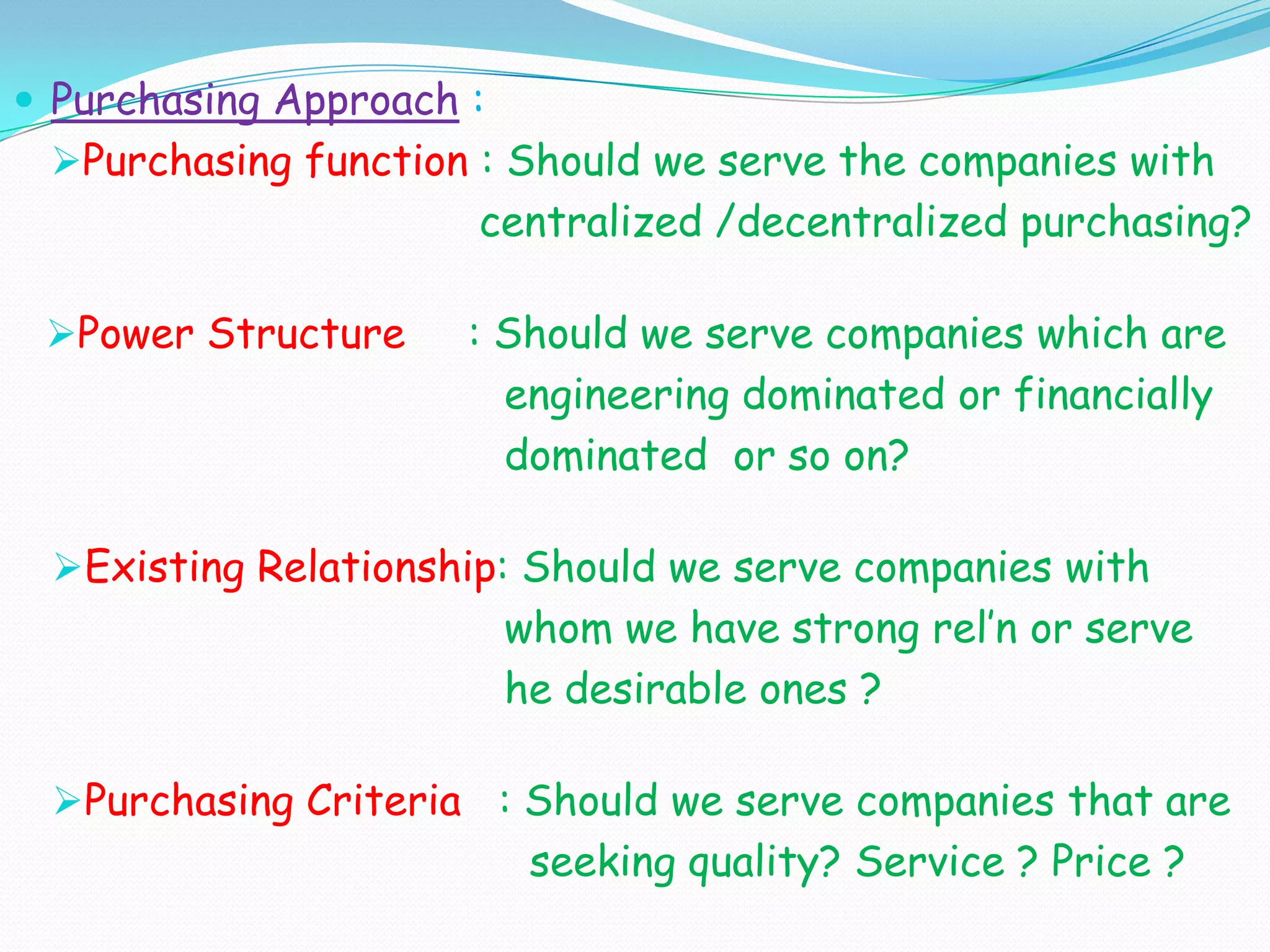
Customer capabilities : Serve as per customer capability ?Purchasing Approach:Purchasing function : Should we serve the companies with                                    centralized /decentralized purchasing?Power Structure     : Should we serve companies which are                                       engineering dominated or financially                                     dominated  or so on?Existing Relationship: Should we serve companies with                                      whom we have strong rel’n or serve                                     he desirable ones ?Purchasing Criteria   : Should we serve companies that are                                       seeking quality? Service ? Price ?
Situational factors:Urgency      : Should we serve the companies that need                         quick  and sudden delivery or service?Specific application: Should we focus on certain application                                    of or product rather than all                                    specifications?Size of order: Should we focus on large or small orders?Personal Characteristics:

Market Segmentation

  • 1.
  • 2.
    Introduction…Companies cannot connectwith all customers in large, broad or diverse markets.Such markets can be divided into groups or segments with distinct need and wants.A company needs to identity which segments it can serve effectively.To develop best marketing plans, managers need to understand what makes each segment unique and different.
  • 3.
    Market Segmentation…A marketsegment consists of a group of customers who share a similar set of needs and wants.
  • 4.
    Concept…Segmentation means dividingthe market into similar sub-markets by understanding the needs and expectations of customers.Companies follow different marketing programs for different segments to maintain better relationship with customers.Market segmentation is the first step in applying the marketing strategy.
  • 5.
    Definitions…“Market segmentation isthe process of dividing a potential market into distinct sub markets of consumers with common needs and characteristics.”“Market segmentation consists of taking the total heterogeneous market for a product and dividing it into several sub-markets or segments each of which tends to be homogeneous in all significant steps. – William J Stanton”
  • 6.
    For example… Kellogg'scereals, Frostiesare marketed to children. Crunchy Nut Cornflakesare marketed to adults. Both goods denote two products which are marketed to two distinct groups of persons, both with similar needs, traits, and wants.
  • 7.
    2. Titan offertheir watches in 4 brands for different customers characteristics.Titan, Timex, Sonata & Fast track.TimexTitanFast TrackSonata
  • 8.
    3. Future Groupoperate in 4 different store formats depending on the category of customers.Big Bazaar, Pantaloon, Central, Loot.
  • 9.
    Benefits of Segmentation…Understandingthe needs of Consumers To adopt better positioning strategies.Proper allocation of marketing budget.Helps in preparing a better competitive strategy.Different offerings in different segments enhance the sales.Customer gets more customized product.Provides opportunities to expand market Encourages innovations
  • 10.
    Bases for Segmentation…ConsumerMarket Segmentation is done on the basis of : Geographic :Region City Rural & Semi-UrbanDemographic: Age Family Size Gender Income Occupation Education
  • 11.
    Psychographic : - Socioeconomic Classification - Lifestyle - PersonalityBehavioral : Occasions – Regular, Special
  • 12.
    Benefits – Quality, Service, Economy, Speed
  • 13.
    User Rate – Nonuser, ex-user, potential, first timer, regular. Usage Rate – Light, medium, heavy
  • 14.
    Loyalty – None, medium, strong, absolute
  • 15.
    Attitude – Enthusiastic, positive, negative, towards indifferent, hostile product
  • 16.
    Industrial Market Segmentationis done on the basis of : Demographic :Industry : Which industry should we serve ?
  • 17.
    Company size :What size of companies should we serve?
  • 18.
    Location : What geographical areas should we serve ?
  • 19.
  • 20.
    Technology : What customer technology do we focus on?
  • 21.
    User/nonuser status :Heavy/medium/light users to serve?
  • 22.
    Customer capabilities :Serve as per customer capability ?Purchasing Approach:Purchasing function : Should we serve the companies with centralized /decentralized purchasing?Power Structure : Should we serve companies which are engineering dominated or financially dominated or so on?Existing Relationship: Should we serve companies with whom we have strong rel’n or serve he desirable ones ?Purchasing Criteria : Should we serve companies that are seeking quality? Service ? Price ?
  • 23.
    Situational factors:Urgency : Should we serve the companies that need quick and sudden delivery or service?Specific application: Should we focus on certain application of or product rather than all specifications?Size of order: Should we focus on large or small orders?Personal Characteristics:
  • 24.
    Buyer-Seller similarity : Should we serve the companies whose people and valued are similar to ours?Attitude towards risk : Should we serve risk-taking or risk-avoiding customers?Loyalty : Should we serve companies that show high loyaltyto their suppliers?
  • 25.
    Service Industry Segmentationis done on the basis of : ?
  • 26.
    Criteria for EffectiveSegmentation…Measurable :Size, purchasing power and other characteristics should be measured.Substantial: -Segment should be large enough to serve- Profitable enough to serve- For e.g. It is possible and profitable for car manufacturer to manufacture cars for people with height below 4 feet.Accessible :Effectively reached and served.Differentiable : - Segments having different characteristics and responds differently to different marketing mix elements. - E.g. If Unmarried and married women respond similarly to a saree sale, then they belong to same segment.Actionable: - Effective programs can be formulated for attracting customers- Regular changes can be possible made in the marketing mix.
  • 27.
    Steps in SegmentationProcess…1. Need Based Segmentation : - Grouping customers depending on needs.2. Segment Identification: -Determine which demographic, lifestyle and usage behaviors make the segment distinct and identifiable.3. Segment Attractiveness :- Market Potential, market growth, competitive advantage of each segment
  • 28.
    4.Segment Profitability : - Profitability analysis of the segment.5.Segment Positioning: - Create ‘value positioning’ based on segment’s unique needs and characteristics.6. Segment ‘Acid Test’: - Test attractiveness of each segment’s positioning strategy.7. Marketing Mix strategy:- Design a marketing mix
  • 29.
    Concepts to beunderstood…1. Target Market:After identifying various market segments, the marketer has to decide which segment offers greatest opportunity.– This segment is the ‘Target Market’. It focus on selling a product or service to a specific market.For e.gPepsi could define its target market as everyone who drinks a only cola beverage and not others drinks….
  • 30.
    2. Market Target:Oncethe firm identifies its target market, it now defines the marketing strategies for this particular market.– This process is called ‘MarketTarget’ or ‘Market Targeting’.-How the product should be?-What should be the price?-Which is the best way to promote the product?-Where should be the product made available?
  • 31.
    3. Positioning: “Act of fixing the place/position/image of the product offer in the mind of target customer.”– Firm decided what parameters of the product has to be placed before the target customer. - It is more concerned with the customer’s perception of the product offer, compared to other product. The aim of- The aim of positioning is to create a perception for the brand in the prospect’s mind so that is stands apart from competing brands